



Some of our readers asked us to explain all those optional features that can be added to or removed from your Windows installation. Even though all of them have some description, the information offered by Windows is either too brief or too complex to understand for most people. So I decided to publish this article and walk you through every Windows feature. I also describe what each of them is or does, so you can decide on your own what Windows features should be turned on and which ones should be removed. At the end, you’ll also find a couple of optional Windows features I recommend you install. Without further ado, let’s get started, as we have plenty of ground to cover:
NOTE: I used Windows 11 Pro Version 23H2 build 22631 and Windows 10 Pro Version 22H2 build 19045 for this article. If you have another version or edition of Windows, you may get a different number of optional features than the ones listed below.
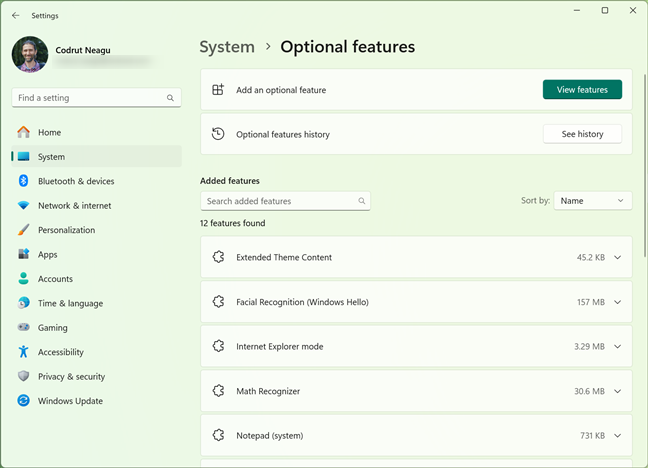
 Some of the Optional features in Windows 11
In Windows 11 and Windows 10, there’s a long list of Optional features either installed by default or that you can add by yourself. Here’s what they are and what they do:
Some of the Optional features in Windows 11
In Windows 11 and Windows 10, there’s a long list of Optional features either installed by default or that you can add by yourself. Here’s what they are and what they do:
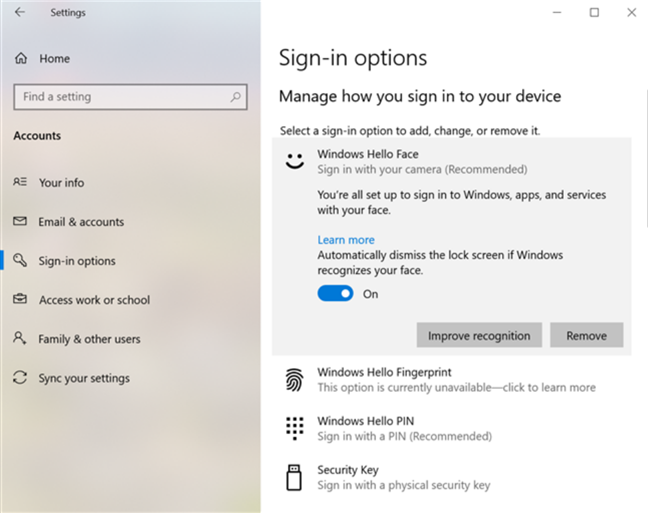
 Windows Hello Face in Windows 10
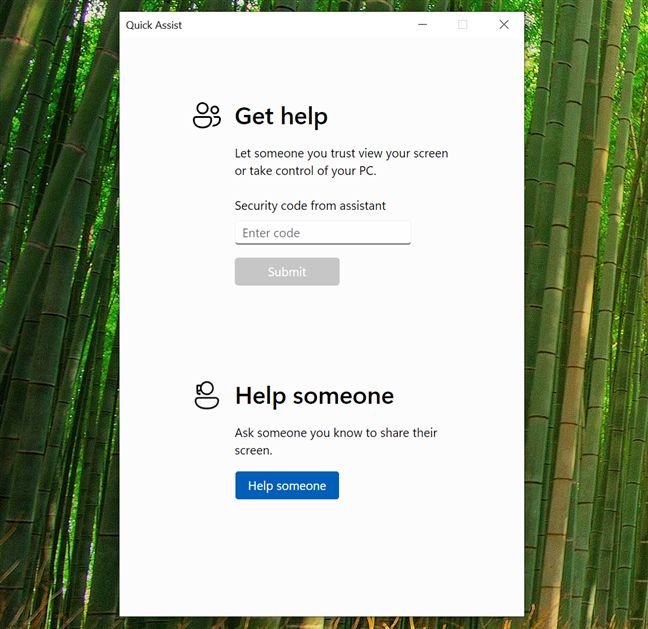
 Microsoft's Quick Assist app in Windows 10
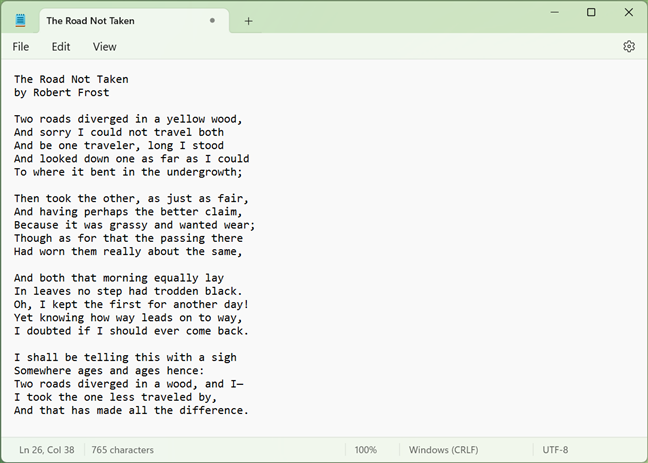
 Notepad in Windows 11
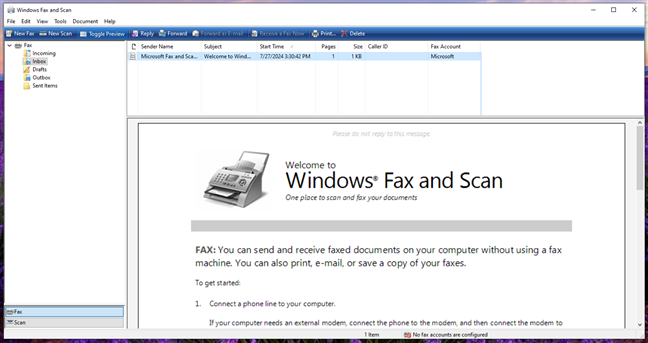
 Windows Fax and Scan in Windows 10
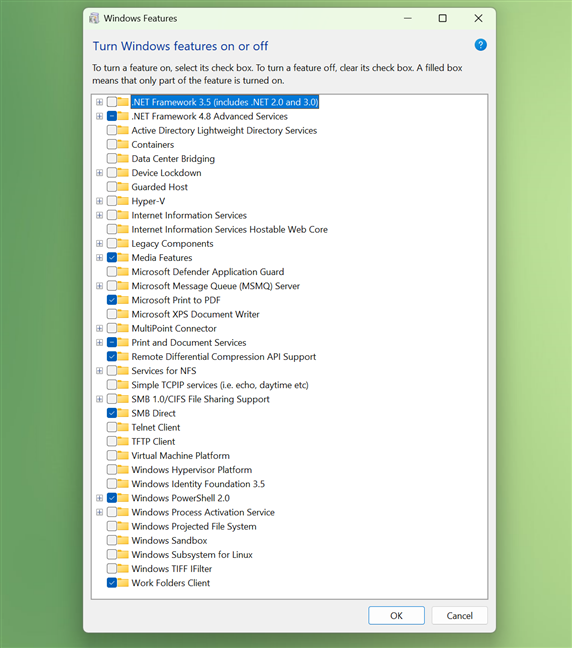
 Turn Windows features on or off
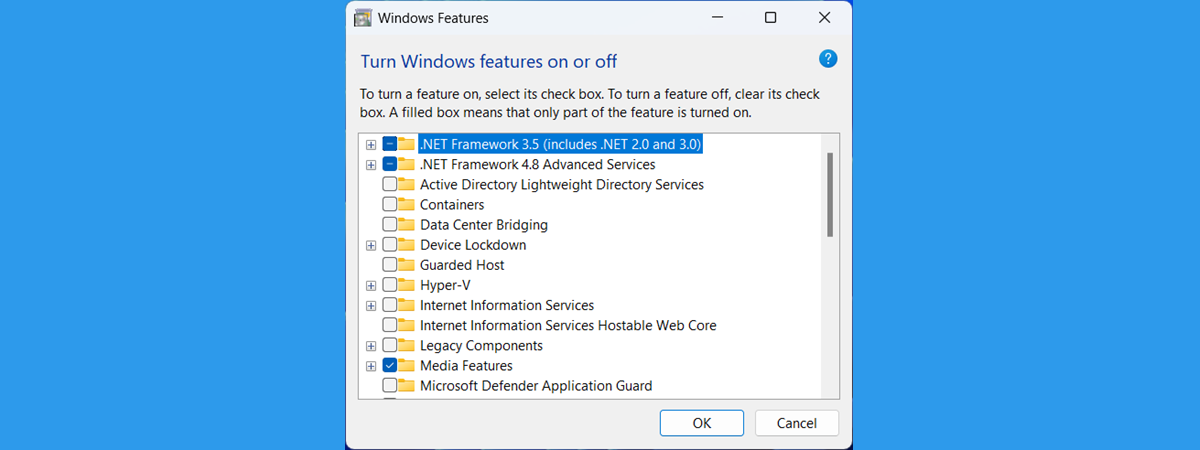
After you open the Windows Features window, you see a long list of Windows features that can be added or removed. Let's walk through each of them and see what it does:
Turn Windows features on or off
After you open the Windows Features window, you see a long list of Windows features that can be added or removed. Let's walk through each of them and see what it does:
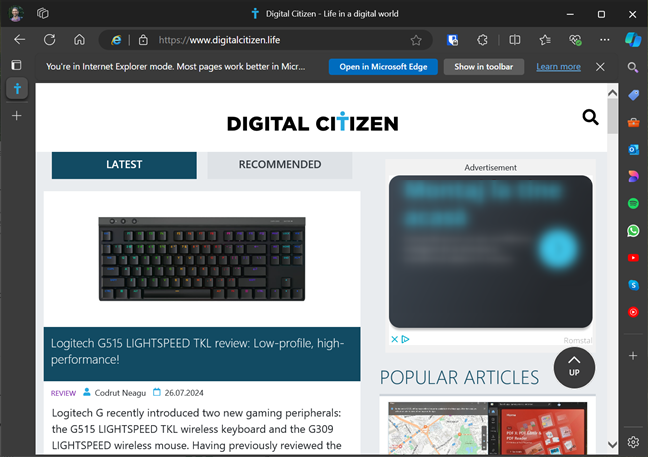
 Microsoft Edge in Internet Explorer mode
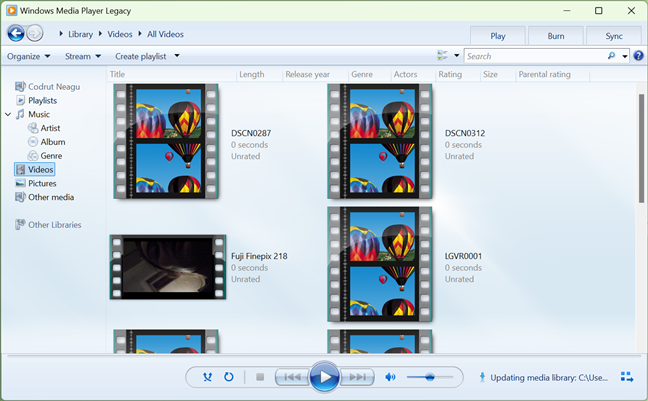
 The legacy Windows Media Player app
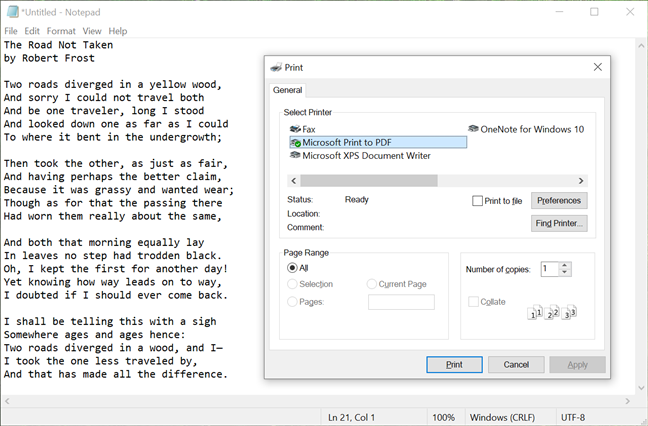
 Using Microsoft Print to PDF with Notepad in Windows 10
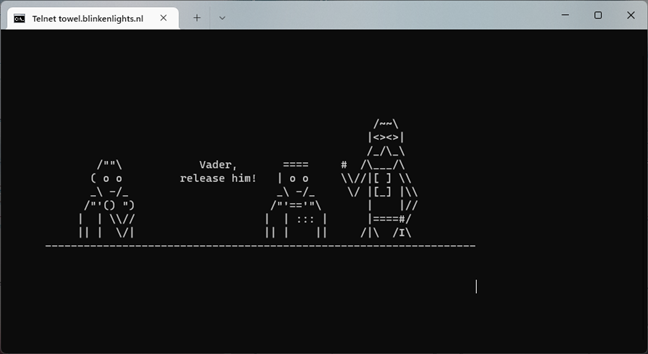
 The Telnet Client in Windows 11
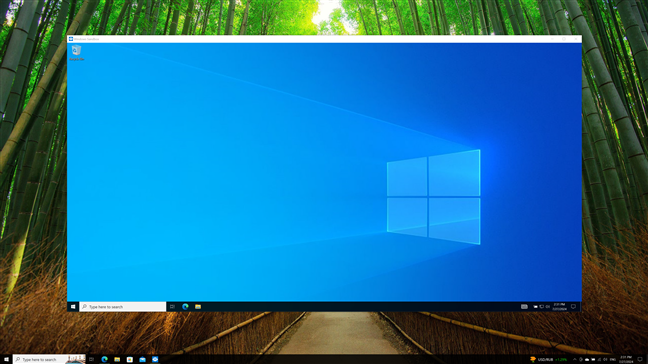
 Windows Sandbox in Windows 10
If you’re interested, here’s how to install Windows Sandbox.
Windows Sandbox in Windows 10
If you’re interested, here’s how to install Windows Sandbox.
Optional Features: What are they & What do they do?
I’ll show you all the Optional features (available to install or installed by default) in Windows 11 and Windows 10. If you want to see how to access them, read this guide: How to add or remove optional features in Windows.- EMS and SAC Toolset for Windows - Windows Emergency Management Services (EMS) and Special Administration Console (SAC) Toolset for Windows (client editions). These tools help you perform remote management and system recovery tasks of Windows systems that aren’t booting correctly. They’re available in both Windows 10 and Windows 11.
- Extended Theme Content - Described as Extended Inbox Theme Content, I couldn’t find detailed information about it, but it seems like it may enable additional wallpapers, possibly for the Mail app. Unfortunately, I can’t confirm that, as no wallpapers disappeared on my Windows 10 or Windows 11 computers when I uninstalled it, neither for the desktop or the Mail app.
- Facial Recognition (Windows Hello) in Windows 11 or Windows Hello Face in Windows 10 - Uses facial recognition technology to unlock devices securely. It employs infrared sensors and cameras to authenticate users by recognizing their facial features. Installed by default in Windows 10 and Windows 11.
- Graphics Tools - Adds DirectX Graphics Tools support. These tools allow developers to perform things like graphics debugging, frame analysis, and GPU usage monitoring in Visual Studio.
- Internet Explorer mode in Windows 11 or Internet Explorer 11 in Windows 10 - Enables Internet Explorer mode in Microsoft Edge for compatibility with legacy web applications and old IE-based websites. Installed by default in both Windows 10 and Windows 11.
- IrDA infrared - Enables communication with devices using infrared technology. If you’re connecting an infrared dongle to your Windows computer, you need to install this optional feature to be able to use it. It allows you to send and receive files through infrared to and from devices compatible with this technology.
- Math Recognizer - Math Input Control and Recognizer. The Math Input Panel is an app that can convert handwritten math into digital text. Installed by default in Windows 10 and 11, this tool can be useful for students, educators, and professionals who frequently work with mathematical equations.
- Microsoft Quick Assist - Allows Microsoft support agents to connect to your device and also lets you share your screen with someone you trust so they can help you. Installed by default in Windows 10 but unavailable as an optional feature in Windows 11. The app is present on Windows 11 by default, though.
- MSIX Packaging Tool Driver - Probably useful for software developers, this feature helps them convert traditional desktop applications into the MSIX format.
- Microsoft WebDriver - A tool that allows web developers to perform automated testing of Microsoft Edge and hosts of the EdgeHTML platform. If you’re a developer, it may help you ensure cross-browser compatibility and performance.
- Notepad (system) - The classic Notepad that used to be part of older Windows versions. It can be used for editing text files when newer versions of the Notepad app are unavailable, and it’s installed by default in Windows 10 and Windows 11.
- OpenSSH Client - Provides secure (encrypted) key management and access to remote machines. Installed by default in Windows 10 and 11.
- OpenSSH Server - Offers secure key management and access from remote machines to your Windows computer.
- RAS Connection Manager Administration Kit (CMAK) - Helps administrators create and manage customized profiles for connecting to remote servers and networks.
- RIP Listener - This service will listen for RIP announcements sent by routers and modify the routing table based on the information gathered. However, the routers your computer communicates with must support the RIPv1 protocol. This feature may be useful on some corporate networks but not for home users.
- Print Management in Windows 11 or Print Management Console in Windows 10 - Enables management of printers, printer drivers, and printer servers. Installed by default in both Windows 10 and Windows 11.
- RSAT Tools - Includes many optional features available to install independently from one another, designed for remote computer management. RSAT (Remote Server Administration Tools) lets administrators manage features, roles, and services on Windows remote computers. The RSAT optional features are Active Directory Certificate Services Tools, Active Directory Domain Services and Lightweight Directory Services Tools, BitLocker Drive Encryption Administration Utilities, DHCP Server Tools, DNS Server Tools, Data Center Bridging LLDP Tools, Failover Clustering Tools, File Services Tools, Group Policy Management Tools, IP Address Management (IPAM) Client, Network Controller Management Tools, Network Load Balancing Tools, PowerShell module for Azure Stack HCI, Remote Access Management Tools, Remote Desktop Services Tools, Server Manager, Shielded VM Tools (only in Windows 10), Storage Migration Service Management Tools, Storage Replica Module for Windows PowerShell, System Insights Module for Windows PowerShell, Volume Activation Tools, and Windows Server Update Services Tools.
- Simple Network Management Protocol (SNMP) - A legacy protocol created for administering devices connected to a network. Using this rather old protocol, you can monitor the network activity of legacy devices like routers, printers, computers, etc. This feature is not required unless you are an IT professional in a business network with a rather old setup.
- Steps Recorder - At the time of writing, it’s installed by default in Windows 10 and Windows 11, and you can use it to capture steps with screenshots to save or share. However, Microsoft plans to deprecate and remove this feature from Windows 11.
- Supplemental Fonts - Includes additional fonts for various languages and dialects. Each of the following fonts is available as a distinct optional feature that you can install in Windows: Arabic Script, Bangla Script, Canadian Aboriginal Syllabics, Cherokee, Chinese (Simplified), Chinese (Traditional), Devanagari, Ethiopic, Gujarati, Gurmukhi, Hebrew, Japanese, Kannada, Khmer, Korean, Lao, Malayalam, Odia, Pan-European, Sinhala, Syriac, Tamil, Telugu, Thai.
- TPM Diagnostics - Tool to retrieve diagnostic information about the Trusted Platform Module. Available only in Windows 11.
- Windows Fax and Scan - A (old) faxing and scanning application for Windows. The app is installed by default in Windows 10, but not shown as an optional feature. In Windows 11, it’s displayed in the list of optional features and you can install it manually.
- Windows Media Player Legacy (App) - An oldies-but-goldies app that you can use to play audio and video files on your local machine and from the internet. Although the number of users still relying on this app is certainly dwindling, it’s still installed by default in both Windows 10 and 11.
- Windows PowerShell ISE in Windows 11 or Windows PowerShell Integrated Scripting Environment in Windows 10 - A graphical editor for PowerShell scripts with syntax-coloring, tab completion, and visual debugging. It’s installed by default in Windows.
- Windows Storage Management - An optional feature that enables advanced storage capabilities, allowing you to manage a wide range of storage configurations, from single-disk desktops to external storage arrays.
- Wireless Display - Requires a Miracast-capable Wi-Fi card and allows your Windows 10 or Windows 11 PC to act as a wireless display receiver for other devices. It allows you to use your Windows laptop for example, as a wireless display for other devices.
- WMI SNMP Provider - Enables WMI clients to consume SNMP information through the CIM model as implemented by WMI. This feature requires Simple Network Management Protocol (SNMP). It’s available as an optional feature, ready to be installed at any time, in both Windows 10 and Windows 11. You can find more information on this page made by Microsoft: WMI and SNMP.
- WMIC - A Windows Management Instrumentations (WMI) command-line utility that allows administrators to query and manage system information and settings. It’s Installed by default in Windows 11, but it’s not available as an optional feature in Windows 10.
- WordPad - A basic word processor that supports creating and editing documents in RTF, DOCX, and TXT formats. It offers more formatting options than Notepad but is simpler than full-fledged word processors like Microsoft Word.
- XPS Viewer - It allows you to read, copy, print, sign, and set permissions for XPS documents, which are Microsoft’s alternative to PDF files.
Windows Features: What are they & What do they do?
Next, let’s see all the features found in the Windows Features window. But, before listing them all, here’s how to access them: How to add or remove Windows features or components.- .NET Framework 3.5 (includes.NET 2.0 and 3.0) - a software development framework created by Microsoft. Many desktop programs and games commonly use it. Windows includes, by default, .NET Framework 4.8, which is newer. If you have older programs or games that need this version to run, you might want to install it.
- .NET Framework 4.8 Advanced Services - these advanced services include ASP.NET 4.8 (a server-side web application framework) and WCF Services - they are used to implement and deploy service-oriented architectures and distributed computing services. Does all of this sound like gibberish to you? These services are relevant only to software developers and business environments with complicated infrastructures and services. Casual users don't need to install these services and should keep only the defaults that come with Windows (WCF Services, TCP Port sharing).
- Active Directory Lightweight Directory Services - a basic version of Active Directory Domain Services. The purpose of this feature is to provide only directory services. A situation in which it can be used is when you have applications that need access to a directory service but do not need to access an Active Directory database. This feature can be used even in environments where no Active Directory domains exist. As you can imagine, it is not needed for casual Windows users. It is helpful only to developers and businesses that use applications requiring this feature.
- Containers - includes everything you need to create containers on your Windows machine. These are tools that allow apps to run in their isolated boxes, with no knowledge of anything outside that box. Regular users do not need these services and tools, but everyone curious can read about them here: Containers on Windows.
- Data Center Bridging - a series of standards developed by IEEE (Institute of Electrical and Electronics Engineers) for data centers. They include standards for storage, data networking, inter-process communication, and management traffic that all share the same Ethernet infrastructure.
- Device Lockdown - lets you install and run services and tools that provide a specialized user interface. In common words, it lets you run your Windows device in a kiosk machine, for example.
- Guarded Host - allows administrators to run shielded virtual machines on Hyper-V to secure them and block access to the attacks coming from malware or other malicious threats.
- Hyper-V - a Windows feature that lets you create and run virtual machines. It is similar to other popular software like VirtualBox or VMware. However, Microsoft went to the next level in terms of performance: Hyper-V is faster than other similar technologies, as its processes run at a lower level in the operating system. This means the virtual machines are closer to the physical layer (the actual hardware) and thus operate faster. If you are interested in working with virtual machines, you might want to consider installing this feature. Otherwise, you do not need it.
- Internet Explorer 11 - Microsoft's old internet browser. You should keep it only if you still have to use it. Available in Windows Features only in Windows 10; in Windows 11, you find it in the Optional features list instead.
- Internet Information Services - this feature is also known as IIS. It allows your Windows computer to act as a web server. This is useful only to software developers and IT professionals. Once you install these services, you can access the IIS Manager from the Start Menu and use any browser to open the sites that you’re hosting. Go to https://localhost in your favorite browser to see an example.
- Internet Information Services Hostable Web Core - another web server feature that is a lighter version of IIS. It includes only the core IIS web engine components, and it requires fewer resources to run. You can use it to host only one website, and it is useful for enabling basic web server capabilities for custom applications or debugging applications. This feature is required only by software developers and IT professionals. Casual users do not need to install it.
- Legacy Components - DirectPlay was a part of the DirectX application programming interface. It used to be a library designed for network communication. Unless you are playing old games developed before 2008 and require this library, you should be OK with removing it.
- Media Features (Windows Media Player in Windows 10 or Windows Media Player Legacy App in Windows 11) - a classic media player bundled by default in Windows operating systems. If you don’t use it to play music or videos, you can remove it. Third-party media players are generally a better option. Windows Media Player can also be used for streaming multimedia content over the local network.
- Microsoft Defender Application Guard - offers a secure container for internet browsing. In other words, it lets you isolate untrusted sites: as an administrator, you define what is among trusted websites, cloud resources, and internal networks in your company, and everything not on your list is considered untrusted.
- Microsoft Message Queue (MSMQ) Server - MSMQ is an old service that has only one purpose: to improve communications when working with unreliable networks. This service stores messages in a buffer, so whenever a connection drops, it can resend them when the network becomes available again. This feature is useful only for businesses that have applications requiring this service.
- Microsoft Print to PDF - both Windows 10 and Windows 11 include a virtual printer installed by default and available to all its users, called Microsoft Print to PDF. It allows you to save documents as PDF files. If you don’t want this feature, you can disable it, although I recommend keeping it as you never know when you need to save something as a PDF file.
- Microsoft XPS Document Writer - provides support for Microsoft's XPS file format, which is an alternative to Adobe's PDF format. You need this service if you want to be able to print and save XPS files.
- MultiPoint Connector - allows for the MultiPoint Manager and Dashboard apps to monitor and manage your Windows device. This is needed only in some corporate networks where such apps are used.
- Print and Document Services - services required by certain (older) printing, faxing, and scanning devices. By default, the Internet Printing Client service is enabled in Windows, allowing you to use HTTP to access web printers. Other services like LPD Print Service and LPR Port Monitor are alternate but deprecated printing technologies, no longer used on a large scale.
- Remote Differential Compression API Support - is a synchronization algorithm that allows fast comparisons between synchronized files and detects the data removed or added from their contents. RDC works by analyzing file data and identifying differences, allowing only the changed data to be transmitted rather than the entire file. This method significantly reduces the amount of data transferred over a network, thus saving bandwidth and improving synchronization speeds. You can find more information about the RDC algorithm on Wikipedia, here: Remote Differential Compression. This feature might be used by some Windows programs and services, so it is best to keep it enabled.
- Services for NFS - lets you access files that use the NFS protocol (Network File system). If you have and use a NAS (Network Attached Storage), you probably want this feature enabled.
- Simple TCP/IP services (i.e., echo, daytime, etc.) - a collection of “oldies but goldies” - command-line tools that include character generator, daytime, discard, echo, and quote of the day. You should not need to use them.
- SMB 1.0/CIFS File Sharing Support - this feature enables the sharing of files and printers with computers running older versions of Windows, ranging from Windows NT 4.0 up to Windows XP and Windows Server 2003 R2. The Server Message Block (SMB) protocol may be used by other operating systems like Linux or macOS to communicate with Windows devices. If that is the case in your network, it is safer not to disable it.
- SMB Direct - allows network adapters to utilize RDMA (Remote Direct Memory Access) to improve the file sharing process when using SMB 3.x file sharing protocol. Installed by default in both Windows 10 and Windows 11.
- Telnet Client - a legacy command-line client that uses the Telnet network protocol to provide bidirectional text-oriented communication with a Telnet server. Most users will never need to use it, although there are some fun and geeky things you can do on Telnet.
- TFTP Client - a simple command-line tool that can be used to transfer files via the Trivial File Transfer Protocol. Most users do not need to use it.
- Virtual Machine Platform - This is part of the native virtualization system offered by Microsoft.
- Windows Hypervisor Platform - an API (Application Programming Interface) used by other third-party virtualization software, such as VirtualBox or Android emulators.
- Windows Identity Foundation 3.5 - a software framework for building identity-aware applications. The .NET Framework 4.8 included in Windows 10 and Windows 11 offers a newer version of this framework. You should, however, install the 3.5 version if you are using older applications that don’t work without it.
- Windows Powershell 2.0 - a command-line tool that focuses on task automation and configuration management. It’s installed by default in both Windows 10 and Windows 11.
- Windows Process Activation Service - a service for message-based applications and components related to Internet Information Services (IIS). It allows software developers to choose the most appropriate protocol for their needs. This feature is probably useful only to software developers.
- Windows Projected File System - also known as ProjFS, lets apps create virtual file systems. Unless you are working with code and developing stuff, you do not need this.
- Windows Sandbox - allows you to run a free Windows 11 or Windows 10 virtual machine within Windows, in which you can safely execute anything you wish: potentially malicious email attachments that you have received, apps that are in development or testing, and so on. Windows Sandbox is an excellent feature for anyone who needs a safe, isolated environment that doesn’t affect the PC it’s running on. It’s not installed by default in either Windows 10 or Windows 11.
- Windows Subsystem for Linux - lets you install and use the Linux distributions such as Ubuntu, OpenSUSE, Debian, or Kali Linux in Windows.
- Windows TIFF IFilter - with this feature turned on, Windows can recognize text inside TIFF image files. It is disabled by default, as optical character recognition has a big impact on performance.
- Work Folders Client - allows users to sync a folder and its content from the work network to their personal devices. Files created locally will sync back to the file server in the corporate environment. Installed by default in Windows 10 and Windows 11.
What Windows Features should be turned on?
As you’ve seen, both Windows 10 and Windows 11 offer a wide range of optional features that you can enable or disable depending on your needs and preferences. Out of the ones that aren’t installed by default and should generally be left like that, there are a few more that I’d recommend you make sure are installed. Here they are:Windows Sandbox
Windows Sandbox is a feature available in both Windows 10 and Windows 11. It creates a temporary desktop environment that’s isolated from the main operating system, where you can run untrusted applications or open suspicious files safely without taking risks.
Discussion (41)
Thank you so much for the windows feature explanations! Huge help and just what I was looking for. thanks a million!!!!
Happy to have helped. Don’t hesitate to subscribe to our newsletter, for more useful tutorials: https://www.digitalcitizen.life/newsletter/
And I must admit that websites like this are very useful, because they are far easier to understand than the complicated jargon on Microsoft’s website, and they have step by step outlines that are easy to follow. Besides, learning is always fun.
Glad to help. Don’t hesitate to subscribe to our email newsletter, for more useful tutorials: https://www.digitalcitizen.life/newsletter/
I could not find Internet Explorer 11 in my list of “Turn Windows Feature On or Off”. Is this because I installed Microsoft Edge?
Thanks, you made adding or removing so simple, thank you so much for doing all my homework!
You say nothing about Internet Information Services – there are many sub
settings (5 – each one has 4 or 5 settings), One is World Wide Web. I use
windows 7 Professional so my Windows Features are different. I notice I
can no longer see Websites from overseas – I guess that they have blocked
just about everything with all their “super security”. I only see a fraction of
the Internet now and it’s just plain boring.
But we do, Read again and search for Internet Information Services. We explain that feature as well.
Thank you very much, usefull!
Yes I am sure it did but I appreciate the work, so I can get rid of things I do not use , THANKS
Thank you very much for taking the time to write this. Very informative and I didn’t have to jump through hoops to find it – I can never find anything useful on Windows/Microsoft forums or community posts – this is much appreciated.
Happy to help. 😉
Thanks for the information. There is little about it and very helpful. thanks
You’re welcome. Do not hesitate to subscribe to our newsletter, for more useful content.
I found that by disabling the ‘Internet Explorer’ feature I had 2 unwanted side effects;
1. On my Win10 laptop at work, by doing so I could no longer click on a link in an email in Outlook and go to the website. It would say something about ‘your organization doesn’t permit it’. After reenabling IE, that problem went away.
2. On my home Win10 laptop, I could not longer get to the WIndows store, which you need to do for app installation. After reenabling IE, that problem went away.
The funny thing is that my default web browser in both instances was Firefox.
Thank you so much for this fantastic information. Excellent. You certainly put a lot into it. I understand it all now.
To the person that took the time to explain each one of these windows features..a HUGE thank you. Quite frankly, I think I only knew 3 of these and what they were used for. To quote my grandson…awesome!!!
Excellent. Happy to help. Don’t hesitate to subscribe to our website and continue reading our content.
Wow!!! I can’t believe I read your very helpful instructions on Windows features on or off. I feel like an IT Tech now. Thank you so much info was very helpful.
Thank you SO much for taking the time to:
Explain, in detail, what each feature is
For wording it in a way “normal” people can understand and
For explaining who needs which features.
My Windows Features match exactly to the list above and I found it EXTREMELY HELPFUL!
Happy to help!
Hold on add or remove? Why do you have to removed it?
Why not disable it?
Fucking stupid.
I know this an older post but it still shows high on the search results when trying to find an explanation to what those Windows Features are, and so is still relevant I think. Your explanations are good for what appears to be your intended audience, people who are configuring their personal home computer. I’d like to point out though that most people with as little knowledge as the intended audience will not be seeking explanations for all of this. IT pros and businesses, on the other hand, are assumed to already have the knowledge to properly configure these things. This leaves what I would guess is your actual audience, people with pretty good computer skills trying to improve them and implement some of these less well known Windows features in a home or small business environment so they can do this later for a business or a home network. I find then that this article is very inadequate in that capacity. It repeatedly cops out and says that this or that feature is only used by IT pros and businesses. Yeah, ok, but we are reading the article to learn how to use them so why can’t we see an example of how to implement some of these things? We obviously are interested because we are taking the time to read this.
Our audience is consumers of technology and home users, not IT professionals. That's why, the article is written as it is. We will continue to write for consumers and not for IT professionals. Some topics of interest will overlap but our approach will be always suited to home users and consumers.
Thanks for the guide on giving Windows a trimming. I’m your target audience… not an IT pro, just an IP pro, but I needed to pare down my Windows system on my new (though mediocre) laptop, to free up memory so I can run MS’s crappy new version of Office. The article is pretty simplistic, but hey, it was a very chill read and I got enough info to make the decisions on what to uninstall.
[One note — I am very glad I read the comments, to learn about IE11 being necessary for Skype and Win10 Home with a touch screen. Maybe you should edit the article to reflect that? I have to use Skype for work and it would seriously mess me up to lose it.]
Anyway, thanks for the info. I will def check out other articles.
Checked off 11 items to disable. Win 8.1 had already unticked all those items selected. Very interesting.
It is actually the best guide i encountered till now !!! great job ! Simple, Short, Clear
It would’ve been nice to show the Windows 7 version, came to W7 tutorial and got W8, I do know IE11 is used for windows to connect to its own thing therefore disabling it causes big time issues. I have W7 as stated and I see features not covered in this article simply because some wag thought us W7 users needed to look at W8 settings way to go.
I am so glad you pointed out what every feature is for, this helped me to free up a blocked port #80 which I needed for my XAMPP installation. After turning of the right features XAMPP works fine
Hi ,
I just want some more information on network projection . actually i am not able to connect to a network projector i am having epson eb 4850wu model projector and it sin netork i am able to ping the projector and i am able to present using easy mp network projection tool but without software i am not able to connect to the projector if i search on devices i am not able to find the projector . i think the software provided by epson will open some port and allow the projection .Kindly let me know how can i project directly with out software
Be warned: just because you never use internet explorer doesn’t mean you can disable it here. If you have Skype installed this will mess it up (plus who knows what else). This lesson cost me half a day.
I followed this guide (Windows 7) and now I cannot uninstall any programs. It tells me the Widows Installer could not be accessed. What can I do to fix it?
Hi. Try the steps in this guide: How to Fix the “Windows Installer Service could not be accessed” Error in Windows 7
I have Windows 8.1 on my home computer and 4 of those features are not listed:
Active Directory Lightweight Directory Services
Hyper-V
Network Projection
RAS Connection Manager Administration Kit (CMAK)
I don’t really need them and assume the feature is only available in the Pro versions of Windows
¯_(ツ)_/¯
Telnet and TFTP are very different and not at all related.
You are right. The article has been updated. Thank you!
Nice, how about a guide for Windows 7 pro please.
Most of the features mentioned in this guide are also found in Windows 7 Professional. There are only a few that are different.
Thanks, very usefull.
I must admit I was very courious about many thingh in the add/remove features but I never dig too much 😉
I’m glad you enjoyed this article.