




So far this year, I tested several Wi-Fi 6 routers that impressed me with their performance in real-world conditions. And it was time I tested a mesh Wi-Fi 6 system too. I’m referring to the ASUS ZenWiFi Pro ET12 (AXE11000) - a tri-band mesh system with support for Wi-Fi 6E. When you first look at it, you’re impressed by its looks and size. When you read its specifications, you’re impressed by the powerful hardware inside. But how does all this translate into real-life use? Is the ASUS ZenWiFi Pro ET12 a great buy? To find out, read this detailed review:
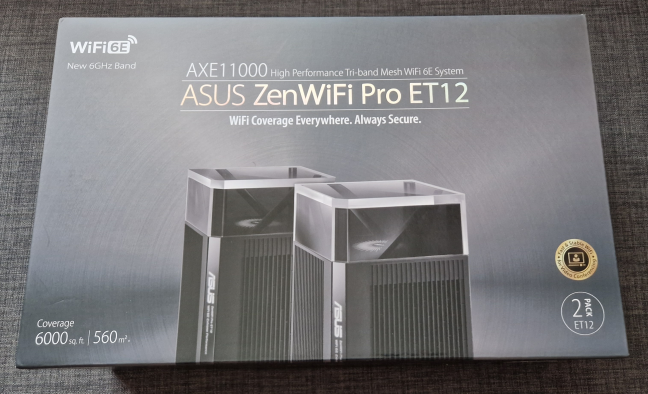
 The packaging for ASUS ZenWiFi Pro ET12 is very elegant
Everything is nicely packaged, and unpacking reveals the following items: the two ZenWiFi Pro ET12 stations and their power adapters, one RJ-45 network cable, the quick start guide, warranty cards, and other leaflets. One nice touch is that in European markets, this kit comes with power adapters for all the power outlets used on the continent.
The packaging for ASUS ZenWiFi Pro ET12 is very elegant
Everything is nicely packaged, and unpacking reveals the following items: the two ZenWiFi Pro ET12 stations and their power adapters, one RJ-45 network cable, the quick start guide, warranty cards, and other leaflets. One nice touch is that in European markets, this kit comes with power adapters for all the power outlets used on the continent.
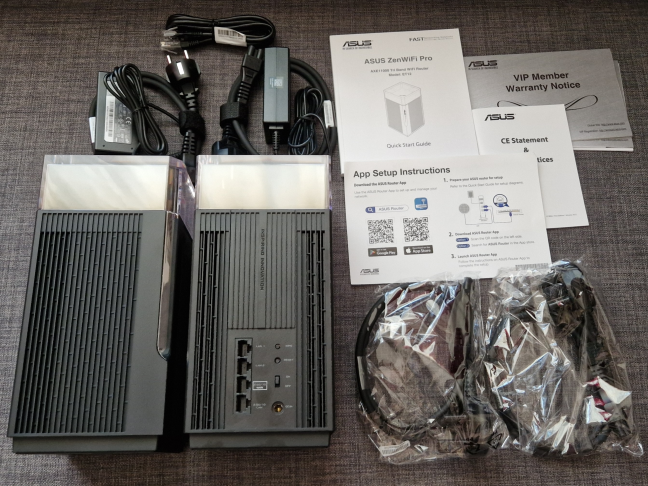
 Everything you find inside the box
The unboxing experience of the ASUS ZenWiFi Pro ET12 mesh Wi-Fi system is very pleasant, making you feel that you’ve just bought premium networking equipment for your home or small business.
Everything you find inside the box
The unboxing experience of the ASUS ZenWiFi Pro ET12 mesh Wi-Fi system is very pleasant, making you feel that you’ve just bought premium networking equipment for your home or small business.
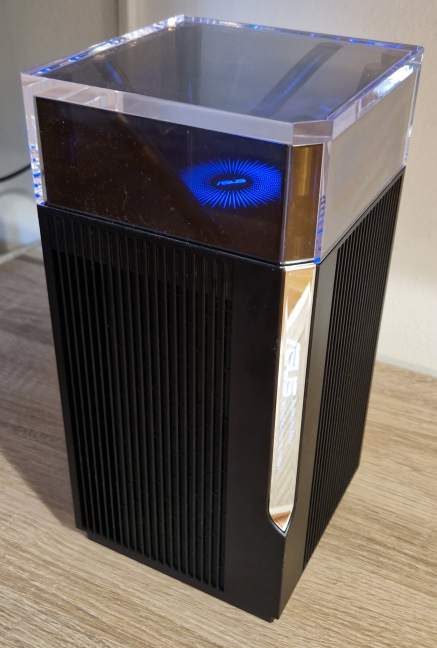
 Each ASUS ZenWiFi Pro ET12 unit is massive in size
On the top, there’s a transparent plastic lid that protects eight antennas (from a total of ten) and some RGB LEDs that light up using the ASUS logo. The LEDs don’t only have an esthetical role but also an informational one. Here’s what each color means:
Each ASUS ZenWiFi Pro ET12 unit is massive in size
On the top, there’s a transparent plastic lid that protects eight antennas (from a total of ten) and some RGB LEDs that light up using the ASUS logo. The LEDs don’t only have an esthetical role but also an informational one. Here’s what each color means:
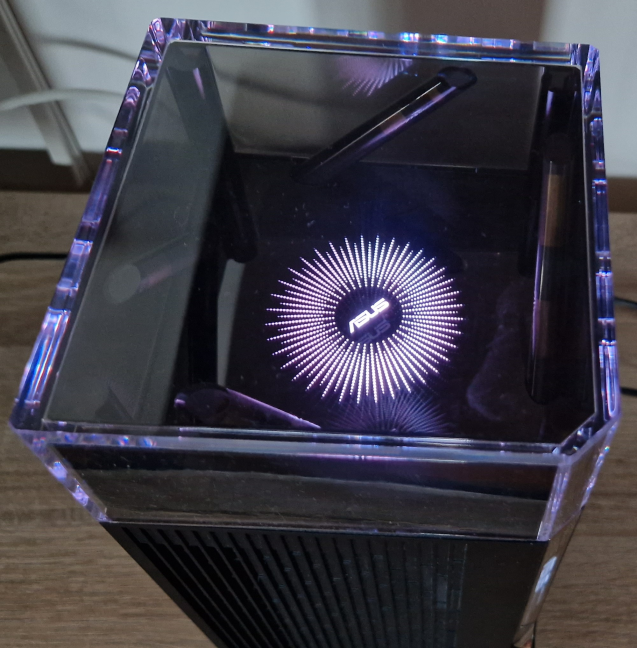
 The LEDs on the top provide useful information
On the back of each ASUS ZenWiFi Pro ET12, there are two 1 Gbps Ethernet ports with support for Link Aggregation, one 2.5 Gbps WAN port for connecting to ultra-fast internet connections, and one 2.5 Gbps Ethernet port useful for connecting a NAS (Network Attached Storage), a PC, home server or a console that can benefit from the added speed. You'll also find the WPS button, the Reset button, an On/Off button, and the Power jack. Unfortunately, there's no USB port on the ASUS ZenWiFi Pro ET12.
The LEDs on the top provide useful information
On the back of each ASUS ZenWiFi Pro ET12, there are two 1 Gbps Ethernet ports with support for Link Aggregation, one 2.5 Gbps WAN port for connecting to ultra-fast internet connections, and one 2.5 Gbps Ethernet port useful for connecting a NAS (Network Attached Storage), a PC, home server or a console that can benefit from the added speed. You'll also find the WPS button, the Reset button, an On/Off button, and the Power jack. Unfortunately, there's no USB port on the ASUS ZenWiFi Pro ET12.
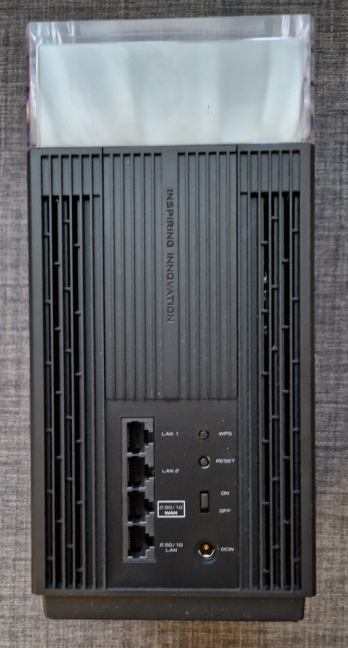
 The ports on the back of each ASUS ZenWiFi Pro ET12
The bottom of each ASUS ZenWiFi Pro ET12 is made of rubber, which prevents it from slipping when placed on glass and other slippery surfaces. On it, you also see details about the device that you have and how to log in to it.
The ports on the back of each ASUS ZenWiFi Pro ET12
The bottom of each ASUS ZenWiFi Pro ET12 is made of rubber, which prevents it from slipping when placed on glass and other slippery surfaces. On it, you also see details about the device that you have and how to log in to it.
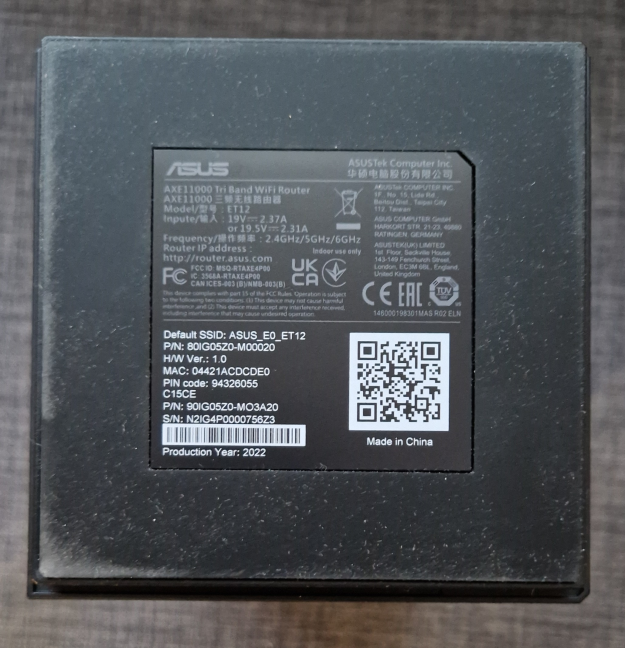
 ASUS ZenWiFi Pro ET12 has a rubber base that prevents it from slipping
TIP: For more information on how to log in to any ASUS router or mesh Wi-Fi system, read this guide: How to login to your ASUS router.
Inside each ASUS ZenWiFi Pro ET12, there’s a high-performance quad-core Broadcom BCM4912 system-on-a-chip running at 2 GHz, 1 GB of RAM, and 256 MB of storage for the firmware. This powerful hardware should handle many network clients, running data-intensive transfers like 4K movie streaming in parallel without any hiccups.
ASUS ZenWiFi Pro ET12 has a rubber base that prevents it from slipping
TIP: For more information on how to log in to any ASUS router or mesh Wi-Fi system, read this guide: How to login to your ASUS router.
Inside each ASUS ZenWiFi Pro ET12, there’s a high-performance quad-core Broadcom BCM4912 system-on-a-chip running at 2 GHz, 1 GB of RAM, and 256 MB of storage for the firmware. This powerful hardware should handle many network clients, running data-intensive transfers like 4K movie streaming in parallel without any hiccups.
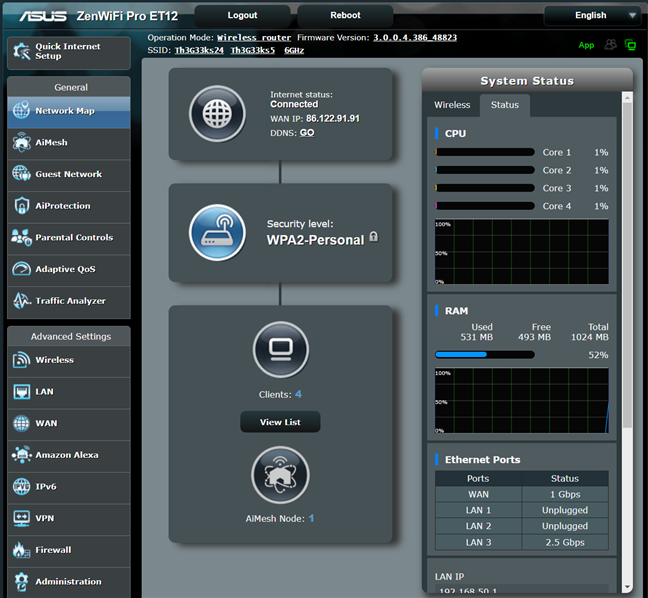
 ASUS ZenWiFi Pro ET12 features a quad-core SoC from Broadcom
ASUS ZenWiFi Pro ET12 is a tri-band whole-home mesh Wi-Fi system with support for the Wi-Fi 6E standard, and its total maximum theoretical bandwidth is split as follows:
ASUS ZenWiFi Pro ET12 features a quad-core SoC from Broadcom
ASUS ZenWiFi Pro ET12 is a tri-band whole-home mesh Wi-Fi system with support for the Wi-Fi 6E standard, and its total maximum theoretical bandwidth is split as follows:
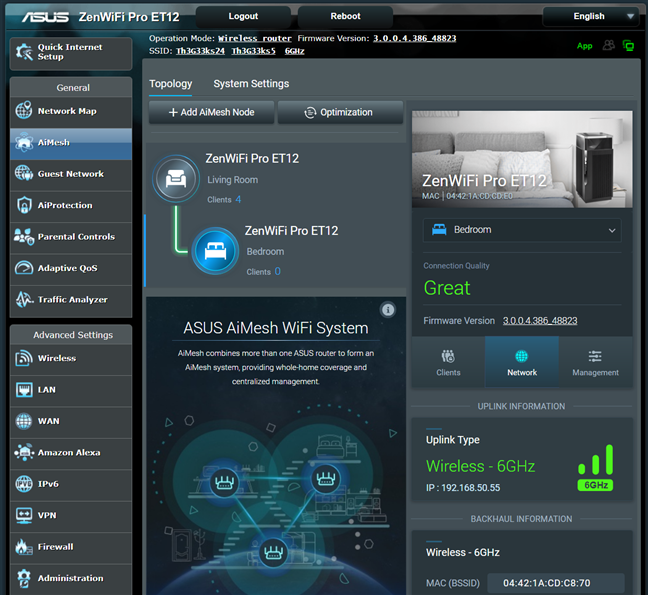
 The 6 GHz band is used for the wireless backhaul
A great technical aspect of the ASUS ZenWiFi Pro ET12 is that it offers 4x4 MU-MIMO transfers on all three bands, not just one or two, like other mesh Wi-Fi systems.
If you want more technical information about this product, I recommend visiting its official page: ASUS ZenWiFi Pro ET12 - AXE11000 Tri-Band Wi-Fi Router.
The 6 GHz band is used for the wireless backhaul
A great technical aspect of the ASUS ZenWiFi Pro ET12 is that it offers 4x4 MU-MIMO transfers on all three bands, not just one or two, like other mesh Wi-Fi systems.
If you want more technical information about this product, I recommend visiting its official page: ASUS ZenWiFi Pro ET12 - AXE11000 Tri-Band Wi-Fi Router.
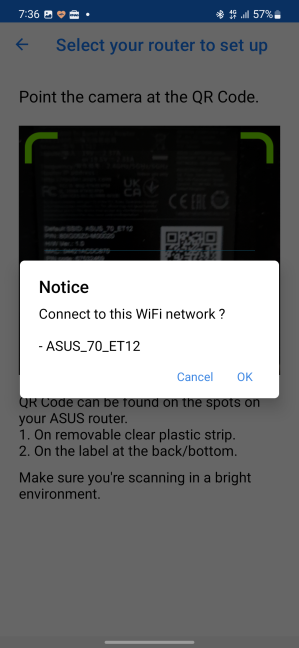
 Connecting the ASUS Router app to ASUS ZenWiFi Pro ET12
The setup process consists of entering the information required to connect to the internet, setting the name and password for your Wi-Fi, configuring an admin account for the ASUS ZenWiFi Pro ET12, and adding the second node (usually, it is detected and added automatically). At the end of the setup process, you see a summary of your settings, and a firmware update check is performed. If you want to benefit from the latest fixes and improvements, you should go ahead and install the newest firmware available.
Connecting the ASUS Router app to ASUS ZenWiFi Pro ET12
The setup process consists of entering the information required to connect to the internet, setting the name and password for your Wi-Fi, configuring an admin account for the ASUS ZenWiFi Pro ET12, and adding the second node (usually, it is detected and added automatically). At the end of the setup process, you see a summary of your settings, and a firmware update check is performed. If you want to benefit from the latest fixes and improvements, you should go ahead and install the newest firmware available.
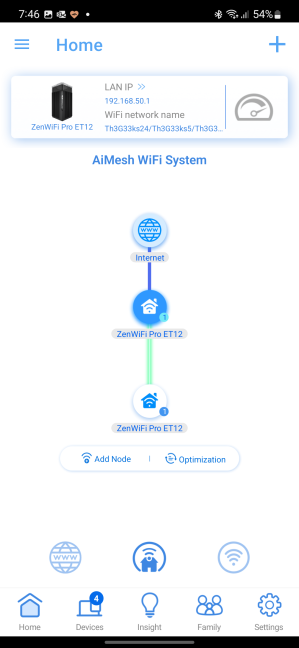 It is easy to configure ASUS ZenWiFi Pro ET12 from the ASUS Router app
After the firmware update is over, it’s worth delving deeper into all the available settings and further configuring the way you want the ASUS ZenWiFi Pro ET12 to work. While the ASUS Router app is useful and easy to use, if you want access to everything this mesh Wi-Fi system has to offer, I recommend you access its admin interface on a PC using a web browser. There, you’ll find all the advanced settings and tools that ASUS has built for the ASUS ZenWiFi Pro ET12.
It is easy to configure ASUS ZenWiFi Pro ET12 from the ASUS Router app
After the firmware update is over, it’s worth delving deeper into all the available settings and further configuring the way you want the ASUS ZenWiFi Pro ET12 to work. While the ASUS Router app is useful and easy to use, if you want access to everything this mesh Wi-Fi system has to offer, I recommend you access its admin interface on a PC using a web browser. There, you’ll find all the advanced settings and tools that ASUS has built for the ASUS ZenWiFi Pro ET12.
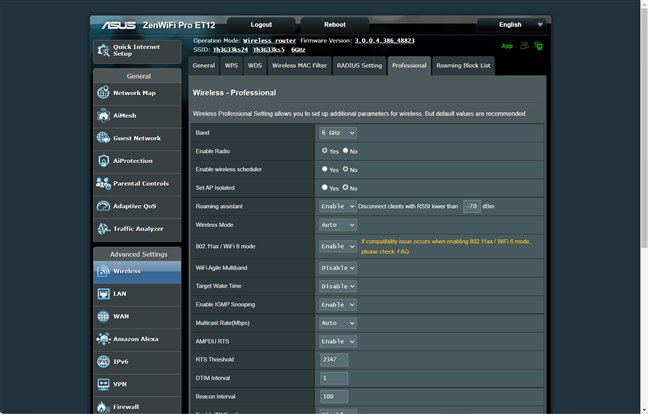
 ASUS ZenWiFi Pro ET12 offers plenty of advanced settings
The user interface for managing this mesh Wi-Fi system is easy to use, well organized into logical sections, and available in twenty five languages. You get to manage everything you want, and both casual and advanced users will be happy with the level of control they receive. The help documentation is easily accessible: when you move the mouse cursor over a setting you do not understand, a question mark is shown. Click the question mark, and you see information explaining that setting. Unfortunately, the documentation has not been updated to provide information about all the features included by ASUS in their latest firmware, so this trick does not work for everything. I would have liked for ASUS to extend this feature to all their new Wi-Fi 6 and Wi-Fi 6E-related settings, thus making it easier to deal with all the new configuration options entailed by these standards.
ASUS ZenWiFi Pro ET12 offers plenty of advanced settings
The user interface for managing this mesh Wi-Fi system is easy to use, well organized into logical sections, and available in twenty five languages. You get to manage everything you want, and both casual and advanced users will be happy with the level of control they receive. The help documentation is easily accessible: when you move the mouse cursor over a setting you do not understand, a question mark is shown. Click the question mark, and you see information explaining that setting. Unfortunately, the documentation has not been updated to provide information about all the features included by ASUS in their latest firmware, so this trick does not work for everything. I would have liked for ASUS to extend this feature to all their new Wi-Fi 6 and Wi-Fi 6E-related settings, thus making it easier to deal with all the new configuration options entailed by these standards.
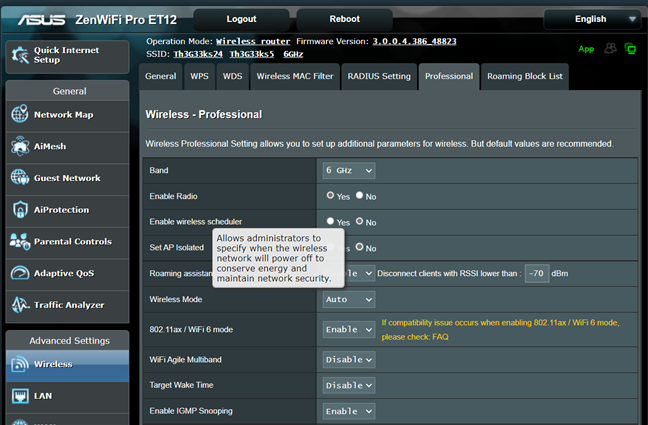
 Help documentation is easy to access
During my week-long testing of the ASUS ZenWiFi Pro ET12, I was very happy with the wireless coverage I got. Actually, this mesh Wi-Fi system is overkill for my apartment, as it can handle much larger homes or even small business offices. The Wi-Fi was fast everywhere, and I didn’t find any spots where I had no signal or the network was slow. The only minor complaint I have is that when transferring data on the 2.4 GHz band, the variability of network transfers was a bit high. However, when switching to the 5 GHz band, the transfers were very stable and fast.
If you want to know more about the real-world performance offered by the ASUS ZenWiFi Pro ET12, go to the next page of this review, where I present detailed measurements and comparisons.
Help documentation is easy to access
During my week-long testing of the ASUS ZenWiFi Pro ET12, I was very happy with the wireless coverage I got. Actually, this mesh Wi-Fi system is overkill for my apartment, as it can handle much larger homes or even small business offices. The Wi-Fi was fast everywhere, and I didn’t find any spots where I had no signal or the network was slow. The only minor complaint I have is that when transferring data on the 2.4 GHz band, the variability of network transfers was a bit high. However, when switching to the 5 GHz band, the transfers were very stable and fast.
If you want to know more about the real-world performance offered by the ASUS ZenWiFi Pro ET12, go to the next page of this review, where I present detailed measurements and comparisons.
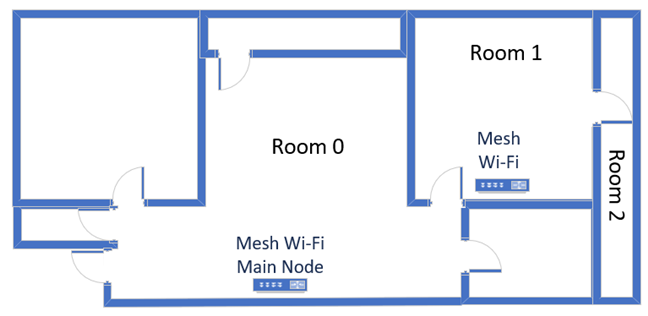
 The apartment in which I tested ASUS ZenWiFi Pro ET12
I evaluate the quality of the wireless network managed by ASUS ZenWiFi Pro ET12 through measurements made in three different places:
The apartment in which I tested ASUS ZenWiFi Pro ET12
I evaluate the quality of the wireless network managed by ASUS ZenWiFi Pro ET12 through measurements made in three different places:
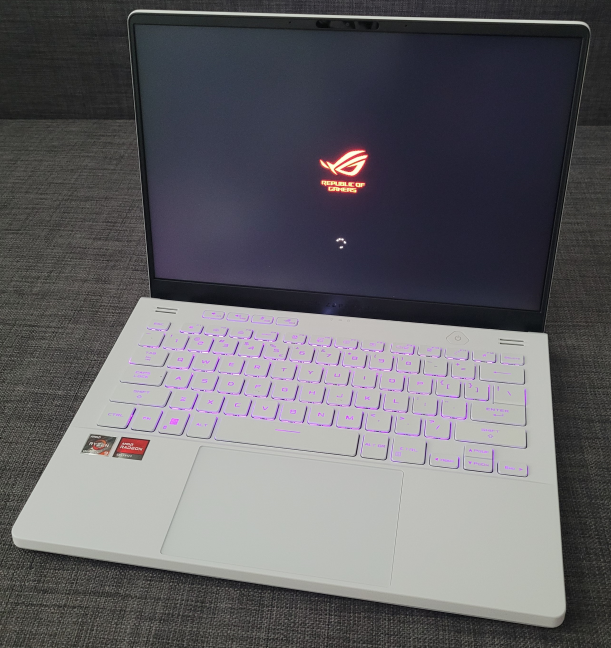
 I made my measurements on an ASUS ROG Zephyrus G14
I had to make some comparisons to better understand how this mesh Wi-Fi system performs. Unfortunately, I didn’t test any other mesh Wi-Fi in my new apartment, so I’ve compared ASUS ZenWiFi Pro ET12 with Synology RT6600ax (one of my favorite Wi-Fi 6 routers on the market) and TP-Link Archer GX90 (a powerful gaming router with excellent wireless coverage).
I made my measurements on an ASUS ROG Zephyrus G14
I had to make some comparisons to better understand how this mesh Wi-Fi system performs. Unfortunately, I didn’t test any other mesh Wi-Fi in my new apartment, so I’ve compared ASUS ZenWiFi Pro ET12 with Synology RT6600ax (one of my favorite Wi-Fi 6 routers on the market) and TP-Link Archer GX90 (a powerful gaming router with excellent wireless coverage).
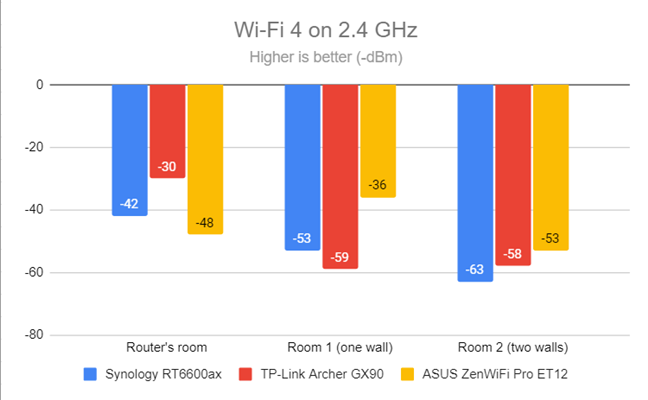
 Signal strength on Wi-Fi 4 (2.4 GHz band)
Switching to the Wi-Fi 6 standard on the 2.4 GHz band meant better signal strength everywhere in my apartment.
Signal strength on Wi-Fi 4 (2.4 GHz band)
Switching to the Wi-Fi 6 standard on the 2.4 GHz band meant better signal strength everywhere in my apartment.
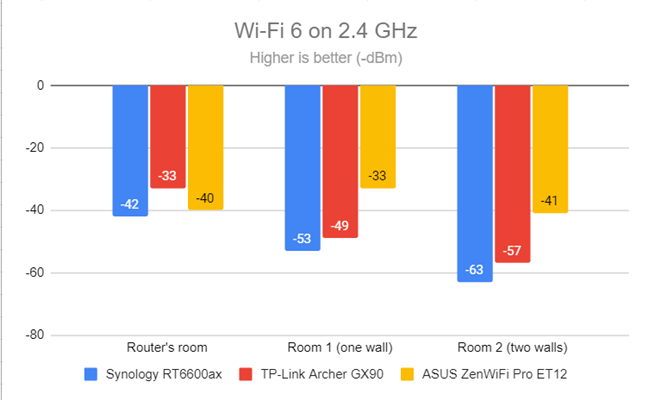 Signal strength on Wi-Fi 6 (2.4 GHz band)
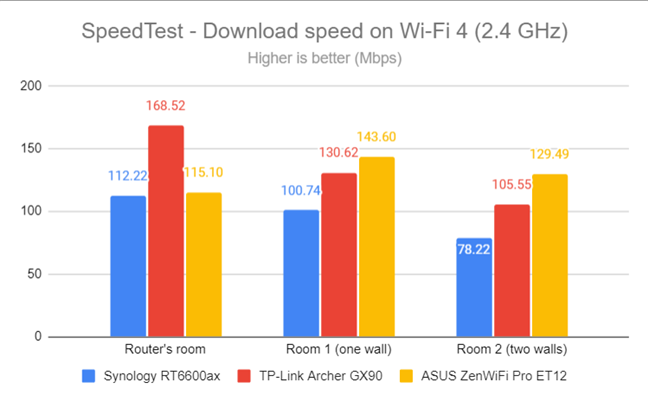
Next, I used the SpeedTest app to measure the maximum speed you get when transferring data to and from the internet on the 2.4 GHz band, using Wi-Fi 4. Again, download speeds were good everywhere in my apartment, especially in Room 2, where routers don’t usually deliver strong coverage.
Signal strength on Wi-Fi 6 (2.4 GHz band)
Next, I used the SpeedTest app to measure the maximum speed you get when transferring data to and from the internet on the 2.4 GHz band, using Wi-Fi 4. Again, download speeds were good everywhere in my apartment, especially in Room 2, where routers don’t usually deliver strong coverage.
 SpeedTest - The download speed on Wi-Fi 4 (2.4 GHz)
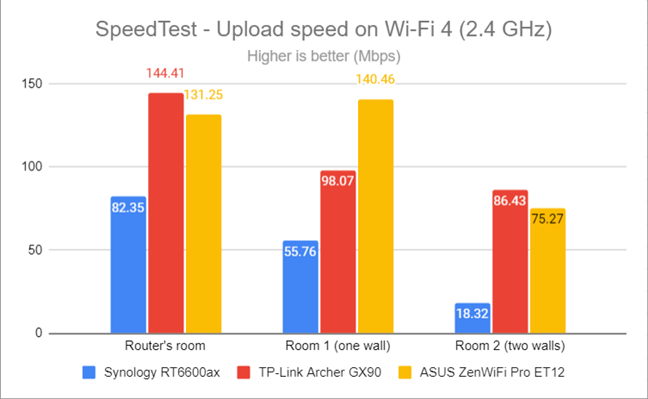
Uploads were performed at slower speeds, but they were still fast in all rooms.
SpeedTest - The download speed on Wi-Fi 4 (2.4 GHz)
Uploads were performed at slower speeds, but they were still fast in all rooms.
 SpeedTest - The upload speed on Wi-Fi 4 (2.4 GHz)
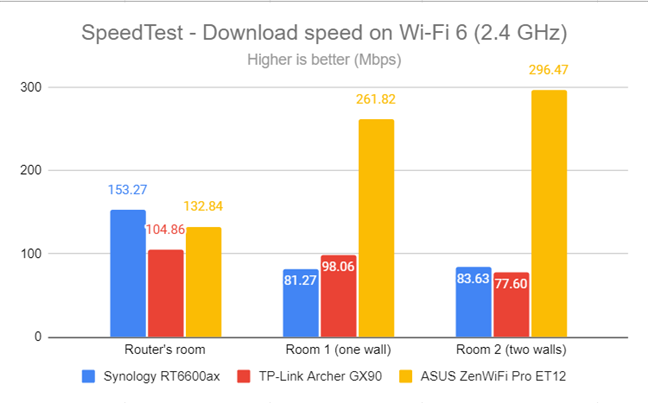
I then switched to Wi-Fi 6 on the 2.4 GHz band and repeated the same measurements. Again, ASUS ZenWiFi Pro ET12 delivered an outstanding download speed upgrade, especially in the rooms furthest from the main station.
SpeedTest - The upload speed on Wi-Fi 4 (2.4 GHz)
I then switched to Wi-Fi 6 on the 2.4 GHz band and repeated the same measurements. Again, ASUS ZenWiFi Pro ET12 delivered an outstanding download speed upgrade, especially in the rooms furthest from the main station.
 SpeedTest - The download speed on Wi-Fi 6 (2.4 GHz)
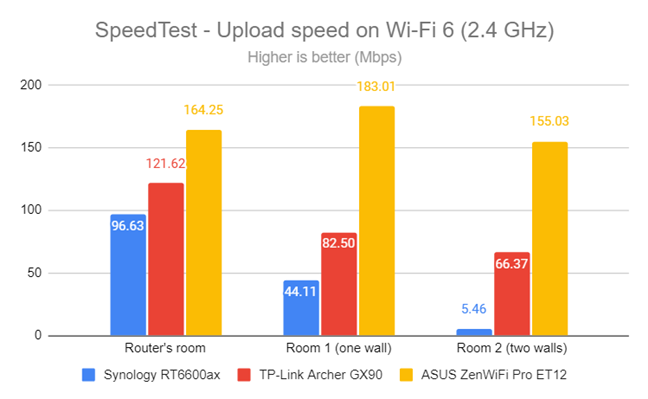
Uploads were just as impressive when using Wi-Fi 6 on the 2.4 GHz band.
SpeedTest - The download speed on Wi-Fi 6 (2.4 GHz)
Uploads were just as impressive when using Wi-Fi 6 on the 2.4 GHz band.
 SpeedTest - The upload speed on Wi-Fi 6 (2.4 GHz)
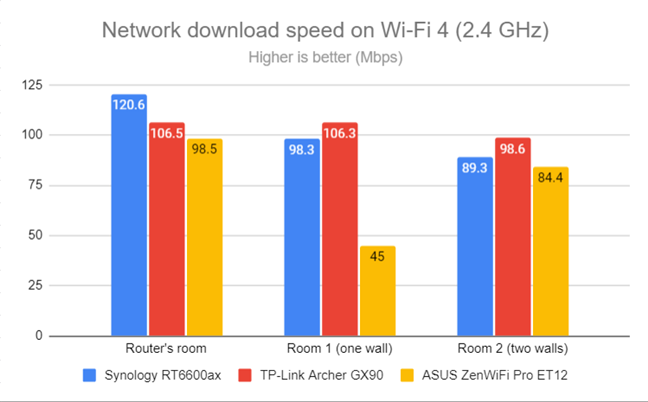
For the next set of measurements, I used the PassMark Performance test to transfer data between two computers connected to the network. Again, I was on the 2.4 GHz band using the Wi-Fi 4 standard. Unfortunately, this time the download speeds offered by ASUS ZenWiFi Pro ET12 were not that impressive.
SpeedTest - The upload speed on Wi-Fi 6 (2.4 GHz)
For the next set of measurements, I used the PassMark Performance test to transfer data between two computers connected to the network. Again, I was on the 2.4 GHz band using the Wi-Fi 4 standard. Unfortunately, this time the download speeds offered by ASUS ZenWiFi Pro ET12 were not that impressive.
 Network Wi-Fi downloads on Wi-Fi 4 (2.4 GHz)
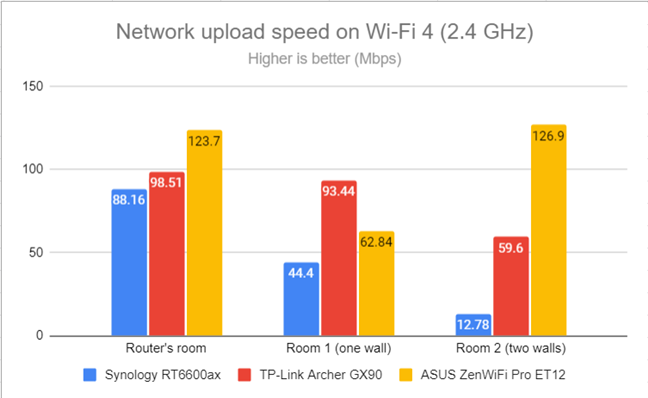
However, the upload speed improved, getting close to the numbers I saw earlier with SpeedTest.
Network Wi-Fi downloads on Wi-Fi 4 (2.4 GHz)
However, the upload speed improved, getting close to the numbers I saw earlier with SpeedTest.
 Network Wi-Fi uploads on Wi-Fi 4 (2.4 GHz)
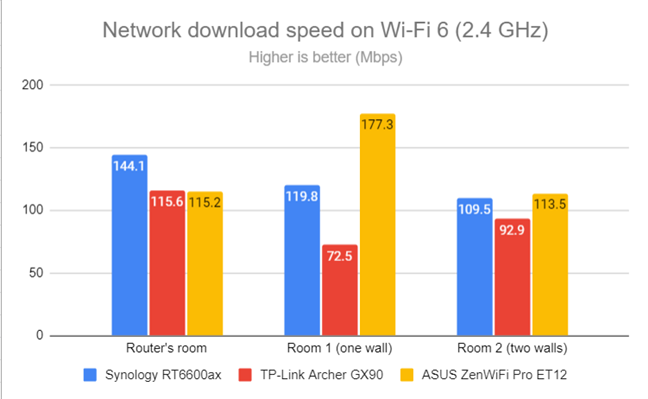
I repeated the same measurements on the 2.4 GHz band, using the Wi-Fi 6 standard. Again, I noticed a significant improvement in download speeds, especially in the rooms furthest from the main station.
Network Wi-Fi uploads on Wi-Fi 4 (2.4 GHz)
I repeated the same measurements on the 2.4 GHz band, using the Wi-Fi 6 standard. Again, I noticed a significant improvement in download speeds, especially in the rooms furthest from the main station.
 Network Wi-Fi downloads on Wi-Fi 6 (2.4 GHz)
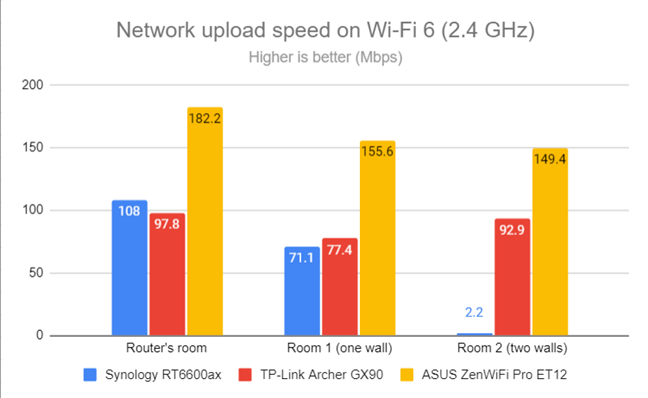
The same happened with the upload speeds, which increased significantly everywhere in my apartment.
Network Wi-Fi downloads on Wi-Fi 6 (2.4 GHz)
The same happened with the upload speeds, which increased significantly everywhere in my apartment.
 Network Wi-Fi uploads on Wi-Fi 6 (2.4 GHz)
ASUS ZenWiFi Pro ET12 offers a large coverage area on the 2.4 GHz band. I appreciate that switching from Wi-Fi 4 to Wi-Fi 6 on this band delivers meaningful improvements in speed and signal strength, which is great.
Network Wi-Fi uploads on Wi-Fi 6 (2.4 GHz)
ASUS ZenWiFi Pro ET12 offers a large coverage area on the 2.4 GHz band. I appreciate that switching from Wi-Fi 4 to Wi-Fi 6 on this band delivers meaningful improvements in speed and signal strength, which is great.
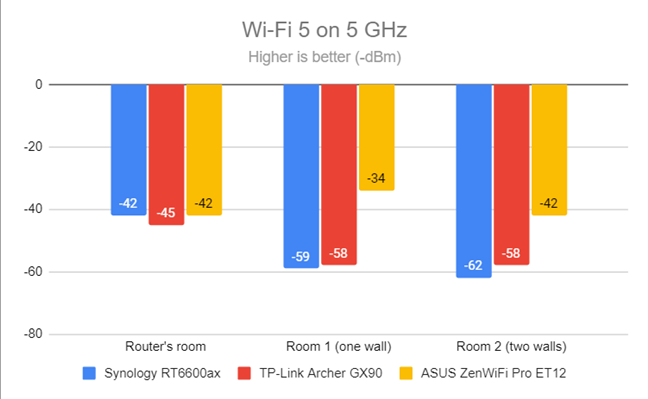 Signal strength on Wi-Fi 5 (5 GHz band)
The situation was similar when switching to Wi-Fi 6 on the 5 GHz band.
Signal strength on Wi-Fi 5 (5 GHz band)
The situation was similar when switching to Wi-Fi 6 on the 5 GHz band.
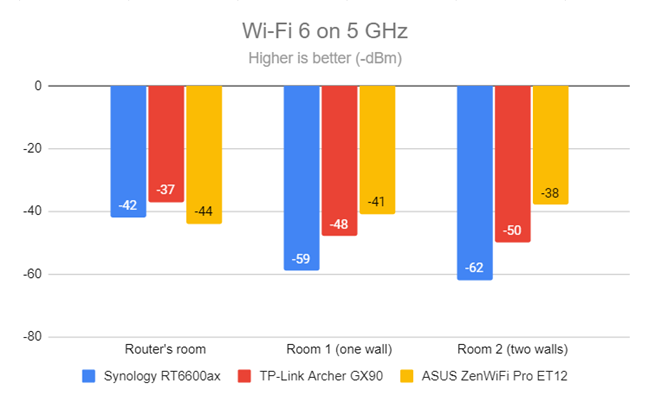 Signal strength on Wi-Fi 6 (5 GHz band)
Moving on, I used the SpeedTest app to see how fast the internet connection is when using the Wi-Fi 5 standard. ASUS ZenWiFi Pro ET12 delivered fast downloads everywhere in my apartment, easily outperforming the routers I’ve compared it to.
Signal strength on Wi-Fi 6 (5 GHz band)
Moving on, I used the SpeedTest app to see how fast the internet connection is when using the Wi-Fi 5 standard. ASUS ZenWiFi Pro ET12 delivered fast downloads everywhere in my apartment, easily outperforming the routers I’ve compared it to.
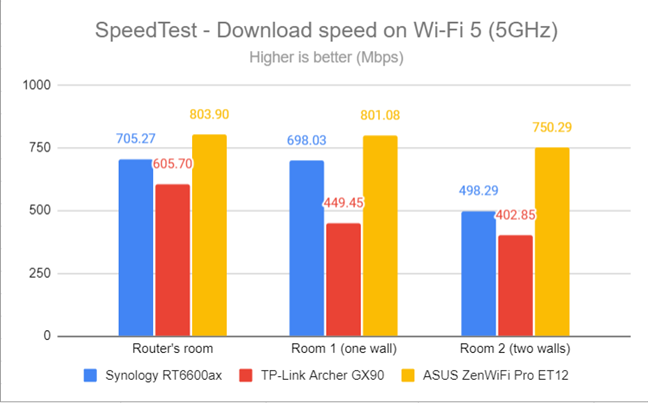 SpeedTest - The download speed on Wi-Fi 5 (5 GHz)
Uploads were also very fast in all the rooms of my apartment.
SpeedTest - The download speed on Wi-Fi 5 (5 GHz)
Uploads were also very fast in all the rooms of my apartment.
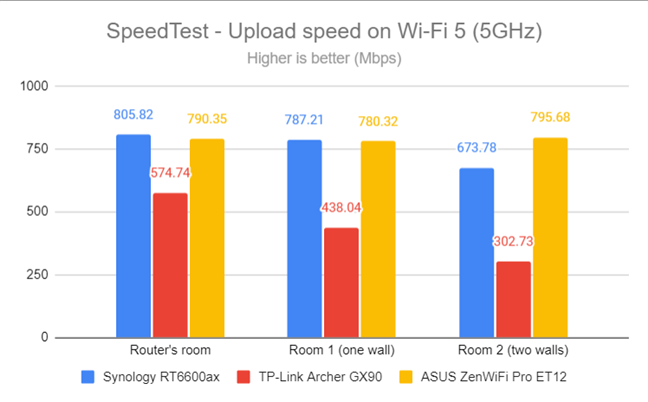 SpeedTest - The upload speed on Wi-Fi 5 (5 GHz)
When switching to the Wi-Fi 6 standard on the 5 GHz band, the download speed further improved in all the rooms, which is great.
SpeedTest - The upload speed on Wi-Fi 5 (5 GHz)
When switching to the Wi-Fi 6 standard on the 5 GHz band, the download speed further improved in all the rooms, which is great.
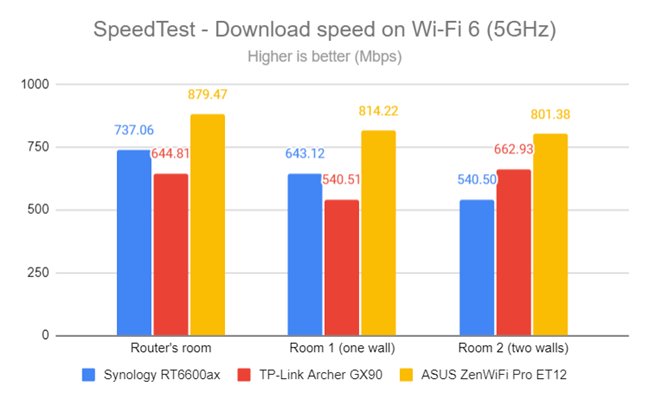 SpeedTest - The download speed on Wi-Fi 6 (5 GHz)
The upload speed improved by a lesser degree. However, using Wi-Fi 6 was still faster than using Wi-Fi 5.
SpeedTest - The download speed on Wi-Fi 6 (5 GHz)
The upload speed improved by a lesser degree. However, using Wi-Fi 6 was still faster than using Wi-Fi 5.
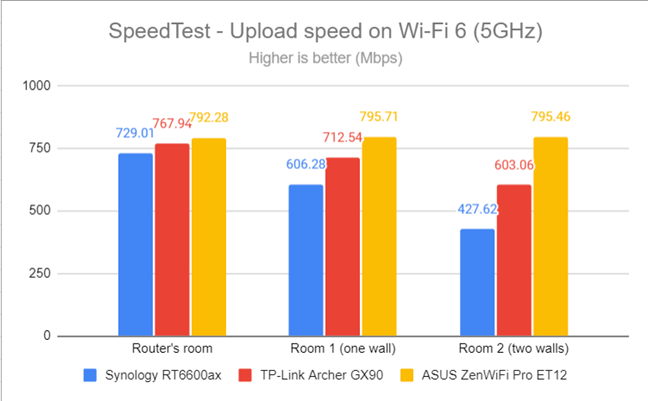 SpeedTest - The upload speed on Wi-Fi 6 (5 GHz)
I switched to the PassMark Performance test and transferred data between two computers connected to the network. This benchmark tells me the average speed you get when transferring data only inside the network and not on the internet. For example, when using Wi-Fi 5, the download speeds offered by ASUS ZenWiFi Pro ET12 breached the 1 Gbps mark, which is great.
SpeedTest - The upload speed on Wi-Fi 6 (5 GHz)
I switched to the PassMark Performance test and transferred data between two computers connected to the network. This benchmark tells me the average speed you get when transferring data only inside the network and not on the internet. For example, when using Wi-Fi 5, the download speeds offered by ASUS ZenWiFi Pro ET12 breached the 1 Gbps mark, which is great.
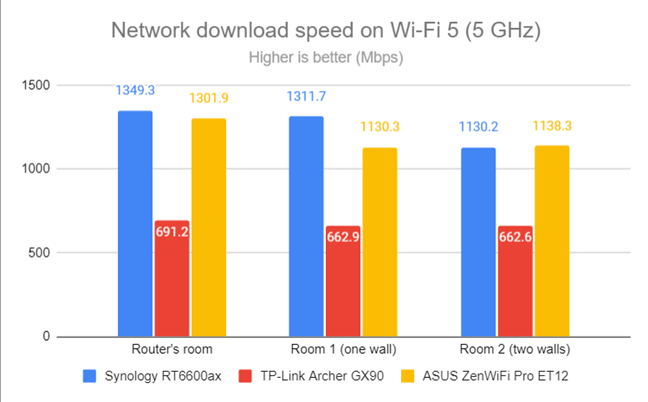 Network Wi-Fi downloads on Wi-Fi 5 (5 GHz)
Uploads were fast too, but below the 1 Gbps mark.
Network Wi-Fi downloads on Wi-Fi 5 (5 GHz)
Uploads were fast too, but below the 1 Gbps mark.
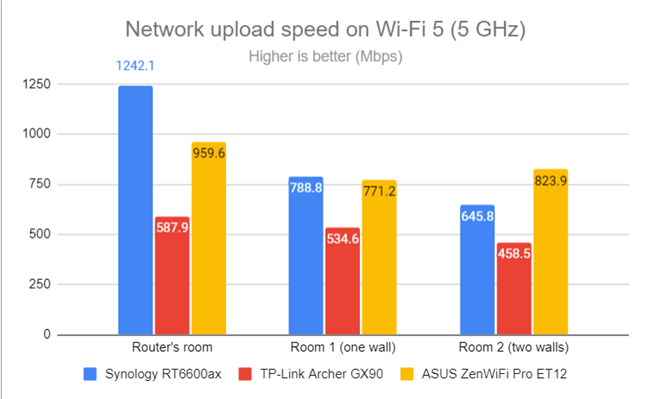 Network Wi-Fi uploads on Wi-Fi 5 (5 GHz)
Switching to the Wi-Fi 6 standard meant that downloads got a bit faster everywhere. ASUS ZenWiFi Pro ET12 performed beautifully in all the rooms of my apartment, easily showcasing the coverage advantage offered by a mesh Wi-Fi system over a single router.
Network Wi-Fi uploads on Wi-Fi 5 (5 GHz)
Switching to the Wi-Fi 6 standard meant that downloads got a bit faster everywhere. ASUS ZenWiFi Pro ET12 performed beautifully in all the rooms of my apartment, easily showcasing the coverage advantage offered by a mesh Wi-Fi system over a single router.
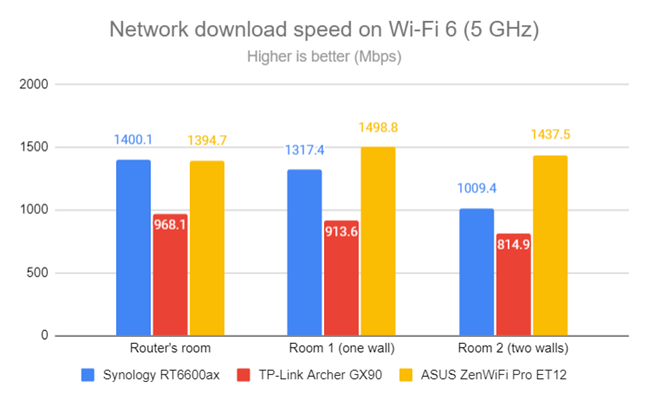 Network Wi-Fi downloads on Wi-Fi 6 (5 GHz)
Uploads were super fast too, but they breached 1 Gbps only in the room where the main unit was placed.
Network Wi-Fi downloads on Wi-Fi 6 (5 GHz)
Uploads were super fast too, but they breached 1 Gbps only in the room where the main unit was placed.
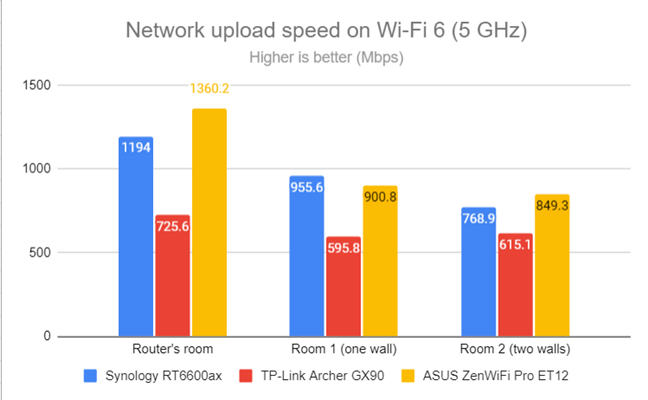 Network Wi-Fi uploads on Wi-Fi 6 (5 GHz)
ASUS ZenWiFi Pro ET12 is an excellent performer on the 5 GHz band, both when using Wi-Fi 5 and Wi-Fi 6. It offers excellent coverage, signal strength, and speed.
Network Wi-Fi uploads on Wi-Fi 6 (5 GHz)
ASUS ZenWiFi Pro ET12 is an excellent performer on the 5 GHz band, both when using Wi-Fi 5 and Wi-Fi 6. It offers excellent coverage, signal strength, and speed.
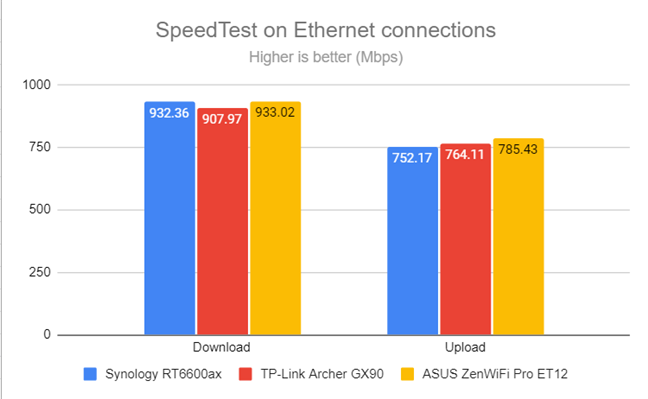 SpeedTest on wired connections
The potential of the ASUS ZenWiFi Pro ET12 is a bit wasted on internet connections that are up to 1 Gbps. If you want to take advantage of everything it offers, it is best to use it with a 2.5 Gbps internet connection. There’s also a minor downside: no USB port on the ASUS ZenWiFi Pro ET12, even though more affordable solutions from the same company, like the ASUS ZenWiFi AC (CT8), have a USB 3.0 port built-in.
SpeedTest on wired connections
The potential of the ASUS ZenWiFi Pro ET12 is a bit wasted on internet connections that are up to 1 Gbps. If you want to take advantage of everything it offers, it is best to use it with a 2.5 Gbps internet connection. There’s also a minor downside: no USB port on the ASUS ZenWiFi Pro ET12, even though more affordable solutions from the same company, like the ASUS ZenWiFi AC (CT8), have a USB 3.0 port built-in.
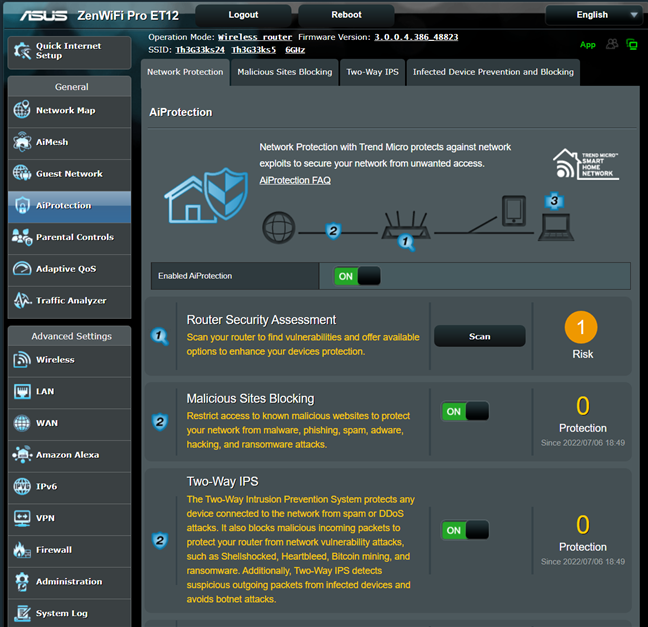
 ASUS ZenWiFi Pro ET12 features useful security tools
The list of features doesn’t stop here. ASUS ZenWiFi Pro ET12 also includes:
ASUS ZenWiFi Pro ET12 features useful security tools
The list of features doesn’t stop here. ASUS ZenWiFi Pro ET12 also includes:
ASUS ZenWiFi Pro ET12: Who is it good for?
This mesh Wi-Fi system is a suitable choice for:- People with subscriptions to ultra-fast 2.5 Gbps internet connections
- Users who want ultra-fast Wi-Fi 6 and Wi-Fi 6E connectivity
- Large homes or small business offices
- Those who want a secure network with excellent antivirus and firewall protection
- Parents who require efficient parental controls for their network
Pros and cons
Here are the things I like about ASUS ZenWiFi Pro ET12:
- Good-looking design
- Wi-Fi 6E support
- Superb performance when using Wi-Fi 6, on both bands (2.4 GHz and 5 GHz)
- Powerful hardware that can handle networks with many connected devices
- Can take advantage of 2.5 Gbps internet connections
- Offers one 2.5 Gbps LAN port too
- Top-notch security tools and parental controls
- Innovative VPN app that connects your mobile devices to your home network
- The price is not for everyone
- No USB port
Verdict
ASUS ZenWiFi Pro ET12 is the fastest mesh Wi-Fi system I have tested so far. It’s large and heavy but also powerful and good-looking, with tons of useful features. If you want extensive wireless connectivity in a large home or small business office, excellent speeds over Wi-Fi, and powerful security tools, ASUS ZenWiFi Pro ET12 is one of the best choices on the market. Also, If you have a 2.5 Gbps internet connection, and you want a mesh Wi-Fi system instead of a router, ASUS ZenWiFi Pro ET12 is definitely the way to go.Unboxing the ASUS ZenWiFi Pro ET12
ASUS ZenWiFi Pro ET12 comes in a large, elegant cardboard box, with a big picture of the two stations that make up the kit on the top cover. On the sides and the back of the box, you see plenty of technical details about this mesh Wi-Fi system, including a detailed presentation of the Wi-Fi 6E standard and the dual 2.5 Gbps ports on this kit.Hardware specifications and design
Each ASUS ZenWiFi Pro ET12 unit is large, having 4.5 x 4.5 x 115 x 9.4 inches or 115 x 241mm in length x width x height. On all sides, there are vertical ventilation grids that look slick. The overall design is elegant and worthy of a premium device that fits well into any living room. You can place the ZenWiFi Pro ET12 anywhere on the furniture without ruining your home’s interior design. However, the weight is just as large as their size - about 3.3 lbs or 1.5 kg for each unit.- Green - signals that the ASUS ZenWiFi Pro ET12 is starting up.
- Blue - the system is ready to be set up.
- White - the ASUS ZenWiFi Pro ET12 is connected to the internet and working well.
- Red - signals that the internet connection is down.
- Light Green - the mesh Wi-Fi system is running the optimization process.
- One 2.4 GHz band, with a total maximum bandwidth of 1148 Mbps. This band can work using either Wi-Fi 4 or Wi-Fi 6.
- One 5 GHz band with a total maximum bandwidth of 4804 Mbps. It can work using either Wi-Fi 5 or Wi-Fi 6.
- One 6 GHz band with a total maximum bandwidth of 4804 Mbps. It works using the Wi-Fi 6E standard and is the only band where Wi-Fi 6E is available on the ASUS ZenWiFi Pro ET12. By default, this band is used for the wireless backhaul between the stations that make up the mesh Wi-Fi system. If you want to free it up for your Wi-Fi 6E devices, it is a good idea to create an Ethernet backhaul between the stations using a standard network cable or to set the Wi-Fi backhaul to use the 5 GHz band. However, this last choice is not ideal because it limits the speed potential of the entire system.
Setting up and using the ASUS ZenWiFi Pro ET12
Setting up the ASUS ZenWiFi Pro ET12 can be done either by using a computer and web browser or the ASUS Router mobile app on your smartphone. This time I chose the mobile app route. After you fire it up, you need to choose which device you want to set up, give the app the permissions it requires, and connect to the main ASUS ZenWiFi Pro ET12 unit, which is the one you choose to connect to the internet.Wireless network performance
My test apartment is set up similarly to the diagram below. As you can see, I’ve placed the main ASUS ZenWiFi Pro ET12 in the largest room, where I spend most of my day. Unfortunately, my apartment is too small to fully test such a powerful mesh Wi-Fi system, and I placed the second node in Room 1 to also provide better Wi-Fi in Room 2, where most routers struggle.- I record the maximum speeds when no walls absorb the wireless signal in the room where the main node is placed.
- Room 1 - is separated by one wall from the main node.
- Room 2 - is separated from the main node by two walls absorbing the wireless signal. Also, the wall between Room 1 and Room 2 is twice as thick as the one between the router’s room and Room 1. Room 2 can be a difficult challenge for many routers, but it should not be a problem for a mesh Wi-Fi system.
How the ASUS ZenWiFi Pro ET12 performs on the 2.4 GHz band
I first measured the signal strength using NetSpot. When using the Wi-Fi 4 standard on the 2.4 GHz band, the signal strength offered by ASUS ZenWiFi Pro ET12 was solid everywhere. I expected this due to the fact that we’re dealing with a mesh Wi-Fi system with two stations instead of a router. It is easier for a mesh Wi-Fi to provide better signal strength over a large area than for a router.How the ASUS ZenWiFi Pro ET12 performs on the 5 GHz band
I moved on to the 5 GHz band and repeated the same measurements performed on the previous band. I started using the Wi-Fi 5 standard and fired up NetSpot to analyze the signal strength. ASUS ZenWiFi Pro ET12 didn’t disappoint and delivered excellent results in all rooms.Wired network performance
It was time to evaluate the performance of Ethernet network connections. My internet connection offers a maximum of 1 Gbps for the download speed and 800 Mbps for the upload. When using SpeedTest, ASUS ZenWiFi Pro ET12 had no problems getting close to the maximum speeds allowed by my internet provider.Extra features
The firmware on the ASUS ZenWiFi Pro ET12 has a lot of advanced features that many will appreciate. First of all, security is a big deal on this mesh Wi-Fi system, and it provides the following tools:- AiProtection - a comprehensive set of security tools that protect your network from attacks, malicious sites, infected devices, and poor router settings. You can find a useful tutorial about this feature here: ASUS AiProtection: On or Off? Enhance your router’s security!
- Parental Controls - efficient cloud-based parental controls, developed by ASUS and Trend Micro, alongside their AiProtection module. You can learn more about what they do from this article: 7 ways in which ASUS Parental Controls protect your children.
- VPN - is a major focus area, with three different services:
- VPN Server - the router can be set to work as a VPN server for your network, using the PPTP, OpenVPN, and IPSec VPN protocols.
- Instant Guard - a mobile app that helps smartphone users navigate the internet securely by establishing a VPN connection to their home network. The app is handy, especially when you have to use free public Wi-Fi networks, which tend to be insecure. For more details, read: How to configure and use Instant Guard on ASUS Wi-Fi routers.
- VPN Fusion - allows you to connect to multiple VPN servers simultaneously and assign your client devices to connect to different VPN tunnels.
- AiMesh - you can add more ASUS ZenWiFi Pro ET12 units or other ASUS routers to extend your network further. For more details on how it works, read: What is an ASUS AiMesh network and how to create one?.
- Adaptive QoS - an easy-to-use Quality of Service feature that allows you to prioritize the traffic you want to get more bandwidth: games, media streaming, work-from-home, learn-from-home, web surfing, etc.
- Guest Network - you can enable three wireless guest networks with individual security and access settings on each band (2.4, 5, and 6 GHz).
- Traffic Analyzer - visual traffic statistics that clearly show how your network is used and by which devices.
- DDNS - allows you to connect to your mesh Wi-Fi from the internet, even if your internet provider assigns you a dynamic public IP address.
- Dual WAN - you can use two internet connections at the same time. However, the second must use a 1 Gbps port. You can’t simultaneously use two 2.5 Gbps internet connections.
- Amazon Alexa - you can say things like “Alexa, ask ASUS ROUTER to upgrade the firmware” to perform different tasks.
- Network Tools - for analyzing the network and identifying what’s wrong. They are helpful when you need to troubleshoot problems.
Discussion (8)
This router is the one provided by my new ISP on a 2gb line. I currently have an Asus AC86U mesh at home, which was installed for gaming and the gaming features on the router. The new router doesn’t have those features, but I think it can take a faster line so I’m torn between the newer and faster router with less gaming features, or a slower router with all the features.
You will be better served by the ZenWiFi. Go for it.
Hi Roger. My sources at ASUS tell me that the new firmware is available for ET12, which includes VPN Fusion. Try it out!
“Extra features
The firmware on the ASUS ZenWiFi Pro ET12 has a lot of advanced features that many will appreciate. First of all, security is a big deal on this mesh Wi-Fi system, and it provides the following tools:
VPN Fusion – allows you to connect to multiple VPN servers simultaneously and assign your client devices to connect to different VPN tunnels.”
I read your review and purchased the ET12, in part because I wanted VPN Fusion. The ET12 does NOT provide this functionality, though the October firmware for the -XT12- added this feature.
Did you update the firmware to the latest version? I wouldn’t have mentioned this feature if it wasn’t there when I tested the Pro ET12.
I received news from someone working at ASUS that the next firmware release for ASUS ZenWiFi Pro ET12 will bring VPN Fusion. It will be released in a couple of weeks.
Great review and very detailed. I am deciding to get the Asus ET12 single unit. I have $500 to spend and went back and forth between a ROG GT-AXE 11000 an ET 8 mesh and of course tge ET 12 single unit.
Your review was just enough of a push to decide. I am thinking in a few years I will add a Wifi-7 router from Asus to be my main and the ET12 will be a node in AiMesh.
Mahalo. Taz
Thank you for the kind message of appreciation. Also, happy to have helped in your decision-making.
Ciprian