



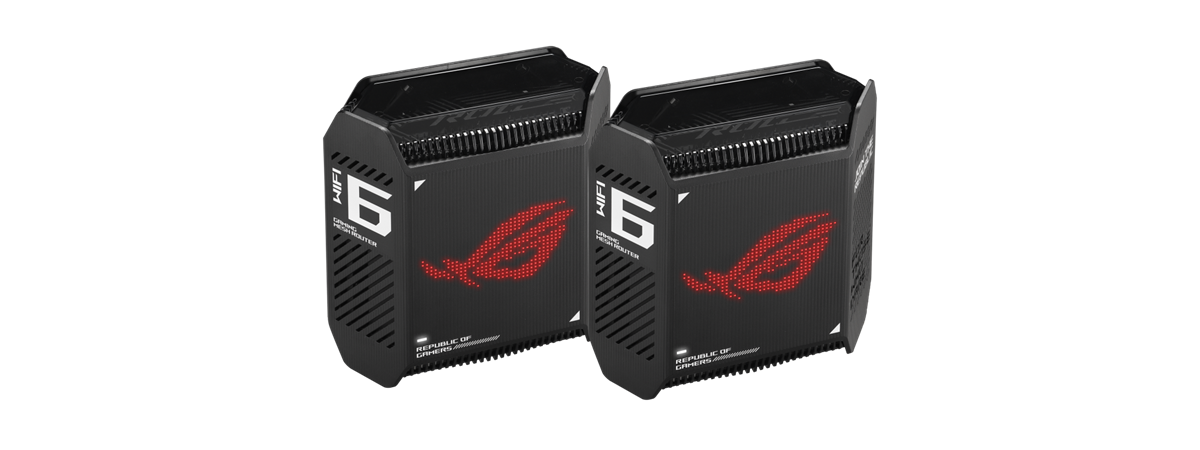
ASUS has many devices designed for gamers, from graphics cards to gaming monitors or accessories like mice and keyboards. During the last couple of years, they’ve also been manufacturing gaming-oriented routers under their Republic of Gamers brand. However, the company wasn’t present in one specific niche: gaming mesh wireless systems. That’s about to change with ASUS ROG Rapture GT6: their first gaming mesh Wi-Fi system. I am one of the first few people to test it before it starts rolling out to stores everywhere, and if you’re curious to know what it offers and whether it’s a good fit for you, read this review:
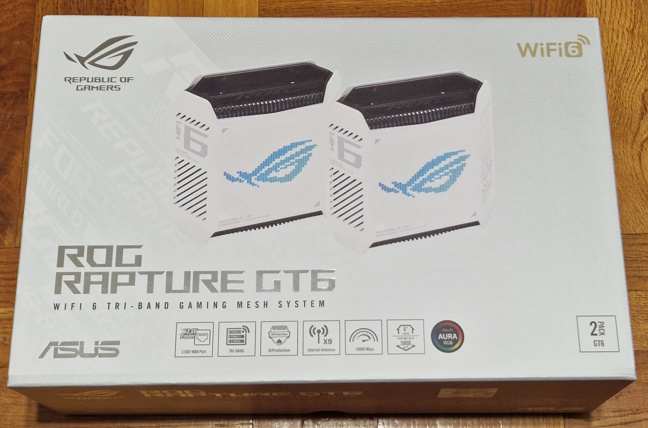
 The packaging for the white variant
On the sides and the back of the box, there are details about the hardware specifications of the ROG Rapture GT6 and a description of its most important features. When you open the box, you see the two units nicely packaged next to each other and a leaflet with troubleshooting tips for devices that might not work great with the Wi-Fi 6 standard.
The packaging for the white variant
On the sides and the back of the box, there are details about the hardware specifications of the ROG Rapture GT6 and a description of its most important features. When you open the box, you see the two units nicely packaged next to each other and a leaflet with troubleshooting tips for devices that might not work great with the Wi-Fi 6 standard.
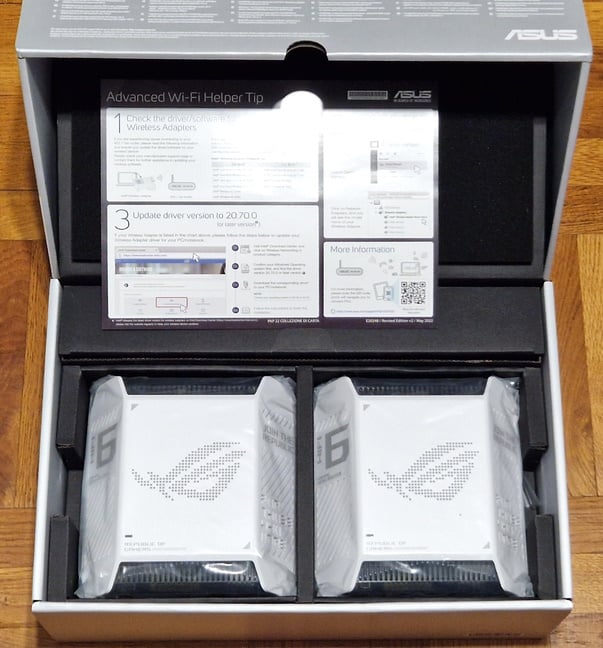
 Unboxing the ASUS ROG Rapture GT6
When you take everything out of the box, you get the following items:
Unboxing the ASUS ROG Rapture GT6
When you take everything out of the box, you get the following items:
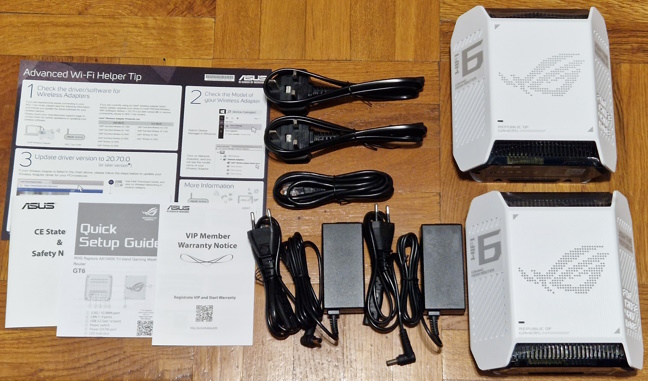
 All the items you find inside the box
The unboxing experience for the ASUS ROG Rapture GT6 mesh Wi-Fi system is pleasant and worthy of a premium product. You receive all the items and information you need to set it up at once.
All the items you find inside the box
The unboxing experience for the ASUS ROG Rapture GT6 mesh Wi-Fi system is pleasant and worthy of a premium product. You receive all the items and information you need to set it up at once.
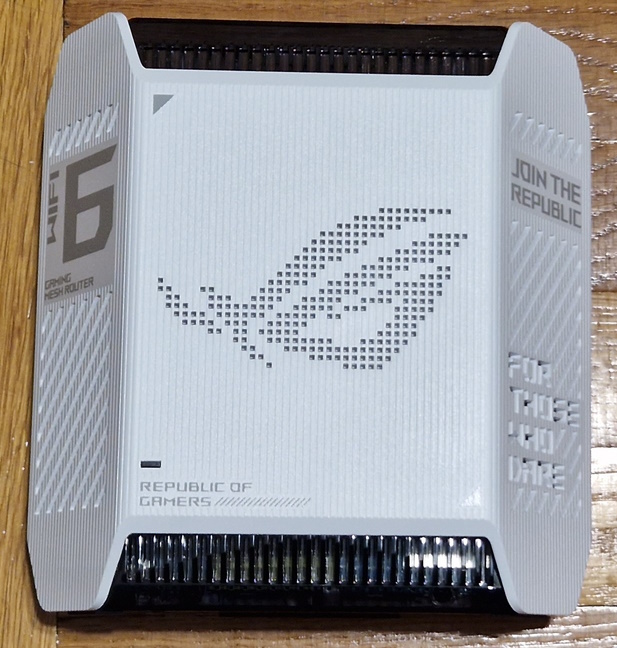
 Do you like the hexagonal patterns?
On the top, you see four of the nine antennas used by the ROG Rapture GT6 to emit its wireless signal, protected by transparent plastic, and the ventilation grids, which are quite large and efficient in cooling the hardware inside each unit. This mesh Wi-Fi system emits the wireless signal on three bands:
Do you like the hexagonal patterns?
On the top, you see four of the nine antennas used by the ROG Rapture GT6 to emit its wireless signal, protected by transparent plastic, and the ventilation grids, which are quite large and efficient in cooling the hardware inside each unit. This mesh Wi-Fi system emits the wireless signal on three bands:
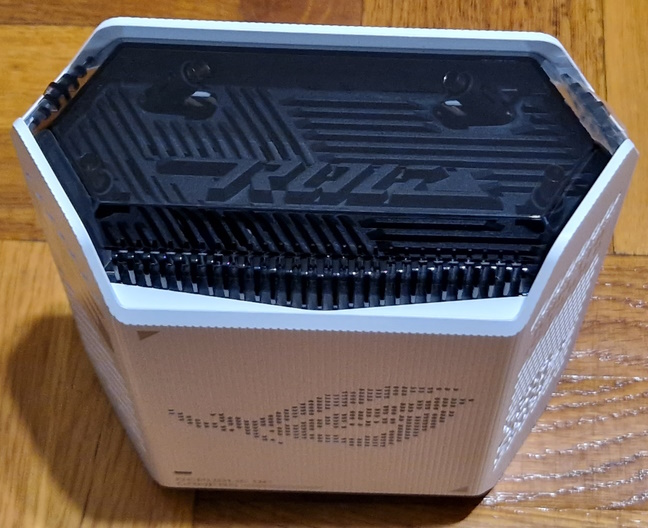
 Four of the nine antennas are placed on the top of each unit
Each ASUS ROG Rapture GT6 station is equipped with a three-core Broadcom BCM6753 chip, running at 1.5 GHz, 512 MB of RAM, and 256 MB of storage space for the firmware. While it is not as powerful as what you get on other ASUS gaming routers, it is powerful enough to handle a decent amount of devices simultaneously connected.
Four of the nine antennas are placed on the top of each unit
Each ASUS ROG Rapture GT6 station is equipped with a three-core Broadcom BCM6753 chip, running at 1.5 GHz, 512 MB of RAM, and 256 MB of storage space for the firmware. While it is not as powerful as what you get on other ASUS gaming routers, it is powerful enough to handle a decent amount of devices simultaneously connected.
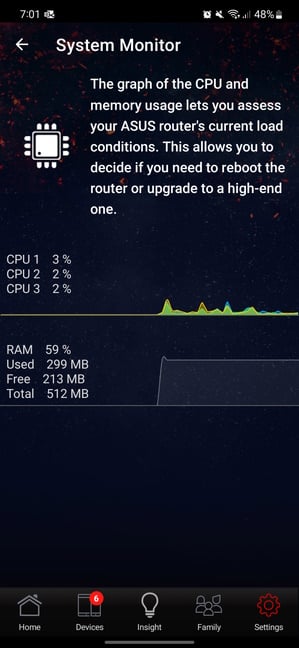
 Details about the hardware inside each ASUS ROG Rapture GT6
On the back of each unit, you find a 2.5 Gbps WAN port, three 1 Gbps LAN ports, one USB 3.2 Gen 1 port, the Power button, and the Power jack. One of the LAN ports is a prioritized gaming port. You also get LAN aggregation if you need it.
Details about the hardware inside each ASUS ROG Rapture GT6
On the back of each unit, you find a 2.5 Gbps WAN port, three 1 Gbps LAN ports, one USB 3.2 Gen 1 port, the Power button, and the Power jack. One of the LAN ports is a prioritized gaming port. You also get LAN aggregation if you need it.
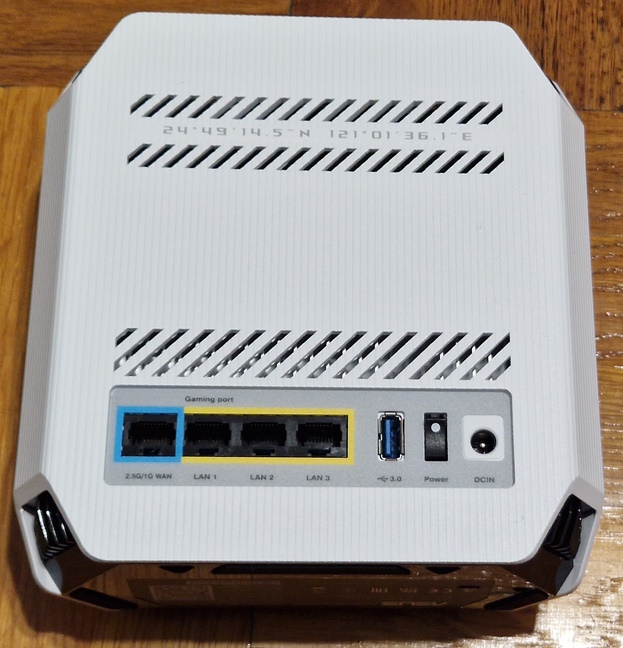
 The ports on the back of each ASUS ROG Rapture GT6
On the bottom, you find the WPS button, which can be personalized from the firmware to perform different actions, the Reset jack, a sticker with information about your specific unit, and other ventilation grids. There are also two rubber feet, useful for keeping the device in place on a flat surface.
The ports on the back of each ASUS ROG Rapture GT6
On the bottom, you find the WPS button, which can be personalized from the firmware to perform different actions, the Reset jack, a sticker with information about your specific unit, and other ventilation grids. There are also two rubber feet, useful for keeping the device in place on a flat surface.
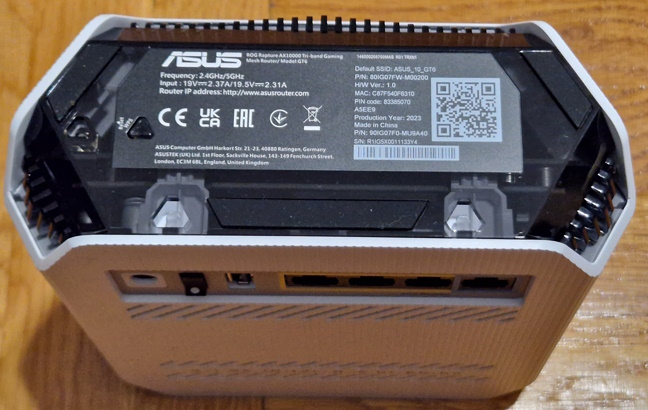
 The WPS button and the Reset jack are on the bottom
Using RGB, the ROG logo lights up in any color you want and can switch between multiple lighting effects. It looks great, especially during the night. If it bothers you during sleep, you can disable it from the ASUS Router app on your smartphone or from the firmware of the GT6.
The WPS button and the Reset jack are on the bottom
Using RGB, the ROG logo lights up in any color you want and can switch between multiple lighting effects. It looks great, especially during the night. If it bothers you during sleep, you can disable it from the ASUS Router app on your smartphone or from the firmware of the GT6.
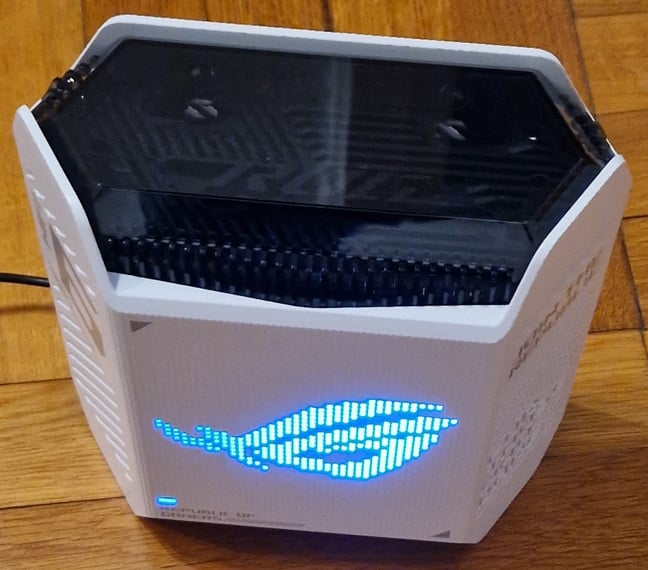
 ASUS ROG Rapture GT6 offers RGB lighting
Spec-wise, this gaming mesh Wi-Fi system includes everything you want, from a USB 3.2 port and 2.5 Gbps WAN port to support for 160 MHz-wide channels on Wi-Fi 6 and WPA3 encryption. If you require even more technical details, you can find all the official specifications on this page: ASUS ROG Rapture GT6.
ASUS ROG Rapture GT6 offers RGB lighting
Spec-wise, this gaming mesh Wi-Fi system includes everything you want, from a USB 3.2 port and 2.5 Gbps WAN port to support for 160 MHz-wide channels on Wi-Fi 6 and WPA3 encryption. If you require even more technical details, you can find all the official specifications on this page: ASUS ROG Rapture GT6.
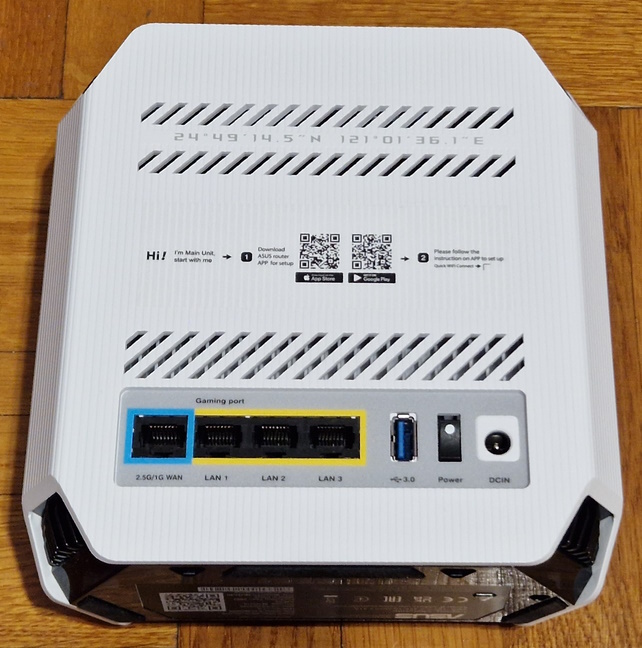
 One of the two units has a sticker telling you that it's the main one
No matter which method you choose (laptop vs. smartphone), the quick setup steps are mostly the same:
One of the two units has a sticker telling you that it's the main one
No matter which method you choose (laptop vs. smartphone), the quick setup steps are mostly the same:
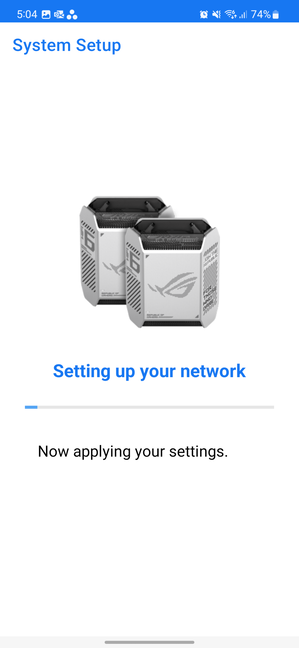 Setting up the ASUS ROG Rapture GT6 is not difficult
When the setup is done, you are shown a summary of your settings. After pressing Finish, you’re asked whether you want to Enable Remote Connection, meaning the option to control the ASUS ROG Rapture GT6 remotely, from anywhere on the internet.
The ASUS Router app is easy to use and provides most of the tools and configuration options you may need. You can also enable and configure some of the available gaming features, but not all.
Setting up the ASUS ROG Rapture GT6 is not difficult
When the setup is done, you are shown a summary of your settings. After pressing Finish, you’re asked whether you want to Enable Remote Connection, meaning the option to control the ASUS ROG Rapture GT6 remotely, from anywhere on the internet.
The ASUS Router app is easy to use and provides most of the tools and configuration options you may need. You can also enable and configure some of the available gaming features, but not all.
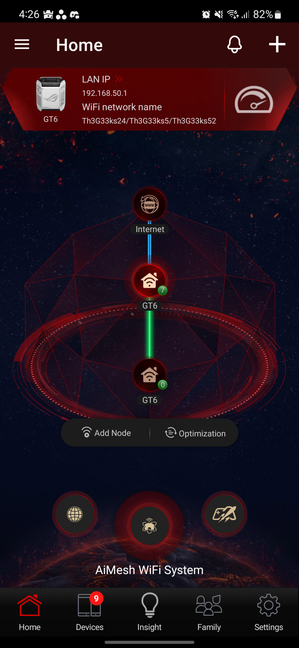 The ASUS Router app has a Republic of Gamers skin
If you want access to everything the ASUS ROG Rapture GT6 offers, you must use a web browser to log in with the admin password you have set. Just like the mobile app, the web interface also has a Republic of Gamers skin, which promotes the gaming features of this mesh Wi-Fi. The level of control you get is impressive. You can configure everything you want, from the VPN features to game profiles and port forwarding to the many parameters of the wireless network.
The ASUS Router app has a Republic of Gamers skin
If you want access to everything the ASUS ROG Rapture GT6 offers, you must use a web browser to log in with the admin password you have set. Just like the mobile app, the web interface also has a Republic of Gamers skin, which promotes the gaming features of this mesh Wi-Fi. The level of control you get is impressive. You can configure everything you want, from the VPN features to game profiles and port forwarding to the many parameters of the wireless network.
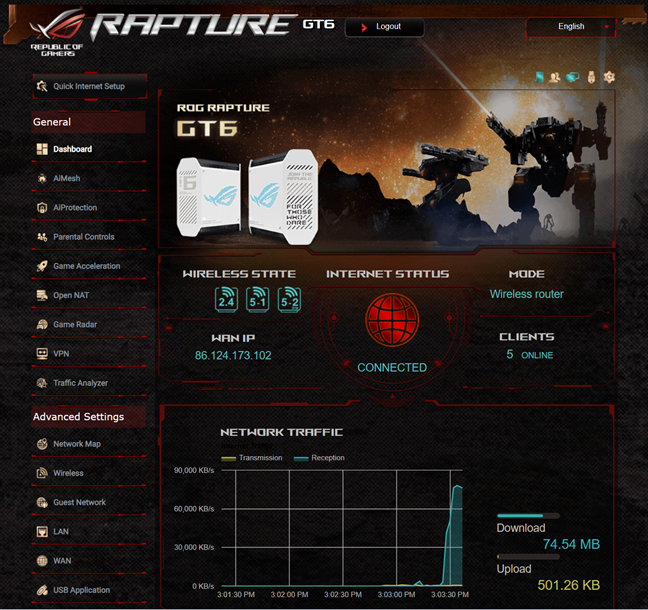
 The web admin interface also has a Republic of Gamers skin
One aspect that I appreciate a lot is the firmware auto-update capability. I recommend you enable it and choose a late hour for it, when you’re likely to be asleep, to avoid being impacted while the mesh Wi-Fi reboots to finalize the update. And speaking of firmware, the initial release seems to have some bugs, which negatively affect the stability of the wireless backhaul. Initially, the backhaul worked well. I enjoyed good signal strength between the two stations and solid transfer speeds everywhere in my apartment. Then, after a while, for no apparent reason, the two stations complained that they had a weak link between them, with poor signal quality. This was really strange as they were arranged ensuring there was an unobstructed line of sight between them, and other mesh Wi-Fi systems didn’t report similar issues. Furthermore, the problems went away on their own after a while and then returned, apparently randomly. I looked for early user reviews of this product and found that some people complained about similar issues. This is unfortunate, and upcoming firmware updates should fix this problem.
The web admin interface also has a Republic of Gamers skin
One aspect that I appreciate a lot is the firmware auto-update capability. I recommend you enable it and choose a late hour for it, when you’re likely to be asleep, to avoid being impacted while the mesh Wi-Fi reboots to finalize the update. And speaking of firmware, the initial release seems to have some bugs, which negatively affect the stability of the wireless backhaul. Initially, the backhaul worked well. I enjoyed good signal strength between the two stations and solid transfer speeds everywhere in my apartment. Then, after a while, for no apparent reason, the two stations complained that they had a weak link between them, with poor signal quality. This was really strange as they were arranged ensuring there was an unobstructed line of sight between them, and other mesh Wi-Fi systems didn’t report similar issues. Furthermore, the problems went away on their own after a while and then returned, apparently randomly. I looked for early user reviews of this product and found that some people complained about similar issues. This is unfortunate, and upcoming firmware updates should fix this problem.
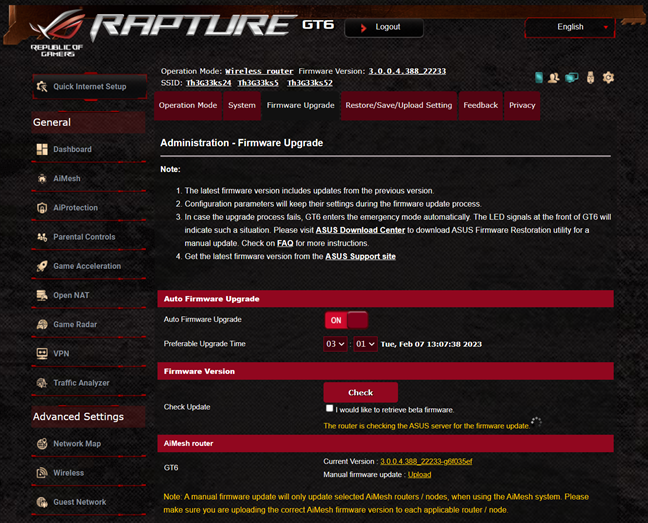
 Always check for firmware updates
The admin interface is available in 25 languages, and the help documentation is easily accessible with links to the manual at the bottom of the web interface. Gamers should not hesitate to familiarize themselves with the many features targeted at them. They’ll also appreciate the RGB lighting on the ASUS ROG Rapture GT6, with some good-looking effects that can be personalized from the web admin interface and the mobile app.
Always check for firmware updates
The admin interface is available in 25 languages, and the help documentation is easily accessible with links to the manual at the bottom of the web interface. Gamers should not hesitate to familiarize themselves with the many features targeted at them. They’ll also appreciate the RGB lighting on the ASUS ROG Rapture GT6, with some good-looking effects that can be personalized from the web admin interface and the mobile app.
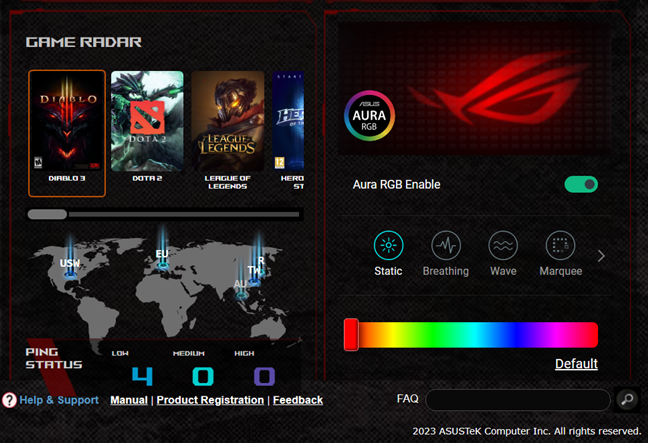
 The RGB lighting effects are easy to configure
Things worked very well when I didn’t encounter the backhaul stability issues mentioned earlier. I could connect all my devices to the Wi-Fi and use them without problems while enjoying good signal strength and satisfying speed. Another aspect I appreciated was how stable Wi-Fi 6 transfers were on the 5 GHz band. Here’s how a network transfer occurred in a room separated by one wall from the main unit. It’s almost a straight line, which is quite impressive.
The RGB lighting effects are easy to configure
Things worked very well when I didn’t encounter the backhaul stability issues mentioned earlier. I could connect all my devices to the Wi-Fi and use them without problems while enjoying good signal strength and satisfying speed. Another aspect I appreciated was how stable Wi-Fi 6 transfers were on the 5 GHz band. Here’s how a network transfer occurred in a room separated by one wall from the main unit. It’s almost a straight line, which is quite impressive.
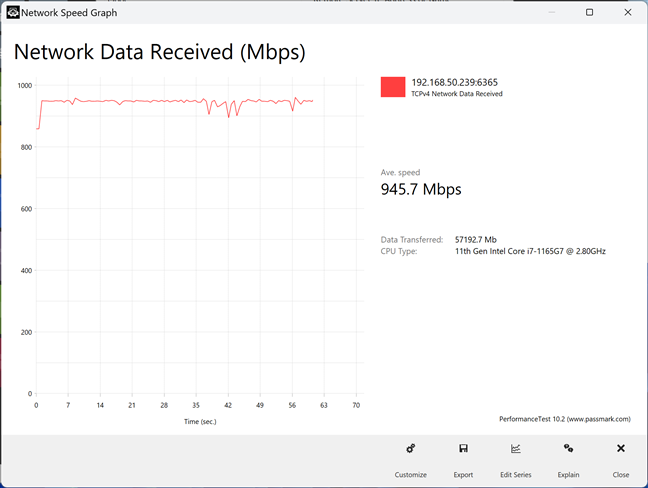
 Wi-Fi 6 transfers on the 5 GHz band can be very stable
Except for the wireless backhaul stability issues I’ve reported, I was satisfied with the user experience offered by this gaming mesh Wi-Fi system. If you want to know more about the real-world performance of the ASUS ROG Rapture GT6, go to the next page of this review, where I present detailed measurements and comparisons.
Wi-Fi 6 transfers on the 5 GHz band can be very stable
Except for the wireless backhaul stability issues I’ve reported, I was satisfied with the user experience offered by this gaming mesh Wi-Fi system. If you want to know more about the real-world performance of the ASUS ROG Rapture GT6, go to the next page of this review, where I present detailed measurements and comparisons.
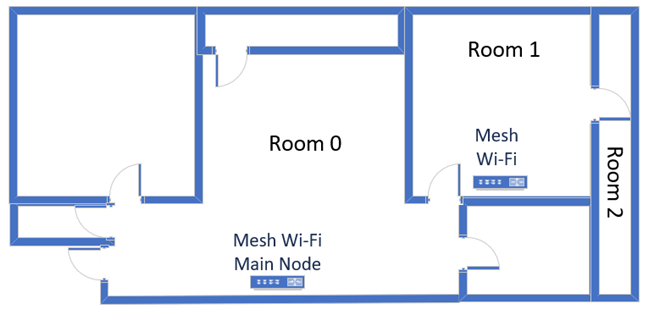
 The apartment where I tested ASUS ROG Rapture GT6
I evaluated the quality of the wireless network managed by the mesh system through measurements made in three different places:
The apartment where I tested ASUS ROG Rapture GT6
I evaluated the quality of the wireless network managed by the mesh system through measurements made in three different places:
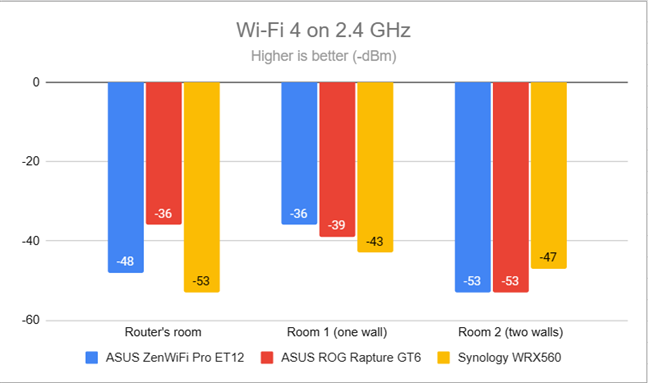
 Signal strength on Wi-Fi 4 (2.4 GHz band)
When switching to the Wi-Fi 6 standard on the same 2.4 GHz band, the signal strength improved in the rooms furthest from the main unit.
Signal strength on Wi-Fi 4 (2.4 GHz band)
When switching to the Wi-Fi 6 standard on the same 2.4 GHz band, the signal strength improved in the rooms furthest from the main unit.
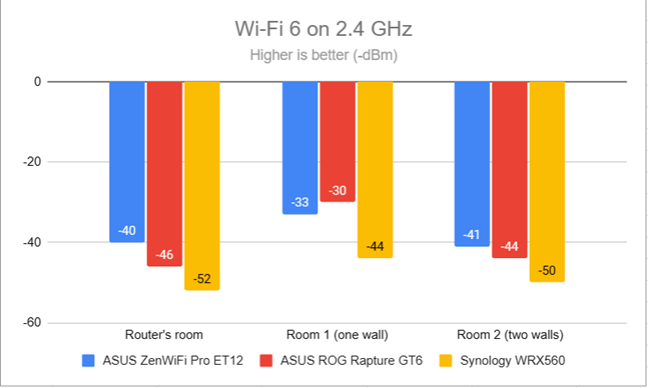
 Signal strength on Wi-Fi 6 (2.4 GHz band)
Next, I ran the SpeedTest app and used it to measure the maximum speed when transferring data to and from the internet on the 2.4 GHz band through Wi-Fi 4. The download speed offered by the mesh system was good, especially in the rooms further away from the main unit.
Signal strength on Wi-Fi 6 (2.4 GHz band)
Next, I ran the SpeedTest app and used it to measure the maximum speed when transferring data to and from the internet on the 2.4 GHz band through Wi-Fi 4. The download speed offered by the mesh system was good, especially in the rooms further away from the main unit.
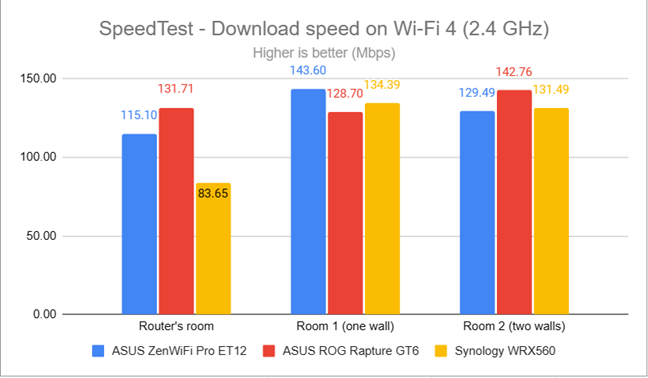
 SpeedTest - The download speed on Wi-Fi 4 (2.4 GHz)
The upload speed was a tad disappointing, especially in Room 2, where the other mesh systems performed much better than ASUS ROG Rapture GT6.
SpeedTest - The download speed on Wi-Fi 4 (2.4 GHz)
The upload speed was a tad disappointing, especially in Room 2, where the other mesh systems performed much better than ASUS ROG Rapture GT6.
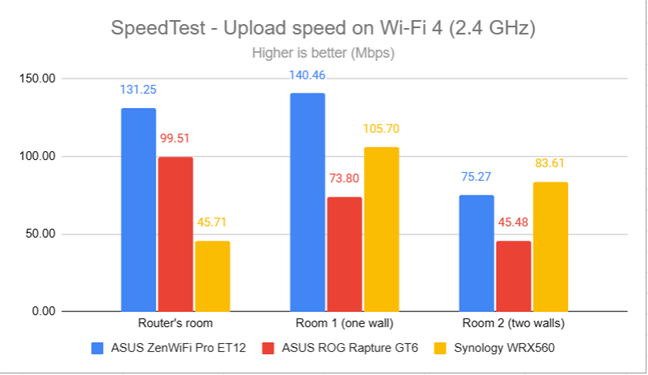
 SpeedTest - The upload speed on Wi-Fi 4 (2.4 GHz)
Next, I switched to Wi-Fi 6 on the 2.4 GHz band and noticed significantly faster download speeds only in the room where the main unit was placed. In the other rooms, downloads were faster when using Wi-Fi 4 instead of Wi-Fi 6.
SpeedTest - The upload speed on Wi-Fi 4 (2.4 GHz)
Next, I switched to Wi-Fi 6 on the 2.4 GHz band and noticed significantly faster download speeds only in the room where the main unit was placed. In the other rooms, downloads were faster when using Wi-Fi 4 instead of Wi-Fi 6.
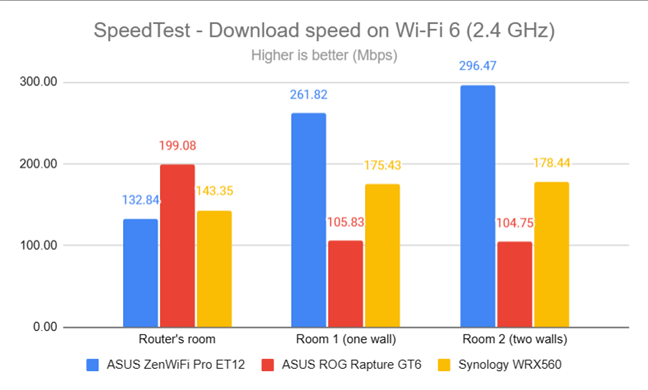
 SpeedTest - The download speed on Wi-Fi 6 (2.4 GHz)
Luckily, uploads improved significantly everywhere in my apartment when switching from Wi-Fi 4 to Wi-Fi 6. However, the other mesh systems easily outperformed the ASUS ROG Rapture GT6.
SpeedTest - The download speed on Wi-Fi 6 (2.4 GHz)
Luckily, uploads improved significantly everywhere in my apartment when switching from Wi-Fi 4 to Wi-Fi 6. However, the other mesh systems easily outperformed the ASUS ROG Rapture GT6.
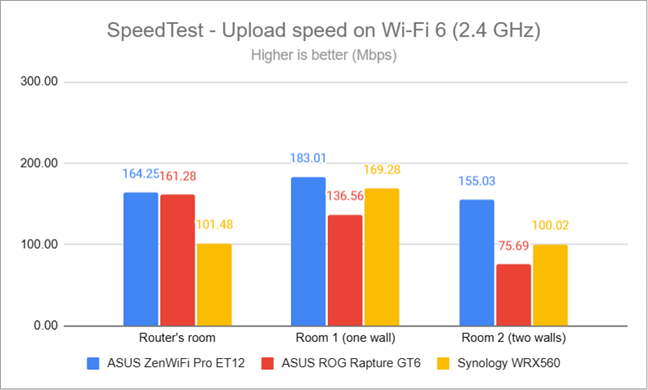 SpeedTest - The upload speed on Wi-Fi 6 (2.4 GHz)
For the next set of measurements, I used the PassMark Performance test to transfer data between two computers connected to the network. On the 2.4 GHz band, when using the Wi-Fi 4 standard, ASUS ROG Rapture GT6 delivered fast download speeds.
SpeedTest - The upload speed on Wi-Fi 6 (2.4 GHz)
For the next set of measurements, I used the PassMark Performance test to transfer data between two computers connected to the network. On the 2.4 GHz band, when using the Wi-Fi 4 standard, ASUS ROG Rapture GT6 delivered fast download speeds.
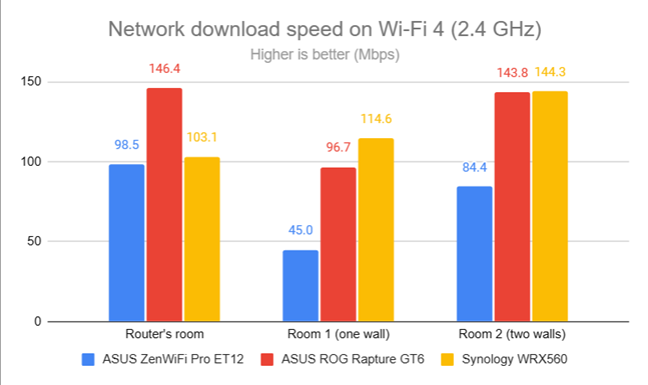
 Network downloads on Wi-Fi 4 (2.4 GHz)
Uploads were significantly slower, though.
Network downloads on Wi-Fi 4 (2.4 GHz)
Uploads were significantly slower, though.
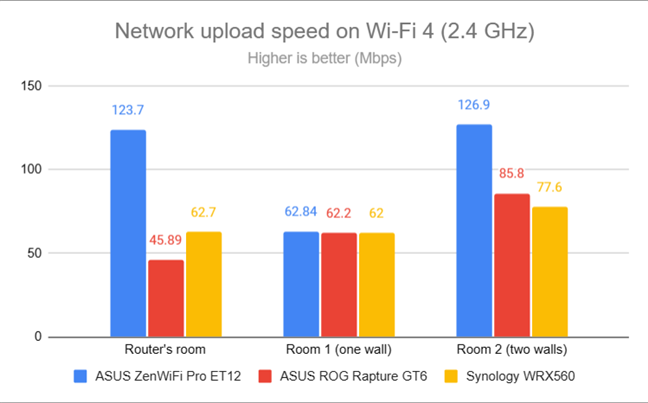
 Network uploads on Wi-Fi 4 (2.4 GHz)
Switching to Wi-Fi 6 on the 2.4 GHz also meant faster downloads everywhere in my apartment.
Network uploads on Wi-Fi 4 (2.4 GHz)
Switching to Wi-Fi 6 on the 2.4 GHz also meant faster downloads everywhere in my apartment.
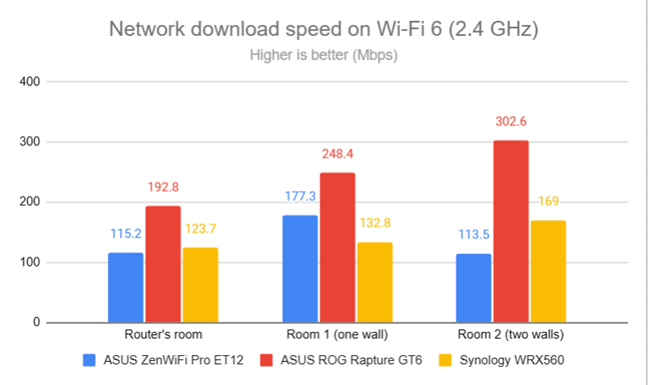 Network downloads on Wi-Fi 6 (2.4 GHz)
Uploads were significantly faster when switching from Wi-Fi 4 to Wi-Fi 6 on the 2.4 GHz band.
Network downloads on Wi-Fi 6 (2.4 GHz)
Uploads were significantly faster when switching from Wi-Fi 4 to Wi-Fi 6 on the 2.4 GHz band.
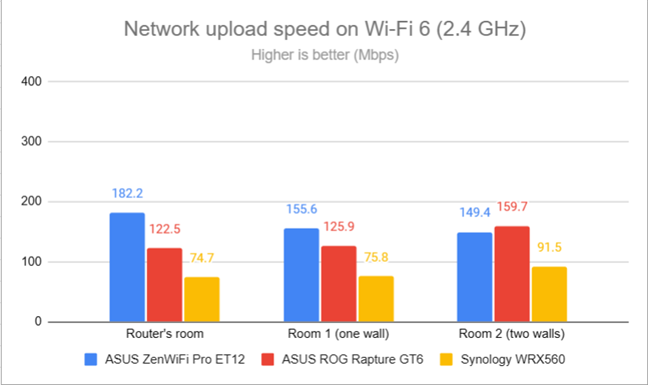 Network uploads on Wi-Fi 6 (2.4 GHz)
The performance offered by ASUS ROG Rapture GT6 in its initial firmware version is a mixed bag on the 2.4 GHz band. Sometimes, the GT6 works great, and other times it’s outperformed quite strongly by other mesh Wi-Fi systems.
Network uploads on Wi-Fi 6 (2.4 GHz)
The performance offered by ASUS ROG Rapture GT6 in its initial firmware version is a mixed bag on the 2.4 GHz band. Sometimes, the GT6 works great, and other times it’s outperformed quite strongly by other mesh Wi-Fi systems.
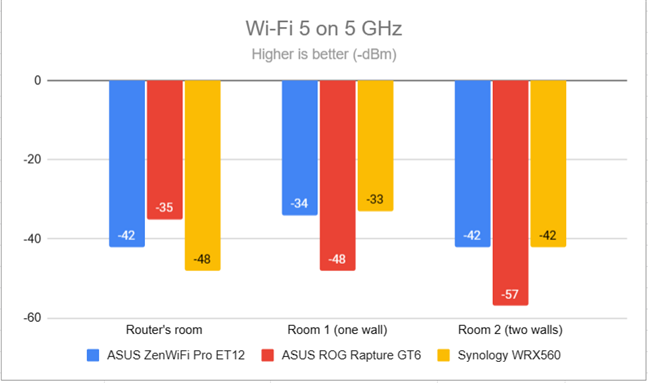 Signal strength on Wi-Fi 5 (5 GHz band)
Switching to Wi-Fi 6 on the 5 GHz band led to an increase in signal strength in the rooms further from the main station.
Signal strength on Wi-Fi 5 (5 GHz band)
Switching to Wi-Fi 6 on the 5 GHz band led to an increase in signal strength in the rooms further from the main station.
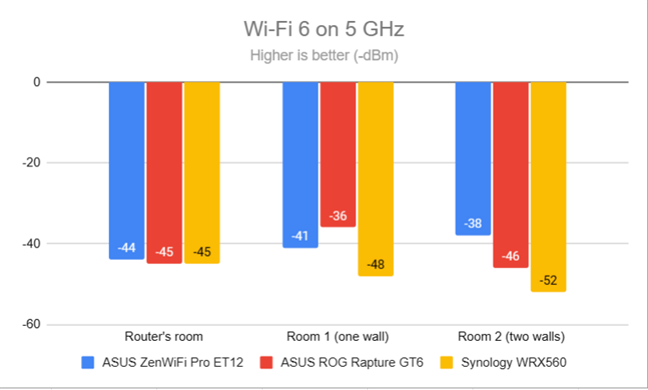 Signal strength on Wi-Fi 6 (5 GHz band)
I switched to the SpeedTest app to see how fast the internet is when connected to the 5 GHz band. ASUS ROG Rapture GT6 delivered fast downloads, but ASUS ZenWiFi Pro ET12 outmatched it.
Signal strength on Wi-Fi 6 (5 GHz band)
I switched to the SpeedTest app to see how fast the internet is when connected to the 5 GHz band. ASUS ROG Rapture GT6 delivered fast downloads, but ASUS ZenWiFi Pro ET12 outmatched it.
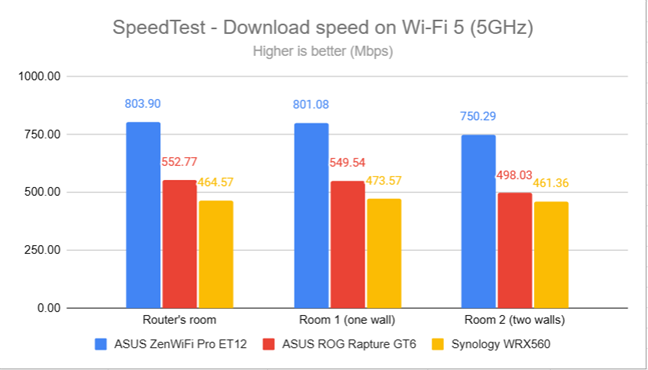
 SpeedTest - The download speed on Wi-Fi 5 (5 GHz)
I was surprised that the upload speed was faster than the download speed when using Wi-Fi 5.
SpeedTest - The download speed on Wi-Fi 5 (5 GHz)
I was surprised that the upload speed was faster than the download speed when using Wi-Fi 5.
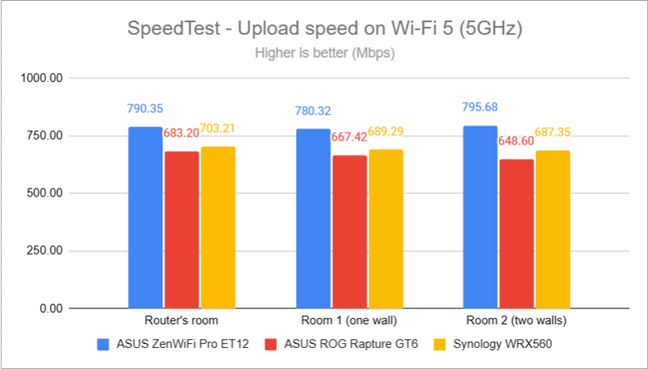
 SpeedTest - The upload speed on Wi-Fi 5 (5 GHz)
I switched to Wi-Fi 6 and repeated the same measurements with SpeedTest. Again, ASUS ROG Rapture GT6 delivered higher download speeds everywhere in my apartment.
SpeedTest - The upload speed on Wi-Fi 5 (5 GHz)
I switched to Wi-Fi 6 and repeated the same measurements with SpeedTest. Again, ASUS ROG Rapture GT6 delivered higher download speeds everywhere in my apartment.
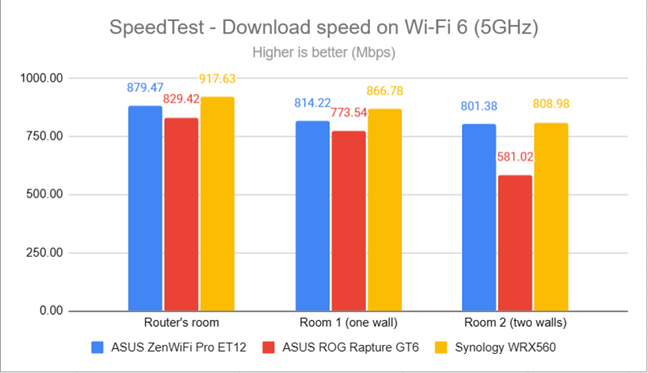
 SpeedTest - The download speed on Wi-Fi 6 (5 GHz)
The upload speed improved too, and I got very close to the maximum allowed by my internet connection: 800 Mbps.
SpeedTest - The download speed on Wi-Fi 6 (5 GHz)
The upload speed improved too, and I got very close to the maximum allowed by my internet connection: 800 Mbps.
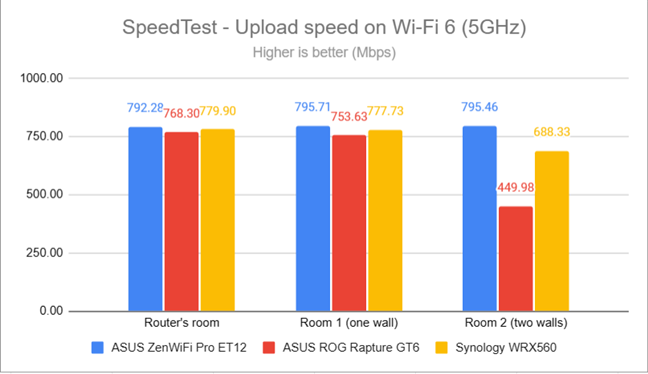
 SpeedTest - The upload speed on Wi-Fi 6 (5 GHz)
For the next set of measurements, I used the PassMark Performance test to transfer data between two computers connected to the network. Here, you see the average speed when transferring data only inside the network, not on the internet. When using the Wi-Fi 5 standard, ASUS ROG Rapture GT6 performed similarly to the Synology WRX560.
SpeedTest - The upload speed on Wi-Fi 6 (5 GHz)
For the next set of measurements, I used the PassMark Performance test to transfer data between two computers connected to the network. Here, you see the average speed when transferring data only inside the network, not on the internet. When using the Wi-Fi 5 standard, ASUS ROG Rapture GT6 performed similarly to the Synology WRX560.
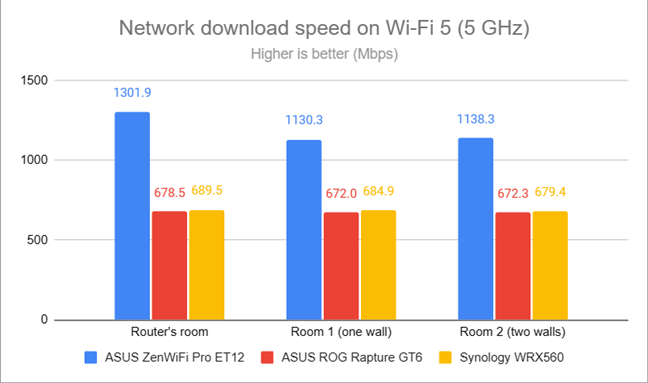 Network downloads on Wi-Fi 5 (5 GHz)
Uploads were fast too, when using Wi-Fi 5.
Network downloads on Wi-Fi 5 (5 GHz)
Uploads were fast too, when using Wi-Fi 5.
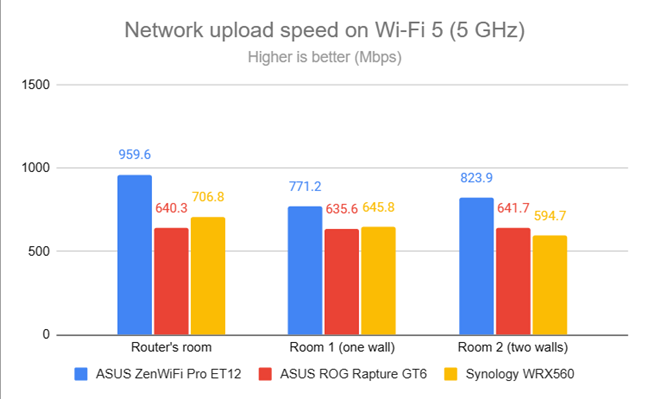
 Network uploads on Wi-Fi 5 (5 GHz)
When I switched to Wi-Fi 6, things improved a lot. Downloads were always close to the 1 Gbps mark.
Network uploads on Wi-Fi 5 (5 GHz)
When I switched to Wi-Fi 6, things improved a lot. Downloads were always close to the 1 Gbps mark.
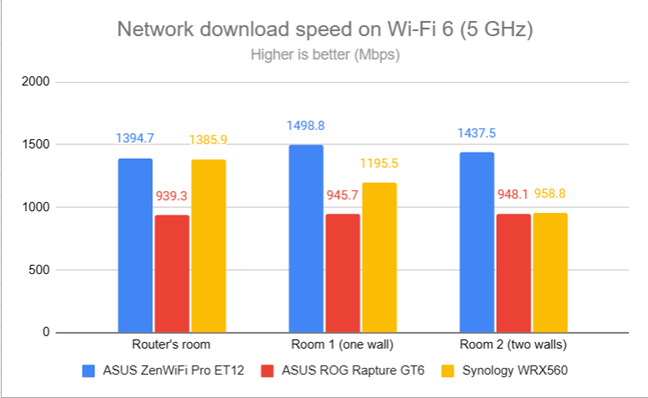
 Network downloads on Wi-Fi 6 (5 GHz)
The same was true for the upload speed.
Network downloads on Wi-Fi 6 (5 GHz)
The same was true for the upload speed.
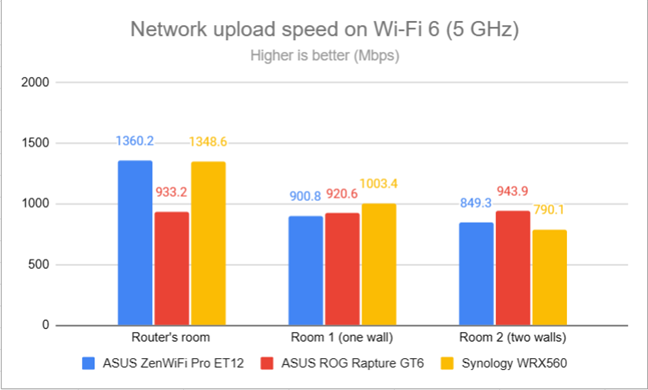 Network uploads on Wi-Fi 6 (5 GHz)
ASUS ROG Rapture GT6 performs well on the 5 GHz band when using both Wi-Fi 5 and Wi-Fi 6. However, I got the best performance when using the Wi-Fi 6 standard.
Network uploads on Wi-Fi 6 (5 GHz)
ASUS ROG Rapture GT6 performs well on the 5 GHz band when using both Wi-Fi 5 and Wi-Fi 6. However, I got the best performance when using the Wi-Fi 6 standard.
 SpeedTest on wired connections
ASUS ROG Rapture GT6 also has a USB 3.2 Gen 1 port which can come in handy. I plugged a fast SSD drive into it and made some data transfers to and from the SSD. The download and upload speeds you get from ASUS ROG Rapture GT6 are good but don’t compare to what you can get from other premium mesh Wi-Fi systems.
SpeedTest on wired connections
ASUS ROG Rapture GT6 also has a USB 3.2 Gen 1 port which can come in handy. I plugged a fast SSD drive into it and made some data transfers to and from the SSD. The download and upload speeds you get from ASUS ROG Rapture GT6 are good but don’t compare to what you can get from other premium mesh Wi-Fi systems.
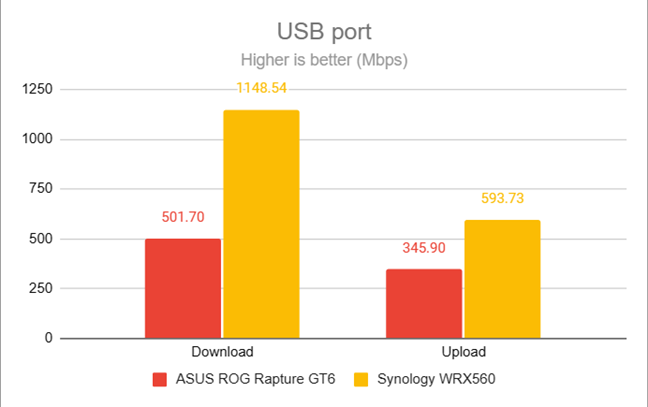
 The speed of the USB 3.2 Gen 1 port
ASUS ROG Rapture GT6 works great with 1 Gbps and 2.5 Gbps Ethernet connections. Also, its USB 3.2 Gen 1 port is fast and delivers satisfying performance. My only complaint is that I would have liked more 2.5 Gbps ports on the ASUS ROG Rapture GT6 instead of just one.
The speed of the USB 3.2 Gen 1 port
ASUS ROG Rapture GT6 works great with 1 Gbps and 2.5 Gbps Ethernet connections. Also, its USB 3.2 Gen 1 port is fast and delivers satisfying performance. My only complaint is that I would have liked more 2.5 Gbps ports on the ASUS ROG Rapture GT6 instead of just one.
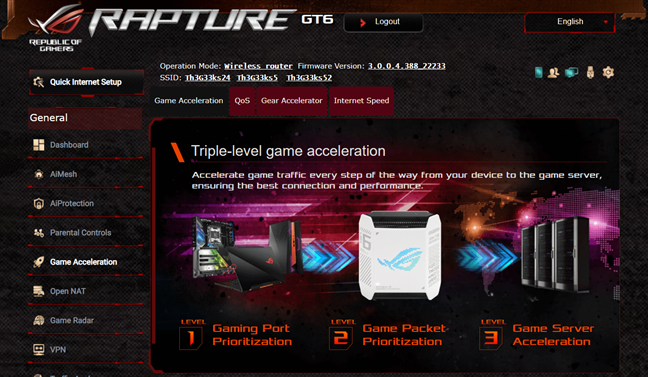
 Game Acceleration tools for gamers
You also get useful security features like:
Game Acceleration tools for gamers
You also get useful security features like:
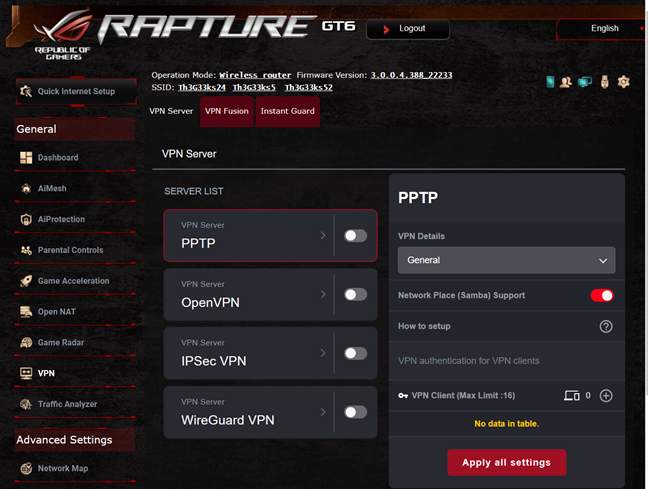
 The VPN settings are easy to configure
ASUS ROG Rapture GT6 also includes:
The VPN settings are easy to configure
ASUS ROG Rapture GT6 also includes:
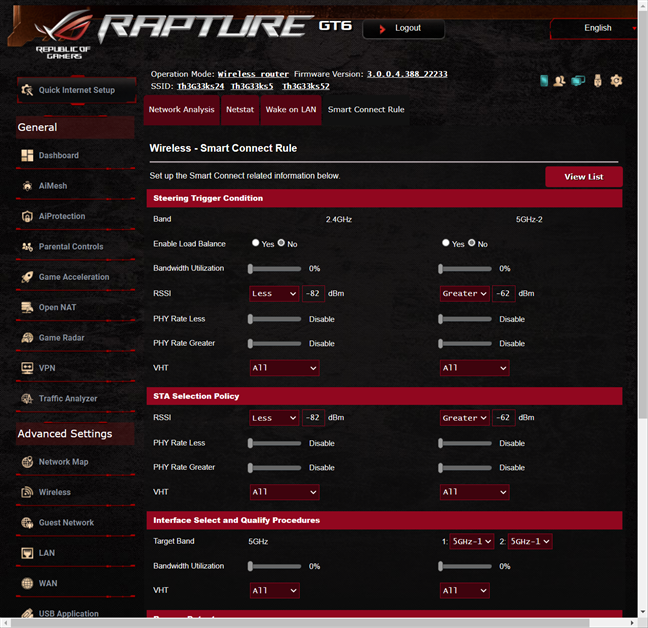
 Setting up ASUS Smart Connect
Just like the ROG routers, the GT6 mesh system includes something useful to everyone, from gamers to small businesses, families with kids, and technical users.
Setting up ASUS Smart Connect
Just like the ROG routers, the GT6 mesh system includes something useful to everyone, from gamers to small businesses, families with kids, and technical users.
ASUS ROG Rapture GT6: Who is it good for?
This gaming mesh Wi-Fi system is a suitable choice for:- Fans of the Republic of Gamers brand
- Users who own 2.5 Gbps internet subscriptions
- Gamers who often play online games
- Knowledgeable users who want many advanced features (VPN, Dual-WAN, etc.)
- Users who wish for a secure network with excellent antivirus and firewall protection
- Parents who need efficient parental controls
Pros and cons
Here are the things I like about ASUS ROG Rapture GT6:
- Beautiful design, aimed at Republic of Gamers brand fans
- Excellent build quality and cooling
- Can take advantage of 2.5 Gbps internet connections
- It includes a USB 3.2 Gen 1 port
- Good performance when using Wi-Fi 6 on the 5 GHz band
- Tons of features for gamers and advanced users
- Top-notch security tools and parental controls
- In the initial firmware, the wireless backhaul experiences stability issues
- Performance on the 2.4 GHz band could be better
- It would have been great to have two 2.5 Gbps ports, not just one
Verdict
The ASUS ROG Rapture GT6 is the first mesh Wi-Fi system for gamers, and it packs plenty of gaming-specific tools and features. As always with ASUS products, security, parental controls, VPN, and Dual-WAN capabilities are also built-in, making this product a good fit for many audiences. Therefore, if you like what it offers and have a fast 1 Gbps or 2.5 Gbps internet connection, you want to place the ASUS ROG Rapture GT6 in your cart. However, for a fully positive experience, do wait until a new firmware version is released, fixing the backhaul stability issues in the initial firmware release. Here’s the support page where you can check the latest updates.Unboxing the ASUS ROG Rapture GT6
ASUS ROG Rapture GT6 is sold in black and white variants, in packages of two units. We received for testing the white model, which comes in a large cardboard box, as shown in the picture below. On the top cover, you see a picture of the units that make up this mesh Wi-Fi system, the product name, and a list of its most important features.- The two ROG Rapture GT6 units
- Their power adapters
- A CAT5e network cable
- The quick setup guide
- Details about the warranty
- The troubleshooting guide mentioned earlier
- Safety information
Hardware specifications and design
I like the design of the ASUS ROG Rapture GT6, which draws inspiration from the Republic of Gamers brand aesthetic and features distinctive hexagonal patterns. On each unit, you see the ROG logo, the “For Those Who Dare” tagline, and “WiFi 6 Gaming Mesh Router” boldly printed. This system is sold both in black and white versions. I received the white one, which looks good, but I consider the black version even more appealing.- A 2.4 GHz band with a maximum theoretical bandwidth of 574 Mbps
- Two 5 GHz bands, each with a maximum theoretical bandwidth of 4804 Mbps
Setting up and using the ASUS ROG Rapture GT6
When you buy the ASUS ROG Rapture GT6 two-units kit, one is preconfigured to be the main station, and the second will automatically connect to it. To get things right, look on their back. One of them will have a sticker saying: “Hi! I’m the Main Unit, start with me.” Follow the recommendation, and set it up from the ASUS Router app on your smartphone or tablet or using your web browser on a laptop or computer connected to the network broadcast by the main unit.- Enter the username and password for connecting the mesh to the internet (if your connection requires one)
- Create your Wi-Fi network and provide the network names and passwords for all bands: one 2.4 GHz band and two 5 GHz bands. By default, ASUS SmartConnect is enabled, but you can turn it off.
- Set the admin username and password for your mesh Wi-Fi system. I highly recommend you choose a different password than the one used for the Wi-Fi network(s).
- Last, your settings are applied, and network optimization begins. It shouldn’t take more than a minute.
Wireless network performance
In the apartment I live in, I set up the two ASUS ROG Rapture GT6 stations according to the diagram below. I placed the second station in Room 1 to provide better Wi-Fi in Room 2, where most routers struggle.- I recorded the maximum speeds when no walls absorb the wireless signal in the room where the main station is.
- Room 1 - is separated by one wall from the main station.
- Room 2 - is separated from the main unit by two walls absorbing the wireless signal. Also, the wall between Room 1 and Room 2 is twice as thick as the one between the router’s room and Room 1. As a result, Room 2 can be a difficult challenge for many routers but shouldn’t be a problem for a mesh Wi-Fi system.
How the ASUS ROG Rapture GT6 performs on the 2.4 GHz band
I first measured the signal strength using NetSpot on the Wi-Fi 4 (802.11n) standard. ASUS ROG Rapture GT6 offered a powerful wireless signal in the rooms closest to the main station.How the ASUS ROG Rapture GT6 performs on the 5 GHz band
I moved on to the 5 GHz band and repeated the same measurements. I started with the Wi-Fi 5 standard and fired up NetSpot to analyze the signal strength. ASUS ROG Rapture GT6 delivered reasonable results everywhere in my apartment.Wired network performance & USB port
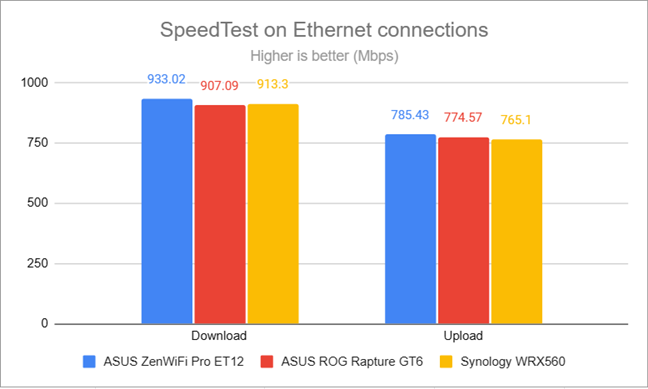
In this section, I evaluate the performance of Ethernet network connections. My internet connection offers a maximum of 1 Gbps for the download speed and 800 Mbps for uploads. As expected, SpeedTest measured the ASUS ROG Rapture GT6 reaching speeds very close to my internet connection’s maximum potential.Extra features
The firmware on the ASUS ROG Rapture GT6 includes tons of features. First, you get the Aura RGB lighting for gamers, which can be set to use the following effects: Static, Breathing, Wave, Marquee, Gradient, Evolution, and Rainbow. Next, you also get the following tools for gaming:- Open NAT - allows you to create port forwarding rules for popular online games.
- Game Radar - check the ping reply for gaming servers worldwide for a predefined list of games that includes popular titles like DOTA 2, League of Legends, Hearthstone, and World of Tanks.
- Game Acceleration - a collection of tools for gamers that includes:
- Game Devices - a dedicated gaming port on the back of the router. Anything you plug into it gets prioritized over other devices on the network.
- ROG First - automatically detects Republic of Gamers devices in your network and prioritizes them over others.
- Game Boost - an adaptive Quality of Service feature that automatically prioritizes online gaming traffic.
- WTFast - a VPN service that is designed for online gaming and tries to optimize network performance for your favorite game servers. You get a free trial with your router.
- AiProtection - cloud-based security that protects your network from attacks, malicious sites, infected devices, and poor router settings. Here’s a step-by-step tutorial about this feature: ASUS AiProtection: On or Off? Enhance your router’s security!
- Parental Controls - cloud-based parental controls developed by ASUS and Trend Micro. Learn how they work from this article: 7 ways in which ASUS Parental Controls protect your children.
- VPN - is a major focus area, with three different services:
- VPN Server - the ROG Rapture GT6 can be set to work as a VPN server for your network using the PPTP, OpenVPN, IPSec, and WireGuard VPN protocols. This feature is handy for knowledgeable users, gamers, and small businesses.
- Instant Guard - a mobile app that helps smartphone users navigate the internet securely by establishing a VPN connection to their home or business network. The app is handy when using free public Wi-Fi networks. Here’s how to configure and use Instant Guard on ASUS Wi-Fi routers.
- VPN Fusion - connect to multiple VPN servers simultaneously and assign your client devices to connect to different VPN tunnels.
- AiMesh - extend your Wi-Fi coverage using other ASUS routers and create your homebrewed mesh Wi-Fi system.
- Guest Network - you can enable three wireless guest networks with individual security and access settings on each band. You can have a total of nine guest networks.
- Traffic Analyzer - visual traffic statistics that show how your network is used and by which devices. Useful when you’re managing a network with dozens of connected devices.
- DDNS - allows you to connect to the router from the internet, even if your internet provider assigns you a dynamic public IP address. You can use a long list of services (Google, DYNDNS, NO-IP, DNSOMATIC), including a free one offered by ASUS.
- Dual WAN - you can use two internet connections simultaneously, one of which can be at 2.5 Gbps. The router works both in Fail Over or Load Balance modes.
- USB Applications - set up the router to use external hard drives or printers through its USB ports. There’s also support for Apple’s Time Machine functionality from macOS.
- AiCloud 2.0 - gives you the tools to create your cloud storage service using a hard drive connected to the router.
- Amazon Alexa & IFTTT - you can say things like “Alexa, ask ASUS ROUTER to upgrade the firmware” to perform different tasks. You can also integrate your router with the IFTTT platform and create all kinds of automation for your home.
- Network Tools - for analyzing the network and identifying what’s wrong. They are helpful when you need to troubleshoot problems. This is also the place where you get to configure ASUS Smart Connect.
Discussion (0)
Comments are closed.