



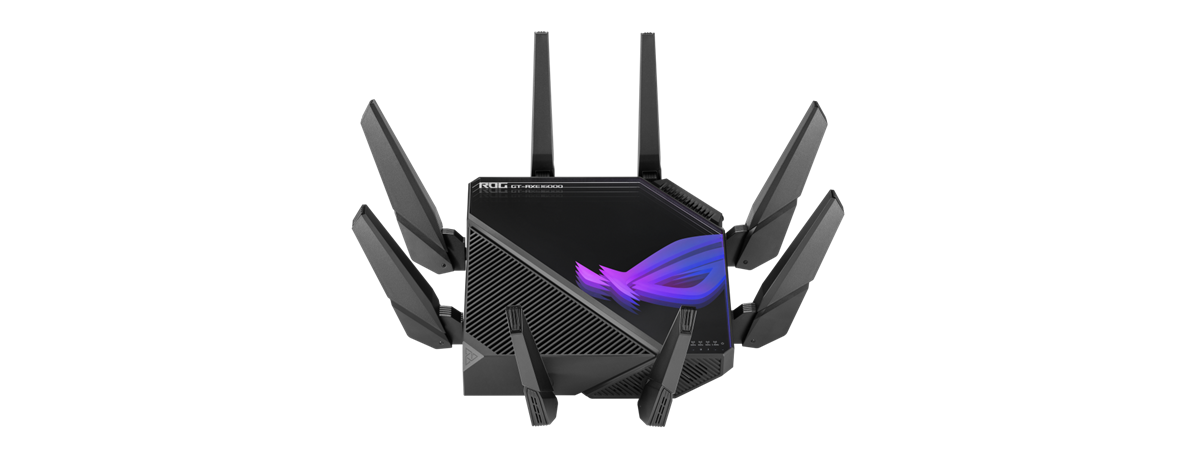
ASUS ROG Rapture GT-AXE16000 is the world’s first quad-band Wi-Fi 6E router, and it’s one of the largest, heaviest, and most expensive routers I’ve tested. I was impressed by its hardware specifications before I received it, and after two weeks of testing it, I’m still impressed. If you’re curious to learn what ASUS ROG Rapture GT-AXE16000 offers and why I found it outstanding, read my review:
![Verdict]()

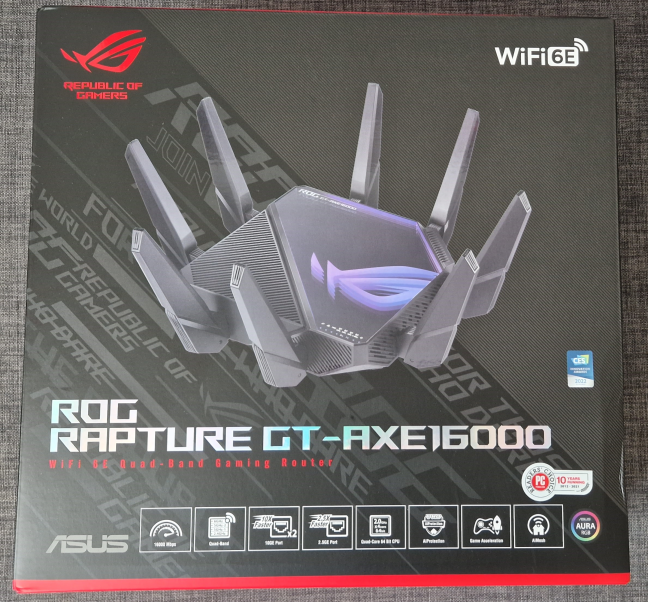
 ASUS ROG Rapture GT-AXE16000 comes in a massive box
On the sides and on the back of the box, you find further information about this product, its hardware and software features. If you take the time to read everything, you’ll have a pretty good idea about what this router has to offer. Opening the box immediately reveals the router, and after you take everything out, you have the following items: the ASUS ROG Rapture GT-AXE16000, its power adapter, a CAT.5e network cable, the quick setup guide, warranty information, and a troubleshooting guide.
ASUS ROG Rapture GT-AXE16000 comes in a massive box
On the sides and on the back of the box, you find further information about this product, its hardware and software features. If you take the time to read everything, you’ll have a pretty good idea about what this router has to offer. Opening the box immediately reveals the router, and after you take everything out, you have the following items: the ASUS ROG Rapture GT-AXE16000, its power adapter, a CAT.5e network cable, the quick setup guide, warranty information, and a troubleshooting guide.
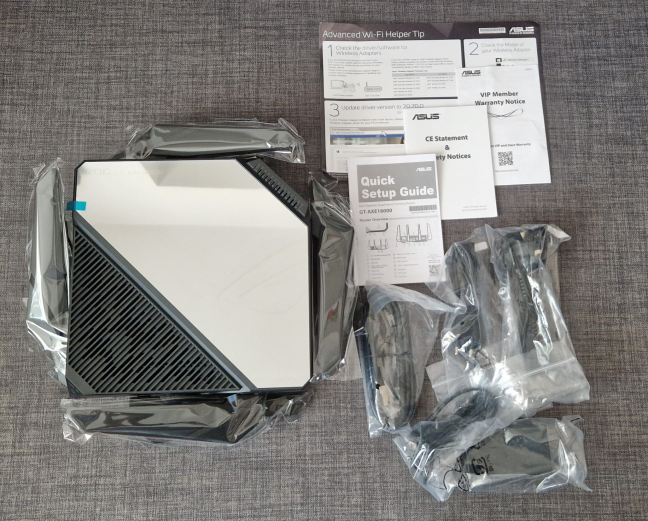
 Here's everything you find inside the box
As this is a very powerful router, it requires a large power adapter the size of those used for laptops. One neat aspect is that the European version of the router bundles two power plugs: the standard EU version and the UK version. Therefore, even if you buy this router from another European country, it will surely work with your country’s power plugs.
Here's everything you find inside the box
As this is a very powerful router, it requires a large power adapter the size of those used for laptops. One neat aspect is that the European version of the router bundles two power plugs: the standard EU version and the UK version. Therefore, even if you buy this router from another European country, it will surely work with your country’s power plugs.
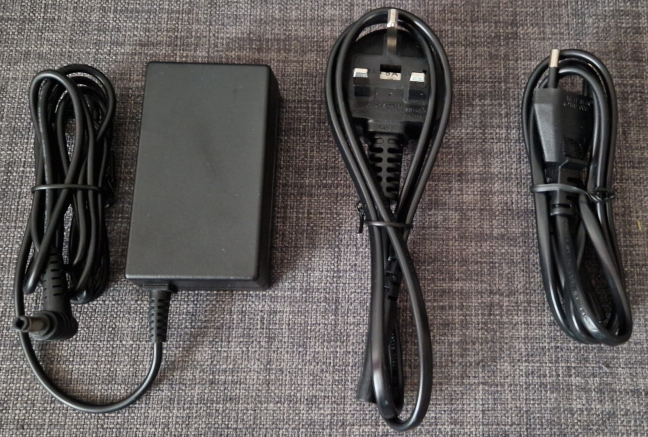
 The EU version comes with two power plugs
The unboxing experience of the ASUS ROG Rapture GT-AXE16000 is both pleasant and straightforward. You definitely get the impression that you just bought a premium router.
The EU version comes with two power plugs
The unboxing experience of the ASUS ROG Rapture GT-AXE16000 is both pleasant and straightforward. You definitely get the impression that you just bought a premium router.
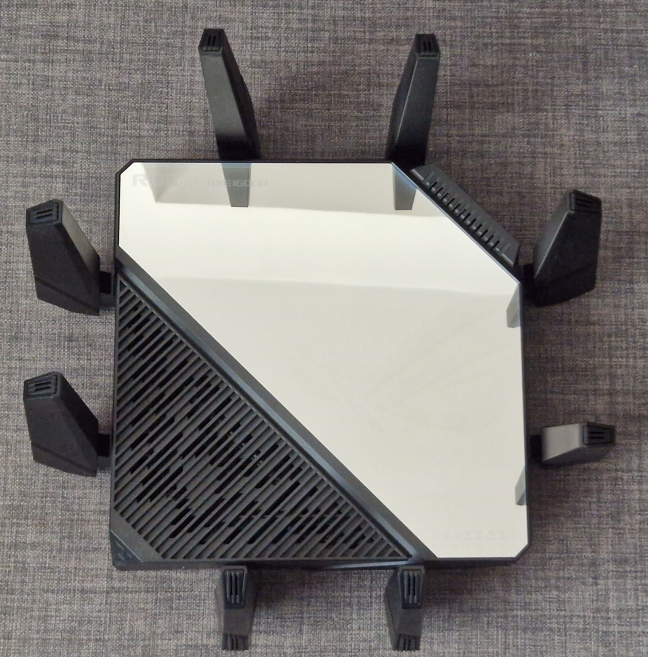
 Do you want to look at yourself in the mirror/router?
You notice these design elements only after starting the router, when the glass lights up to display the Republic of Gamers logo and the LEDs. Unfortunately, the product name is not lit up, so you barely see it even when the router is turned on.
Do you want to look at yourself in the mirror/router?
You notice these design elements only after starting the router, when the glass lights up to display the Republic of Gamers logo and the LEDs. Unfortunately, the product name is not lit up, so you barely see it even when the router is turned on.
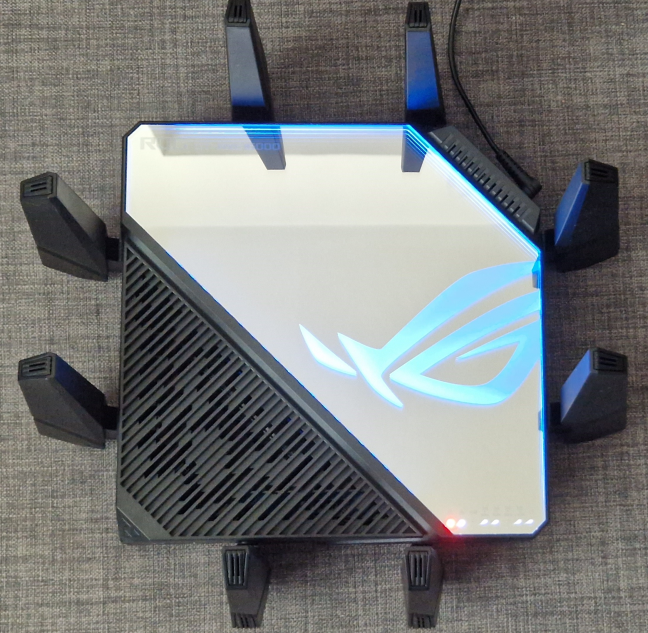
 The RGB lighting captures your attention as soon as you start it
If you look on all the sides of the ASUS ROG Rapture GT-AXE16000, you’ll see that there are ventilation grids everywhere. That’s because inside this router resides some incredibly powerful hardware: a quad-core Broadcom BCM4912 chip running at 2 GHz, 2 GB of DDR4 RAM (yes, you read that right), and 256 MB of storage for the firmware. All this hardware emits the Wi-Fi signal on four bands:
The RGB lighting captures your attention as soon as you start it
If you look on all the sides of the ASUS ROG Rapture GT-AXE16000, you’ll see that there are ventilation grids everywhere. That’s because inside this router resides some incredibly powerful hardware: a quad-core Broadcom BCM4912 chip running at 2 GHz, 2 GB of DDR4 RAM (yes, you read that right), and 256 MB of storage for the firmware. All this hardware emits the Wi-Fi signal on four bands:
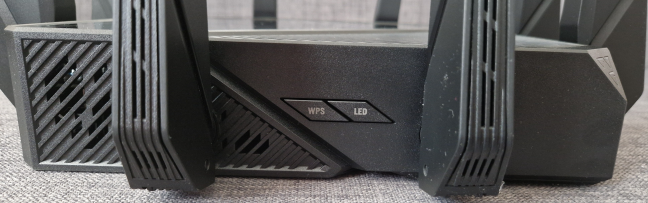
 The WPS and LED buttons
If you rotate the router, you also see the ports available: one 2.5 Gigabit WAN port colored in blue, two 10 Gigabit ports that can be used for WAN and LAN connections, and four 1 Gbps LAN ports. Near them, there’s also the Reset jack.
The WPS and LED buttons
If you rotate the router, you also see the ports available: one 2.5 Gigabit WAN port colored in blue, two 10 Gigabit ports that can be used for WAN and LAN connections, and four 1 Gbps LAN ports. Near them, there’s also the Reset jack.
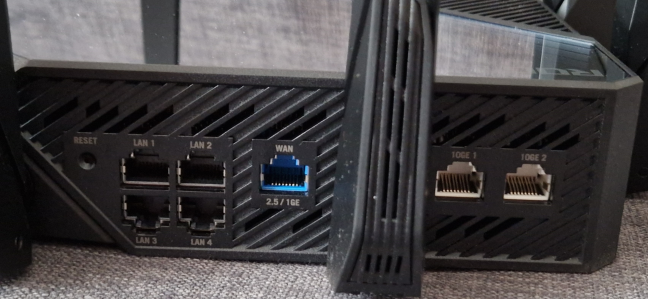
 The ports on the back of the ASUS ROG Rapture GT-AXE16000
Rotate the router a bit more; you’ll find two USB ports: one USB 3.2 Gen 1 port and one USB 2.0 port. Considering how powerful and expensive this router is, I would have preferred two USB 3.2 ports. Near them, there’s the Power button and the power jack.
The ports on the back of the ASUS ROG Rapture GT-AXE16000
Rotate the router a bit more; you’ll find two USB ports: one USB 3.2 Gen 1 port and one USB 2.0 port. Considering how powerful and expensive this router is, I would have preferred two USB 3.2 ports. Near them, there’s the Power button and the power jack.
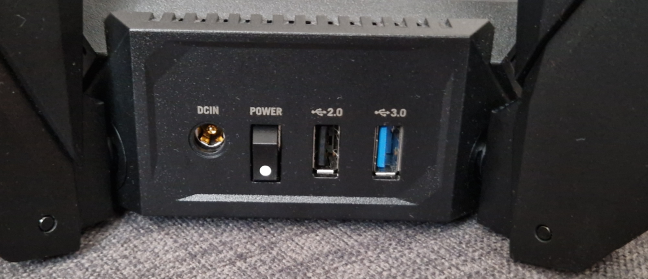
 You get two USB ports: USB 3.2 Gen 1 and USB 2.0
On the bottom, there are even more ventilation grids, a sticker with details about the router you bought, and a hole for wall mounting. Unfortunately, this router is very heavy, weighing 2.425 kg or 5.346 lbs, and one hole seems too little for safely mounting it on walls. I recommend placing this router on flat surfaces in your home or office.
You get two USB ports: USB 3.2 Gen 1 and USB 2.0
On the bottom, there are even more ventilation grids, a sticker with details about the router you bought, and a hole for wall mounting. Unfortunately, this router is very heavy, weighing 2.425 kg or 5.346 lbs, and one hole seems too little for safely mounting it on walls. I recommend placing this router on flat surfaces in your home or office.
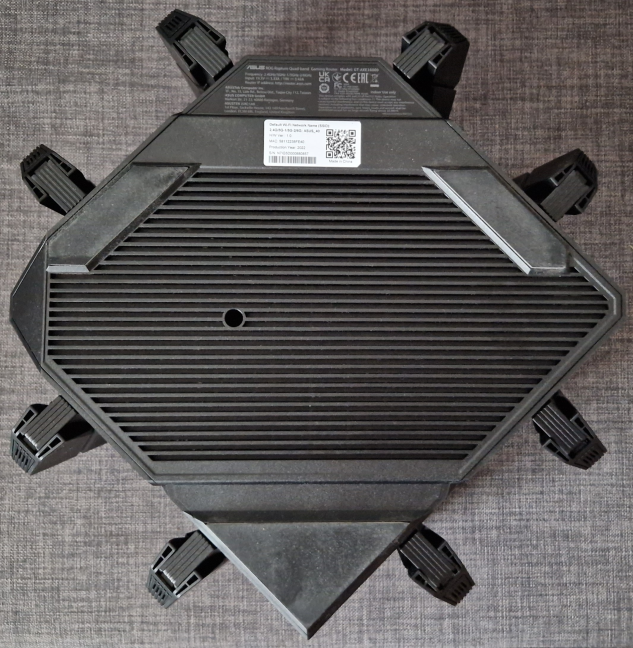
 The bottom side of the router
Spec-wise, this router includes everything you want, from Wi-Fi6E support to 160MHz-wide channels on Wi-Fi 6 and WPA3 encryption. If you want even more technical details, you can find all the official specifications on this page: ASUS ROG Rapture GT-AXE16000.
The bottom side of the router
Spec-wise, this router includes everything you want, from Wi-Fi6E support to 160MHz-wide channels on Wi-Fi 6 and WPA3 encryption. If you want even more technical details, you can find all the official specifications on this page: ASUS ROG Rapture GT-AXE16000.
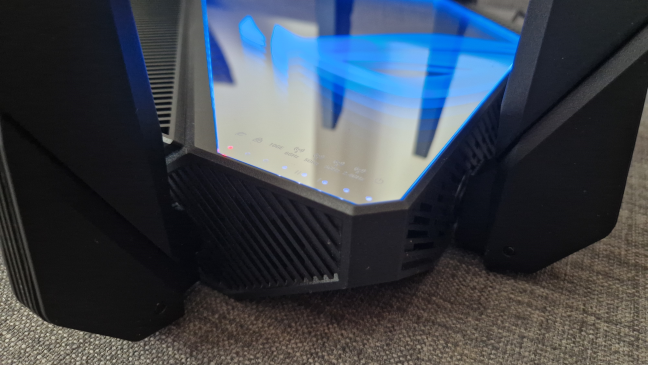
 Wait for ASUS ROG Rapture GT-AXE16000 to boot
Connect a mobile device or a laptop to the Wi-Fi emitted by the ASUS ROG Rapture GT-AXE16000. Then, either start the ASUS Router app on your smartphone or tablet, or fire up a web browser on your laptop and navigate to router.asus.com or the IP address of the router (it’s usually 192.168.50.1). For this review, I used the ASUS Router app for the initial setup. If you want to follow my lead, select your router and press Get Started.
Wait for ASUS ROG Rapture GT-AXE16000 to boot
Connect a mobile device or a laptop to the Wi-Fi emitted by the ASUS ROG Rapture GT-AXE16000. Then, either start the ASUS Router app on your smartphone or tablet, or fire up a web browser on your laptop and navigate to router.asus.com or the IP address of the router (it’s usually 192.168.50.1). For this review, I used the ASUS Router app for the initial setup. If you want to follow my lead, select your router and press Get Started.
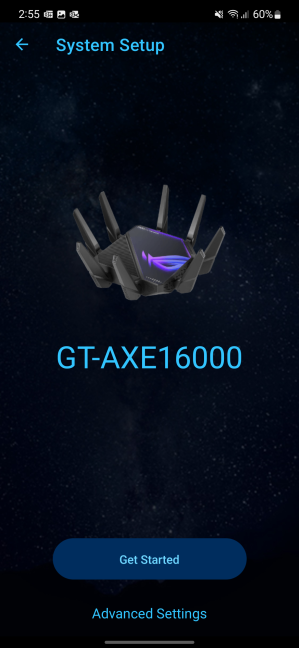
 Setting up the ASUS ROG Rapture GT-AXE16000
Then, you’re asked to enter the username and password for connecting the router to the internet (if your connection requires one). Once that is done, you create your Wi-Fi network and provide the network names and passwords for all four bands: one 2.4 GHz band, two 5 GHz bands, and one 6 GHz band. The ASUS Router app then asks you to set up the admin username and password for your router. I highly recommend you use a different password than the one you’re using for connecting to the Wi-Fi. Next, your settings are applied, and a network optimization process begins. It shouldn’t take more than a minute.
Setting up the ASUS ROG Rapture GT-AXE16000
Then, you’re asked to enter the username and password for connecting the router to the internet (if your connection requires one). Once that is done, you create your Wi-Fi network and provide the network names and passwords for all four bands: one 2.4 GHz band, two 5 GHz bands, and one 6 GHz band. The ASUS Router app then asks you to set up the admin username and password for your router. I highly recommend you use a different password than the one you’re using for connecting to the Wi-Fi. Next, your settings are applied, and a network optimization process begins. It shouldn’t take more than a minute.
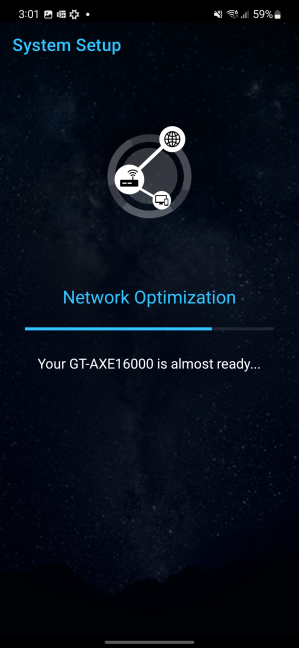 The Network Optimization process finds the best settings for your Wi-Fi
When done, you are shown a summary of your settings. After pressing Finish, you’re asked whether you want to Enable Remote Connection, meaning the option to remote control the ASUS ROG Rapture GT-AXE16000 from anywhere on the internet.
The Network Optimization process finds the best settings for your Wi-Fi
When done, you are shown a summary of your settings. After pressing Finish, you’re asked whether you want to Enable Remote Connection, meaning the option to remote control the ASUS ROG Rapture GT-AXE16000 from anywhere on the internet.
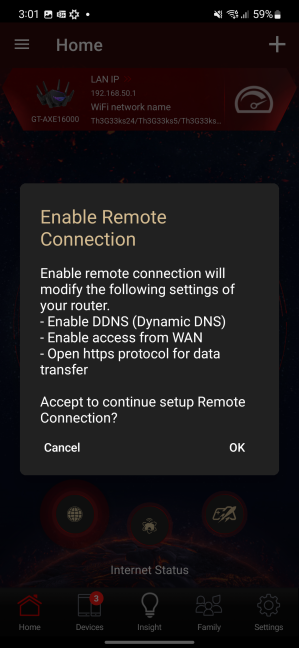 Do you want to remote control your router?
Make your choice, agree to the terms and conditions, and you can start using the app. One aspect that I appreciate about ASUS Router is that it immediately checks for firmware updates. If any are available, you are informed. I recommend that you install the most recent firmware to benefit from the latest security fixes and performance improvements.
Do you want to remote control your router?
Make your choice, agree to the terms and conditions, and you can start using the app. One aspect that I appreciate about ASUS Router is that it immediately checks for firmware updates. If any are available, you are informed. I recommend that you install the most recent firmware to benefit from the latest security fixes and performance improvements.
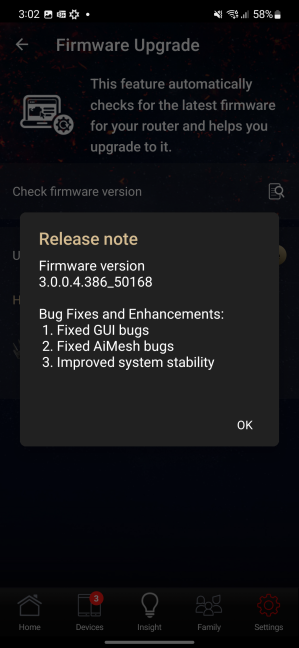 Firmware updates are welcomed
The ASUS Router app is friendly and easy to use and provides most of the tools and configuration options you need. You can also enable and configure some of this router’s gaming features.
Firmware updates are welcomed
The ASUS Router app is friendly and easy to use and provides most of the tools and configuration options you need. You can also enable and configure some of this router’s gaming features.
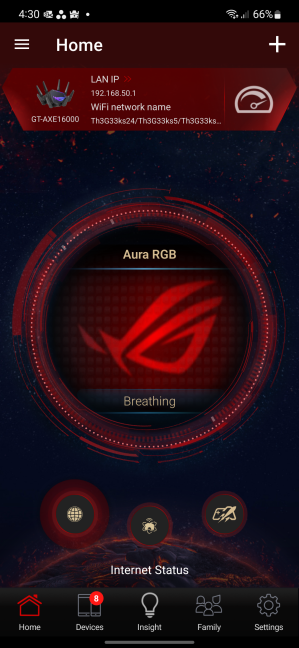 ASUS Router uses a ROG skin
However, if you want access to everything this router offers, you must access its web-based admin interface. It, too, has a Republic of Gamers skin, which promotes the gaming features of the ASUS ROG Rapture GT-AXE16000. Personally, I prefer the traditional skin used by ASUS for its non-gaming routers.
ASUS Router uses a ROG skin
However, if you want access to everything this router offers, you must access its web-based admin interface. It, too, has a Republic of Gamers skin, which promotes the gaming features of the ASUS ROG Rapture GT-AXE16000. Personally, I prefer the traditional skin used by ASUS for its non-gaming routers.
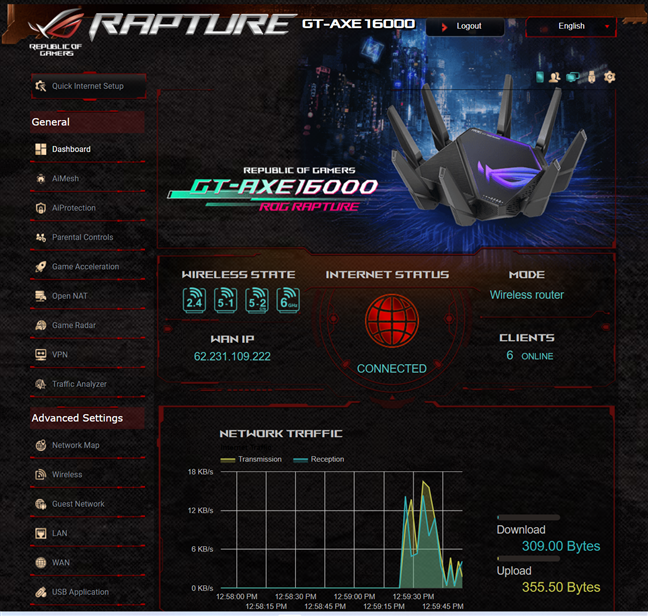
 The web-based admin interface
However, the way things are organized is the same, and the level of control you get is truly impressive. You can easily configure everything you want, from the VPN features, to how the Wi-Fi 6E signal is emitted.
The web-based admin interface
However, the way things are organized is the same, and the level of control you get is truly impressive. You can easily configure everything you want, from the VPN features, to how the Wi-Fi 6E signal is emitted.
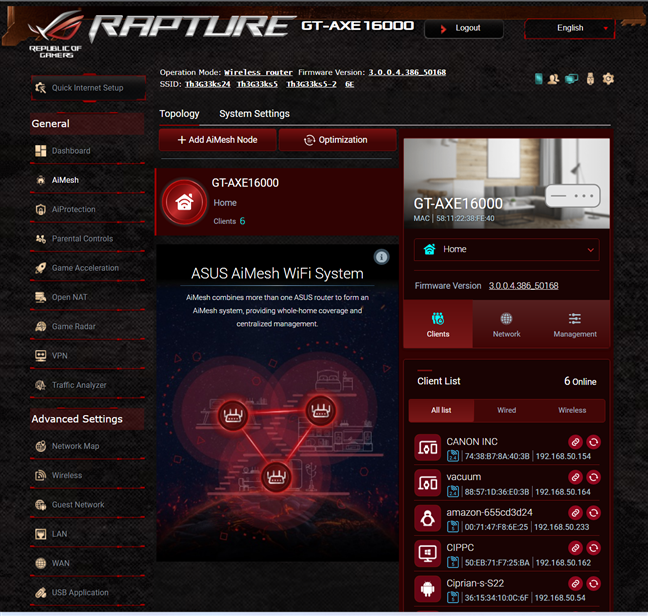 There are tons of features available
One aspect that we appreciate a lot is the firmware auto-update capability. I recommend you enable it and choose a late hour for it, when you’re likely to be asleep, to avoid being impacted while the router reboots to finalize the update.
There are tons of features available
One aspect that we appreciate a lot is the firmware auto-update capability. I recommend you enable it and choose a late hour for it, when you’re likely to be asleep, to avoid being impacted while the router reboots to finalize the update.
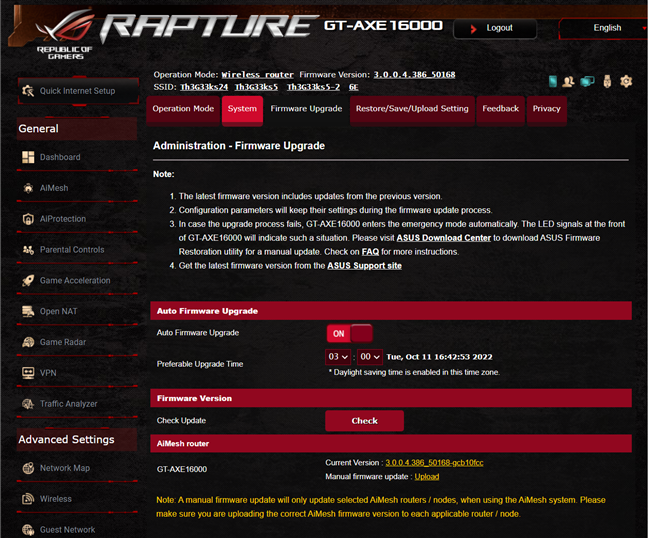
 You should enable the Auto Firmware Upgrade
The admin interface is available in 25 languages, and the help documentation is easily accessible with links to the manual at the bottom of the interface. Gamers should not hesitate to familiarize themselves with this router’s firmware, as they will find many features targeted at them. They’ll also appreciate the RGB lighting on the router, with some good-looking effects that can be personalized from the admin interface.
You should enable the Auto Firmware Upgrade
The admin interface is available in 25 languages, and the help documentation is easily accessible with links to the manual at the bottom of the interface. Gamers should not hesitate to familiarize themselves with this router’s firmware, as they will find many features targeted at them. They’ll also appreciate the RGB lighting on the router, with some good-looking effects that can be personalized from the admin interface.
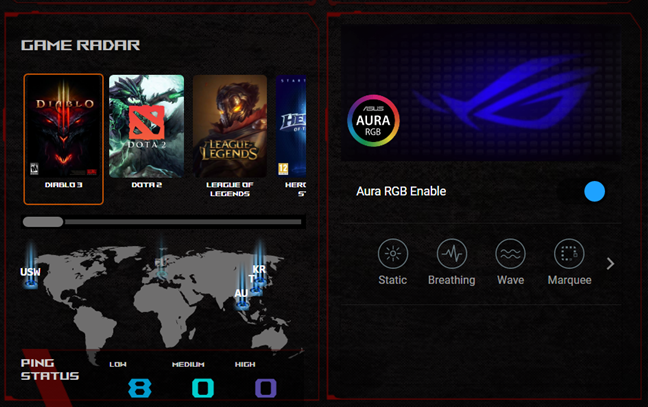
 Setting up the RGB lighting is easy
When using the Wi-Fi network, things were great on the 2.4 GHz and 5 GHz bands. All my devices connected without problems, and the speeds recorded were excellent. However, the 6 GHz band proved troublesome. Like in the early days of the Wi-Fi 6 standard, my laptop didn’t see the Wi-Fi 6E network initially, even though it was compatible. I had to update Windows 11 to the latest version, update the Wi-Fi network card drivers, and install the latest firmware on the router before my laptop could see this band and connect to it. You’ll probably have a similar experience because we live in the early days of the Wi-Fi 6E standard. Not all operating systems and devices offer great support for it. However, just like with Wi-Fi 6, a year from now, Wi-Fi 6E compatibility issues should be resolved, and the whole experience will become much smoother.
Setting up the RGB lighting is easy
When using the Wi-Fi network, things were great on the 2.4 GHz and 5 GHz bands. All my devices connected without problems, and the speeds recorded were excellent. However, the 6 GHz band proved troublesome. Like in the early days of the Wi-Fi 6 standard, my laptop didn’t see the Wi-Fi 6E network initially, even though it was compatible. I had to update Windows 11 to the latest version, update the Wi-Fi network card drivers, and install the latest firmware on the router before my laptop could see this band and connect to it. You’ll probably have a similar experience because we live in the early days of the Wi-Fi 6E standard. Not all operating systems and devices offer great support for it. However, just like with Wi-Fi 6, a year from now, Wi-Fi 6E compatibility issues should be resolved, and the whole experience will become much smoother.
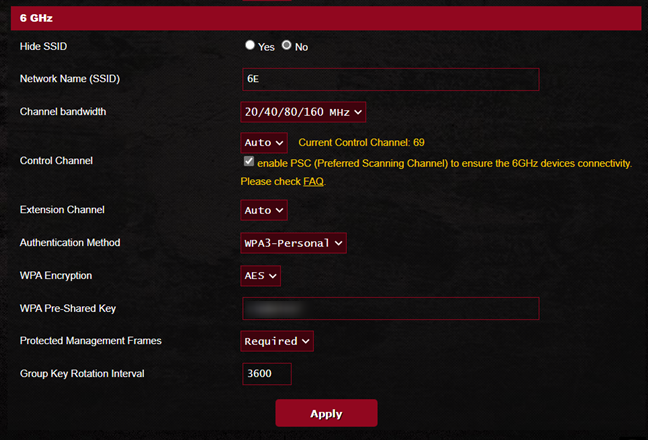
 The basic settings for the 6 GHz band
When reviewing a router, I also look at the variability of wireless transfers. I was pleased with my measurements when using the 5 GHz and 6 GHz bands. However, on the 2.4 GHz band, I noticed that wireless transfers suffered relatively high variability, with important differences between the minimum and maximum speeds achieved. Here’s how a network transfer occurred in a room separated by one wall from the router when using the Wi-Fi 4 (802.11n) standard.
The basic settings for the 6 GHz band
When reviewing a router, I also look at the variability of wireless transfers. I was pleased with my measurements when using the 5 GHz and 6 GHz bands. However, on the 2.4 GHz band, I noticed that wireless transfers suffered relatively high variability, with important differences between the minimum and maximum speeds achieved. Here’s how a network transfer occurred in a room separated by one wall from the router when using the Wi-Fi 4 (802.11n) standard.
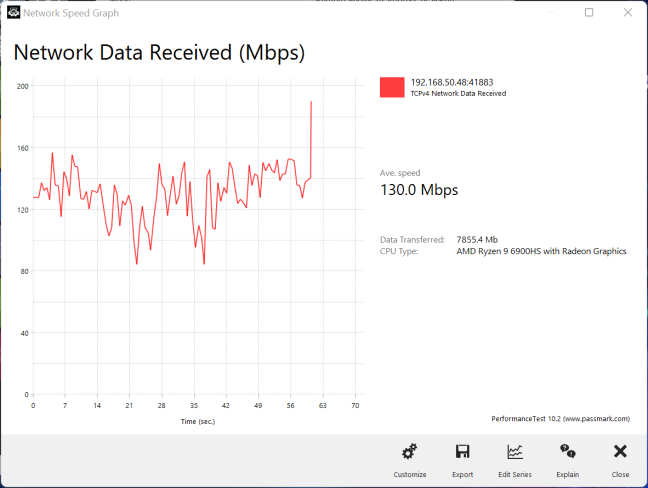
 Transferring data on the 2.4 GHz band via Wi-Fi 4
When switching to Wi-Fi 6, on the same 2.4 GHz band, the swings between the minimum and maximum transfer rate increased, even though the average transfer speed was excellent. This is an aspect that may deserve some improvement in future firmware updates.
Transferring data on the 2.4 GHz band via Wi-Fi 4
When switching to Wi-Fi 6, on the same 2.4 GHz band, the swings between the minimum and maximum transfer rate increased, even though the average transfer speed was excellent. This is an aspect that may deserve some improvement in future firmware updates.
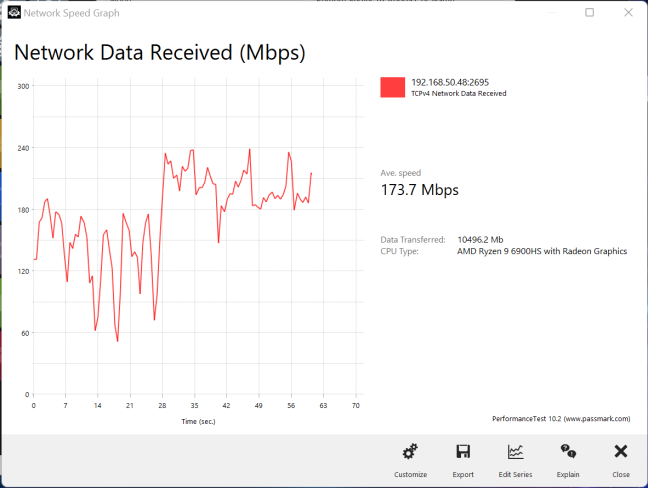 Transferring data on the 2.4 GHz band via Wi-Fi 6
Overall, I was very happy with my user experience when testing this router. If you want to know more about the real-world performance offered by the ASUS ROG Rapture GT-AXE16000, go to the next page of this review, where I present detailed measurements and comparisons with other premium routers.
Transferring data on the 2.4 GHz band via Wi-Fi 6
Overall, I was very happy with my user experience when testing this router. If you want to know more about the real-world performance offered by the ASUS ROG Rapture GT-AXE16000, go to the next page of this review, where I present detailed measurements and comparisons with other premium routers.
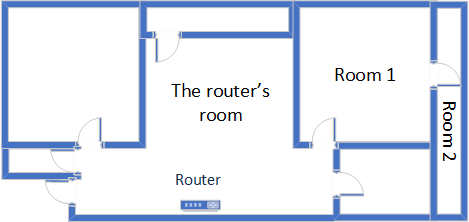
 The apartment in which I tested ASUS ROG Rapture GT-AXE16000
I evaluate the quality of the wireless network managed by ASUS ROG Rapture GT-AXE16000 through measurements made in three different places:
The apartment in which I tested ASUS ROG Rapture GT-AXE16000
I evaluate the quality of the wireless network managed by ASUS ROG Rapture GT-AXE16000 through measurements made in three different places:
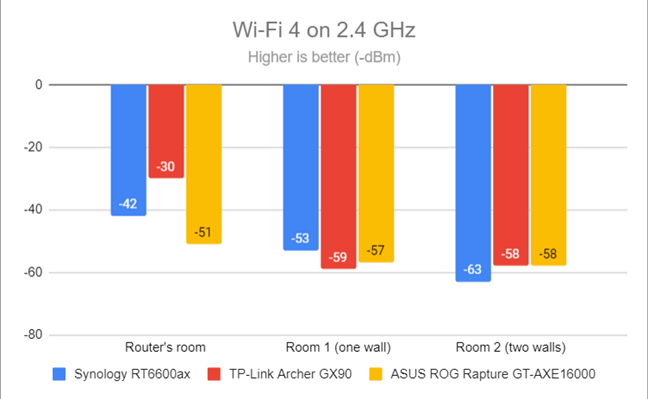
 Signal strength on Wi-Fi 4 (2.4 GHz band)
However, it decreased a bit when switching to the Wi-Fi 6 standard, on the same 2.4 GHz band.
Signal strength on Wi-Fi 4 (2.4 GHz band)
However, it decreased a bit when switching to the Wi-Fi 6 standard, on the same 2.4 GHz band.
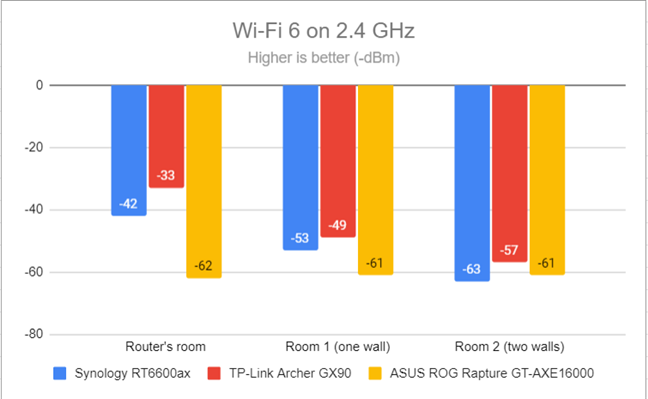 Signal strength on Wi-Fi 6 (2.4 GHz band)
Next, I started the SpeedTest app and used it to measure the maximum speed you get when transferring data to and from the internet on the 2.4 GHz band. When using the Wi-Fi 4 standard, ASUS ROG Rapture GT-AXE16000 delivered download speeds that were outperformed by TP-Link Archer GX90, a Wi-Fi 6 router that impressed me with its performance on the 2.4 GHz band.
Signal strength on Wi-Fi 6 (2.4 GHz band)
Next, I started the SpeedTest app and used it to measure the maximum speed you get when transferring data to and from the internet on the 2.4 GHz band. When using the Wi-Fi 4 standard, ASUS ROG Rapture GT-AXE16000 delivered download speeds that were outperformed by TP-Link Archer GX90, a Wi-Fi 6 router that impressed me with its performance on the 2.4 GHz band.
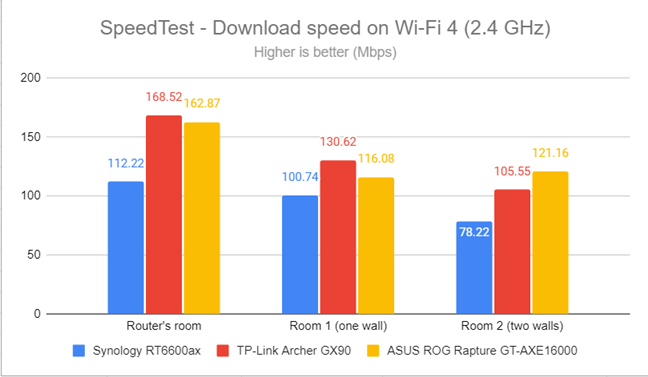
 SpeedTest - The download speed on Wi-Fi 4 (2.4 GHz)
When measuring the upload speed, ASUS ROG Rapture GT-AXE16000 was the clear winner everywhere in my apartment.
SpeedTest - The download speed on Wi-Fi 4 (2.4 GHz)
When measuring the upload speed, ASUS ROG Rapture GT-AXE16000 was the clear winner everywhere in my apartment.
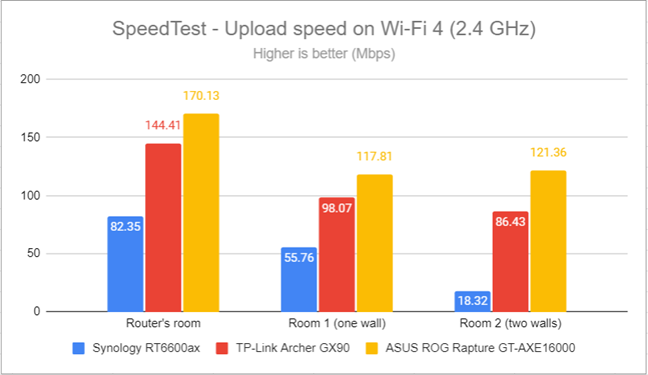
 SpeedTest - The upload speed on Wi-Fi 4 (2.4 GHz)
When switching to the Wi-Fi 6 standard on the 2.4 GHz band, ASUS ROG Rapture GT-AXE16000 demolished the competition, proving to be the fastest router everywhere.
SpeedTest - The upload speed on Wi-Fi 4 (2.4 GHz)
When switching to the Wi-Fi 6 standard on the 2.4 GHz band, ASUS ROG Rapture GT-AXE16000 demolished the competition, proving to be the fastest router everywhere.
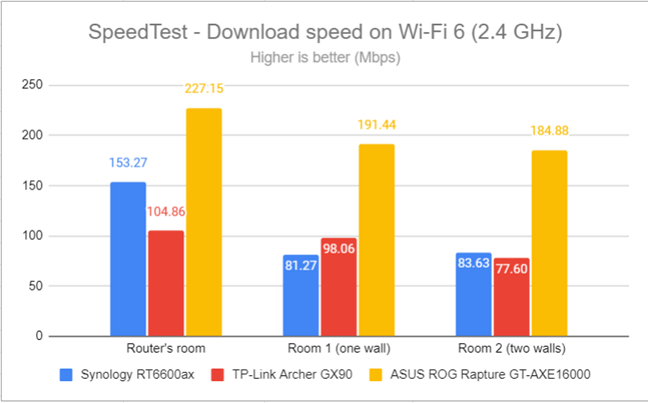
 SpeedTest - The download speed on Wi-Fi 6 (2.4 GHz)
I was pleased to see the same trend also when measuring the upload speeds with SpeedTest.
SpeedTest - The download speed on Wi-Fi 6 (2.4 GHz)
I was pleased to see the same trend also when measuring the upload speeds with SpeedTest.
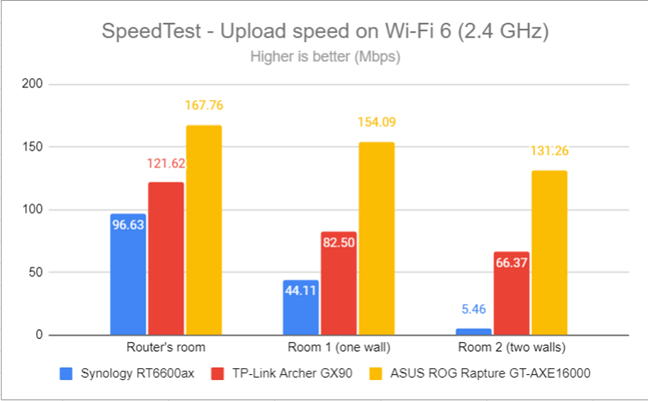
 SpeedTest - The upload speed on Wi-Fi 6 (2.4 GHz)
For the next set of measurements, I used the PassMark Performance test to transfer data between two computers connected to the network. I was on the 2.4 GHz band with the Wi-Fi 4 standard turned on. Downloads were fast in all rooms, demonstrating once more the power delivered by ASUS ROG Rapture GT-AXE16000.
SpeedTest - The upload speed on Wi-Fi 6 (2.4 GHz)
For the next set of measurements, I used the PassMark Performance test to transfer data between two computers connected to the network. I was on the 2.4 GHz band with the Wi-Fi 4 standard turned on. Downloads were fast in all rooms, demonstrating once more the power delivered by ASUS ROG Rapture GT-AXE16000.
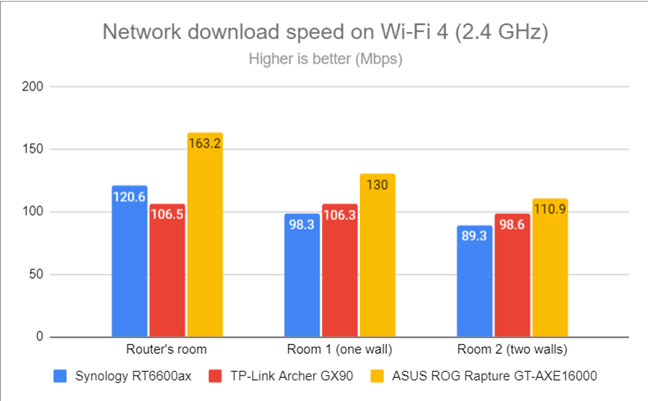 Network downloads on Wi-Fi 4 (2.4 GHz)
The upload speed measurements painted a similarly positive story.
Network downloads on Wi-Fi 4 (2.4 GHz)
The upload speed measurements painted a similarly positive story.
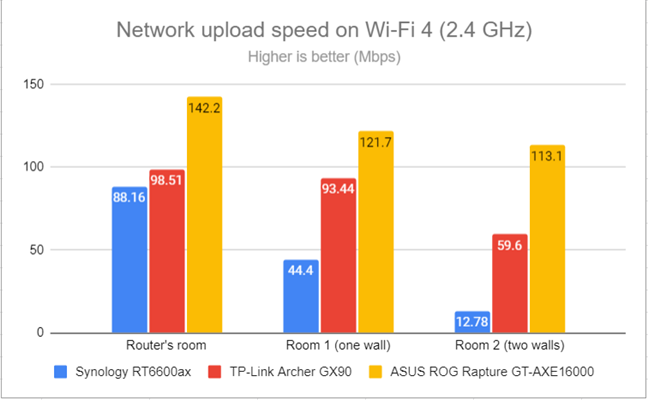
 Network uploads on Wi-Fi 4 (2.4 GHz)
When switching to the Wi-Fi 6 standard on the 2.4 GHz band, I measured even higher download speeds in all rooms.
Network uploads on Wi-Fi 4 (2.4 GHz)
When switching to the Wi-Fi 6 standard on the 2.4 GHz band, I measured even higher download speeds in all rooms.
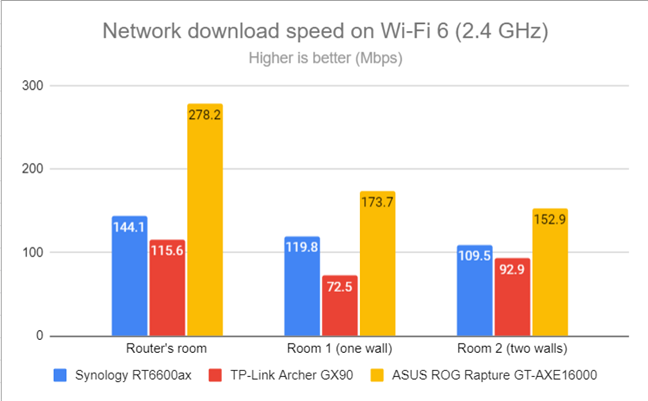 Network downloads on Wi-Fi 6 (2.4 GHz)
Uploads were satisfyingly fast in all rooms, with huge differences over the routers I’ve compared it to.
Network downloads on Wi-Fi 6 (2.4 GHz)
Uploads were satisfyingly fast in all rooms, with huge differences over the routers I’ve compared it to.
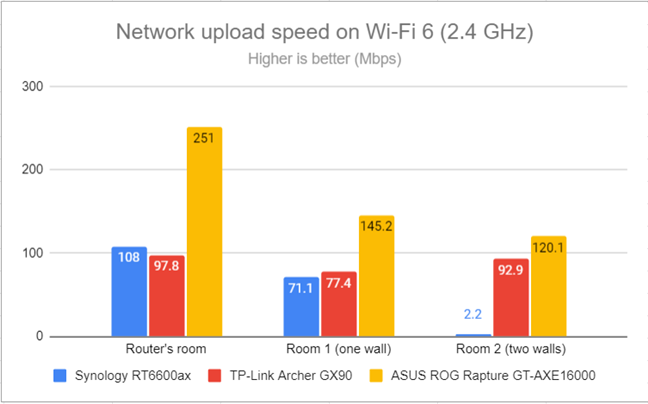
 Network uploads on Wi-Fi 6 (2.4 GHz)
My measurements have shown that the ASUS ROG Rapture GT-AXE16000 offers excellent coverage and performance on the 2.4 GHz band, both when using Wi-Fi 4 and Wi-Fi 6.
Network uploads on Wi-Fi 6 (2.4 GHz)
My measurements have shown that the ASUS ROG Rapture GT-AXE16000 offers excellent coverage and performance on the 2.4 GHz band, both when using Wi-Fi 4 and Wi-Fi 6.
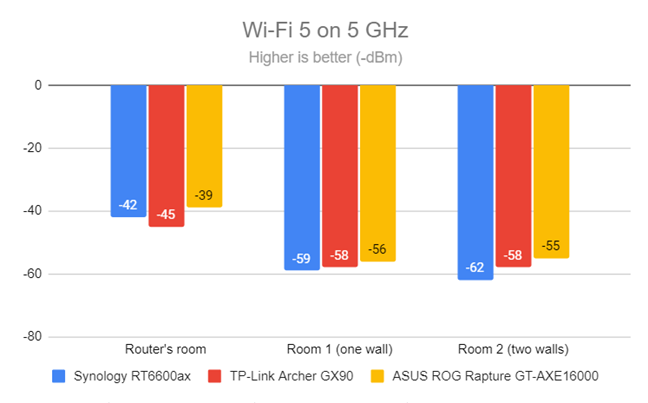 Signal strength on Wi-Fi 5 (5 GHz band)
The same was true when using the Wi-Fi 6 standard on the 5 GHz band.
Signal strength on Wi-Fi 5 (5 GHz band)
The same was true when using the Wi-Fi 6 standard on the 5 GHz band.
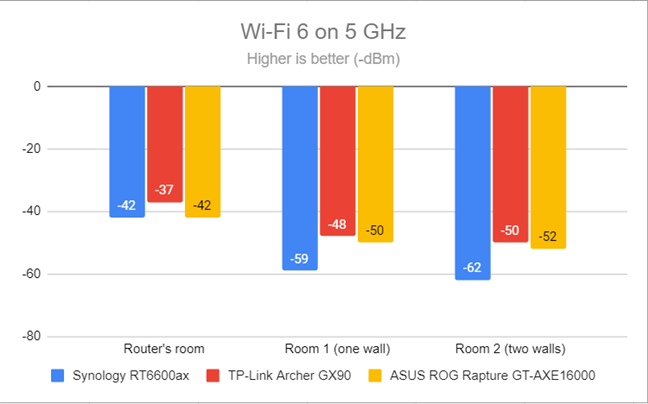 Signal strength on Wi-Fi 6 (5 GHz band)
Moving on to the SpeedTest app, on the 5 GHz band, the download speeds offered by ROG Rapture GT-AXE16000 were outperformed by Synology RT6600ax.
Signal strength on Wi-Fi 6 (5 GHz band)
Moving on to the SpeedTest app, on the 5 GHz band, the download speeds offered by ROG Rapture GT-AXE16000 were outperformed by Synology RT6600ax.
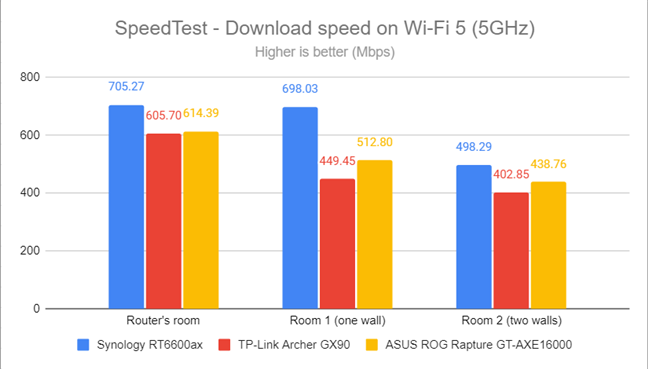
 SpeedTest - The download speed on Wi-Fi 5 (5 GHz)
When measuring the upload speed, the two routers were much closer together, with less meaningful differences.
SpeedTest - The download speed on Wi-Fi 5 (5 GHz)
When measuring the upload speed, the two routers were much closer together, with less meaningful differences.
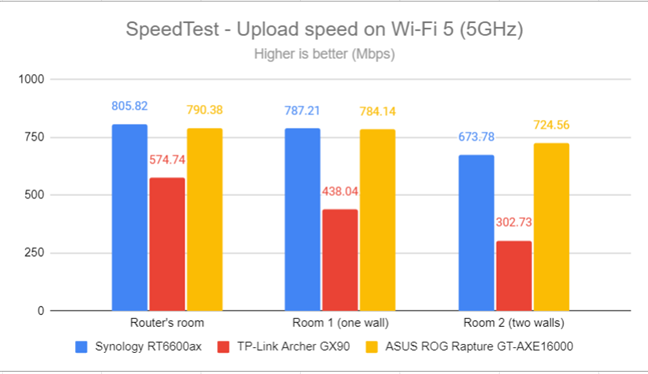
 SpeedTest - The upload speed on Wi-Fi 5 (5 GHz)
Moving on to the Wi-Fi 6 standard on the 5 GHz band: the situation changed, and ASUS ROG Rapture GT-AXE16000 was the fastest router almost everywhere in my apartment.
SpeedTest - The upload speed on Wi-Fi 5 (5 GHz)
Moving on to the Wi-Fi 6 standard on the 5 GHz band: the situation changed, and ASUS ROG Rapture GT-AXE16000 was the fastest router almost everywhere in my apartment.
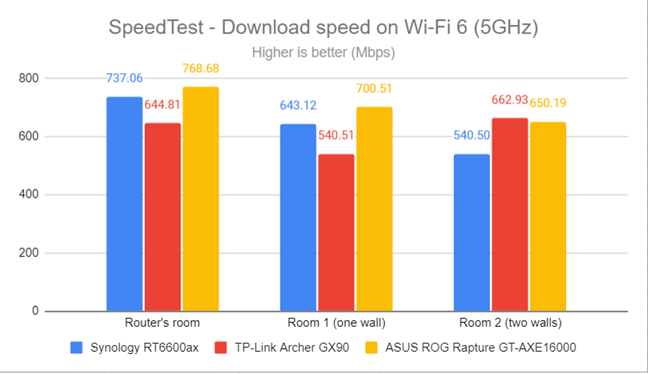 SpeedTest - The download speed on Wi-Fi 6 (5 GHz)
Upload speeds were super fast too, getting close to the maximum speed allowed by my internet provider.
SpeedTest - The download speed on Wi-Fi 6 (5 GHz)
Upload speeds were super fast too, getting close to the maximum speed allowed by my internet provider.
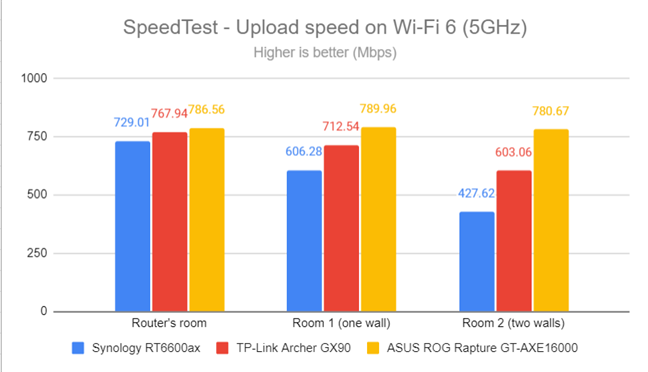
 SpeedTest - The upload speed on Wi-Fi 6 (5 GHz)
For the next set of measurements, I used the PassMark Performance test to transfer data between two computers connected to the network. In this test too, the download speeds offered by ASUS ROG Rapture GT-AXE16000 were outmatched by Synology RT6600ax.
SpeedTest - The upload speed on Wi-Fi 6 (5 GHz)
For the next set of measurements, I used the PassMark Performance test to transfer data between two computers connected to the network. In this test too, the download speeds offered by ASUS ROG Rapture GT-AXE16000 were outmatched by Synology RT6600ax.
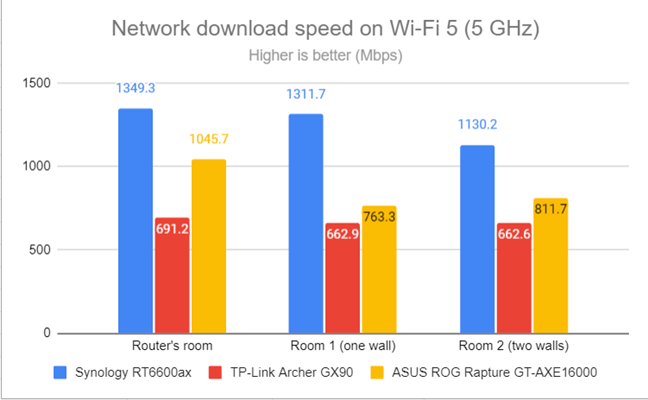 Network downloads on Wi-Fi 5 (5 GHz)
However, when measuring the upload speed, things were not as clear-cut.
Network downloads on Wi-Fi 5 (5 GHz)
However, when measuring the upload speed, things were not as clear-cut.
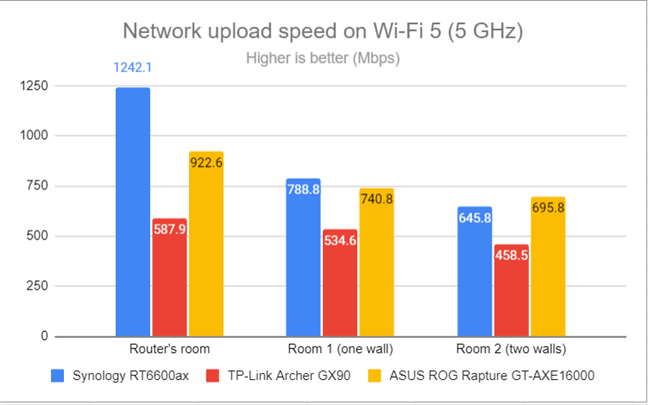
 Network uploads on Wi-Fi 5 (5 GHz)
I switched to the Wi-Fi 6 standard on the 5 GHz band and repeated the same measurements with the PassMark Performance test. ASUS ROG Rapture GT-AXE16000 delivered faster downloads and in some rooms, it was the fastest router I’ve ever used.
Network uploads on Wi-Fi 5 (5 GHz)
I switched to the Wi-Fi 6 standard on the 5 GHz band and repeated the same measurements with the PassMark Performance test. ASUS ROG Rapture GT-AXE16000 delivered faster downloads and in some rooms, it was the fastest router I’ve ever used.
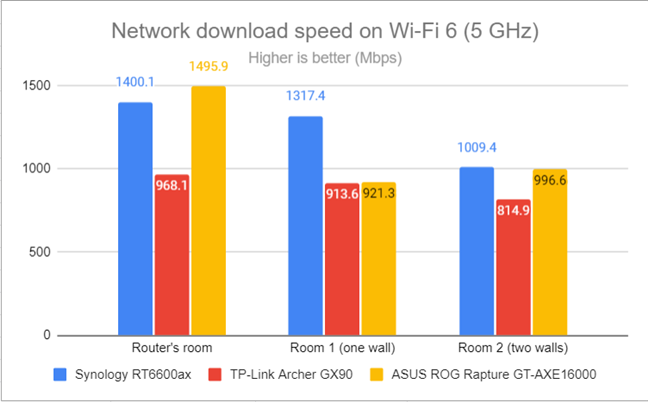
 Network downloads on Wi-Fi 6 (5 GHz)
Uploads were super fast too, and I was impressed with the results delivered by ASUS ROG Rapture GT-AXE16000 in the room furthest from the router.
Network downloads on Wi-Fi 6 (5 GHz)
Uploads were super fast too, and I was impressed with the results delivered by ASUS ROG Rapture GT-AXE16000 in the room furthest from the router.
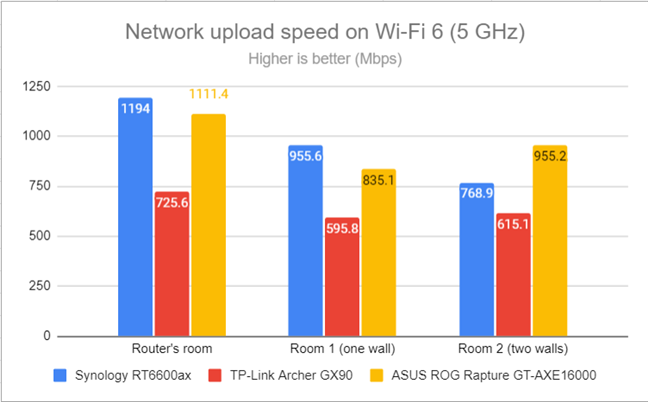 Network uploads on Wi-Fi 6 (5 GHz)
When using the 5 GHz band, both on Wi-Fi 5 and Wi-Fi 6, ASUS ROG Rapture GT-AXE16000 is an excellent router that delivers super fast data transfers and a wide coverage area.
Network uploads on Wi-Fi 6 (5 GHz)
When using the 5 GHz band, both on Wi-Fi 5 and Wi-Fi 6, ASUS ROG Rapture GT-AXE16000 is an excellent router that delivers super fast data transfers and a wide coverage area.
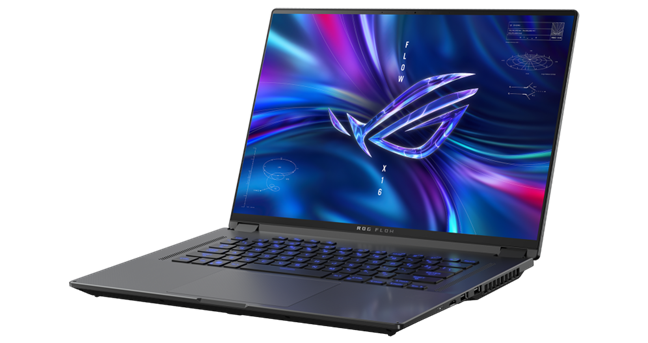
 ASUS ROG Flow X16 (2022) works with Wi-Fi 6E
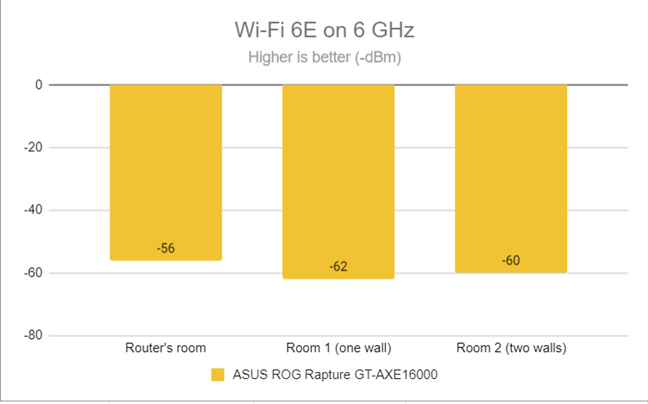
I started by measuring the signal strength with NetSpot, and I noticed that the signal strength delivered by ASUS ROG Rapture GT-AXE16000 on the 6 GHz band is weaker than on the 5 GHz band. This only confirms my theoretical knowledge that the Wi-Fi 6E standard was designed to provide a shorter range than Wi-Fi 5 or Wi-Fi 6.
ASUS ROG Flow X16 (2022) works with Wi-Fi 6E
I started by measuring the signal strength with NetSpot, and I noticed that the signal strength delivered by ASUS ROG Rapture GT-AXE16000 on the 6 GHz band is weaker than on the 5 GHz band. This only confirms my theoretical knowledge that the Wi-Fi 6E standard was designed to provide a shorter range than Wi-Fi 5 or Wi-Fi 6.
 Signal strength on Wi-Fi 6E (6 GHz band)
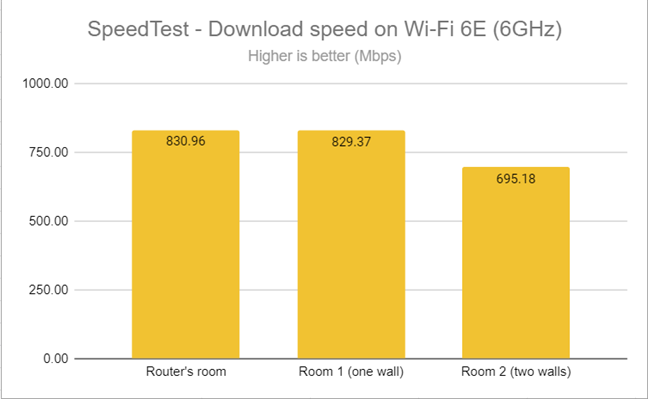
Next, I used the SpeedTest app to measure the maximum speed you get when transferring data to and from the internet on the 6 GHz band. The download speed was slightly faster than when using Wi-Fi 6 on the 5 GHz band, but it wasn’t much faster because my internet connection is limited to a maximum of 900 Mbps - 1 Gbps.
Signal strength on Wi-Fi 6E (6 GHz band)
Next, I used the SpeedTest app to measure the maximum speed you get when transferring data to and from the internet on the 6 GHz band. The download speed was slightly faster than when using Wi-Fi 6 on the 5 GHz band, but it wasn’t much faster because my internet connection is limited to a maximum of 900 Mbps - 1 Gbps.
 SpeedTest - The download speed on Wi-Fi 6E (6 GHz)
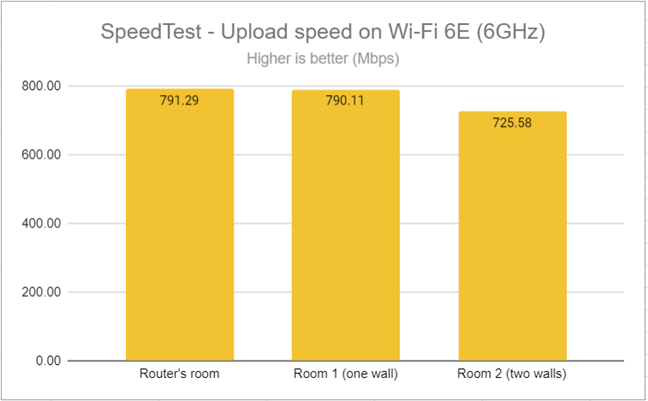
Uploads were very similar too when using Wi-Fi 6 on the 5 GHz band because my internet connection is capped at 800 Mbps for the upload speed. This limitation proves one more time that your router can’t be faster than your internet connection. Therefore, if you want to reach speeds above 1 Gbps, you need to upgrade your internet connection, not just your router.
SpeedTest - The download speed on Wi-Fi 6E (6 GHz)
Uploads were very similar too when using Wi-Fi 6 on the 5 GHz band because my internet connection is capped at 800 Mbps for the upload speed. This limitation proves one more time that your router can’t be faster than your internet connection. Therefore, if you want to reach speeds above 1 Gbps, you need to upgrade your internet connection, not just your router.
 SpeedTest - The upload speed on Wi-Fi 6E (6 GHz)
For the next set of measurements, I used the PassMark Performance test to transfer data between two computers connected to the network. In this test, I can better understand the speed potential offered by Wi-Fi 6E because I’m not limited by my internet connection speed, only by the devices I’m using and the router itself. Although the ASUS ROG Rapture GT-AXE16000 was fast in all rooms, I noticed a small speed improvement only in the rooms closest to it. The more limited range of Wi-Fi 6E meant that, in Room 2, I had faster downloads when using Wi-Fi 6 or Wi-Fi 5.
SpeedTest - The upload speed on Wi-Fi 6E (6 GHz)
For the next set of measurements, I used the PassMark Performance test to transfer data between two computers connected to the network. In this test, I can better understand the speed potential offered by Wi-Fi 6E because I’m not limited by my internet connection speed, only by the devices I’m using and the router itself. Although the ASUS ROG Rapture GT-AXE16000 was fast in all rooms, I noticed a small speed improvement only in the rooms closest to it. The more limited range of Wi-Fi 6E meant that, in Room 2, I had faster downloads when using Wi-Fi 6 or Wi-Fi 5.
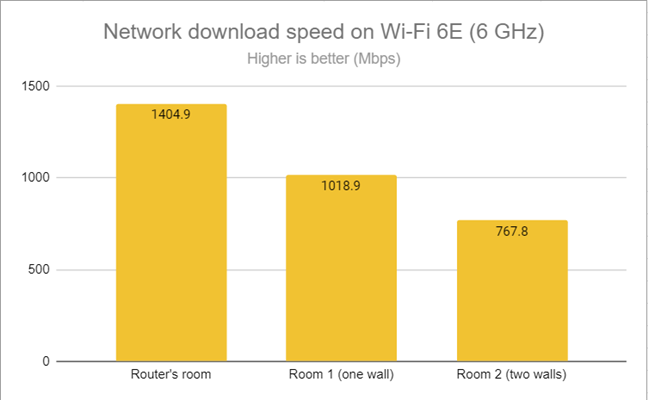 Network downloads on Wi-Fi 6E (6 GHz)
Network uploads over Wi-Fi 6E were fast too, with some minor improvements over Wi-Fi 6 in the rooms close to the router and slower speeds in the room furthest to it.
Network downloads on Wi-Fi 6E (6 GHz)
Network uploads over Wi-Fi 6E were fast too, with some minor improvements over Wi-Fi 6 in the rooms close to the router and slower speeds in the room furthest to it.
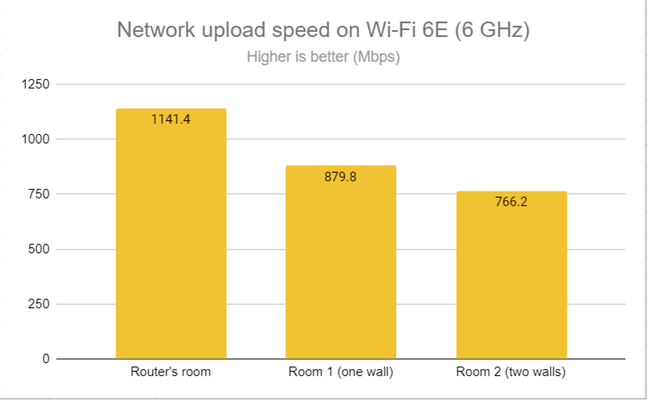 Network uploads on Wi-Fi 6E (6 GHz)
ASUS ROG Rapture GT-AXE16000 works well using the new Wi-Fi 6E and it delivers some improvements over Wi-Fi 6. However, they’re not that big, and the range of the 6 GHz band is shorter than the other two bands.
Network uploads on Wi-Fi 6E (6 GHz)
ASUS ROG Rapture GT-AXE16000 works well using the new Wi-Fi 6E and it delivers some improvements over Wi-Fi 6. However, they’re not that big, and the range of the 6 GHz band is shorter than the other two bands.
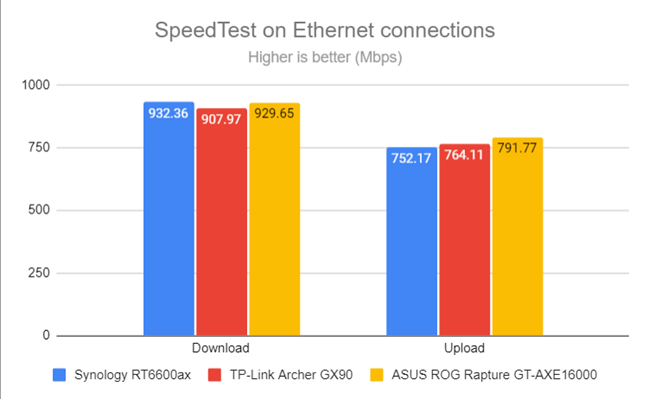 SpeedTest on wired connections
I also plugged a fast SSD drive into the USB 3.2 Gen 1 port of the router and made some data transfers on it. I was blown away by how fast data transfers were. ASUS ROG Rapture GT-AXE16000 was the fastest router I’ve tested so far. With speeds this fast, you can easily turn your ASUS router into a NAS and enjoy an excellent experience.
SpeedTest on wired connections
I also plugged a fast SSD drive into the USB 3.2 Gen 1 port of the router and made some data transfers on it. I was blown away by how fast data transfers were. ASUS ROG Rapture GT-AXE16000 was the fastest router I’ve tested so far. With speeds this fast, you can easily turn your ASUS router into a NAS and enjoy an excellent experience.
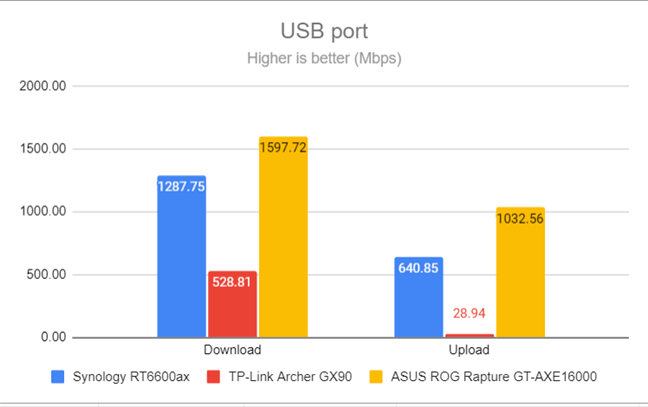 The speed of the USB 3.2 port
The ASUS ROG Rapture GT-AXE16000 has no problem handling 1 Gbps Ethernet connections. That’s not surprising since it’s advertised to work with 2.5 Gbps and 10 Gbps internet connections. Also, its USB 3.2 Gen 1 port is the fastest I’ve seen on all the routers I’ve tested.
The speed of the USB 3.2 port
The ASUS ROG Rapture GT-AXE16000 has no problem handling 1 Gbps Ethernet connections. That’s not surprising since it’s advertised to work with 2.5 Gbps and 10 Gbps internet connections. Also, its USB 3.2 Gen 1 port is the fastest I’ve seen on all the routers I’ve tested.

 Check the ping reply for game servers worldwide
Security is a big deal too, and this router provides the following tools:
Check the ping reply for game servers worldwide
Security is a big deal too, and this router provides the following tools:
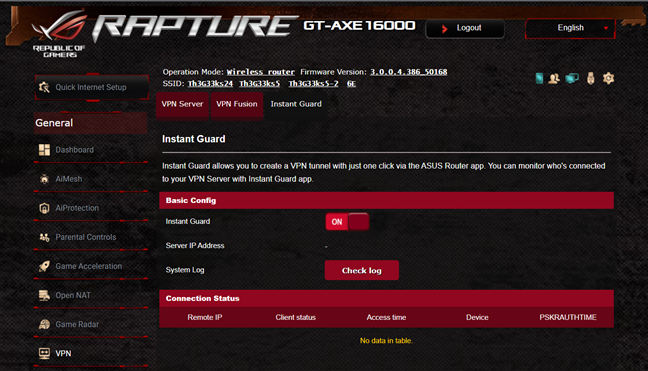
 Instant Guard is available on the ASUS ROG Rapture GT-AXE16000
The list of features doesn’t stop here. This powerful wireless router also includes:
Instant Guard is available on the ASUS ROG Rapture GT-AXE16000
The list of features doesn’t stop here. This powerful wireless router also includes:
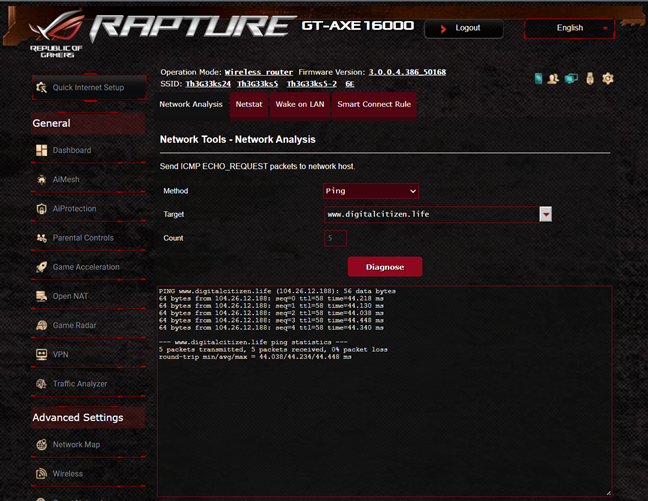
 You also get plenty of troubleshooting tools
The list of features on the ASUS ROG Rapture GT-AXE16000 is simultaneously extensive and impressive. Few routers from other brands can compare with it.
You also get plenty of troubleshooting tools
The list of features on the ASUS ROG Rapture GT-AXE16000 is simultaneously extensive and impressive. Few routers from other brands can compare with it.
ASUS ROG Rapture GT-AXE16000: Who is it good for?
This wireless router is a suitable choice for:- Homes or offices with 2.5 Gbps or 10 Gbps internet connections
- Users who own Wi-Fi 6E compatible devices
- Gamers who often play online games
- Users who want a secure network with excellent antivirus and firewall protection
- Parents who are in need of efficient parental controls for their home network
- Knowledgeable users who want tons of advanced features (ultra-fast USB port, VPN, Dual-WAN, and more)
Pros and cons
Here are the things I like about ASUS ROG Rapture GT-AXE16000:
- Works with 2.5 Gbps & 10 Gbps internet connections
- Wi-Fi 6E support and four Wi-Fi bands
- Plenty of high-speed Ethernet ports
- Powerful hardware that can handle many network clients
- Many features for gamers
- Ultra-fast USB 3.2 port, plus a second USB 2.0 port
- Top-notch security tools and parental controls
- Tons of advanced features, including VPN
- It’s very expensive
- It’s massive and heavy
Verdict
ASUS ROG Rapture GT-AXE16000 impresses with its price, design, hardware, features, and performance. It is a truly premium router that delivers everything you want and more. While it’s not always the fastest router, it is always among the fastest, and its Wi-Fi 6E support makes it ideal for people who want to future-proof their home or small business network. Gamers will be happy too, as they get many features for playing online games in style. Although it costs a lot of money, if you’re upgrading your internet connection to 2.5 Gbps or 10 Gbps, ASUS ROG Rapture GT-AXE16000 is one of the best routers you can buy today.Unboxing the ASUS ROG Rapture GT-AXE16000
ASUS ROG Rapture GT-AXE16000 comes in a huge cardboard box, with the usual black and red being the dominant colors, as is the case with all things Republic of Gamers. You see a picture of the router on the top cover, as well as its most important characteristics, starting with its Wi-Fi 6E compatibility.Hardware specifications and design
ASUS ROG Rapture GT-AXE16000 impresses you first with its sheer size and the many antennas: eight external non-detachable ones and four internal antennas, which provide 4x4 MU-MIMO transfers on all bands. This router measures 7.6 by 13.9 by 13.9 inches or 19.3 by 35.3 by 35.3 centimeters in height x width x depth. As you can see in the picture below, a large portion of its top side is covered in glass, which reflects everything around it. You can barely make out the product name written on the top and the LEDs placed on the bottom of the glass.- One 2.4 GHz band, using either Wi-Fi 6 or Wi-Fi 4, depending on your preferred standard. The total theoretical bandwidth is 1148 Mbps when using Wi-Fi 6.
- Two 5 GHz bands, using either Wi-Fi 6 or Wi-Fi 5, depending on what you want. The total theoretical bandwidth for each is 4804 Mbps when using Wi-Fi 6.
- One 6 GHz band, using only the Wi-Fi6E standard. The total theoretical bandwidth for it is 4804 Mbps.
Setting up and using the ASUS ROG Rapture GT-AXE16000
The installation process works the same as for all other routers: you plug in the internet cable into the WAN port or you connect it to the modem provided by your internet service provider (ISP). Turn it on, wait for it to boot and for all the LEDs to light up.Wireless network performance
My new test apartment is set up similarly to the diagram below. As you can see, I’ve placed the ASUS ROG Rapture GT-AXE16000 in a central position to provide good coverage in all the rooms where I tend to spend most of my time.- I record the maximum speeds when no walls absorb the wireless signal in the room where the router is placed.
- Room 1 - is separated by one wall from the router. The wireless signal and the Wi-Fi speed I get should be lower here.
- Room 2 - is separated from the router by two walls absorbing the wireless signal. Also, the wall between Room 1 and Room 2 is twice as thick as the one between the router’s room and Room 1. Room 2 can be a difficult challenge for many routers.
How the ASUS ROG Rapture GT-AXE16000 performs on the 2.4 GHz band
As always, I first measured the signal strength using NetSpot, while connected to the 2.4 GHz band. When using the Wi-Fi 4 standard, ROG Rapture GT-AXE16000 delivered a solid signal, especially in the rooms furthest from it.How the ASUS ROG Rapture GT-AXE16000 performs on the 5 GHz band
I switched to the 5 GHz band, and I started by measuring the signal strength with NetSpot. When using the Wi-Fi 5 standard, the signal strength delivered by ROG Rapture GT-AXE16000 was excellent in all the rooms of my apartment.How the ASUS ROG Rapture GT-AXE16000 performs on the 6 GHz band
ASUS ROG Rapture GT-AXE16000 is a Wi-Fi 6E router, and it also delivers a fourth 6 GHz band. To connect to this band, you need devices with support for Wi-Fi 6E, which may be a problem for many. However, if you have compatible devices such as the ASUS ROG Flow X16 (2022) laptop I used for this review, you can enjoy its benefits, like more security thanks to the mandatory WiFi Protected Access 3 (WPA3) encryption and increased bandwidth.Wired network performance & USB port
It was time to evaluate the performance offered by ASUS ROG Rapture GT-AXE16000 on Ethernet network connections. My internet connection offers a maximum of 1 Gbps for the download speed and 800 Mbps for the upload and, when using SpeedTest, ROG Rapture GT-AXE16000 got very close to the maximum allowed.Extra features
ASUS ROG Rapture GT-AXE16000 has tons of tools and features which cater to the needs of different audiences. First, we have the Aura RGB lighting for gamers that can be set to use the following effects: Static, Breathing, Wave, Marquee, Gradient, Evolution, and Rainbow. You can see some of them in action in the video below. However, the list of gaming-oriented features doesn’t stop here. You also get the following:- Game Acceleration - a set of tools for gamers. It includes the following:
- Game Devices - a dedicated gaming port on the back of the router. Anything you plug into it gets prioritized over other devices on the network.
- ROG First - another feature that automatically detects Republic of Gamers devices in your network and prioritizes them over others.
- Game Boost - is an adaptive Quality of Service feature that automatically prioritizes online gaming traffic.
- WTFast - a VPN service that is designed for online gaming and tries to optimize network performance to your favorite game servers. You get a free trial with your router.
- Open NAT - an easy way to create port forwarding rules for popular online games.
- Game Radar - check the ping reply for gaming servers worldwide for a predefined list of games that includes popular titles like Diablo 3, DOTA 2, League of Legends, Overwatch, and World of Tanks.
- AiProtection - cloud-based security tools that protect your network from attacks, malicious sites, infected devices, and poor router settings. You can find a useful tutorial about this feature here: ASUS AiProtection: On or Off? Enhance your router’s security!
- Parental Controls - efficient cloud-based parental controls, developed by ASUS together with Trend Micro, alongside their AiProtection module. You can learn more about what they do from this article: 7 ways in which ASUS Parental Controls protect your children.
- VPN - is a major focus area, with three different services:
- VPN Server - the router can be set to work as a VPN server for your network, using the PPTP, OpenVPN, and IPSec VPN protocols. This feature is useful both for knowledgeable users and small businesses.
- Instant Guard - a mobile app that helps smartphone users navigate the internet securely by establishing a VPN connection to their home network. The app is handy, especially when you have to use free public Wi-Fi networks, which tend to be insecure. For more details, read: How to configure and use Instant Guard on ASUS Wi-Fi routers.
- VPN Fusion - allows you to connect to multiple VPN servers simultaneously and assign your client devices to connect to different VPN tunnels.
- AiMesh - extend your Wi-Fi coverage using ASUS routers and create your homebrewed mesh Wi-Fi system. For more details, read: What is an ASUS AiMesh network and how to create one?.
- Guest Network - you can enable three wireless guest networks with individual security and access settings on each band (2.4 GHz, two 5 GHz bands, and 6 GHz). You can have a total of twelve guest networks, which is completely bonkers if you ask me. 🙂
- Traffic Analyzer - visual traffic statistics that show how your network is used and by which devices. Useful when you’re managing a network with dozens of connected devices.
- DDNS - allows you to connect to the router from the internet, even if your internet provider assigns you a dynamic public IP address. You can use a long list of services (Google, DYNDNS, NO-IP, DNSOMATIC, etc) including a free one offered by ASUS.
- Dual WAN - you can use two internet connections at the same time. In theory, you can even use two 10 Gbps internet connections simultaneously, both in Fail Over or Load Balance modes.
- USB Applications - set up the router to use external hard drives or printers through its USB ports. There’s also support for Apple’s Time Machine functionality from macOS.
- AiCloud 2.0 - gives you the tools to create your cloud storage service using a hard drive connected to the router.
- Amazon Alexa - you can say things like “Alexa, ask ASUS ROUTER to upgrade the firmware” to perform different tasks.
- Network Tools - for analyzing the network and identifying what’s wrong. They are helpful when you need to troubleshoot problems. This is the place from where you can configure ASUS Smart Connect.

Discussion (0)
Comments are closed.