At CES 2020 (Consumer Electronics Show) in Las Vegas, ASUS launched many products, including a new line-up of advanced mesh Wi-Fi systems. The most affordable of them is ASUS ZenWiFi AC (CT8), also known as ASUS RT-AC95U. It is a tri-band mesh Wi-Fi system that looks great. ZenWiFi AC (CT8) promises improved firmware and performance compared to the ASUS Lyra line-up from previous years. We took it for a spin, made plenty of measurements, and here is our opinion about what it has to offer:
ASUS ZenWiFi AC (CT8): Who is it good for?
This AiMesh Wi-Fi system is an excellent choice for:
Users who want the best security for their smart home
People who desire an advanced mobile app from which they can remotely control their network
Knowledgeable users who want advanced firmware that offers complete control
People who want task automation services from their network, through IFTT (If This, Then That)
Users who want to control their home network using the Alexa voice assistant
Pros and cons
Here are the things we like about ASUS ZenWiFi AC (CT8):
Advanced firmware with tons of features and settings
Can be remotely controlled from a mobile app
It has a USB 3.0 port
Excellent security features that secure your smart home
Great multilingual support and easily accessible Help documentation
It works with other ASUS networking devices that support AiMesh
Plenty of Ethernet ports
There are also negatives to consider:
The launch price is a bit high
To get the best experience, upgrade the firmware to newer versions
Product rating5/5
Verdict
ASUS ZenWiFi AC (CT8) is an elegant mesh Wi-Fi system that offers excellent performance and security. It has plenty of ports, including USB 3.0, and an advanced mobile app that you can use to remotely control your network from anywhere on the internet. You can also use it alongside any AiMesh compatible router and mesh Wi-Fi system from ASUS. The only notable downside is that the launch price is a bit high. Overall, ASUS ZenWiFi AC (CT8) is an excellent choice for anyone who wants fast Wi-Fi, as well as excellent wireless coverage.
Unboxing the ASUS ZenWiFi AC (CT8) mesh Wi-Fi system
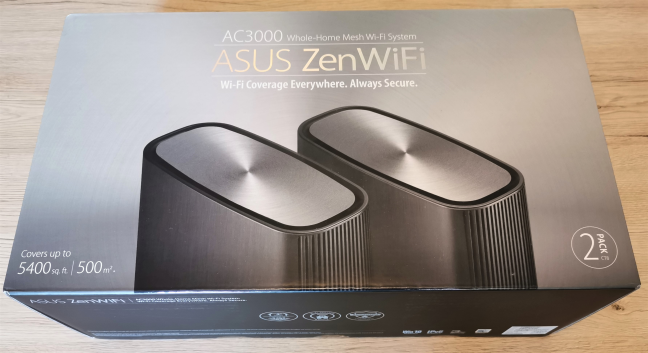
The ASUS ZenWiFi AC3000 whole-home mesh Wi-Fi system comes in packages of one or two stations. It is also available in two colors: black and white. We received the black 2-pack package for testing. As you can see in the picture below, the box has an elegant look worthy of a premium device. On the sides of the box, you find more details about the features of this mesh Wi-Fi system.
The packaging for the ASUS ZenWiFi AC3000
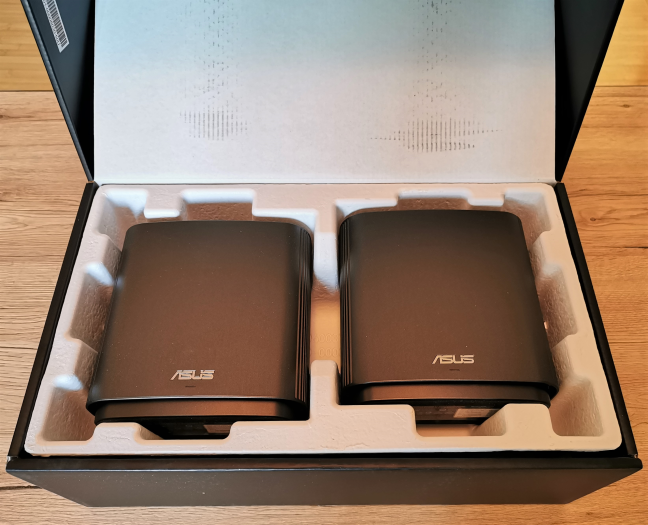
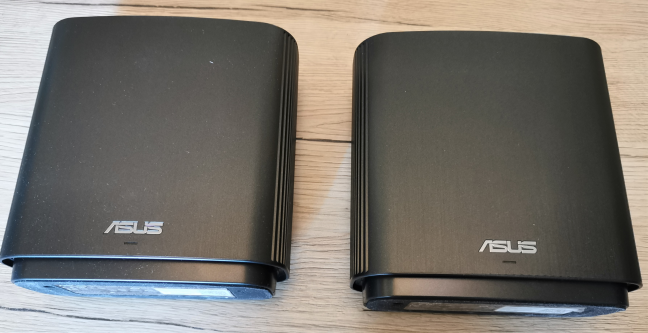
When you open the box, you see the two devices that make up the kit. The stations have a clean look that appeals to people who are looking for an elegant device to use in their homes.
Unboxing the ASUS ZenWiFi AC (CT8)
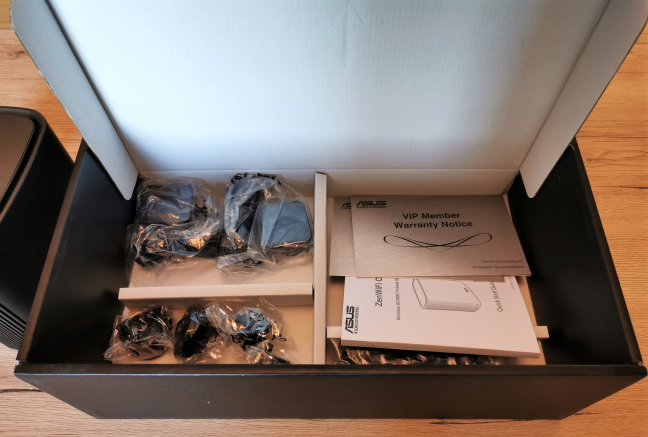
Beneath the stations, you find the power adapters for them, an Ethernet network cable, the quick setup guide, and the warranty.
The accessories that come with ASUS ZenWiFi AC (CT8)
The unboxing experience offered by ASUS ZenWiFi AC (CT8) is worthy of a premium device, and the packaging includes everything you need to get started.
Hardware specifications and design
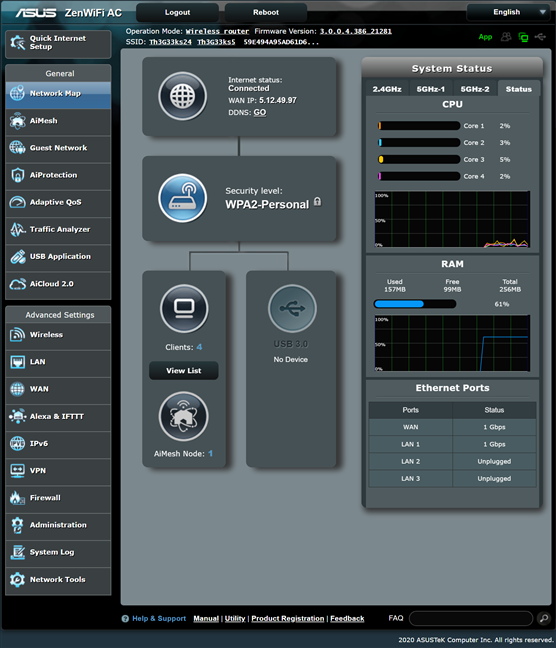
ASUS ZenWiFi AC (CT8) is also known under the product name ASUS RT-AC95U. Each station has a quad-core Qualcomm IPQ4019 processor running at 717 MHz, 256 MB of RAM, and 128 MB of storage space for the firmware. It offers support for the Wi-Fi 5 (802.11ac Wave 2) standard and 2x2 MU-MIMO wireless transfers.
The System Status on the ASUS ZenWiFi AC (CT8)
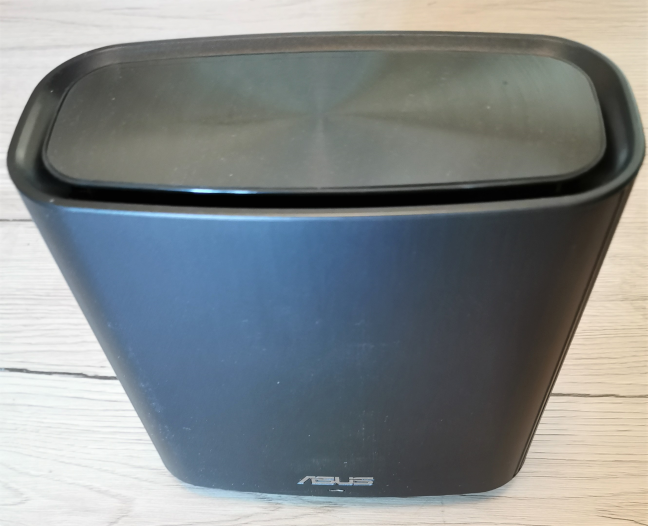
The stations that make up the ASUS ZenWiFi AC (CT8) mesh Wi-Fi kit have an understated elegance. Their vertical housing holds a special six antenna design and a circuit board that optimizes Wi-Fi signal strength. You see the ASUS logo on the front and a small LED light that changes its color depending on the status of each station. On the sides, you have ventilation grids that provide the necessary airflow to keep things cool on the inside.
ASUS ZenWiFi AC (CT8)
There is a cover on the top, with a bit of space around the edge. That is used to redirect the airflow for optimal cooling. As a result, the ASUS ZenWiFi AC (CT8) never gets hot, even when the processor is used at its maximum capacity. Inside each station, there is also a double heatsink for maximum heat dissipation.
ASUS ZenWiFi AC (CT8)
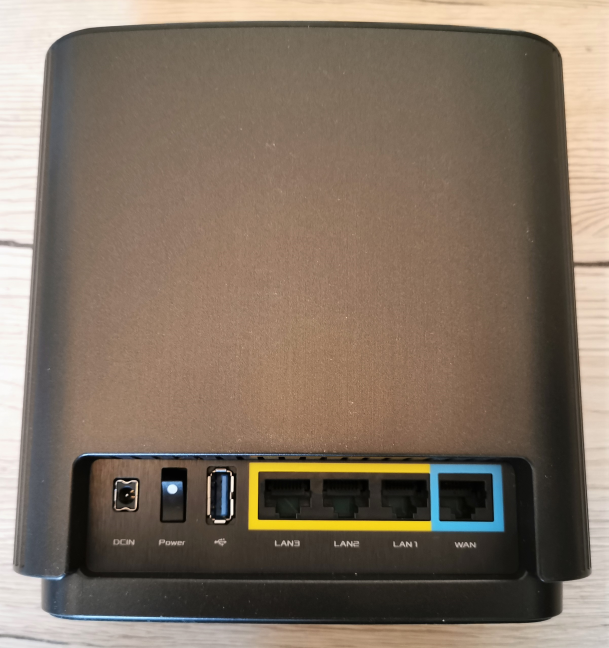
Each station has a size of 6.2 x 3 x 6.3 inches or 16 x 7.5 x 16.15 cm (Width x Depth x Height). It weighs a total of 25.7 ounces or 730 grams. On the back of each ASUS ZenWiFi AC (CT8), you find the power jack, power button, a USB 3.0 port, and four Ethernet ports at 1 Gbps. One of those is used to connect the main station to the internet. When compared with other mesh Wi-Fi solutions, the port selection is quite generous.
The ports on the back of the ASUS ZenWiFi AC (CT8)
ASUS ZenWiFi AC (CT8) is a tri-band mesh Wi-Fi system. The total maximum bandwidth is split as follows: 400 Mbps for the 2.4 GHz band, 867 Mbps for the first 5 GHz band, and 1733 Mbps for the second 5 GHz band. One crucial aspect to keep in mind is that the second 5 GHz band is used for the backhaul between the stations that make up the kit. It can't be used by the devices that connect to the network, only by the mesh Wi-Fi system, so that it provides the lowest latency and the maximum speed possible.
To learn more about the technical specifications of this product, go to this page: ASUS ZenWiFi AC (CT8) Specifications.
Setting up and using the ASUS ZenWiFi AC (CT8) mesh Wi-Fi system
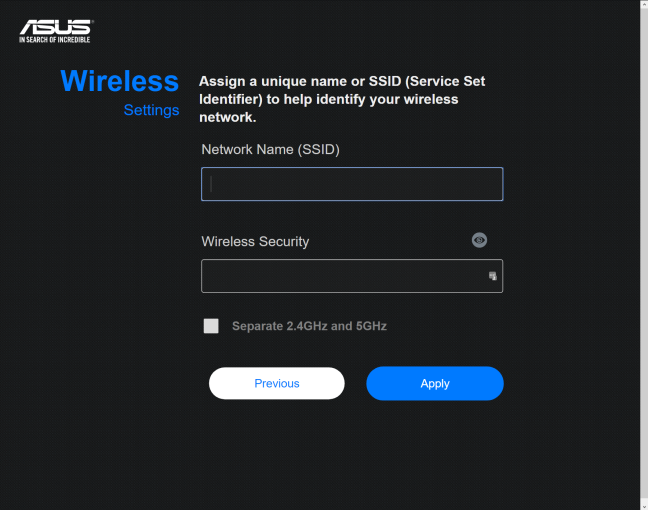
Setting up the ASUS ZenWiFi AC (CT8) can be done using a web browser or the ASUS Router mobile app for Android and iOS. The setup involves providing the details for your internet connection, choosing a network name and password for the WiFi, and setting up the login name and password for ASUS ZenWiFi AC (CT8). At the end of the setup wizard, you are also asked whether you want to use the Yandex.DNS service to restrict access to malicious sites and adult content. Considering that this DNS service is from Russia, most international users won't enable it for their network.
The quick setup wizard
One cool feature is that the two stations that make up the 2-pack kit are paired from the factory. You don't need to add the second station to the mesh Wi-Fi system. You configure everything in one go, as if it were a single device, not two. However, if you need to add a third station, that one needs to be manually added to the mesh Wi-Fi system. ZenWiFi AC (CT8) uses ASUS's AiMesh technology, meaning that it can be coupled with wireless routers and mesh Wi-Fi stations made by the same company. If you already own an ASUS wireless device, it is cheaper to upgrade your network by buying one ASUS ZenWiFi AC (CT8) instead of two.
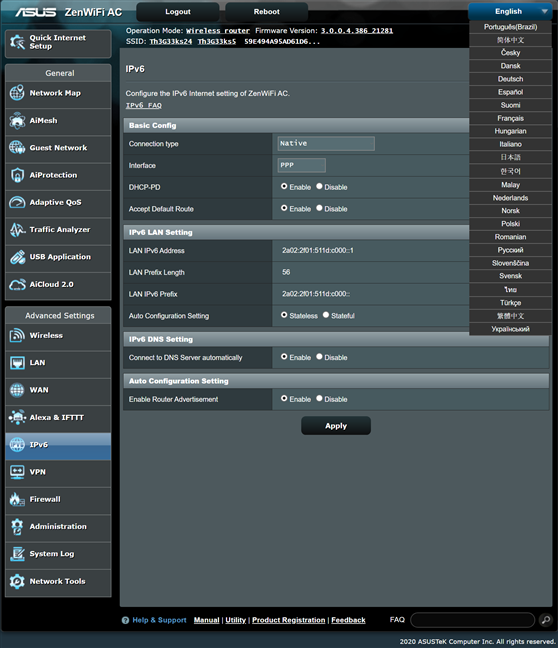
The user interface is the same as on other ASUS wireless devices, meaning that it is easy to use, well organized, and available in 24 languages. Also, if you are an advanced user, you are going to appreciate the complete control that you get. There are plenty of settings available for all the features of this mesh Wi-Fi system.
The languages available for ASUS ZenWiFi AC (CT8)
The user documentation is accessible and well built. One neat trick is to move the mouse cursor over a setting that you do not understand, and a question mark is shown. Click on the question mark, and you see information explaining that setting. One downside is that the documentation has not been updated to include information about all the features included by ASUS in their firmware. Therefore, for a few of them, this trick does not work.
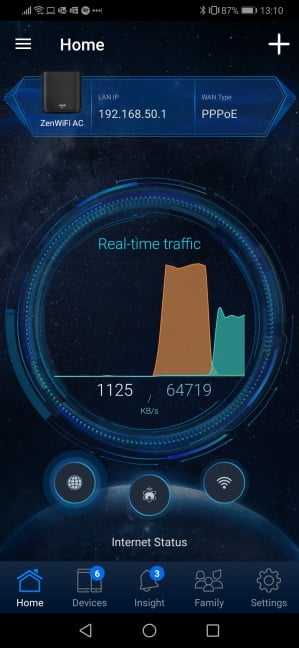
If you are not an advanced user, you may prefer the ASUS Router mobile app for setting up and administering the ASUS ZenWiFi AC (CT8). One cool feature is that you can use it to remotely control your network from anywhere on the internet. The app has been updated recently, it has a new look, and it is organized better than before. With it, you can view the devices connected to the network, see their traffic in real time, block them or limit their bandwidth, manage the devices used by your children, set up parental control rules, and configure the main features of ASUS ZenWiFi AC (CT8).
The ASUS Router mobile app
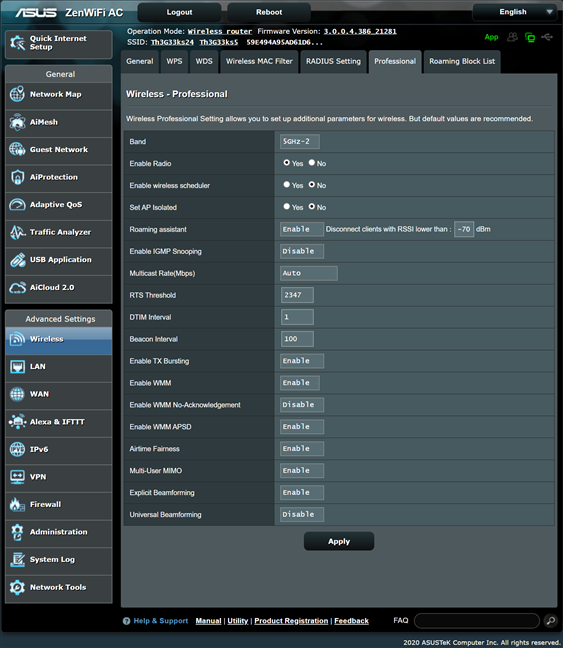
While the ASUS Router mobile app is a lot more advanced than similar apps for mesh Wi-Fi systems, you can't use it to configure everything, as you do from the firmware. Regarding the firmware, the initial version has Multi-User MIMO disabled by default. We found this strange because this technology delivers better Wi-Fi performance. We recommend that you upgrade to the newest firmware version for improved performance, and to double-check that MU-MIMO is turned on for all wireless bands, including the backhaul.
Setting wireless settings on the ASUS ZenWiFi AC (CT8)
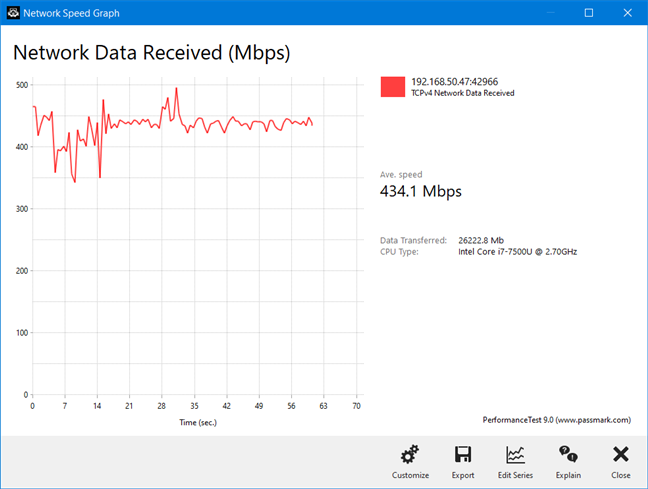
We connected more than a dozen devices to the network managed by ASUS ZenWiFi AC (CT8), including a desktop PC, two laptops, one tablet, several smartphones, one wireless printer, two smart plugs, one smart bulb, an intelligent robot vacuum cleaner, and an Xbox One console. Then, we started sharing data and making data transfers. We enjoyed fast Wi-Fi in all the rooms of our apartment. We evaluated the speed and variability of wireless transfers, and we were pleased with the results. We took our laptop and moved to a room that is separated by one wall from the main station. We made a wireless transfer on it. As you can see below, it was quite stable, and the average speed was high.
A wireless transfer on the ASUS ZenWiFi AC (CT8)
If you want to know more about the real-world performance offered by ASUS ZenWiFi AC (CT8), including comparisons with other mesh Wi-Fi systems, go to the next page of this review.
Wireless network performance
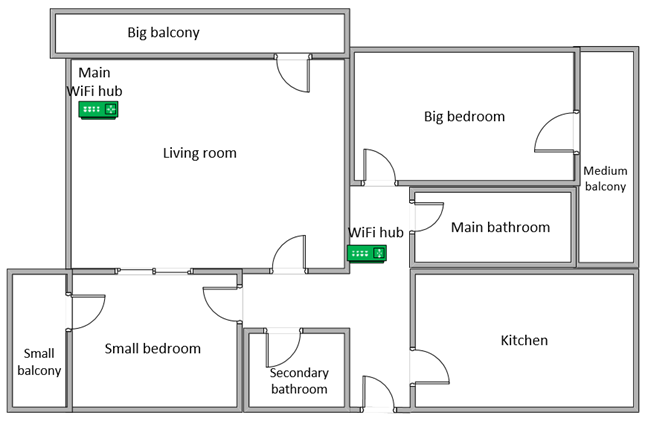
Let's look at the apartment that was used in our testing and how it is set up. You can see that the main ASUS ZenWiFi AC (CT8) is placed in the living room. To improve the coverage of the network, we placed the ZenWiFi AC (CT8) station in the hallway, close to the entrance to the kitchen. Our testing was done using a fast 1 Gigabit Internet connection that is capable of uploads on the internet of up to 500 Mbps. We used an HP Spectre 13 laptop for all our measurements and several software tools.
The apartment in which we tested the ASUS ZenWiFi AC (CT8)
To get a better idea of the performance offered by ASUS ZenWiFi AC (CT8), we compared it with TP-Link Deco M9 Plus, ASUS Lyra, and Synology MR2200ac.
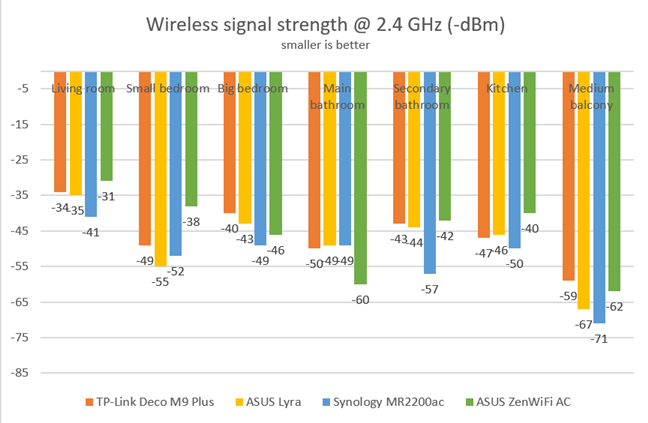
We started by evaluating the 2.4 GHz wireless network and measured the signal strength offered in each room using a tool named NetSpot Pro. As you can see below, ASUS ZenWiFi AC (CT8) offered great signal strength in almost all rooms.
ASUS ZenWiFi AC (CT8) - wireless signal strength on the 2.4 GHz band
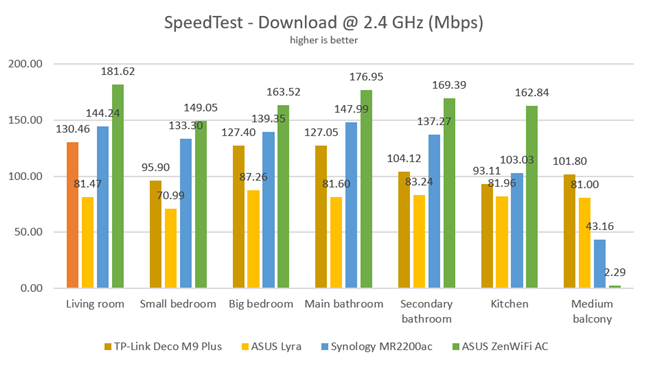
Then, we used SpeedTest to see how fast the internet connection is when using the 2.4 GHz wireless frequency. Except for the room farthest from the main station, ASUS ZenWiFi AC (CT8) delivered excellent download speed everywhere, beating both the competition and its predecessor - ASUS Lyra - with ease.
ASUS ZenWiFi AC (CT8) - Downloads in SpeedTest, on the 2.4 GHz band
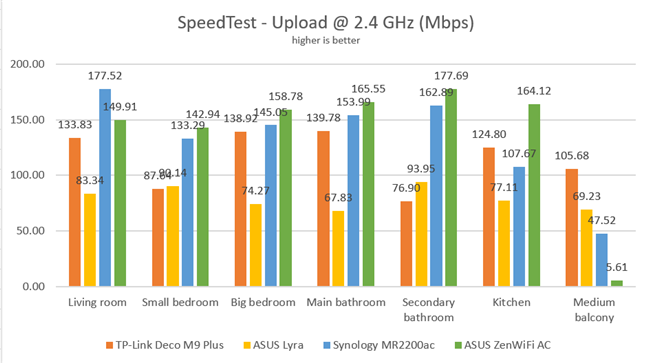
The upload speed was excellent in all rooms, except the one farthest from the main station.
ASUS ZenWiFi AC (CT8) - Uploads in SpeedTest, on the 2.4 GHz band
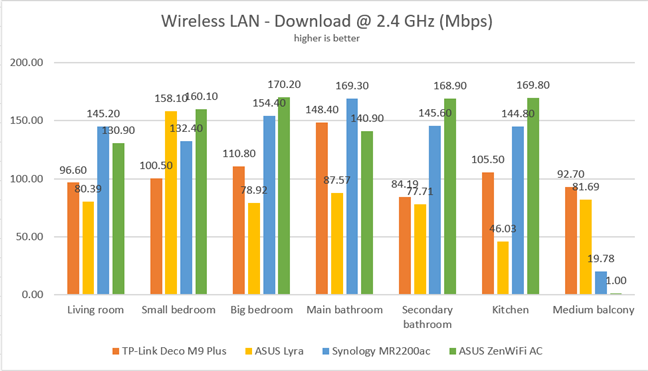
For the next measurements, we used the PassMark Performance test to transfer data between two computers connected to the network, using the 2.4 GHz wireless frequency. In some rooms, ASUS ZenWiFi AC (CT8) offered the fastest downloads, while in others it performed similarly to the competition.
ASUS ZenWiFi AC (CT8) - Wireless downloads on the 2.4 GHz band
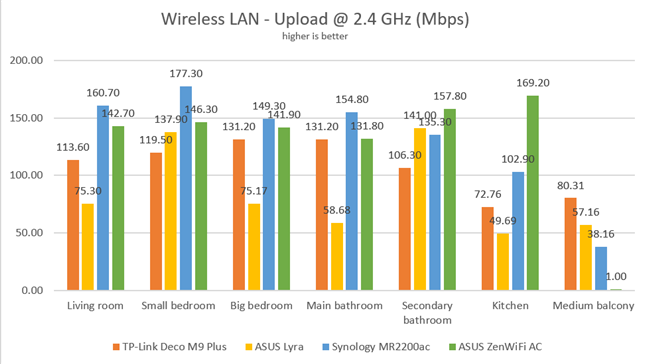
The upload speed was excellent too, in all rooms, except for the one farthest from the main station.
ASUS ZenWiFi AC (CT8) - Wireless uploads on the 2.4 GHz band
On the 2.4 GHz wireless frequency, ASUS ZenWiFi AC (CT8) offers excellent performance, that is similar to or better than that of its competition.
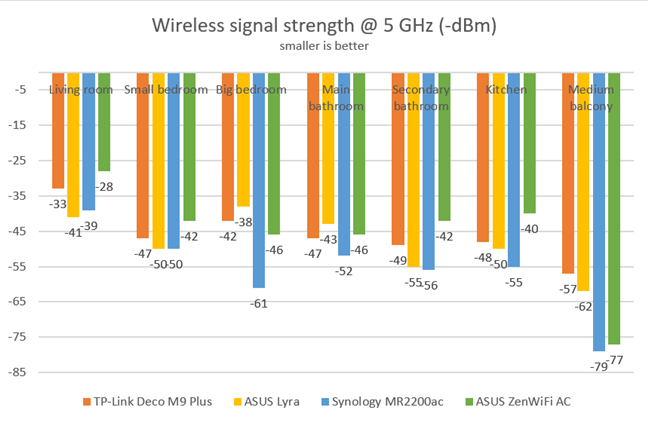
Next, we analyzed the performance offered by the 5GHz wireless network. We started by looking at the evolution of the signal strength. In many rooms, ASUS ZenWiFi AC (CT8) had a higher signal strength than the mesh Wi-Fi systems we compared it to.
ASUS ZenWiFi AC (CT8) - wireless signal strength on the 5 GHz band
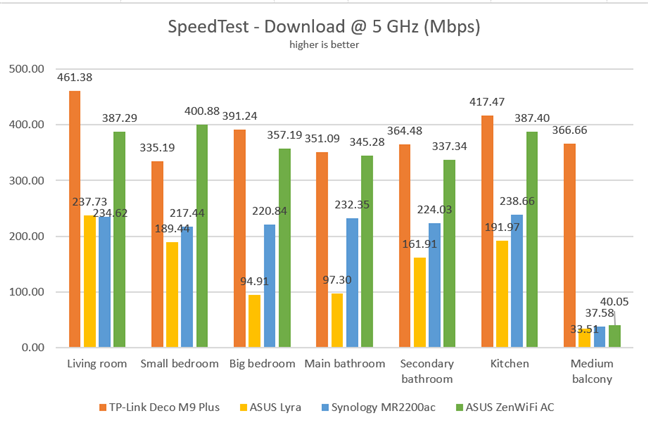
We then ran SpeedTest to see how fast the internet connection is on the 5GHz band. ASUS ZenWiFi AC (CT8) offered fast downloads in all the rooms of our test apartment, except the one farthest from the main station.
ASUS ZenWiFi AC (CT8) - Downloads in SpeedTest, on the 5 GHz band
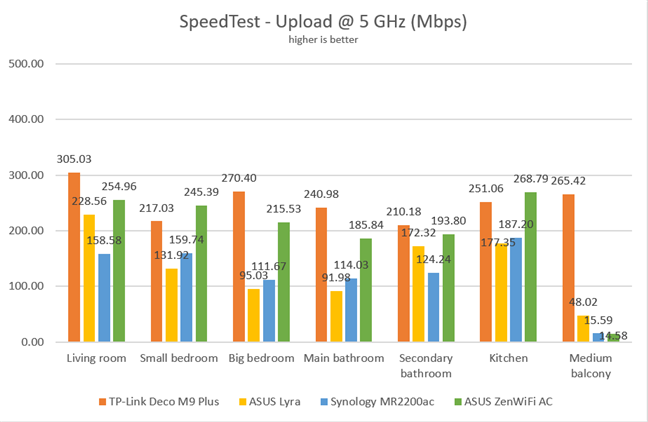
Upload speeds were fast, as you can see below.
ASUS ZenWiFi AC (CT8) - Uploads in SpeedTest, on the 5 GHz band
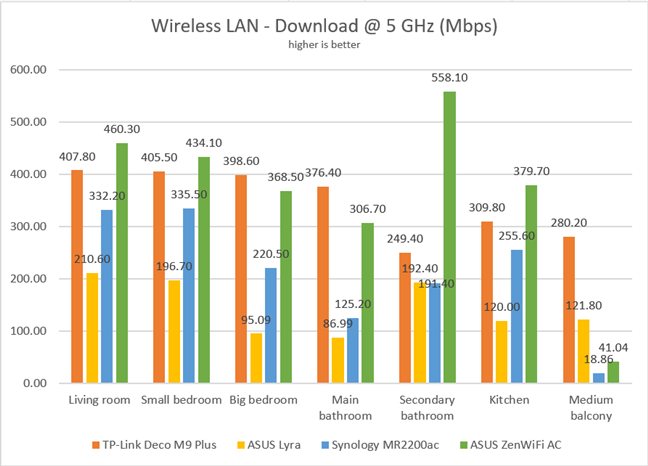
For the last measurements on the 5GHz wireless network, we used the PassMark Performance test to transfer data between two computers connected to the network. ASUS ZenWiFi AC (CT8) was the speed champion in many rooms.
ASUS ZenWiFi AC (CT8) - Wireless downloads on the 5 GHz band
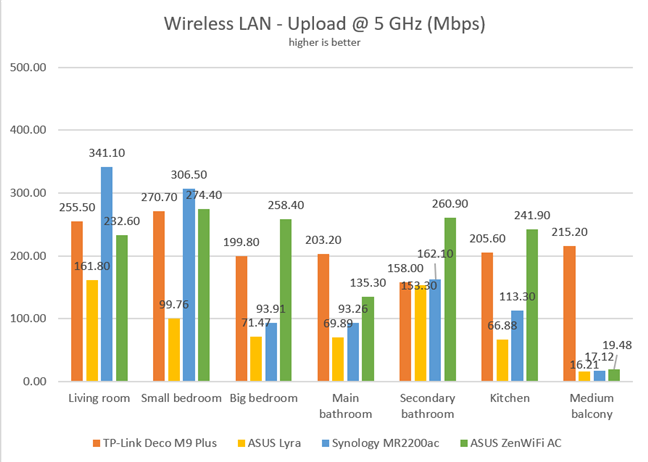
The upload speed offered by ASUS ZenWiFi AC (CT8) was excellent in all rooms, except for the one farthest from the main station.
ASUS ZenWiFi AC (CT8) - Wireless uploads on the 5 GHz band
On the 5 GHz wireless frequency, ASUS ZenWiFi AC (CT8) offers impressive speeds, both for the download and upload.
Wired network performance
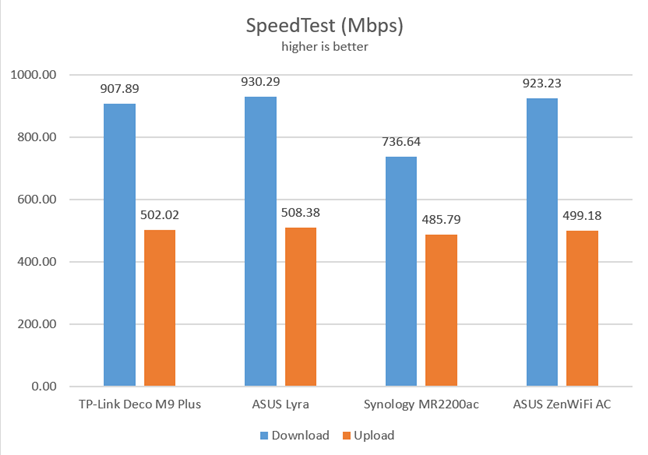
To test the quality of the wired Ethernet connection, we used a desktop PC, and we measured the speed of the internet connection when using a 1 Gbps Ethernet cable using SpeedTest. In this test, ASUS ZenWiFi AC (CT8) reached the maximum potential of our internet connection.
ASUS ZenWiFi AC (CT8) - SpeedTest on Ethernet connections
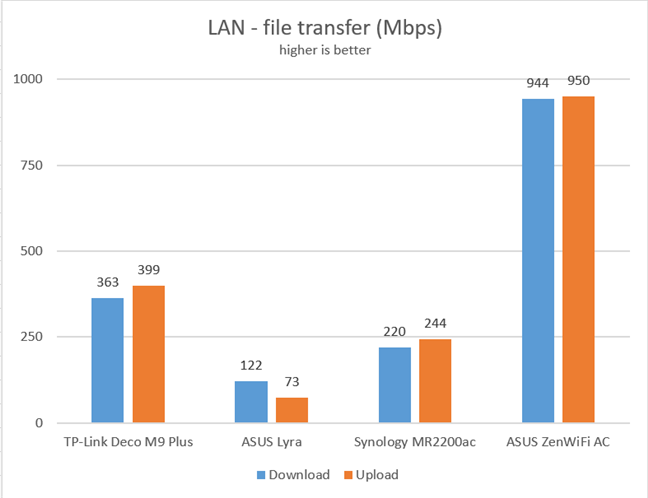
We ran a network transfer between the two computers, both connected with an Ethernet cable to the main station. We ran data transfers between them, using PassMark Performance test. ASUS ZenWiFi AC (CT8) reached speeds close to 1 Gbps, as promised in its specifications.
ASUS ZenWiFi AC (CT8) - File transfers through Ethernet connections
The other mesh Wi-Fi systems deliver lower speeds because they do not have enough ports to connect two desktop computers to the same station. Therefore, the network transfers were mediated through Wi-Fi.
USB performance
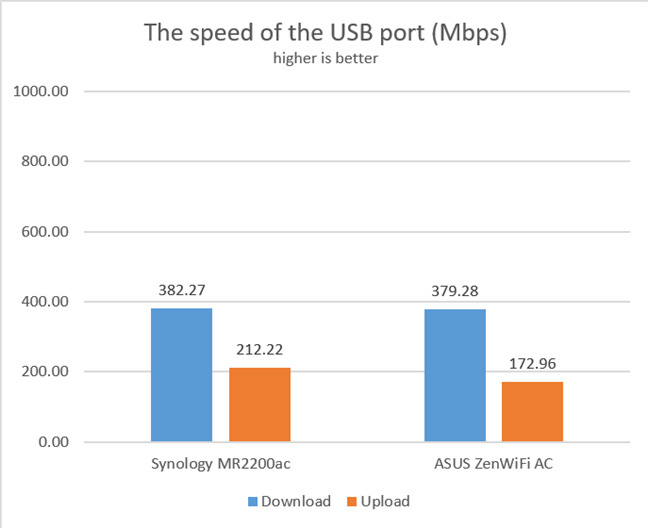
We connected a portable SSD to the USB port of the ASUS ZenWiFi AC (CT8). We then transferred data between a desktop PC and the SSD. As you can see below, the USB 3.0 port on the ASUS ZenWiFi AC (CT8) is reasonably fast. Except for the Synology MR2200ac, the other mesh Wi-Fi systems did not have a USB port so that we could compare speeds.
ASUS ZenWiFi AC (CT8) - The speed of the USB port
Unlike many mesh Wi-Fi systems, ASUS ZenWiFi AC (CT8) does have a USB 3.0 port that is reasonably fast.
Extra features
The ASUS ZenWiFi AC3000 whole-home mesh Wi-Fi system bundles many advanced features:
A comprehensive Router Security Assessment tool that verifies whether your settings are secure. When it finds problems, it proactively informs you and takes you where you need to be to fix things.
Malicious Sites Blocking - an efficient cloud-based antivirus that blocks malicious websites on all the devices connected to your network.
Two-Way IPS - a two-way intrusion prevention system that protects your network from spam, DDoS attacks, network attacks, and more. It also scans the packets that are sent from your network to the internet.
Infected Device Prevention and Blocking - if your network devices get infected, and they become zombies in malware networks, they are automatically blocked, and you are informed about this problem.
Parental Controls - useful, cloud-based parental controls that parents can use to set rules about internet access for their children's devices.
Adaptive QoS - an advanced Quality of Service feature that can be used to optimize network traffic, including but not limited to online gaming.
Guest Network - you can enable up to three wireless networks for each band, with individual security and access settings.
Traffic Analyzer - visual traffic statistics that give you a clear picture of how your network is used and by which devices.
USB Applications - apps that are designed to work with the devices that you connect to the mesh Wi-Fi using USB: external hard disks, printers, and 3G or 4G dongles or modems. You also have a Download Manager that you can use to set your AiMesh to download stuff from the internet to an external hard disk that's connected to it.
AiCloud 2.0 - a mobile app that keeps you connected to your data wherever and whenever you have an Internet connection. With it, you can access the folders shared in your home network from your Android or iOS smartphone or via a personalized URL
IPv6 - support for IPv6 addresses that are going to replace IPv4.
VPN - you can set the AiMesh system to work as a VPN server, and you can also use it to turn your network-connected devices into VPN-enabled clients, without additional VPN software required.
Network Tools - for analyzing the network and identifying what's wrong. They are useful when you need to troubleshoot problems.
Dual WAN - excellent for both small businesses and professionals who require always-on internet connections. You can also use a dual WAN to improve the quality of your internet connection and get the best possible performance.
DDNS - a service that allows you to connect to the AiMesh from the internet, even if your internet provider gives you a dynamic public IP address.
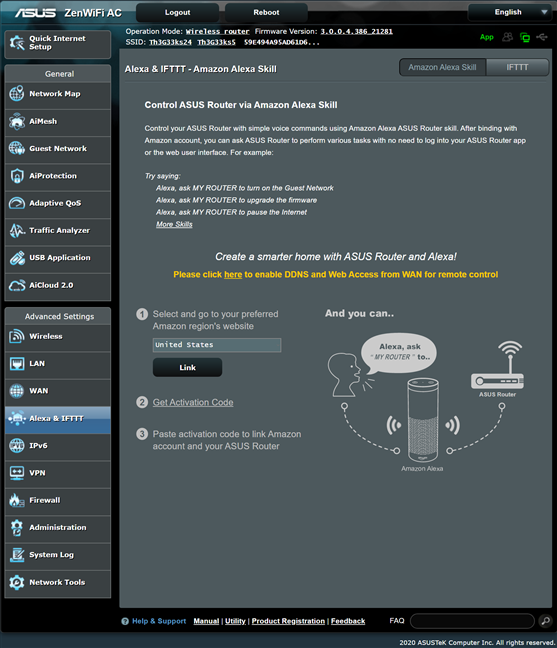
Integration with Amazon's Alexa voice assistant and IFTT (If This, Then That) - you can automate tasks that might otherwise be repetitive or unable to "talk to each other." With the help of these services, you can say things like "Alexa, ask ASUS ROUTER to upgrade the firmware" or get an email when your child gets home and connects his or her smartphone to the home Wi-Fi.
Alexa & IFTT integration
What is your opinion about the ASUS ZenWiFi AC (CT8) mesh Wi-Fi system?
Now you know our opinion about the ASUS ZenWiFi AC3000 whole-home mesh Wi-Fi system, what we like, and do not like about it. Before closing this review, tell us your opinion about this product. Do you consider it a good choice? If you already have it, what was your experience with it? Comment below and let's discuss.
Well as a user of their previous generation of extender/bridge/repeaters stability hasnt changed. Some of the unique tools in the old extender app have yet to be ported & still have value when you have to troubleshoot
Ciprian Adrian Rusen ·
Our contact from ASUS told us that they plan to add WPA3 support in the future. However, there’s no clear timeline at this point.
Jepps ·
will this have WPA3 support in future?
splendiferous ·
Great, thanks for the review. Looking forward to the XT8 review.
Anonymous ·
That review should be published in the next month or so.
































Discussion (5)
Well as a user of their previous generation of extender/bridge/repeaters stability hasnt changed. Some of the unique tools in the old extender app have yet to be ported & still have value when you have to troubleshoot
Our contact from ASUS told us that they plan to add WPA3 support in the future. However, there’s no clear timeline at this point.
will this have WPA3 support in future?
Great, thanks for the review. Looking forward to the XT8 review.
That review should be published in the next month or so.