



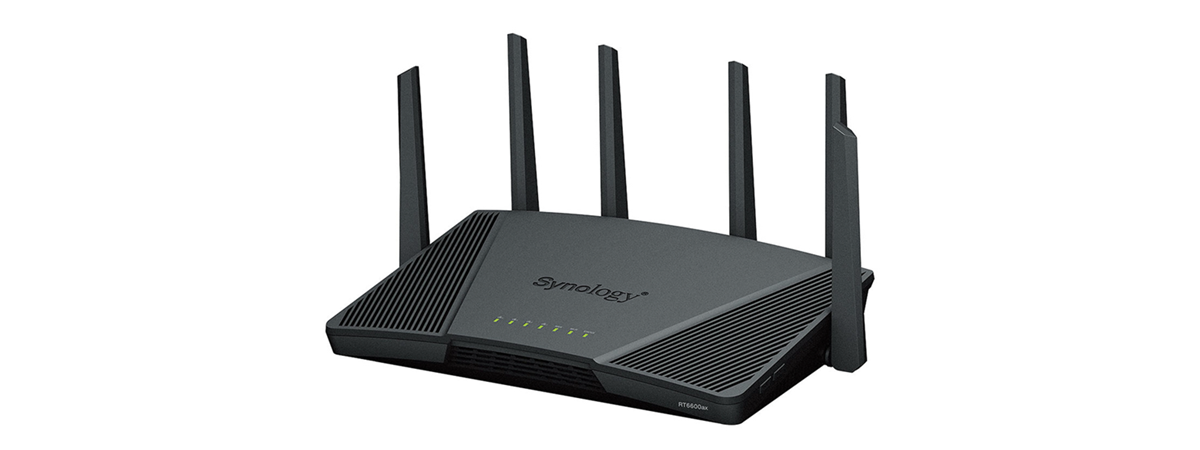
Synology is a less known brand in the world of consumer electronics and some people know the company only for its advanced Network Attached Storage (NAS) solutions. However, Synology also manufactures wireless routers for consumers and small businesses. It has a few models, accompanied by outstanding firmware and software support, and they just launched their first Wi-Fi 6 router - Synology RT6600ax. Yes, it’s late to the party, as the market is already filled with lots of models from other companies. But this doesn’t mean that Synology RT6600ax should be ignored. On the contrary, RT6600ax can offer many things you don’t get from others. Read this review to learn why it’s an impressive Wi-Fi 6 router:
![Verdict]()

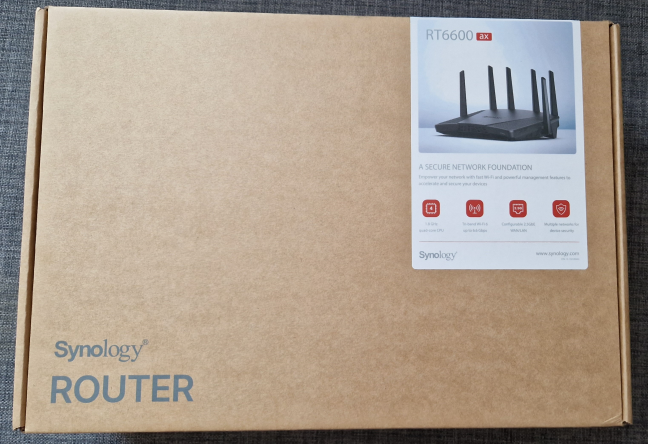
 Synology RT6600ax comes in a simple cardboard box
On the back and the sides of the cardboard box, you find details about the hardware and software features of the router.
Synology RT6600ax comes in a simple cardboard box
On the back and the sides of the cardboard box, you find details about the hardware and software features of the router.
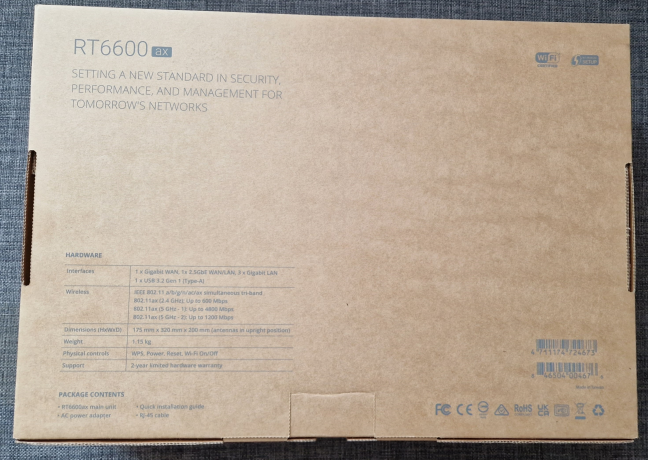
 The back of the box is even simpler than the front
When you unbox the router, you find the following items: the router itself, its power adapter, a CAT5e network cable, and the user manual.
The back of the box is even simpler than the front
When you unbox the router, you find the following items: the router itself, its power adapter, a CAT5e network cable, and the user manual.
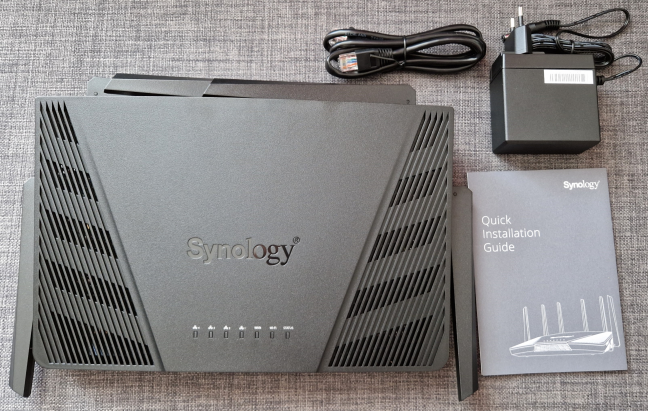
 What you find inside the box
The unboxing experience offered by Synology is very straightforward, with simple materials. Inside the box, you find what you need to start setting up your network immediately.
What you find inside the box
The unboxing experience offered by Synology is very straightforward, with simple materials. Inside the box, you find what you need to start setting up your network immediately.
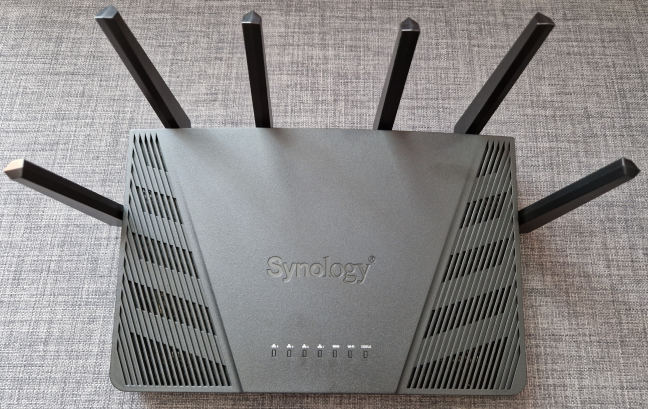
 Synology RT6600ax has six external antennas
The router has a very aggressive look, with ventilation grids on the front and the model discretely written on the right.
Synology RT6600ax has six external antennas
The router has a very aggressive look, with ventilation grids on the front and the model discretely written on the right.
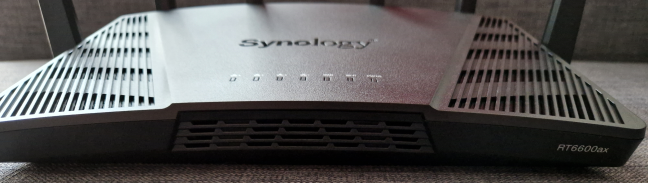
 Synology RT6600ax seen from the front
On the right side of the router, you find the buttons for WPS and Wi-Fi, which enable or disable these features. There are no buttons on the left side of the router, only the ventilation grids similar to those on the right.
Synology RT6600ax seen from the front
On the right side of the router, you find the buttons for WPS and Wi-Fi, which enable or disable these features. There are no buttons on the left side of the router, only the ventilation grids similar to those on the right.
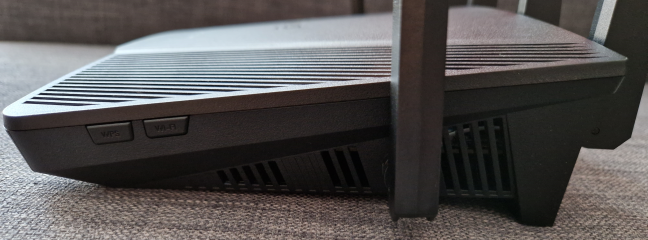
 The buttons for WPS and Wi-Fi
On the bottom of the Synology RT6600ax, there are other ventilation grids that help keep things cool, a sticker with information about the product you bought, and two holes for mounting the router on walls.
The buttons for WPS and Wi-Fi
On the bottom of the Synology RT6600ax, there are other ventilation grids that help keep things cool, a sticker with information about the product you bought, and two holes for mounting the router on walls.
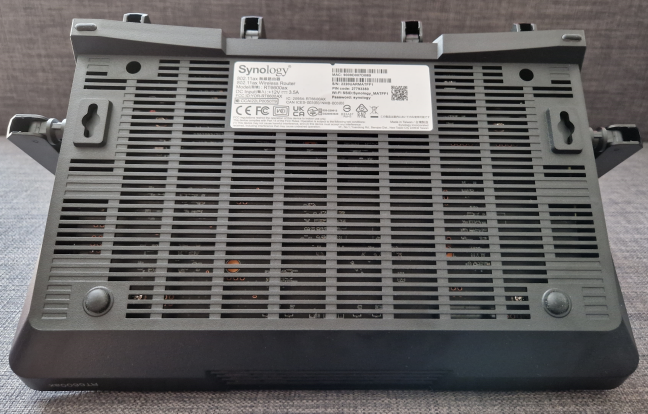
 On the bottom, you find holes for mounting the router on walls
On the back of the router, you find a USB 3.2 Gen 1 port, a WAN port working at 1 Gbps, a 2.5 Gbps port that can be used either for WAN or LAN and three other 1 Gbps Ethernet ports. Next to them, you can see the Power button for the router, a Reset jack, and the Power jack.
On the bottom, you find holes for mounting the router on walls
On the back of the router, you find a USB 3.2 Gen 1 port, a WAN port working at 1 Gbps, a 2.5 Gbps port that can be used either for WAN or LAN and three other 1 Gbps Ethernet ports. Next to them, you can see the Power button for the router, a Reset jack, and the Power jack.
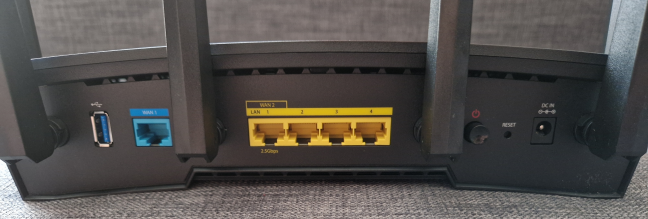
 The ports on the back of the Synology RT6600ax
Inside the Synology RT6600ax, there is a quad-core Atheros IPQ6018 1.8 GHz processor from Qualcomm, 1 GB of DDR3 RAM, and a generous 4 GB of eMMC Flash storage for the firmware.
The router is quite large and heavy, with a size of 175 mm x 320 mm x 200 mm or 6.88 x 12.59 x 7.86 inches in height x width x depth and a weight of 1.6 kg or 3.52 pounds.
If you want more technical information about this product, I recommend you visit its official page: Synology RT6600ax.
The ports on the back of the Synology RT6600ax
Inside the Synology RT6600ax, there is a quad-core Atheros IPQ6018 1.8 GHz processor from Qualcomm, 1 GB of DDR3 RAM, and a generous 4 GB of eMMC Flash storage for the firmware.
The router is quite large and heavy, with a size of 175 mm x 320 mm x 200 mm or 6.88 x 12.59 x 7.86 inches in height x width x depth and a weight of 1.6 kg or 3.52 pounds.
If you want more technical information about this product, I recommend you visit its official page: Synology RT6600ax.
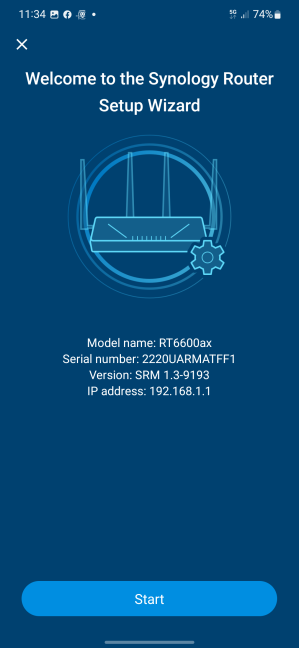
 Setting up the router using the DS router app
The DS router app applies your settings and asks you to reconnect to your Wi-Fi using the details you’ve just entered. Next, you can choose to link your router to a Synology cloud account that allows you to configure and monitor your network from anywhere, as long as you’re connected to the internet. This step is optional. Once that is out of the way, you see your Synology router in the app and can manage all its settings.
Setting up the router using the DS router app
The DS router app applies your settings and asks you to reconnect to your Wi-Fi using the details you’ve just entered. Next, you can choose to link your router to a Synology cloud account that allows you to configure and monitor your network from anywhere, as long as you’re connected to the internet. This step is optional. Once that is out of the way, you see your Synology router in the app and can manage all its settings.
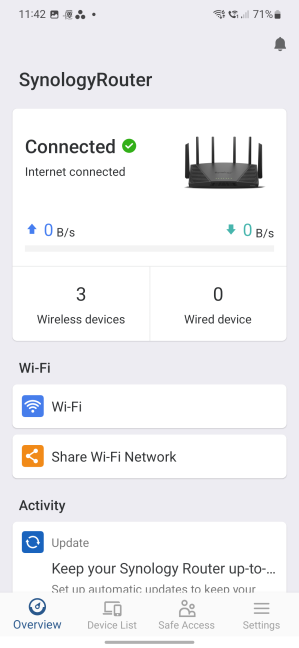 The DS router app
What I appreciate about the DS router app is that it offers an extensive list of configuration options. You can manage your Wi-Fi settings, share the connection details with others, manage connected devices, configure parental controls (included in the Safe Access module), and access many other features like VPN, port forwarding rules, the firewall, or firmware updates. While the mobile app is not as comprehensive as the router’s admin web-based interface, it covers most of the things you need. Speaking of which, I’m always impressed by how well made Synology’s web-based interface is: it’s called Synology Router Manager or SRM - a custom version of Linux that was created by Synology for managing its routers. It is available in twenty languages (less used languages like my native Romanian are not included though), it is very modular (you install the modules/features you want and remove those you don’t to optimize resource consumption), very well organized, and with plenty of advanced configuration options and features.
The DS router app
What I appreciate about the DS router app is that it offers an extensive list of configuration options. You can manage your Wi-Fi settings, share the connection details with others, manage connected devices, configure parental controls (included in the Safe Access module), and access many other features like VPN, port forwarding rules, the firewall, or firmware updates. While the mobile app is not as comprehensive as the router’s admin web-based interface, it covers most of the things you need. Speaking of which, I’m always impressed by how well made Synology’s web-based interface is: it’s called Synology Router Manager or SRM - a custom version of Linux that was created by Synology for managing its routers. It is available in twenty languages (less used languages like my native Romanian are not included though), it is very modular (you install the modules/features you want and remove those you don’t to optimize resource consumption), very well organized, and with plenty of advanced configuration options and features.
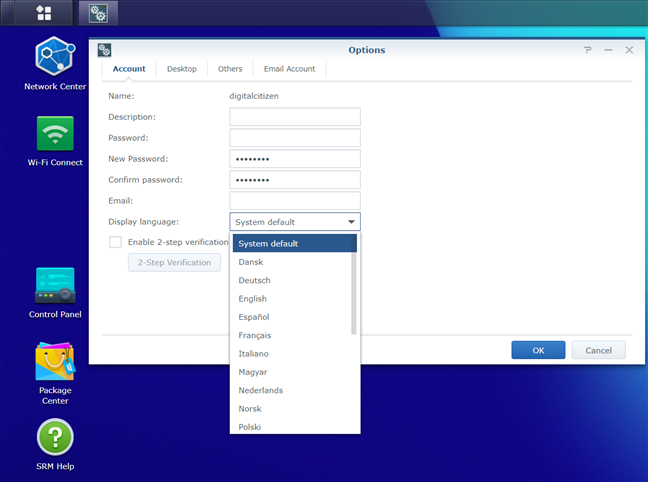
 SRM v1.3 is available in twenty languages
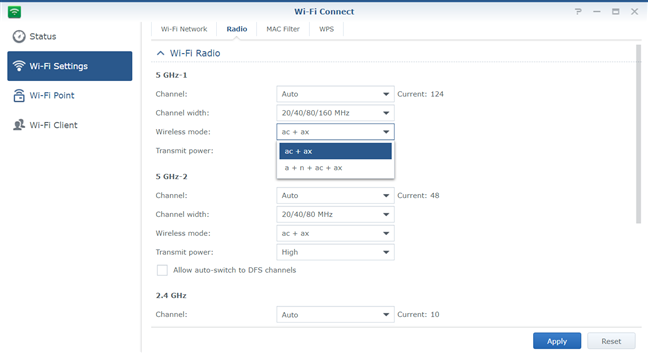
For the most part, SRM is very easy to use and finding your way shouldn’t be a problem even if you are not a technical user. The user documentation is very well organized and easily accessible. Therefore, even if you come across more technical settings, you have all the information you need to set things up correctly. The only downside I could find was that I couldn’t set the Synology RT6600ax to NOT use Wi-Fi 6 for all its bands. On tri-band routers, I personally prefer to use the following setup: Wi-Fi 4 for the 2.4 GHz band, Wi-Fi 5 for the slower 5 GHz band, and Wi-Fi 6 for the fastest 5 GHz band. I couldn’t do this here, and Wi-Fi 6 was turned on for everything. I think that Synology should improve this aspect in their future SRM versions.
SRM v1.3 is available in twenty languages
For the most part, SRM is very easy to use and finding your way shouldn’t be a problem even if you are not a technical user. The user documentation is very well organized and easily accessible. Therefore, even if you come across more technical settings, you have all the information you need to set things up correctly. The only downside I could find was that I couldn’t set the Synology RT6600ax to NOT use Wi-Fi 6 for all its bands. On tri-band routers, I personally prefer to use the following setup: Wi-Fi 4 for the 2.4 GHz band, Wi-Fi 5 for the slower 5 GHz band, and Wi-Fi 6 for the fastest 5 GHz band. I couldn’t do this here, and Wi-Fi 6 was turned on for everything. I think that Synology should improve this aspect in their future SRM versions.
 Configuring the Wi-Fi on Synology RT6600ax
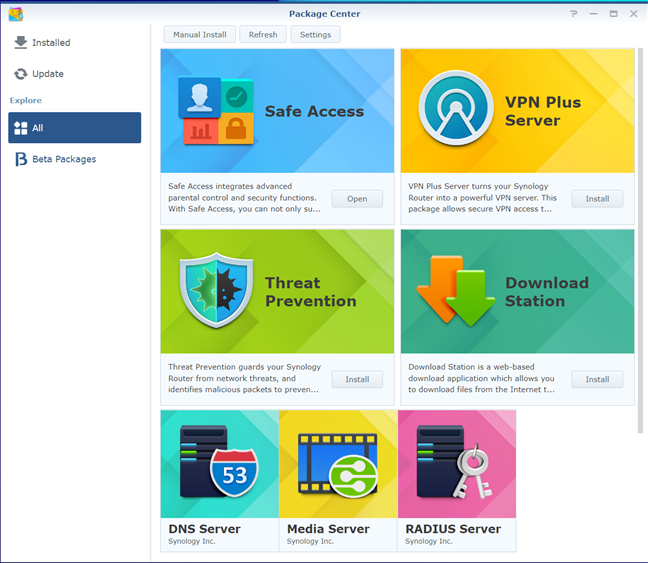
Leaving this issue aside, you CAN set the Synology RT6600ax to broadcast using the older standards alongside Wi-Fi 6. Therefore, there’s no reason to panic because even older devices should still see and connect to your Wi-Fi, even if they are not compatible with Wi-Fi 6 networks. I was saying earlier that the SRM is modular. This means that it includes only the features that Synology considers as “core” to the router and what most people would want to use. Extra features like the VPN Plus Server, Threat prevention, and Media Server can be installed, configured, and updated as modules from the Package Center.
Configuring the Wi-Fi on Synology RT6600ax
Leaving this issue aside, you CAN set the Synology RT6600ax to broadcast using the older standards alongside Wi-Fi 6. Therefore, there’s no reason to panic because even older devices should still see and connect to your Wi-Fi, even if they are not compatible with Wi-Fi 6 networks. I was saying earlier that the SRM is modular. This means that it includes only the features that Synology considers as “core” to the router and what most people would want to use. Extra features like the VPN Plus Server, Threat prevention, and Media Server can be installed, configured, and updated as modules from the Package Center.
 The Package Center is where you install advanced features
In my view, this is a very good approach because it doesn’t overload the hardware resources of your router with features that are dormant and not used. People get to install and use only what they want, without any bloatware, and that’s great.
In my week of using this router, I noticed the following aspects:
The Package Center is where you install advanced features
In my view, this is a very good approach because it doesn’t overload the hardware resources of your router with features that are dormant and not used. People get to install and use only what they want, without any bloatware, and that’s great.
In my week of using this router, I noticed the following aspects:
 The apartment in which I tested Synology RT6600ax
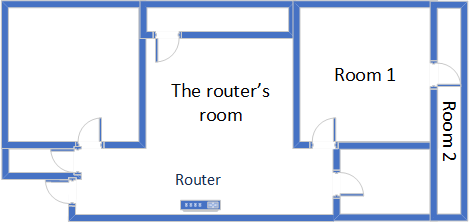
I evaluate the quality of the wireless network managed by Synology RT6600ax through measurements made in three different places:
The apartment in which I tested Synology RT6600ax
I evaluate the quality of the wireless network managed by Synology RT6600ax through measurements made in three different places:
 Signal strength on Wi-Fi 6 (2.4 GHz band)
To make measurements using the Wi-Fi 4 standard, I configured the drivers on my HP laptop to use it instead of Wi-Fi 6. Then, I started the SpeedTest app and used it to measure the maximum speed you get when transferring data to and from the internet on the 2.4 GHz band, using Wi-Fi 4. As you can see below, Synology RT6600ax delivered fast downloads in all rooms.
Signal strength on Wi-Fi 6 (2.4 GHz band)
To make measurements using the Wi-Fi 4 standard, I configured the drivers on my HP laptop to use it instead of Wi-Fi 6. Then, I started the SpeedTest app and used it to measure the maximum speed you get when transferring data to and from the internet on the 2.4 GHz band, using Wi-Fi 4. As you can see below, Synology RT6600ax delivered fast downloads in all rooms.
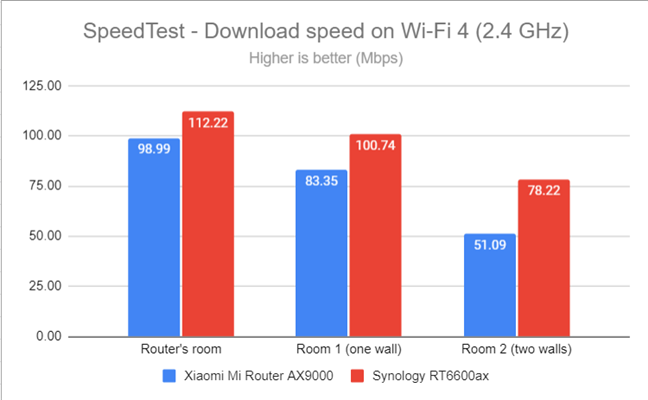
 SpeedTest - The download speed on Wi-Fi 4 (2.4 GHz)
The uploads were a lot slower than the downloads, especially in Room 2, where other routers tend to have problems too.
SpeedTest - The download speed on Wi-Fi 4 (2.4 GHz)
The uploads were a lot slower than the downloads, especially in Room 2, where other routers tend to have problems too.
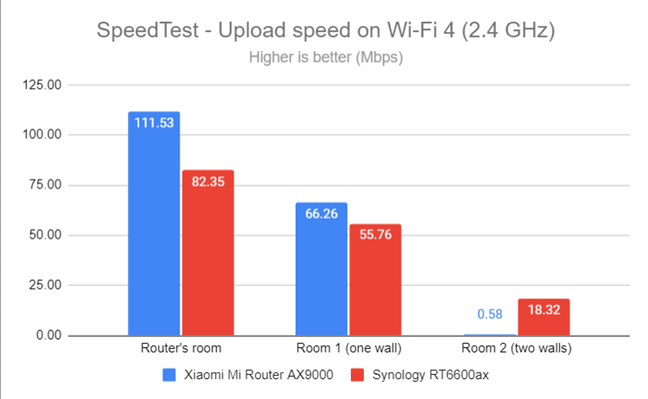
 SpeedTest - The upload speed on Wi-Fi 4 (2.4 GHz)
I switched to Wi-Fi 6 on the 2.4 GHz band, and downloads were again pretty fast everywhere in my apartment.
SpeedTest - The upload speed on Wi-Fi 4 (2.4 GHz)
I switched to Wi-Fi 6 on the 2.4 GHz band, and downloads were again pretty fast everywhere in my apartment.
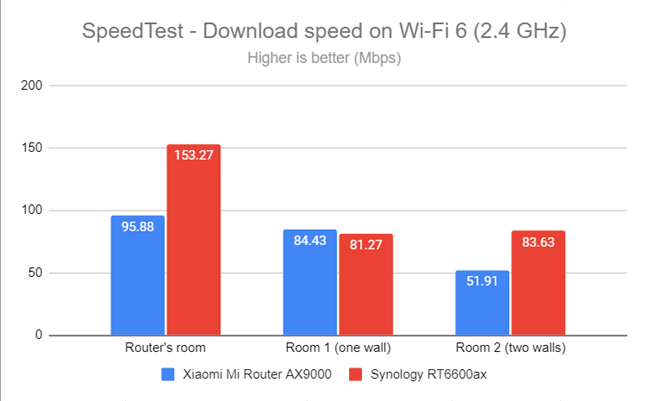 SpeedTest - The download speed on Wi-Fi 6 (2.4 GHz)
The upload speed was lower everywhere, and in Room 2 it was even slower than the one I got when using Wi-Fi 4, which isn’t great at all.
SpeedTest - The download speed on Wi-Fi 6 (2.4 GHz)
The upload speed was lower everywhere, and in Room 2 it was even slower than the one I got when using Wi-Fi 4, which isn’t great at all.
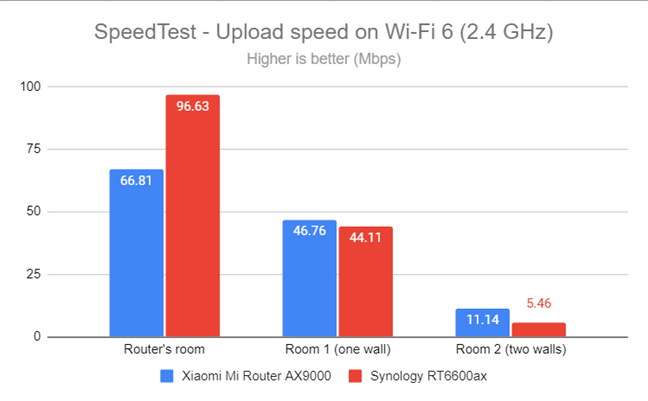 SpeedTest - The upload speed on Wi-Fi 6 (2.4 GHz)
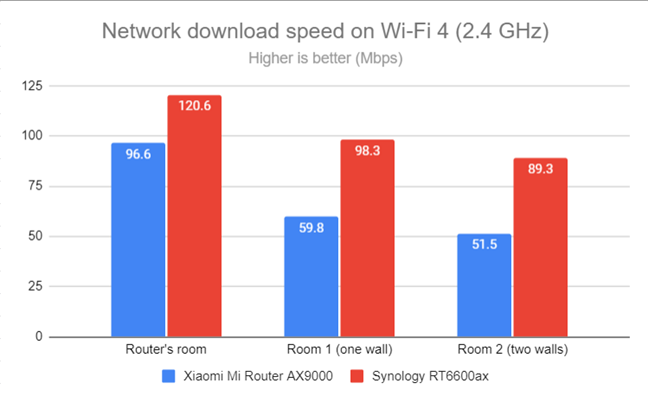
For the next set of measurements, I used the PassMark Performance test to transfer data between two computers connected to the network. I was on the 2.4 GHz band using the Wi-Fi 4 standard, and the average download speed was excellent everywhere.
SpeedTest - The upload speed on Wi-Fi 6 (2.4 GHz)
For the next set of measurements, I used the PassMark Performance test to transfer data between two computers connected to the network. I was on the 2.4 GHz band using the Wi-Fi 4 standard, and the average download speed was excellent everywhere.
 Network Wi-Fi downloads on Wi-Fi 4 (2.4 GHz)
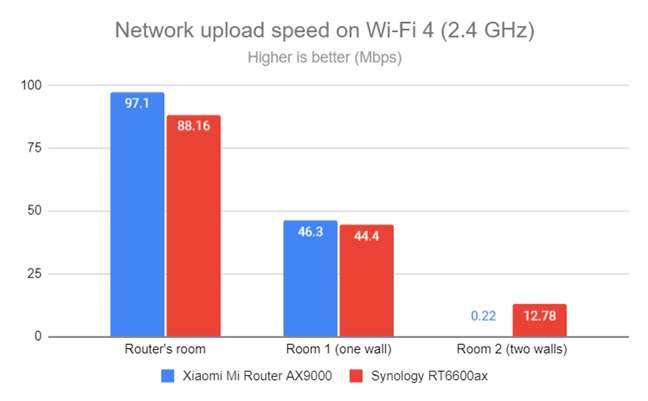
Again, uploads were generally slower, especially in Room 2.
Network Wi-Fi downloads on Wi-Fi 4 (2.4 GHz)
Again, uploads were generally slower, especially in Room 2.
 Network Wi-Fi uploads on Wi-Fi 4 (2.4 GHz)
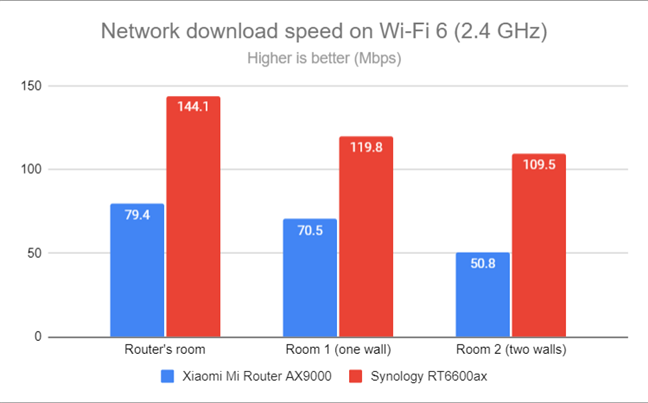
I repeated the same measurements on the 2.4 GHz band, this time using the Wi-Fi 6 standard. I noticed significant improvements in download speeds in all the rooms of my apartment.
Network Wi-Fi uploads on Wi-Fi 4 (2.4 GHz)
I repeated the same measurements on the 2.4 GHz band, this time using the Wi-Fi 6 standard. I noticed significant improvements in download speeds in all the rooms of my apartment.
 Network Wi-Fi downloads on Wi-Fi 6 (2.4 GHz)
Uploads were fast everywhere except Room 2, where I barely managed to transfer some data over the network.
Network Wi-Fi downloads on Wi-Fi 6 (2.4 GHz)
Uploads were fast everywhere except Room 2, where I barely managed to transfer some data over the network.
Network Wi-Fi uploads on Wi-Fi 6 (2.4 GHz)
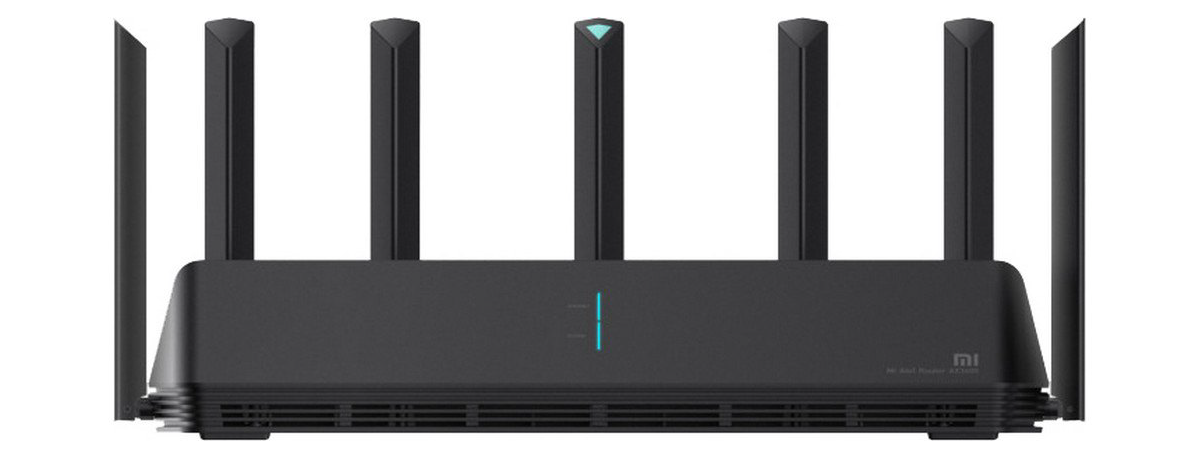
My measurements have shown that the Synology RT6600ax doesn’t offer a large coverage area on the 2.4 GHz band. Even though it is faster than the Xiaomi Mi Router AX9000, it shares the same issue in Room 2, where uploading data becomes a real pain. This issue is most probably caused by the Qualcomm chips both routers are using than their manufacturer’s firmware.
 Signal strength on Wi-Fi 6 (5 GHz band)
I switched to the SpeedTest app. When using the Wi-Fi 5 standard, the Synology RT6600ax delivers fast downloads but it was easily beaten by the Xiaomi Mi Router AX9000.
Signal strength on Wi-Fi 6 (5 GHz band)
I switched to the SpeedTest app. When using the Wi-Fi 5 standard, the Synology RT6600ax delivers fast downloads but it was easily beaten by the Xiaomi Mi Router AX9000.
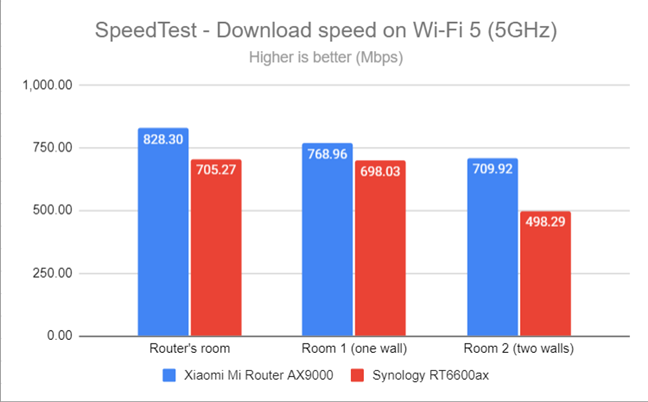 SpeedTest - The download speed on Wi-Fi 5 (5 GHz)
When measuring the upload speed, the picture changed, and Synology RT6600ax was the faster router.
SpeedTest - The download speed on Wi-Fi 5 (5 GHz)
When measuring the upload speed, the picture changed, and Synology RT6600ax was the faster router.
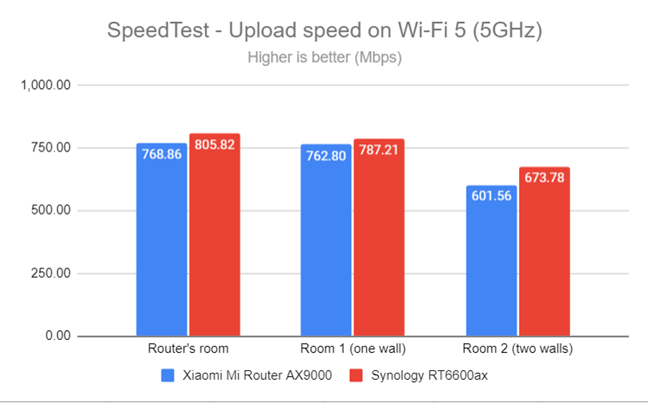 SpeedTest - The upload speed on Wi-Fi 5 (5 GHz)
When switching to the Wi-Fi 6 standard, Synology RT6600ax delivered download speeds which were slower than the router I’ve compared it to.
SpeedTest - The upload speed on Wi-Fi 5 (5 GHz)
When switching to the Wi-Fi 6 standard, Synology RT6600ax delivered download speeds which were slower than the router I’ve compared it to.
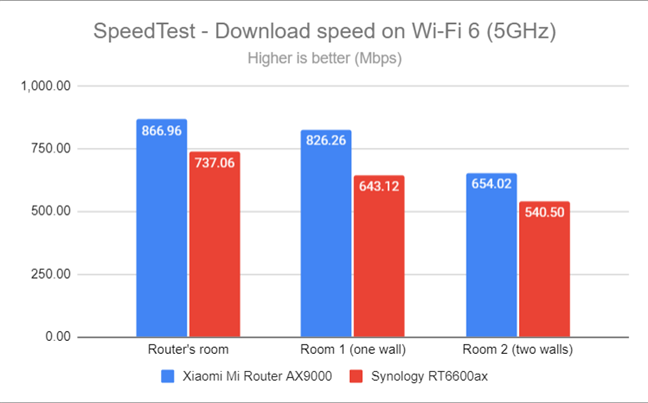 SpeedTest - The download speed on Wi-Fi 6 (5 GHz)
When measuring the upload speeds, they were slower when using Wi-Fi 6 than the ones we got when using Wi-Fi 5.
SpeedTest - The download speed on Wi-Fi 6 (5 GHz)
When measuring the upload speeds, they were slower when using Wi-Fi 6 than the ones we got when using Wi-Fi 5.
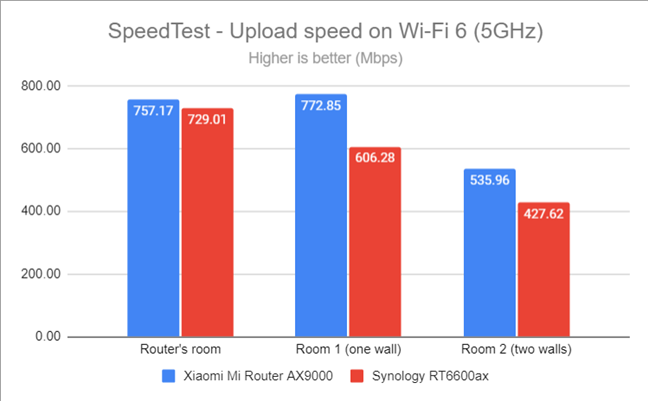 SpeedTest - The upload speed on Wi-Fi 6 (5 GHz)
For the next set of measurements, I used the PassMark Performance test to transfer data between two computers connected to the network. Here I see the average speed you get when transferring data only inside the network, and not on the internet. This time, things improved tremendously, and Synology RT6600ax showed its true potential, reaching download speeds of 1349.3 Mbps on Wi-Fi 5. That’s super impressive.
SpeedTest - The upload speed on Wi-Fi 6 (5 GHz)
For the next set of measurements, I used the PassMark Performance test to transfer data between two computers connected to the network. Here I see the average speed you get when transferring data only inside the network, and not on the internet. This time, things improved tremendously, and Synology RT6600ax showed its true potential, reaching download speeds of 1349.3 Mbps on Wi-Fi 5. That’s super impressive.
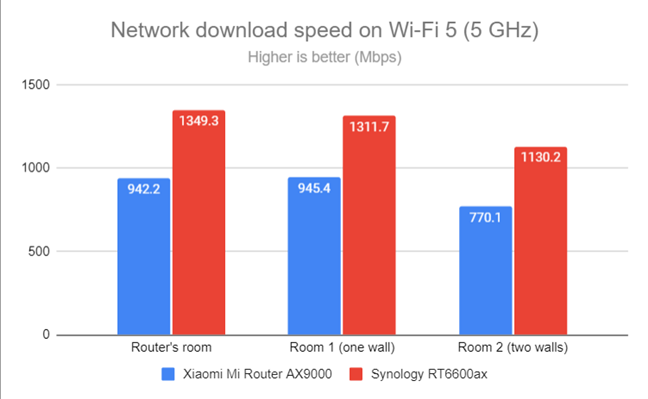 Network Wi-Fi downloads on Wi-Fi 5 (5 GHz)
Uploads were very fast too, but Synology RT6600ax was the fastest router of our comparison only in the room where it was placed.
Network Wi-Fi downloads on Wi-Fi 5 (5 GHz)
Uploads were very fast too, but Synology RT6600ax was the fastest router of our comparison only in the room where it was placed.
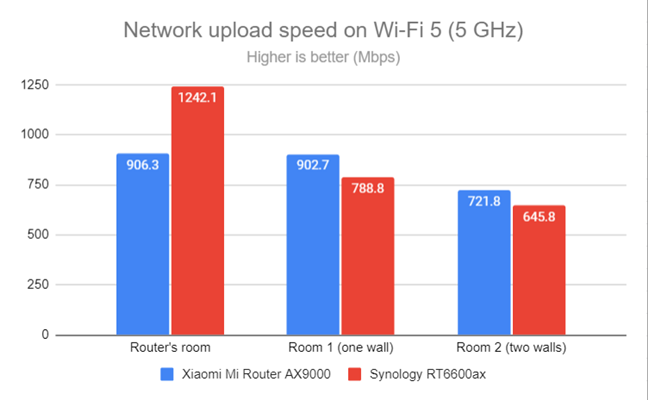 Network Wi-Fi uploads on Wi-Fi 5 (5 GHz)
Moving on to the Wi-Fi 6 standard, I noticed further improvements to the download speed. However, they were not very high.
Network Wi-Fi uploads on Wi-Fi 5 (5 GHz)
Moving on to the Wi-Fi 6 standard, I noticed further improvements to the download speed. However, they were not very high.
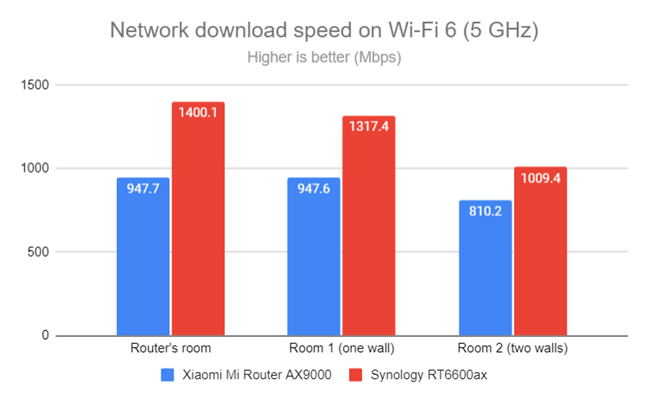 Network Wi-Fi downloads on Wi-Fi 6 (5 GHz)
Uploads were faster when using Wi-Fi 6 in the rooms furthest from the router.
Network Wi-Fi downloads on Wi-Fi 6 (5 GHz)
Uploads were faster when using Wi-Fi 6 in the rooms furthest from the router.
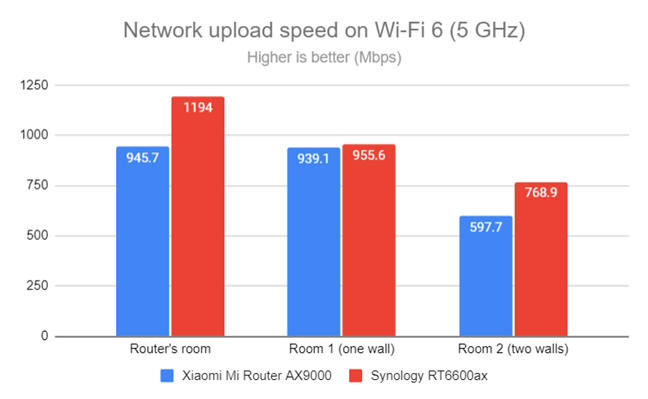 Network Wi-Fi uploads on Wi-Fi 6 (5 GHz)
When using the 5 GHz band, both on Wi-Fi 5 and Wi-Fi 6, the performance delivered by the Synology RT6600ax is excellent.
Network Wi-Fi uploads on Wi-Fi 6 (5 GHz)
When using the 5 GHz band, both on Wi-Fi 5 and Wi-Fi 6, the performance delivered by the Synology RT6600ax is excellent.
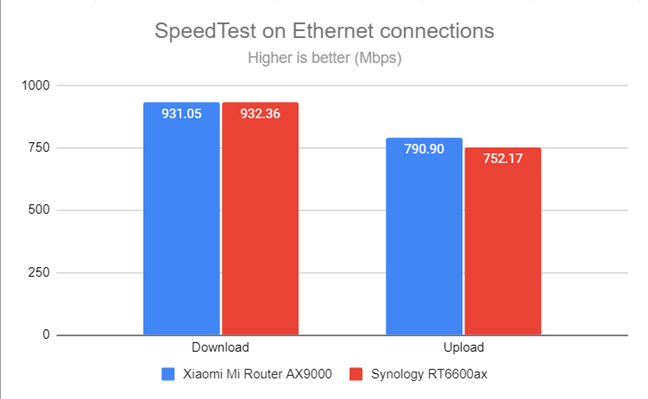 SpeedTest on wired connections
I also plugged a fast SSD drive into the USB 3.2 Gen 1 port of the router and made some data transfers on it. The speeds I measured were the fastest I’ve seen on a router. It only made me wish the router had all its Ethernet ports working at 2.5 Gbps instead of 1 Gbps, so that more devices in the network would profit from the ultra-fast USB port.
SpeedTest on wired connections
I also plugged a fast SSD drive into the USB 3.2 Gen 1 port of the router and made some data transfers on it. The speeds I measured were the fastest I’ve seen on a router. It only made me wish the router had all its Ethernet ports working at 2.5 Gbps instead of 1 Gbps, so that more devices in the network would profit from the ultra-fast USB port.
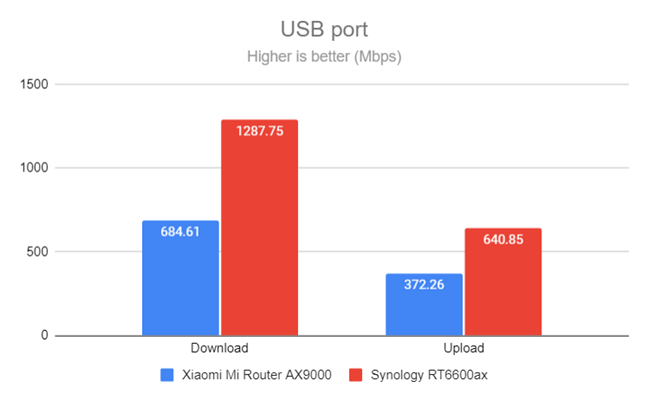 The speed of the USB 3.2 Gen 1 port
The Synology RT6600ax has no problem handling 1 Gbps Ethernet connections, and it can use 2.5 Gbps internet connections too. Also, its USB 3.2 Gen 1 port is the fastest I’ve seen on a consumer router so far. My only complaint is that I would have liked to see more 2.5 Gbps ports on this router, not just one.
The speed of the USB 3.2 Gen 1 port
The Synology RT6600ax has no problem handling 1 Gbps Ethernet connections, and it can use 2.5 Gbps internet connections too. Also, its USB 3.2 Gen 1 port is the fastest I’ve seen on a consumer router so far. My only complaint is that I would have liked to see more 2.5 Gbps ports on this router, not just one.
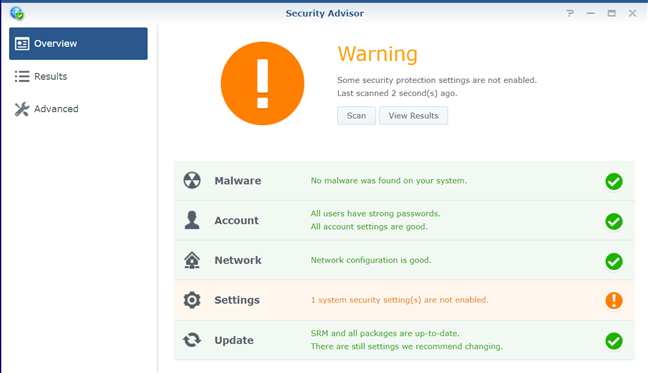
 Synology's Security Advisor
Synology RT6600ax: Who is it good for?
This wireless router is a suitable choice for:- Users who have 2.5 Gbps internet connections
- People who want fast Wi-Fi in their homes or small businesses
- Users who like efficient security, parental controls, VPN, and other advanced features on their router
- Those who want advanced control options on their router’s mobile app
- Wi-Fi networks that include many connected devices
- People who want a router with a fast USB port to turn into a NAS or media server
Pros and cons
Here are the things we like about Synology RT6600ax:- Excellent hardware that can handle many network devices
- Fast Wi-Fi on all three bands
- WPA3 encryption support
- 160 MHz channel bandwith
- Modular firmware with many advanced features that you won’t find anywhere else
- Ultra-fast USB 3.2 Gen 1 port
- Mesh Wi-Fi support
- Top-notch security tools and parental controls
- Excellent help documentation
- All its Ethernet ports should have been 2.5 Gbps ports, not just one
- Small coverage area on the 2.4 GHz band
- It’s pricier than other AX6000 routers
Verdict
Synology RT6600ax is a combination of superb hardware and firmware in a simple no-nonsense package that doesn’t overpromise anything. Except for its small coverage area on the 2.4 GHz band, Synology RT6600ax hits all the right boxes, and it has quickly become one of my favorite models. I recommend it to anyone who can afford it and wants a well-crafted Wi-Fi 6 router that’s not just fast but also secure, capable of doing just about anything you can think of. I highly recommend it, and I’m convinced you won’t be sorry for your purchase.Unboxing the Synology RT6600ax
The packaging used by Synology for its products is always rather spartan, including the one for the RT6600ax router. This product comes in a simple cardboard box with a sticker on the top cover showing a picture of the router and its main technical characteristics.Hardware specifications and design
Synology RT6600ax has a classic design with six external non-detachable antennas. On the top, you see the Synology logo, some ventilation grids, and LEDs that signal the router's functioning and its features: Wi-Fi, Ethernet ports, and internet access. It is a tri-band Wi-Fi 6 router, with the total theoretical bandwidth split as follows: 600 Mbps for its 2.4 GHz band, 4800 Mbps for its first 5 GHz band, and 1200 Mbps for its second 5 GHz band. Synology RT6600ax offers 4x4 MU-MIMO wireless transfers on the 5 GHz bands and 2x2 MU-MIMO on the 2.4 GHz band. The first 5 GHz band can work with a 160 MHz channel bandwidth, while the second with a maximum of 80 MHz. You can also use WPA3 encryption on all bands, which is excellent.Setting up and using the Synology RT6600ax
Setting up the Synology RT6600ax can be done both using a web browser on a computer that’s connected to the network managed by the router and by using the DS router app for Android and iOS. This time, I chose to use the mobile app for this process. The DS router app offers a friendly and comprehensive wizard for the installation of your router. It starts by informing you about your privacy, the types of data it collects, and for which purposes. Then, you choose the Synology router you want to set up, create an admin account for the router, choose a name and password for your Wi-Fi, select the operation mode for your router, add the details for connecting to the internet, and agree to the terms of service.- The Wi-Fi is fast on all three bands, and downloads are generally fast everywhere in the coverage area.
- The coverage for the 2.4 GHz frequency band has similar issues to the Xiaomi routers I’ve tested in recent weeks, all equipped with Qualcomm processors, just like Synology RT6600ax.
- Transfers on the 2.4 GHz band also suffer from relatively high variability, with big differences between the minimum and maximum speeds achieved.
- Wi-Fi 5 and Wi-Fi 6 performance is very good across the board.
Wireless network performance
My test apartment is set up similarly to the diagram below. As you can see, I’ve placed the Synology RT6600ax in a central position to provide good coverage in all the rooms where I tend to spend most of my time.- I record the maximum speeds when no walls absorb the wireless signal in the room where the router is placed.
- Room 1 - is separated by one wall from the router. The wireless signal and the Wi-Fi speed I get should be lower here.
- Room 2 - is separated from the router by two walls absorbing the wireless signal. Also, the wall between Room 1 and Room 2 is twice as thick as the one between the router’s room and Room 1. Room 2 can be a difficult challenge for many routers.
How the Synology RT6600ax performs on the 2.4 GHz band
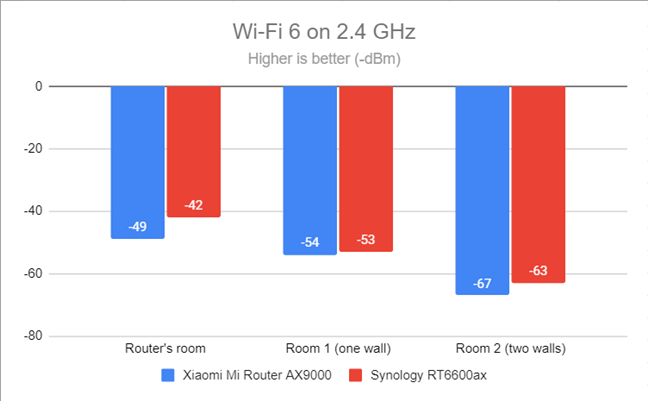
I first measured the signal strength using NetSpot. Unfortunately, you cannot set the Synology RT6600ax to use only Wi-Fi 4 or only Wi-Fi 6 on the 2.4 GHz band. It broadcasted both standards at the same time, so the signal strength was the same for both. As you can see below, the router delivered solid signal strength in all rooms.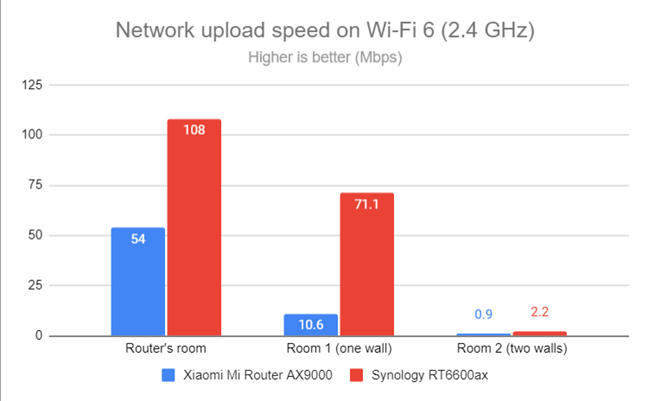
How the Synology RT6600ax performs on the 5 GHz band
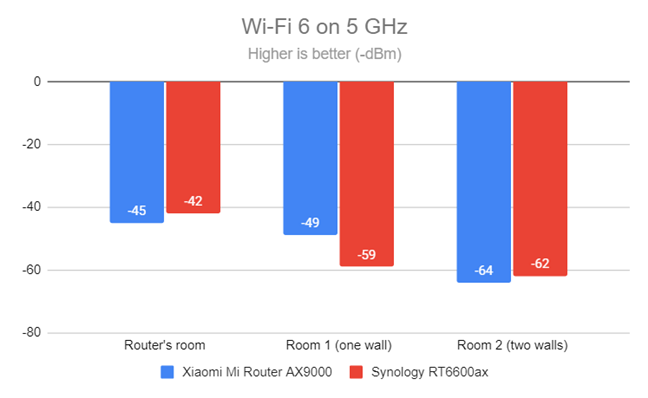
I switched to the 5 GHz band, and I started by measuring the signal strength with NetSpot. Again, I couldn’t set the Synology RT6600ax to use either Wi-Fi 5 or Wi-Fi 6 on its 5 GHz bands. It only broadcasted both at the same time. However, the signal strength was solid in all the rooms of my apartment, as shown below.Wired network performance & USB port
It was time to evaluate the performance of Ethernet network connections. My internet connection offers a maximum of 1 Gbps for the download speed and 800 Mbps for the upload. When using SpeedTest, the Synology RT6600ax reached speeds that were close to the maximum potential of my internet connection, as shown in the graphic below.Extra features
The firmware on the Synology RT6600ax is delightfully rich in advanced features that users can install and configure if they want:- Safe Access - a comprehensive security module that includes cloud-based parental controls, a security advisor, safe online search and web browsing, as well as threat prevention.
- Threat Prevention - identifies malicious packets and network threats, preventing your Synology router from infection and data compromise.
- Download Station - a web-based application which allows you to download files from the internet straight to a hard disk or SSD connected to the router’s USB port, using a wide variety of protocols.
- Media Server - turn your external hard disk connected to the router into a streaming server for the entire network, with music, photos, and videos stored on it. This service is compatible with Xbox and PS consoles too.
- Dual WAN - useful for both small businesses and professionals who require always-on internet connections. You can also use a Dual WAN to improve the quality of your internet connection and get the best possible performance.
- 4G/5G Dongle and Tethering - you can connect a USB modem to provide the router and your network with a backup internet connection.
- VPN Plus Server - you can set the router to work as a VPN server, and you can also use it to turn your network-connected devices into VPN-enabled clients, without additional VPN software required.
- DNS Server - you can set your router to work as a DNS server and provide name and IP address resolution services. This is a very advanced feature you don’t find on routers from other manufacturers.
- RADIUS Server - a networking protocol that provides centralized authentication, authorization, and accounting for wireless network access. This feature is aimed mostly at business users.
- Guest Network - you can enable a wireless network with separate security from the rest of your network, a customized guest portal (very useful for business users), and different access settings.
- Network Tools - a collection of troubleshooting tools that’s useful when things don’t work well in your network.
- DDNS - a service that allows you to connect to the router from the internet, even if your internet provider gives you a dynamic public IP address.
Discussion (0)
Comments are closed.