




Both Intel’s and AMD’s latest generation of desktop processors are excellent choices for gaming. They deliver incredible speeds and performance, from the mid-range area all the way up to the higher-end models. There’s no question about it: you’ll make a great choice by going with either AMD or Intel processors, at least in terms of gaming. However, I couldn’t help myself from wondering whether Intel is better than AMD or the other way around. Thus, I decided to test two similar processors from both companies and see which one’s the winner of the framerate battle. I didn’t choose the most powerful processors; I used the runner-ups from both teams: the Intel Core i9-13900K and the AMD Ryzen 9 7900X. Are you curious about which one is better in games? Then read on and find out:
 AMD Ryzen 9 7900X vs. Intel Core i9-13900K
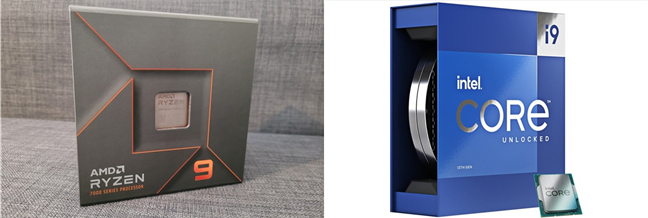
AMD’s Ryzen 9 7900X is also the second in line from the company’s latest generation of processors, based on the Zen 4 architecture. Featuring twelve cores and twenty-four execution threads, this CPU can reach a maximum boost frequency of 5.6 GHz, it can rely on 12 MB of Level 2 cache and 64 MB of Level 3 cache, and it supports DDR5 memory only. The only AMD processor that’s faster is the AMD Ryzen 9 7950X, which offers a maximum turbo speed of 5.7 GHz and four cores (8 threads) more. Compared to Intel’s Core i9-13900K, the AMD Ryzen 9 7900X is sold at a more affordable price of about 420 USD.
AMD Ryzen 9 7900X vs. Intel Core i9-13900K
AMD’s Ryzen 9 7900X is also the second in line from the company’s latest generation of processors, based on the Zen 4 architecture. Featuring twelve cores and twenty-four execution threads, this CPU can reach a maximum boost frequency of 5.6 GHz, it can rely on 12 MB of Level 2 cache and 64 MB of Level 3 cache, and it supports DDR5 memory only. The only AMD processor that’s faster is the AMD Ryzen 9 7950X, which offers a maximum turbo speed of 5.7 GHz and four cores (8 threads) more. Compared to Intel’s Core i9-13900K, the AMD Ryzen 9 7900X is sold at a more affordable price of about 420 USD.
 Benchmarks results in 3DMark Speed Way
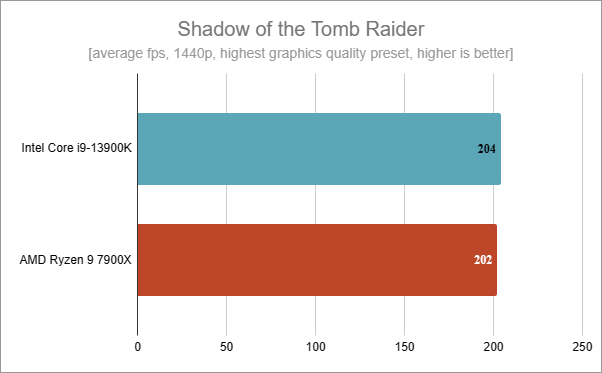
Next, I began testing real games, starting with Shadow of the Tomb Raider. In its benchmark tool, both computers delivered similar averages of frames per second. On the PC equipped with the Intel Core i9-13900K, the benchmark measured an average framerate of 204, which is practically the same as the 202 fps I got with the AMD Ryzen 9 7900X. A two frames per second difference is not meaningful and falls well within the margin of error (less than 1%).
Benchmarks results in 3DMark Speed Way
Next, I began testing real games, starting with Shadow of the Tomb Raider. In its benchmark tool, both computers delivered similar averages of frames per second. On the PC equipped with the Intel Core i9-13900K, the benchmark measured an average framerate of 204, which is practically the same as the 202 fps I got with the AMD Ryzen 9 7900X. A two frames per second difference is not meaningful and falls well within the margin of error (less than 1%).
 Benchmarks results in Shadow of the Tomb Raider
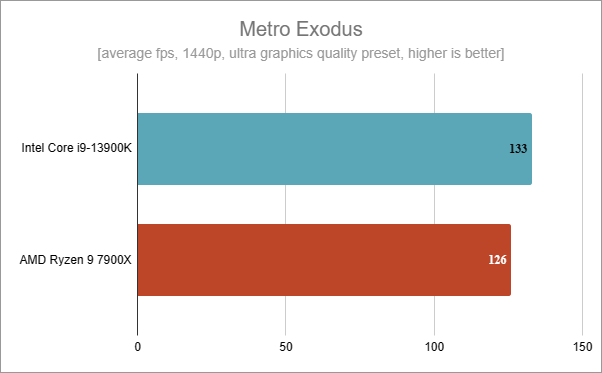
In Metro Exodus, there was a slightly more meaningful improvement in fps on the PC equipped with the Intel Core i9-13900K. With it, the game was able to render about 5.5% more fps than what the AMD-based computer managed.
Benchmarks results in Shadow of the Tomb Raider
In Metro Exodus, there was a slightly more meaningful improvement in fps on the PC equipped with the Intel Core i9-13900K. With it, the game was able to render about 5.5% more fps than what the AMD-based computer managed.
 Benchmarks results in Metro Exodus
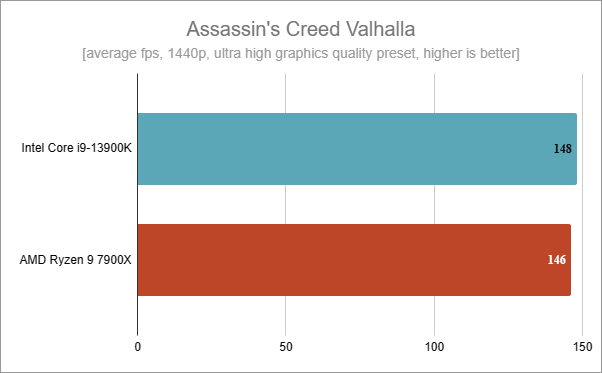
Continuing with Assassin’s Creed Valhalla, the results of the two computers were again pretty similar: 148 fps with the Intel Core i9-13900K and 146 fps with the AMD Ryzen 9 7900X.
That’s an improvement in performance of just over 1 percent for the Intel CPU compared to the AMD one. I’d say that it’s, again, a tie between the two processors, as the results are within the margin of error.
Benchmarks results in Metro Exodus
Continuing with Assassin’s Creed Valhalla, the results of the two computers were again pretty similar: 148 fps with the Intel Core i9-13900K and 146 fps with the AMD Ryzen 9 7900X.
That’s an improvement in performance of just over 1 percent for the Intel CPU compared to the AMD one. I’d say that it’s, again, a tie between the two processors, as the results are within the margin of error.
 Benchmarks results in Assassin's Creed Valhalla
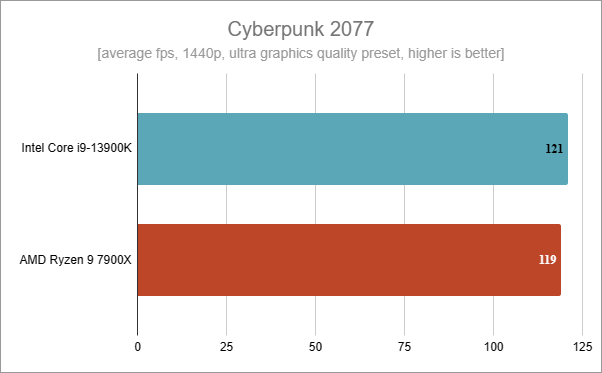
Next, Cyberpunk 2077, a game that punishes any computer, no matter how powerful it is. On the Intel-based PC, I got 121 frames per second, while on the AMD-based one, the game’s benchmark rendered 119 fps. Conclusion: the Intel Core i9-13900K led to an increase in performance of only about 1.6% compared to the AMD Ryzen 9 7900X.
Benchmarks results in Assassin's Creed Valhalla
Next, Cyberpunk 2077, a game that punishes any computer, no matter how powerful it is. On the Intel-based PC, I got 121 frames per second, while on the AMD-based one, the game’s benchmark rendered 119 fps. Conclusion: the Intel Core i9-13900K led to an increase in performance of only about 1.6% compared to the AMD Ryzen 9 7900X.
 Benchmarks results in Cyberpunk 2077
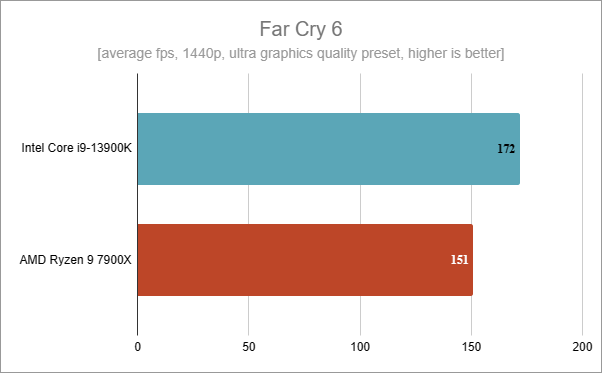
The most notable improvement in performance I’ve seen while testing these two processors was in Far Cry 6. This game is highly dependent on single-thread performance, and as my results show, the Intel Core i9-13900K is significantly better in this regard compared to the AMD Ryzen 9 7900X. With the Intel CPU, I got 172 frames per second, on average, while with the AMD processor, I only got 151. The result: using the Intel Core i9-13900K, I witnessed an fps increase of almost 14% compared to the AMD Ryzen 9 7900X.
Benchmarks results in Cyberpunk 2077
The most notable improvement in performance I’ve seen while testing these two processors was in Far Cry 6. This game is highly dependent on single-thread performance, and as my results show, the Intel Core i9-13900K is significantly better in this regard compared to the AMD Ryzen 9 7900X. With the Intel CPU, I got 172 frames per second, on average, while with the AMD processor, I only got 151. The result: using the Intel Core i9-13900K, I witnessed an fps increase of almost 14% compared to the AMD Ryzen 9 7900X.
 Benchmarks results in Far Cry 6
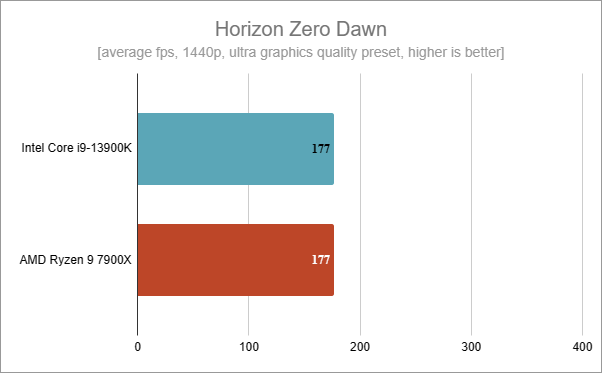
And last but not least, I tested Horizon Zero Dawn, an older but beautiful game that I still love playing to this day. Surprise: both computers, regardless of the processor, rendered exactly the same average number of frames per second. It didn’t matter if I used the Intel Core i9-13900K or the AMD Ryzen 9 7900X; the framerate was 177 in both scenarios.
Benchmarks results in Far Cry 6
And last but not least, I tested Horizon Zero Dawn, an older but beautiful game that I still love playing to this day. Surprise: both computers, regardless of the processor, rendered exactly the same average number of frames per second. It didn’t matter if I used the Intel Core i9-13900K or the AMD Ryzen 9 7900X; the framerate was 177 in both scenarios.
 Benchmarks results in Horizon Zero Dawn
Now let’s draw some conclusions:
Benchmarks results in Horizon Zero Dawn
Now let’s draw some conclusions:
Intel Core i9-13900K vs. AMD Ryzen 9 7900X: Quick specs and prices
Intel’s Core i9-13900K is Team Blue’s second-best Raptor Lake desktop processor. It can reach an impressively high single-core turbo frequency of 5.80 GHz. The only CPU that can outmatch it today is its big brother, the Intel Core i9-13900KS, which offers exactly the same specs except for the fact that it can reach 6.00 GHz. The Core i9-13900K offers twenty-four cores, thirty-two threads, 68 MB of cache memory (32 MB Level 2 cache and 36 MB Level 3 cache), a built-in Intel UHD Graphics 770 GPU, and compatibility with both DDR5 and DDR4 memory. The recommended price is 589 ~ 599 USD, and the real price on Amazon is around 600 USD.Intel Core i9-13900K vs. AMD Ryzen 9 7900X: Hardware used for gaming benchmarks
For this battle of processors, I assembled two desktop computers using the following hardware:- Motherboard:
- ASUS ProArt Z790-Creator WiFi (for the Intel PC)
- ASUS Prime X670E-Pro WiFi (for the AMD PC)
- Processor:
- Cooler: ASUS ROG Ryuo III 240 ARGB
- RAM: Kingston Fury Beast DDR5-6000 32GB
- Graphics Card: AMD Radeon RX 7900 XT
- Storage: Kingston KC3000 NVMe PCIe 4.0 SSD
- Power Supply Unit: ASUS ROG Thor 850W Platinum
- Operating System: Windows 11 Pro Version 22H2
Intel Core i9-13900K vs. AMD Ryzen 9 7900X: Gaming benchmarks results
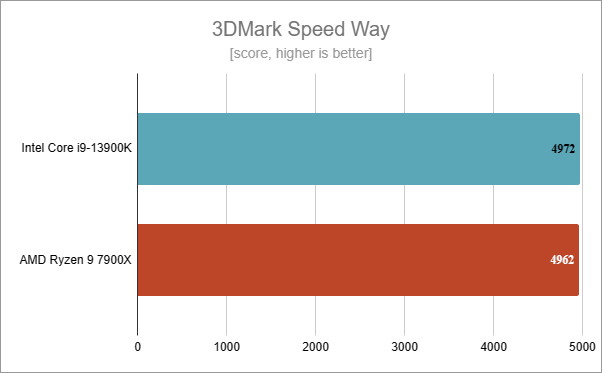
Before we get to the results, keep in mind that I tested all the following games at the highest graphics quality available but without using ray-tracing effects or upscaling technologies such as NVIDIA DLSS or AMD FSR. Furthermore, I ran all the games in 1440p resolution as I’m confident that this is the sweet spot for gaming today. While some still play in 1080p, it’s too low for modern monitors, in my opinion. On the same note, 4K requires a graphics card that’s extremely powerful (and therefore costs an exorbitant amount of money). I started with 3DMark’s Speed Way benchmark, which tests the computer’s performance when using DirectX 12 Ultimate on the latest graphics cards. With the Intel Core i9-13900K, I got a score of 4972 points, while with the AMD Ryzen 9 7900X, I got 4962 points. These are extremely similar scores that don’t point to any clear winner and show that both CPUs are just as powerful when it comes to the next generation of gaming graphics.

Discussion (2)
I have never seen a serious benchmark that exlcudes 1080p when it is testing the CPU.
65% of all steam users use 1080p, so that’s the standard resolution. Only 16% use 1440p.
You only go to 1440p or “4k” if you want to test which GPU delivers best performance as that’s the usual bottleneck. But in games you always must use 1080p as basis to see which CPU is more consistent. In your benchmark, the limiting factor is the GPU that’s why the cpus are almost same performance but AMD costs way less money. 1440p is far from being mainstream you were just too lazy to test both resolutions.
You barely see any difference in performance in 1440p. Do you honestly believe that you would see a difference in 1080p, which demands even less from both the CPU and GPU? Before accusing us of laziness, did you spend a couple of minutes to do some thinking? We should have tested in 4K too, not in 1080p, to maybe see a higher difference between the two processors. However, when we worked this article, we didn’t have the appropriate hardware for 4K testing.