




Some users don’t like traditional wireless routers with external antennas. Others want to hide their router from view by mounting it on a wall or placing it in the corner of a room. However, only a few routers cater to these needs. Luckily, ASUS has recently launched the RT-AX59U for these users. A dual-band Wi-Fi 6 router with a beautiful design, solid hardware, and an extensive list of features that make it a good fit for home users and small businesses. If you want to see its performance and how ASUS RT-AX59U works in real life, read my review:
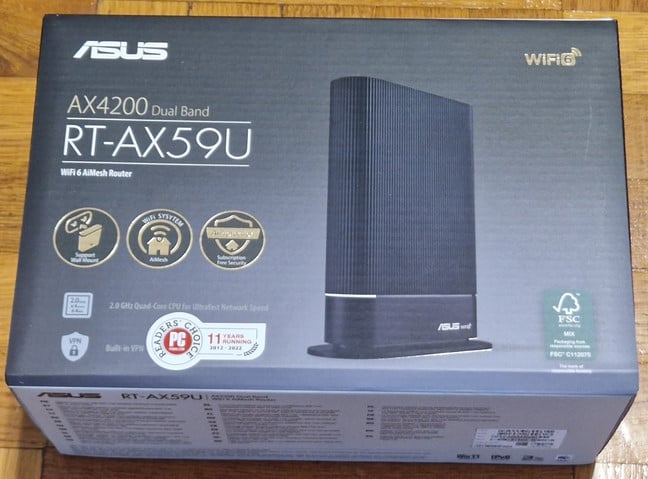
 The packaging for the ASUS RT-AX59U AX4200 dual-band
More information about the product can be found on the box’s back and sides. When you open it, you see several leaflets and, under them, the router itself. When you take everything out, you should find the following items: the ASUS RT-AX59U and its power adapter, a CAT5e network cable, some screws for mounting it on walls and a mounting guide, the quick setup guide, the warranty card, a troubleshooting guide, and other leaflets.
The packaging for the ASUS RT-AX59U AX4200 dual-band
More information about the product can be found on the box’s back and sides. When you open it, you see several leaflets and, under them, the router itself. When you take everything out, you should find the following items: the ASUS RT-AX59U and its power adapter, a CAT5e network cable, some screws for mounting it on walls and a mounting guide, the quick setup guide, the warranty card, a troubleshooting guide, and other leaflets.
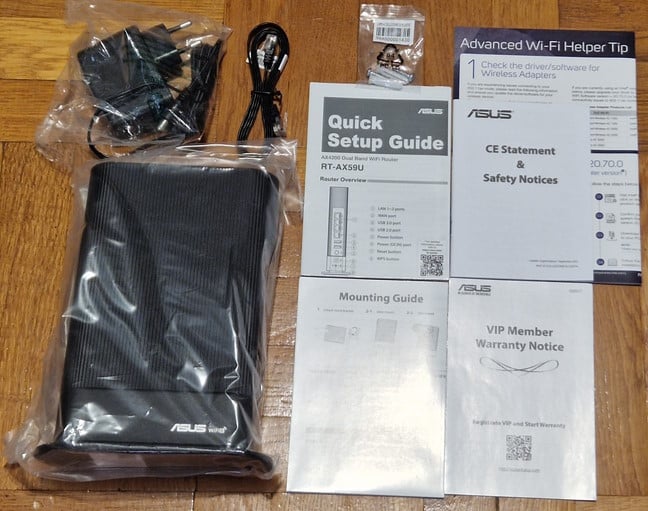
 Unboxing the ASUS RT-AX59U
The unboxing experience is quick, and you can get straight to business: read the quick setup guide, remove the router from its protective plastic bag, and set it up.
Unboxing the ASUS RT-AX59U
The unboxing experience is quick, and you can get straight to business: read the quick setup guide, remove the router from its protective plastic bag, and set it up.
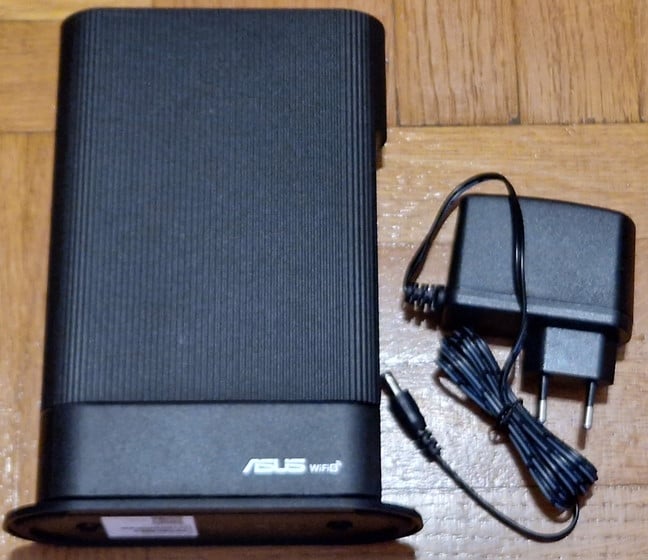
 ASUS RT-AX59U has as minimalistic design
RT-AX59U has a flexible mounting system, which allows it to be placed on desks and other flat surfaces, as well as on walls. As you can see, the stand bracket can be detached and moved to another position.
ASUS RT-AX59U has as minimalistic design
RT-AX59U has a flexible mounting system, which allows it to be placed on desks and other flat surfaces, as well as on walls. As you can see, the stand bracket can be detached and moved to another position.
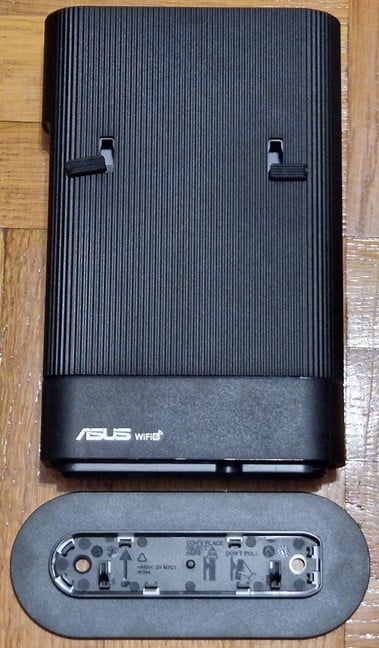
 The stand bracket can be detached
When you insert the bracket into the holes at the top of the router, you can use the bundled screws to install the RT-AX59U on a ceiling or wall, maybe somewhere out of sight.
The stand bracket can be detached
When you insert the bracket into the holes at the top of the router, you can use the bundled screws to install the RT-AX59U on a ceiling or wall, maybe somewhere out of sight.
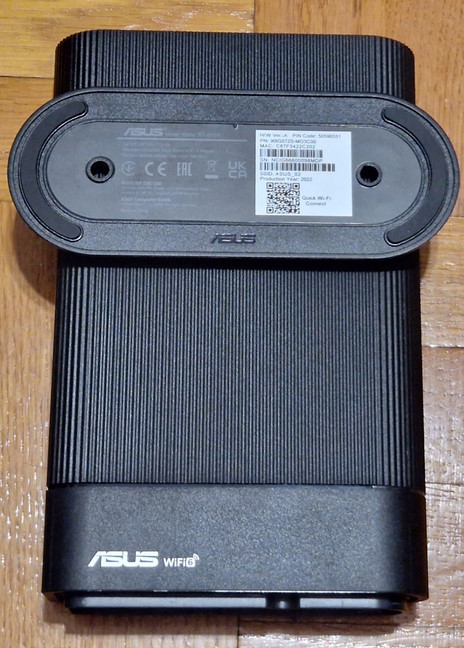
 It is easy to mount this router on a wall
On the back of the router, you find three Ethernet ports working at 1 Gbps and one WAN port. There’s also a USB 3.2 Gen 1 port and a USB 2.0 port. You also have the power jack, the WPS button, and the Reset jack.
It is easy to mount this router on a wall
On the back of the router, you find three Ethernet ports working at 1 Gbps and one WAN port. There’s also a USB 3.2 Gen 1 port and a USB 2.0 port. You also have the power jack, the WPS button, and the Reset jack.
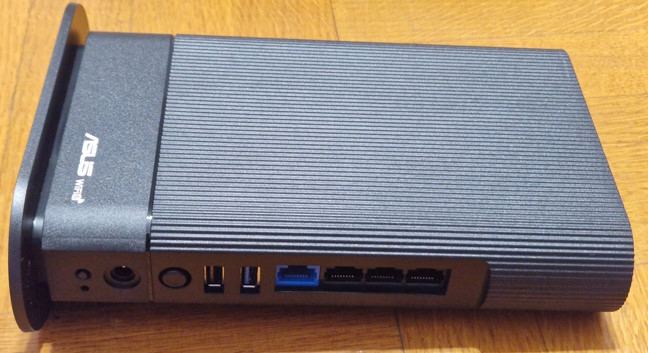
 The ports on the back of the router
Towards the bottom, ASUS RT-AX59U has just one LED, which changes colors to let you know its functioning status. As you can see, it’s discreet and can be turned off from its software if you are bothered by it, or you can have it turn off automatically at night and light up during the day.
The ports on the back of the router
Towards the bottom, ASUS RT-AX59U has just one LED, which changes colors to let you know its functioning status. As you can see, it’s discreet and can be turned off from its software if you are bothered by it, or you can have it turn off automatically at night and light up during the day.

 The LED at the bottom of the router
The total theoretical maximum bandwidth is split as follows: 574 Mbps on the 2.4 GHz band and 3603 Mbps on the 5 GHz band when using the Wi-Fi 6 standard. For transmitting data, ASUS RT-AX59U uses 2x2 MU-MIMO on the 2.4 GHz band and 3x3 MU-MIMO on the 5 GHz band.
When evaluating the hardware characteristics of this router, it’s clear that it is a mid-range model that aims to provide a good balance between price, performance, and features. For more information about the official specifications of this router, visit this page: ASUS RT-AX59U - Tech Specs.
The LED at the bottom of the router
The total theoretical maximum bandwidth is split as follows: 574 Mbps on the 2.4 GHz band and 3603 Mbps on the 5 GHz band when using the Wi-Fi 6 standard. For transmitting data, ASUS RT-AX59U uses 2x2 MU-MIMO on the 2.4 GHz band and 3x3 MU-MIMO on the 5 GHz band.
When evaluating the hardware characteristics of this router, it’s clear that it is a mid-range model that aims to provide a good balance between price, performance, and features. For more information about the official specifications of this router, visit this page: ASUS RT-AX59U - Tech Specs.
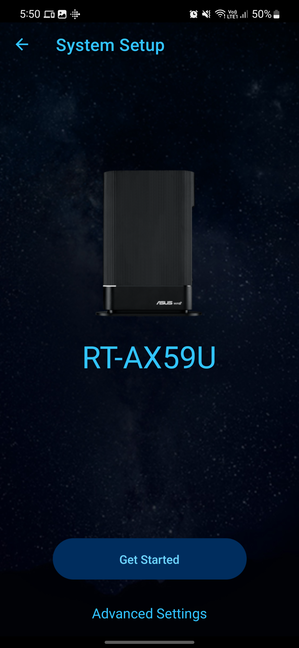
 Setting up the ASUS RT-AX59U
Then, you type the name and password you want for your Wi-Fi, choose an admin username and password, and wait for the router to apply your settings.
Setting up the ASUS RT-AX59U
Then, you type the name and password you want for your Wi-Fi, choose an admin username and password, and wait for the router to apply your settings.
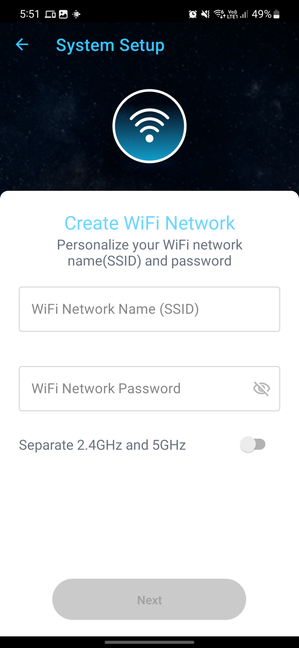 Configuring the Wi-Fi network
In the end, you see a summary of your settings and can decide whether you want to enable a remote connection, which allows you to control the router from anywhere on the internet. Then, you can start using the ASUS Router app to configure other, more advanced settings, like parental controls or the router’s integration with Alexa or Google Assistant.
The ASUS Router app is easy to use and provides several configuration options you may need. However, it only offers access to some of the tools and features of the RT-AX59U.
Configuring the Wi-Fi network
In the end, you see a summary of your settings and can decide whether you want to enable a remote connection, which allows you to control the router from anywhere on the internet. Then, you can start using the ASUS Router app to configure other, more advanced settings, like parental controls or the router’s integration with Alexa or Google Assistant.
The ASUS Router app is easy to use and provides several configuration options you may need. However, it only offers access to some of the tools and features of the RT-AX59U.
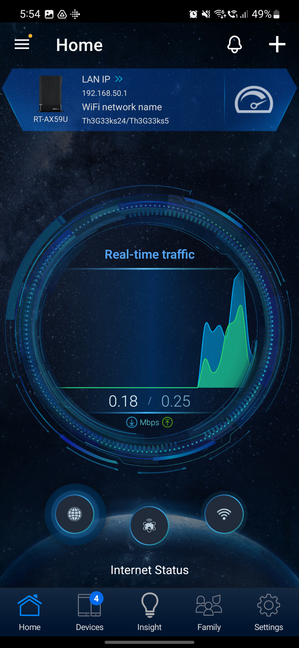 The ASUS Router mobile app is easy to use
If you want access to everything the ASUS RT-AX59U offers, you must use a web browser to log in with the admin password you’ve set. The web interface is friendly, well-organized, and available in 25 languages. Also, the level of control you get is impressive: you can configure everything you want, from the VPN features to antivirus protection and port forwarding to the many parameters of the wireless network.
The ASUS Router mobile app is easy to use
If you want access to everything the ASUS RT-AX59U offers, you must use a web browser to log in with the admin password you’ve set. The web interface is friendly, well-organized, and available in 25 languages. Also, the level of control you get is impressive: you can configure everything you want, from the VPN features to antivirus protection and port forwarding to the many parameters of the wireless network.
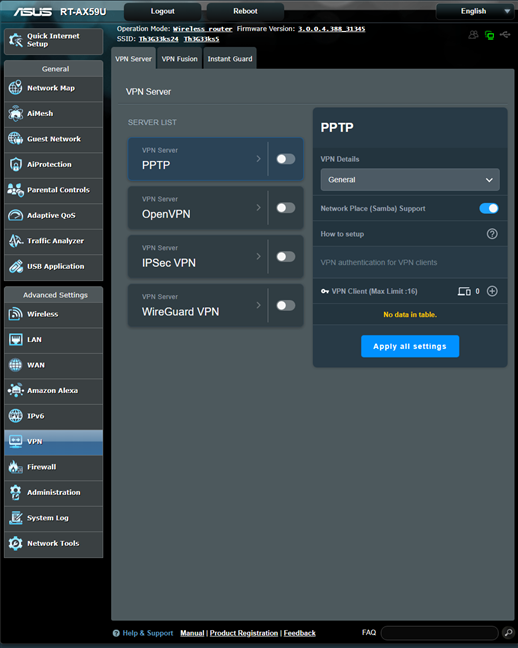
 ASUS RT-AX59U has many VPN-related features
One aspect that I appreciate is the firmware auto-update capability. I recommend you enable it and choose a late hour for it, when you’re asleep, to avoid being impacted while the wireless router reboots to finalize the update.
If you have problems understanding a specific setting, you’ll be happy to know that the help documentation is easily accessible through links to the manual at the bottom of the web interface. You also see a question mark for some settings when hovering over them. Clicking on it reveals a tooltip with information on what that setting does.
ASUS RT-AX59U has many VPN-related features
One aspect that I appreciate is the firmware auto-update capability. I recommend you enable it and choose a late hour for it, when you’re asleep, to avoid being impacted while the wireless router reboots to finalize the update.
If you have problems understanding a specific setting, you’ll be happy to know that the help documentation is easily accessible through links to the manual at the bottom of the web interface. You also see a question mark for some settings when hovering over them. Clicking on it reveals a tooltip with information on what that setting does.
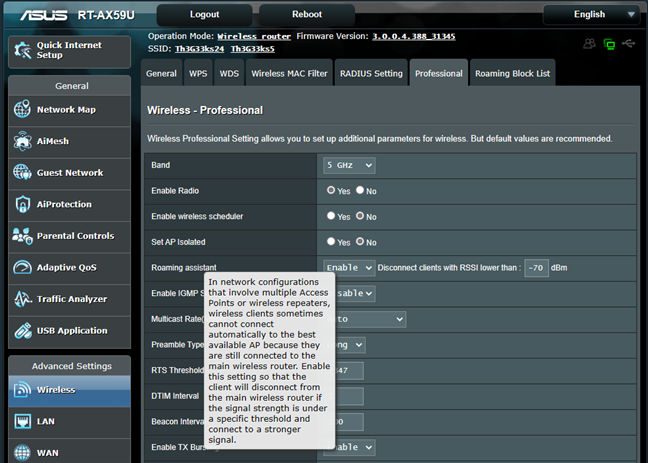
 Many settings have useful descriptions of what they do
Connecting all my devices to the wireless network worked without problems, even when using WPA3 encryption or 160 MHz channels on the 5 GHz band. The overall performance was solid, and the stability of network transfers was especially good on the 5 GHz band when using Wi-Fi 6. Here’s an example of a transfer made through Wi-Fi on a computer placed in a room separated by two walls from the router. As you can see, the throughput was very stable.
Many settings have useful descriptions of what they do
Connecting all my devices to the wireless network worked without problems, even when using WPA3 encryption or 160 MHz channels on the 5 GHz band. The overall performance was solid, and the stability of network transfers was especially good on the 5 GHz band when using Wi-Fi 6. Here’s an example of a transfer made through Wi-Fi on a computer placed in a room separated by two walls from the router. As you can see, the throughput was very stable.
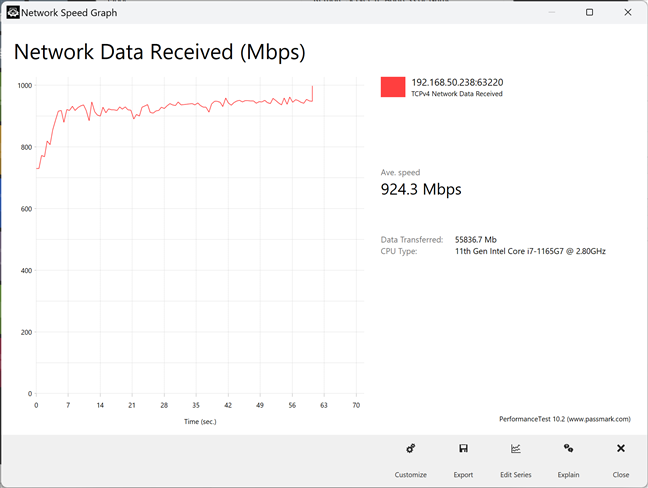
 A wireless transfer on the 5 GHz band
On the 2.4 GHz band though, the variability of wireless transfers is relatively high—however, the router compensated by providing a good coverage area on this band.
If you want to know more about the real-world performance offered by the ASUS RT-AX59U, including a comparison with other routers, go to the next page of this review, where I present detailed measurements.
A wireless transfer on the 5 GHz band
On the 2.4 GHz band though, the variability of wireless transfers is relatively high—however, the router compensated by providing a good coverage area on this band.
If you want to know more about the real-world performance offered by the ASUS RT-AX59U, including a comparison with other routers, go to the next page of this review, where I present detailed measurements.
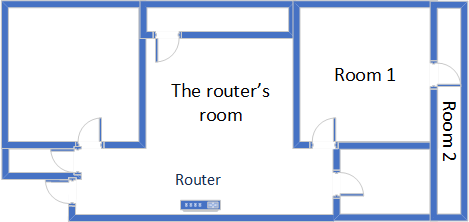
 The apartment where I tested ASUS RT-AX59U
I evaluated the quality of the wireless network managed by this router through measurements made in three different places:
The apartment where I tested ASUS RT-AX59U
I evaluated the quality of the wireless network managed by this router through measurements made in three different places:
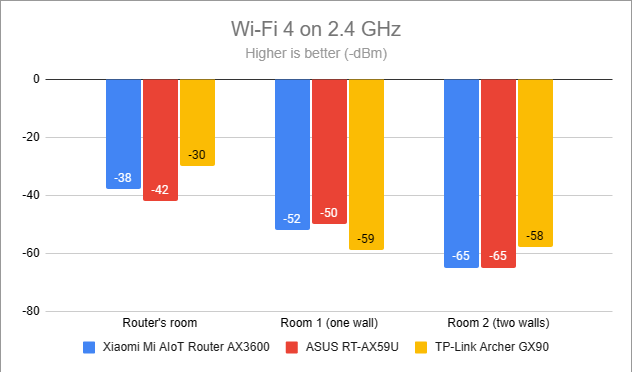
 Signal strength on Wi-Fi 4 (2.4 GHz band)
Switching to Wi-Fi 6 on the same 2.4 GHz band improved signal strength in the room furthest from the router, which is great.
Signal strength on Wi-Fi 4 (2.4 GHz band)
Switching to Wi-Fi 6 on the same 2.4 GHz band improved signal strength in the room furthest from the router, which is great.
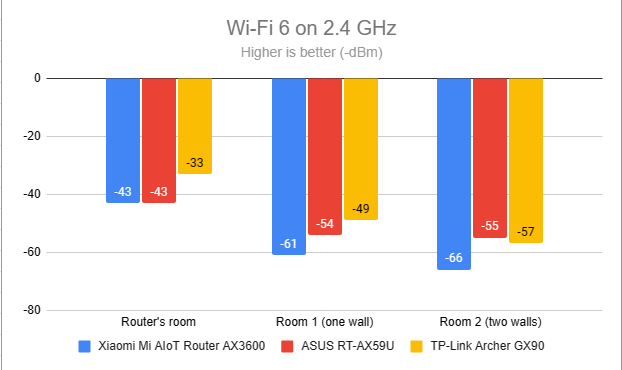
 Signal strength on Wi-Fi 6 (2.4 GHz band)
I moved on to the SpeedTest app and used it to measure the maximum speed you get when transferring data to and from the internet on the 2.4 GHz band. When using the Wi-Fi 4 standard, ASUS RT-AX59U delivered reasonably fast download speeds without impressing.
Signal strength on Wi-Fi 6 (2.4 GHz band)
I moved on to the SpeedTest app and used it to measure the maximum speed you get when transferring data to and from the internet on the 2.4 GHz band. When using the Wi-Fi 4 standard, ASUS RT-AX59U delivered reasonably fast download speeds without impressing.
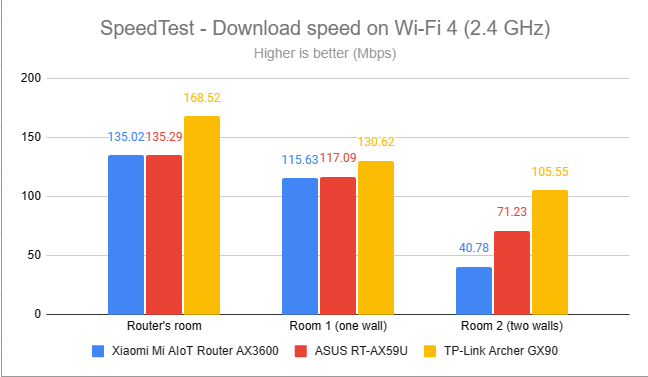
 SpeedTest - The download speed on Wi-Fi 4 (2.4 GHz)
Uploads were slower across the board, without becoming disappointing, except for the room furthest from the router.
SpeedTest - The download speed on Wi-Fi 4 (2.4 GHz)
Uploads were slower across the board, without becoming disappointing, except for the room furthest from the router.
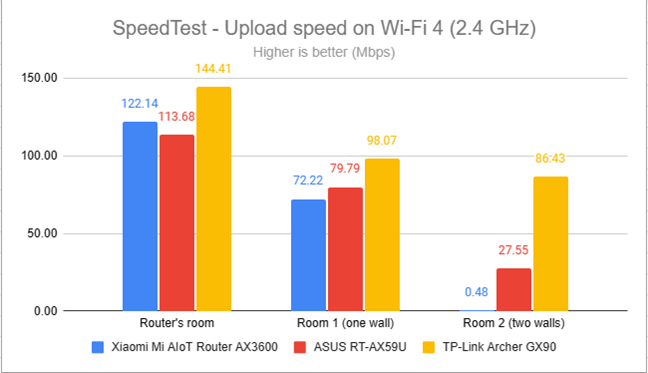
 SpeedTest - The upload speed on Wi-Fi 4 (2.4 GHz)
I switched to the Wi-Fi 6 standard on the 2.4 GHz band and repeated the same measurements with SpeedTest. This test revealed much faster download speeds everywhere in my apartment.
SpeedTest - The upload speed on Wi-Fi 4 (2.4 GHz)
I switched to the Wi-Fi 6 standard on the 2.4 GHz band and repeated the same measurements with SpeedTest. This test revealed much faster download speeds everywhere in my apartment.
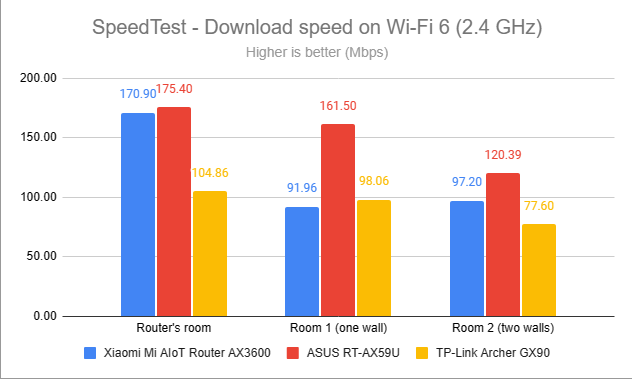
 SpeedTest - The download speed on Wi-Fi 6 (2.4 GHz)
Uploads received a similar boost, which is great.
SpeedTest - The download speed on Wi-Fi 6 (2.4 GHz)
Uploads received a similar boost, which is great.
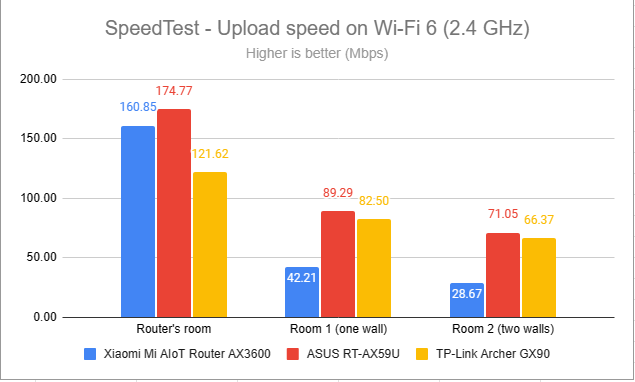
 SpeedTest - The upload speed on Wi-Fi 6 (2.4 GHz)
For the next set of measurements, I used the PassMark Performance test to transfer data between two computers connected to the network. Again, I was connected to the 2.4 GHz band with the Wi-Fi 4 standard turned on. This test confirmed that ASUS RT-AX59U is a reasonably fast router when using Wi-Fi 4, but not the fastest.
SpeedTest - The upload speed on Wi-Fi 6 (2.4 GHz)
For the next set of measurements, I used the PassMark Performance test to transfer data between two computers connected to the network. Again, I was connected to the 2.4 GHz band with the Wi-Fi 4 standard turned on. This test confirmed that ASUS RT-AX59U is a reasonably fast router when using Wi-Fi 4, but not the fastest.
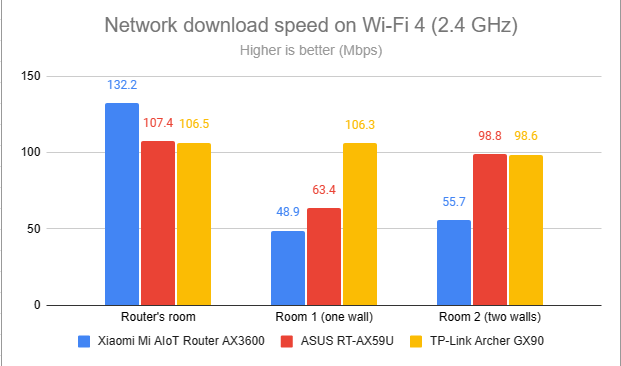
 Network downloads on Wi-Fi 4 (2.4 GHz)
The same was valid for the upload speed.
Network downloads on Wi-Fi 4 (2.4 GHz)
The same was valid for the upload speed.
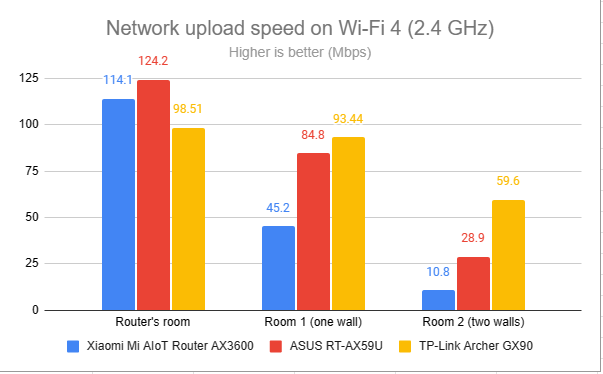
 Network uploads on Wi-Fi 4 (2.4 GHz)
Switching to Wi-Fi 6 on the same 2.4 GHz band meant faster downloads in all rooms, proving that this router is better optimized for Wi-Fi 6 rather than Wi-Fi 4.
Network uploads on Wi-Fi 4 (2.4 GHz)
Switching to Wi-Fi 6 on the same 2.4 GHz band meant faster downloads in all rooms, proving that this router is better optimized for Wi-Fi 6 rather than Wi-Fi 4.
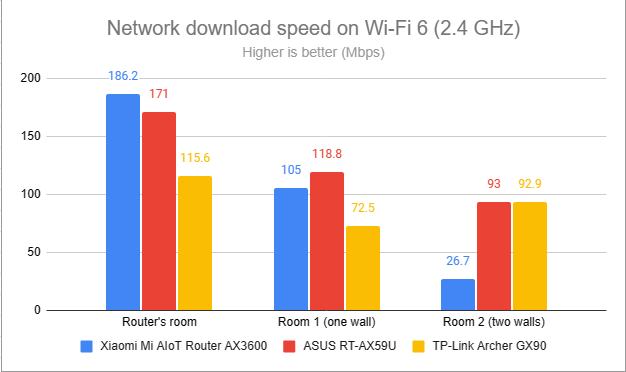
 Network downloads on Wi-Fi 6 (2.4 GHz)
Uploads were again faster when using Wi-Fi 6 instead of Wi-Fi 4.
Network downloads on Wi-Fi 6 (2.4 GHz)
Uploads were again faster when using Wi-Fi 6 instead of Wi-Fi 4.
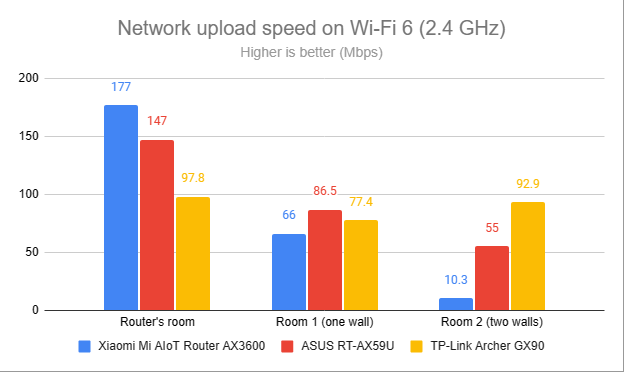
 Network uploads on Wi-Fi 6 (2.4 GHz)
My tests have shown that ASUS RT-AX59U generally works well on the 2.4 GHz band. However, it doesn’t break any speed records and works better when using the Wi-Fi 6 (802.11ax) standard on this band than when using the older Wi-Fi 4 (802.11n).
Network uploads on Wi-Fi 6 (2.4 GHz)
My tests have shown that ASUS RT-AX59U generally works well on the 2.4 GHz band. However, it doesn’t break any speed records and works better when using the Wi-Fi 6 (802.11ax) standard on this band than when using the older Wi-Fi 4 (802.11n).
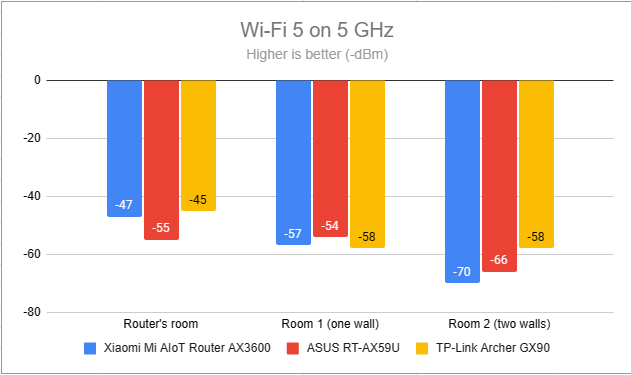
 Signal strength on Wi-Fi 5 (5 GHz band)
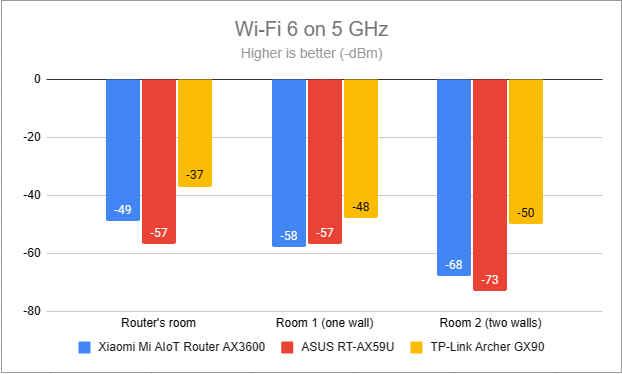
Switching to Wi-Fi 6 on the 5 GHz band meant the signal strength slightly decreased.
Signal strength on Wi-Fi 5 (5 GHz band)
Switching to Wi-Fi 6 on the 5 GHz band meant the signal strength slightly decreased.
 Signal strength on Wi-Fi 6 (5 GHz band)
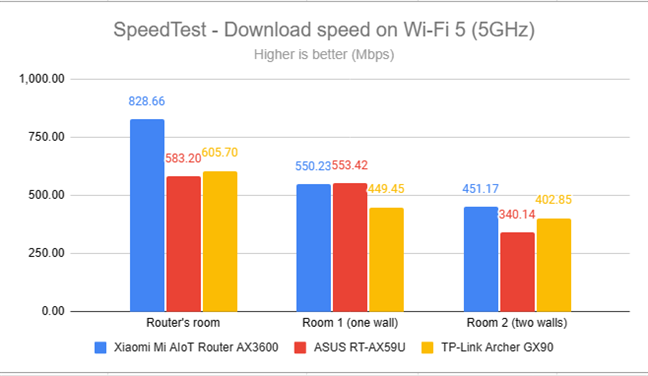
I moved on to the SpeedTest app. Download speeds were reasonably fast when using the Wi-Fi 5 (802.11ac) standard. However, other routers can outperform ASUS RT-AX59U.
Signal strength on Wi-Fi 6 (5 GHz band)
I moved on to the SpeedTest app. Download speeds were reasonably fast when using the Wi-Fi 5 (802.11ac) standard. However, other routers can outperform ASUS RT-AX59U.
 SpeedTest - The download speed on Wi-Fi 5 (5 GHz)
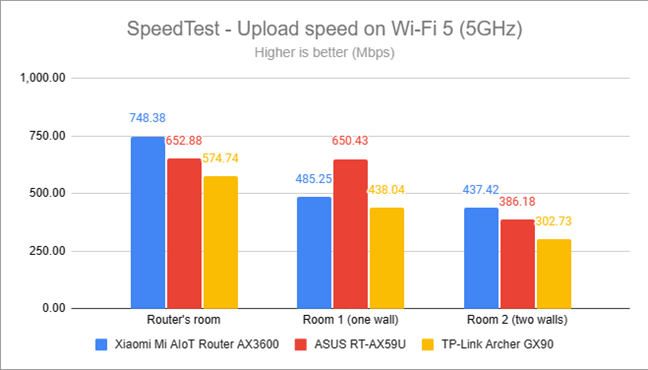
Uploads were faster than downloads, which I found unusual. The results for most routers are the other way around.
SpeedTest - The download speed on Wi-Fi 5 (5 GHz)
Uploads were faster than downloads, which I found unusual. The results for most routers are the other way around.
 SpeedTest - The upload speed on Wi-Fi 5 (5 GHz)
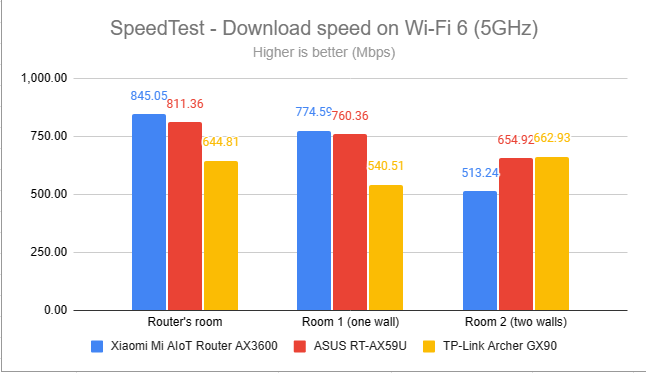
When switching to the Wi-Fi 6 standard on the 5 GHz band, the download speeds offered by ASUS RT-AX59U improved significantly.
SpeedTest - The upload speed on Wi-Fi 5 (5 GHz)
When switching to the Wi-Fi 6 standard on the 5 GHz band, the download speeds offered by ASUS RT-AX59U improved significantly.
 SpeedTest - The download speed on Wi-Fi 6 (5 GHz)
Uploads were notably faster than when using Wi-Fi 5.
SpeedTest - The download speed on Wi-Fi 6 (5 GHz)
Uploads were notably faster than when using Wi-Fi 5.
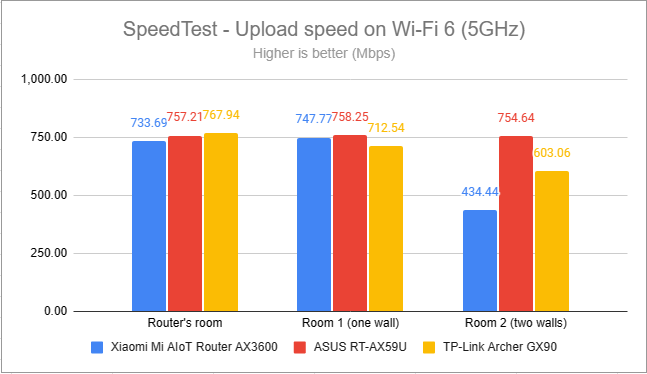
 SpeedTest - The upload speed on Wi-Fi 6 (5 GHz)
For the next set of measurements, I used the PassMark Performance test to transfer data between two computers connected to the network. Just like with SpeedTest, ASUS RT-AX59U delivered reasonably fast downloads, but not enough to take my breath away.
SpeedTest - The upload speed on Wi-Fi 6 (5 GHz)
For the next set of measurements, I used the PassMark Performance test to transfer data between two computers connected to the network. Just like with SpeedTest, ASUS RT-AX59U delivered reasonably fast downloads, but not enough to take my breath away.
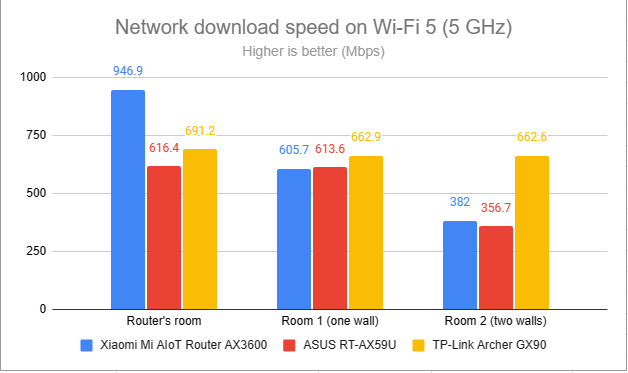
 Network downloads on Wi-Fi 5 (5 GHz)
In some rooms, uploads were again faster than downloads when using 802.11ac (Wi-Fi 5).
Network downloads on Wi-Fi 5 (5 GHz)
In some rooms, uploads were again faster than downloads when using 802.11ac (Wi-Fi 5).
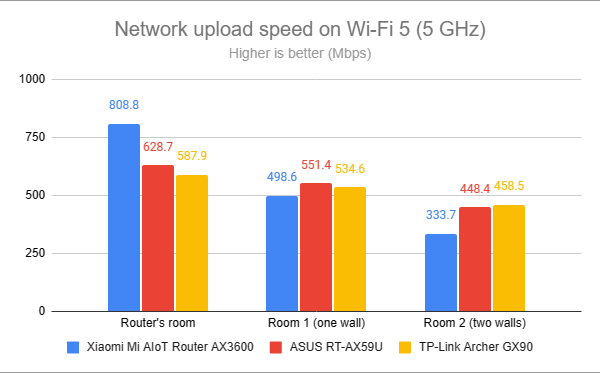
 Network uploads on Wi-Fi 5 (5 GHz)
Switching to the Wi-Fi 6 standard meant I enjoyed download speeds close to the 1 Gbps mark across the network. This a great result, showcasing one more time that this router is optimized to use the newer Wi-Fi 6 standard instead of the older ones.
Network uploads on Wi-Fi 5 (5 GHz)
Switching to the Wi-Fi 6 standard meant I enjoyed download speeds close to the 1 Gbps mark across the network. This a great result, showcasing one more time that this router is optimized to use the newer Wi-Fi 6 standard instead of the older ones.
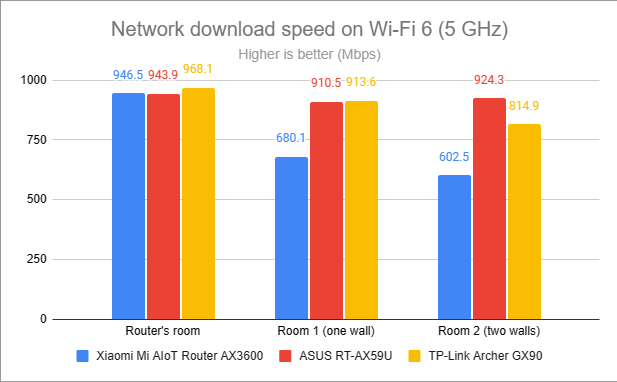
 Network downloads on Wi-Fi 6 (5 GHz)
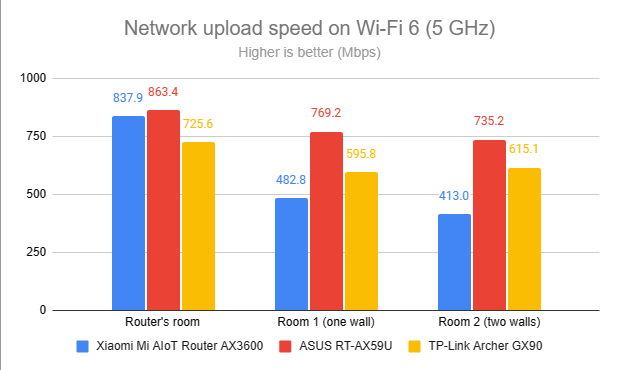
Uploads were very fast, as you can see below.
Network downloads on Wi-Fi 6 (5 GHz)
Uploads were very fast, as you can see below.
 Network uploads on Wi-Fi 6 (5 GHz)
ASUS RT-AX59U performs best on the 5 GHz band when using the Wi-Fi 6 (802.11ax) standard. It delivers solid coverage and fast transfers across the board.
Network uploads on Wi-Fi 6 (5 GHz)
ASUS RT-AX59U performs best on the 5 GHz band when using the Wi-Fi 6 (802.11ax) standard. It delivers solid coverage and fast transfers across the board.
 SpeedTest on Ethernet connections
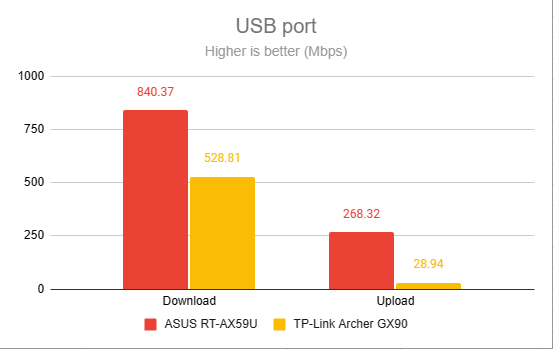
ASUS RT-AX59U also has a USB 3.2 Gen 1 port that can be handy. I plugged a fast SSD drive into it and made some data transfers to and from the SSD. The download speed was excellent. Even though the upload speed it delivered was much higher than that offered by TP-Link Archer GX90, other routers can be even faster.
SpeedTest on Ethernet connections
ASUS RT-AX59U also has a USB 3.2 Gen 1 port that can be handy. I plugged a fast SSD drive into it and made some data transfers to and from the SSD. The download speed was excellent. Even though the upload speed it delivered was much higher than that offered by TP-Link Archer GX90, other routers can be even faster.
 The speed of the USB port
ASUS RT-AX59U works great with 1 Gbps Ethernet connections. Also, its USB 3.2 Gen 1 port delivers satisfying performance when you attach a storage device.
The speed of the USB port
ASUS RT-AX59U works great with 1 Gbps Ethernet connections. Also, its USB 3.2 Gen 1 port delivers satisfying performance when you attach a storage device.
 ASUS RT-AX59U includes AiProtection
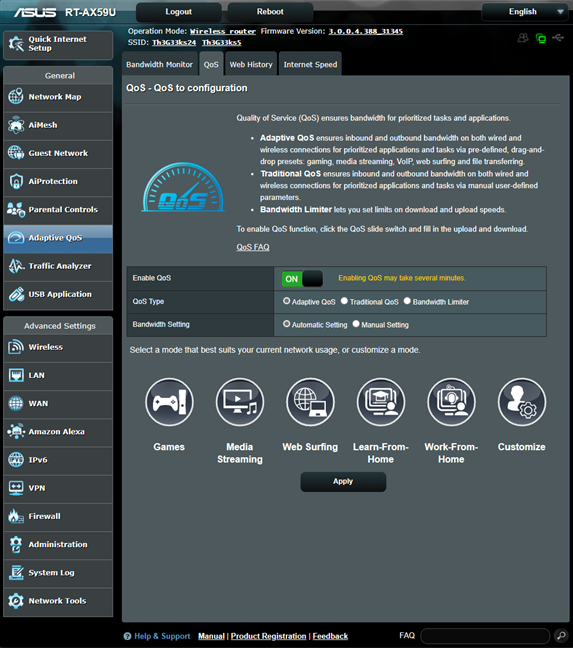
 The Adaptive QoS is easy to configure
ASUS RT-AX59U: Who is it good for?
This wireless router is a suitable choice for:- Medium-sized apartments and equivalent office spaces
- Users who want efficient parental controls, antivirus, and firewall protection
- Internet connections with speeds of up to 1 Gbps
- People who want to remotely control their router from anywhere on the internet using a mobile app
- Users who want to control their home network using Alexa and IFTTT (If This, Then That)
Pros and cons
Here are the things we like about ASUS RT-AX68U:
- Works well when using the Wi-Fi 6 standard on both bands
- Attractive design
- It has two USB ports
- Excellent security tools and parental controls
- You can remotely control it with a mobile app from anywhere
- Innovative VPN features
- It can be mounted on walls
- Unimpressive performance when using older standards like Wi-Fi 4 and Wi-Fi 5
- The price is a bit high for the performance you get
Verdict
Even though the ASUS RT-AX59U is equipped with a MediaTek processor, this router doesn’t perform poorly. On the contrary, its performance is what you would expect from a solid mid-range router. And to make things even more appealing, the feature set for the RT-AX59U is the same as what you get on more premium routers from ASUS. Overall, this reliable, good-looking wireless router is a great fit for mid-sized apartments or office spaces with internet connectivity of up to 1 Gbps. And bonus points, it has a flexible mounting system, allowing you to place it anywhere you want, including on walls.Unboxing the ASUS RT-AX59U
ASUS RT-AX59U is a dual-band AX4200 wireless router that comes in a black cardboard box, typical for ASUS routers. On the top cover, you see a picture of the router and a list of its most important features.Hardware specifications and design
ASUS RT-AX59U is an elegant, tall wireless router with Wi-Fi 6. It has a size of 15 by 20 cm or 5.91 by 7.87 inches in width and height and a thickness of 6 cm or 2.36 inches. It’s also quite light, weighing only 476 grams or 16.79 ounces. One design aspect that many will appreciate is that all its five antennas are internal. As a result, ASUS RT-AX59U doesn’t look like most routers do. That’s great if you care about using minimalistic yet good-looking devices in your home or office.Setting up and using the ASUS RT-AX59U
You can install ASUS RT-AX59U using the ASUS Router mobile app for Android and iOS or a computer connected to the router using a web browser. This time, I decided to use the mobile app. The setup process is the same as for other ASUS routers: you connect to the default Wi-Fi, select the router you want to install, and provide the details for connecting to the internet.Wireless network performance
My new test apartment is set up similarly to the diagram below. As you can see, I’ve placed the ASUS RT-AX59U in a central position to provide good coverage in all the rooms where I spend most of my time.- The router’s room - I record the maximum speeds when no walls absorb the wireless signal in the room where the router is placed.
- Room 1 is separated by one wall from the router, so the wireless signal and the Wi-Fi speed I get should be lower here.
- Room 2 is separated from the router by two walls absorbing the wireless signal. Also, the wall between Room 1 and Room 2 is twice as thick as the one between The router’s room and Room 1. As a result, Room 2 can be a difficult challenge for many routers.
How the ASUS RT-AX59U performs on the 2.4 GHz band
As always, I first measured the signal strength using NetSpot, while connected to the 2.4 GHz band. When using the Wi-Fi 4 standard (802.11n), the signal strength delivered by ASUS RT-AX59U was similar to that of other routers. It wasn’t great, but it wasn’t bad either.How the ASUS RT-AX59U performs on the 5 GHz band
I switched to the 5 GHz band and started measuring the signal strength with NetSpot. When using the Wi-Fi 5 standard, ASUS RT-AX59U offered good signal strength everywhere in my apartment.Wired network performance & USB port
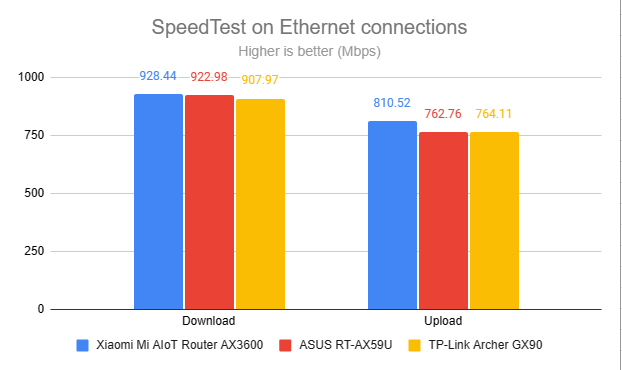
After evaluating Wi-Fi performance, let’s assess the performance you get when using Ethernet network connections. My internet connection offers a maximum of 1 Gbps for the download speed and 800 Mbps for the upload. As expected, SpeedTest measured the ASUS RT-AX59U reaching speeds close to my internet connection’s maximum potential.Extra features
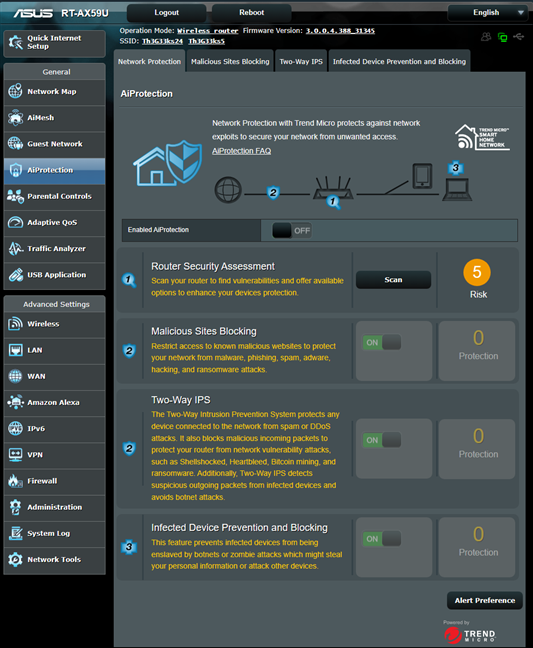
ASUS markets the RT-AX59U as an AiMesh router, meaning you can use it alongside other ASUS routers to create your own mesh Wi-Fi. If you’re creating a mesh Wi-Fi, here’s how to turn on & configure the backhaul on ASUS routers with AiMesh. The router also includes the useful AiProtection module that provides:- A comprehensive Router Security Assessment tool that verifies whether your router settings are secure. When it finds problems, it proactively informs and helps you fix things.
- Malicious Sites Blocking – an efficient cloud-based module that blocks malicious websites on all the devices connected to your network.
- Two-Way IPS – a two-way intrusion prevention system that protects the network from spam, DDoS attacks, network attacks, etc.
- Infected Device Prevention and Blocking – when some network devices get infected and become zombies in malware networks, they are automatically blocked, and you are informed about this problem.
- Parental Controls – cloud-based parental controls that can be used to set rules about internet access for children’s devices. If you are interested in using them, here’s how to set up Parental Controls on an ASUS router and how to control your child’s internet time.
- Guest Network – you can enable three wireless guest networks with individual security and access settings on each frequency band.
- Adaptive QoS – you can use it to optimize network traffic for activities like online gaming, media streaming, web browsing, work-from-home, etc.
- Traffic Analyzer – visual traffic statistics that clearly show how your network is used and by which devices.
- USB Applications - set up your router to use external hard disks or printers through its USB ports. You can also use a USB modem from your telephony provider as a backup internet connection for your network.
- Dual WAN - you can use two internet connections at the same time.
- IPv6 – support for IPv6 addresses that are replacing IPv4. Here’s how to enable IPv6 on your ASUS router or mesh Wi-Fi.
- VPN – you can set the router to work as a VPN server using the following protocols: PPTP, OpenVPN, IPSec VPN, and WireGuard VPN. You can also use it to turn your network-connected devices into VPN-enabled clients without additional VPN software. And to complete the picture, this router gives you access to VPN Fusion and Instant Guard.
- Network Tools – for analyzing the network and identifying what’s wrong. They are useful when you need to troubleshoot problems.
- DDNS – a service that allows you to connect to the router from the internet, even if your internet provider assigns you a dynamic public IP address. The list of supported services is quite long, and ASUS also includes its own free service.
- Integration with Amazon’s Alexa and IFTTT – you can say things like “Alexa, ask ASUS ROUTER to upgrade the firmware” to perform different tasks. You can also automate tasks that might otherwise be repetitive or unable to “talk to each other.”
Discussion (0)
Comments are closed.