



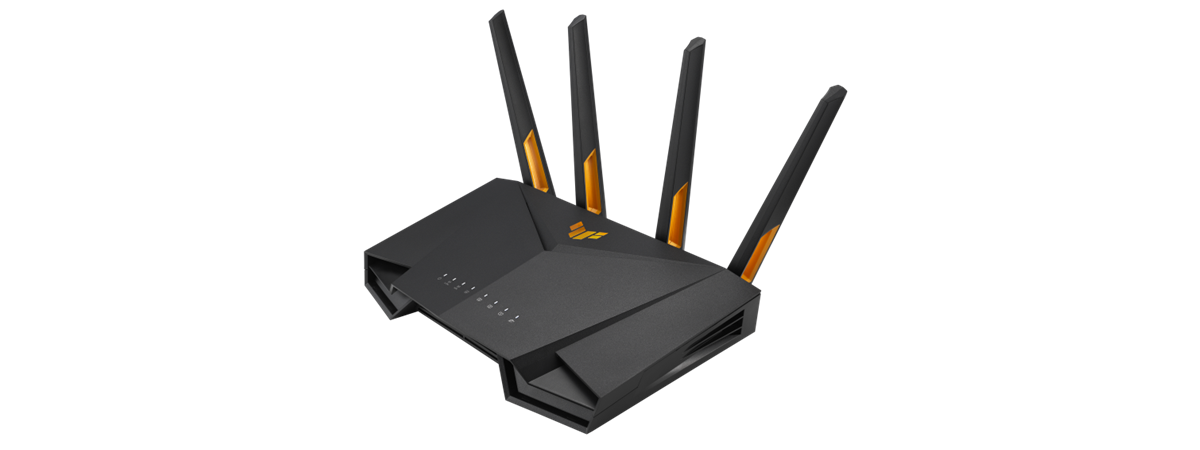
Fast internet connections are slowly gaining ground everywhere in the world. As our homes and businesses are increasingly crowded with more devices that require Wi-Fi connectivity, getting yourself a good router is a must. If you want a solid mid-range Wi-Fi 6 router, which features modern hardware and offers good performance, you should take a look at the ASUS TUF Gaming AX3000 V2 or ASUS TUF-AX3000 V2, as you’ll see it named in some shops. Here’s what this router has to offer:
![Verdict]()

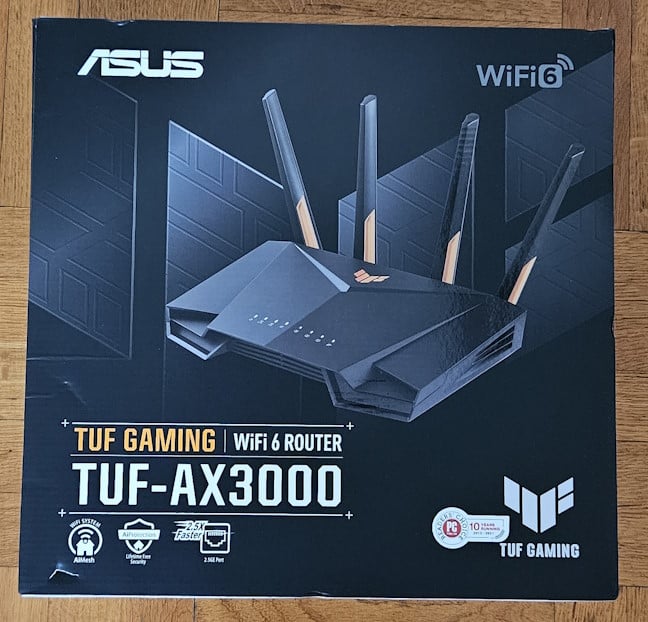
 The packaging for ASUS TUF Gaming AX3000 V2
On the sides of the box, there are quite a few details about the hardware configuration of the ASUS TUF-AX3000 V2 router. On the bottom of the box, there’s plenty of information about some of its most interesting features, starting with its 2.5 Gbps WAN port and LAN aggregation features, that allow you to use two 1 Gbps internet connections simultaneously. Inside the box is the router, its power adapter, a short network cable, the quick setup guide, the warranty details, and a troubleshooting guide.
The packaging for ASUS TUF Gaming AX3000 V2
On the sides of the box, there are quite a few details about the hardware configuration of the ASUS TUF-AX3000 V2 router. On the bottom of the box, there’s plenty of information about some of its most interesting features, starting with its 2.5 Gbps WAN port and LAN aggregation features, that allow you to use two 1 Gbps internet connections simultaneously. Inside the box is the router, its power adapter, a short network cable, the quick setup guide, the warranty details, and a troubleshooting guide.
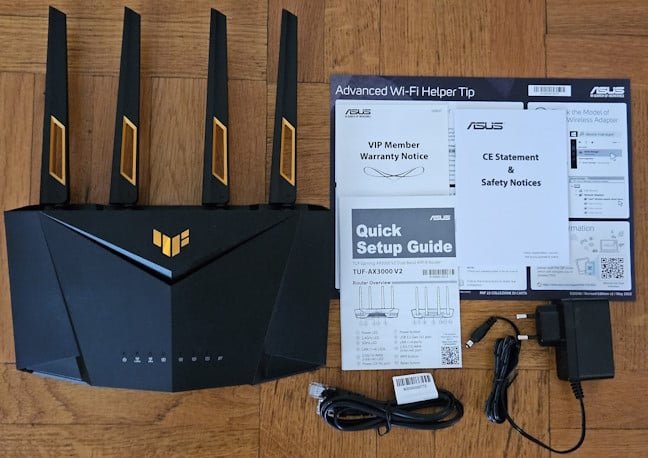
 Everything you find inside the box
The unboxing experience for ASUS TUF Gaming AX3000 V2 is a standard one. Taking the router out of the box is done in no time, and inside, you have all the information and accessories you need to get started.
Everything you find inside the box
The unboxing experience for ASUS TUF Gaming AX3000 V2 is a standard one. Taking the router out of the box is done in no time, and inside, you have all the information and accessories you need to get started.
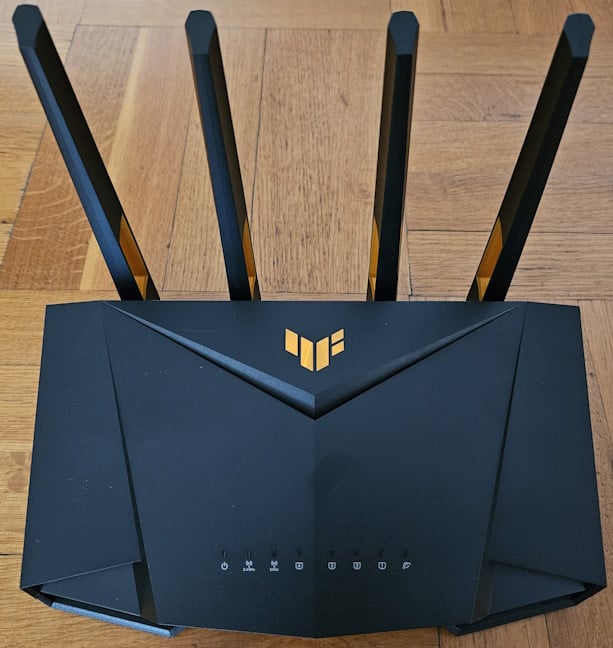
 ASUS TUF-AX3000 V2 is designed to appeal to gamers
There are many LEDs on the top cover of the ASUS TUF Gaming AX3000 V2, which signal the status of different aspects: your internet connection, the Wi-Fi for each band, your Ethernet connections, and so on. The LEDs are visible but not annoying, and they can be turned off by setting the WPS button on the back to control the LEDs instead of the WPS feature.
ASUS TUF-AX3000 V2 is designed to appeal to gamers
There are many LEDs on the top cover of the ASUS TUF Gaming AX3000 V2, which signal the status of different aspects: your internet connection, the Wi-Fi for each band, your Ethernet connections, and so on. The LEDs are visible but not annoying, and they can be turned off by setting the WPS button on the back to control the LEDs instead of the WPS feature.
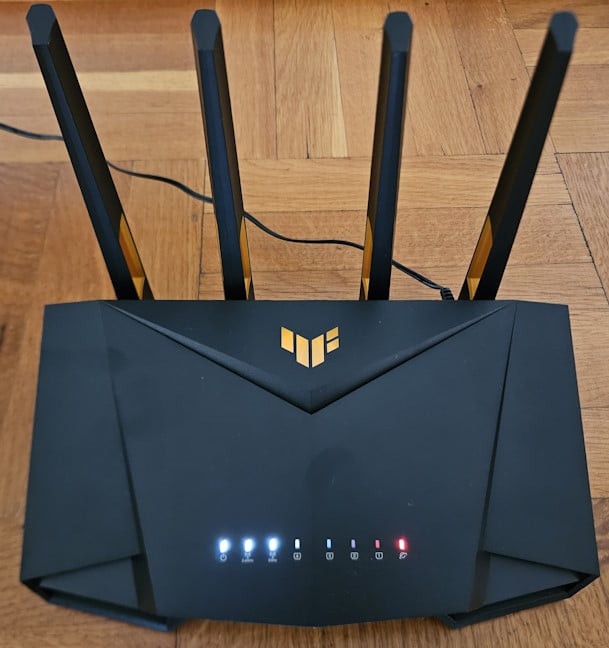
 There are several LEDs on the top
Speaking of the back of this router, here is where you find all its ports. You have the Power jack and the Power button, a USB 3.2 Gen 1 port, four Ethernet ports at 1 Gbps (two of which feature LAN Aggregation), and the WAN port, which can work at speeds up to 2.5 Gbps.
There are several LEDs on the top
Speaking of the back of this router, here is where you find all its ports. You have the Power jack and the Power button, a USB 3.2 Gen 1 port, four Ethernet ports at 1 Gbps (two of which feature LAN Aggregation), and the WAN port, which can work at speeds up to 2.5 Gbps.
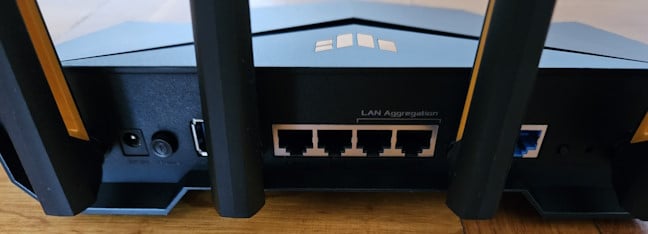
 The ports are on the back of the router
TIP: For more information about USB ports, their versions, and speeds, read this article: What is USB? Types of USB, speeds, ports & connectors.
On the sides, you see some ventilation grids, used to cool the powerful hardware inside the ASUS TUF-AX3000 V2 router: a quad-core Broadcom BCM6756 processor running at 1.7 GHz, 512 MB of RAM, and 256 MB of storage for the firmware.
The ports are on the back of the router
TIP: For more information about USB ports, their versions, and speeds, read this article: What is USB? Types of USB, speeds, ports & connectors.
On the sides, you see some ventilation grids, used to cool the powerful hardware inside the ASUS TUF-AX3000 V2 router: a quad-core Broadcom BCM6756 processor running at 1.7 GHz, 512 MB of RAM, and 256 MB of storage for the firmware.
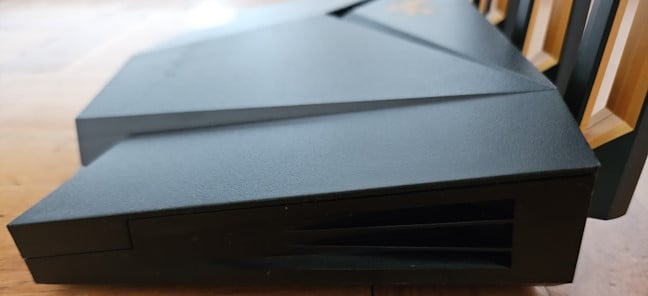
 The sides feature ventilation grids
On the bottom of the router, you have large ventilation grids, four rubber feet for holding the router steady on flat surfaces, and two holes for mounting it on walls. You also find stickers with information about the specific router you bought, its default Wi-Fi settings, serial number, and so on.
The sides feature ventilation grids
On the bottom of the router, you have large ventilation grids, four rubber feet for holding the router steady on flat surfaces, and two holes for mounting it on walls. You also find stickers with information about the specific router you bought, its default Wi-Fi settings, serial number, and so on.
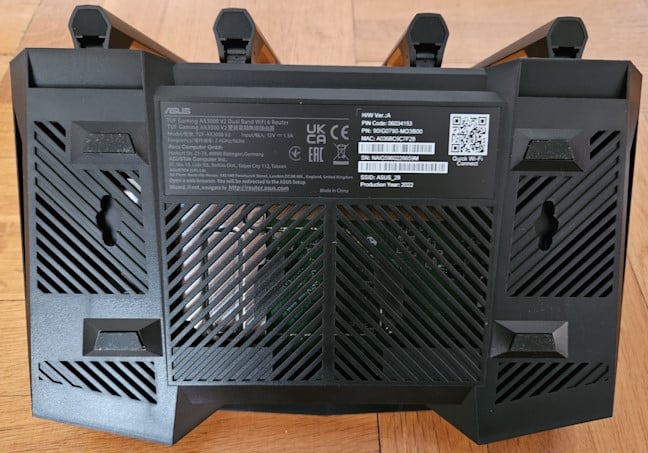
 The bottom of the ASUS TUF-AX3000 V2
ASUS TUF Gaming AX3000 V2 is a dual-band Wi-Fi 6 router with a total theoretical bandwidth split as follows: 2402 Mbps for the 5 GHz band and 574 Mbps for the 2.4 GHz band. This makes it an AX3000 wireless router. Other important features include its 160 MHz channel bandwidth support, WPA3 encryption, and 2x2 MU-MIMO wireless transfers.
As you can see, the specs of this router are those of a mid-range device, which should perform well. For more information about this product and its specifications, visit this page: ASUS TUF Gaming AX3000 V2.
The bottom of the ASUS TUF-AX3000 V2
ASUS TUF Gaming AX3000 V2 is a dual-band Wi-Fi 6 router with a total theoretical bandwidth split as follows: 2402 Mbps for the 5 GHz band and 574 Mbps for the 2.4 GHz band. This makes it an AX3000 wireless router. Other important features include its 160 MHz channel bandwidth support, WPA3 encryption, and 2x2 MU-MIMO wireless transfers.
As you can see, the specs of this router are those of a mid-range device, which should perform well. For more information about this product and its specifications, visit this page: ASUS TUF Gaming AX3000 V2.

 Setting up the ASUS TUF-AX3000 V2 router
The initial setup is the same as it is on all ASUS routers: you start by providing the connection details for your internet connection, setting a name and password for the Wi-Fi, and choosing the username and password for the router management interface. In the end, you see a summary of your settings, and you can connect all your devices to the network. After the initial setup is complete, checking for firmware updates and installing them is a great idea. This way, you can benefit from the latest bug fixes and any features that ASUS added after the release of this router.
Setting up the ASUS TUF-AX3000 V2 router
The initial setup is the same as it is on all ASUS routers: you start by providing the connection details for your internet connection, setting a name and password for the Wi-Fi, and choosing the username and password for the router management interface. In the end, you see a summary of your settings, and you can connect all your devices to the network. After the initial setup is complete, checking for firmware updates and installing them is a great idea. This way, you can benefit from the latest bug fixes and any features that ASUS added after the release of this router.
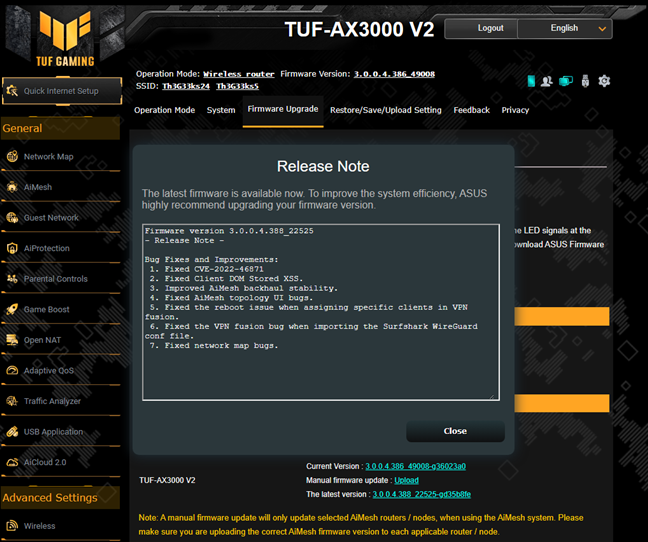
 Updating the firmware is a good idea
Another great idea is to enable the auto updates for the firmware and have the router handle this task automatically each night, during a time frame when everyone is asleep. The web interface for this TUG Gaming router is friendly, well-organized, and available in 25 languages. Also, the level of control you get is impressive: you can configure everything you want, from the VPN features, antivirus protection, and port forwarding for online gaming, to the many parameters of the wireless network.
Updating the firmware is a good idea
Another great idea is to enable the auto updates for the firmware and have the router handle this task automatically each night, during a time frame when everyone is asleep. The web interface for this TUG Gaming router is friendly, well-organized, and available in 25 languages. Also, the level of control you get is impressive: you can configure everything you want, from the VPN features, antivirus protection, and port forwarding for online gaming, to the many parameters of the wireless network.
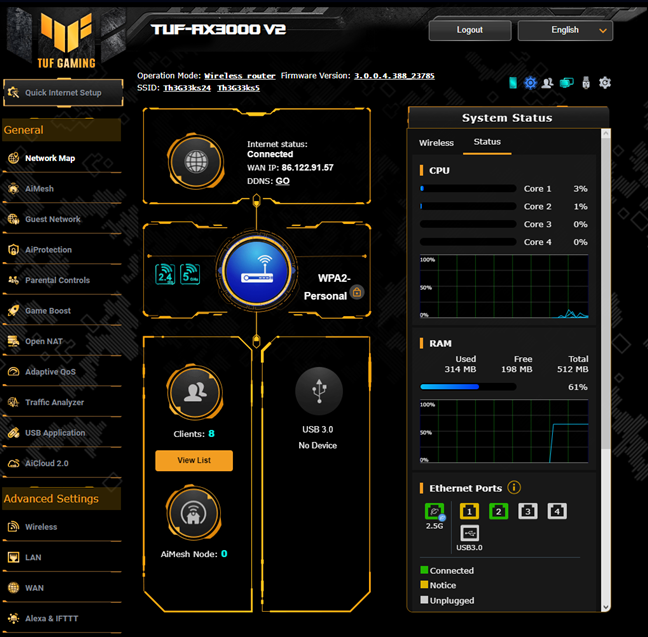
 The web admin interface uses a TUF Gaming skin
Documentation is easily available through links at the bottom of the interface. You also see a question mark for some settings when hovering over them with the mouse. Clicking on it reveals a tooltip with information on what that setting does, as shown in the screenshot below.
The web admin interface uses a TUF Gaming skin
Documentation is easily available through links at the bottom of the interface. You also see a question mark for some settings when hovering over them with the mouse. Clicking on it reveals a tooltip with information on what that setting does, as shown in the screenshot below.
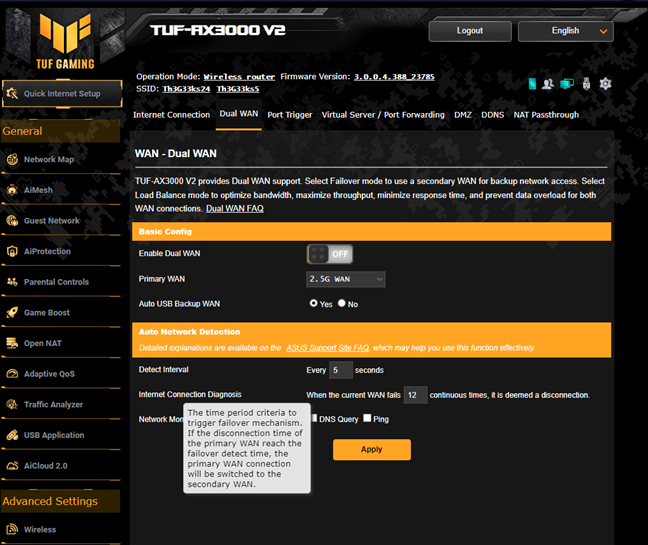
 Help documentation is easily available
You can also manage the ASUS TUF-AX3000 V2 router using the ASUS Router app for Android and iOS. The app is free and easy to use. It offers a surprisingly larger number of features and settings. However, it can’t cover everything you get from the router. Therefore, you still need to access its web-based admin interface if you want complete control. The app itself works the same as for all ASUS routers, and, unlike the web-based interface, it doesn’t have a TUF Gaming skin applied to it.
Help documentation is easily available
You can also manage the ASUS TUF-AX3000 V2 router using the ASUS Router app for Android and iOS. The app is free and easy to use. It offers a surprisingly larger number of features and settings. However, it can’t cover everything you get from the router. Therefore, you still need to access its web-based admin interface if you want complete control. The app itself works the same as for all ASUS routers, and, unlike the web-based interface, it doesn’t have a TUF Gaming skin applied to it.
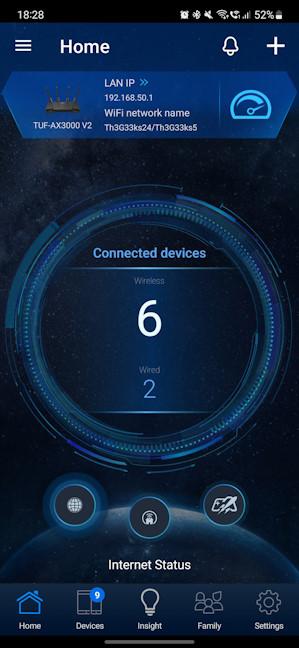
 The ASUS Router app
I enjoyed my experience with the ASUS TUF-AX3000 V2 and liked that I could use WPA3 encryption or 160 MHz channels on the 5 GHz band to take full advantage of the Wi-Fi 6 standard. The overall performance was solid, and the stability of network transfers was especially good on the 5 GHz band when using Wi-Fi 6. When switching back and forth between standards, I noticed that this router is slower when using Wi-Fi 4 and Wi-Fi 5 and tends to favor Wi-Fi 6 for both bands.
For details about the real-world performance offered by ASUS TUF Gaming AX3000 V2, including a comparison with other routers, go to the next page of this review.
The ASUS Router app
I enjoyed my experience with the ASUS TUF-AX3000 V2 and liked that I could use WPA3 encryption or 160 MHz channels on the 5 GHz band to take full advantage of the Wi-Fi 6 standard. The overall performance was solid, and the stability of network transfers was especially good on the 5 GHz band when using Wi-Fi 6. When switching back and forth between standards, I noticed that this router is slower when using Wi-Fi 4 and Wi-Fi 5 and tends to favor Wi-Fi 6 for both bands.
For details about the real-world performance offered by ASUS TUF Gaming AX3000 V2, including a comparison with other routers, go to the next page of this review.
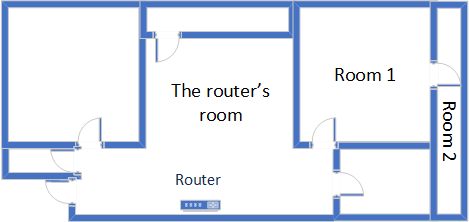
 The apartment where I tested ASUS TUF Gaming AX3000 V2
I evaluated the quality of the wireless network managed by this router through measurements made in three different places:
The apartment where I tested ASUS TUF Gaming AX3000 V2
I evaluated the quality of the wireless network managed by this router through measurements made in three different places:
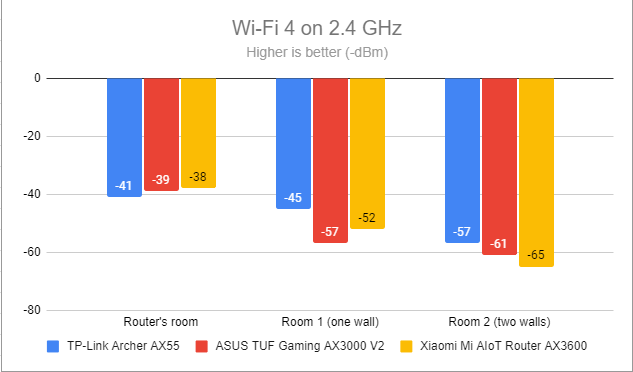
 Signal strength on Wi-Fi 4 (2.4 GHz band)
I switched to the Wi-Fi 6 (802.11ax) standard on the same 2.4 GHz band and noticed the signal strength decreased slightly. However, this trend is normal for most Wi-Fi 6 routers.
Signal strength on Wi-Fi 4 (2.4 GHz band)
I switched to the Wi-Fi 6 (802.11ax) standard on the same 2.4 GHz band and noticed the signal strength decreased slightly. However, this trend is normal for most Wi-Fi 6 routers.
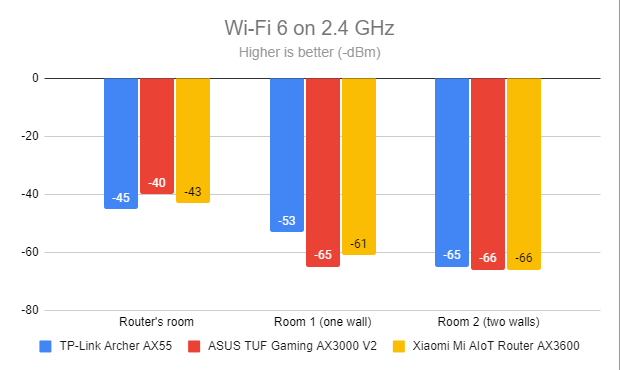
 Signal strength on Wi-Fi 6 (2.4 GHz band)
For the next measurement, I ran the SpeedTest app and used it to check the maximum speed you get when transferring data to and from the internet on the 2.4 GHz band. ASUS TUF Gaming AX3000 V2 performed well and delivered satisfying download speeds.
Signal strength on Wi-Fi 6 (2.4 GHz band)
For the next measurement, I ran the SpeedTest app and used it to check the maximum speed you get when transferring data to and from the internet on the 2.4 GHz band. ASUS TUF Gaming AX3000 V2 performed well and delivered satisfying download speeds.
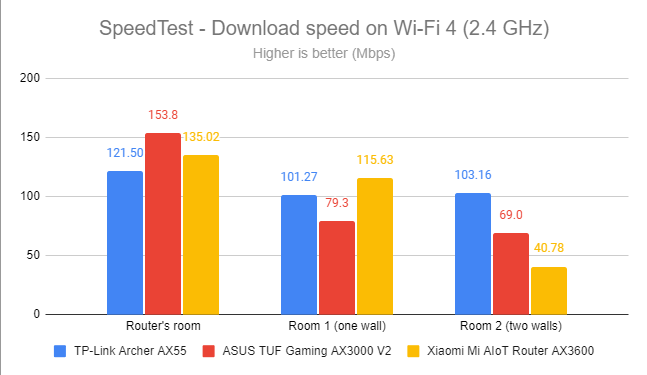
 SpeedTest - The download speed on Wi-Fi 4 (2.4 GHz)
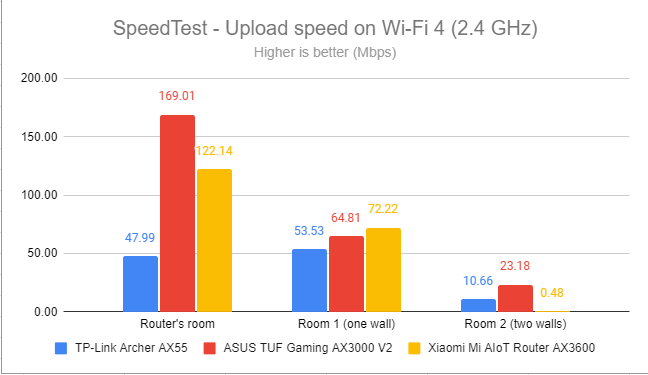
Regarding the upload speed, ASUS TUF Gaming AX3000 V2 outmatched its competitors in the room where it was placed and in Room 2, which is furthest away from the router.
SpeedTest - The download speed on Wi-Fi 4 (2.4 GHz)
Regarding the upload speed, ASUS TUF Gaming AX3000 V2 outmatched its competitors in the room where it was placed and in Room 2, which is furthest away from the router.
 SpeedTest - The upload speed on Wi-Fi 4 (2.4 GHz)
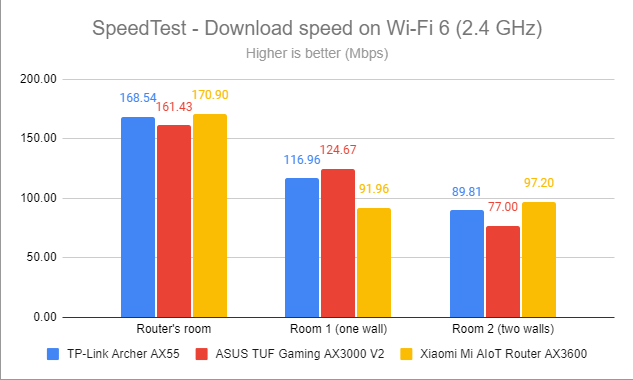
I switched to Wi-Fi 6 on the 2.4 GHz band and repeated the same measurements to see the difference. The download speed got faster everywhere in my apartment, which is great.
SpeedTest - The upload speed on Wi-Fi 4 (2.4 GHz)
I switched to Wi-Fi 6 on the 2.4 GHz band and repeated the same measurements to see the difference. The download speed got faster everywhere in my apartment, which is great.
 SpeedTest - The download speed on Wi-Fi 6 (2.4 GHz)
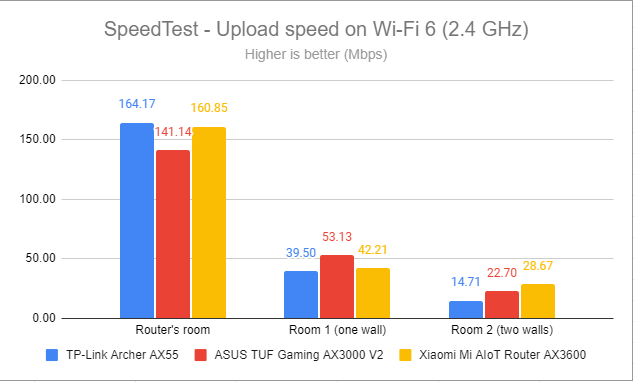
Uploads were also fast, but the ASUS TUF Gaming AX3000 V2 was no longer the speed champion.
SpeedTest - The download speed on Wi-Fi 6 (2.4 GHz)
Uploads were also fast, but the ASUS TUF Gaming AX3000 V2 was no longer the speed champion.
 SpeedTest - The upload speed on Wi-Fi 6 (2.4 GHz)
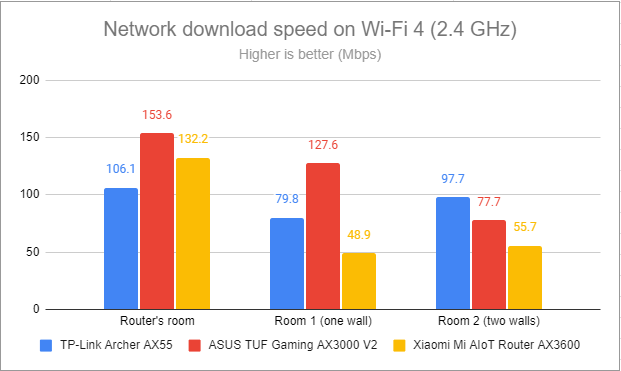
For the next set of measurements, I used the PassMark Performance test to transfer data between two computers connected to the network. Again, I was connected to the 2.4 GHz band with the Wi-Fi 4 standard turned on. Downloads were excellent everywhere in my apartment.
SpeedTest - The upload speed on Wi-Fi 6 (2.4 GHz)
For the next set of measurements, I used the PassMark Performance test to transfer data between two computers connected to the network. Again, I was connected to the 2.4 GHz band with the Wi-Fi 4 standard turned on. Downloads were excellent everywhere in my apartment.
 Network downloads on Wi-Fi 4 (2.4 GHz)
ASUS TUF Gaming AX3000 V2 was again the fastest router in this comparison when measuring the upload speed.
Network downloads on Wi-Fi 4 (2.4 GHz)
ASUS TUF Gaming AX3000 V2 was again the fastest router in this comparison when measuring the upload speed.
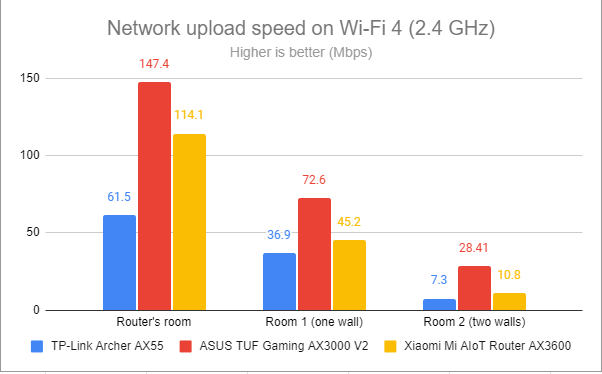
 Network uploads on Wi-Fi 4 (2.4 GHz)
Switching to Wi-Fi 6, on the 2.4 GHz band, led to even faster downloads. I especially liked how this router performed in Room 2, which is tough to handle for many routers.
Network uploads on Wi-Fi 4 (2.4 GHz)
Switching to Wi-Fi 6, on the 2.4 GHz band, led to even faster downloads. I especially liked how this router performed in Room 2, which is tough to handle for many routers.
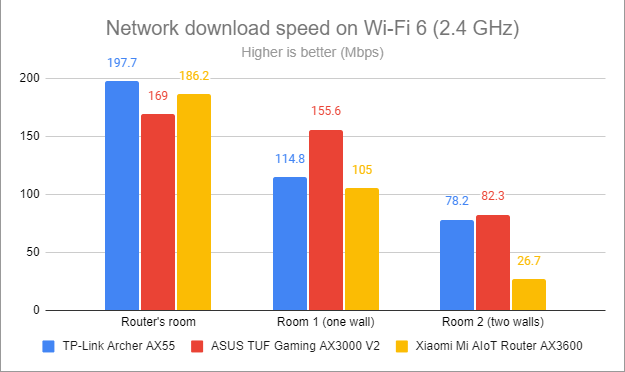
 Network downloads on Wi-Fi 6 (2.4 GHz)
Uploads were fast too but could have been better in Room 2.
Network downloads on Wi-Fi 6 (2.4 GHz)
Uploads were fast too but could have been better in Room 2.
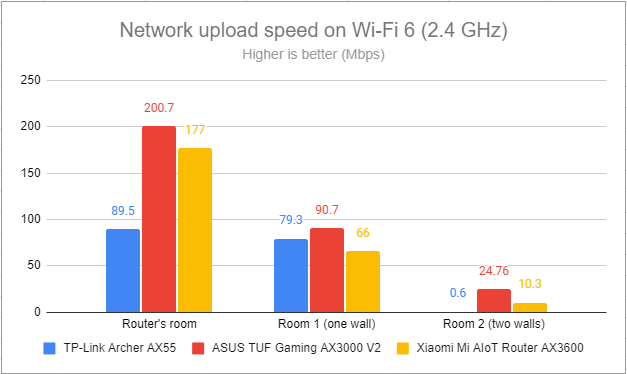
 Network uploads on Wi-Fi 6 (2.4 GHz)
My tests revealed that ASUS TUF Gaming AX3000 V2 performed well on the 2.4 GHz band. You should use Wi-Fi 6 instead of Wi-Fi 4 for the best performance. However, if you have older devices that don’t work with Wi-Fi 6, switching to Wi-Fi 4 isn’t a bad idea, and the performance you get is satisfactory.
Network uploads on Wi-Fi 6 (2.4 GHz)
My tests revealed that ASUS TUF Gaming AX3000 V2 performed well on the 2.4 GHz band. You should use Wi-Fi 6 instead of Wi-Fi 4 for the best performance. However, if you have older devices that don’t work with Wi-Fi 6, switching to Wi-Fi 4 isn’t a bad idea, and the performance you get is satisfactory.
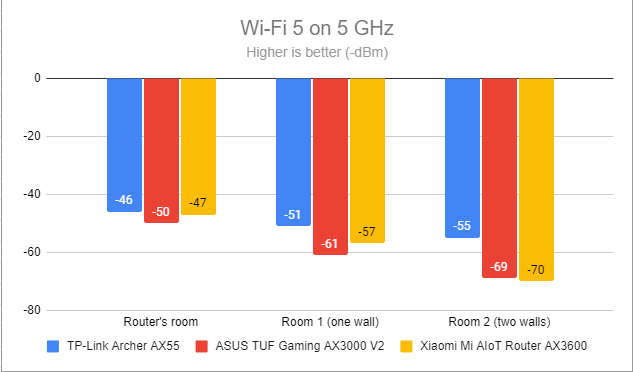 Signal strength on Wi-Fi 5 (5 GHz band)
Switching to Wi-Fi 6 (802.11ax), I noticed an improvement in signal strength, which is surprising but also great news.
Signal strength on Wi-Fi 5 (5 GHz band)
Switching to Wi-Fi 6 (802.11ax), I noticed an improvement in signal strength, which is surprising but also great news.
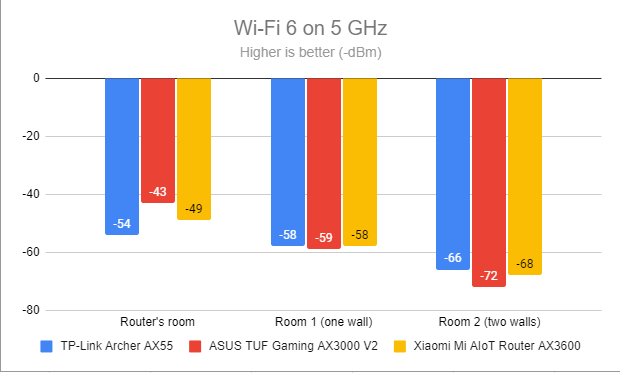
 Signal strength on Wi-Fi 6 (5 GHz band)
I moved on to the SpeedTest app. When using the Wi-Fi 5 standard, ASUS TUF Gaming AX3000 V2 delivered lower download speeds than its competitors.
Signal strength on Wi-Fi 6 (5 GHz band)
I moved on to the SpeedTest app. When using the Wi-Fi 5 standard, ASUS TUF Gaming AX3000 V2 delivered lower download speeds than its competitors.
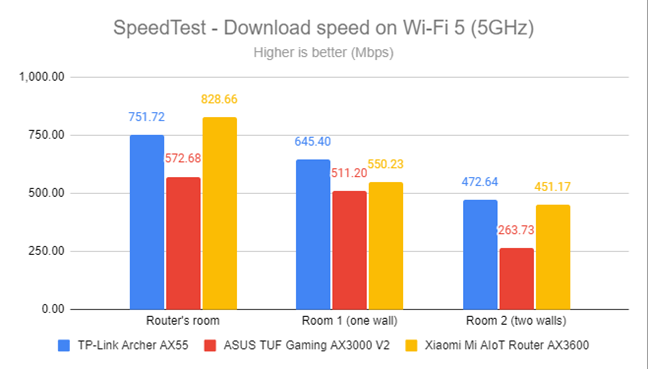
 SpeedTest - The download speed on Wi-Fi 5 (5 GHz)
Uploads followed a similar trend: ASUS TUF Gaming AX3000 V2 was reasonably fast but outperformed by its competitors.
SpeedTest - The download speed on Wi-Fi 5 (5 GHz)
Uploads followed a similar trend: ASUS TUF Gaming AX3000 V2 was reasonably fast but outperformed by its competitors.
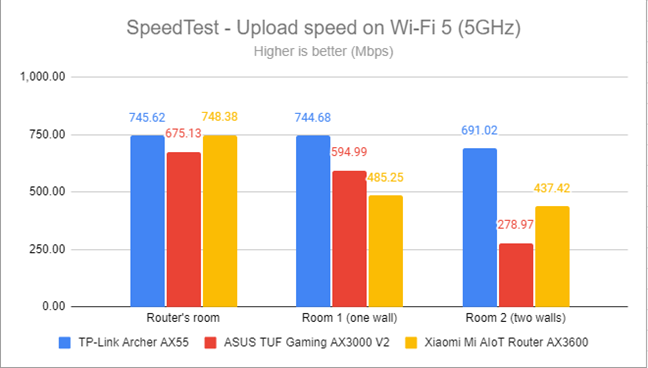
 SpeedTest - The upload speed on Wi-Fi 5 (5 GHz)
Switching to the Wi-Fi 6 standard on the 5 GHz band greatly improved the download speed. This time ASUS TUF Gaming AX3000 V2 outperformed its competitors in most rooms.
SpeedTest - The upload speed on Wi-Fi 5 (5 GHz)
Switching to the Wi-Fi 6 standard on the 5 GHz band greatly improved the download speed. This time ASUS TUF Gaming AX3000 V2 outperformed its competitors in most rooms.
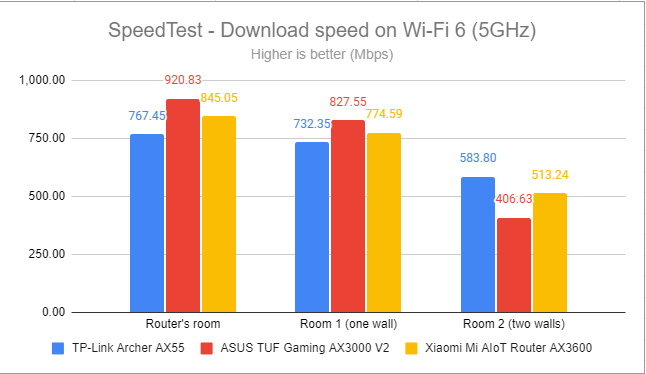
 SpeedTest - The download speed on Wi-Fi 6 (5 GHz)
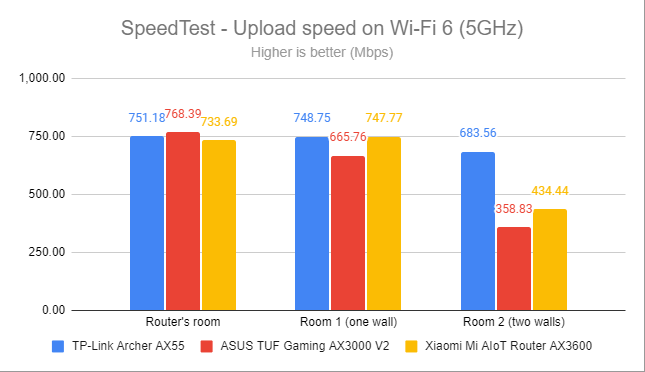
Uploads were much faster when using Wi-Fi 6 instead of Wi-Fi 5.
SpeedTest - The download speed on Wi-Fi 6 (5 GHz)
Uploads were much faster when using Wi-Fi 6 instead of Wi-Fi 5.
 SpeedTest - The upload speed on Wi-Fi 6 (5 GHz)
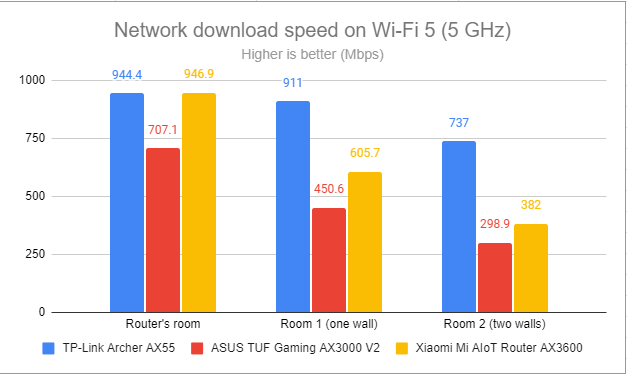
For the next set of measurements, I used the PassMark Performance test to transfer data between two computers connected to the network. When using the Wi-Fi 5 standard on the 5 GHz band, download speeds were good but could have been better than those offered by the competition.
SpeedTest - The upload speed on Wi-Fi 6 (5 GHz)
For the next set of measurements, I used the PassMark Performance test to transfer data between two computers connected to the network. When using the Wi-Fi 5 standard on the 5 GHz band, download speeds were good but could have been better than those offered by the competition.
 Network downloads on Wi-Fi 5 (5 GHz)
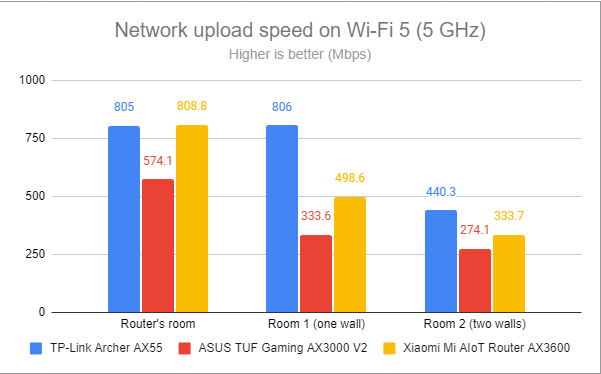
Uploads were ok, but the ASUS TUF Gaming AX3000 V2 was easily outmatched.
Network downloads on Wi-Fi 5 (5 GHz)
Uploads were ok, but the ASUS TUF Gaming AX3000 V2 was easily outmatched.
 Network uploads on Wi-Fi 5 (5 GHz)
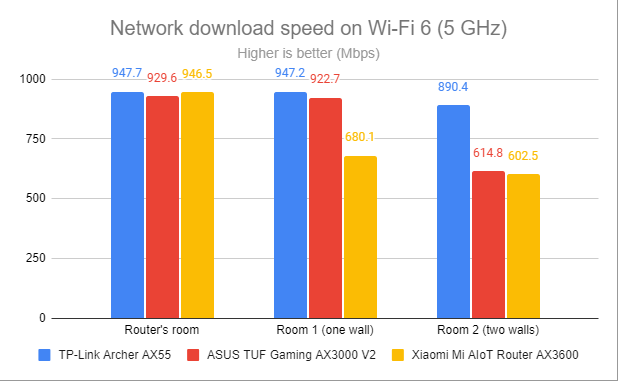
Again, switching from Wi-Fi 5 to Wi-Fi 6 changed things a lot: downloads were very fast everywhere in my apartment.
Network uploads on Wi-Fi 5 (5 GHz)
Again, switching from Wi-Fi 5 to Wi-Fi 6 changed things a lot: downloads were very fast everywhere in my apartment.
 Network downloads on Wi-Fi 6 (5 GHz)
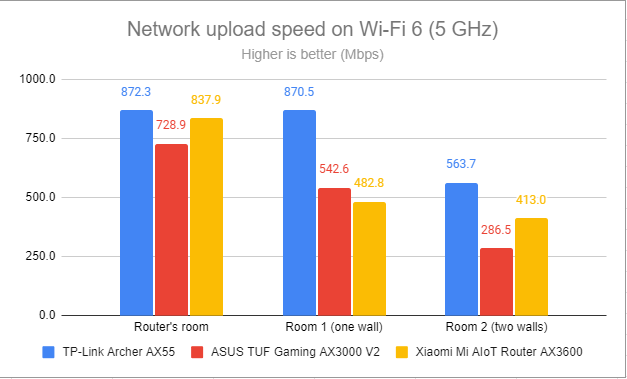
The uploads were much faster too.
Network downloads on Wi-Fi 6 (5 GHz)
The uploads were much faster too.
 Network uploads on Wi-Fi 6 (5 GHz)
My testing revealed that ASUS TUF Gaming AX3000 V2 is optimized to work using the Wi-Fi 6 (802.11ax) standard on the 5 GHz band. If you want the fastest downloads and uploads, don’t use the older 802.11ac standard, or you’ll be disappointed by this router.
Network uploads on Wi-Fi 6 (5 GHz)
My testing revealed that ASUS TUF Gaming AX3000 V2 is optimized to work using the Wi-Fi 6 (802.11ax) standard on the 5 GHz band. If you want the fastest downloads and uploads, don’t use the older 802.11ac standard, or you’ll be disappointed by this router.
 SpeedTest on Ethernet connections
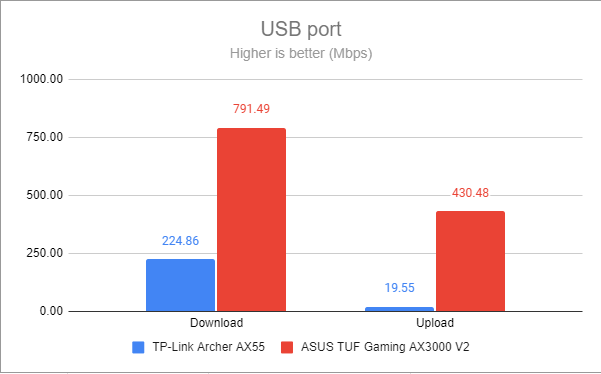
I like that ASUS TUF Gaming AX3000 V2 has a built-in USB 3.0 port. You can connect an external hard drive and turn your router into a NAS (Network Attached Storage). I plugged a fast SSD drive into it and made some data transfers to and from the SSD. The speeds I measured were excellent - much higher than those from a competitor like TP-Link Archer AX55. Xiaomi Mi AIoT Router AX3600 wasn’t included in the chart below because it doesn’t have a USB port.
SpeedTest on Ethernet connections
I like that ASUS TUF Gaming AX3000 V2 has a built-in USB 3.0 port. You can connect an external hard drive and turn your router into a NAS (Network Attached Storage). I plugged a fast SSD drive into it and made some data transfers to and from the SSD. The speeds I measured were excellent - much higher than those from a competitor like TP-Link Archer AX55. Xiaomi Mi AIoT Router AX3600 wasn’t included in the chart below because it doesn’t have a USB port.
 The speed of the USB port
As expected from a modern Wi-Fi 6 router, ASUS TUF Gaming AX3000 V2 has no problems handling 1 Gbps internet and wired network connections. To make things even more appealing, its USB 3.0 port is useful and very fast.
The speed of the USB port
As expected from a modern Wi-Fi 6 router, ASUS TUF Gaming AX3000 V2 has no problems handling 1 Gbps internet and wired network connections. To make things even more appealing, its USB 3.0 port is useful and very fast.

 ASUS TUF-AX3000 V2 is an extendable router
Security is another major focus area for ASUS, and this router packs the following features:
ASUS TUF-AX3000 V2 is an extendable router
Security is another major focus area for ASUS, and this router packs the following features:
 Parental Controls are easy to set up
Gaming is another focus area for ASUS TUF Gaming AX3000 V2. You get the following tools:
Parental Controls are easy to set up
Gaming is another focus area for ASUS TUF Gaming AX3000 V2. You get the following tools:

 Gaming is a major focus area
The list of advanced features and tools doesn’t stop here. You also get the following:
Gaming is a major focus area
The list of advanced features and tools doesn’t stop here. You also get the following:
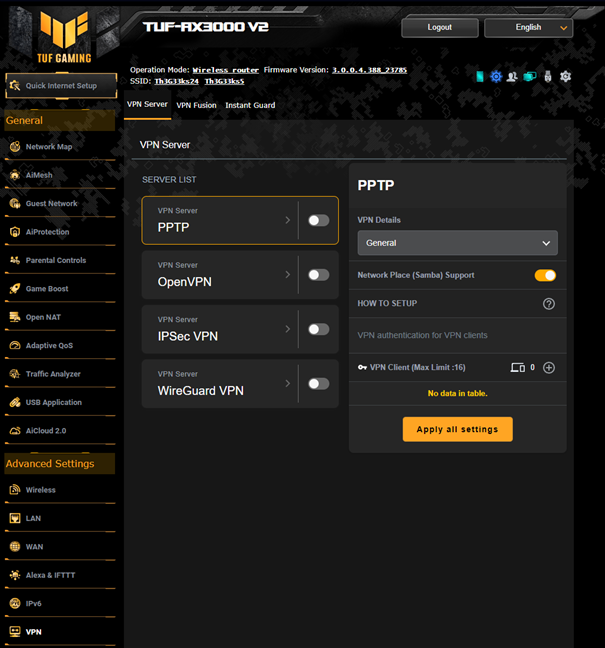
 Do you want to turn your router into a VPN server?
ASUS TUF Gaming AX3000 V2 has a long list of advanced features that will be useful for many users. Its target audience includes gamers, families with children, or technical users who want VPN solutions on their wireless routers, integrations with virtual assistants, or practical USB applications.
Do you want to turn your router into a VPN server?
ASUS TUF Gaming AX3000 V2 has a long list of advanced features that will be useful for many users. Its target audience includes gamers, families with children, or technical users who want VPN solutions on their wireless routers, integrations with virtual assistants, or practical USB applications.
ASUS TUF Gaming AX3000 V2: Who is it good for?
This wireless router is a smart choice for:- Internet connections with speeds of up to 2.5 Gbps
- Online gamers who want minimal latency when gaming
- Families who want efficient parental controls, antivirus, and firewall protection
- Medium-sized apartments and equivalent office spaces
- People who want to remotely control their router from anywhere on the internet using a mobile app
- Users who want to control their home network using Alexa and IFTTT (If This, Then That)
Pros and cons
Here are the things I like about ASUS TUF Gaming AX3000 V2:- It can use 2.5 Gbps internet connections
- Excellent performance when using the Wi-Fi 6 standard
- Fast USB port
- Useful features for gamers
- Excellent security tools and parental controls
- It can be controlled using a mobile app from anywhere
- Innovative VPN features
- Less-than-impressive performance when using older standards like Wi-Fi 4 and Wi-Fi 5
Verdict
ASUS TUF Gaming AX3000 V2 is a good wireless router that checks all the fundamentals: modern hardware that can handle many connected devices, good Wi-Fi 6 performance, tons of valuable features, and excellent security. Its support for 2.5 Gbps internet connections and the Link Aggregation feature also make it ideal for people who want to future-proof their network. I like it a lot and recommend it to anyone who wants a Wi-Fi 6 router that offers good value for money.Unboxing the ASUS TUF Gaming AX3000 V2
This gaming router comes in a black cardboard box, with a big picture of the device on the top cover, alongside the product name and ASUS and TUF Gaming branding.Hardware specifications and design
ASUS TUF Gaming AX3000 V2 has an aggressive rugged look aimed mostly at gamers. Its four external antennas are not detachable. When you extend them to their intended positions, the router has a size of 27 x 15 x 19 cm or 10.63 x 5.91 x 7.48 inches. It also weighs about 547 grams or 19.29 oz, which is surprisingly light. Design-wise, you see a golden TUF logo on the top, which is not backlit like the one on the ASUS TUF-AX5400. The same gold color is used for certain areas on the antennas, and it helps the router have its own visual identity.Setting up and using the ASUS TUF Gaming AX3000 V2
When you install the ASUS TUF Gaming AX3000 V2 using a laptop and a web browser, it’s clear that you’re dealing with a gaming router as soon as you load the quick setup wizard, which uses a TUF Gaming skin, just like the rest of the administration interface.Wireless network performance
My test apartment is set up like in the diagram below. I’ve placed the ASUS TUF Gaming AX3000 V2 in a central position to provide good coverage in an area as large as possible.- The router’s room - I record the maximum speeds when no walls absorb the wireless signal in the room where the router is placed.
- Room 1 - is separated by one wall from the router, so the wireless signal and the Wi-Fi speed I get should be lower here.
- Room 2 - is separated from the router by two walls absorbing the wireless signal. Also, the wall between Room 1 and Room 2 is twice as thick as the one between The router’s room and Room 1. As a result, Room 2 can be a difficult challenge for many routers.
How the ASUS TUF Gaming AX3000 V2 performs on the 2.4 GHz band
I first measured the signal strength using NetSpot when connected to the 2.4 GHz band on the Wi-Fi 4 standard (802.11n). The signal strength delivered by ASUS TUF Gaming AX3000 V2 was ok, without impressing.How the ASUS TUF Gaming AX3000 V2 performs on the 5 GHz band
I switched to the 5 GHz band and started measuring the signal strength with NetSpot. When using the Wi-Fi 5 (802.11ac) standard, ASUS TUF Gaming AX3000 V2 delivered good signal strength at levels similar to its competitors.Wired network performance & USB port
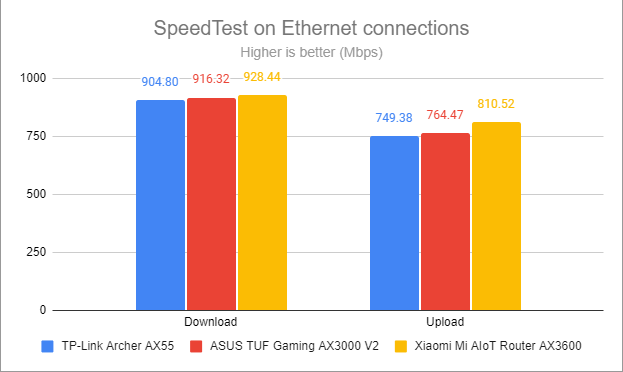
Let’s verify how the ASUS TUF Gaming AX3000 V2 performs on Ethernet connections. My internet connection offers a maximum of 1 Gbps for the download speed and 800 Mbps for the upload. When testing with SpeedTest, this router achieved a maximum download speed of 916.32 Mbps and an upload speed of 764.47 Mbps. Both values are close to the maximum potential of my internet connection.Advanced features
TUF Gaming AX3000 V2 comes with the standard ASUS firmware that bundles many useful tools. First of all, this router is extendable due to its support for AiMesh. If you have another ASUS router and want to create a mesh Wi-Fi, here’s how to turn on & configure the backhaul on ASUS routers with AiMesh.- Router Security Assessment – verifies whether your router’s settings are secure. When it finds problems, it proactively informs and helps you fix things.
- Malicious Sites Blocking – an efficient cloud-based module that blocks malicious websites on all the devices connected to your network.
- Two-Way IPS – a two-way intrusion prevention system that protects the network from spam, DDoS attacks, network attacks, etc.
- Infected Device Prevention and Blocking – when some network devices get infected and become zombies in malware networks, they are automatically blocked, and you are informed about this problem.
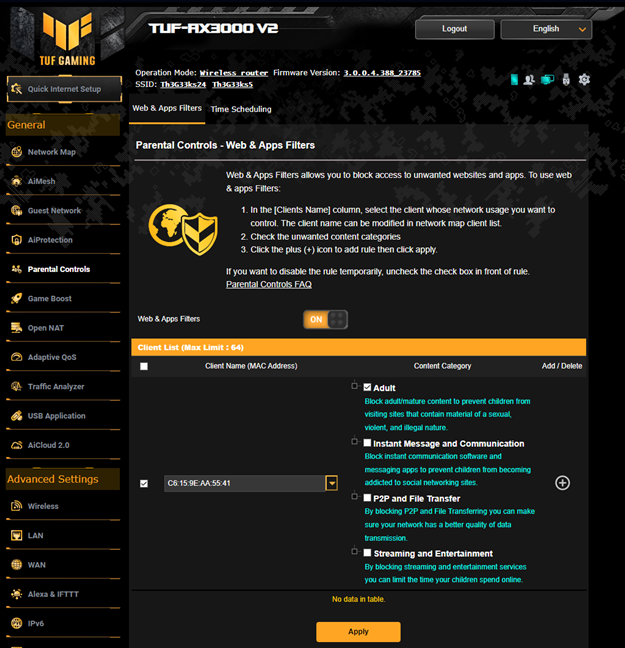
- Parental Controls – cloud-based parental controls that can be used to set rules about internet access for children’s devices: the types of inappropriate content that is blocked, when they are allowed to use the internet, for how long, etc. If you are interested in using them, here’s how to set up Parental Controls on an ASUS router and how to control your child’s internet time.
- Gear accelerator – you can prioritize your gaming devices for the best experience.
- Mobile Game Mode – with the help of the ASUS Router app, you can turn on this mode for the best possible mobile gaming experience.
- Open NAT – allows you to set port-forwarding rules for online games, using predefined profiles that cover the most popular titles, like Call of Duty, CS Go, PUBG, FIFA, and League of Legends.
- Guest Network – you can enable three wireless guest networks with individual security and access settings on each frequency band: 2.4 GHz and 5 GHz.
- Adaptive QoS – optimize network traffic for online gaming, media streaming, web browsing, work-from-home, etc.
- Traffic Analyzer – visual traffic statistics that clearly show how your network is used and by which devices. It’s useful when you want to manage your internet traffic.
- USB Applications – set up your router to use external hard disks or printers through USB ports. You can also use a USB modem or smartphone as a backup internet connection for your network.
- Dual WAN – you can use two internet connections simultaneously in load balancing or backup mode.
- IPv6 – support for IPv6 addresses that are replacing IPv4. Here’s how to enable IPv6 on your ASUS router or mesh Wi-Fi.
- VPN – you can set the router to work as a VPN server using the following protocols: PPTP, OpenVPN, IPSec VPN, and WireGuard VPN. You can also turn your network-connected devices into VPN-enabled clients without additional VPN software. And to complete the picture, this router gives you access to VPN Fusion and Instant Guard.
- Network Tools – for analyzing the network and identifying what’s wrong. They are useful when you need to troubleshoot problems.
- DDNS – a service that allows you to connect to the router remotely, from anywhere on the internet, even if your internet provider assigns you a dynamic public IP address. The list of supported services is quite long, and ASUS also includes its free service.
- Integration with Amazon’s Alexa and IFTTT – you can say things like “Alexa, ask ASUS ROUTER to upgrade the firmware” to perform different tasks. You can also automate tasks that might otherwise be repetitive or unable to “talk to each other.”

Discussion (0)
Comments are closed.