



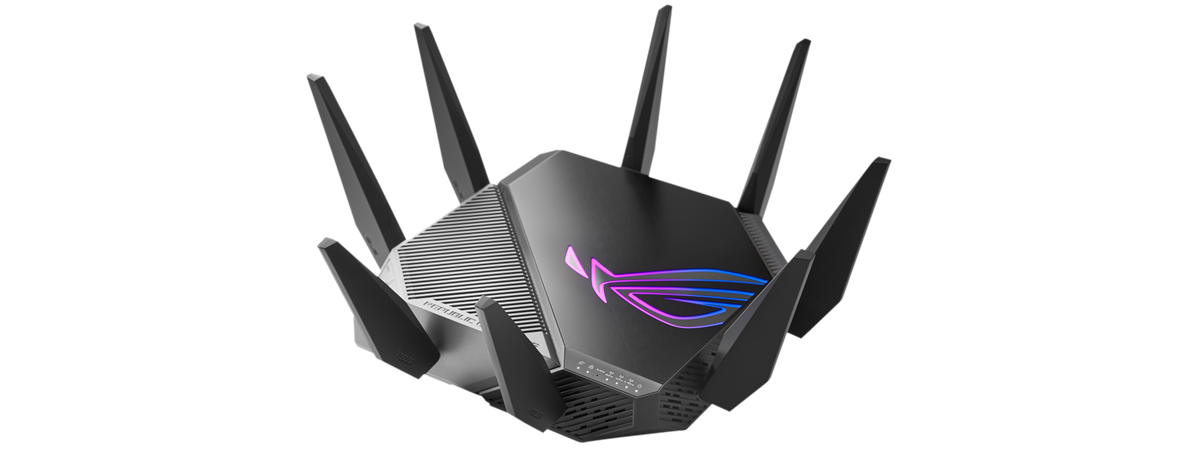
ASUS ROG Rapture GT-AXE11000 is a massive Wi-Fi6E router with an aggressive yet good-looking design that tries to attract people who want the best money can buy. It also packs some great hardware and an extensive list of features that cater to the needs of different audiences: gamers, knowledgeable users, small businesses, and families with children. If you want to see how well it performs in real-life tests and understand whether it’s a good fit for you and your specific needs, read this review:
![Verdict]()

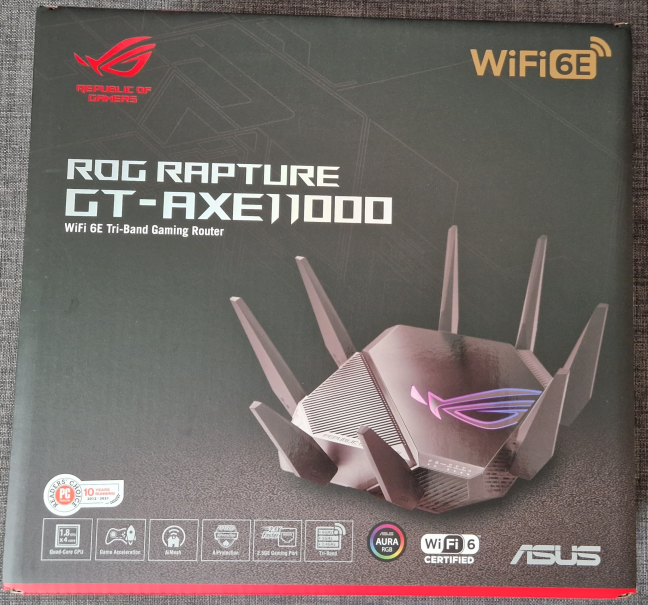
 The packaging used for ASUS ROG Rapture GT-AXE11000
You will find further information on the box’s sides and back, including a description of the new Wi-Fi 6E standard and its benefits. When you unbox everything, you find the following items: the router, an RJ-45 network cable, a troubleshooting guide, the quick setup guide, the warranty card, and the power adapter. GT-AXE11000 is a powerful router that requires a large power adapter the size of those used for laptops. One neat aspect is that the European version of the router bundles two power plugs: the standard EU version and the UK version. Therefore, even if you buy this router from another European country, it will surely work with your country’s power plugs.
The packaging used for ASUS ROG Rapture GT-AXE11000
You will find further information on the box’s sides and back, including a description of the new Wi-Fi 6E standard and its benefits. When you unbox everything, you find the following items: the router, an RJ-45 network cable, a troubleshooting guide, the quick setup guide, the warranty card, and the power adapter. GT-AXE11000 is a powerful router that requires a large power adapter the size of those used for laptops. One neat aspect is that the European version of the router bundles two power plugs: the standard EU version and the UK version. Therefore, even if you buy this router from another European country, it will surely work with your country’s power plugs.
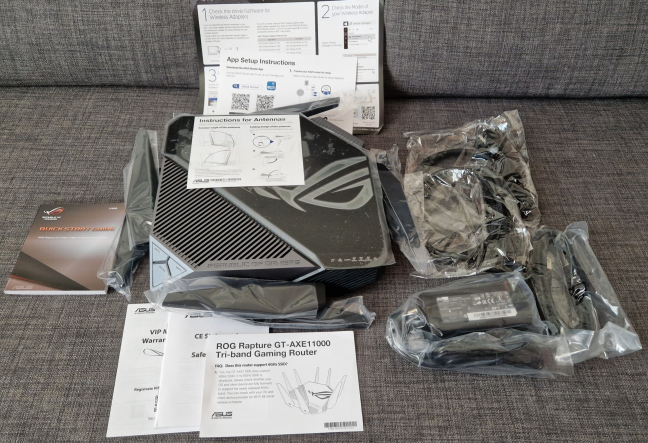
 What you'll find inside the box
When you remove all the protective materials from the router, you will be awed by how massive and great it looks. Furthermore, visually speaking, it fits the Republic of Gamers family of devices.
What you'll find inside the box
When you remove all the protective materials from the router, you will be awed by how massive and great it looks. Furthermore, visually speaking, it fits the Republic of Gamers family of devices.
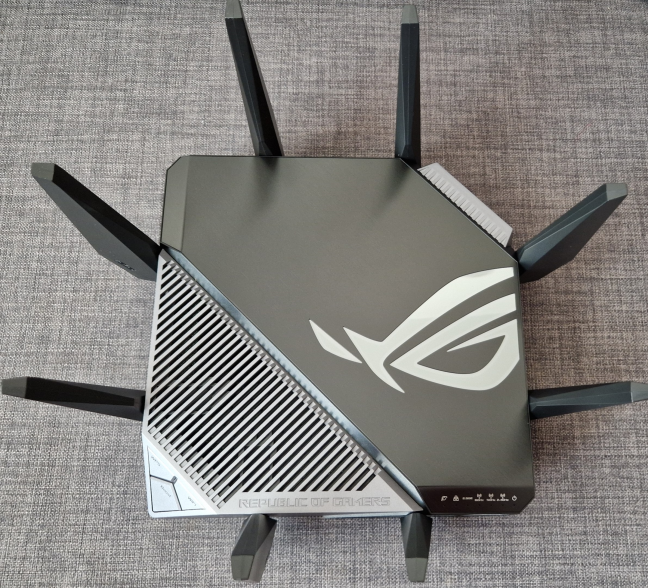
 ASUS ROG Rapture GT-AXE11000 has an aggressive look
The unboxing experience offered by ASUS ROG Rapture GT-AXE11000 is impressive. You get the feeling that you just bought a premium router, and ASUS provides you with everything you need to get started.
ASUS ROG Rapture GT-AXE11000 has an aggressive look
The unboxing experience offered by ASUS ROG Rapture GT-AXE11000 is impressive. You get the feeling that you just bought a premium router, and ASUS provides you with everything you need to get started.
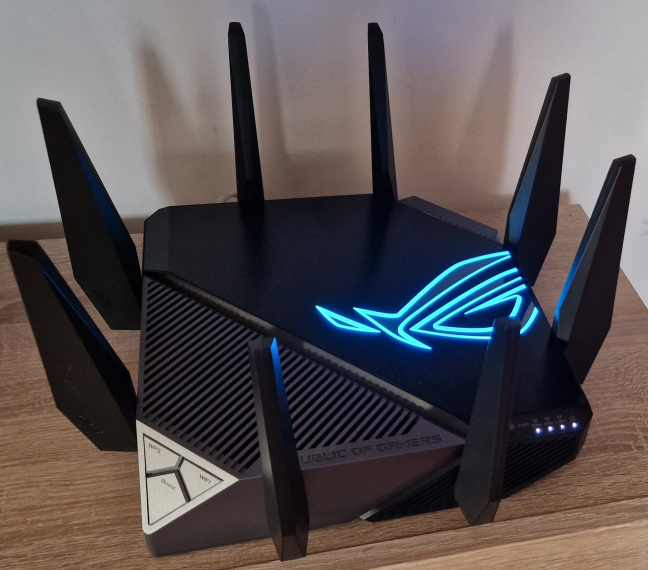
 The RGB lighting looks great
ASUS ROG Rapture GT-AXE11000 looks similar to the even more expensive ASUS ROG Rapture GT-AXE16000. However, I like the GT-AXE11000 better because its top cover is not made of glass but matte plastic. Therefore, it looks better and is more practical. Also, it doesn’t gather as many fingerprints and is easier to clean. Furthermore, the LEDs signaling the status of the router and its features are also more visible. However, if you find them annoying, you can disable them from the router’s firmware.
The RGB lighting looks great
ASUS ROG Rapture GT-AXE11000 looks similar to the even more expensive ASUS ROG Rapture GT-AXE16000. However, I like the GT-AXE11000 better because its top cover is not made of glass but matte plastic. Therefore, it looks better and is more practical. Also, it doesn’t gather as many fingerprints and is easier to clean. Furthermore, the LEDs signaling the status of the router and its features are also more visible. However, if you find them annoying, you can disable them from the router’s firmware.
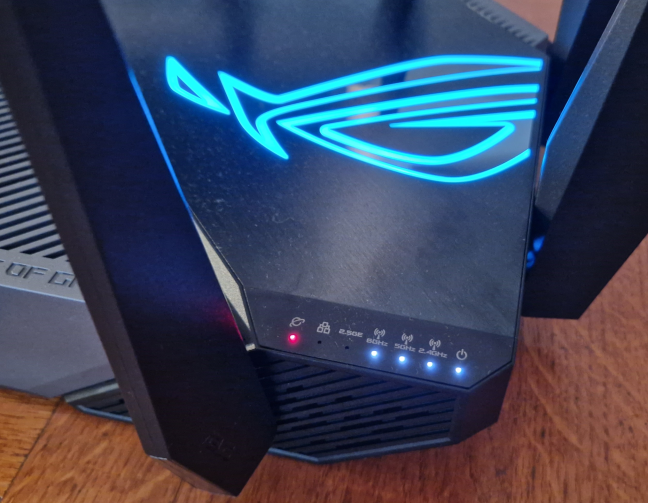
 The LEDs on the top
Inside the ASUS ROG Rapture GT-AXE11000, you find some potent hardware: a Broadcom BCM4908 quad-core processor running at 1.8GHz, 1 GB of DDR3 RAM, and 256 MB of storage for the firmware. The router broadcasts its wireless signal on three bands, as follows:
The LEDs on the top
Inside the ASUS ROG Rapture GT-AXE11000, you find some potent hardware: a Broadcom BCM4908 quad-core processor running at 1.8GHz, 1 GB of DDR3 RAM, and 256 MB of storage for the firmware. The router broadcasts its wireless signal on three bands, as follows:
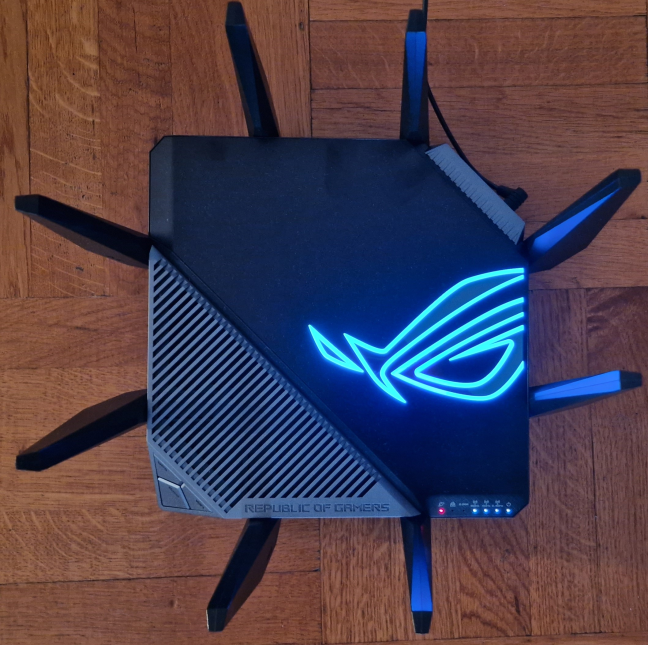
 There are many ventilation grids on this router
You find three buttons on the corner opposite the LEDs: WPS, Wi-Fi, and Boost. They enable or disable the features written on them. However, the Boost button can be configured in the router’s firmware to activate or deactivate things like the LEDs, the DFS (Dynamic Frequency Selection) Channel, the Aura RGB lighting, or Game Boost.
There are many ventilation grids on this router
You find three buttons on the corner opposite the LEDs: WPS, Wi-Fi, and Boost. They enable or disable the features written on them. However, the Boost button can be configured in the router’s firmware to activate or deactivate things like the LEDs, the DFS (Dynamic Frequency Selection) Channel, the Aura RGB lighting, or Game Boost.
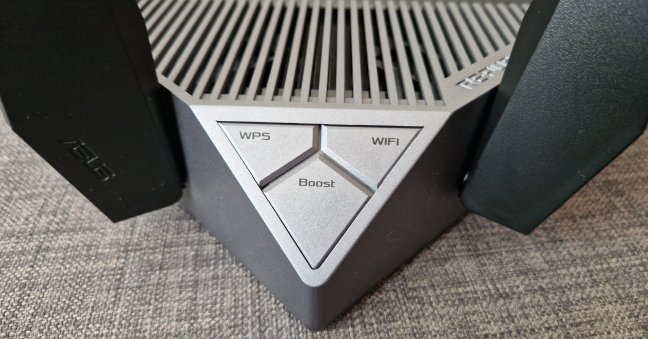
 WPS, Wi-Fi, and Boost
Rotate the ASUS ROG Rapture GT-AXE11000 a bit, and you find two USB 3.2 ports, which is incredibly rare on a wireless router. They will be very useful to knowledgeable users, who want to build their own NAS (Network Attached Storage) solution using their router, and to small business users.
WPS, Wi-Fi, and Boost
Rotate the ASUS ROG Rapture GT-AXE11000 a bit, and you find two USB 3.2 ports, which is incredibly rare on a wireless router. They will be very useful to knowledgeable users, who want to build their own NAS (Network Attached Storage) solution using their router, and to small business users.
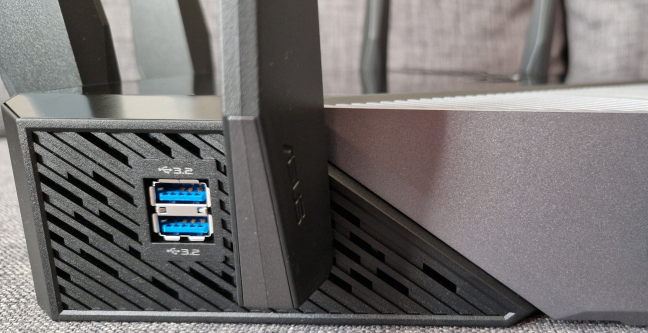
 ASUS ROG Rapture GT-AXE11000 has two USB 3.2 ports
TIP: Here’s how to turn your ASUS router into a NAS.
Rotate the router further, and you see the WAN port in blue (working at 1 Gbps), and a 2.5 Gbps Ethernet port that can be used for the internet connection or for connecting a device can take advantage of it. For example, I used it to connect my desktop PC, on which I installed the ASUS XG-C100C PCI-Express network card. Next to them, you also find four 1 Gbps Ethernet ports.
ASUS ROG Rapture GT-AXE11000 has two USB 3.2 ports
TIP: Here’s how to turn your ASUS router into a NAS.
Rotate the router further, and you see the WAN port in blue (working at 1 Gbps), and a 2.5 Gbps Ethernet port that can be used for the internet connection or for connecting a device can take advantage of it. For example, I used it to connect my desktop PC, on which I installed the ASUS XG-C100C PCI-Express network card. Next to them, you also find four 1 Gbps Ethernet ports.
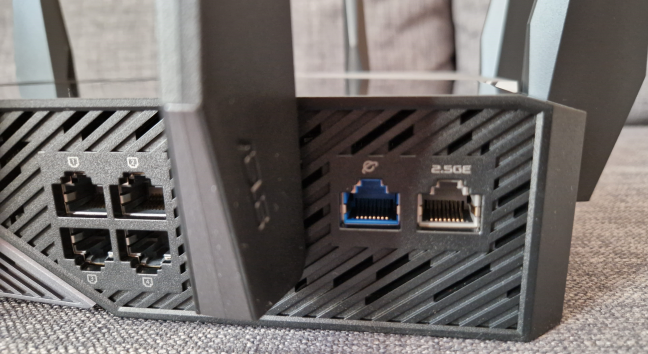
 You can use a 2.5 Gbps internet connection
Lastly, after one more rotation, you see the Power jack, the Power button, and the Reset jack.
You can use a 2.5 Gbps internet connection
Lastly, after one more rotation, you see the Power jack, the Power button, and the Reset jack.
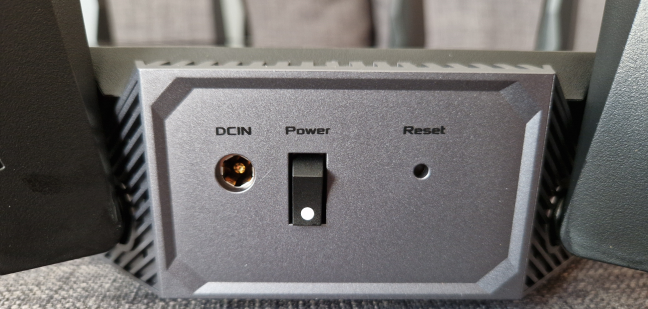
 The Power jack, the Power button, and the Reset jack
There are even more ventilation grids on the bottom of the router, a sticker with details about the device you bought, and a hole for wall mounting. Considering how massive and heavy this router is, one hole feels insufficient for safely mounting it on walls. I recommend placing the ASUS ROG Rapture GT-AXE11000 on flat surfaces in your home or office.
The Power jack, the Power button, and the Reset jack
There are even more ventilation grids on the bottom of the router, a sticker with details about the device you bought, and a hole for wall mounting. Considering how massive and heavy this router is, one hole feels insufficient for safely mounting it on walls. I recommend placing the ASUS ROG Rapture GT-AXE11000 on flat surfaces in your home or office.
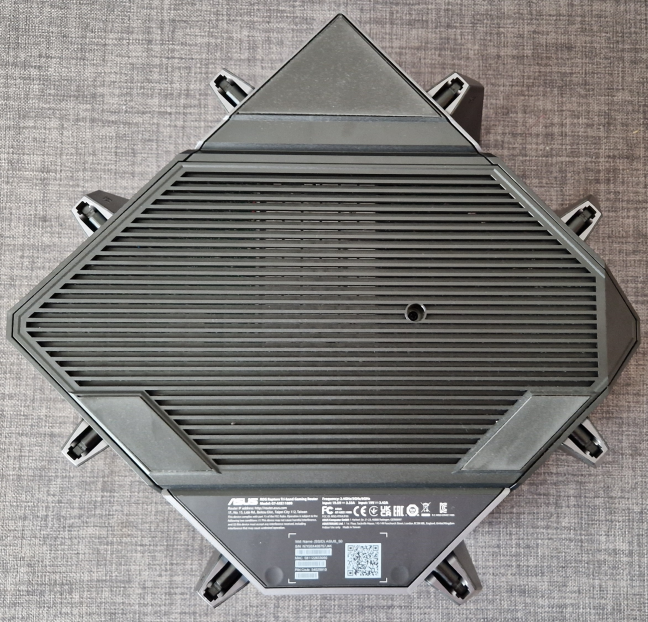
 The bottom side of the router
The hardware and the design of the ASUS ROG Rapture GT-AXE11000 are impressive. This router has everything you can think of, from Wi-Fi6E support to 160 MHz-wide channels on Wi-Fi 6 and WPA3 encryption. For more technical details, visit this page: ASUS ROG Rapture GT-AXE11000.
The bottom side of the router
The hardware and the design of the ASUS ROG Rapture GT-AXE11000 are impressive. This router has everything you can think of, from Wi-Fi6E support to 160 MHz-wide channels on Wi-Fi 6 and WPA3 encryption. For more technical details, visit this page: ASUS ROG Rapture GT-AXE11000.
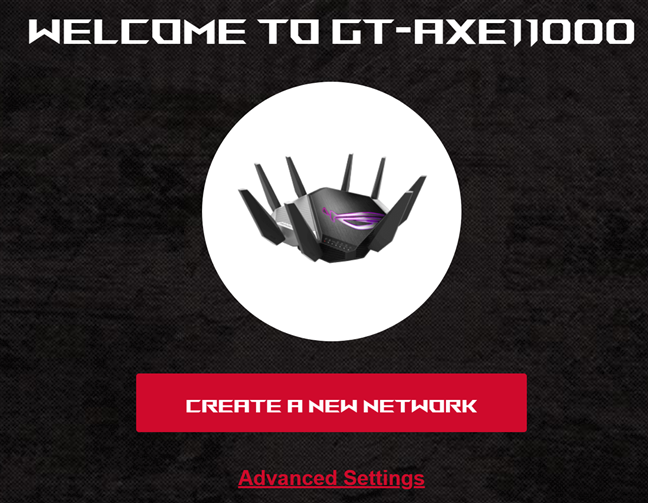 Setting up ASUS ROG Rapture GT-AXE11000 is not complicated
The setup wizard does a good job presenting the necessary information to set things up correctly: connect the router to the internet, choose a name and password for the Wi-Fi, set an admin account and password, etc. When you are done with the initial setup, you are shown a summary of your settings, and you are recommended to upgrade the firmware to the latest version. Follow this recommendation as you benefit from the latest bug fixes, security updates, and performance improvements.
For managing this router, I prefer using the web-based admin interface offered by ASUS because it gives you access to all the tools and features. For ASUS ROG Rapture GT-AXE11000, this interface has a Republic of Gamers skin with red and black accents. Some people may like it, while others prefer the classic skin from other ASUS routers.
Setting up ASUS ROG Rapture GT-AXE11000 is not complicated
The setup wizard does a good job presenting the necessary information to set things up correctly: connect the router to the internet, choose a name and password for the Wi-Fi, set an admin account and password, etc. When you are done with the initial setup, you are shown a summary of your settings, and you are recommended to upgrade the firmware to the latest version. Follow this recommendation as you benefit from the latest bug fixes, security updates, and performance improvements.
For managing this router, I prefer using the web-based admin interface offered by ASUS because it gives you access to all the tools and features. For ASUS ROG Rapture GT-AXE11000, this interface has a Republic of Gamers skin with red and black accents. Some people may like it, while others prefer the classic skin from other ASUS routers.
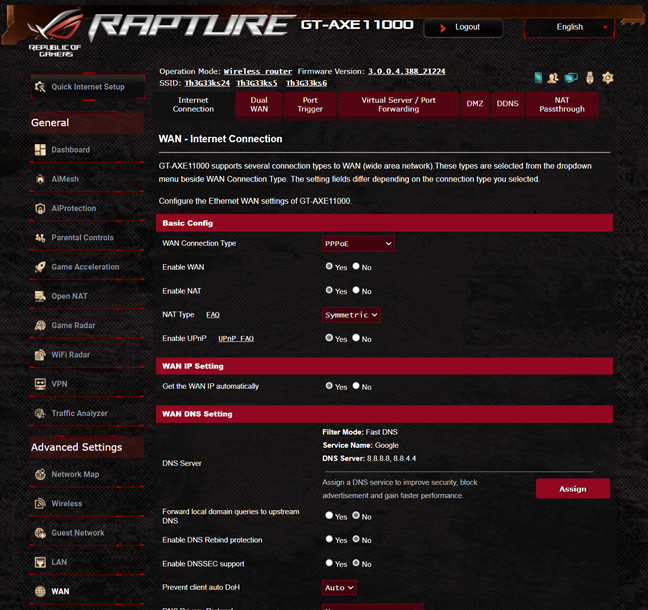
 The web-based admin interface
The admin interface is available in twenty-five languages, and the help documentation is easily accessible with links to the manual at the bottom of the interface. Gamers should not hesitate to familiarize themselves with this router’s firmware, as they will find many features targeted at them. They’ll also appreciate the RGB lighting with some stunning effects that you can easily personalize.
The web-based admin interface
The admin interface is available in twenty-five languages, and the help documentation is easily accessible with links to the manual at the bottom of the interface. Gamers should not hesitate to familiarize themselves with this router’s firmware, as they will find many features targeted at them. They’ll also appreciate the RGB lighting with some stunning effects that you can easily personalize.
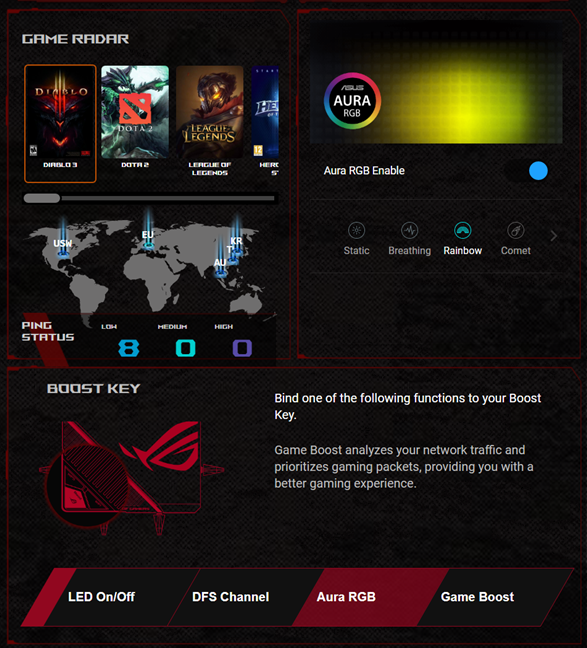
 ASUS ROG Rapture GT-AXE11000 has many features for gamers
One improvement of the latest firmware versions for this router is the option to set DNS servers from a list provided by ASUS, which includes many great services, including those offered by Google.
ASUS ROG Rapture GT-AXE11000 has many features for gamers
One improvement of the latest firmware versions for this router is the option to set DNS servers from a list provided by ASUS, which includes many great services, including those offered by Google.
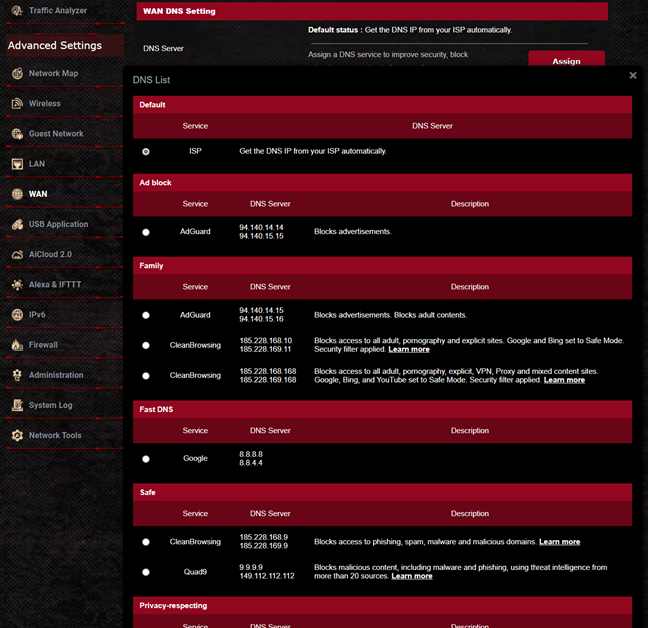
 The new DNS settings are useful
Administering the ASUS ROG Rapture GT-AXE11000 is a pleasant experience. The web-based interface is well organized and split into logical sections with plenty of settings and information. In addition, newer versions of firmware improve how some settings are organized, like the VPN or AiMesh.
The new DNS settings are useful
Administering the ASUS ROG Rapture GT-AXE11000 is a pleasant experience. The web-based interface is well organized and split into logical sections with plenty of settings and information. In addition, newer versions of firmware improve how some settings are organized, like the VPN or AiMesh.
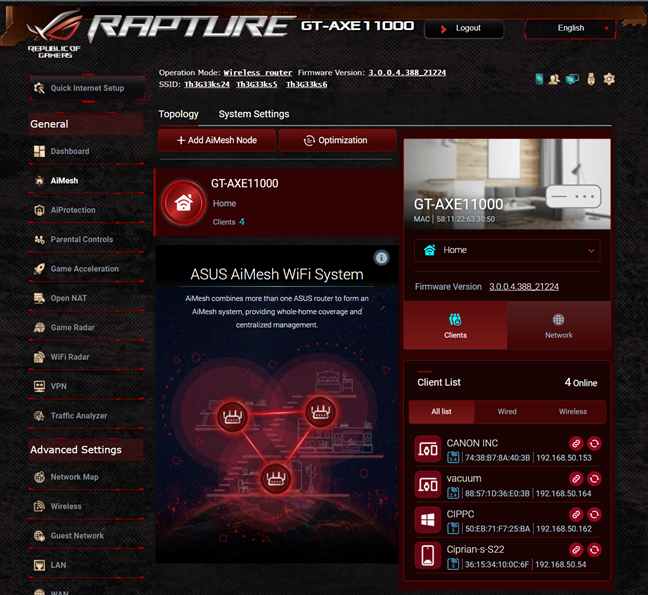
 ASUS ROG Rapture GT-AXE11000 works with AiMesh
The ASUS Router app is easy to use, even though it doesn’t give you access to as many features and tools. However, it does cover the basics you need, including more advanced features like Parental Controls and setting up rules for your children and their devices.
ASUS ROG Rapture GT-AXE11000 works with AiMesh
The ASUS Router app is easy to use, even though it doesn’t give you access to as many features and tools. However, it does cover the basics you need, including more advanced features like Parental Controls and setting up rules for your children and their devices.
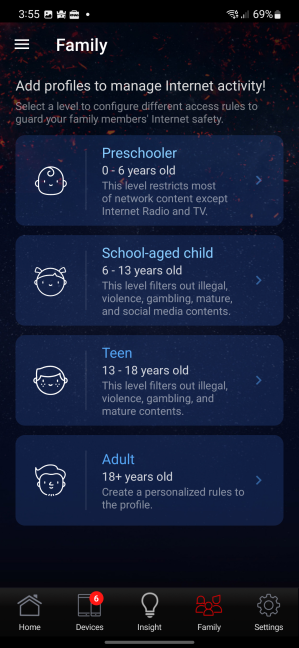
 The ASUS Router app
ASUS ROG Rapture GT-AXE11000 broadcasts its signal on a third 6 GHz band, using the new Wi-Fi 6E standard. While the new standard is speedy, it can also be troublesome because it works only with compatible devices. Like in the early days of the Wi-Fi 6 standard, your new and shiny laptop may not see the Wi-Fi 6E network, even though it is compatible. You may have to update Windows 11 to the latest version, update the Wi-Fi network card drivers, and install the newest firmware on the router before the laptop can connect to the network emitted by this router. You’ll probably have a similar experience because we live in the early days of the Wi-Fi 6E standard. However, just like with Wi-Fi 6, a year from now, Wi-Fi 6E compatibility issues should be resolved, and the whole experience will become much smoother.
Overall, I’m happy with how easy it is to set up the ASUS ROG Rapture GT-AXE11000, how it works, the administration experience it offers, and its general performance. If you want to know more about the real-world performance offered by this router, go to the next page of this review, where I present detailed measurements and comparisons.
The ASUS Router app
ASUS ROG Rapture GT-AXE11000 broadcasts its signal on a third 6 GHz band, using the new Wi-Fi 6E standard. While the new standard is speedy, it can also be troublesome because it works only with compatible devices. Like in the early days of the Wi-Fi 6 standard, your new and shiny laptop may not see the Wi-Fi 6E network, even though it is compatible. You may have to update Windows 11 to the latest version, update the Wi-Fi network card drivers, and install the newest firmware on the router before the laptop can connect to the network emitted by this router. You’ll probably have a similar experience because we live in the early days of the Wi-Fi 6E standard. However, just like with Wi-Fi 6, a year from now, Wi-Fi 6E compatibility issues should be resolved, and the whole experience will become much smoother.
Overall, I’m happy with how easy it is to set up the ASUS ROG Rapture GT-AXE11000, how it works, the administration experience it offers, and its general performance. If you want to know more about the real-world performance offered by this router, go to the next page of this review, where I present detailed measurements and comparisons.
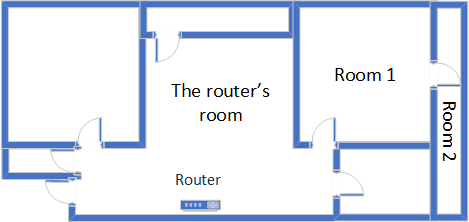
 The apartment in which I tested ASUS ROG Rapture GT-AXE11000
I evaluate the quality of the wireless network managed by ASUS ROG Rapture GT-AXE11000 through measurements made in three different places:
The apartment in which I tested ASUS ROG Rapture GT-AXE11000
I evaluate the quality of the wireless network managed by ASUS ROG Rapture GT-AXE11000 through measurements made in three different places:
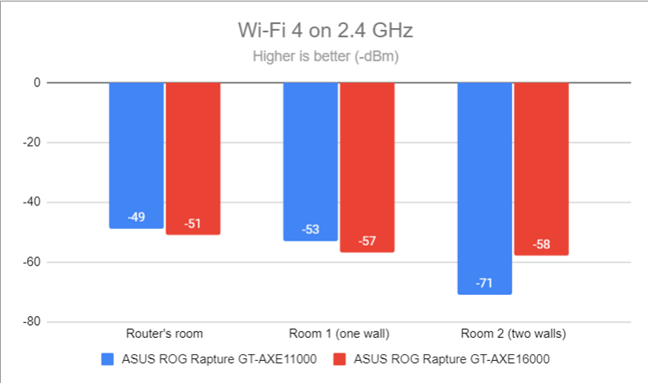
 Signal strength on Wi-Fi 4 (2.4 GHz band)
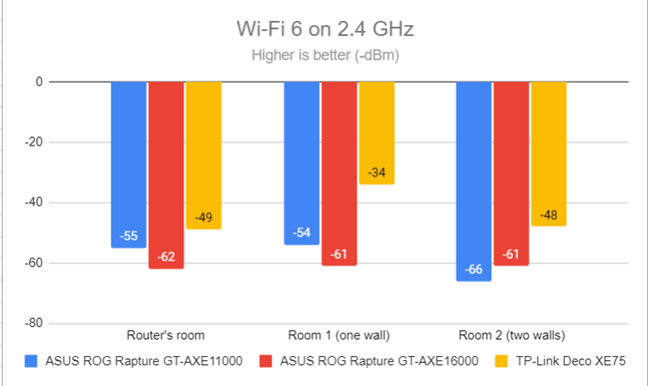
Switching to the Wi-Fi 6 standard on the same 2.4 GHz band decreased the signal strength slightly. However, it did not reach problematic levels. And, as expected, TP-Link Deco XE75 performed better because it is a mesh Wi-Fi system that covers the same living space using multiple units, not just one, as routers do.
Signal strength on Wi-Fi 4 (2.4 GHz band)
Switching to the Wi-Fi 6 standard on the same 2.4 GHz band decreased the signal strength slightly. However, it did not reach problematic levels. And, as expected, TP-Link Deco XE75 performed better because it is a mesh Wi-Fi system that covers the same living space using multiple units, not just one, as routers do.
 Signal strength on Wi-Fi 6 (2.4 GHz band)
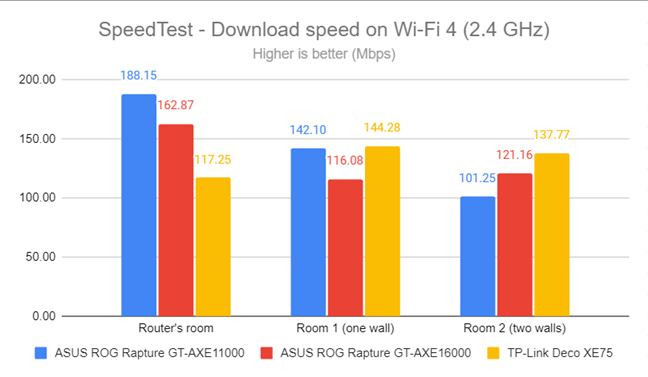
Next, I started the SpeedTest app and used it to measure the maximum speed you get when transferring data to and from the internet on the 2.4 GHz band. When using the Wi-Fi 4 standard, ASUS ROG Rapture GT-AXE11000 delivered fast downloads in all the rooms of my apartment.
Signal strength on Wi-Fi 6 (2.4 GHz band)
Next, I started the SpeedTest app and used it to measure the maximum speed you get when transferring data to and from the internet on the 2.4 GHz band. When using the Wi-Fi 4 standard, ASUS ROG Rapture GT-AXE11000 delivered fast downloads in all the rooms of my apartment.
 SpeedTest - The download speed on Wi-Fi 4 (2.4 GHz)
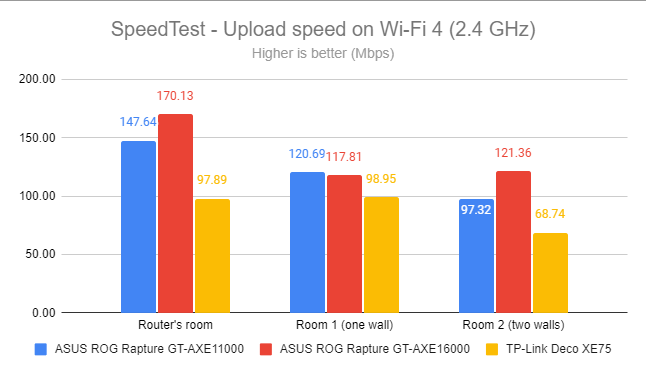
Uploads were fast, but GT-AXE11000 was outmatched by its more expensive brother.
SpeedTest - The download speed on Wi-Fi 4 (2.4 GHz)
Uploads were fast, but GT-AXE11000 was outmatched by its more expensive brother.
 SpeedTest - The upload speed on Wi-Fi 4 (2.4 GHz)
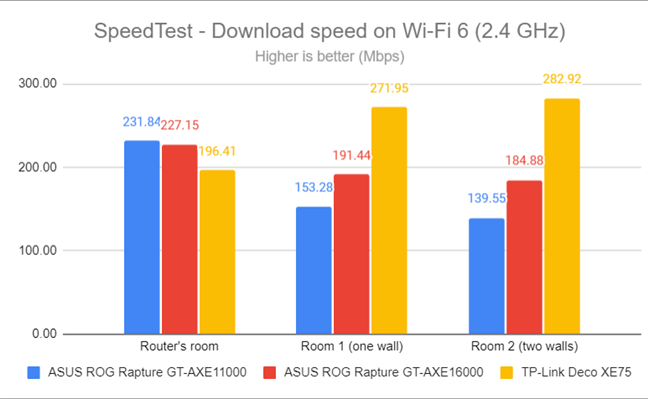
When switching to the Wi-Fi 6 standard on the 2.4 GHz band, download speeds increased significantly, as shown in the graphic below.
SpeedTest - The upload speed on Wi-Fi 4 (2.4 GHz)
When switching to the Wi-Fi 6 standard on the 2.4 GHz band, download speeds increased significantly, as shown in the graphic below.
 SpeedTest - The download speed on Wi-Fi 6 (2.4 GHz)
However, uploads were slower, and ASUS ROG Rapture GT-AXE11000 was the fastest only in the room where it was placed.
SpeedTest - The download speed on Wi-Fi 6 (2.4 GHz)
However, uploads were slower, and ASUS ROG Rapture GT-AXE11000 was the fastest only in the room where it was placed.
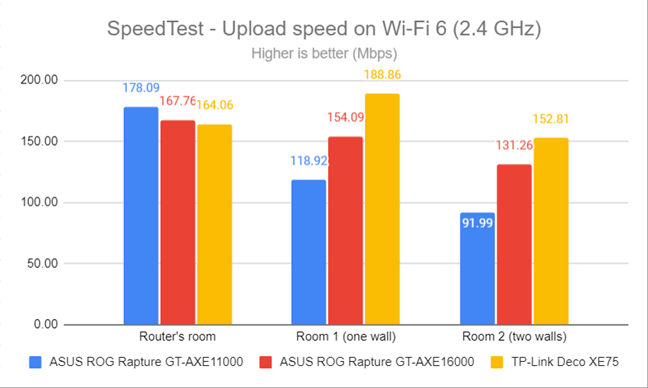
 SpeedTest - The upload speed on Wi-Fi 6 (2.4 GHz)
For the next set of measurements, I used the PassMark Performance test to transfer data between two computers connected to the network. Again, I was on the 2.4 GHz band with the Wi-Fi 4 standard turned on. In some rooms, ASUS ROG Rapture GT-AXE11000 delivered better download speeds than those offered by ASUS ROG Rapture GT-AXE16000, which is great.
SpeedTest - The upload speed on Wi-Fi 6 (2.4 GHz)
For the next set of measurements, I used the PassMark Performance test to transfer data between two computers connected to the network. Again, I was on the 2.4 GHz band with the Wi-Fi 4 standard turned on. In some rooms, ASUS ROG Rapture GT-AXE11000 delivered better download speeds than those offered by ASUS ROG Rapture GT-AXE16000, which is great.
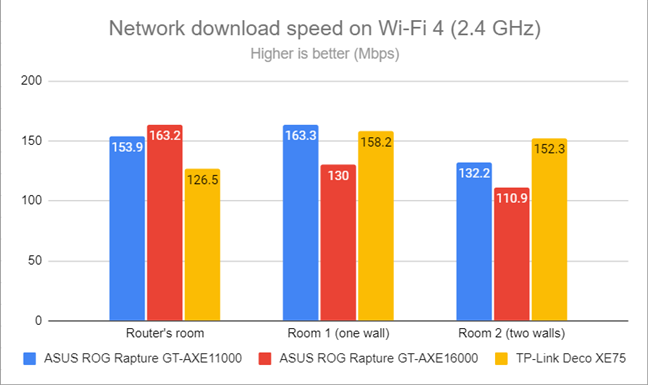
 Network downloads on Wi-Fi 4 (2.4 GHz)
When looking at the upload speed, GT-AXE11000 was the clear winner of this comparison.
Network downloads on Wi-Fi 4 (2.4 GHz)
When looking at the upload speed, GT-AXE11000 was the clear winner of this comparison.
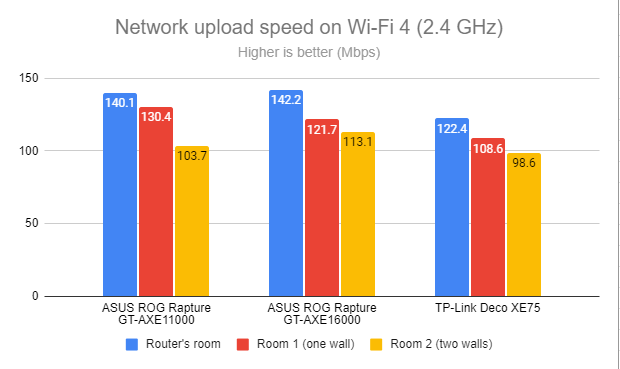
 Network uploads on Wi-Fi 4 (2.4 GHz)
When switching to the Wi-Fi 6 standard on the 2.4 GHz band, ASUS ROG Rapture GT-AXE11000 delivered fast download speeds everywhere in my apartment, but it was outmatched by the devices I’ve compared it with.
Network uploads on Wi-Fi 4 (2.4 GHz)
When switching to the Wi-Fi 6 standard on the 2.4 GHz band, ASUS ROG Rapture GT-AXE11000 delivered fast download speeds everywhere in my apartment, but it was outmatched by the devices I’ve compared it with.
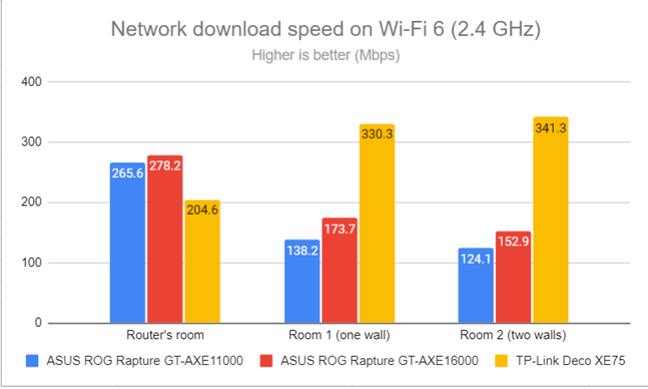
 Network downloads on Wi-Fi 6 (2.4 GHz)
The same trend was noticed when measuring the upload speed too.
Network downloads on Wi-Fi 6 (2.4 GHz)
The same trend was noticed when measuring the upload speed too.
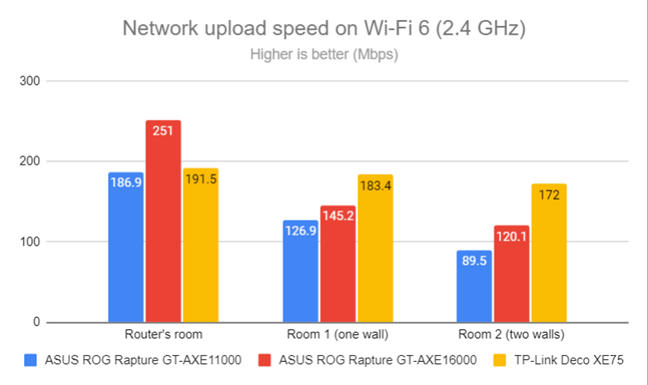 Network uploads on Wi-Fi 6 (2.4 GHz)
ASUS ROG Rapture GT-AXE11000 offers excellent wireless coverage and signal strength on the 2.4 GHz band. However, it stands out as a speed champion when using the older Wi-Fi 4 standard, not Wi-Fi 6.
Network uploads on Wi-Fi 6 (2.4 GHz)
ASUS ROG Rapture GT-AXE11000 offers excellent wireless coverage and signal strength on the 2.4 GHz band. However, it stands out as a speed champion when using the older Wi-Fi 4 standard, not Wi-Fi 6.
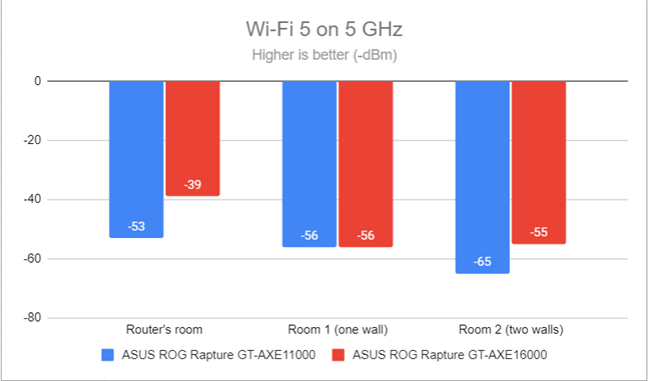
 Signal strength on Wi-Fi 5 (5 GHz band)
When switching to the Wi-Fi 6 standard, the signal strength improved a lot, which is great.
Signal strength on Wi-Fi 5 (5 GHz band)
When switching to the Wi-Fi 6 standard, the signal strength improved a lot, which is great.
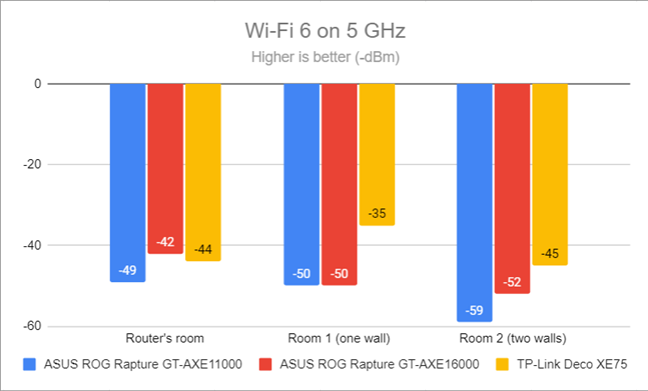
 Signal strength on Wi-Fi 6 (5 GHz band)
Next, I used the SpeedTest app to see how fast the internet connection is when using the 5 GHz band. ASUS ROG Rapture GT-AXE11000 delivered superb download speeds in all rooms.
Signal strength on Wi-Fi 6 (5 GHz band)
Next, I used the SpeedTest app to see how fast the internet connection is when using the 5 GHz band. ASUS ROG Rapture GT-AXE11000 delivered superb download speeds in all rooms.
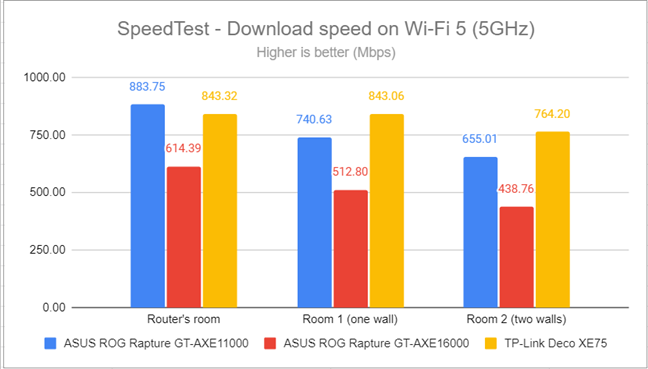
 SpeedTest - The download speed on Wi-Fi 5 (5 GHz)
When measuring the upload speed, ASUS ROG Rapture GT-AXE11000 had no problem reaching speeds very close to the maximum allowed by my internet connection: 800 Mbps.
SpeedTest - The download speed on Wi-Fi 5 (5 GHz)
When measuring the upload speed, ASUS ROG Rapture GT-AXE11000 had no problem reaching speeds very close to the maximum allowed by my internet connection: 800 Mbps.
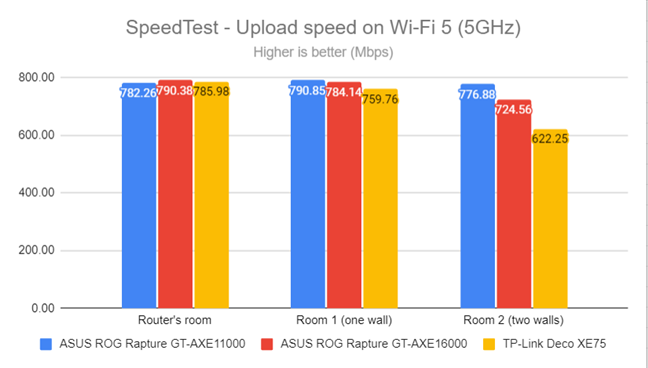
 SpeedTest - The upload speed on Wi-Fi 5 (5 GHz)
Moving on to the Wi-Fi 6 standard on the 5 GHz band: ASUS ROG Rapture GT-AXE11000 maintained its excellent performance in delivering fast download speeds.
SpeedTest - The upload speed on Wi-Fi 5 (5 GHz)
Moving on to the Wi-Fi 6 standard on the 5 GHz band: ASUS ROG Rapture GT-AXE11000 maintained its excellent performance in delivering fast download speeds.
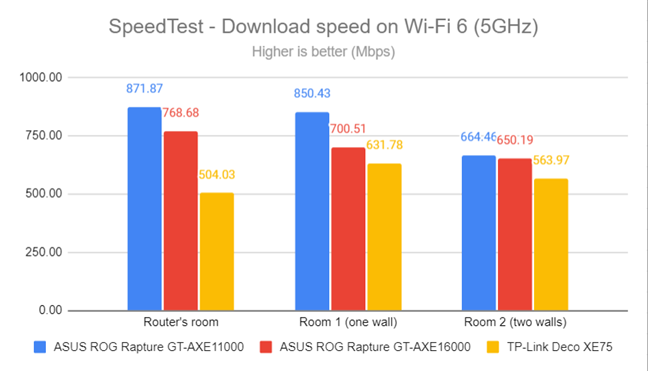
 SpeedTest - The download speed on Wi-Fi 6 (5 GHz)
Uploads were also super satisfying and very close to the maximum allowed by my internet connection.
SpeedTest - The download speed on Wi-Fi 6 (5 GHz)
Uploads were also super satisfying and very close to the maximum allowed by my internet connection.
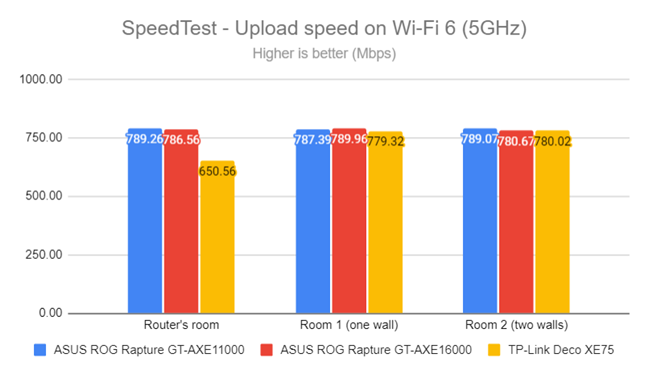
 SpeedTest - The upload speed on Wi-Fi 6 (5 GHz)
For the next set of measurements, I used the PassMark Performance test to transfer data between two computers connected to the network. In this test, I saw that ASUS ROG Rapture GT-AXE11000 could deliver download speeds higher than 1 Gbps, which is excellent.
SpeedTest - The upload speed on Wi-Fi 6 (5 GHz)
For the next set of measurements, I used the PassMark Performance test to transfer data between two computers connected to the network. In this test, I saw that ASUS ROG Rapture GT-AXE11000 could deliver download speeds higher than 1 Gbps, which is excellent.
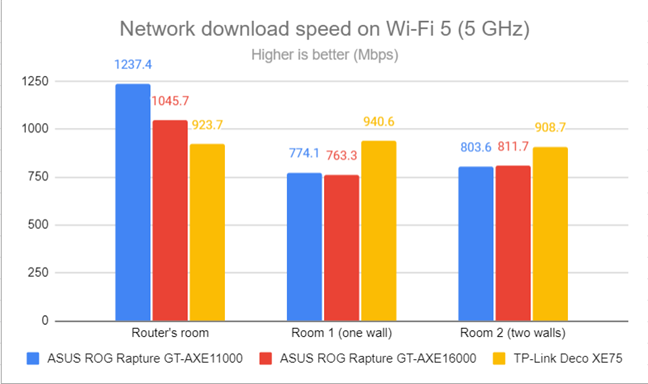
 Network downloads on Wi-Fi 5 (5 GHz)
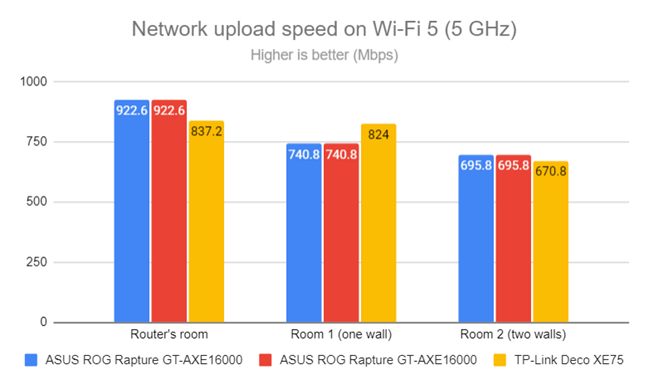
Uploads were super fast, but they did not go above 1 Gbps as the downloads did.
Network downloads on Wi-Fi 5 (5 GHz)
Uploads were super fast, but they did not go above 1 Gbps as the downloads did.
 Network uploads on Wi-Fi 5 (5 GHz)
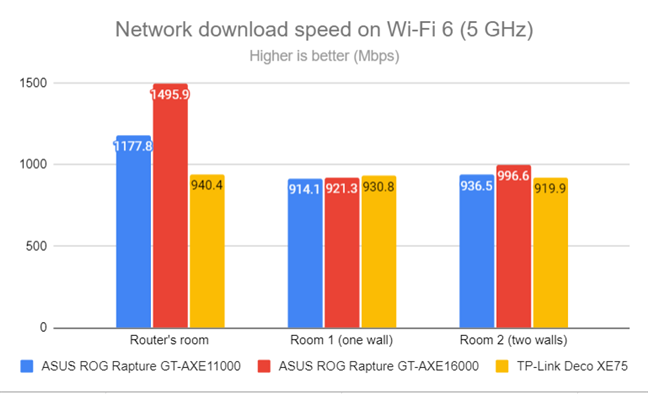
I switched from Wi-Fi 5 to Wi-Fi 6 on the same 5 GHz band and repeated the same measurements. As you can see below, downloads got faster in the rooms furthest from the router.
Network uploads on Wi-Fi 5 (5 GHz)
I switched from Wi-Fi 5 to Wi-Fi 6 on the same 5 GHz band and repeated the same measurements. As you can see below, downloads got faster in the rooms furthest from the router.
 Network downloads on Wi-Fi 6 (5 GHz)
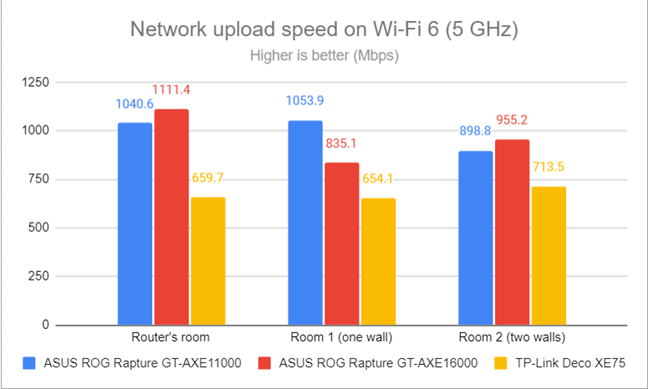
The same happened when measuring the upload speed. And, on Wi-Fi 6, the upload speed managed to go beyond 1 Gbps, showcasing the potential of this newer standard.
Network downloads on Wi-Fi 6 (5 GHz)
The same happened when measuring the upload speed. And, on Wi-Fi 6, the upload speed managed to go beyond 1 Gbps, showcasing the potential of this newer standard.
 Network uploads on Wi-Fi 6 (5 GHz)
On the 5 GHz band, ASUS ROG Rapture GT-AXE11000 delivers excellent data transfers and a wide coverage area. Also, it works great both with Wi-Fi 5 and Wi-Fi 6.
Network uploads on Wi-Fi 6 (5 GHz)
On the 5 GHz band, ASUS ROG Rapture GT-AXE11000 delivers excellent data transfers and a wide coverage area. Also, it works great both with Wi-Fi 5 and Wi-Fi 6.
 Signal strength on Wi-Fi 6E (6 GHz band)
Next, I used the SpeedTest app to measure the maximum speed you get when transferring data to and from the internet on the 6 GHz band. The download speed delivered by ASUS ROG Rapture GT-AXE11000 was a bit underwhelming compared to what you get when using the 5 GHz band.
Signal strength on Wi-Fi 6E (6 GHz band)
Next, I used the SpeedTest app to measure the maximum speed you get when transferring data to and from the internet on the 6 GHz band. The download speed delivered by ASUS ROG Rapture GT-AXE11000 was a bit underwhelming compared to what you get when using the 5 GHz band.
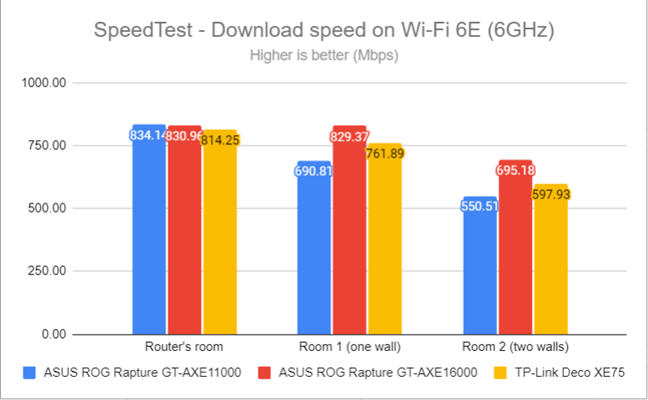
 SpeedTest - The download speed on Wi-Fi 6E (6 GHz)
Uploads were again very close to the maximum allowed by our internet connection. However, they were a tad faster when using the 5 GHz band.
SpeedTest - The download speed on Wi-Fi 6E (6 GHz)
Uploads were again very close to the maximum allowed by our internet connection. However, they were a tad faster when using the 5 GHz band.
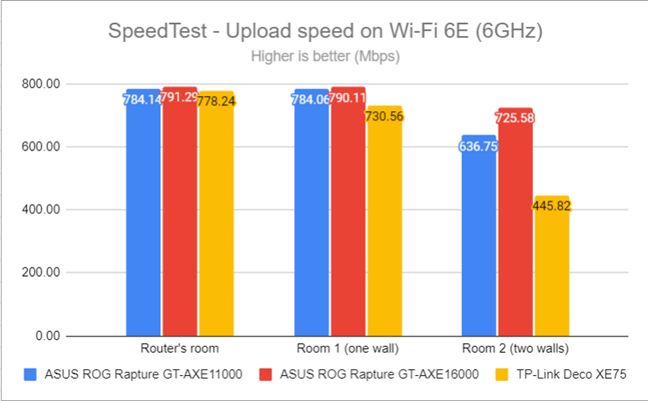
 SpeedTest - The upload speed on Wi-Fi 6E (6 GHz)
For the next set of measurements, I used the PassMark Performance test to transfer data between two computers connected to the network. In this test, I can better understand the speed potential offered by Wi-Fi 6E because I’m not limited by my internet connection speed, only by the devices I’m using and the router itself. Unfortunately, the download speed delivered by this router on the 6 GHz band was lower than on the 5 GHz band.
SpeedTest - The upload speed on Wi-Fi 6E (6 GHz)
For the next set of measurements, I used the PassMark Performance test to transfer data between two computers connected to the network. In this test, I can better understand the speed potential offered by Wi-Fi 6E because I’m not limited by my internet connection speed, only by the devices I’m using and the router itself. Unfortunately, the download speed delivered by this router on the 6 GHz band was lower than on the 5 GHz band.
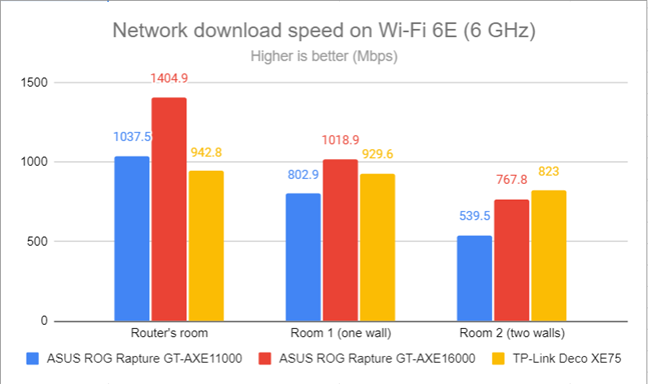 Network downloads on Wi-Fi 6E (6 GHz)
Uploads were fast on the 6 GHz band but not as fast as on the 5 GHz band.
Network downloads on Wi-Fi 6E (6 GHz)
Uploads were fast on the 6 GHz band but not as fast as on the 5 GHz band.
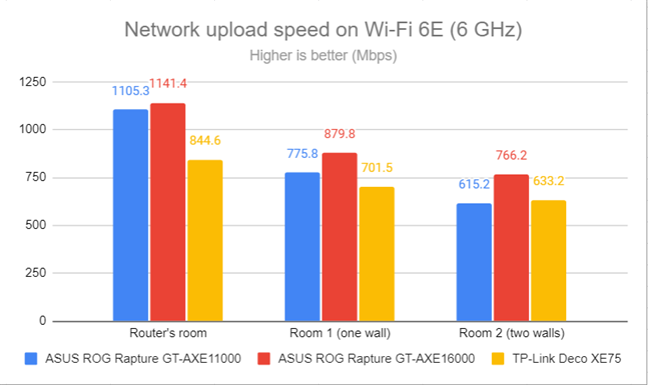 Network uploads on Wi-Fi 6E (6 GHz)
ASUS ROG Rapture GT-AXE11000 works well with the new Wi-Fi 6E standard on the 6 GHz band but doesn’t deliver faster speeds or more coverage than on the 5 GHz band when using Wi-Fi 6.
Network uploads on Wi-Fi 6E (6 GHz)
ASUS ROG Rapture GT-AXE11000 works well with the new Wi-Fi 6E standard on the 6 GHz band but doesn’t deliver faster speeds or more coverage than on the 5 GHz band when using Wi-Fi 6.
 SpeedTest on wired connections
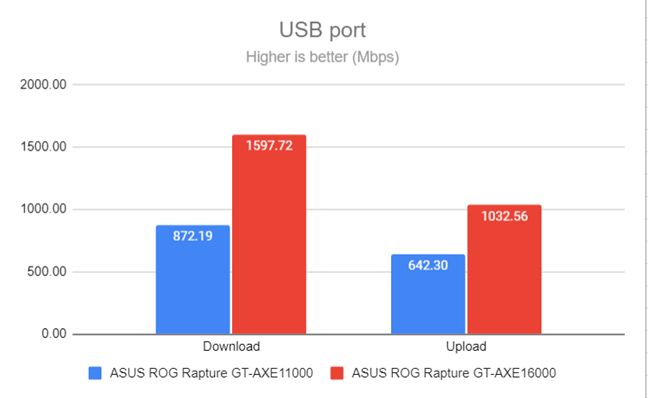
I also plugged a fast SSD drive into one of the USB 3.2 ports of the router and made some data transfers on it. GT-AXE11000 was fast but not as fast as its more expensive brother. Considering that you get two USB 3.2 ports, having them work at such speeds is quite impressive.
SpeedTest on wired connections
I also plugged a fast SSD drive into one of the USB 3.2 ports of the router and made some data transfers on it. GT-AXE11000 was fast but not as fast as its more expensive brother. Considering that you get two USB 3.2 ports, having them work at such speeds is quite impressive.
 The speed of the USB 3.2 ports
The Ethernet ports on the ASUS ROG Rapture GT-AXE11000 have no trouble reaching their maximum advertised speeds. The USB 3.2 ports are also quite speedy.
The speed of the USB 3.2 ports
The Ethernet ports on the ASUS ROG Rapture GT-AXE11000 have no trouble reaching their maximum advertised speeds. The USB 3.2 ports are also quite speedy.
 Game Acceleration tools for gamers
You also get many useful security features and tools:
Game Acceleration tools for gamers
You also get many useful security features and tools:
 The VPN settings are now easier to configure
ASUS ROG Rapture GT-AXE11000 also includes:
The VPN settings are now easier to configure
ASUS ROG Rapture GT-AXE11000 also includes:
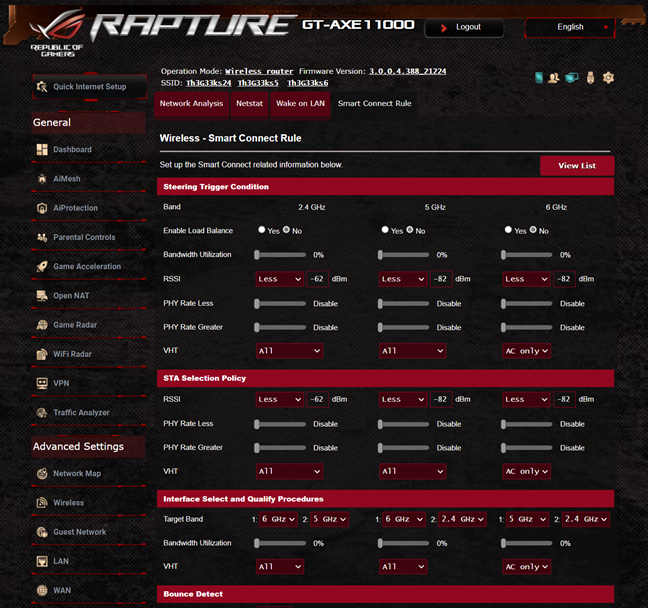
 Setting up ASUS Smart Connect
The list of features on the ASUS ROG Rapture GT-AXE11000 is simultaneously extensive and impressive. It includes something useful to everyone, from gamers to small business users, families with kids, and technical users.
Setting up ASUS Smart Connect
The list of features on the ASUS ROG Rapture GT-AXE11000 is simultaneously extensive and impressive. It includes something useful to everyone, from gamers to small business users, families with kids, and technical users.
ASUS ROG Rapture GT-AXE11000: Who is it good for?
This wireless router is a suitable choice for:- Homes or offices with 2.5 Gbps internet connections
- Users who own Wi-Fi 6E compatible devices
- Gamers who often play online games
- Users who want a secure network with excellent antivirus and firewall protection
- Parents who require efficient parental controls for their home network
- Knowledgeable users who want tons of advanced features (two USB ports, VPN, Dual-WAN, Alexa and IFTT support, etc.)
Pros and cons
Here are the things I like about ASUS ROG Rapture GT-AXE11000:
- Works with 2.5 Gbps internet connections
- Wi-Fi 6E support
- Powerful hardware that can handle many network clients
- Many features for gamers
- Top-notch security tools and parental controls
- Tons of advanced features, including VPN
- Two USB 3.2 ports
- It’s very expensive
- It’s massive and heavy
Verdict
ASUS ROG Rapture GT-AXE11000 is a premium wireless router for people who want to future-proof their Wi-Fi and have access to speedy 1 Gbps or 2.5 Gbps internet connections. While it is not as fast as the even more expensive ASUS ROG Rapture GT-AXE16000, it’s one of the fastest routers on the market and delivers tons of features. So, if you can afford it and have a fast internet connection, you’ll love using the ASUS ROG Rapture GT-AXE11000.Unboxing the ASUS ROG Rapture GT-AXE11000
ASUS ROG Rapture GT-AXE11000 comes in a large cardboard box featuring the Republic of Gamers logo, the product name and picture, and broadcasting its compatibility with the Wi-Fi 6E standard and its most important hardware and software features.Hardware specifications and design
ASUS ROG Rapture GT-AXE11000 is a beautiful wireless router that looks great, especially when you turn it on and configure its RGB lighting system. It has a size of 10.4 x 10.4 x 2.9 inches or 26.4 x 26.4 x 7.4 cm in width x depth x height, and it weighs a massive 3.94 pounds or 1.79 kg. Its eight tall, non-detachable external antennas make it even more imposing.- On the 2.4 GHz band, using Wi-Fi 6, with a maximum theoretical bandwidth of 1148 Mbps
- On the 5 GHz band, using Wi-Fi 6 and 160 MHz channel width, with a maximum theoretical bandwidth of 4804 Mbps
- On the 6 GHz band, using Wi-Fi 6E and 160 MHz channel width, with a maximum theoretical bandwidth of 4804 Mbps
Setting up and using the ASUS ROG Rapture GT-AXE11000
The installation process for the ROG Rapture GT-AXE11000 is the same as for all other ASUS routers. You can set it up using a laptop and a web browser or the ASUS Router app for Android and iOS on a smartphone or tablet. I followed both processes during my testing, and it all worked well each time.Wireless network performance
My new test apartment is set up similarly to the diagram below. As you can see, I’ve placed the ASUS ROG Rapture GT-AXE11000 in a central position to provide good coverage in all the rooms where I spend most of my time.- I record the maximum speeds when no walls absorb the wireless signal, in the room where the router is placed.
- Room 1 - is separated by one wall from the router, so the wireless signal and the Wi-Fi speed I get should be lower here.
- Room 2 - is separated from the router by two walls absorbing the wireless signal. Also, the wall between Room 1 and Room 2 is twice as thick as the one between the router’s room and Room 1. As a result, Room 2 can be a difficult challenge for many routers.
How the ASUS ROG Rapture GT-AXE11000 performs on the 2.4 GHz band
As always, I first measured the signal strength using NetSpot, while connected to the 2.4 GHz band. The signal strength offered by GT-AXE11000 was higher than that of GT-AXE16000 in the rooms close to the router and lower in the ones furthest from it. The TP-Link Deco XE75 is missing from the chart below because you can’t set it to use only the Wi-Fi 4 standard.How the ASUS ROG Rapture GT-AXE11000 performs on the 5 GHz band
I switched to the 5 GHz band, and I started by measuring the signal strength with NetSpot. I first used the Wi-Fi 5 standard, and ASUS ROG Rapture GT-AXE11000 delivered good signal strength everywhere in my apartment, even though it was not as strong as that provided by the even more expensive GT-AXE16000.How the ASUS ROG Rapture GT-AXE11000 performs on the 6 GHz band
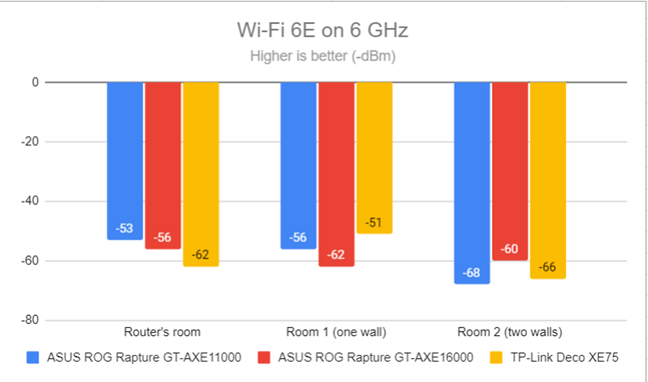
This router emits the wireless signal on a third 6 GHz band, using the Wi-Fi 6E standard. To connect to this band, you need devices with support for Wi-Fi 6E, which may be a problem for many. Suppose you have compatible devices, such as the ASUS ROG Flow X16 (2022) laptop I used for this review. Then, you can enjoy its benefits, like more security, thanks to the mandatory WiFi Protected Access 3 (WPA3) encryption and increased bandwidth. I started by measuring the signal strength with NetSpot and noticed that it was weaker than on the 5 GHz band. This is normal because the Wi-Fi 6E standard is designed to provide a shorter range than Wi-Fi 5 and Wi-Fi 6.Wired network performance & USB port
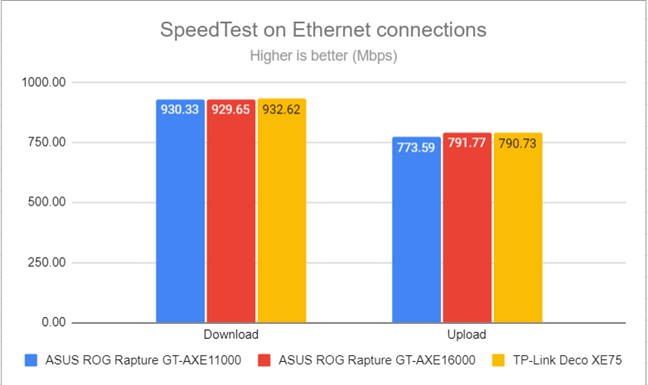
After evaluating Wi-Fi performance, it is time to focus on Ethernet network connections. My internet connection offers a maximum of 1 Gbps for the download speed and 800 Mbps for the upload. When using SpeedTest, ASUS ROG Rapture GT-AXE11000 got very close to the maximum allowed, just like the other networking devices in this comparison.Extra features
GT-AXE11000 is a premium router with all the bells and whistles created by ASUS for its lineup. The list of features may be overwhelming to some people, but it does include many goodies that you’ll find useful. First, we have the Aura RGB lighting for gamers that can be set to use the following effects: Static, Breathing, Wave, Marquee, Gradient, Evolution, and Rainbow. You can see some of them in action in the video below. You also get the following tools for gaming:- Open NAT - an easy way to create port forwarding rules for popular online games.
- Game Radar - check the ping reply for gaming servers worldwide for a predefined list of games that includes popular titles like Diablo 3, DOTA 2, League of Legends, and World of Warcraft.
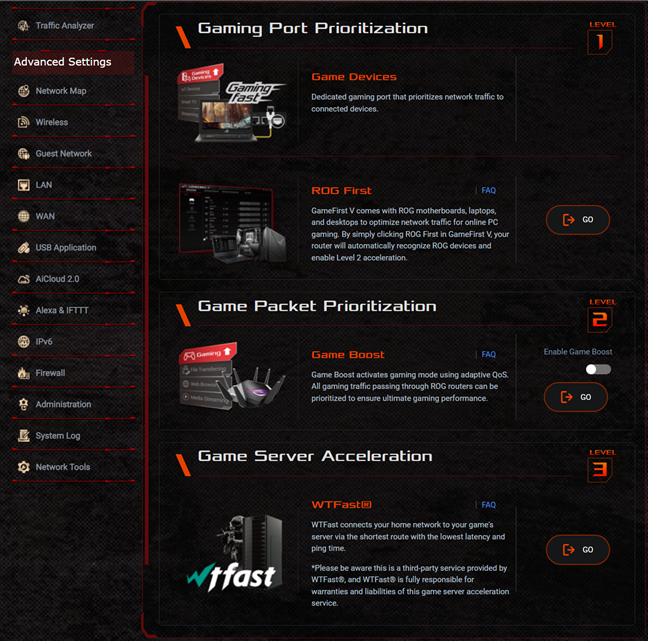
- Game Acceleration - a collection of tools for gamers which includes:
- Game Devices - a dedicated gaming port on the back of the router. Anything you plug into it gets prioritized over other devices on the network.
- ROG First - automatically detects Republic of Gamers devices in your network and prioritizes them over others.
- Game Boost - is an adaptive Quality of Service feature that automatically prioritizes online gaming traffic.
- WTFast - a VPN service that is designed for online gaming and tries to optimize network performance to your favorite game servers. You get a free trial with your router.
- AiProtection - cloud-based security that protects your network from attacks, malicious sites, infected devices, and poor router settings. Here’s a step-by-step tutorial about this feature: ASUS AiProtection: On or Off? Enhance your router’s security!
- Parental Controls - efficient cloud-based parental controls developed by ASUS and Trend Micro. You can learn how they work from this article: 7 ways in which ASUS Parental Controls protect your children.
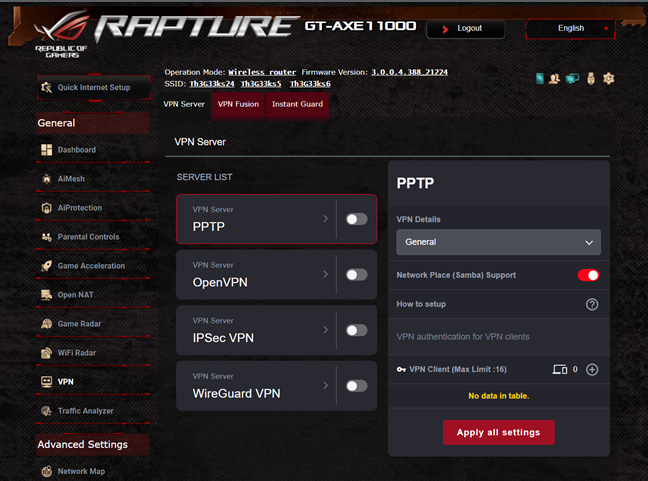
- VPN - is a major focus area, with three different services:
- VPN Server - the router can be set to work as a VPN server for your network, using the PPTP, OpenVPN, IPSec, and WireGuard VPN protocols. This feature is useful for knowledgeable users, gamers, and small business users.
- Instant Guard - a mobile app that helps smartphone users navigate the internet securely by establishing a VPN connection to their home network. The app is handy when using free public Wi-Fi networks. For more details, read: How to configure and use Instant Guard on ASUS Wi-Fi routers.
- VPN Fusion - connect to multiple VPN servers simultaneously and assign your client devices to connect to different VPN tunnels.
- AiMesh - extend your Wi-Fi coverage using other ASUS routers and create your homebrewed mesh Wi-Fi system.
- Guest Network - you can enable three wireless guest networks with individual security and access settings on each band (2.4 GHz, 5 GHz, and 6 GHz). You can have a total of nine guest networks.
- Traffic Analyzer - visual traffic statistics that show how your network is used and by which devices. Useful when you’re managing a network with dozens of connected devices.
- DDNS - allows you to connect to the router from the internet, even if your internet provider assigns you a dynamic public IP address. You can use a long list of services (Google, DYNDNS, NO-IP, DNSOMATIC), including a free one offered by ASUS.
- Dual WAN - you can use two internet connections simultaneously, one of which can be at 2.5 Gbps. The router works both in Fail Over or Load Balance modes.
- USB Applications - set up the router to use external hard drives or printers through its USB ports. There’s also support for Apple’s Time Machine functionality from macOS.
- AiCloud 2.0 - gives you the tools to create your cloud storage service using a hard drive connected to the router.
- Amazon Alexa & IFTTT - you can say things like “Alexa, ask ASUS ROUTER to upgrade the firmware” to perform different tasks. You can also integrate your router with the IFTTT platform and create all kinds of automation for your home.
- WiFi Radar - a collection of troubleshooting tools for the wireless spectrum in your area that’s usually found only on a few models of ASUS routers. You get a WiFi Site Survey feature, wireless channel statistics, and advanced troubleshooting.
- Network Tools - for analyzing the network and identifying what’s wrong. They are helpful when you need to troubleshoot problems. This is also the place where you get to configure ASUS Smart Connect.

Discussion (0)
Comments are closed.