



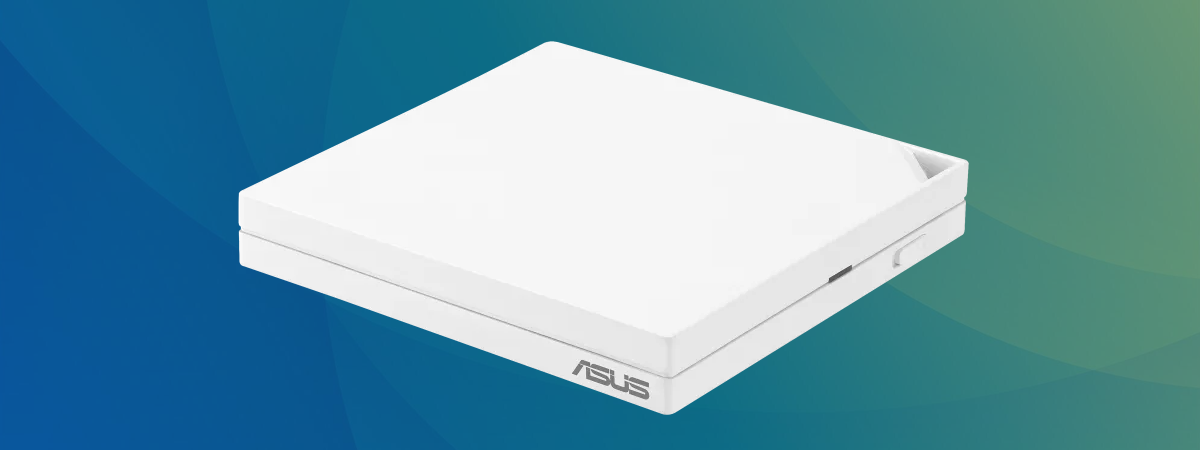
ASUS started the year 2024 by launching a versatile travel router with an interesting list of features, some of which are surprisingly advanced. This router is named ASUS RT-AX57 Go. It’s small, lightweight, and can provide 4G and 5G mobile tethering capabilities, advanced VPN features, and subscription-free security. If you want to know more about this router and whether it is a good choice, read this review:
![Verdict]()

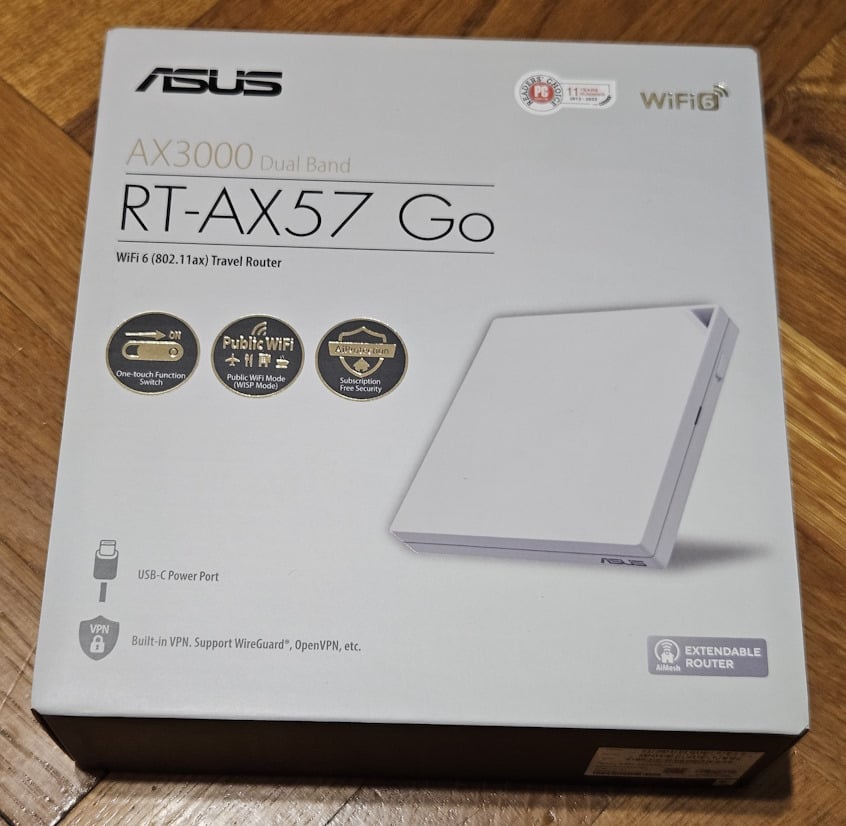
 The packaging for ASUS RT-AX57 Go
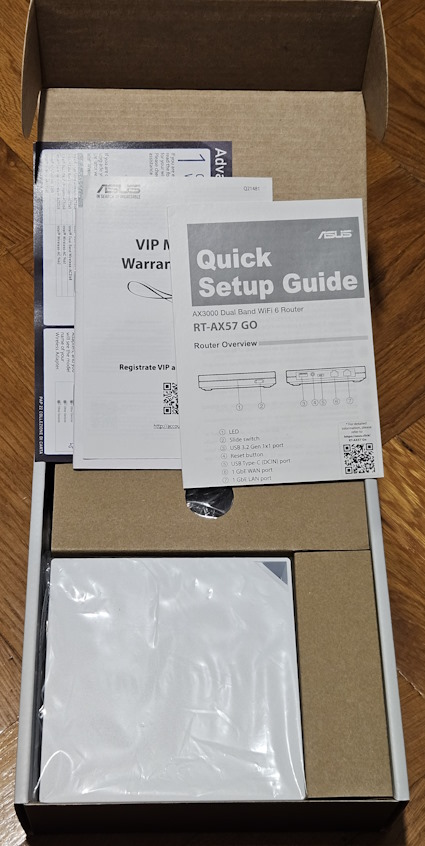
On the back of the box, you will find further information about this router, its 4G/5G mobile tethering capabilities, and so on. Open the box, and you first see several leaflets on top of the router.
The packaging for ASUS RT-AX57 Go
On the back of the box, you will find further information about this router, its 4G/5G mobile tethering capabilities, and so on. Open the box, and you first see several leaflets on top of the router.
 Unboxing the ASUS RT-AX57 Go
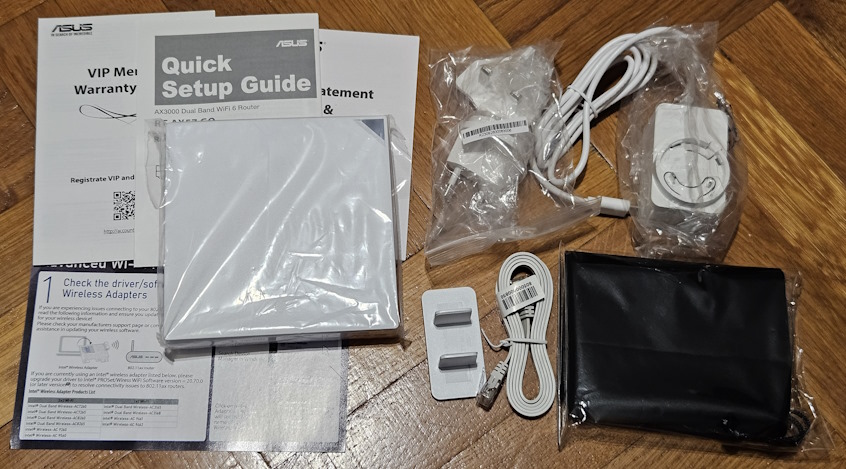
When you take everything out, you find the following items: the ASUS RT-AX57 Go travel router, its power adapter, a network cable, the router’s stand, a flannel bag for travel, the quick start guide, the warranty card, a troubleshooting guide, and other leaflets.
Unboxing the ASUS RT-AX57 Go
When you take everything out, you find the following items: the ASUS RT-AX57 Go travel router, its power adapter, a network cable, the router’s stand, a flannel bag for travel, the quick start guide, the warranty card, a troubleshooting guide, and other leaflets.
 Everything you find inside the box
One thing I liked about the router’s power adapter is that it includes plugs for the standard EU electrical networks and the UK. You simply attach the plug you want and are ready to go. A small but important plus for a travel router, don’t you think?
Everything you find inside the box
One thing I liked about the router’s power adapter is that it includes plugs for the standard EU electrical networks and the UK. You simply attach the plug you want and are ready to go. A small but important plus for a travel router, don’t you think?
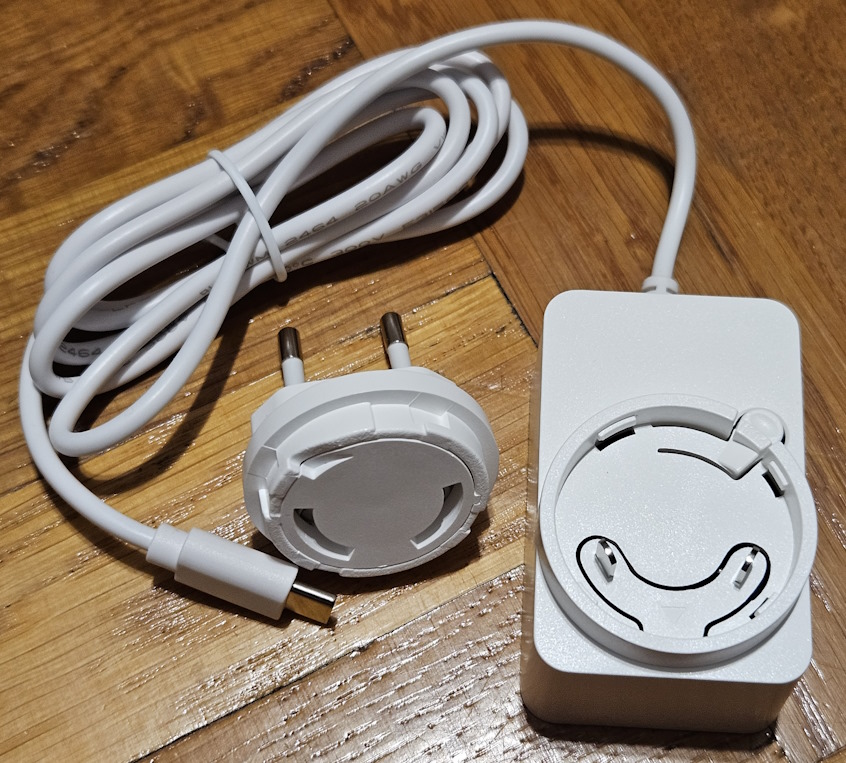
 The power adapter includes plugs for EU and UK
Unboxing the ASUS RT-AX57 Go is an enjoyable experience. I’m pleased that ASUS has included several accessories that are useful for its intended audience: people who need a travel router to ensure good Wi-Fi connectivity wherever they go.🙂
The power adapter includes plugs for EU and UK
Unboxing the ASUS RT-AX57 Go is an enjoyable experience. I’m pleased that ASUS has included several accessories that are useful for its intended audience: people who need a travel router to ensure good Wi-Fi connectivity wherever they go.🙂

 ASUS RT-AX57 Go is small and lightweight
On one of its sides, you see a LED that lights up when the router is up and running and a slide switch that can be configured to do all kinds of things, like turn the Wi-Fi on and off.
ASUS RT-AX57 Go is small and lightweight
On one of its sides, you see a LED that lights up when the router is up and running and a slide switch that can be configured to do all kinds of things, like turn the Wi-Fi on and off.

 This router has one programmable button
On the back, you can find a USB 3.2 Gen 1x1 port, the Reset button, the Power port (it uses USB Type-C), and the WAN and LAN ports, both working at 1 Gbps.
This router has one programmable button
On the back, you can find a USB 3.2 Gen 1x1 port, the Reset button, the Power port (it uses USB Type-C), and the WAN and LAN ports, both working at 1 Gbps.
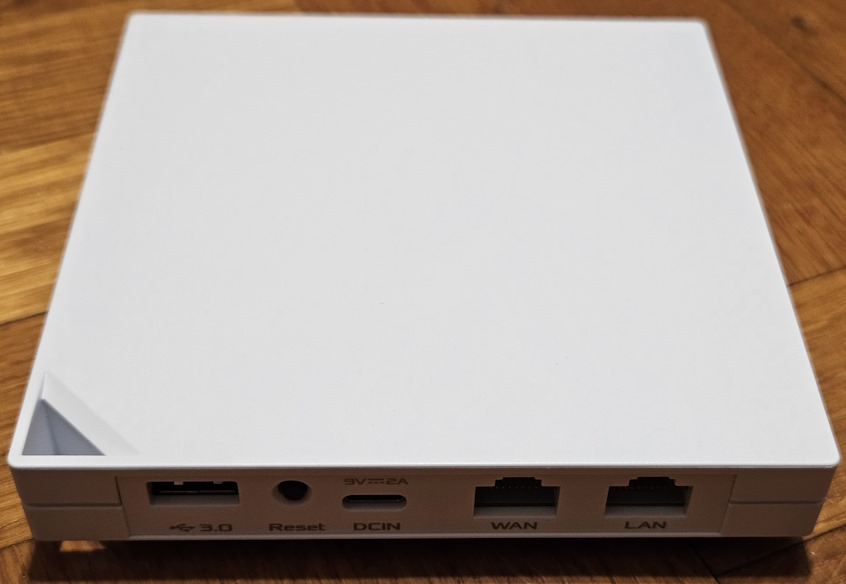
 The ports on the back of the ASUS RT-AX57 Go
On the bottom of the router, you find four rubber feet for holding it into place on flat surfaces and two holes for mounting it on walls. Here, you also see the ventilation grids that help keep the router cool, a sticker with information about the model you just bought, and a QR code for connecting your devices to Wi-Fi.
The ports on the back of the ASUS RT-AX57 Go
On the bottom of the router, you find four rubber feet for holding it into place on flat surfaces and two holes for mounting it on walls. Here, you also see the ventilation grids that help keep the router cool, a sticker with information about the model you just bought, and a QR code for connecting your devices to Wi-Fi.
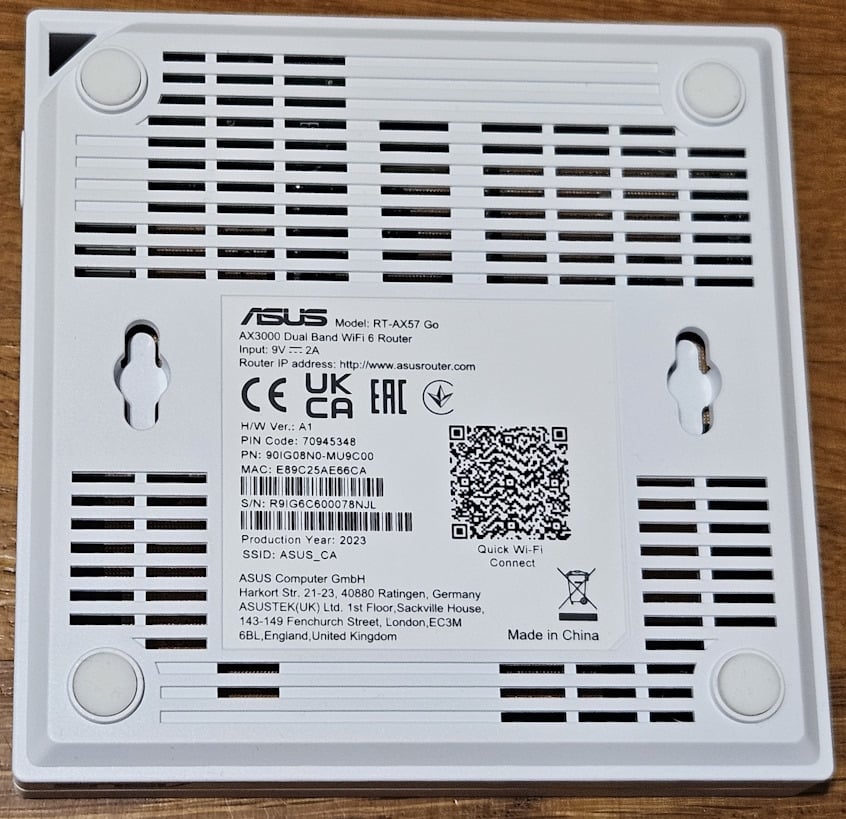
 ASUS RT-AX57 Go has holes for wall mounting
ASUS RT-AX57 Go is powered by a MediaTek MT7981B chipset, running at 1.3 GHz, and has 512 MB of RAM and 128 MB of storage space for the firmware. This chipset brings a new design with five internal antennas for improved wireless reception. The company uses one more 5GHz antenna than a traditional AX3000 wireless router, which enhances the wireless signal and improves its strength on the 5 GHz frequency band. This should translate into fewer dead zones on the 5 GHz band and a better Wi-Fi experience. The router uses 2x2 MU-MIMO for wireless transfers on both bands. This means that ASUS RT-AX57 Go offers two spatial streams for sending and receiving data wirelessly on the same frequency (2.4 GHz and 5 GHz). The total theoretical bandwidth is split as follows: 574 Mbps on the 2.4 GHz band and 2402 Mbps on the 5 GHz band when using the Wi-Fi 6 standard. Even though the router can use older wireless standards like Wi-Fi 4 on the 2.4 GHz band and Wi-Fi 5 on the 5 GHz, the maximum bandwidth will be lower.
ASUS RT-AX57 Go has holes for wall mounting
ASUS RT-AX57 Go is powered by a MediaTek MT7981B chipset, running at 1.3 GHz, and has 512 MB of RAM and 128 MB of storage space for the firmware. This chipset brings a new design with five internal antennas for improved wireless reception. The company uses one more 5GHz antenna than a traditional AX3000 wireless router, which enhances the wireless signal and improves its strength on the 5 GHz frequency band. This should translate into fewer dead zones on the 5 GHz band and a better Wi-Fi experience. The router uses 2x2 MU-MIMO for wireless transfers on both bands. This means that ASUS RT-AX57 Go offers two spatial streams for sending and receiving data wirelessly on the same frequency (2.4 GHz and 5 GHz). The total theoretical bandwidth is split as follows: 574 Mbps on the 2.4 GHz band and 2402 Mbps on the 5 GHz band when using the Wi-Fi 6 standard. Even though the router can use older wireless standards like Wi-Fi 4 on the 2.4 GHz band and Wi-Fi 5 on the 5 GHz, the maximum bandwidth will be lower.
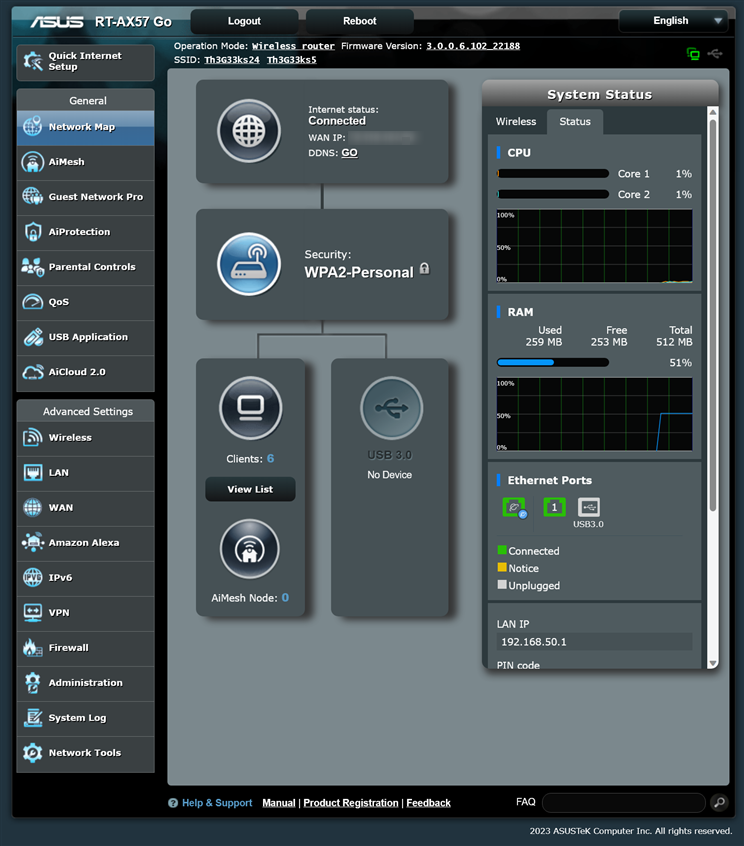
 Details about the hardware inside the ASUS RT-AX57 Go
ASUS RT-AX57 Go can use 160 MHz channel bandwidth on the 5 GHz band when using Wi-Fi 6 and WPA3 password encryption.
Overall, I’m happy with the hardware configuration of this travel router. It is relatively well-powered, with plenty of ports and features, which I will cover in more detail later in this review. For more technical details about this product and its specifications, visit its official webpage: ASUS RT-AX57 Go.
Details about the hardware inside the ASUS RT-AX57 Go
ASUS RT-AX57 Go can use 160 MHz channel bandwidth on the 5 GHz band when using Wi-Fi 6 and WPA3 password encryption.
Overall, I’m happy with the hardware configuration of this travel router. It is relatively well-powered, with plenty of ports and features, which I will cover in more detail later in this review. For more technical details about this product and its specifications, visit its official webpage: ASUS RT-AX57 Go.
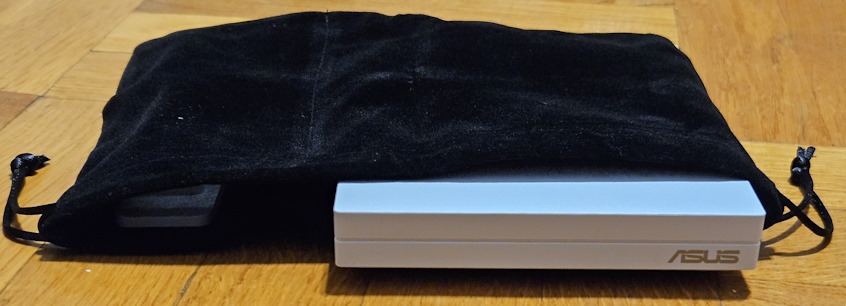
 Do you like its travel pouch?
This router also comes with a stand. Therefore, you can place it vertically, like in the picture below, keep it horizontally on a table, or even mount it on walls, using its two holes on the bottom. I like this flexibility and wish more home routers would offer a similar system.🙂
Do you like its travel pouch?
This router also comes with a stand. Therefore, you can place it vertically, like in the picture below, keep it horizontally on a table, or even mount it on walls, using its two holes on the bottom. I like this flexibility and wish more home routers would offer a similar system.🙂
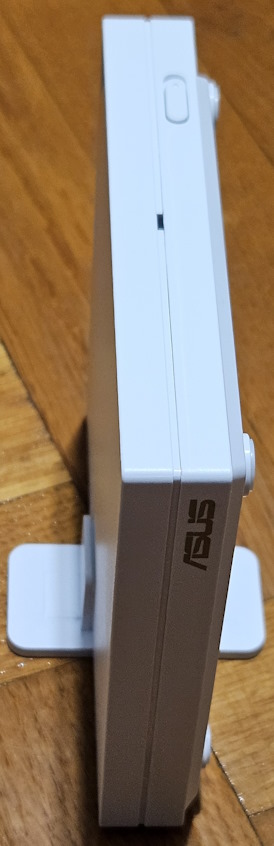
 You can use ASUS RT-AX57 Go in a vertical position
You can set up the ASUS RT-AX57 Go travel router by connecting a laptop to its Wi-Fi, opening a web browser and navigating to router.asus.com, or using the free ASUS Router app for iOS and Android. I chose the web browser this time because inputting all the necessary data for setting up a router is easier. The process is similar to that of other ASUS routers. It involves choosing your internet connection type, providing the necessary connection details, choosing a name and password for the Wi-Fi emitted by ASUS RT-AX57 Go, setting a username and password for administering the router, accepting the company’s terms and conditions, and upgrading the firmware if a newer version is available.
You can use ASUS RT-AX57 Go in a vertical position
You can set up the ASUS RT-AX57 Go travel router by connecting a laptop to its Wi-Fi, opening a web browser and navigating to router.asus.com, or using the free ASUS Router app for iOS and Android. I chose the web browser this time because inputting all the necessary data for setting up a router is easier. The process is similar to that of other ASUS routers. It involves choosing your internet connection type, providing the necessary connection details, choosing a name and password for the Wi-Fi emitted by ASUS RT-AX57 Go, setting a username and password for administering the router, accepting the company’s terms and conditions, and upgrading the firmware if a newer version is available.
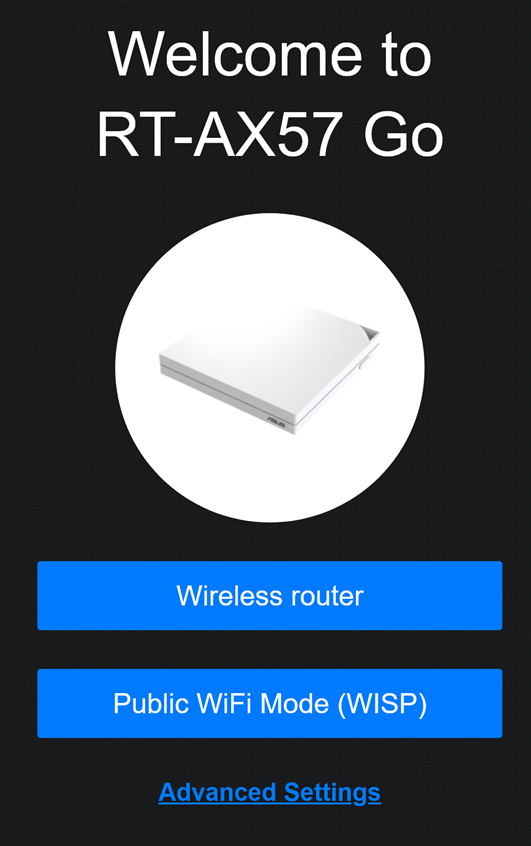
 Setting up the ASUS RT-AX57 Go
I recommend upgrading the firmware for this router as soon as you install it because the latest firmware fixes some bugs and introduces some new features that weren’t present in the initial version of the firmware. The process is not complicated, and the initial installation and firmware update should not take more than five minutes.
Next, you can log in to the admin interface and continue tweaking your settings and the many features available on the ASUS RT-AX57 Go. One of the aspects I enjoyed is that ASUS has tweaked the user interface a bit, introducing minor improvements to how the interface looks and is organized. The first visible change is the router’s login page, which now includes real pictures of the router. If you have to administer multiple ASUS routers, it is easier to tell them apart from one another.🙂
Setting up the ASUS RT-AX57 Go
I recommend upgrading the firmware for this router as soon as you install it because the latest firmware fixes some bugs and introduces some new features that weren’t present in the initial version of the firmware. The process is not complicated, and the initial installation and firmware update should not take more than five minutes.
Next, you can log in to the admin interface and continue tweaking your settings and the many features available on the ASUS RT-AX57 Go. One of the aspects I enjoyed is that ASUS has tweaked the user interface a bit, introducing minor improvements to how the interface looks and is organized. The first visible change is the router’s login page, which now includes real pictures of the router. If you have to administer multiple ASUS routers, it is easier to tell them apart from one another.🙂

 The Sign In screen
Another positive is that you now have the wireless settings on one screen for both bands. Therefore, you can configure both the 2.4 GHz and 5 GHz frequency bands simultaneously instead of one at a time, as was the case in the past. This simple change has saved me precious minutes when tweaking the router’s wireless settings according to my needs.
The Sign In screen
Another positive is that you now have the wireless settings on one screen for both bands. Therefore, you can configure both the 2.4 GHz and 5 GHz frequency bands simultaneously instead of one at a time, as was the case in the past. This simple change has saved me precious minutes when tweaking the router’s wireless settings according to my needs.
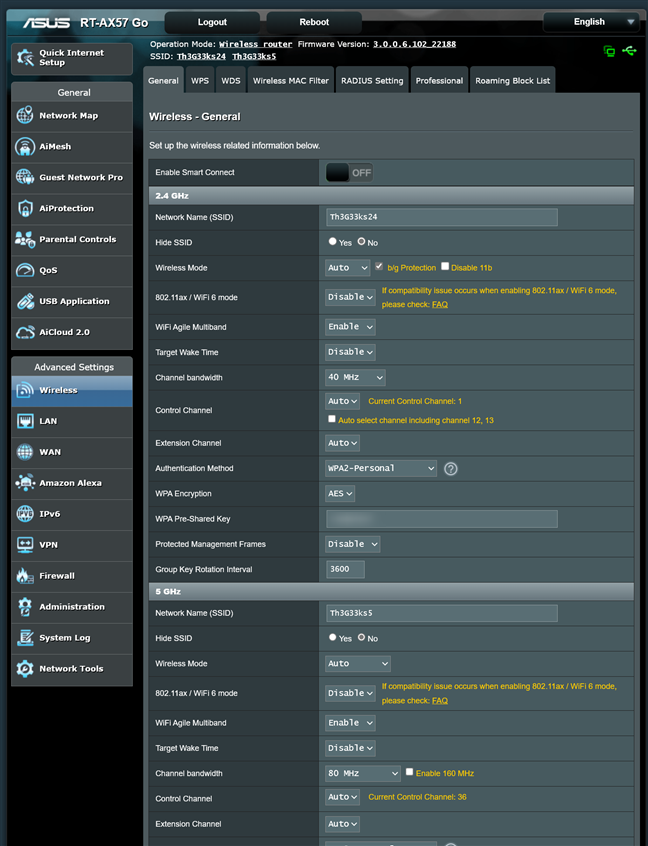
 The wireless settings are well organized
The user interface remains well-organized and well-documented. You shouldn’t have any issues finding your way around the many available settings, and most things were well explained, either straight in the user interface itself or the Manual, which can be accessed by clicking on a link at the bottom. Another plus is that ASUS has translated its user interface into twenty-five languages. Very few router manufacturers provide this level of localization for their products.
The wireless settings are well organized
The user interface remains well-organized and well-documented. You shouldn’t have any issues finding your way around the many available settings, and most things were well explained, either straight in the user interface itself or the Manual, which can be accessed by clicking on a link at the bottom. Another plus is that ASUS has translated its user interface into twenty-five languages. Very few router manufacturers provide this level of localization for their products.
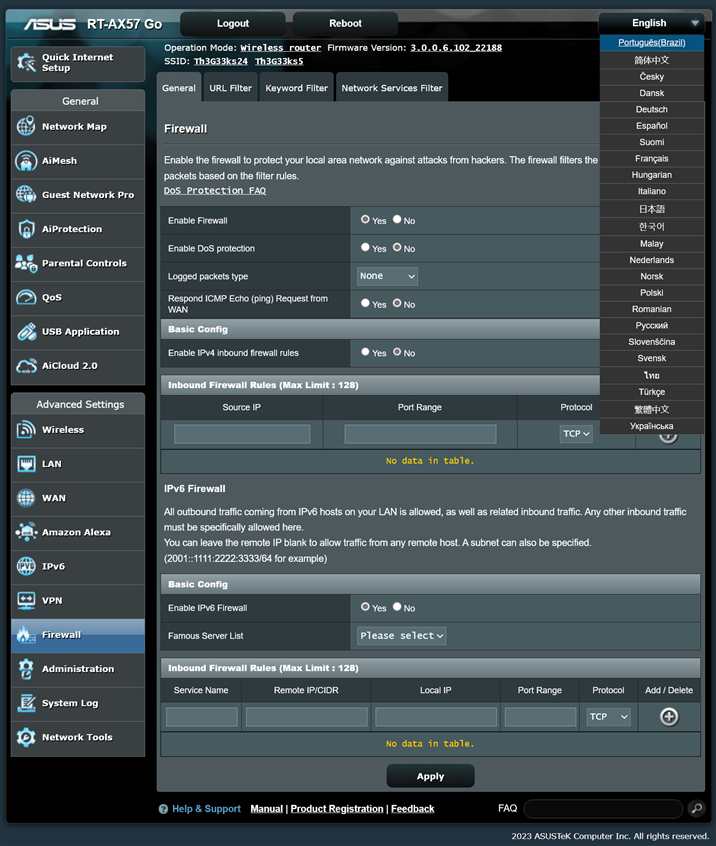
 The user interface is available in 25 languages
One of ASUS RT-AX57 Go’s special features is the small button on one of its sides. By default, it doesn’t do anything, but you can set it for actions you may consider useful: turning the Wi-Fi broadcasting on and off, turning the router’s LED on and off, or enabling and disabling the VPN Fusion functionality. Setting it up is easy, but remember that it requires a router restart to apply your settings.
The user interface is available in 25 languages
One of ASUS RT-AX57 Go’s special features is the small button on one of its sides. By default, it doesn’t do anything, but you can set it for actions you may consider useful: turning the Wi-Fi broadcasting on and off, turning the router’s LED on and off, or enabling and disabling the VPN Fusion functionality. Setting it up is easy, but remember that it requires a router restart to apply your settings.
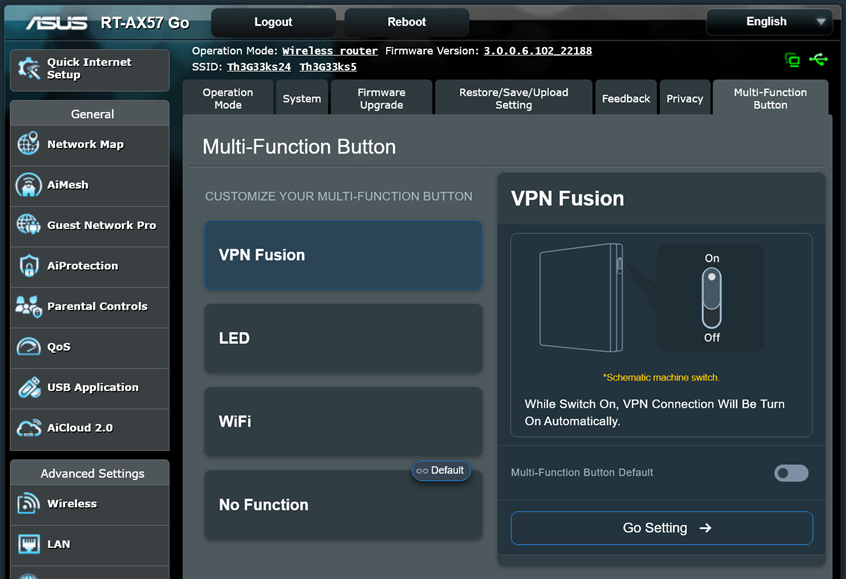
 Programming the button is easy
The ASUS Router app has also been updated to include access to new features like the Guest Network Pro, which allows you to create different types of Wi-Fi networks, including secure Wi-Fi for children or a VPN network useful to business users. You can also enable remote management and link the ASUS RT-AX57 Go to your ASUS account to administer it from anywhere online.
Programming the button is easy
The ASUS Router app has also been updated to include access to new features like the Guest Network Pro, which allows you to create different types of Wi-Fi networks, including secure Wi-Fi for children or a VPN network useful to business users. You can also enable remote management and link the ASUS RT-AX57 Go to your ASUS account to administer it from anywhere online.
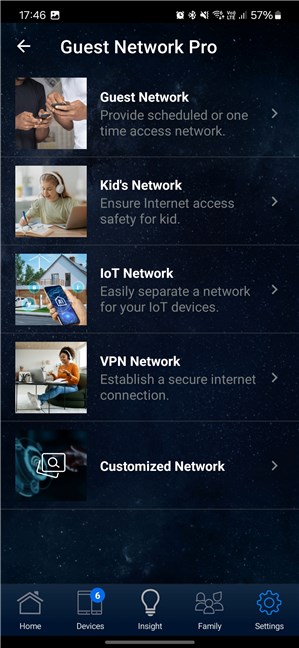
 The Guest Network Pro options in the ASUS Router app
Using the ASUS RT-AX57 Go was a pleasant experience. After I set up everything I wanted, I connected all my devices to the network without problems. I also enjoyed good speeds and signal stability when using the Wi-Fi 6 standard. My wireless transfers were stable, and I could do even a bit of online gaming without lag or other visible issues.
Before running my benchmarks, I was also curious about the power consumption of this router, and I measured it with a smart power plug: it varied between 3 and 7 Watts, depending on the resource load of the router. Its USB-C charger is rated for a maximum output of 18 Watts. It’s perfect for a device this small.🙂
The Guest Network Pro options in the ASUS Router app
Using the ASUS RT-AX57 Go was a pleasant experience. After I set up everything I wanted, I connected all my devices to the network without problems. I also enjoyed good speeds and signal stability when using the Wi-Fi 6 standard. My wireless transfers were stable, and I could do even a bit of online gaming without lag or other visible issues.
Before running my benchmarks, I was also curious about the power consumption of this router, and I measured it with a smart power plug: it varied between 3 and 7 Watts, depending on the resource load of the router. Its USB-C charger is rated for a maximum output of 18 Watts. It’s perfect for a device this small.🙂
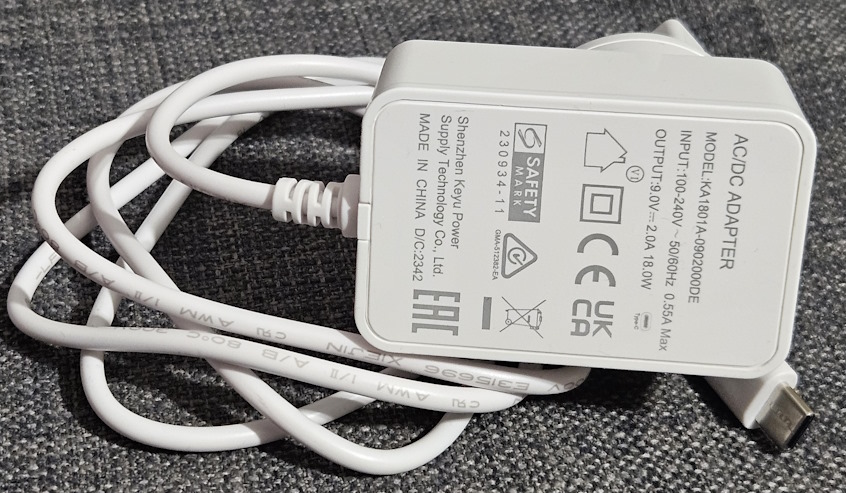
 The power adapter for ASUS RT-AX57 Go
If you want to know more about the real-world performance offered by ASUS RT-AX57 Go, including a comparison with other dual-band AX3000 routers, go to the next page of this review.
The power adapter for ASUS RT-AX57 Go
If you want to know more about the real-world performance offered by ASUS RT-AX57 Go, including a comparison with other dual-band AX3000 routers, go to the next page of this review.
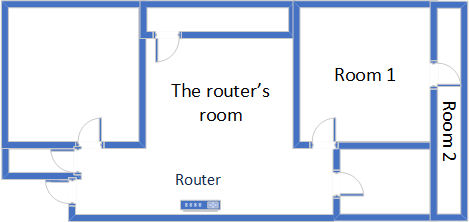
 The apartment where I tested ASUS RT-AX57 Go
I evaluated the quality of the wireless network managed by this router through measurements made in three different places:
The apartment where I tested ASUS RT-AX57 Go
I evaluated the quality of the wireless network managed by this router through measurements made in three different places:
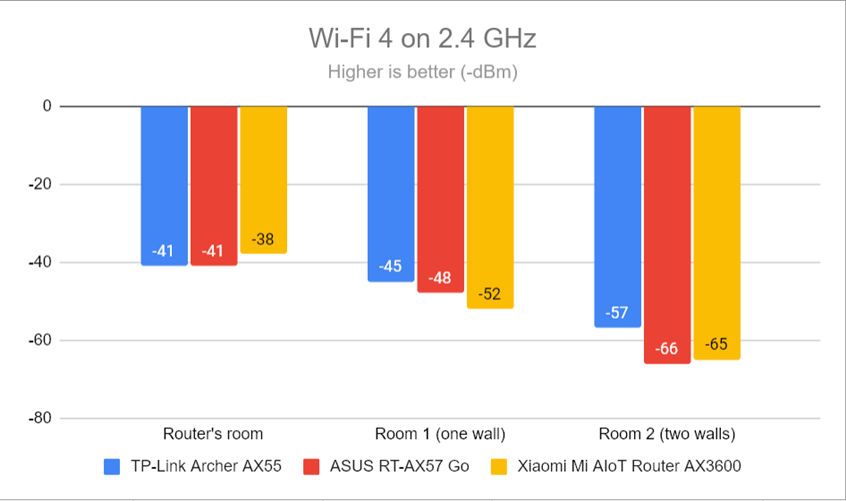
 Signal strength on Wi-Fi 4 (2.4 GHz band)
The switch to Wi-Fi 6 on the 2.4 GHz band meant the signal strength decreased slightly. However, this is normal for most Wi-Fi 6 routers in its price range.
Signal strength on Wi-Fi 4 (2.4 GHz band)
The switch to Wi-Fi 6 on the 2.4 GHz band meant the signal strength decreased slightly. However, this is normal for most Wi-Fi 6 routers in its price range.
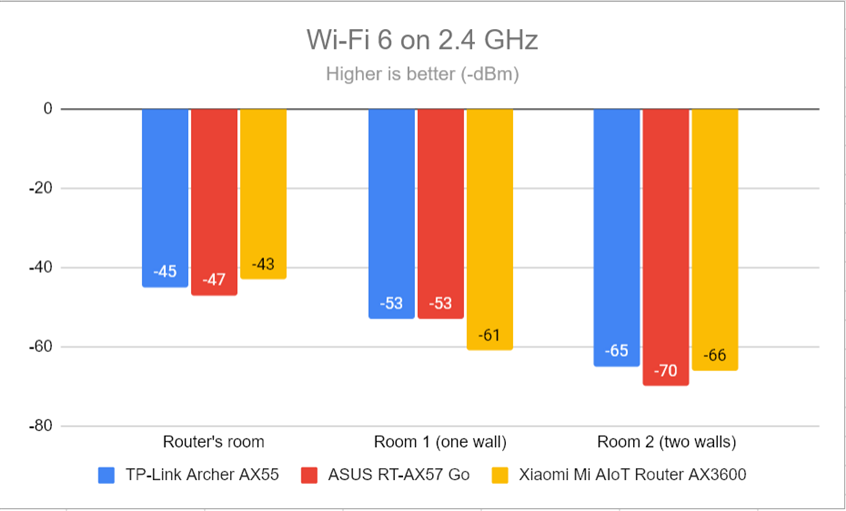
 Signal strength on Wi-Fi 6 (2.4 GHz band)
For the next measurement, I ran the SpeedTest app and used it to check the maximum speed you get when transferring data to and from the internet on the 2.4 GHz band. The ASUS RT-AX57 Go delivered reasonably fast downloads without outperforming the routers I compared it to.
Signal strength on Wi-Fi 6 (2.4 GHz band)
For the next measurement, I ran the SpeedTest app and used it to check the maximum speed you get when transferring data to and from the internet on the 2.4 GHz band. The ASUS RT-AX57 Go delivered reasonably fast downloads without outperforming the routers I compared it to.
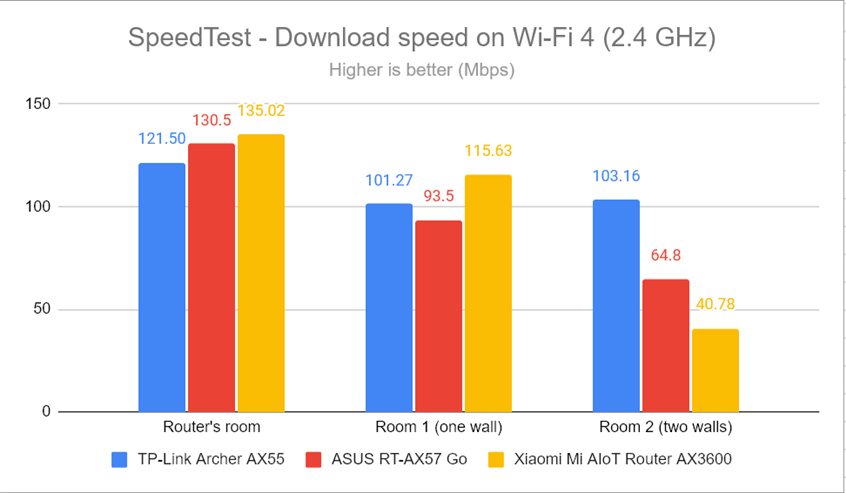 SpeedTest - The download speed on Wi-Fi 4 (2.4 GHz)
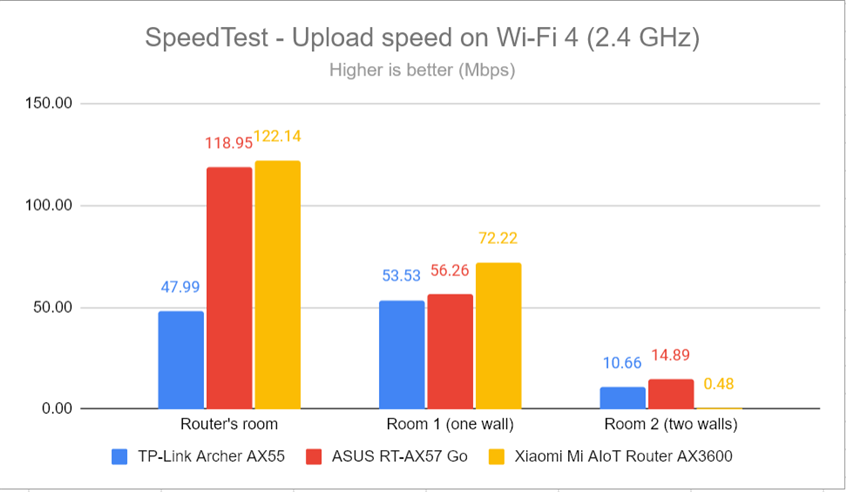
The upload speed was reasonable and surprisingly better than what I got from the other routers in the room, which was furthest away from the router.
SpeedTest - The download speed on Wi-Fi 4 (2.4 GHz)
The upload speed was reasonable and surprisingly better than what I got from the other routers in the room, which was furthest away from the router.
 SpeedTest - The upload speed on Wi-Fi 4 (2.4 GHz)
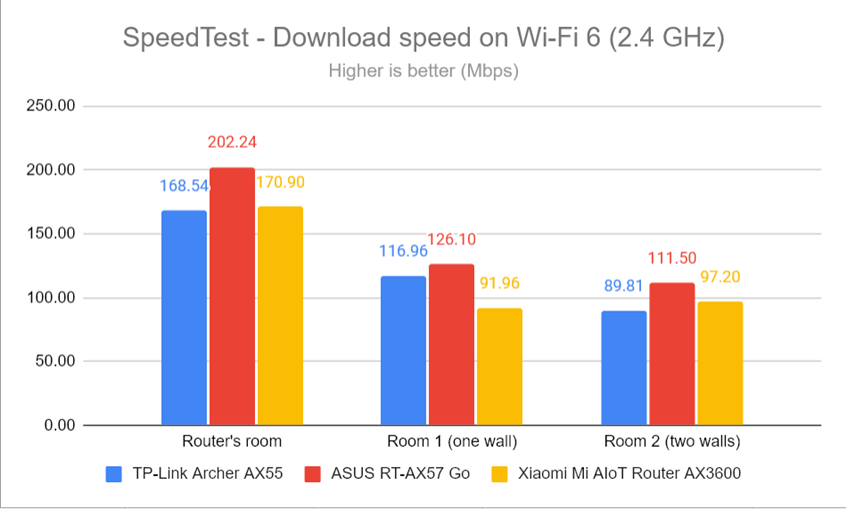
I switched to Wi-Fi 6 on the 2.4 GHz band and repeated the same measurements to see the difference. The download speed in SpeedTest was a lot faster everywhere in my apartment. A good start, don’t you think? 🙂
SpeedTest - The upload speed on Wi-Fi 4 (2.4 GHz)
I switched to Wi-Fi 6 on the 2.4 GHz band and repeated the same measurements to see the difference. The download speed in SpeedTest was a lot faster everywhere in my apartment. A good start, don’t you think? 🙂
 SpeedTest - The download speed on Wi-Fi 6 (2.4 GHz)
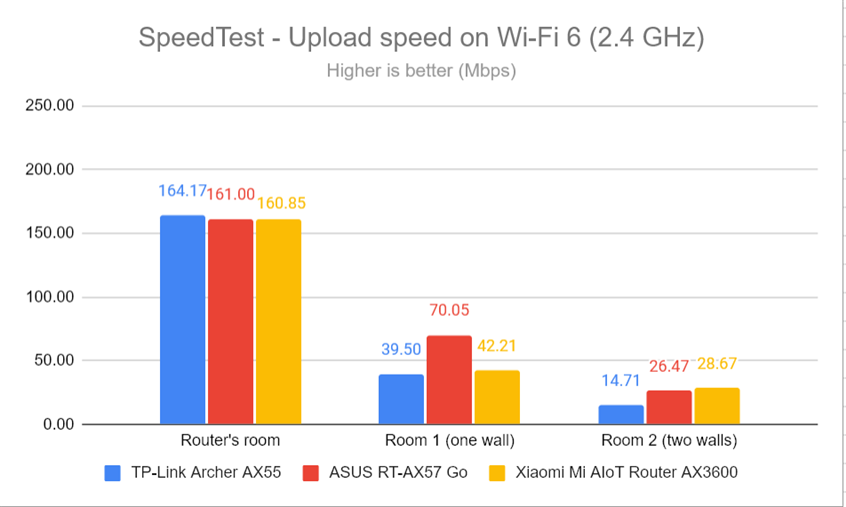
Uploads were significantly faster, too, when using Wi-Fi 6 on the 2.4 GHz band.
SpeedTest - The download speed on Wi-Fi 6 (2.4 GHz)
Uploads were significantly faster, too, when using Wi-Fi 6 on the 2.4 GHz band.
 SpeedTest - The upload speed on Wi-Fi 6 (2.4 GHz)
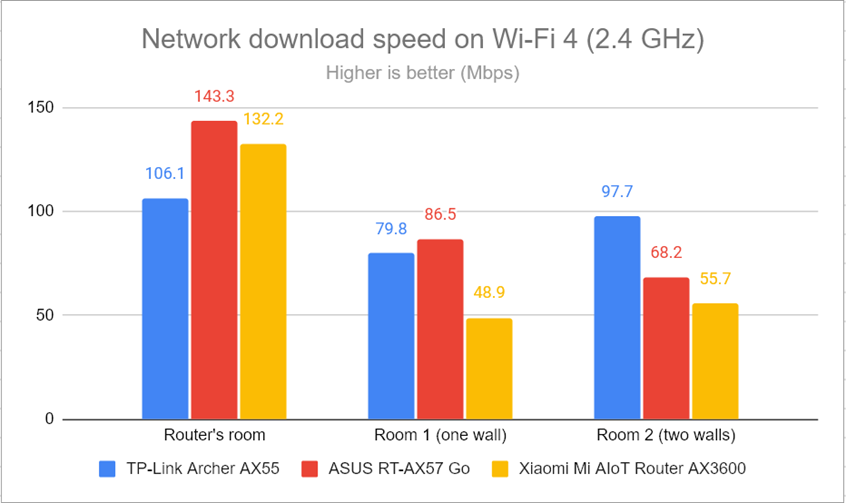
For the next set of measurements, I used the PassMark Performance test to transfer data between two computers connected to the network. Again, I was connected to the 2.4 GHz band with the Wi-Fi 4 standard turned on. Then, when measuring the download speed, the ASUS RT-AX57 Go proved to be pretty fast. However, it didn’t outmatch its competitors.
SpeedTest - The upload speed on Wi-Fi 6 (2.4 GHz)
For the next set of measurements, I used the PassMark Performance test to transfer data between two computers connected to the network. Again, I was connected to the 2.4 GHz band with the Wi-Fi 4 standard turned on. Then, when measuring the download speed, the ASUS RT-AX57 Go proved to be pretty fast. However, it didn’t outmatch its competitors.
 Network downloads on Wi-Fi 4 (2.4 GHz)
The upload speeds were better than on the other two routers.
Network downloads on Wi-Fi 4 (2.4 GHz)
The upload speeds were better than on the other two routers.
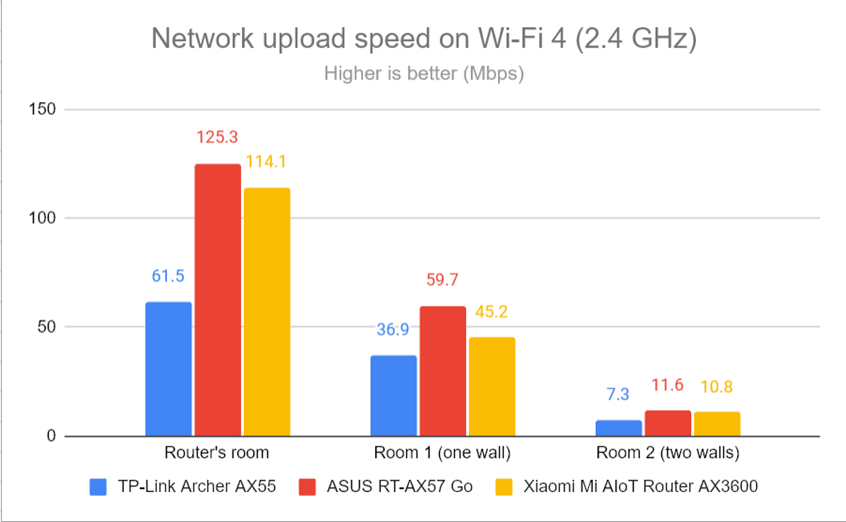
 Network uploads on Wi-Fi 4 (2.4 GHz)
Switching to Wi-Fi 6 on the 2.4 GHz band led to even faster downloads. I especially liked how the ASUS RT-AX57 Go performed in Room 2, which is tough to handle for many routers.
Network uploads on Wi-Fi 4 (2.4 GHz)
Switching to Wi-Fi 6 on the 2.4 GHz band led to even faster downloads. I especially liked how the ASUS RT-AX57 Go performed in Room 2, which is tough to handle for many routers.
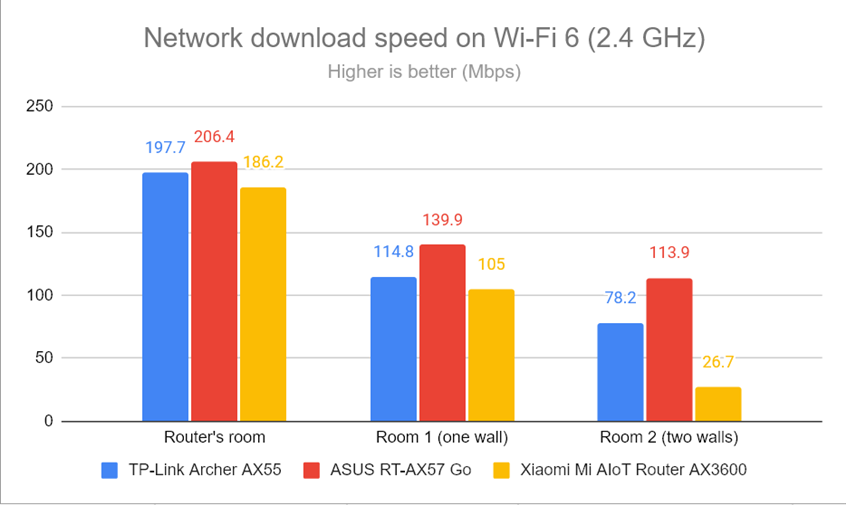
 Network downloads on Wi-Fi 6 (2.4 GHz)
The upload speed didn’t increase as much in this test when switching from Wi-Fi 4 to Wi-Fi 6 on the 2.4 GHz band. However, the ASUS RT-AX57 Go performed well.
Network downloads on Wi-Fi 6 (2.4 GHz)
The upload speed didn’t increase as much in this test when switching from Wi-Fi 4 to Wi-Fi 6 on the 2.4 GHz band. However, the ASUS RT-AX57 Go performed well.
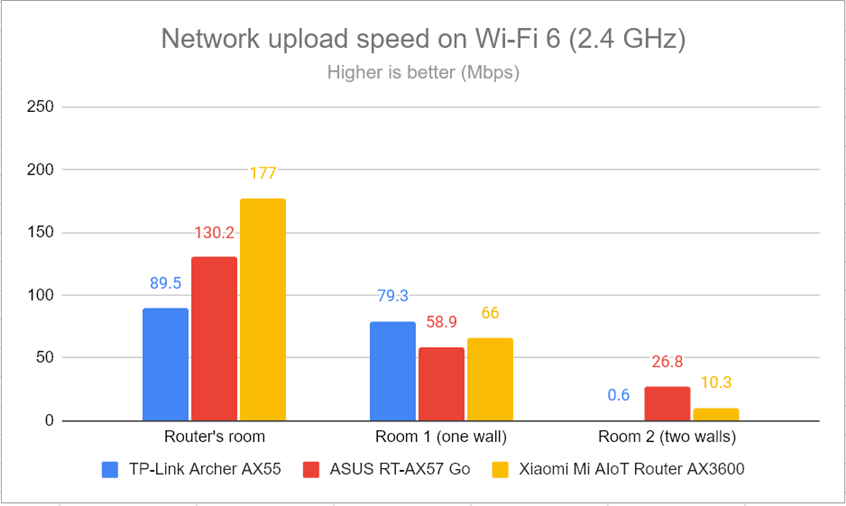
 Network uploads on Wi-Fi 6 (2.4 GHz)
ASUS’ RT-AX57 Go works well on the 2.4 GHz band. The signal strength and speed it delivers are similar to other dual-band AX3000 wireless routers. However, for the best performance, you should use the Wi-Fi 6 standard instead of the older Wi-Fi 4.
Network uploads on Wi-Fi 6 (2.4 GHz)
ASUS’ RT-AX57 Go works well on the 2.4 GHz band. The signal strength and speed it delivers are similar to other dual-band AX3000 wireless routers. However, for the best performance, you should use the Wi-Fi 6 standard instead of the older Wi-Fi 4.
 Signal strength on Wi-Fi 5 (5 GHz band)
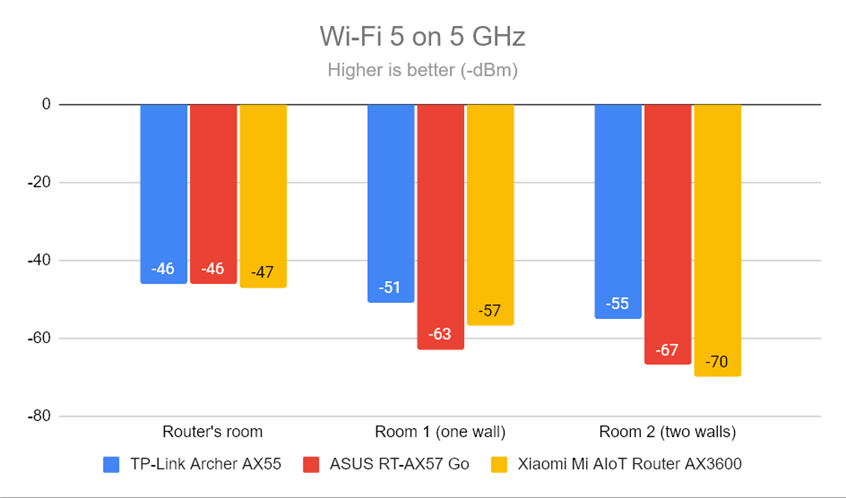
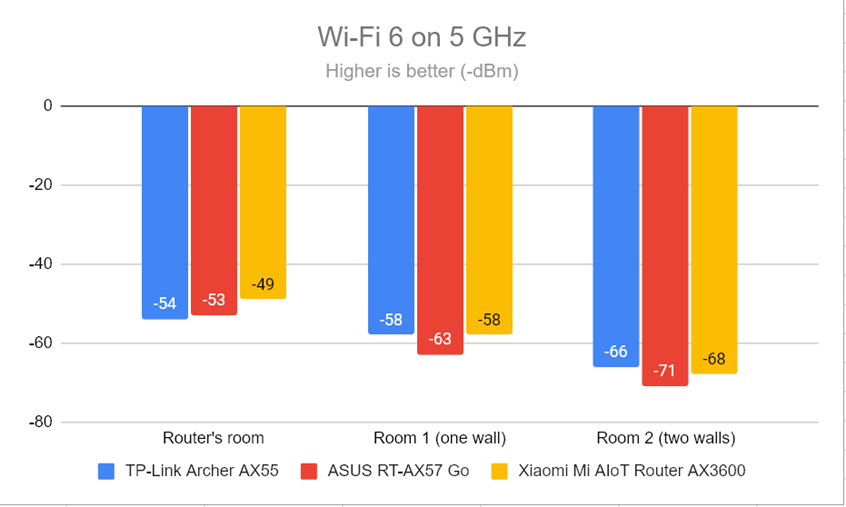
Switching to Wi-Fi 6 (802.11ax), I noticed lower signal strength. Again, the unique antenna design didn’t seem to improve things tangibly compared to other dual-band AX3000 wireless routers.
Signal strength on Wi-Fi 5 (5 GHz band)
Switching to Wi-Fi 6 (802.11ax), I noticed lower signal strength. Again, the unique antenna design didn’t seem to improve things tangibly compared to other dual-band AX3000 wireless routers.
 Signal strength on Wi-Fi 6 (5 GHz band)
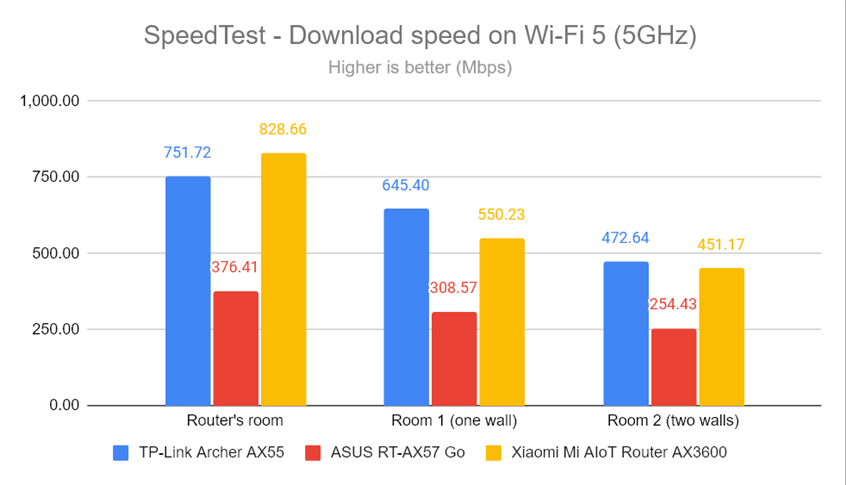
I moved on to the SpeedTest app. When using the Wi-Fi 5 standard, ASUS RT-AX57 Go delivers download speeds on the lower end of the spectrum.
Signal strength on Wi-Fi 6 (5 GHz band)
I moved on to the SpeedTest app. When using the Wi-Fi 5 standard, ASUS RT-AX57 Go delivers download speeds on the lower end of the spectrum.
 SpeedTest - The download speed on Wi-Fi 5 (5 GHz)
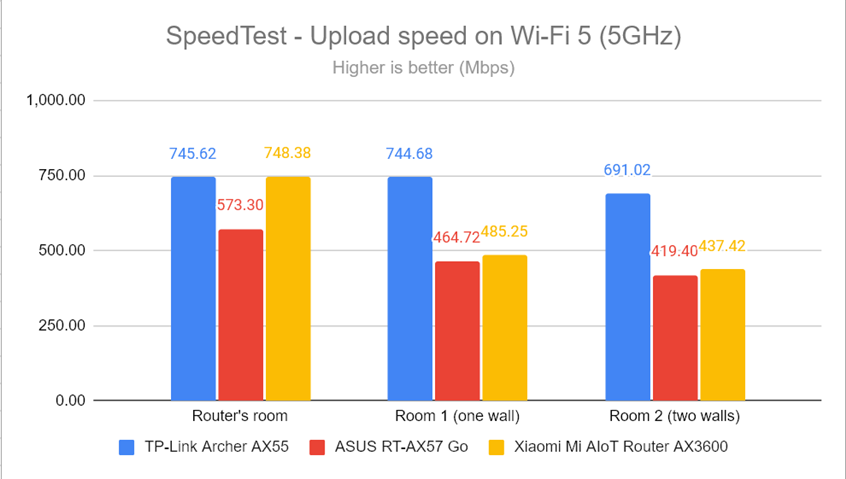
Surprisingly, upload speeds were faster than the downloads, sometimes by a huge margin.
SpeedTest - The download speed on Wi-Fi 5 (5 GHz)
Surprisingly, upload speeds were faster than the downloads, sometimes by a huge margin.
 SpeedTest - The upload speed on Wi-Fi 5 (5 GHz)
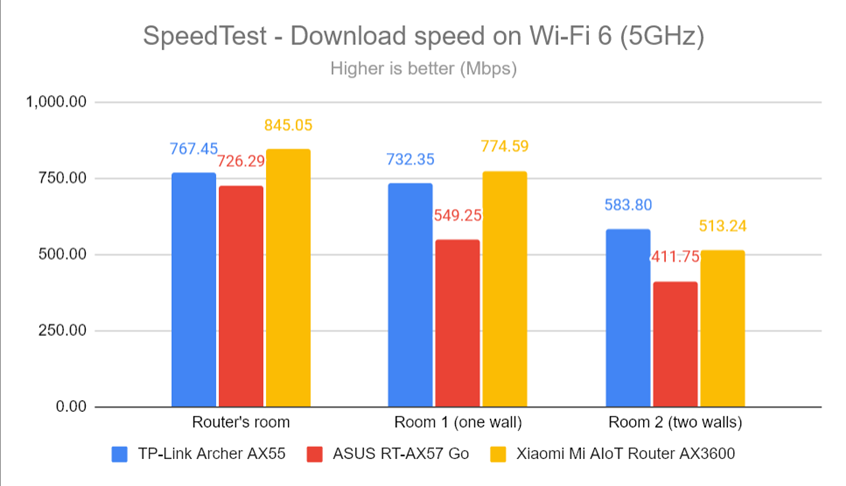
Switching to the Wi-Fi 6 standard on the 5 GHz band greatly improved the download speed. The ASUS RT-AX57 Go performed much better but didn’t outperform the routers I compared it to.
SpeedTest - The upload speed on Wi-Fi 5 (5 GHz)
Switching to the Wi-Fi 6 standard on the 5 GHz band greatly improved the download speed. The ASUS RT-AX57 Go performed much better but didn’t outperform the routers I compared it to.
 SpeedTest - The download speed on Wi-Fi 6 (5 GHz)
Uploads were also faster, but not as fast as those offered by the other two routers.
SpeedTest - The download speed on Wi-Fi 6 (5 GHz)
Uploads were also faster, but not as fast as those offered by the other two routers.
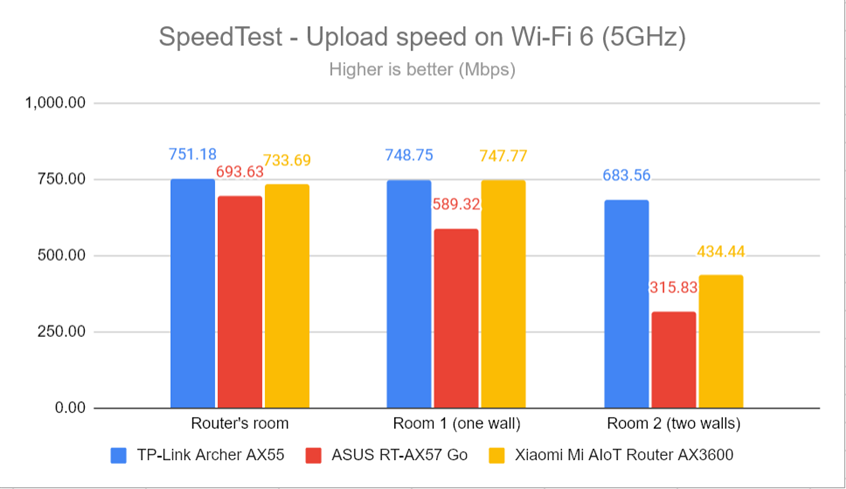
 SpeedTest - The upload speed on Wi-Fi 6 (5 GHz)
For the next set of measurements, I used the PassMark Performance test to transfer data between two computers connected to the network. When using the Wi-Fi 5 standard on the 5 GHz band, the ASUS RT-AX57 Go performed reasonably well, but TP-Link Archer AX55 outperformed it.
SpeedTest - The upload speed on Wi-Fi 6 (5 GHz)
For the next set of measurements, I used the PassMark Performance test to transfer data between two computers connected to the network. When using the Wi-Fi 5 standard on the 5 GHz band, the ASUS RT-AX57 Go performed reasonably well, but TP-Link Archer AX55 outperformed it.
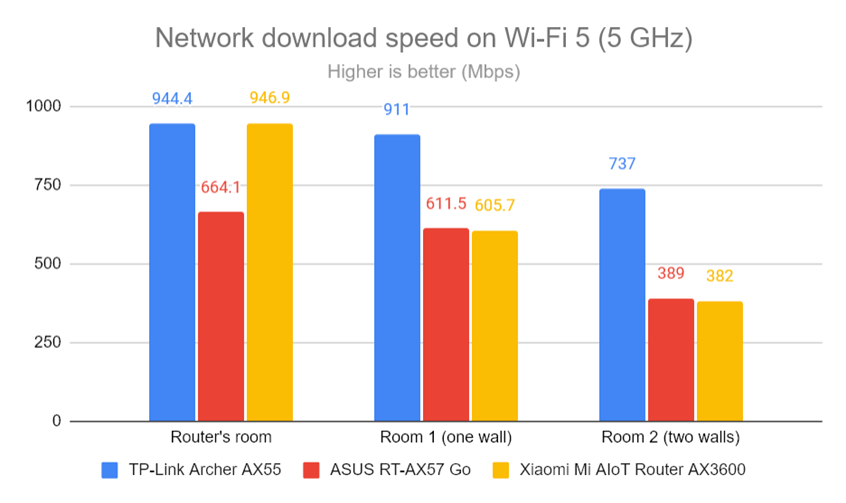 Network downloads on Wi-Fi 5 (5 GHz)
Upload speeds were reasonably fast but could have been more impressive.
Network downloads on Wi-Fi 5 (5 GHz)
Upload speeds were reasonably fast but could have been more impressive.
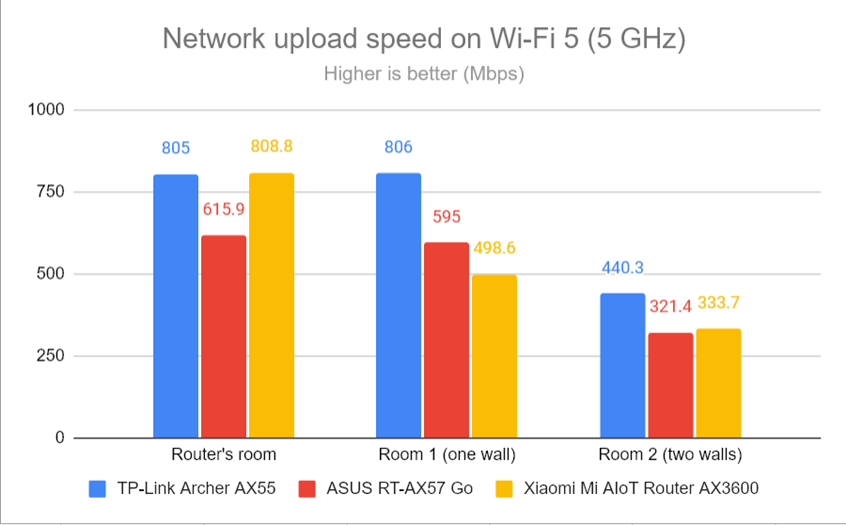
 Network uploads on Wi-Fi 5 (5 GHz)
Again, switching from Wi-Fi 5 to Wi-Fi 6 changed things a lot: downloads were much faster everywhere in my apartment. This shows that the ASUS RT-AX57 Go is optimized for using the newer Wi-Fi 6 standard.
Network uploads on Wi-Fi 5 (5 GHz)
Again, switching from Wi-Fi 5 to Wi-Fi 6 changed things a lot: downloads were much faster everywhere in my apartment. This shows that the ASUS RT-AX57 Go is optimized for using the newer Wi-Fi 6 standard.
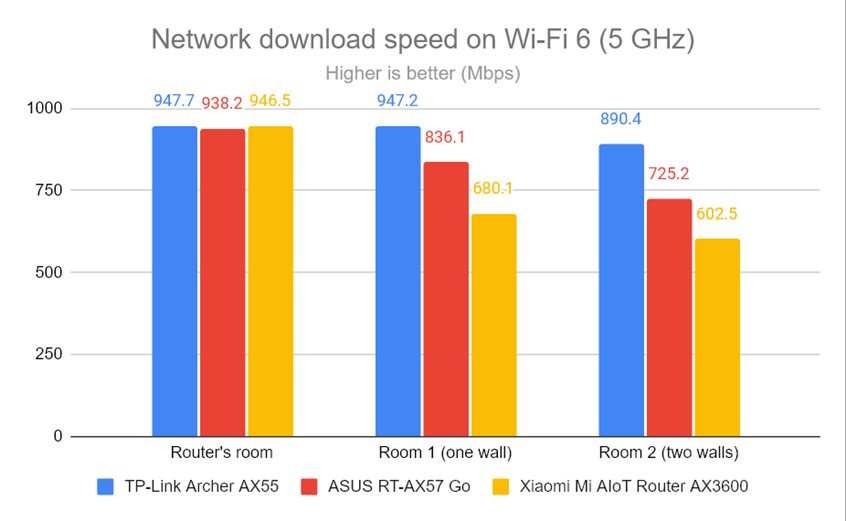
 Network downloads on Wi-Fi 6 (5 GHz)
Uploads were also much faster when using Wi-Fi 6 instead of Wi-Fi 5.
Network downloads on Wi-Fi 6 (5 GHz)
Uploads were also much faster when using Wi-Fi 6 instead of Wi-Fi 5.
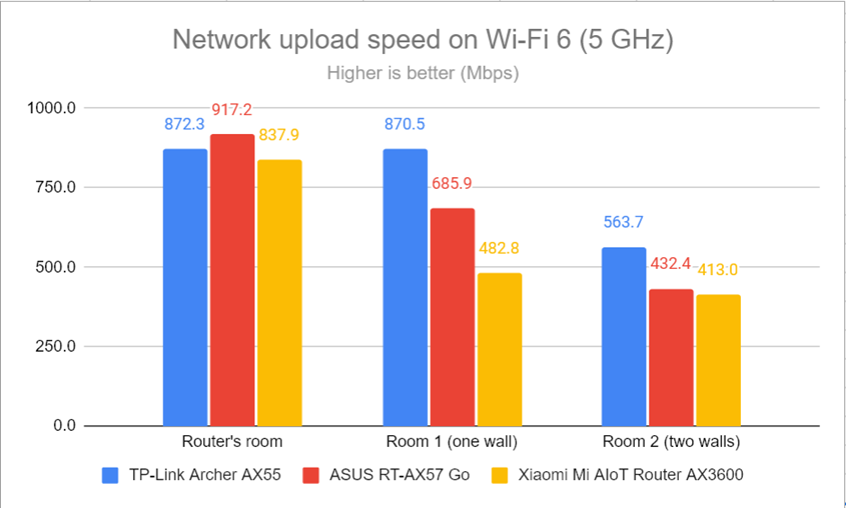
 Network uploads on Wi-Fi 6 (5 GHz)
My testing revealed that the ASUS RT-AX57 Go is optimized to work using the newer Wi-Fi 6 (802.11ax) standard on the 5 GHz band. If you want the fastest downloads and uploads, don’t use the older 802.11ac standard, or you’ll be disappointed by this router.
Network uploads on Wi-Fi 6 (5 GHz)
My testing revealed that the ASUS RT-AX57 Go is optimized to work using the newer Wi-Fi 6 (802.11ax) standard on the 5 GHz band. If you want the fastest downloads and uploads, don’t use the older 802.11ac standard, or you’ll be disappointed by this router.
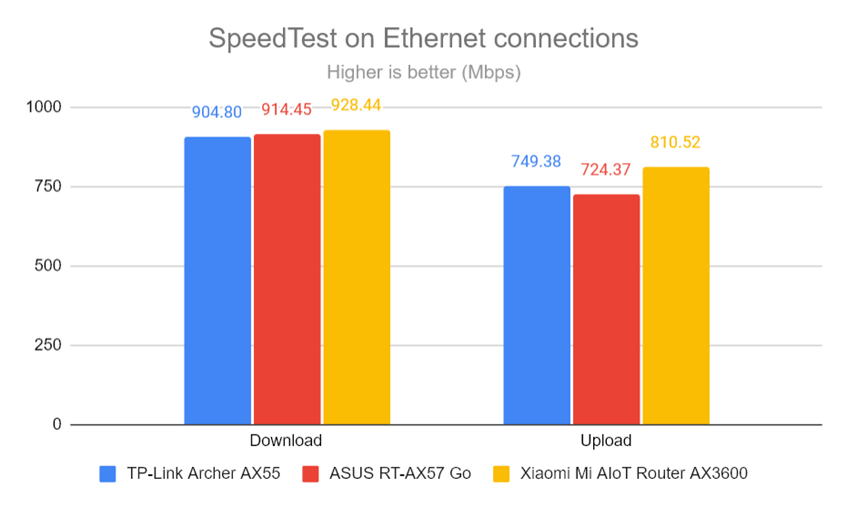 SpeedTest on Ethernet connections
Some users will appreciate that the ASUS RT-AX57 Go has a USB 3.2 Gen 1 port to plug in all kinds of gadgets. I plugged a fast SSD drive into it and made some data transfers to and from the SSD. I measured 870.56 Mbps for downloading data from the SSD and 365.64 Mbps for uploading the data to it. These speeds are excellent for a small travel router and will make users happy.
SpeedTest on Ethernet connections
Some users will appreciate that the ASUS RT-AX57 Go has a USB 3.2 Gen 1 port to plug in all kinds of gadgets. I plugged a fast SSD drive into it and made some data transfers to and from the SSD. I measured 870.56 Mbps for downloading data from the SSD and 365.64 Mbps for uploading the data to it. These speeds are excellent for a small travel router and will make users happy.
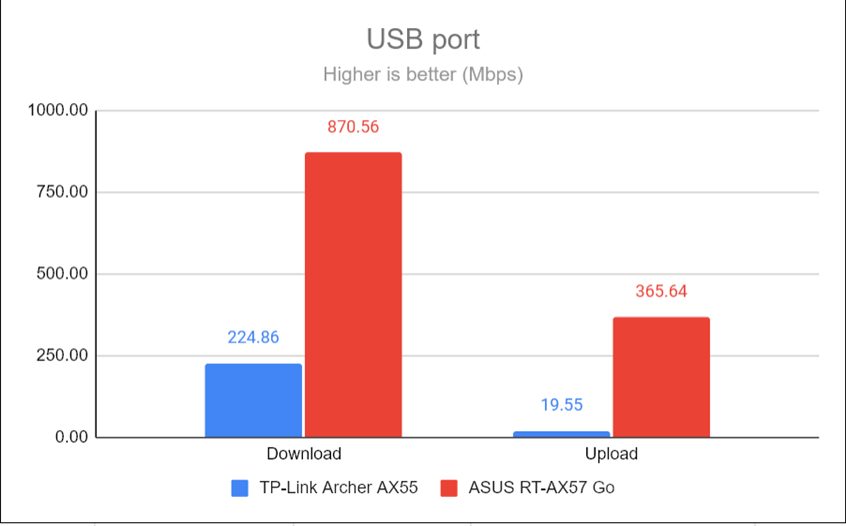
 The speed of the USB port
Even though the ASUS RT-AX57 Go is a small travel router, it has no issues handling 1 Gbps internet connections. Its LAN port works at speeds close to 1 Gbps, and the USB port on this router is quite fast. Good news for anyone who needs these features on their router! 🙂
The speed of the USB port
Even though the ASUS RT-AX57 Go is a small travel router, it has no issues handling 1 Gbps internet connections. Its LAN port works at speeds close to 1 Gbps, and the USB port on this router is quite fast. Good news for anyone who needs these features on their router! 🙂
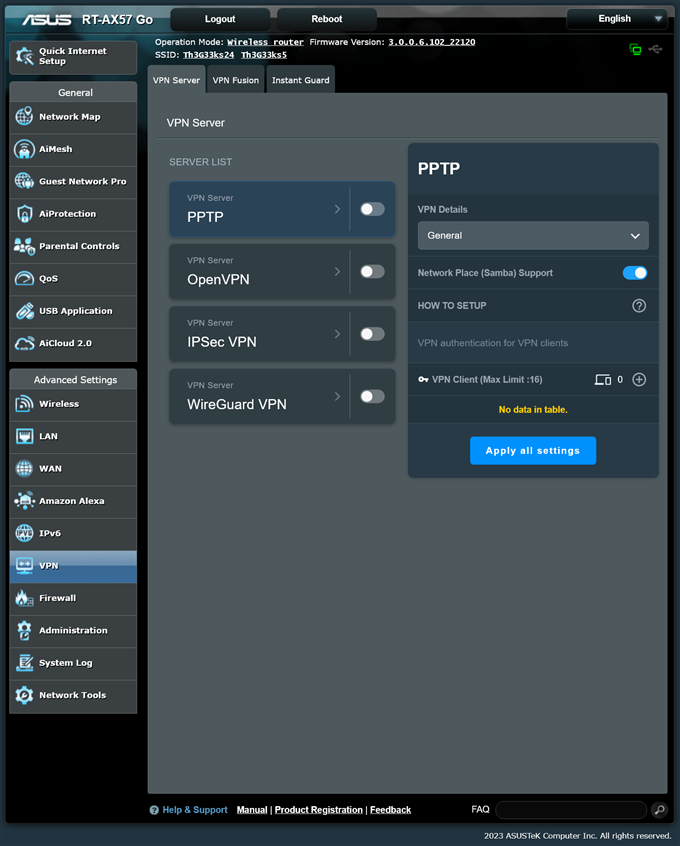
 The VPN features available on the ASUS RT-AX57 Go
ASUS RT-AX57 Go shines through its long list of advanced features that will be useful to families and business users who need good Wi-Fi on the go.
The VPN features available on the ASUS RT-AX57 Go
ASUS RT-AX57 Go shines through its long list of advanced features that will be useful to families and business users who need good Wi-Fi on the go.
ASUS RT-AX57 Go: Who is it good for?
This wireless router is a smart choice for:- People who travel and need a capable router they can take with them
- Families with children who want to protect their kids when online
- Business users who need advanced VPN features on their router: VPN server, VPN Fusion, Instant Guard, etc.
- Knowledgeable users who want a travel router that can do many things
Pros and cons
Here are the things I like about ASUS RT-AX57 Go:- It is small and easy to carry
- Good performance when using the Wi-Fi 6 standard
- It can be used vertically, horizontally, or attached to a wall
- Tons of innovative VPN features
- You can quickly build diverse Wi-Fi portals for different uses
- Excellent security tools for protecting the router and your network
- Fast USB port
- ASUS has fine-tuned its web admin interface
- Less impressive performance when using older standards like Wi-Fi 4 and Wi-Fi 5
- The parental controls no longer have content-filtering capabilities
- Other travel routers are more affordable (but not as feature-packed)
Verdict
The ASUS RT-AX57 Go is a niche product with a generous list of tools and features. Its hardware is very capable for a travel router and provides fast Wi-Fi 6 connectivity. It is not as fast as traditional Wi-Fi 6 routers but is no slouch either. Where it shines is its advanced firmware, which is packed with tons of features that cater to the needs of many users. It’s a great choice for families traveling with their children, who need to manage how much time their children spend online, as well as for business users who need to work while on the go and connect to their company’s or home VPN server(s). To make things even more appealing, the ASUS RT-AX57 Go can provide Wi-Fi coverage over relatively large spaces despite being a small portable travel router. I’m happy with my testing experience and recommend it to anyone interested in a good router to take along on their travels.Unboxing the ASUS RT-AX57 Go
This travel router comes in a small cardboard box with a white front cover and a black back. On the front, you see a picture of the router, its name, and some of its most important characteristics. One thing that I liked right away is that the router includes a Public WiFi mode that can be useful when you travel and want to share your internet connection with others, as well as all kinds of VPN-related services that should make it useful to business users.Hardware specifications and design
ASUS RT-AX57 Go is a square router measuring 120 mm x 120 mm x 21.5 mm or 4.7 x 4.7 x 0.8 inches and weighing just 210 grams or 7.4 ounces. As you can see in the picture below, its shell is made of white plastic, featuring just the ASUS logo on the front. A hole in one of its corners allows you to tie the router to your luggage if you want.Setting up and using the ASUS RT-AX57 Go
ASUS RT-AX57 Go is intended to be used while traveling. As a result, it is not only small and lightweight, but it also comes with a nice travel bag. You place it inside, close the bag, and place it in your luggage to protect it. When you arrive at your destination, connect it to the internet using your smartphone, a network cable, or a public Wi-Fi available in your area, and then start setting it up.Wireless network performance
My test apartment is set up like in the diagram below. I’ve placed the ASUS RT-AX57 Go in a central position to provide good coverage in an area as large as possible.- The router’s room - I record the maximum speeds when no walls absorb the wireless signal in the room where the router is placed.
- Room 1 - is separated by one wall from the router, so the wireless signal and the Wi-Fi speed I get should be lower here.
- Room 2 - is separated from the router by two walls absorbing the wireless signal. Also, the wall between Room 1 and Room 2 is twice as thick as the one between The router’s room and Room 1. As a result, Room 2 can be a difficult challenge for many routers.
How the ASUS RT-AX57 Go performs on the 2.4 GHz band
I first measured the signal strength using NetSpot when connected to the 2.4 GHz band on the Wi-Fi 4 standard (802.11n). The signal strength delivered by the ASUS RT-AX57 Go evolved similarly to that of the routers I’ve compared it to, without being better or worse than them.How the ASUS RT-AX57 Go performs on the 5 GHz band
I switched to the 5 GHz band and started measuring the signal strength with NetSpot. When using the Wi-Fi 5 (802.11ac) standard, ASUS RT-AX57 Go delivered good signal strength at levels similar to its competitors. Considering MediaTek’s unique antenna design for the 5 GHz band, I was expecting a bit more. However, don’t get me wrong; these are not bad results, just not as great as the product’s marketing would have you believe.🙂Wired network performance & USB port
Lastly, I verified how the ASUS RT-AX57 Go performs when using Ethernet connections on its single LAN port. My internet connection offers a maximum of 1 Gbps for the download speed and 800 Mbps for the upload. When testing with SpeedTest, ASUS RT-AX57 Go came close to the maximum potential of my internet connection. However, its upload speed was slightly lower than the routers I compared it to.Advanced features
The firmware on the ASUS RT-AX57 Go is surprisingly well-equipped. It includes more than you would think a travel router could do:- AiMesh - you can connect it with other ASUS routers and create your own mesh Wi-Fi systems. Therefore, you can use it as a secondary node at home to improve the coverage of your wireless network and then take it with you when you travel and use it as a travel router. If you already have a wireless router made by ASUS, I recommend reading this analysis too: Is ASUS AiMesh worth it? Does it increase your Wi-Fi speed?
- Guest Network Pro - you can create all kinds of guest networks, depending on how you plan to use them: build a captive portal for digital marketing like those available on business routers like ASUS ExpertWiFi EBR63, create a safe Wi-Fi for your children, or a VPN network for business use.
- AiProtection is a collection of security tools for protecting your network, which includes a router security assessment, a malicious sites blocking tool, and infected device prevention and blocking. This suite was created with Trend Micro, a renowned antivirus vendor.
- Parental Controls - super useful when traveling with our family. You can set a schedule for the devices children use to control for how long they can connect to the internet. Unfortunately, you can’t set content filters like you can on other ASUS routers.
- QoS is a basic Quality of Service tool that allows you to split your available bandwidth among the different connected devices according to your rules. The tool also includes a Traffic Monitor, which shows you how your bandwidth is used in real-time.
- USB Applications - for connecting a USB hard drive to the router (and using it as a NAS), as well as a network printer, an Android smartphone, or a 4G USB wireless dongle for mobile tethering.
- AiCloud 2.0 - allows you to attach USB storage to the router and use it as a cloud storage service for your devices.
- DDNS - allows you to connect to the router remotely from anywhere on the internet, even if your internet provider assigns it a dynamic public IP address. The list of supported services is quite long, and ASUS also includes its free service.
- VPN - you can set the router to work as a VPN server using the following protocols: PPTP, OpenVPN, IPSec VPN, and WireGuard VPN. You can also turn your network-connected devices into VPN-enabled clients without additional VPN software. And to complete the picture, this router gives you access to VPN Fusion and Instant Guard.
- Integration with Amazon Alexa, Google Assistant, and IFTT - you can say things like “Alexa, ask ASUS ROUTER to upgrade the firmware” to perform different tasks. You can also automate tasks that might otherwise be repetitive or unable to “talk to each other.” However, these integrations are handled through the ASUS Router mobile app.
- Network Tools – for analyzing the network and troubleshooting what’s wrong when the Wi-Fi or the router doesn’t work well.

Discussion (8)
jo one thing: not able to get that thing. to connect to android phone only able to provide mobile hot spot on channel 149.
the router does not see the mobile hot spot @ 5ghz ! bought in the eu.
they promoting the thing as travel router but see above + not able to create a 5ghz network with channel above 140 cuz no channels about 140 selectable (not there) + no way to change the country / “continent” in the settings..
+ the minimum should be this thing beeing able to connect to channel 149 / all channels… if its not able to create networks cuz “eu / us version and fcc shit.
pls can u contact you asus guy and ask wtf they did here. + fu** that fcc thing. you cant tell everyone hey here is a travel router and than this??
I’m not sure I understand what issue you’re having. I was able to create Wi-Fi on the 5 GHz using the 160 MHz channel bandwidth. Also, the control channel can be set to Auto, or you can choose a specific channel yourself.
the problem is exactly as written above.
EU samsung phone creates 5ghz wifi mobile hotspot on fixed channel 149. there is no way to change it on the samsung phone.
the asus-rt-ax57-go does not see channel 149 of the phone when using wisp mode. pls can u contact you asus guy and ask wtf they did here.
channel 149 is allowed in the eu. thx
Hi Mike,
I forwarded our discussion to a contact at ASUS. Let’s wait and see what they advise.
Will keep you posted.
Ciprian
Digital Citizen
Hello Mike,
I received this answer:
“U-NII-3 is available on this router, but the power is really low in EU, most AP routers won’t get certificated. Currently the only solution is to change Samsung from 5G to 2.4G”
Some information about U-NII-3 can be found here: https://en.wikipedia.org/wiki/Unlicensed_National_Information_Infrastructure
I propose another solution though. You can connect your Samsung Galaxy to the router through its USB port and enable USB tethering. I think this should solve the issue. See here a tutorial about what I mean:
https://www.digitalcitizen.life/auto-usb-backup-wan/
I hope this helps,
Ciprian
Digital Citizen
The Amazon reviews of Asus routers are near useless as all models are mixed up in a steam of reviews, with most reviewers failing to mention their model number. That’s why I came here. Excellent review by the way. There are 3 things I wanted to know most: 1. Can this piggy back off e.g. a hotel’s standard WiFi or a captive WiFi portal (where you have to log in) then redistribute the WiFi to multiple devices? 2. Having done the above, can the ax57 act as a VPN so that devices connecting to it are now using that VPN. 3. Can this router utilize popular VPN providers like NordVPN, Windscribe, etc?
Hello,
Thank you for appreciating my work. I will try to answer your questions:
1. I don’t know. I didn’t test this scenario and can’t provide you useful information. Sorry! What it can surely do is use an Ethernet connection from a hotel room as the internet source and redistribute it to your device through Wi-Fi.
2. The router can act as a VPN so that all your connected devices can use that VPN.
3. The router can use NordVPN, CyberGhost, and other popular VPN services that offer OpenVPN configuration files for you to add to your router’s settings.
I hope this information helps.
I will also ask a contact at ASUS to see if that person can answer your first question.
Will let you know if I get more info,
Ciprian
Digital Citizen
Hi Noel,
I received a reply from an engineer at ASUS who said that this router can do what you want, using a feature named WISP mode, which is found in its firmware.
So, the answer to question Nr 1 is Yes, it can. 🙂