



Even though Sony manufactures some great high-end smartphones, it seems to be struggling to create compelling mid-range smartphones. The Xperia 10 represents the company's 2019 attempt of entering the mid-range market with a unique smartphone. What makes it unique? Well, the Xperia 10 is the only mid-range smartphone that offers a display with a cinematic 21:9 aspect ratio. Is that enough to make people buy it? Find out more about the Sony Xperia 10, what it offers, and its real-world performance, in this review:
Sony Xperia 10: Who is it good for?
Sony Xperia 10 is a solid choice for people who:
- Enjoy watching movies on their smartphones and want a screen with 21:9 cinematic aspect ratio
- Long for a beautiful Android smartphone that looks premium
- Want a mid-range smartphone for everyday use
Pros and cons
Here are the good things we'd like to point out about the Sony Xperia 10:
- It is a beautiful smartphone, with a pleasant design
- The display has a wide 21:9 cinematic aspect ratio
- It runs regular everyday apps well, fulfilling the needs of regular users
There are also some downsides to consider:
- Playing games on it is not going to be a great experience
- The battery is too small to last for a day if you're going to watch a movie or two
- There are alternatives with better performance at a similar price
Verdict
The Sony Xperia 10 gave us an array of mixed feelings. We love its wide 21:9 screen and the experience we had watching movies on it. We also found it to be a beautiful device that looks more expensive than it is. But, its chipset is slow, and its performance lags compared to similarly priced smartphones. We recommend that you familiarize yourself with the strengths and weaknesses of the Sony Xperia 10, before deciding whether to purchase it or not.
Unboxing the Sony Xperia 10
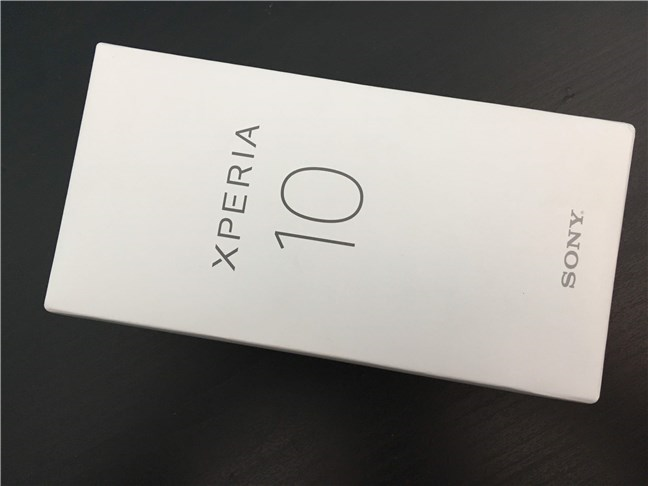
The Sony Xperia 10 comes in a good-looking box made of white cardboard. On its top side, you can see the Xperia 10 name and the Sony brand printed in stylish light gray fonts.
Open the box and you should find the smartphone, a charger with a detachable USB Type-A to Type-C cable, a pair of in-ear headphones, the user manual and warranty card.
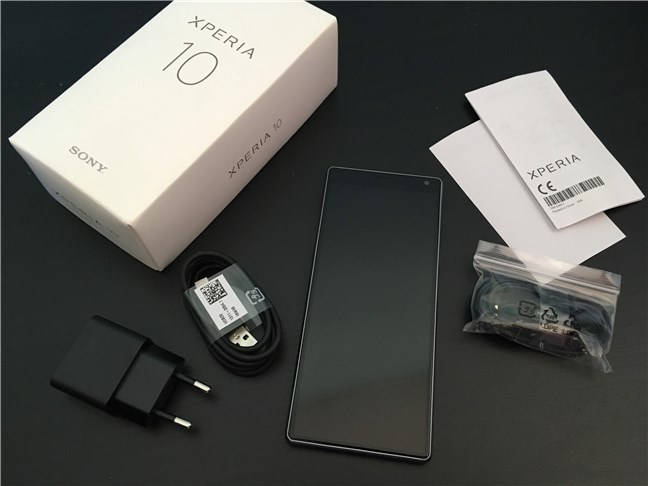
Unboxing the Sony Xperia 10 is a fast and straightforward experience, and it's nice to see that Sony also bundled a pair of headphones. Many manufacturers do not do that anymore.
Design and build quality
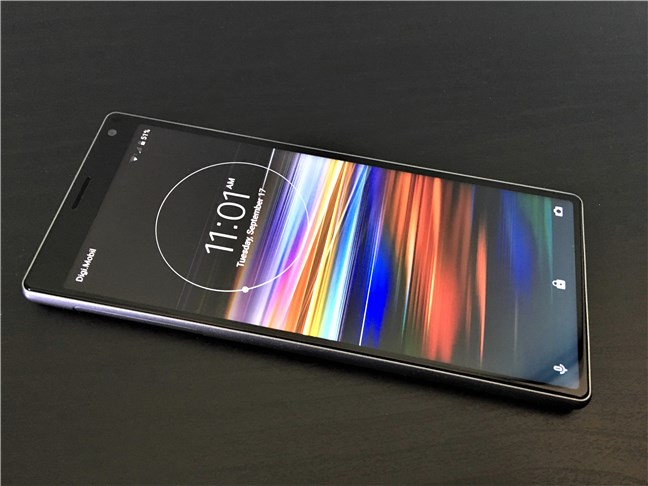
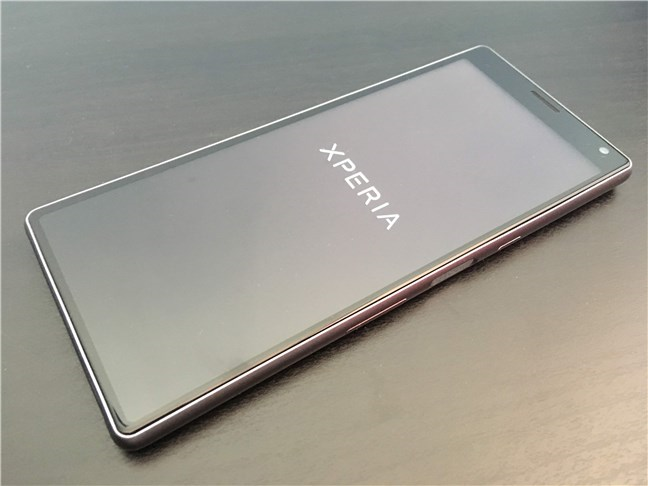
This is a beautiful smartphone: we loved how it looks, right from the start. The most striking feature of the Sony Xperia 10 is its long display with its cinematic aspect ratio of 21:9. It is a long smartphone but also a slim one, which means that you can easily hold it in your hands without the risk of dropping it. However, when you put it in your pocket, it is probably not going to fit inside and you are likely going to feel it when you are walking.
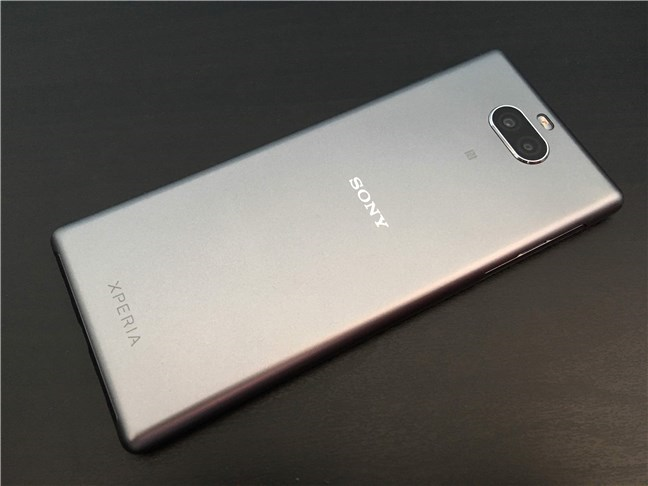
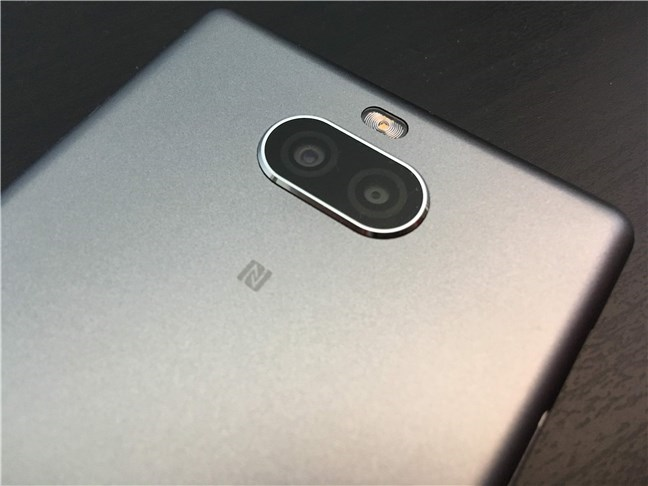
The back of the Sony Xperia 10 is made of plastic material but looks like it's made of metal. The edges are rounded, adding to the impression of a stylish and elegant device. Also on the back, right at the top of the smartphone, you see the two main cameras and the flash. It is worth noting that the camera system protrudes only a little, so it's not going to annoy you when you put your Xperia 10 on a table. Toward the middle, Sony engraved its logo and, at the bottom, the Xperia brand.
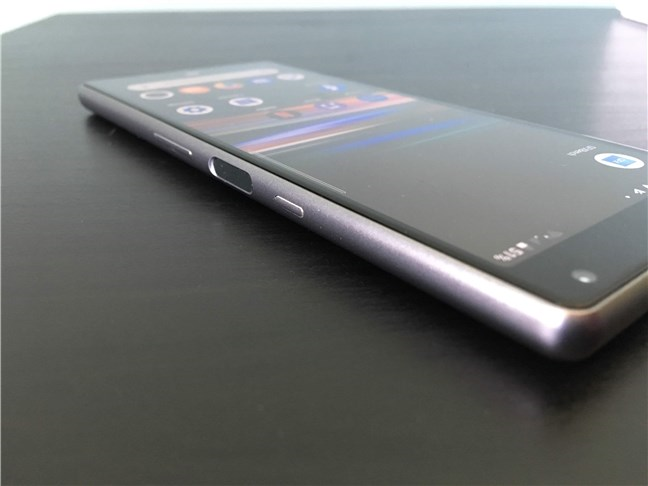
The power button and the volume rocker are found on the right edge, and the fingerprint reader sits between them. While the fingerprint reader is easy to identify because it is sunk inside the body, the volume rocker and the power button are a bit more finicky because they have a very short pressure point and they extend just a millimeter above the surface of the smartphone. We'll tell you more about our experience with these buttons later on, in The smartphone experience section.
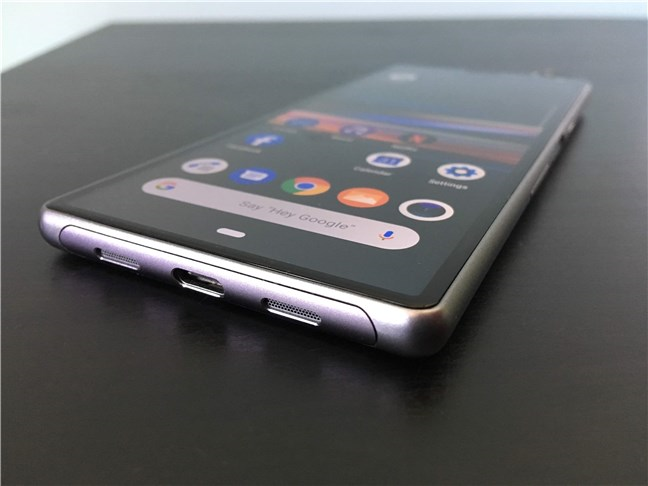
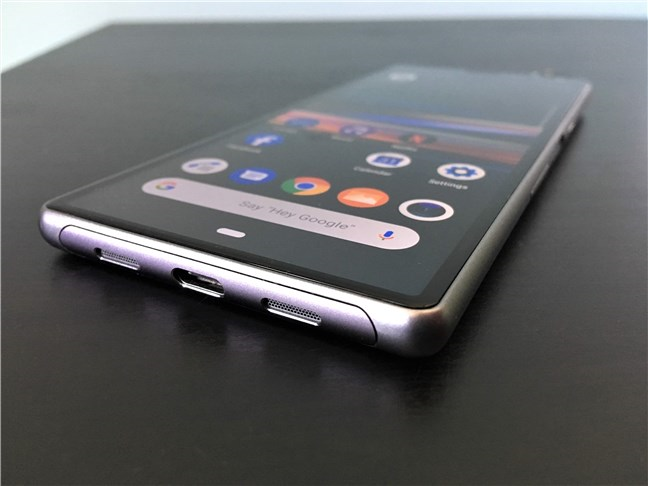
The bottom edge of the Sony Xperia 10 is home to the USB Type-C port and two air grilles: one of them hides the loudspeaker and the other one is just for design.
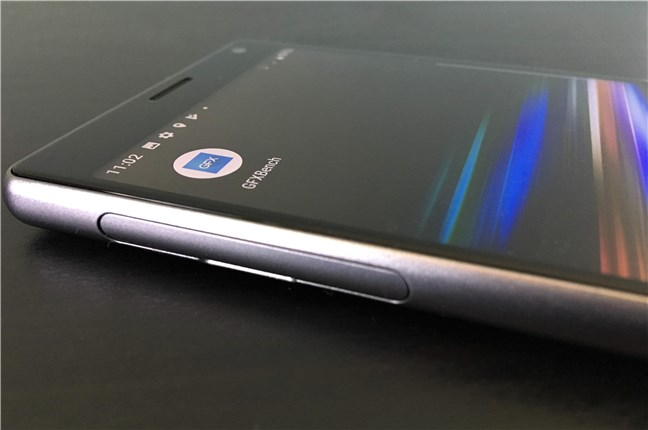
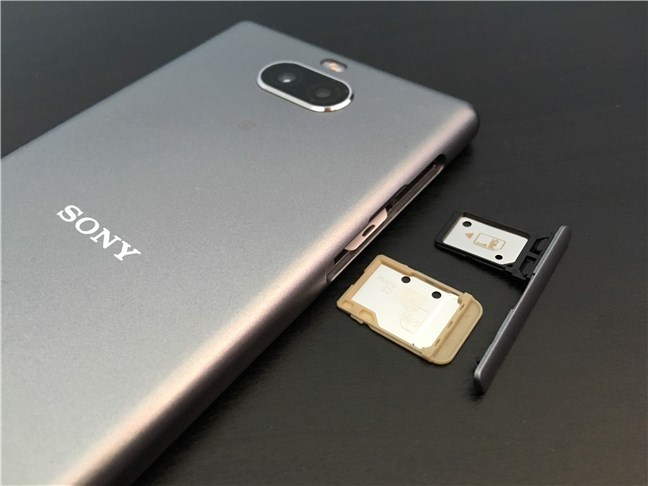
On the left side, there is the SIM and microSD cards tray. To get to one or the other, you have to take both out using a fingernail, not a pin, like many other smartphones do today. It is a nice design choice from Sony.
Finally, we would like to mention that you can get the Sony Xperia 10 in one of four different color variations: Navy, Black, Silver, and Pink. Here's what they look like:
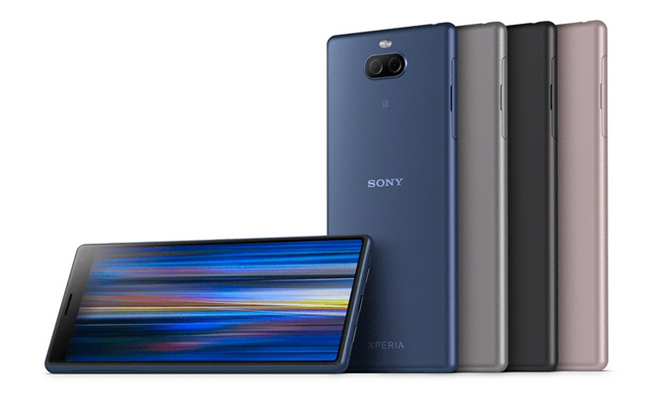
We love the premium feeling that you get from the Sony Xperia 10. It looks gorgeous and its design is both simple and beautiful.
Hardware specifications
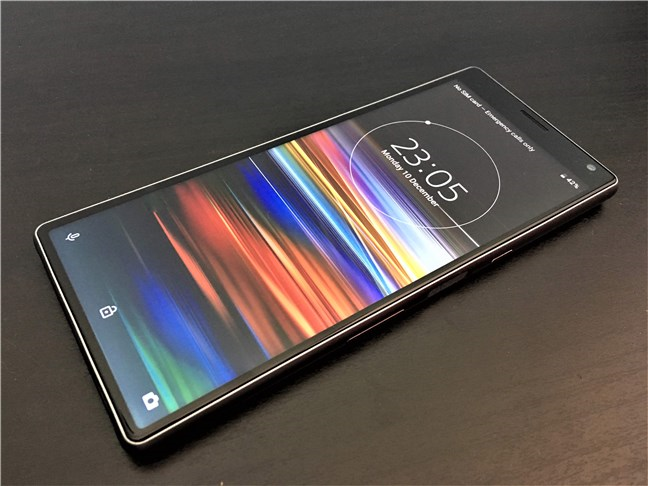
The Sony Xperia 10 uses a wide 6 inch IPS LCD display with a cinematic 21:9 aspect ratio and Full HD+ resolution of 1080 x 2520 pixels. That translates into high pixel density (approximately 457 ppi), which means plenty of detail for anything shown on the screen. The display is protected against scratches and small drops by Gorilla Glass 5.
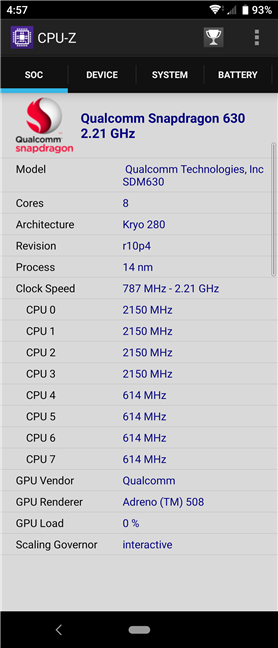
The smartphone gets its power from a Qualcomm SDM630 Snapdragon 630 chipset that uses an octa-core 2.2 GHz Cortex-A53 processor. The graphics of the smartphone are handled by an Adreno 508 GPU which, according to Wikipedia, supports the following APIs: Vulkan 1.0, OpenGL ES 3.2, OpenCL 2.0, OpenGL 3.1, and Direct3D 11.
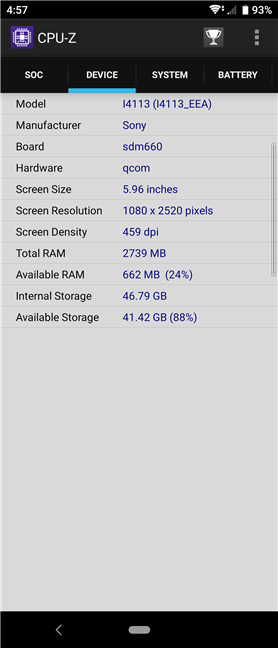
The Sony Xperia 10 comes with 64 GB of internal storage space and 3 GB of RAM, although a version with 4 GB of RAM is also available, but only in China. Additionally, you can also insert a microSD card of up to 512 GB to increase your storage space.
The smartphone is available in a Single SIM variant, as well as Dual SIM, in which case it uses a Dual SIM Dual Standby implementation, which means that, even if both SIM cards are active when you are not using them, once you take a call on one of them, the other becomes inactive. Both versions use Nano-SIM cards. In the Dual SIM version, you have to choose between using a secondary SIM or adding a microSD card, as they use the same slot.
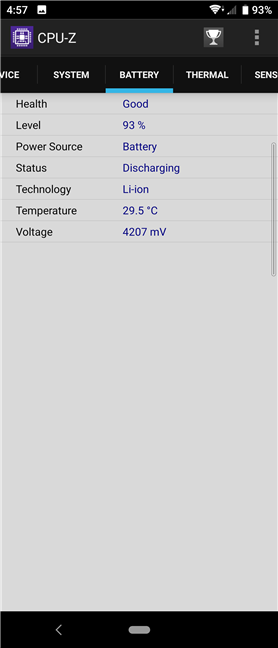
Regarding its autonomy, the Sony Xperia 10 comes with a non-removable Li-Ion battery with a capacity of 2870 mAh. Unfortunately, the battery seems pretty small considering the large 21:9 Full HD+ screen. The phone also supports Qualcomm Quick Charge 3.0 but the bundled Sony UCH20 is a lightweight travel charger that's not capable of fast charging. If you want fast charging, you have to buy a different charger, such as Sony's UCH32C.
On its back, the Sony Xperia 10 has two cameras: one with a 13-megapixel sensor and f/2.0 aperture, and another one with a 5-megapixel sensor and f/2.4 aperture. The camera system uses phase-detection autofocus (PDAF), a dual-LED flash useful for low-light photography, and Sony's SteadyShot technology for image stabilization. On the front, you get an 8-megapixel selfie camera with f/2.0 lens.
The Sony Xperia 10 has a USB Type-C port, Bluetooth 5.0, NFC, dual-band wireless with support for the 802.11 a/b/g/n/ac standards, and 2x2 MIMO. As for built-in sensors, you get a fingerprint sensor on the right edge of the phone, accelerometer, proximity, and compass sensors.
Although it doesn't feel like it, the Sony Xperia 10 is a large smartphone, because of its long 21:9 screen. It is 6.13 x 2.68 x 0.33 inches (155.7 x 68 x 8.4 mm) in length x width x thickness. It weighs just 5.71 ounces (162 grams), and that's a good thing, but we would have preferred a larger battery even if that meant a heavier device.
For more details about Sony Xperia 10's hardware specifications and features, visit its official webpage: Sony Xperia 10 Specs.
The Sony Xperia 10 comes with a gorgeous cinema-style display and with excellent build quality. However, its chipset is not going to impress anyone with its speed, and the battery seems to be too small.
Check the next page to find out more about the smartphone experience offered by the Sony Xperia 10, its cameras, bundled apps, and performance in benchmarks.
The smartphone experience on the Sony Xperia 10
We used the Sony Xperia 10 smartphone daily, for over two weeks. Our experience with it during this time was both good and bad. Its Snapdragon 630 chipset and 3 GB of memory are good enough for regular activities such as browsing the internet, chatting on Whatsapp, watching movies on Netflix or YouTube, or playing Candy Crush-like games. However, sometimes apps and the Android user interface stuttered.
The fingerprint sensor proved to be fast at unlocking the smartphone, but its positioning on the right edge was not great for me, personally. I tend to hold the smartphone with my left hand and, although I would not say that my fingers are short, I still had trouble reaching it. Furthermore, I had even more issues finding the power button: it is above the fingerprint reader, and hard to reach. If you usually hold your phone with the right hand, you should not have these problems.
As for the phone calls, their audio quality is excellent. We could hear the ones we called clearly, and they said the same thing about hearing us. The mobile coverage is not great in the mountainous town where I live, but I did not experience any call drops.
The best thing about Sony Xperia 10 is its screen. The 21:9 aspect ratio and the Full HD+ resolution make it an excellent choice for people who like to watch movies or TV series on their smartphones. The screen displays vivid colors with good detail and high brightness. Even if you use it outdoors in sunlight, you can see what's on the screen without having to look for shade. On the other hand, Xperia 10's best feature is also the one least exploited: there are not many movies, and even less TV series, available in 21:9 format. At least not on Netflix and HBO GO, the two streaming services that we're subscribed to. If you are watching a video with 16:9 aspect ratio, you're going to see some thick black bars on the left and right sides of the screen.
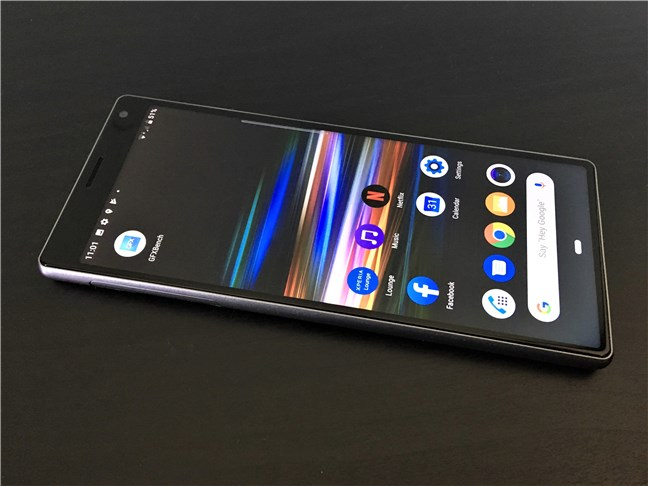
Sony's Xperia 10 also delivers excellent sound when you're using your headphones with it, wired or Bluetooth. Yes, this smartphone offers a 3.5 mm jack which you can use to plug in your wired headphones. It is nice to see that you're not forced to use a USB Type-C to audio adapter.
Although it has two grilles on its bottom edge, the Xperia 10 has only one loudspeaker, and the audio experience is not the best. It does not distort, and it's loud, but the high tones feel too high.
Playing games on the Sony Xperia 10 can be a satisfying experience as long as you don't expect high graphics quality and are OK with games not rendering on the whole screen. There are not many games that are designed to work on 21:9 screens. Also, if you are the type of person who enjoys playing racing or any other fast action games, they might not run as smooth as you'd like.
If you enjoy watching movies on your smartphone often, you will probably like the Sony Xperia 10 because of its cinematic 21:9 screen. Otherwise, although it is a decent mid-range smartphone overall, it has a few quirks that might annoy you.
The camera experience on the Sony Xperia 10
On the back of the Sony Xperia 10, there's a dual-camera system. The primary camera has a 13-megapixel sensor, f/2.0 aperture, and support for PDAF (phase-detection autofocus). The secondary camera has 5 megapixels, f/2.4 aperture, and it's used for calculating what's in front of the smartphone and to add depth to pictures. We took photos in different lighting conditions and using various subjects. Most of the time, the camera focuses correctly on the subject, but, unfortunately, sometimes it takes a while until it's ready to shoot. That means that, occasionally, you might lose the scene that you were trying to shoot.
As for the image quality, most of the photos taken outdoors in natural lighting conditions look good, with detail, vivid colors, and proper exposure. However, when there was a lot of sunlight or bright clouds, the photos we took were sometimes oversaturated. In low light, the smartphone struggles: pictures lack detail and feel soft. Furthermore, in these conditions, photos also tend to have too much yellow.
The 8-megapixel camera on the front of the smartphone takes good selfies in good lighting conditions, but just like the main cameras, it does not do too well in low light.
If you want to see some samples of photos taken with the Sony Xperia 10, both indoors and outdoors, panoramic, landscape and closeups, check the gallery below:
The Sony Xperia 10 can record videos at a maximum resolution of 2160p and 30 frames per second, as well as in 1080p/30 fps. However, all the videos we tried to film in 2160p were stuttering as the smartphone dropped a lot of frames when recording. But, we got smooth videos when we filmed in 1080p Full HD. Here is a sample in which you can see how the camera does when filming moving objects:
Also, here is a more static video to get an idea of how the smartphone handles videos with less movement involved:
Sony Xperia 10 manages to capture beautiful photos in ideal lighting conditions but does not do great in low light. Also, it performs well if you are OK with filming videos in 1080p, but doesn't have enough processing power to film 4K videos without stuttering.
Android 9 Pie and bundled apps
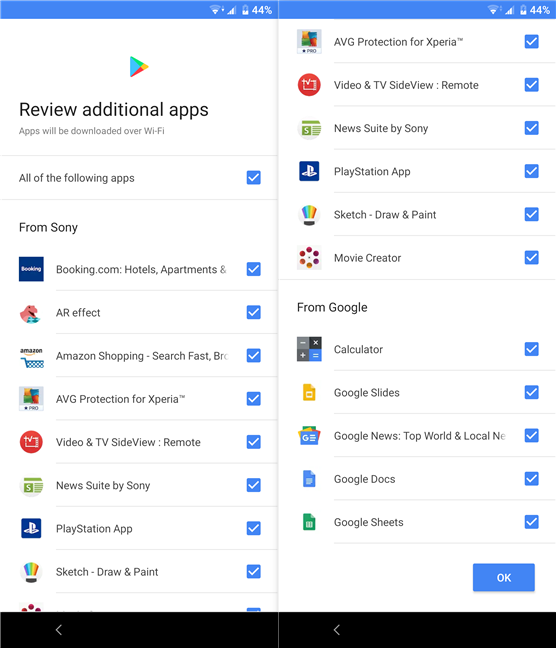
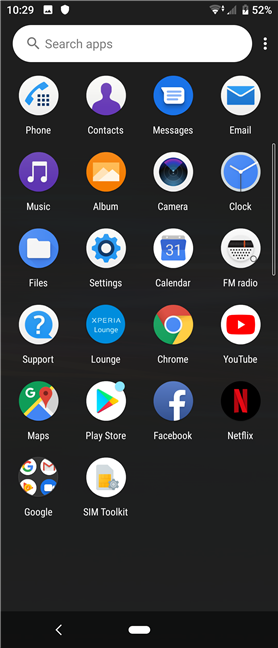
Sony Xperia 10 comes with Android 9 Pie installed and, although it lets you easily install a bunch of additional apps recommended by the company, it does not force you into it. When you configure it, the smartphone asks you what apps you want and which you do not. We prefer an operating system as clean as possible, so we didn't add any of the offered apps. However, you might find some of them useful. In the next screenshot, you can see the full list of recommended apps.
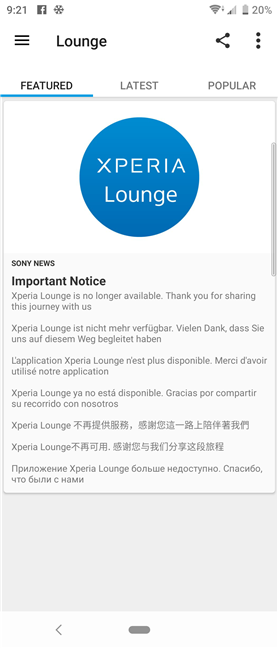
On top of the recommended apps, Sony also pre-installs a few apps that you can't say no to: the default Google apps such as Gmail, Drive or YouTube, but also Facebook, Netflix, and Xperia Lounge. Though the others are arguably used by most of us, the Xperia Lounge app is not. Furthermore, when we opened it, we found that it's not even working: we were greeted with the message that "Xperia Lounge is no longer available."
Sony also modified some aspects of the user interface, so you need a bit of time adjusting to it if you are used to stock Android. First of all, getting to the apps drawer is done with a swipe gesture from the bottom.
And then there's the Side sense: a tool that is always accessible no matter what you're doing on your smartphone, designed to offer you easier access with only one hand, to the apps you use more often. To get to it, you have to touch the bar displayed on the right side of the screen. This action shows you a list of your apps that you probably want to use. The list is compiled by a sort of AI (artificial intelligence) based on the apps you use more often at certain times of day. Honestly, the Side sense can be useful when you do not want to use both hands, but it can also be annoying because its bar is always overlaid on top of your apps and their controls. Because of this, we accidentally opened Side sense, instead of tapping on a movie on Netflix.
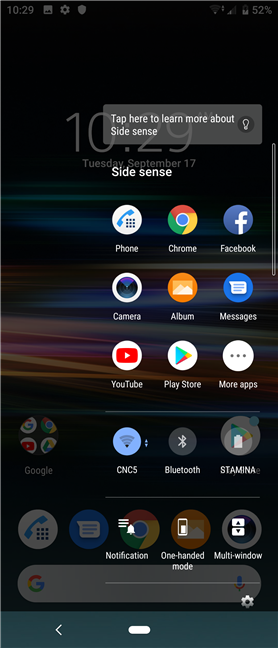
We like the fact that Sony Xperia 10 does not force its users to use a lot of bundled apps and that it lets you choose what apps you prefer. Although it is not perfect, we also appreciate the Side sense feature, because it can improve your experience.
Performance in benchmarks
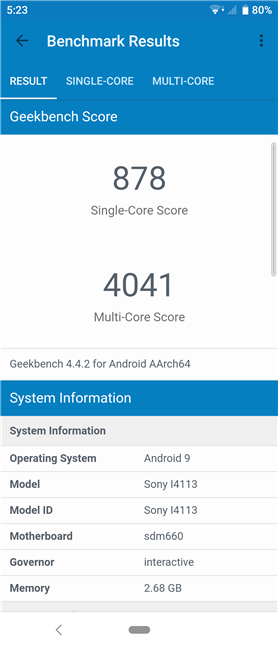
We started with Geekbench 4, to see how fast the processor found on the Sony Xperia 10 is. It got a score of 878 points in the Single-Core tests and 4041 points in the Multi-Core tests. These are not impressive results at all. The single-core score is similar to that of the old Samsung Galaxy S5, and the multi-core score is similar to that of the Google Pixel (first generation). For further comparison, the ASUS Zenfone 5 that was launched last year (2018) has roughly the same price as the Xperia 10 but is 25% faster on multi-core and 58% faster on single-core!
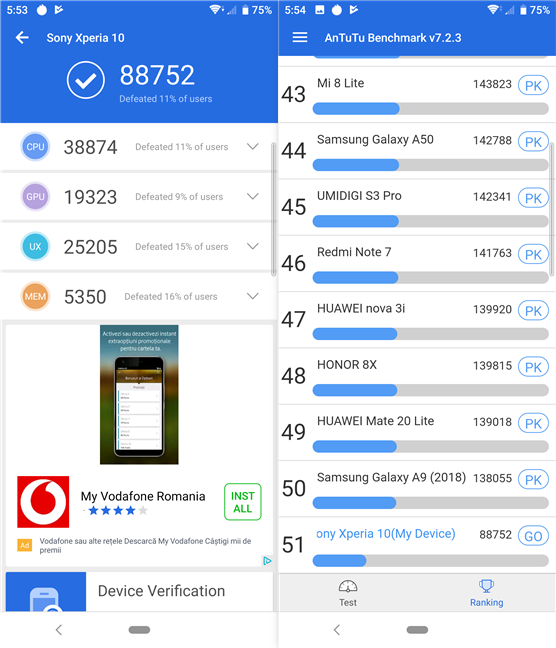
In the AnTuTu Benchmark, the Sony Xperia 10 showed similar low-key performance. It managed to get a score of only 88752 points, which places it in the bottom 11% smartphones that have been benchmarked by AnTuTu. It is slower than similarly priced smartphones, such as ASUS Zenfone 5 or Samsung Galaxy A9 (2018).
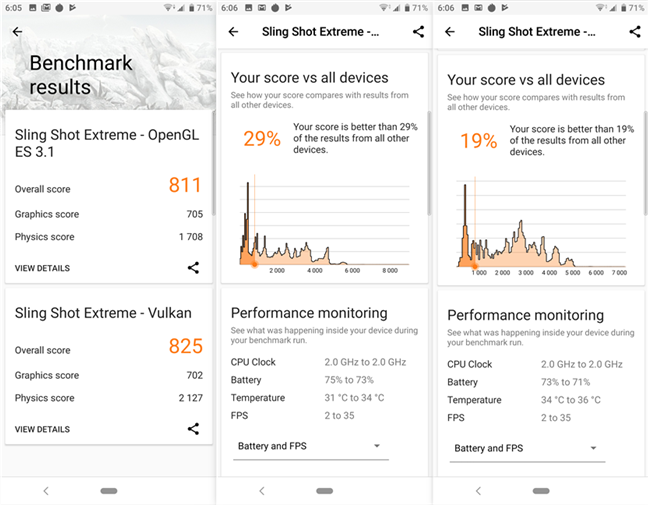
Next, we ran a few gaming benchmarks. First, we checked the gaming performance of the Xperia 10 using the 3DMark's Sling Shot Extreme tests. It got 811 points in Sling Shot Extreme - OpenGL ES 3.1 and 825 points in Sling Shot Extreme - Vulkan. Both scores are low, lower than what you get from the ASUS Zenfone 5 which manages 954 points on OpenGL, or the Samsung Galaxy A9 (2018) with 1341 points.
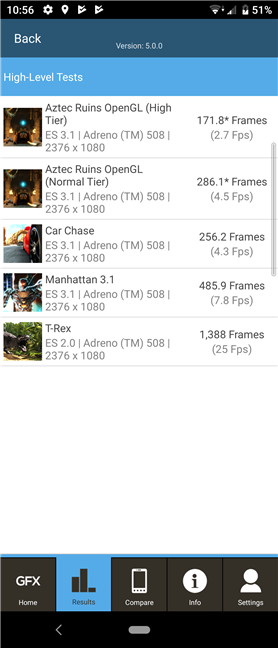
GFXBench also showed poor performance results for the Sony Xperia 10. We used the on-screen tests because they are the ones that really matter: no matter what smartphone you use, you're likely going to want to enjoy graphics on the full resolution of your screen. Unfortunately, although the Sony Xperia 10 has an impressive and gorgeous display, you cannot benefit from it in games with beautiful visuals, because they also require graphics power. In GFXBench, the Xperia 10 managed to get just 25 frames per second in the T-Rex test (for older games), almost 8 fps in Manhattan 3.1, and less than 5 fps in Car Chase and Aztec Ruins.
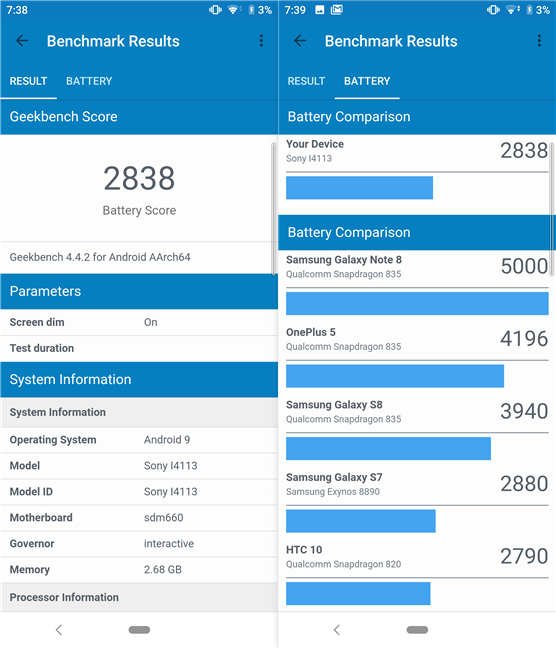
Users are also interested in battery life. That's why we also ran Geekbench's Battery test. It got a score of 2838 and the smartphone lasted for 6 hours and 2 minutes, which is OK but not great. It means that the Sony Xperia 10 can last you for a day of moderate use. If you are going to watch movies or play games, you'll have to charge it before getting into bed in the evening.
The benchmarks results confirm our subjective impression when using this smartphone. The Sony Xperia 10 is not a fast device, and it is rather weak when it comes to games. Even if you are a regular user who does not play games or run demanding apps, you might still see this smartphone stutter or lag on occasion.
Do you like the Sony Xperia 10 smartphone?
After reading our review, you know that we like its 21:9 cinematic screen and its design and build quality. However, we found it to be slow compared to other smartphones with similar prices. What will you do? Will you buy the Sony Xperia 10 because of its great screen or will turn to other options from the market? Share your insights in the comments below and tell us what you think about it.
Discussion (0)
Comments are closed.