The market of affordable wireless routers has seen many devices launched recently. While they are not the fastest nor the most complex, they tend to offer all the basics people need, at unbeatable prices. One of the newest routers in this niche is TP-Link Archer C1200. This WiFi router comes at a low price that anyone can afford and offers modern hardware and support for the latest mainstream wireless technologies. Is it a suitable choice for networking your home? Read this review and find out:
What is the TP-Link Archer C1200 good at?
TP-Link Archer C1200 is an entry-level wireless router that is a very suitable choice for small and medium-sized apartments, and users who don't want many advanced features.
It offers modern wireless networking, at good speed and quality, and a very affordable price.
There are several great things about the TP-Link Archer C1200:
Very affordable price
It packs all the basics people need, including a smartphone app
Modern hardware that offers good quality WiFi
The speed you get on the 5GHz wireless network is one of the best for a router in its price range
It can be mounted on walls
There are also a few downsides:
The smartphone app can be used only when you are connected to the WiFi that is broadcast by the router
This router is a fingerprint and dust magnet
Product rating5/5
Verdict
TP-Link Archer C1200 is the successor to the TP-Link Archer C7, and it beats its predecessor in every regard. It is a modern entry level router, with up-to-date hardware and WiFi technology. Its price is very affordable, and it offers all the basics people need for networking their apartments. As long as you don't have a large home or apartment and many devices, TP-Link Archer C1200 is one of the best affordable routers that you can buy.
Unboxing the TP-Link Archer C1200
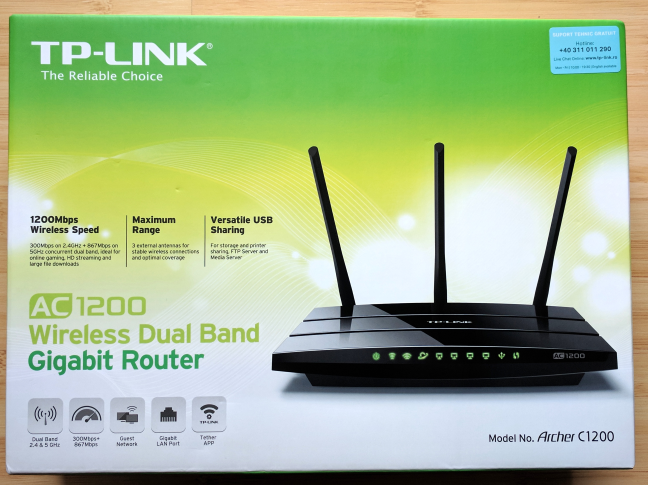
TP-Link Archer C1200 comes in a large cardboard box with calming white and green colors. On the top, you can see a picture of this AC1200 wireless router, as well as its most important characteristics.
TP-Link Archer C1200
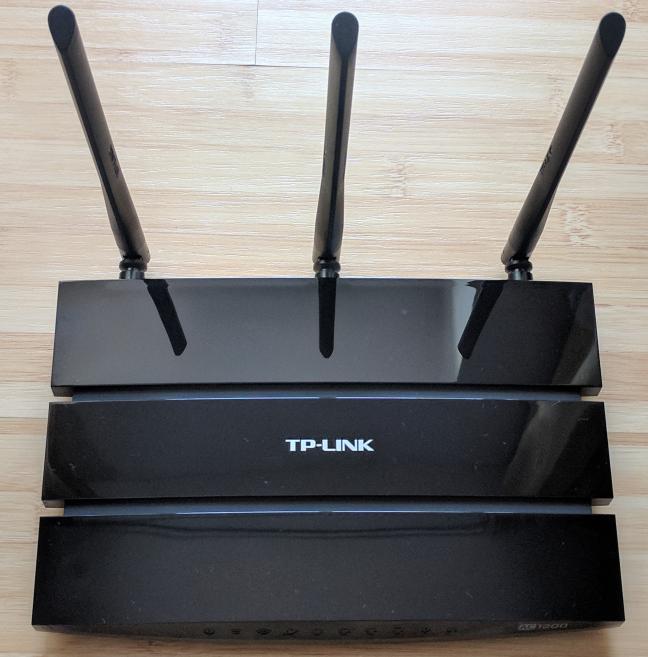
On the back of the box, TP-LINK displays detailed information about the major features of the TP-Link Archer C1200 and a comparison with other routers in the company's portfolio. We can see that this router is the successor to the old TP-Link Archer C7. It also shares its looks with this older model, as you can see for yourself when you unbox it.
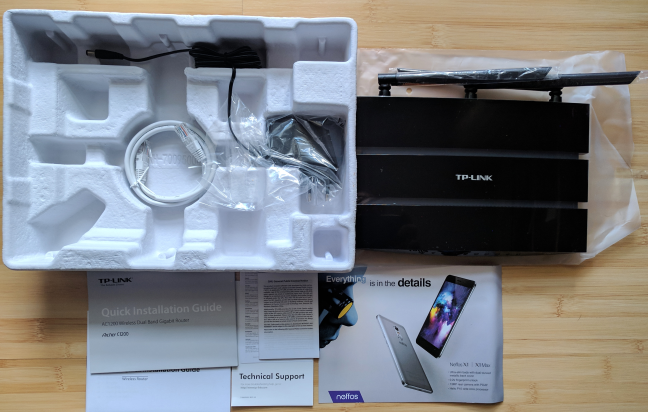
Inside the box, you will find the following items: the router, the power adapter, a network cable, the quick installation guides, technical support information, the warranty and a leaflet about TP-LINK's Neffos line-up of smartphones. If you are curious about their smartphones, read this review: TP-Link Neffos X1.
TP-Link Archer C1200
The unboxing experience offered by TP-Link Archer C1200 is quick and painless. Inside the packaging of this wireless router, you will find all the usual accessories and no extras.
Hardware specifications and design
TP-Link Archer C1200 comes with a Broadcom BCM47189 processor, running at 900 MHz, 128 MB of RAM and 16 MB of storage for the firmware. It offers support for 2x2 MU-MIMO, which is ideal for an affordable router. It is a dual-band wireless router with a total maximum bandwidth of 867 Mbps on the 5GHz band and 300 Mbps on the 2.4 GHz band, leading to a total maximum bandwidth of 1167 Mbps. It offers support for the following networking standards: IEEE 802.11a, 802.11b, 802.11g, 802.11n, and 802.11ac.
TP-Link Archer C1200
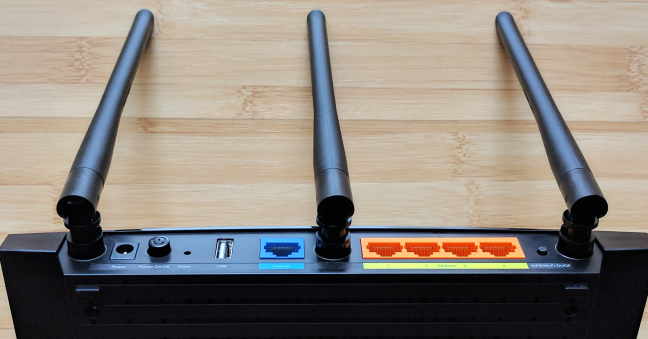
On the back of the router, you will find the following elements: the Power jack, the Power button, a Reset jack, a USB 2.0 port, the Internet port, four Ethernet ports that work at 1 Gbps, and the WPS button. There are also three external antennas which cannot be unplugged from the body of the router.
TP-Link Archer C1200
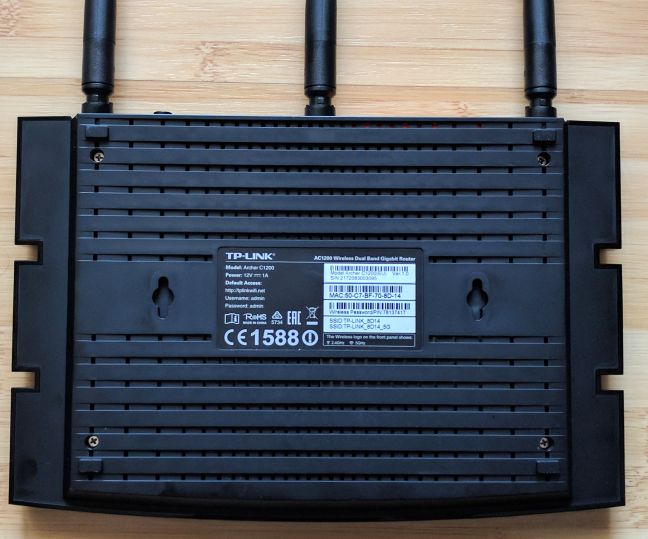
On the bottom of the router, you can find some slots for mounting it on walls, which are very useful.
TP-Link Archer C1200
Regarding size, TP-Link Archer C1200 is not very large: it is 9.6 inches or 243 mm in width, 6.4 inches or 160.6 mm in depth, and 1.3 inches or 32.5 mm in height. Also, it weighs 1045 grams or 2.3 pounds.
If you would like to learn the official specifications of this WiFi router, go to this page: TP-Link Archer C1200 Specifications.
Setting up and using the TP-Link Archer C1200
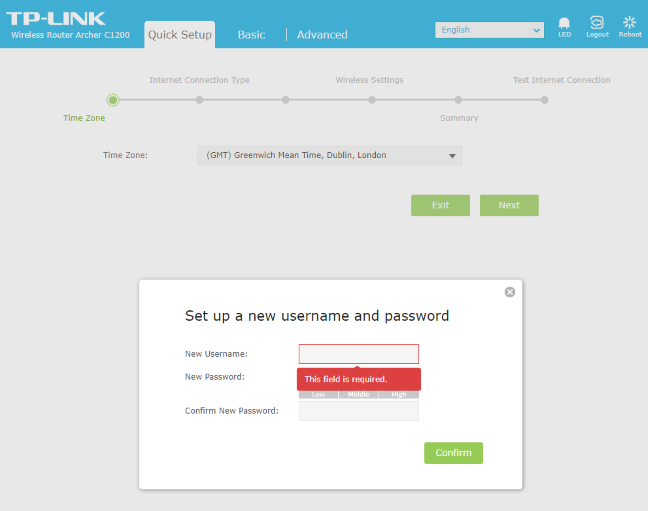
Setting up the TP-Link Archer C1200 is not a difficult task. If you follow the quick start guide, you will be finished in a couple of minutes. The quick setup wizard starts by recommending that you change the default username and password. We highly recommend that you don't use admin/admin and also change the name of the admin user, not only the password.
TP-Link Archer C1200
The quick setup wizard first asks for the time zone you are in. It then helps detect the type of your internet connection and asks for the necessary connection details. For the next step, it asks you to set basic WiFi settings like the network name and the password and then shows a summary of your initial settings and tests your connection to the internet.
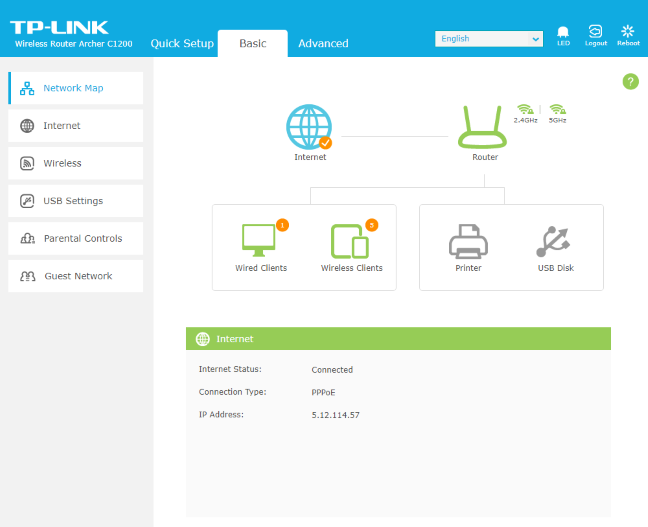
When you are done, you get to see the administration user interface. It uses calming colors like blue, white and green and it is organized logically, so that you can find what you need, with ease. The firmware first displays its basic settings, and this is where most users will fiddle. However, if you want real personalization, you must go to the Advanced tab.
TP-Link Archer C1200
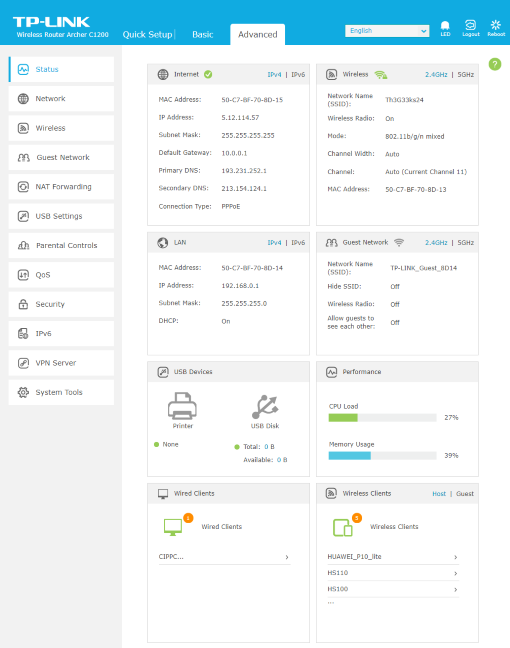
Here you will find all the settings that are available for TP-Link Archer C1200. Also, the interface is a lot more crowded with details. Knowledgeable users won't have issues in finding their way and settings things the way they want to.
TP-Link Archer C1200
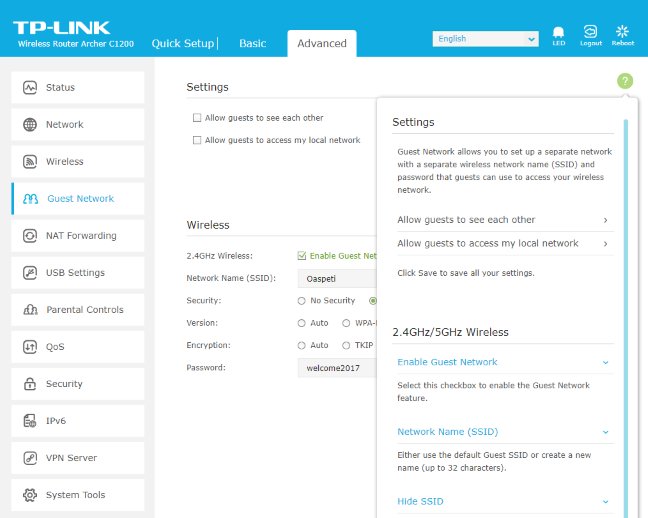
However, beginners and less experienced users will have to access the help documentation. Luckily, it is easily available, with a click on the question mark that is found in the top-right corner of every page with settings. Click on it, and you see a detailed description of all the settings that are found on the page.
TP-Link Archer C1200
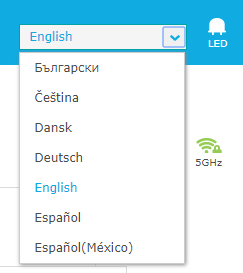
The user interface is available in a couple of languages, which you can see below. It is not as great as on the routers of other brands, but it is better than having everything available only in English.
TP-Link Archer C1200
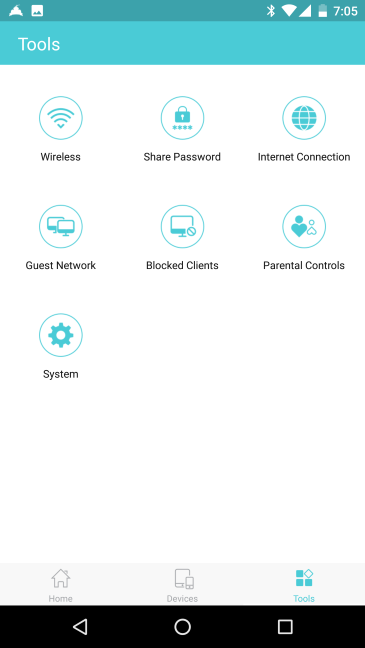
For administering your router, you also have access to the TP-Link Tether app for Android and iOS. We tested only the Android version. With this app, you can change basic settings like the ones you see below. Also, you can do this only when your smartphone is connected to the WiFi that is broadcast by TP-Link Archer C1200.
TP-Link Archer C1200
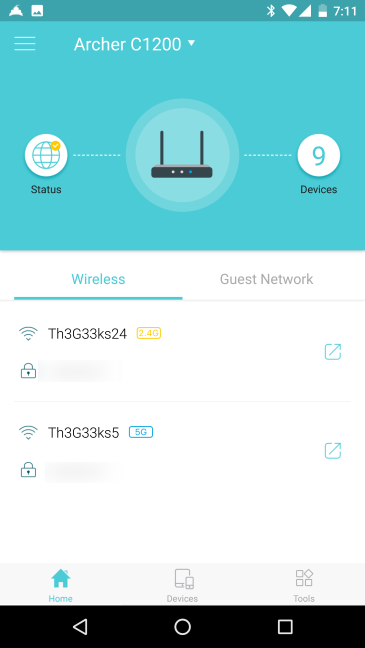
Also, with it, you can quickly check the status of your router's operations: how many devices are connected, view the WiFi passwords and so on.
TP-Link Archer C1200
We wished that the TP-Link Tether app was usable also when you are not at home. However, this feature seems to be reserved only for more premium routers from TP-Link's portfolio.
Once we were done configuring everything, we connected all our devices to the network: desktop computers, tablets, laptops, smart plugs, smart bulbs, wireless printers, consoles, and smartphones. We had no issues in connecting them, and we enjoyed stable connections in most rooms. However, in two places of our test apartment, where other affordable routers also tend to struggle, we experienced some random disconnections or periods of time with slow WiFi, mostly on the 2.4 GHz band.
Another minor issue that we identified is that TP-Link Archer C1200 is a magnet for dust and fingerprints. If you want to keep it looking good, you may need to clean it more often than other routers.
If you would like to see the real-world performance that TP-Link Archer C1200 offers, and comparisons with other AC1200 routers, go to the next page of this review.
Wireless network performance
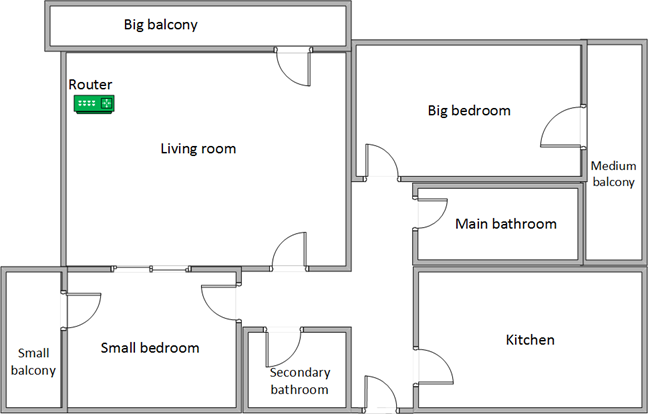
Before sharing the data from our measurements, let's take a look at the apartment that was used in our testing and how it is set up. You can see that the router is placed in the living room. With most wireless routers, the signal strength is not that high in places like the Kitchen and the Medium balcony.
TP-Link Archer C1200
Our testing was done using a fast 1 Gigabit Internet connection that's capable of uploads on the internet of up to 500 Mbps. We used a Microsoft Surface Pro 3 for all our measurements and several software tools.
To get a better perspective of the performance offered by TP-Link Archer C1200, we compared it with other AC1200 wireless routers (Edimax BR-6478AC V2 and Tenda AC9 AC1200), ASUS RT-AC58U (an AC1300 dual-band wireless router) and TP-LINK Archer C7 (the router which TP-Link Archer C1200 is replacing).
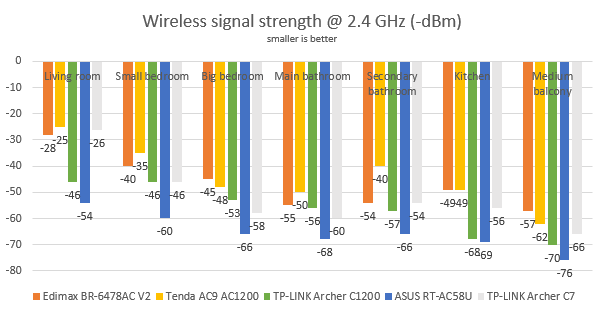
We first evaluated the wireless network that is broadcast on the 2.4 GHz frequency, and we looked at the signal strength, with a tool named inSSIDer. As you can see, the signal strength offered by TP-Link Archer C1200 tends to be weaker than most of its competitors. However, this doesn't mean that the WiFi that it offers is slow.
TP-Link Archer C1200
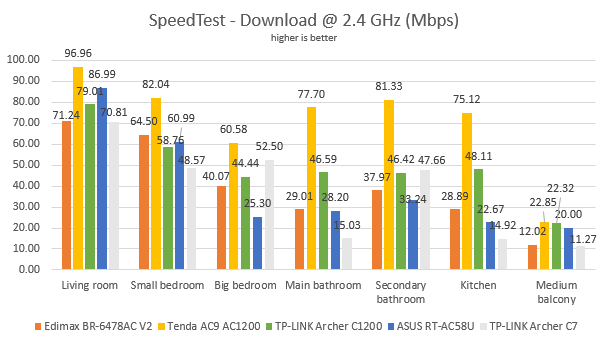
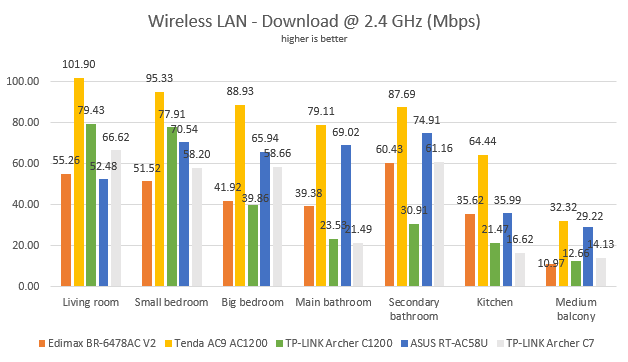
Then, we used SpeedTest to measure how fast the internet connection provided by this router is. In the download test, TP-Link Archer C1200 performed well, but it was not the fastest.
TP-Link Archer C1200
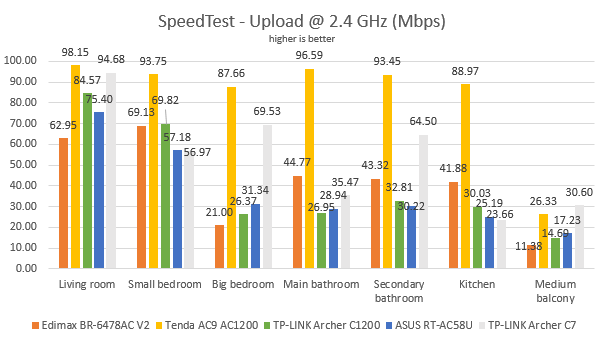
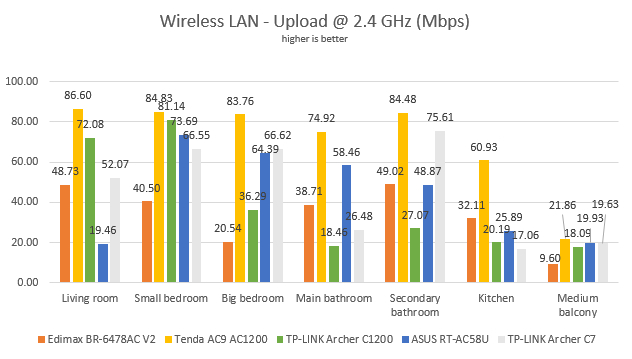
The same was true when looking at the upload speed offered by TP-Link Archer C1200.
TP-Link Archer C1200
Continuing our measurements on the 2.4 GHz wireless network, we used the PassMark Performance test to transfer data between two computers connected to the network. TP-Link Archer C1200 was a good performer, but it was not the best. Also, it struggled in rooms where other affordable routers struggle too.
TP-Link Archer C1200
When looking at the upload speed, we noticed a similar situation: TP-Link Archer C1200 performed well, but it was not the best.
TP-Link Archer C1200
On the 2.4 GHz WiFi band, TP-Link Archer C1200 performs similarly to other AC1200 wireless routers that it is competing with, without beating its competition.
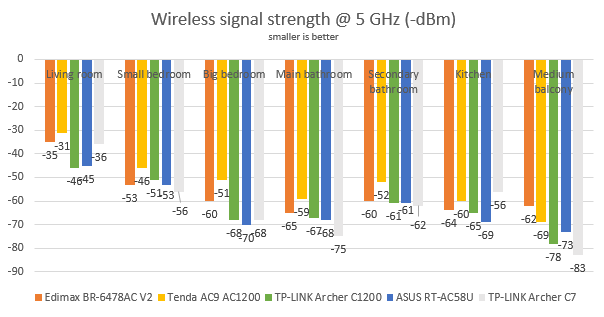
We moved on to the wireless network that is broadcast on the 5GHz frequency, and we looked at the signal strength, using inSSIDer. As you can see, the signal strength offered by TP-Link Archer C1200 tends to be weaker than most of its competitors. However, this doesn't mean that the WiFi that it offers is slow.
TP-Link Archer C1200
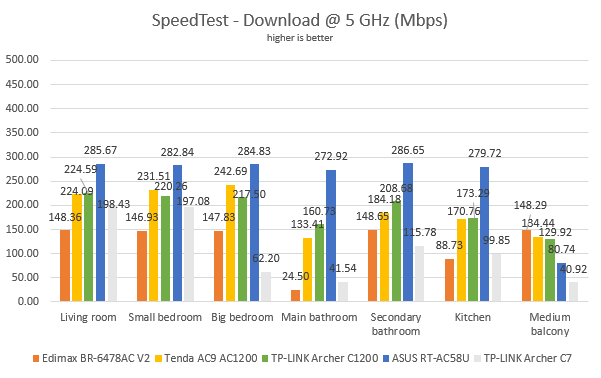
Then, we took SpeedTest, to measure the speed of the internet connection on the 5GHz wireless network. To see the maximum potential of this router, we used the world's only PCI-E network card with support for 4x4 MU-MIMO. When we used this network card, we obtained a maximum speed of 286.39 Mbps for the download speed, which is a good result for an AC1200 wireless router.
TP-Link Archer C1200
We also measured the download speed with SpeedTest, in every room of our test apartment, using our usual Surface Pro 3 tablet. As you can see below, TP-Link Archer C1200 is a fast wireless router, and it outperforms its predecessor TP-Link Archer C7.
TP-Link Archer C1200
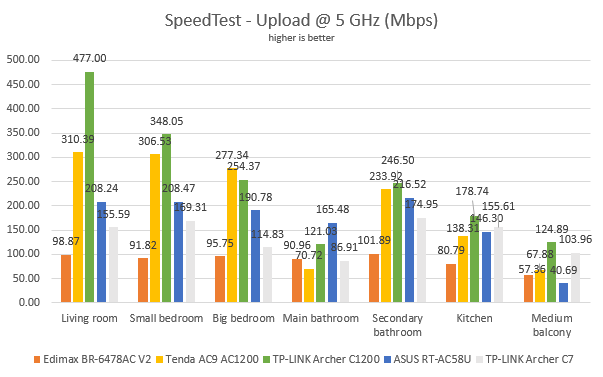
When looking at the upload speed, TP-Link Archer C1200 outshone its competition by a significant margin, in almost every room of our test apartment.
TP-Link Archer C1200
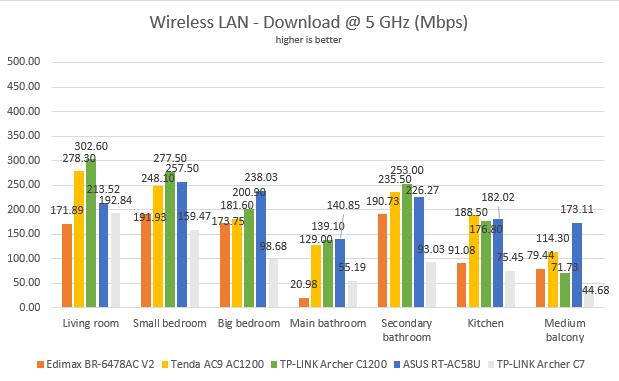
For the last measurements on the 5GHz wireless network, we used the PassMark Performance test to transfer data between two computers connected to the network. TP-Link Archer C1200 offered fast downloads and, in some rooms, it managed to be the fastest router.
TP-Link Archer C1200
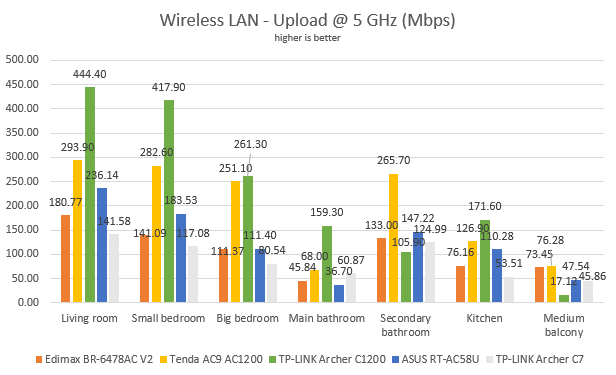
When looking at the upload speed, TP-Link Archer C1200 delivered outstanding performance, one more time.
TP-Link Archer C1200
Our tests have shown that TP-Link Archer C1200 is a fast router on the 5GHz band and it offers the fastest uploads possible for an AC1200 wireless router.
Wired network performance
To test the quality of the wired Ethernet connection, we used a desktop PC, equipped with an Intel Core i5 4460 processor, running at 3.20GHz, 16GB of RAM and a very fast Samsung 850 Pro 512GB SSD and a Lenovo Ideacentre 610s mini PC.
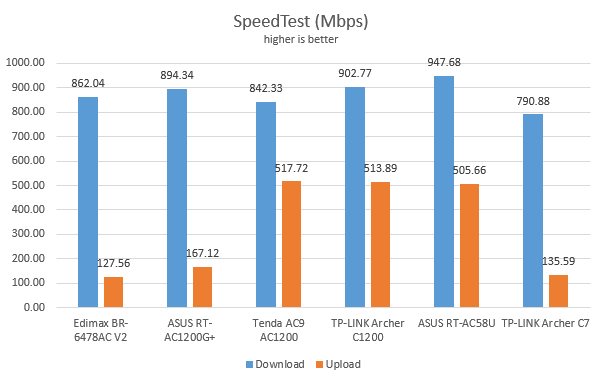
We started by measuring the download and upload speeds using SpeedTest. As you can see below, TP-Link Archer C1200 has performed well and delivered the speeds which are very close to the maximum possible on our internet connection.
TP-Link Archer C1200
In the graphic above you see that some routers achieved upload speeds lower than 200 Mbps. That's also because when we tested them, our internet connection was capped at 200 Mbps for the upload speed. Since then, our Internet Service Provider has raised the cap to 500 Mbps.
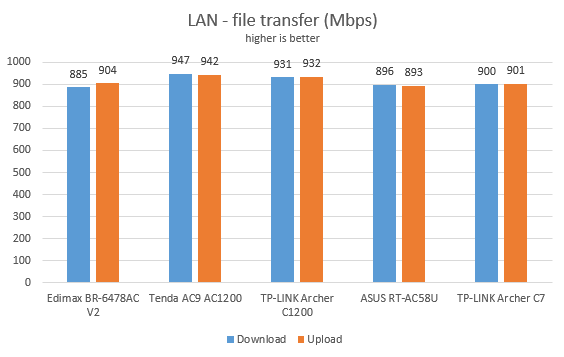
Then, we ran a network transfer between the two computers, using the PassMark Performance test. TP-Link Archer C1200 was one of the best performs in this test, as you can see below.
TP-Link Archer C1200
TP-Link Archer C1200 delivers true 1 Gbps Ethernet connections, as promised in its specifications.
USB performance
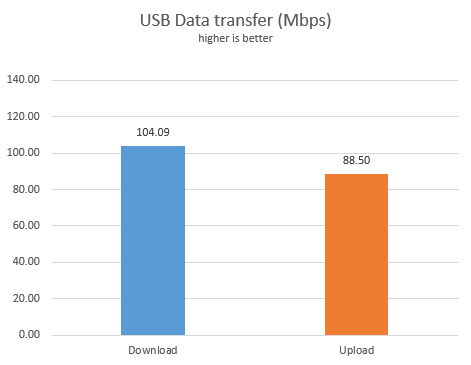
We connected a portable SSD drive to the TP-Link Archer C1200, through the USB 2.0 port and then we used LAN SpeedTest Lite to transfer data to and from it and measure the speed. You can see the download and upload speed we measured in the graphic below.
TP-Link Archer C1200
The USB port on the TP-Link Archer C1200 is quite fast when compared to other AC1200 wireless routers.
Extra features
TP-Link Archer C1200 is a low-end router with an accessible price. This means that it doesn't bundle many extras. However, it does include some tools and features that can be useful:
Guest network - you can enable up to two guest networks, one for each band. Visitors should not be allowed to access your network, for increased security and privacy.
QoS - a basic Quality of Service feature that helps you control how the total bandwidth is split between devices and applications. Unfortunately, this service cannot run while the NAT Boost feature is enabled. You have to disable NAT Boost before being able to control the bandwidth in your network. Unfortunately, TP-LINK doesn't explain in its documentation what the NAT Boost is, how it works and why it is enabled by default.
USB Settings - which allow you to connect USB storage devices like an external hard disk or a printer and share them with the network.
Parental Controls - this module allows you to control the internet access of devices on your network as well as block access to certain websites based on keywords. It's a rather basic parental controls feature which has limited usefulness and needs lots of manual maintenance.
Dynamic DNS - allows you to assign a fixed host and domain name to a dynamic IP address. It can work with the No-IP and DynDNS service providers.
VPN server - you can set the router to work as a VPN server using OpenVPN and PPTP VPN protocols. The router also allows VPN pass-through for clients that are connecting to external VPN services.
IPv6 - support for IPv6 addresses and internet connections.
System Tools - a collection of logs, statistics and diagnostic tools that allow you to troubleshoot problems.
TP-LINK Tether App – an Android and iOS app that lets you to manage the router from your smartphone. The app is very basic, and it doesn't help with administering more advanced features. You have to use your computer and a web browser for advanced administration tasks.
TP-Link Archer C1200 bundles what most users need, without being too advanced. There are some handy extras like the Guest network or the USB Settings.
What is your opinion about TP-Link Archer C1200?
Now you know how TP-Link Archer C1200 has fared in our testing and what is our opinion about this wireless router. Before closing this review, share with us your views about this device. Do you like what it has to offer? Would you consider buying? Share in the comments below.
A good compact little router. I bought it before checking if there was any open source software available for it like DD-WRT or OPEN-WRT but so far I haven’t found any.
Anybody know of any good linux-based open-source software for it ???
George ·
Very nice review, thank you. Just ordered it (the router, not the review). I will probably only use it in Access Point mode. Hopefully it will perform equally well, both wired/wireless.
I’m confused about whether it’s best to use the same SSID and/or password for the 2.4 / 5GHz networks or not, but that’s another story.
aios ·
After the C1200 lost the ADSL connection at least once a day , I found that it can not hold both modem and wifi at the same time for along time ( overheated ?) . I’m using it now only as an ADSL modem , with linksys 1900 router .
moose ·
You have tested those routers in 2 different frequency, 2.4 GHz and 5 GHz. At home, which frequency do I get using the same TP-Link Archer C1200?
Joanne D ·
I bought this router a few months ago because the wifi signal wasn’t reaching my ring doorbell well. It was easy to set up, I got better speed and the range was all the way down the street. Unfortunately, a few weeks after I installed it, my internet data use increased dramatically from 5 gigs/day may to 50, which even occurred on days I was away and had nothing running but my doorbell and thermostat. After changing the router password, my data use went back to normal for a few weeks, but then suddenly increased again. This is an issue since I have a data cap on my internet. I have been checking the app to see if any unfamiliar devices are attached to the router, but I recognize all of them. I don’t know if someone has been only going on when I’m asleep. Yesterday I was able to use the app to whitelist all my devices, and I see that only a few gigs of data were used for the day. I don’t ant to keep changing my password every few days or deal with the hassle of tying to figure out how to add new devices if I get them. Is there anything I can do to keep out the hacker or better yet, identify him or her and report this? I called Cox, my provider, and they tried to talk me into buying one of their internet modems so I can monitor how much data each device is using, but I can do that with my PC, phone and Fire stick anyway, and it still won’t stop the hacker.
Anonymous ·
What kind of security did you choose for your network. Is it WPA2?
Joanne D ·
Yes. I haven’t read about any security issues with the Archer C1200. I changed the network name and the password twice, but somebody still got in. I have now whitelisted my devices and I haven’t seen unusual data use in the few days since. I hope this will do the trick although it’s a pain if I want to add more devices.
Dan guerra ·
I tried to connect a yi camera and was not able to connect as i received message it was not compatible to the 5 G router.
Also, we bought the Ring Pro doorbell camera and the literature states it will only work with 2.4 GHz.
Is there a way to turn off the 5 Ghz on the router?
Anonymous ·
Do not turn off 5 GHz on the router. It is a bad idea. This router is dual-band, meaning that it offers wireless connections on 2.4 GHz and 5 GHz. Just give different names to the two bands, and then connect your 2.4 GHz devices to the 2.4 GHz frequency.
Joanne D ·
Both 2.4 Ghz and 5 Ghz networks are shown in the list when you are selecting a wifi network at setup. I just chose the 2.4 GHz network and it’s worked fine.
Mark ·
Which is better Archer AC1200 or AC1900 for office use with more than 15 Computers. we are using Fiber connection with 2MBPS direct line (Business account)
Thanks
Anonymous ·
I would go for TP-Link AC1900 (Archer C9). It is a better, more powerful model.
Marko ·
Very good router for home use, it has everything that normal user needs, guest wifi network, usb port for sharing usb connected disk, wifi signal is also good. The new web settings portal is a lot better than in past… For that amount of money very good device.
Viktor ·
Hi, which one would you recommend out of TP-Link Archer AC1200 and RT-AC1200G+? They seemed very closely matched in your comparisons and I can’t decide. Thank you!
KevinFSU ·
Great review! I read this review and ordered one right away!
Ciprian Adrian Rusen ·
I hope that you will enjoy this product as much as we did testing it. 😉
Dilip ·
Should I get the tp link archer c1200 or the Asus ac58u, both being the same cost, which would give me better range/speed
Ciprian Adrian Rusen ·
See our review for ASUS RT-AC58U. The hardware for ASUS RT-AC58U is slightly better. However, when we reviewed this model, the firmware had several stability issues and we couldn’t give this router the maximum score. If they were fixed in new firmware updates, it might just be slightly better than TP-Link Archer C1200. Otherwise, TP-Link Archer C1200 is both cheap and stable, as you can see in our review. We had 0 issues with it.

































Discussion (18)
A good compact little router. I bought it before checking if there was any open source software available for it like DD-WRT or OPEN-WRT but so far I haven’t found any.
Anybody know of any good linux-based open-source software for it ???
Very nice review, thank you. Just ordered it (the router, not the review). I will probably only use it in Access Point mode. Hopefully it will perform equally well, both wired/wireless.
I’m confused about whether it’s best to use the same SSID and/or password for the 2.4 / 5GHz networks or not, but that’s another story.
After the C1200 lost the ADSL connection at least once a day , I found that it can not hold both modem and wifi at the same time for along time ( overheated ?) . I’m using it now only as an ADSL modem , with linksys 1900 router .
You have tested those routers in 2 different frequency, 2.4 GHz and 5 GHz. At home, which frequency do I get using the same TP-Link Archer C1200?
I bought this router a few months ago because the wifi signal wasn’t reaching my ring doorbell well. It was easy to set up, I got better speed and the range was all the way down the street. Unfortunately, a few weeks after I installed it, my internet data use increased dramatically from 5 gigs/day may to 50, which even occurred on days I was away and had nothing running but my doorbell and thermostat. After changing the router password, my data use went back to normal for a few weeks, but then suddenly increased again. This is an issue since I have a data cap on my internet. I have been checking the app to see if any unfamiliar devices are attached to the router, but I recognize all of them. I don’t know if someone has been only going on when I’m asleep. Yesterday I was able to use the app to whitelist all my devices, and I see that only a few gigs of data were used for the day. I don’t ant to keep changing my password every few days or deal with the hassle of tying to figure out how to add new devices if I get them. Is there anything I can do to keep out the hacker or better yet, identify him or her and report this? I called Cox, my provider, and they tried to talk me into buying one of their internet modems so I can monitor how much data each device is using, but I can do that with my PC, phone and Fire stick anyway, and it still won’t stop the hacker.
What kind of security did you choose for your network. Is it WPA2?
Yes. I haven’t read about any security issues with the Archer C1200. I changed the network name and the password twice, but somebody still got in. I have now whitelisted my devices and I haven’t seen unusual data use in the few days since. I hope this will do the trick although it’s a pain if I want to add more devices.
I tried to connect a yi camera and was not able to connect as i received message it was not compatible to the 5 G router.
Also, we bought the Ring Pro doorbell camera and the literature states it will only work with 2.4 GHz.
Is there a way to turn off the 5 Ghz on the router?
Do not turn off 5 GHz on the router. It is a bad idea. This router is dual-band, meaning that it offers wireless connections on 2.4 GHz and 5 GHz. Just give different names to the two bands, and then connect your 2.4 GHz devices to the 2.4 GHz frequency.
Both 2.4 Ghz and 5 Ghz networks are shown in the list when you are selecting a wifi network at setup. I just chose the 2.4 GHz network and it’s worked fine.
Which is better Archer AC1200 or AC1900 for office use with more than 15 Computers. we are using Fiber connection with 2MBPS direct line (Business account)
Thanks
I would go for TP-Link AC1900 (Archer C9). It is a better, more powerful model.
Very good router for home use, it has everything that normal user needs, guest wifi network, usb port for sharing usb connected disk, wifi signal is also good. The new web settings portal is a lot better than in past… For that amount of money very good device.
Hi, which one would you recommend out of TP-Link Archer AC1200 and RT-AC1200G+? They seemed very closely matched in your comparisons and I can’t decide. Thank you!
Great review! I read this review and ordered one right away!
I hope that you will enjoy this product as much as we did testing it. 😉
Should I get the tp link archer c1200 or the Asus ac58u, both being the same cost, which would give me better range/speed
See our review for ASUS RT-AC58U. The hardware for ASUS RT-AC58U is slightly better. However, when we reviewed this model, the firmware had several stability issues and we couldn’t give this router the maximum score. If they were fixed in new firmware updates, it might just be slightly better than TP-Link Archer C1200. Otherwise, TP-Link Archer C1200 is both cheap and stable, as you can see in our review. We had 0 issues with it.