



Cookies are tiny files stored on your PC or device, which can be used by websites or web apps to tailor your online experience. That’s all nice and dandy, but where are cookies stored in Windows 10 and Windows 11? In the past, web browsers used to keep cookies in separate text files in the user’s folder or the browser’s installation directory. However, the cookies’ location is significantly more challenging to find when it comes to today’s major web browsers. Read this article to see where Google Chrome, Mozilla Firefox, Microsoft Edge, and Opera store their cookies on your Windows 10 or Windows 11 PC:
IMPORTANT: This guide helps you locate the cookies saved by major browsers on Windows. The cookies folders and files from Windows 10 and Windows 11 are hidden and marked as protected system items. If you want to see them, you should first enable the viewing of hidden files and folders.
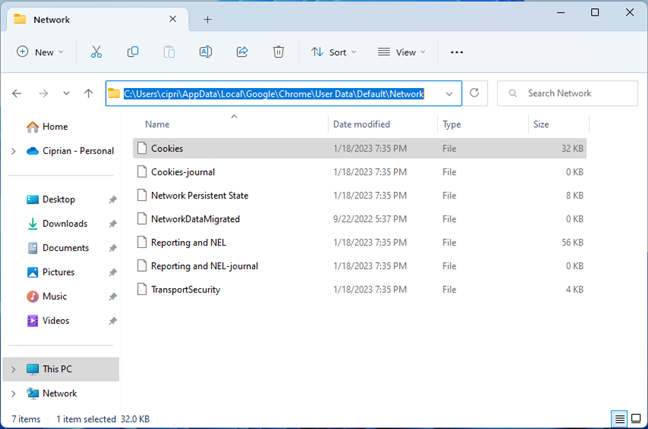
 Chrome's Cookies location in Windows
Unfortunately, the information found inside Chrome’s Cookies file is not human-readable. So if you want to see and manage cookies in Google Chrome, you should use the browser’s interface instead. You can find more details in our guide about clearing cookies from Chrome.
Chrome's Cookies location in Windows
Unfortunately, the information found inside Chrome’s Cookies file is not human-readable. So if you want to see and manage cookies in Google Chrome, you should use the browser’s interface instead. You can find more details in our guide about clearing cookies from Chrome.
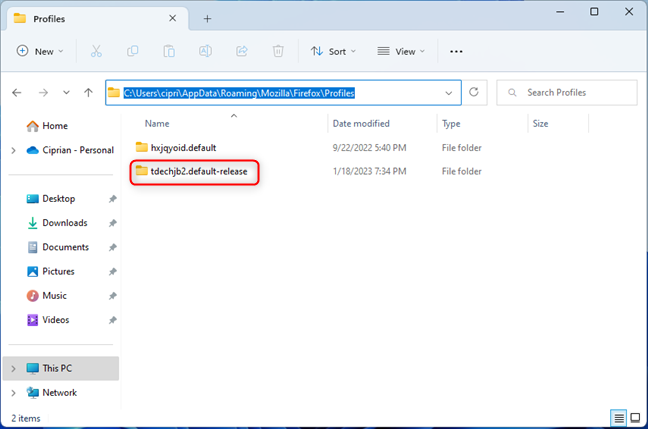 The location of Firefox's user profile folders
TIP: Here are five ways to double-click with a single click in Windows.
In your Firefox profile folder, you should find the file called cookies.sqlite.
The location of Firefox's user profile folders
TIP: Here are five ways to double-click with a single click in Windows.
In your Firefox profile folder, you should find the file called cookies.sqlite.
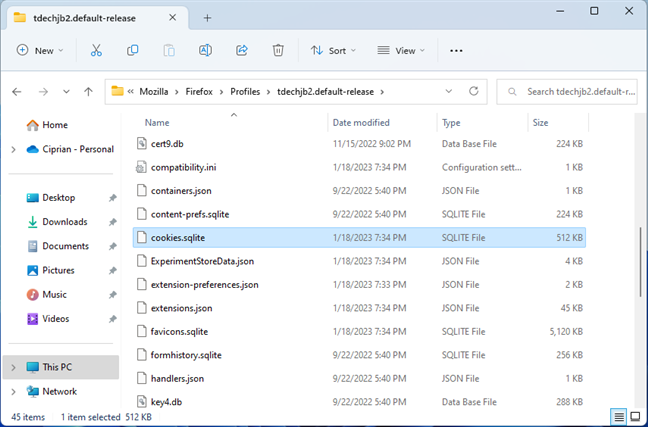
 The Firefox cookies location
However, you can’t just open the cookies.sqlite file with a text editor to see the cookies inside. For this task, you should use Firefox’s built-in features. Our guide on clearing cookies on Firefox offers more details on the subject.
The Firefox cookies location
However, you can’t just open the cookies.sqlite file with a text editor to see the cookies inside. For this task, you should use Firefox’s built-in features. Our guide on clearing cookies on Firefox offers more details on the subject.
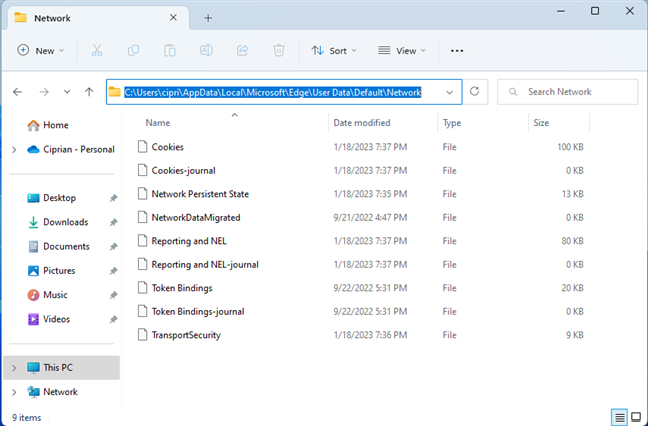
 Microsoft Edge Cookies location
The information in Edge’s Cookies file is not in a human-readable format. However, you can use the browser’s interface to see and interact with its cookies. Learn more about this from our guide on clearing cookies on Microsoft Edge.
Microsoft Edge Cookies location
The information in Edge’s Cookies file is not in a human-readable format. However, you can use the browser’s interface to see and interact with its cookies. Learn more about this from our guide on clearing cookies on Microsoft Edge.
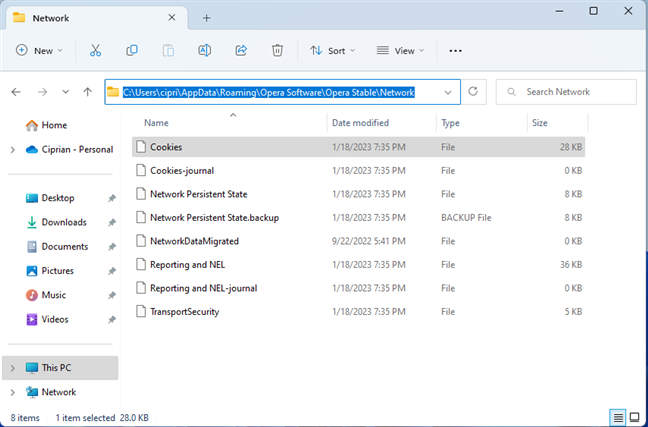 The Cookies location used by Opera
If you’re using the Opera GX browser, copy and paste this path into File Explorer’s address bar:
The Cookies location used by Opera
If you’re using the Opera GX browser, copy and paste this path into File Explorer’s address bar:
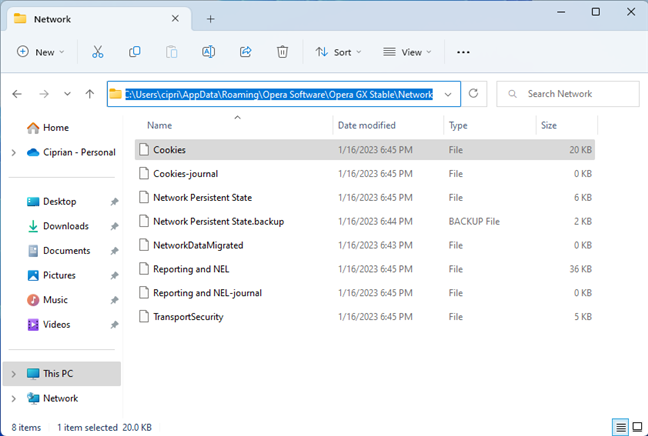
 The cookies location for Opera GX
You can’t just open and read the information stored by the Cookies with a text editor. Instead, check out our guide to learn how to view and remove the cookies in Opera and Opera GX.
The cookies location for Opera GX
You can’t just open and read the information stored by the Cookies with a text editor. Instead, check out our guide to learn how to view and remove the cookies in Opera and Opera GX.
Where are Google Chrome’s cookies located in Windows?
If you’re wondering, "Where are cookies stored by Chrome?", the answer is simple: Google Chrome stores all its cookies in a single file called Cookies. To reach Chrome’s Cookies location in Windows 10 and Windows 11, open File Explorer and type the following path into the address bar:C:\Users\Your_User_Name\AppData\Local\Google\Chrome\User Data\Default\Network
Remember to replace Your_User_Name with the name of your user account.
For a simpler way that works on all user accounts, copy and paste into File Explorer the following path, which uses an environment variable that exists on all Windows computers:
%LOCALAPPDATA%\Google\Chrome\User Data\Default\Network
Where does Firefox store cookies in Windows?
Mozilla Firefox stores all the cookies from every website you visit in a single file called cookies.sqlite. Reaching the Firefox cookies location is more complicated. First, copy and paste the following path into File Explorer’s address bar:%APPDATA%\Mozilla\Firefox\Profiles
This path translates into an address similar to this one:
C:\Users\Your_User_Name\AppData\Roaming\Mozilla\Firefox\Profiles
Just make sure to replace Your_User_Name with the name of your user account.
Next, you see your Firefox profile folder, whose name is composed of random characters followed by default-release. For example, as you can see below, my Firefox profile folder is called tdechjb2.default-release - but yours should contain a different string of characters. Double-click or double-tap on this folder to open it.
Microsoft Edge’s cookies location in Windows 10 and Windows 11
The place used by Microsoft Edge to store cookies is similar to Chrome. All Microsoft Edge cookies are also stored in a single file called Cookies. Open File Explorer and copy and paste the following path into the address bar:%LOCALAPPDATA%\Microsoft\Edge\User Data\Default\Network
This translates into a path similar to this:
C:\Users\Your_User_Name\AppData\Local\Microsoft\Edge\User Data\Default\Network
Remember to replace Your_User_Name with the name of your Windows user account.
The location of Opera and Opera GX cookies in Windows 10 and Windows 11
Opera and Opera GX keep their cookies in a single file called Cookies, just like Google Chrome and Microsoft Edge. If you use Opera, you can find the Cookies file by inserting the following path in File Explorer’s address bar:%AppData%\Opera Software\Opera Stable\Network
%AppData%\Opera Software\Opera GX Stable\Network
Discussion (56)
I found cookies I have on certain PC using portable browser in my USB drive didn’t transfer between my PCs so I figure out what causes this.
My Facebook account was hacked a few days ago, and it had 2FA enabled, so I did some research to figure out how that happened and found about redline sealer can steal your browser cookies and use that to login without password, TOTP or 2FA so just wanted to know how the cookies are stored and where not that it’s going to help me do anything about the browser exploit, but it’s never bad to know something more.
With the most recent Chrome update, the See All Cookies option which showed “super” cookies that Clear didn’t delete, now says, See All Site Data and Permissions, and these “super” cookies do not show so cannot be deleted. Thank goodness for the Ghostery extension so ads don’t show, but sites are collecting cookie data now that cannot be deleted.
My co-worker’s computer had to update to Windows11. After the update all her Chrome data was deleted. I wanted to create a backup of my Chrome files before my computer suffered the same fate.
That is really unfortunate. I hope our guide is helpful to you, so that you make a backup of everything, including cookies.
I CANNOT RECEIVE LINKS…ALWAYS GOES TO NORTON APP!!!!!! SAYS TO ENABLE COOKIES???????.. HELP OR CANCEL MY PERSCRIPTION. TRYING TO GET HELP ON THUS SUBJECT SEVERAL WEEKS……..
I don’t really understand your problem, what you are doing, and what is going on. Also, which Norton product are you using?
Cookies are a tool used by global tech companies, such as Google and Facebook, to persuade us to give up our privacy for the sake of convenience. Our personal information gathered by these companies has been used by others not only to predict our behavior but also to influence and modify it. If restricting or destroying cookies does anything to disrupt this assault on our privacy, then I’m all for it.
I wanted to move cookies from my SSD to my HDD.
Deleting the file C:\Users\Your_User_Name\AppData\Local\Google\Chrome\User Data\Default\cookies won’t clean all cookies. Where are the rest of the cookies? If I delete the whole Default folder, all cookies are removed.
Microsoft Edge cookies are stored in an SQlite database. MS just omitted the ‘.sqlite’ extention. So you know…
I use CCleaner free version every morning to clear stuff including cookies that aren’t on my Cookies To Keep list. I’m somewhat curious if it actually deletes all other cookies from Chrome & Firefox. Sounds like there’s no way of telling.
I wanted to make sure sites I don’t trust are obeying no cookies and no tracking.
I want to have all cookies automatically relocated to a ramdrive. Then when I reboot, I can be sure they are GONE!
I’m looking to have my information BLOCKED in your file.I have not had any issues with other predatory businesses that violate my rights to privacy by making it possible to have me harassed with unwanted and unsubscribed solicitation.As with others “if you can’t or won’t comply with my request.Please notify me so I can take steps to get my right to privacy back”.
Joseph
Please don’t reply with “just hit the unsubscribe link”. That is lame and I shouldn’t have to.
I want to find cookies because my Musiciansfriend.com shopping cart is corrupt and the support staff told me to delete their cookies and clear my browser cache. Rarely is clearing browser cache the real issue so I wanted to delete their cookies and see if that helped.
I wanted to screw with twitter’s tracking cookies. Why just delete them when I can change them?
My bank uses cookies. CC Cleaner erases them.
In a situation where cookies might be reason for malfunctioning of some software, I want to backup the cookies in a .zip-file, delete all cookies in my brouwser (Chrome) and the test the malfunctioning software to see if cookies indeed are the source of the problem.
After that I want to restore the cookies I had.
How can I do that?
I just downloaded from window 7 to 10 and do not like that i cannot control when I am willing to lower my cookies. In windows 7 I only lowered them to mid level when there was a site I was on that required them. I very seldom had my cookies lowered at any time. I do not like the security risk
I have a right to control MY personal information !
You asked why I want to have access to cookies. I am having problems streaming movies and the site told me to delete cookies. But if that does not work I might want to restore them again? so…
I want to know for learning purposes only
Because i am studying cookies now
I am changing to a new windows 10 computer from a windows 8.1 computer and want to take the cookies with me.
You can’t, and you shouldn’t. 🙂
i’ve bin have a lot of trouble with my lab top for a will i had some one to ficks it and he made it wort grand daughter to fix and she made it worse so how can i get back to what it was before
My HP laptop is slowing down to the point of non function. I want to clean it up. Unused programs and massive waste from cookies , I suspect, is the cause. Plus cookies are a massive waste of my bandwidth and my time.
to remove all cookies on a home computer for privacy and security
Work related, trying to figure out how to locate the Google cookies used for establishing connection for the logged in user. I want use a http service with VBA in Excel to make requests to a web server on our corporate domain which is a Google domain. Damn, the learning curve is a bit steep, though, but thanks for this helpful article 🙂
why could you not just find the cookie file/folder/location and r-click on it and under the security tab, write-protect it so they can’t actually write to the location when you quit your browser?
I am using a website that lets me “Save” my settings in a cookie which I am supposed to find and copy, then paste into the website. I cannot find the cookie to do this…
Work related. Learning some ASP for my employer.
Hacker continuous put inference cookies to stop web browser, interference login, logout, show false login popup, etc.
I cannot stay connected to Yahoo email even though I have checked keep me signed in for two weeks. Need to find cookie file.
Why can’t browsers store cookies elsewhere that’s not my device?
I want to know how to delete one cookie, without deleting them all.
We have links for that, in this article, for each browser. Please read carefully.
I want to find the cookies file so I can temporarily re-name it.
Every time I have a problem, tech service wants me to delete all cookies.
I do not care to lose all these settings. Since this seldom solves the problem,
I would prefer to be able to restore all cookies after trouble shooting.
smart 🙂
Just needed to double check that all browsers still store there cookies in there own locations. This is to allow me to login into websites with more than one account. I have just updated to the new Edge and since it is based on chromium decided to check. Thanks for the article….
I do not want every crooked website tracking me
How can I stop cookies from websites I know nothing about, and clear the ones that have already infected my computer
Use Ccleaner, search on web for this program
Wanted to know how to change the path to where the Cookies are stoed – unfortunately the article didn’t cover that 🙁
You can’t do that.
To capture it through profile management software for the roaming profile
Reason for wanting to know where cookies are stored? It’s my PC so I should have ultimate and easy to access control.
I wanted to see where they are located so I can control my data. The big tech companies are deliberately making it hard to locate, control and delete cookies. The question is why and who is behind this ever increasing secrecy?
I use a site that frequently forces me to remove cookies manually. I’ve done so from within Chrome many times and even set Chrome to clear them automatically on exit. This, however, does not appease this site I’m required to use, so I’m going to try using a bat file as an alternative.
The ability to delete selected cookies is a good troubleshooting tool. In case a cookie becomes corrupted you can delete it and then access the website to create a new one. This can be done without needing to delete ALL cookies thereby necessitating re-logging in or whatever to other sites which store info in the cookies.
The ability to access individual cookies should never have been removed specifically because of the above stated reason. Microsoft and/or browser manufacturers are thereby crippling users and IT admins alike.
not necessarily. At least in the case of Firefox, I’m sure most competent IT administrators can, at least with a bit of research, figure out how to open an SQLite database. As it so happens, I already have a suitable database browser already installed because I used to use it when administering a “TShock”-based Terraria gameserver, and it’s handy to have around besides that. Hopefully, there’s a similar approach that can be applied to other browsers (You might have to get creative with Microsoft Edge, though… But why would you want to use Edge for business use in the first place?)
I am going mad because every time I go to a new web site I have to log on.
I have done something in the past day or two that has caused it but I have no idea. Please help me correct it
Most probably, your browser is set to block third-party cookies. See this tutorial, and do the opposite of our instructions: https://www.digitalcitizen.life/how-disable-third-party-cookies-all-major-browsers
Check that deprecated folder “C:UsersYour User NameAppDataLocalMicrosoftWindowsINetCookies” further: I found a .dat file in there that had 800kB of old cookies in it!
I wanted to know how to completely delete cookies and web history. Would it be possible to close the browser, delete the file containing the cookies and rely on the browser to create a new empty file on next startup?
Does this mean that Windows itself, Norton security suite, & CCleaner no longer actually clean up cookies?