




Cash App has become one of the most popular peer-to-peer payment platforms in the U.S., making it easy to send, receive, and invest money directly from your phone. But when it comes to linking accounts or setting up direct deposits, many users ask the same question: what bank does Cash App actually use?
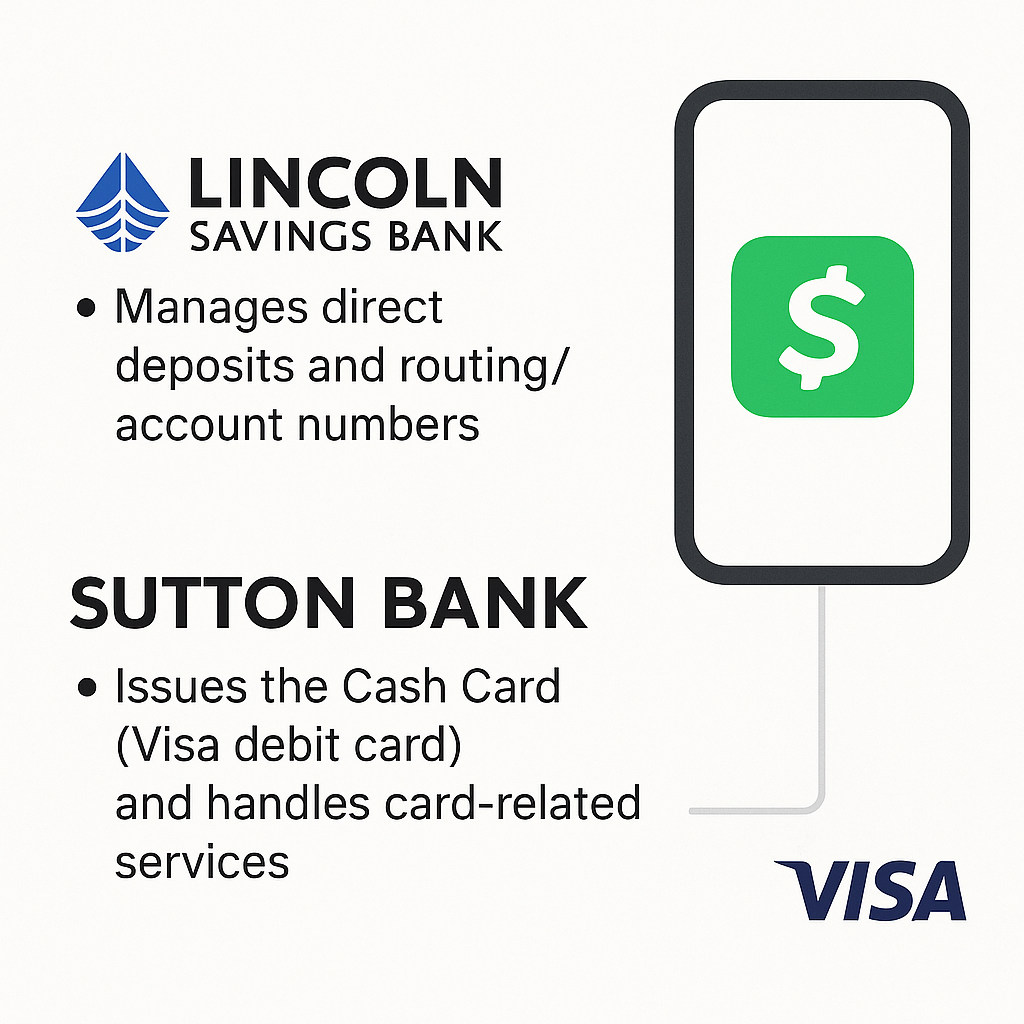
Although Cash App is not a bank, it partners with two FDIC-insured financial institutions, Lincoln Savings Bank and Sutton Bank, to power its banking features. Each plays a different role depending on how you use your account. But the Recent Cash App Terms of Service indicate that Wells Fargo Bank also acts as a partner bank for FDIC pass-through insurance for funds associated with a Cash Card. This means your money is held across multiple institutions.
Who Provides Cash App’s Banking Services?
Cash App operates under its parent company, Block, Inc. (formerly Square), but relies on regulated partner banks to handle deposits, routing numbers, and Cash Card services. These banks ensure your money moves through FDIC-insured institutions and complies with U.S. banking laws.
- Lincoln Savings Bank (IA) – Provides routing and account numbers for direct deposits and supports ACH transfers.
- Sutton Bank (OH) – Issues the Cash Card (Visa debit card) and helps manage card-related funds.
- Wells Fargo Bank (NA) – Acts as an additional partner bank for certain Cash Card balances and assists with FDIC pass-through coverage,
Eligible Cash App balances may qualify for FDIC pass-through insurance up to $250,000, but only under specific conditions. According to Cash App’s current Terms of Service, your money is only eligible for FDIC coverage if you have a Cash Card or sponsored account and your funds are being held by one of Cash App’s partner banks for that purpose.
If you store money in Cash App without a Cash Card, your balance is not automatically FDIC insured.
How to Find the Bank Name Linked to Your Cash App Account
You can check which bank is connected to your Cash App by following these steps:
- Open Cash App and go to your Banking or Account section (In most versions, you’ll see a “Banking” tab on the home screen or tap your profile icon → Account & Routing.)
- Tap your routing and account numbers to view the bank name assigned to your Cash App account.
- Depending on your setup, you may see Lincoln Savings Bank, Sutton Bank, or Wells Fargo Bank listed.
Cash App updates its interface regularly, but the bank information is always displayed next to your routing and account numbers within the Banking section.
What Each Bank Does in the Cash App Ecosystem
| Bank Partner | Main Function | Use Case |
|---|---|---|
| Lincoln Savings Bank | Direct deposits, routing numbers, Plaid connections | Payroll deposits, linking to other bank apps |
| Wells Fargo Bank | Provide FDIC pass-through insurance for certain Cash Card balances. | Fund protection and compliance |
| Sutton Bank | Cash Card issuance, ATM access, card transactions | Cash withdrawals, point-of-sale payments |
How to Use Cash App for Direct Deposit
Setting up direct deposit with Cash App allows your paycheck or government benefits to arrive up to two days earlier. Here’s how to do it safely:
- Open Cash App → go to Banking.
- Tap “Direct Deposit” → select “Get Account Number.”
- Copy your routing and account numbers from Lincoln Savings Bank.
- Submit these details to your employer or payroll provider.
- Verify that the first deposit arrives before switching fully to Cash App.
Direct deposit is optional but can make Cash App function like a lightweight checking account. Funds appear directly in your balance and can be used instantly with your Cash Card.

Is Cash App a Real Bank?
No, Cash App is not a bank. It’s a financial services platform that partners with licensed U.S. banks to offer bank-like features such as direct deposit and a Visa Cash Card.
Cash App does not itself provide FDIC insurance. FDIC protection only applies when your funds are held by a partner bank (such as Lincoln Savings Bank, Sutton Bank, or Wells Fargo) under an insured program linked to your Cash Card or sponsored account.
FAQs About Cash App’s Bank Partners
Q: What bank does Cash App use for Plaid?
A: Cash App uses Lincoln Savings Bank when linking through Plaid for third-party apps.
Q: Can I change which bank my Cash App uses?
A: No. The bank partner is assigned automatically depending on your feature (Cash Card = Sutton Bank; Direct Deposit = Lincoln Savings Bank).
Q: Is Sutton Bank owned by Cash App?
A: No, Sutton Bank is an independent FDIC-insured institution based in Ohio. It simply issues Cash App’s Visa debit cards.
Q: How can I contact Sutton Bank?
A: For Cash App card issues, contact Cash App Support directly, not the bank. Sutton Bank does not handle customer service for Cash App users.
Q: Is my Cash App balance FDIC insured?
A: Sometimes. Your Cash App balance may qualify for FDIC pass-through insurance (up to $250,000) only if you’ve activated a Cash Card or sponsored account and your funds are held by a partner bank (Lincoln Savings Bank, Sutton Bank, or Wells Fargo). If you haven’t activated those features, your stored balance is not automatically insured.
Conclusion
Cash App’s banking backbone is powered by Lincoln Savings Bank and Sutton Bank, two trusted U.S. institutions that enable everything from direct deposits to Cash Card transactions. Knowing which bank your account uses helps you set up deposits, verify payments, and troubleshoot connection issues with confidence.
While Cash App isn’t a traditional bank, it offers a modern, flexible alternative for managing money, spending, and investing, all from your phone.
Discussion (0)
Be the first to comment.