



All computer viruses are bad, but some are nastier than others. When an evil one infects your system and takes control of your PC, you might find yourself “in prison”: you can’t use your infected computer for anything, including removing the viruses from it. When something like this happens, a way to get out and escape from the virus’ hands is to create an antivirus rescue disk on another PC and use it to boot up and clean your infected Windows computer. A few antivirus companies still develop and maintain disk images for antivirus rescue disks, which you can burn on a CD/DVD or write on a bootable USB memory stick. Here are the disk images you can still confidently use today to remove viruses on your Windows 10 and Windows 11 computers:
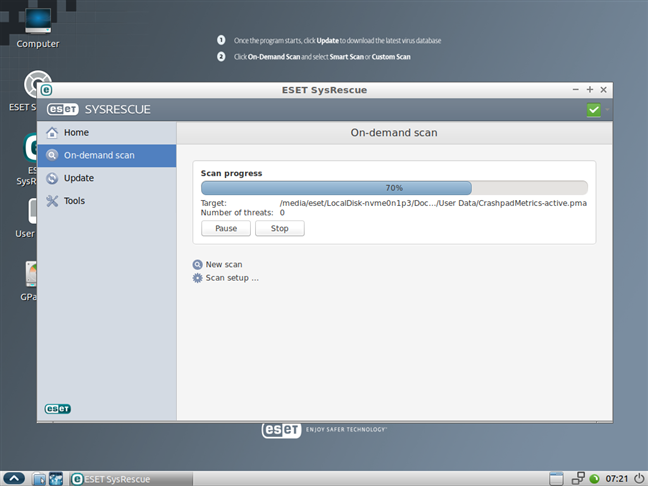
 Free antivirus rescue disc: ESET SysRescue Live
Download: ESET SysRescue Live
TIP: This rescue disk uses the same antivirus engine in ESET Internet Security. If you want to know how efficient it is, read our review: Review ESET Internet Security: Powerful and easy to use.
Free antivirus rescue disc: ESET SysRescue Live
Download: ESET SysRescue Live
TIP: This rescue disk uses the same antivirus engine in ESET Internet Security. If you want to know how efficient it is, read our review: Review ESET Internet Security: Powerful and easy to use.
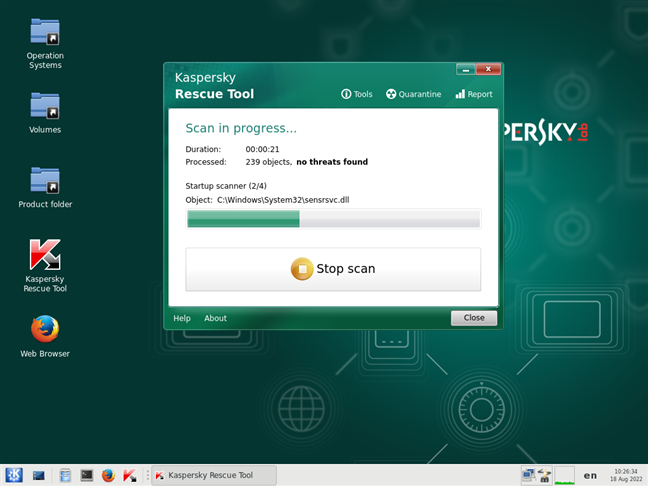 Antivirus scan with the free Kaspersky Rescue Disk
Download: Kaspersky Rescue Disk
Antivirus scan with the free Kaspersky Rescue Disk
Download: Kaspersky Rescue Disk
 Free antivirus rescue disc: Avast Rescue Disk
Avast Rescue Disk offers a simple graphical user interface that’s easy to use. You can either scan all your hard disks for malicious files, or you can choose to scan only some disks or folders.
Free antivirus rescue disc: Avast Rescue Disk
Avast Rescue Disk offers a simple graphical user interface that’s easy to use. You can either scan all your hard disks for malicious files, or you can choose to scan only some disks or folders.
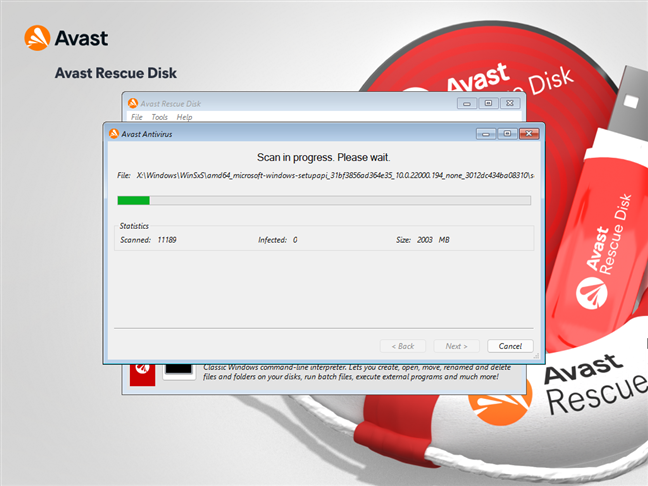 Scanning a computer for malware using Avast Rescue Disk
Download: Avast
Scanning a computer for malware using Avast Rescue Disk
Download: Avast
1. ESET SysRescue Live
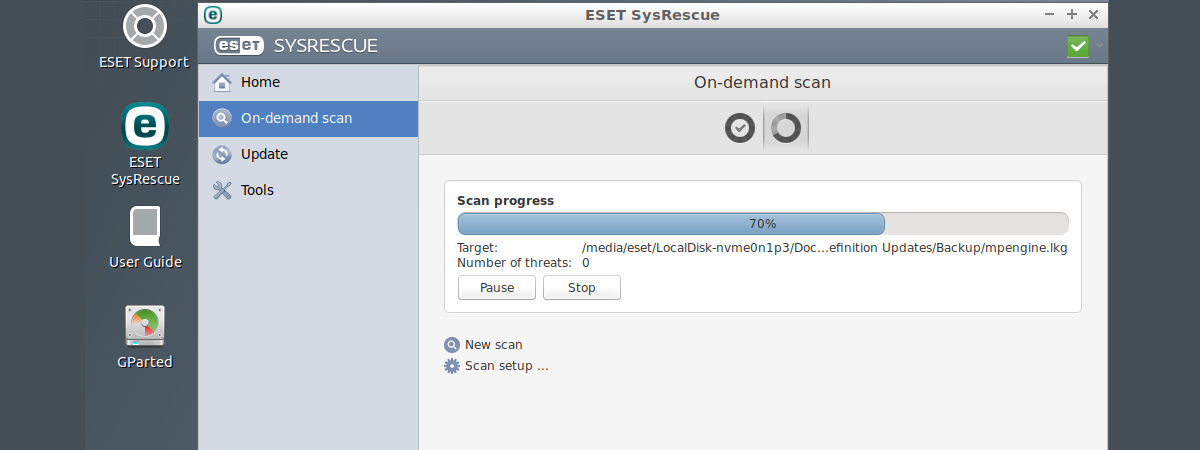
ESET SysRescue Live is an antivirus rescue disk with an easy-to-use graphical user interface and lots of ways to customize the scans that you perform. You can run smart antivirus scans and custom ones, you can set exclusions, choose custom folders or files to be scanned, and even decide whether you want to look for possibly unwanted programs on your infected computer. ESET SysRescue Live can also update its antivirus definitions to help you clean your computer even if it’s infected with a very new virus.2. Kaspersky Rescue Disk
The Kaspersky Rescue Disk has a long history, dating back to 2010. Before starting to check your computer, it updates the malware definitions to ensure that the antivirus scans you’ll perform are efficient. Kaspersky Rescue Disk offers a good-looking graphical user interface that’s easy to use and includes many customization options: you can scan boot sectors and/or hidden startup objects, specific folders or files, only files with specific extensions, and you can set exclusions. It’s really useful when you need a virus removal tool that can deal with nasty infections like rootkits, some forms of ransomware, and so on.3. Avast Rescue Disk
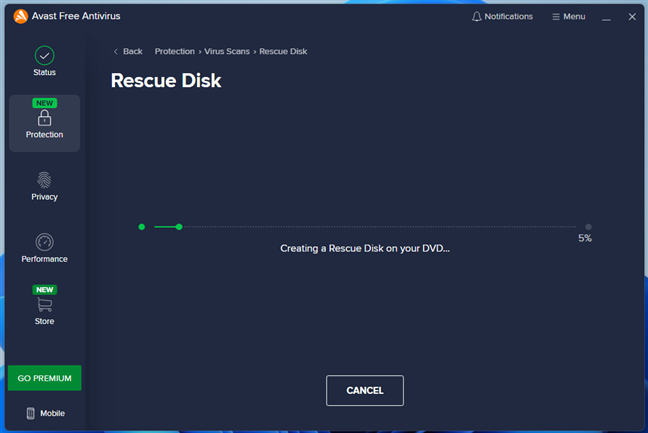
Avast doesn’t offer a standalone download ISO file for creating an Avast Rescue Disk. The only way you can create an Avast Rescue Disk is from within an Avast Security product. The good thing is that you can create this rescue disk even from the free version of Avast Antivirus, so you don’t have to buy one of Avast’s paid products.
Discussion (5)
I used to use the Bitdefender rescue cd at first, it has a lots of customizations and great graphical interface, but at the end of scan results it always shows errors that not solved, whenever i choose to resolve them nothings happen.
So i switched to use Avira & Kaspersky Rescue Disks and both of them are totally Amazing, Avira has an interface of Ubuntu operation system and i loved it and it’s so simple and easy to use. While Kaspersky has both (Graphical & Text Mode) and also it has an additional scan for hidden system files and registry editor.
At the end i could say that the last two manufacturers that i mentioned are my favourites and i used to start with “Avira” ending with “Kaspersky” to make sure that I’m on a clean way from any malicious objects or malwares that could harm my pc.
I created a Bitdefender USB for a Windows 10-based HP 15-version laptop, and it would not work. I changed into Legacy mode, created a BIOS admin password, and disabled the secure boot. Nothing worked, I could start the USB fine, but after choosing to start in English and getting past the start screen, it continually froze as starting 232. If anyone has any idea what to do in order to get this to work, I would appreciate the help!
I ended up saving files, resetting the entire machine, downloading Bitdefender, and running many and various antivirus softwares to finally make it work.
BOoooooooo, Bitdefender USB. Y U no love me?
I’m going back to Kali, Windows. 😛
Hello!
First, sorry for my poor English: it’s not my native language (I’m from Italy).
Well, I repair PCs and I use to keep in my pocket a multiboot USB with tons of tools which can help me to solve most of the problems I face almost every day.
These are my favorite live tools:
> Antivirus: Bitdefender, Kaspersky, Dr. Web and AVG. Both Kaspersky and Bitdefender can have some wifi issue with some (few) cards, but everything works fine if you use them from the new UEFI-BIOS YUMI (it’s still a beta but it works fine). Don’t ask me why! 🙂 The latest AVG has improved its network tools and now wifi works like a charm (once you could connect only using eth0), so you can easily update the signatures.
> System Tools: Boot Repair Disk, Rescatux, Super Grub 2 (included in Rescatux) Gparted, Mini Tool Partition Wizard and my favorite ones: Clonezilla and System Rescue CD (which among hundreds of tools includes Gparted and Super Grub2). Clonezilla never failed me and System Rescue CD, though it’s not for newby, is absolutely one of the best multitool, if not THE best. I repeat: not very easy for beginners, but very powerful: you can clone, image, save data from failing disks, manage partitions etc… Many of its features are good for Windows too.
For Cloning you can also use Ghost 4 Linux but it doesn’t still have UEFI boot support.
> Distros: Porteus, on my opinion, is the best live OS you can use: it’s customizable BEFORE you download it and it’s very light (about 300 Mb). You can have more than one, depending on your needs: for example you can have one for BIOS 64 bit, on for UEFI 64 bit and one for BIOS 32 bit. Debian live it’s a good choice too. Puppy and Elementary are good but I don’t like them very much (it’s my opinion).
> More: if you want to be “bad boys” 🙂 you can use Pentesting and “Hacking” distros like Kali, Backbox or BlackArch. They are not so easy to use if you want to be a pro, but they are worth a try even if you are not interested in this kind of operations.
If you want to be anonymous you can use Tails, a Debian base distro that uses Tor for anonymous browsing.
Parrot OS is another distro which combines anonymous browsing and pentesting.
For forensics purposes i suggest CAINE and (but it’s not very updated) Deft. CAINE can be used like a regular distro, having LibreOffice, Browsers etc… The good is that it has a gui for Photorec and DDrescue, for those who are scared by command line: for example System Rescue CD has only the command line version of both.
Finally, I want to mention some discontinued tools that cannot be used on modern PCs (especially the UEFI based ones) but if you have an old machine they can be still useful: Trinity Rescue Kit, Falcons Four and, above all, Ultimate Boot CD. In fact, Ultimate Boot CD should be developed into a new graphical version that now is in a beta… I don’t know if it’s dead or not. Let’s wait and see!
Remember that none of these three tools are UEFI boot compatible.
Well, there are many, many other live tools, but on my opinion these are (among free ones) the best, and if I should mention all the rest I would take the risk of writing a boring, endless post! 🙂
Just a tip: most of the times you (me too!) don’t really need all these tools, but it can be a good idea to keep them in a multiboot USB. Easy2Boot and Yumi are the best multiboot USB creators. We’re waiting for Yumi to became stable in its UEFI compatible verisions. Yumi is also being rewritten for Linux but there’s not a ETA.
Cheers, 🙂
Bert
If you want to use a windows environment the next evolution of a Hirens type of disc would be a current PE environment. Not only could you run lower level tools but also modern applications. Bob.Omb’s Modified Win10PE x64 is what I’m using now and the only thing it need is a few more utilities, but if your working on a PC it can already do everything you need. Found it at vault.theworkpc.com – There was also a torrent.