Affordable wireless routers are not particularly exciting, even though they sell in higher volumes than premium ones. In the last couple of months, we reviewed many new models with exciting features like Wi-Fi 6 compatibility. This time we decided to change things up a bit and review one of the most affordable wireless routers from ASUS: RT-AC1200 V2. If you want to know what you get from a router that almost anyone can afford, read this review:
ASUS RT-AC1200 V2: Who is it good for?
This wireless router is a suitable choice for:
People with studios or one-bedroom apartments
Homes with a small number of devices connected to the Wi-Fi
Users who want to remotely control their router using a mobile app, from anywhere on the internet
Internet connections that are up to 100 Mbps
Pros and cons
There are many good things about ASUS RT-AC1200 V2:
A useful mobile app that can be used from anywhere on the internet
Dual-WAN on an affordable router is a rare sight
Great multilingual support and easily accessible Help documentation
It can be mounted on walls
There are a few downsides as well:
It can use internet connections that have a maximum speed of 100 Mbps
The performance on the 2.4 GHz wireless band could be improved
It doesn't have a USB port
Product rating3/5
Verdict
ASUS RT-AC1200 V2 is a new model on the market of affordable routers. In its price range, companies do not offer exciting innovation. However, the ASUS RT-AC1200 V2 does have a couple of great things going for it: reliable performance on the 5 GHz wireless band, a good mobile app for remote control, and Dual-WAN capabilities. If you don't want to break the bank on your next router, and you do not have many devices connected to the Wi-Fi, ASUS RT-AC1200 V2 is the right choice that delivers the basics you need. However, keep in mind that it is best used in small living spaces, like a studio or a one-bedroom apartment.
Unboxing the ASUS RT-AC1200 V2 wireless router
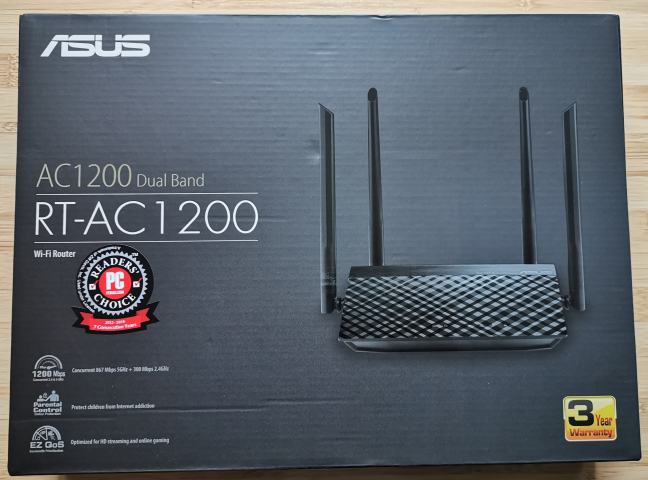
The packaging used for the ASUS RT-AC1200 V2 router is simple. The router comes in a black box with a picture of the device on the top. On the back and the sides, you can read details about its hardware, specifications, and features.
The packaging used for ASUS RT-AC1200 V2
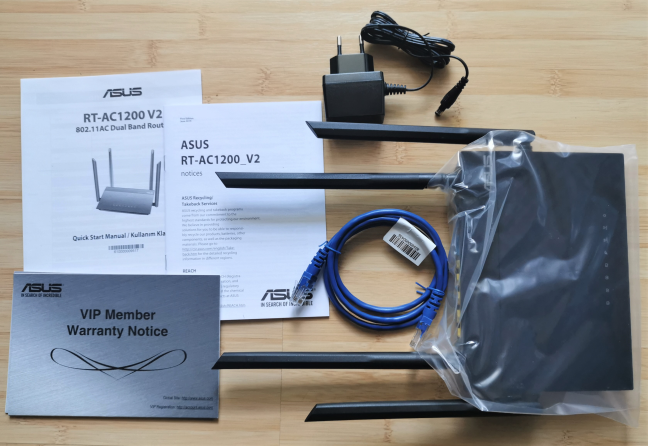
When you open the box, you find the following elements: the router itself, its charger, a short network cable, the warranty, and the user guide.
ASUS RT-AC1200 V2 - What is inside the box
The unboxing experience is quick and straightforward. You receive only the basics required to get started.
Hardware specifications and design
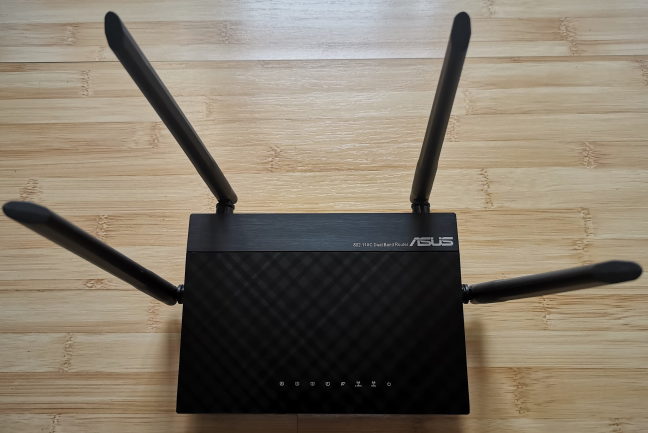
ASUS RT-AC1200 V2 has a single-core MediaTek MT7628DAN processor, running at 575 MHz, 64 MB of RAM, and 16 MB of storage space for the firmware. Since this is an affordable wireless router for 100 Mbps internet connections, its modest specs are not surprising. The router is dual-band, with a total maximum theoretical bandwidth of 300 Mbps for the 2.4 GHz wireless frequency, and 867 Mbps for the 5 GHz frequency. ASUS RT-AC1200 V2 has four undetachable external antennas that are used to broadcast the Wi-Fi signal, two for each band.
ASUS RT-AC1200 V2
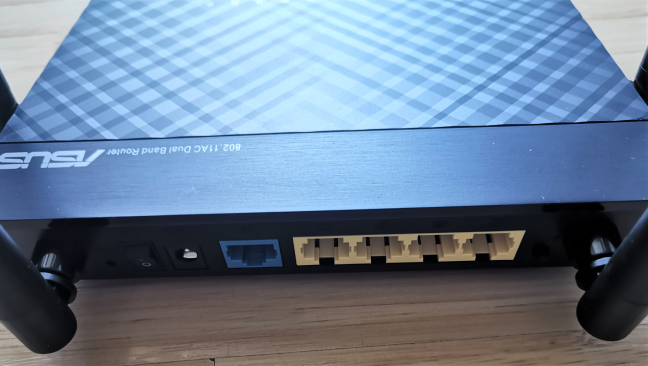
On the back of the router, you find the WAN port and four Ethernet ports, all working at a speed of 100 Mbps. There are also the Power jack, the Power button, the Reset jack, and the WPS button.
The ports on the back of the ASUS RT-AC1200 V2
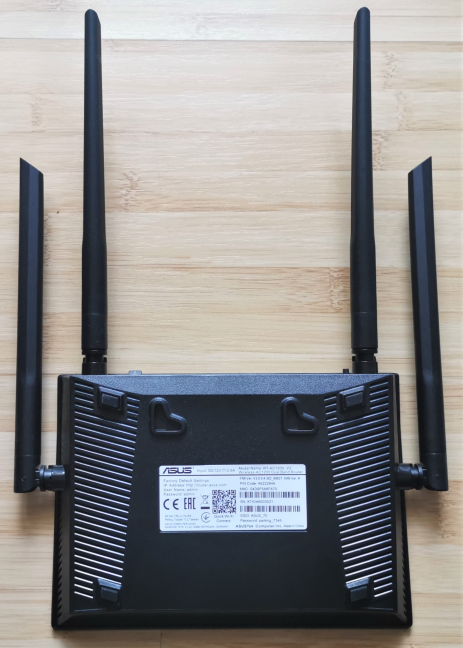
On the bottom of the router, there are the ventilation grids, four rubber feet for keeping it in place, and two holes for mounting it on walls.
The bottom of the ASUS RT-AC1200 V2 router
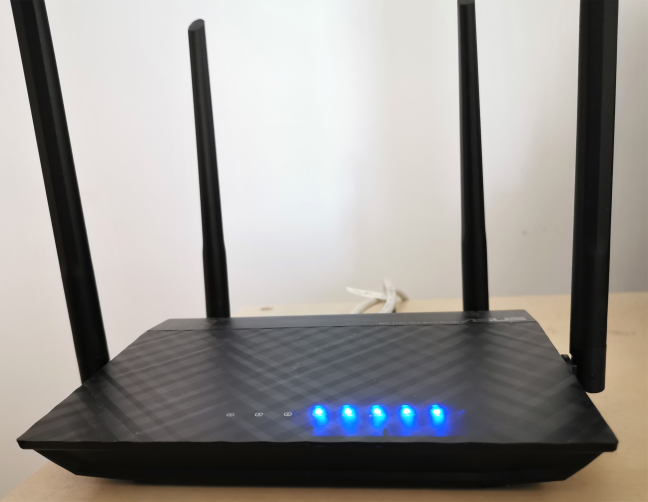
On the top side of the router, you find eight LEDs that signal the working status of the router, its internet connection, two Wi-Fi bands, and Ethernet ports.
The LEDs on the ASUS RT-AC1200 V2
ASUS RT-AC1200 V2 has a classic router design, and it looks the same as most entry-level models from the same company. It is made from plastic, and it is rather small, 6.9 x 4.9 x 177 x 1.33 inches or 177 x 126 x 34 mm in width x depth x height. It is also light, weighing just 0.59 lb or 271 grams.
If you would like to know more about the specifications of this model, go to this page: ASUS RT-AC1200 V2 Specifications.
Setting up and using the ASUS RT-AC1200 V2 wireless router
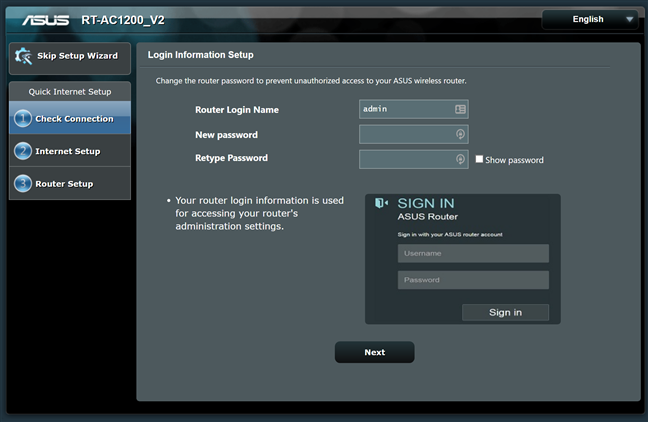
We set up the ASUS RT-AC1200 V2 using a computer and a web browser. The setup wizard starts by asking you to set a login name and password for the router. For increased security, use a custom name and password that is different from the one you are going to use for Wi-Fi. Then, you need to enter the details of your internet connection and set the name and password for the Wi-Fi. In the end, you are shown a summary of your settings, and you can also enable the Yandex.DNS service, if you wish to use it. Considering that this DNS service is from Russia, most international users won't enable it for their network.
Setting up ASUS RT-AC1200 V2
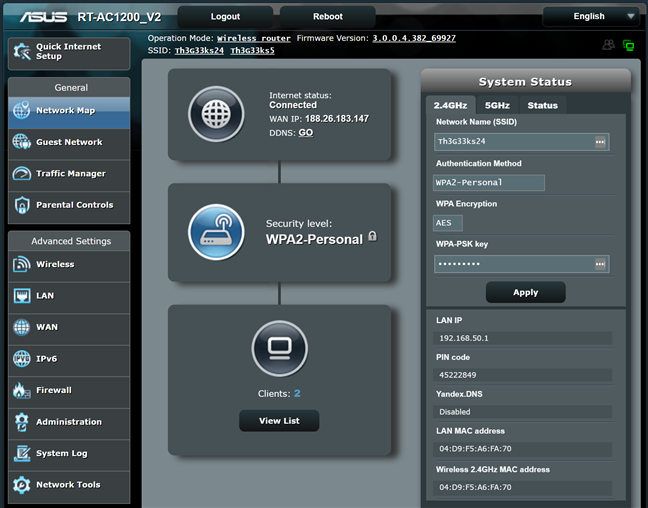
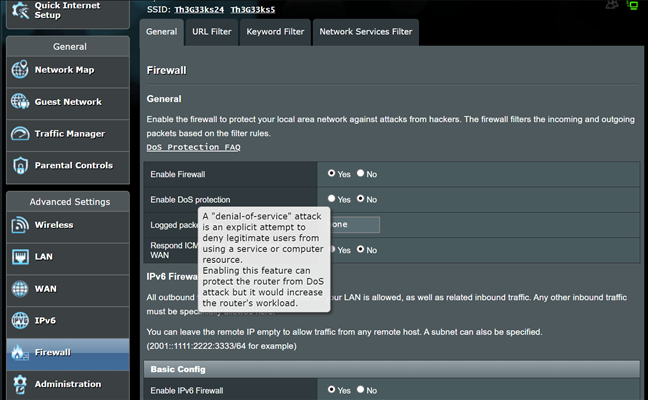
The user interface created by ASUS is easy to use, well organized, and available in 24 languages. If you are an advanced user, you are going to appreciate the complete control that you get for all the features of this wireless router.
The firmware on the ASUS RT-AC1200 V2
The user documentation is easily accessible. When you move the mouse cursor over a setting that you do not understand, a question mark is shown. Click on the question mark, and you see information explaining that setting. One downside is that the documentation has not been updated to include information about all the features included by ASUS in their latest firmware, like IPv6. Therefore, this trick does not work for everything.
Help documentation for ASUS RT-AC1200 V2
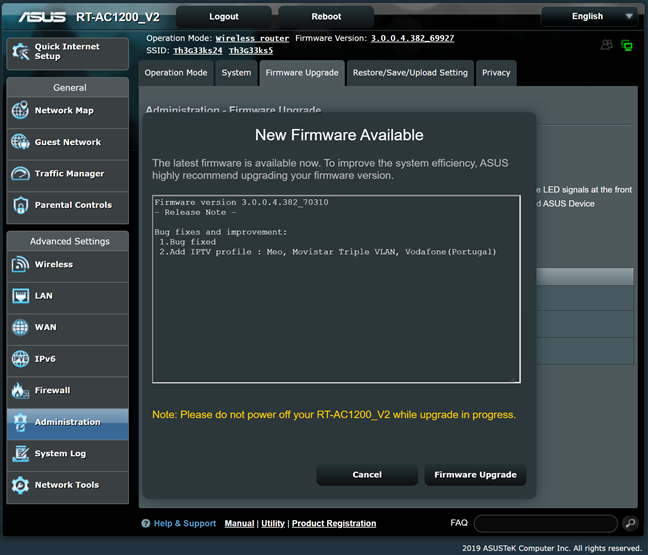
The initial firmware version of this router has some bugs that were fixed in recent updates. We recommend that you upgrade the firmware to its latest version to benefit from the best possible experience. ASUS offers a description of its fixes when it notifies you about firmware updates.
Firmware update available for ASUS RT-AC1200 V2
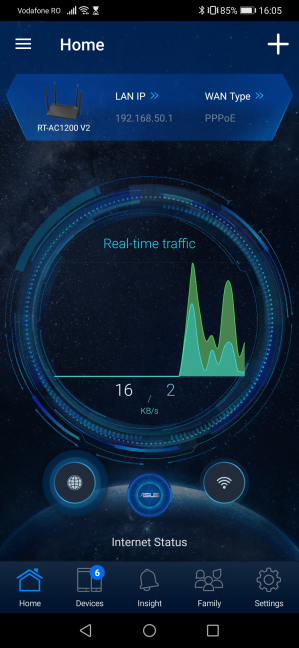
Some users may prefer the ASUS Router mobile app for setting up and administering the ASUS RT-AC1200 V2. You can use the app to control the router from anywhere on the internet. With it, you can view the devices connected to the network, see their traffic in real time, block them or limit their bandwidth, manage the devices used by your children, and configure the main features of the router.
The ASUS Router mobile app
When using the ASUS RT-AC1200 V2 router, we enjoyed stable throughput on the 5 GHz band, with good-quality connections. However, the 2.4 GHz band suffered from moments of instability, and we sometimes encountered problems with lag when streaming movies or doing video conferencing.
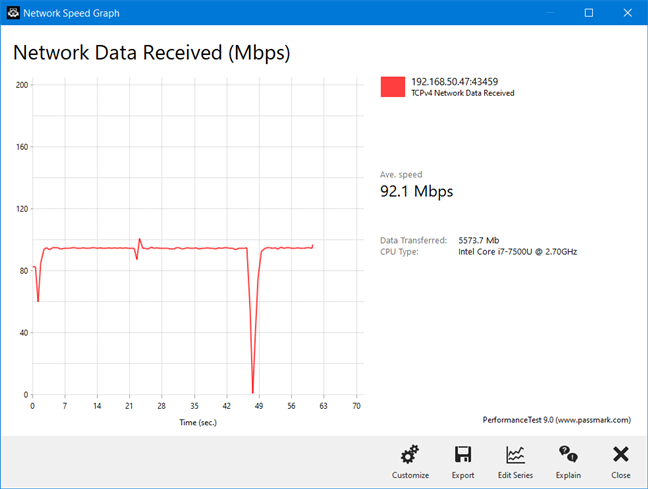
We connected about a dozen devices to the network managed by ASUS RT-AC1200 V2, including a desktop PC, two laptops, several smartphones, one wireless printer, one smart plug, one smart bulb, an intelligent robot vacuum cleaner, and an Xbox One console. We then evaluated the speed and variability of wireless transfers. We took our laptop and moved to a room that is separated by one wall from the router. We made a wireless transfer on it. While the average speed on the 2.4 GHz band was satisfying, the variability of the wireless transfer was above average. It is a problem that should be improved by ASUS in future firmware updates.
A Wi-Fi transfer on the 2.4 GHz band
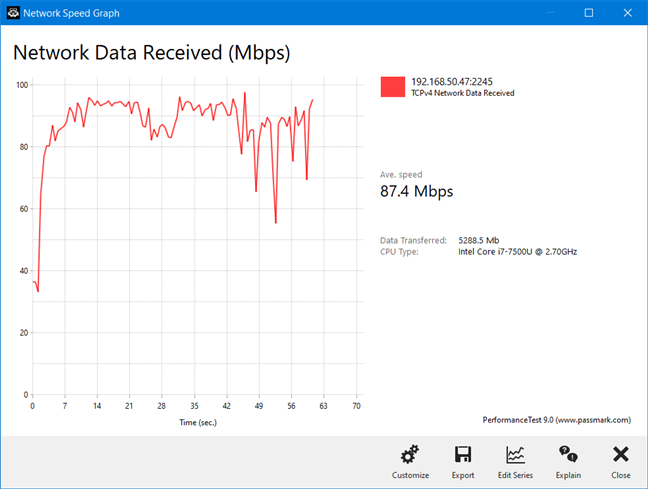
When we switched to the 5 GHz band, the data transfer was a lot more stable, and the average speed was higher than on the 2.4 GHz band. This measurement confirmed that the 5 GHz wireless band is the better choice when using ASUS RT-AC1200 V2.
A Wi-Fi transfer on the 5 GHz band
If you want to know more about the real-world performance offered by ASUS RT-AC1200 V2, including comparisons with other wireless routers, go to the next page of this review.
Wireless network performance
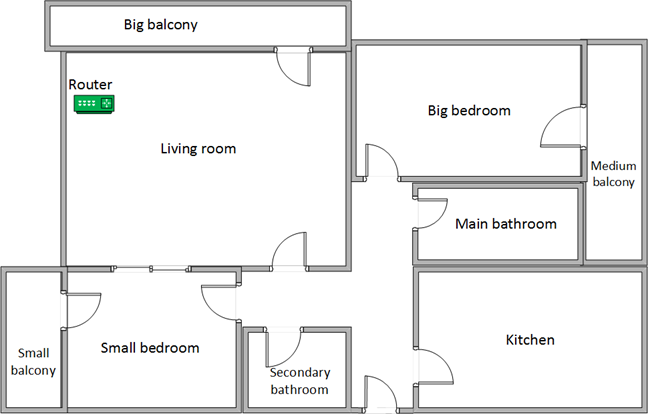
First, let's look at the apartment that was used in our testing and how it is set up. You can see that the router is placed in the living room. With most wireless routers, the signal strength is not that good in places like the Kitchen and the Medium balcony.
The apartment in which we tested the ASUS RT-AC1200 V2
Our testing was done using a fast 1 Gigabit Internet connection that is capable of uploads on the internet of up to 500 Mbps. We used an HP Spectre 13 laptop for all our measurements, together with several software tools.
To get a better idea of the performance offered by ASUS RT-AC1200 V2, we compared it with Xiaomi Mi Router 3 (another router that works with 100 Mbps internet connections) and ASUS RT-AC1200G+ (an affordable model that can work with speedier internet connections).
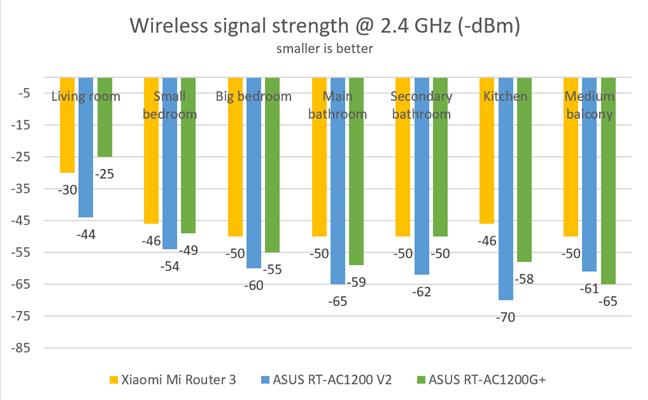
We analyzed the 2.4 GHz band first and measured the signal strength with NetSpot. You can see the evolution of the signal strength in the graph below. The other routers generally outperformed ASUS RT-AC1200 V2 in this regard.
ASUS RT-AC1200 V2 - Wireless signal strength on the 2.4 GHz band
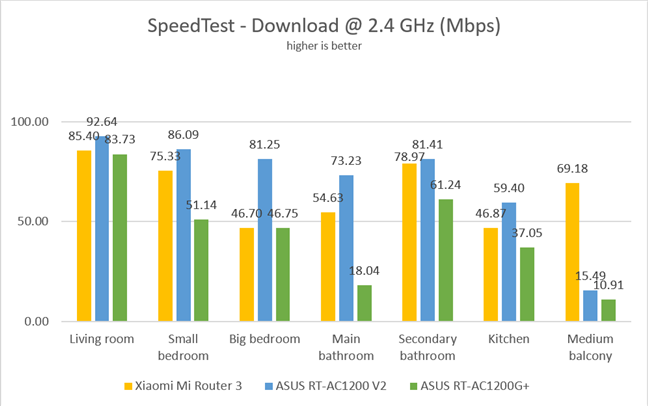
Next, we used SpeedTest to measure the speed of the internet connection when connected to the 2.4 GHz band. ASUS RT-AC1200 V2 offered good download speed in most rooms.
SpeedTest - Download speed on the 2.4 GHz band
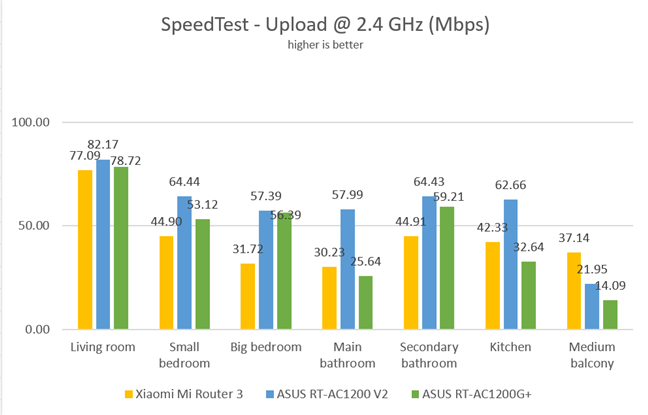
The upload speed was lower in all rooms and followed a similar trend.
SpeedTest - Upload speed on the 2.4 GHz band
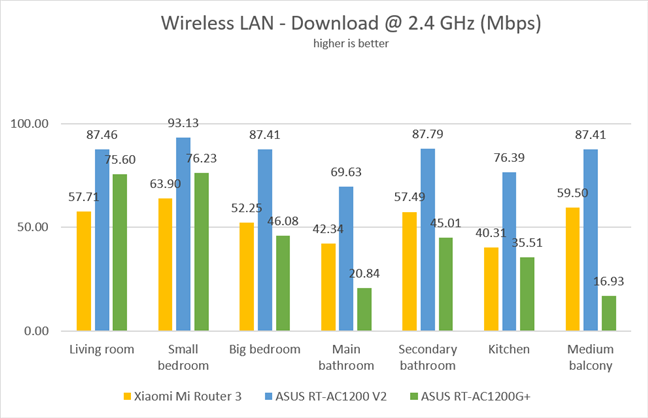
Continuing our measurements on the 2.4 GHz wireless network, we used the PassMark Performance test to transfer data between two computers connected to the network. In this test, ASUS RT-AC1200 V2 had the fastest downloads in our comparison.
Wireless transfers - Download speed on the 2.4 GHz band
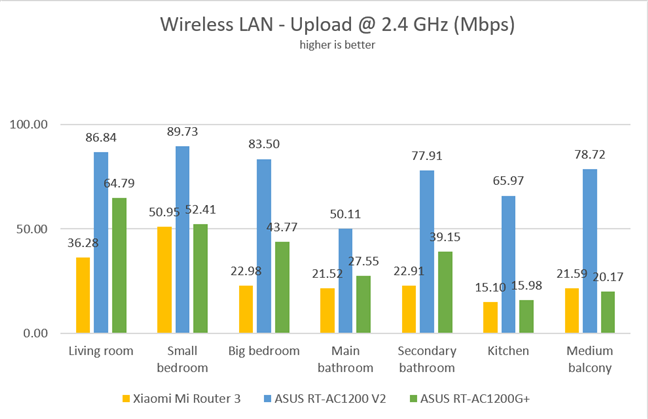
The same thing happened when we measured the upload speed. However, what you can't see in these graphs is that the variability of wireless transfers on the 2.4 GHz band was not the greatest, and it deserves some improvement.
Wireless transfers - Upload speed on the 2.4 GHz band
On the 2.4 GHz wireless band, ASUS RT-AC1200 V2 is reasonably fast, offering the speeds you expect from a router in its price range.
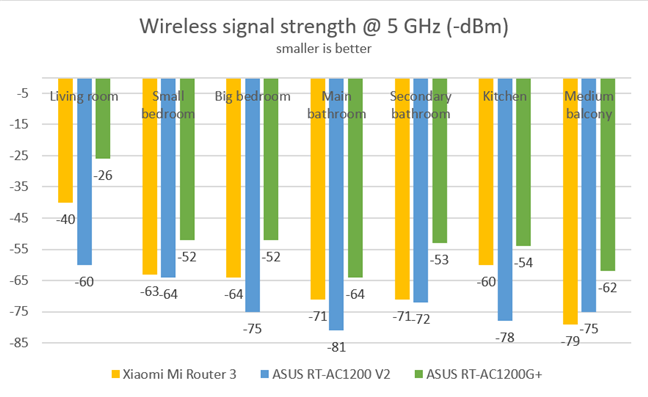
For the next set of measurements, we analyzed the performance of the 5GHz wireless band using Wi-Fi 5. We looked at the evolution of the signal strength from room to room. Once more, ASUS RT-AC1200 V2 was not the top-performing router in this comparison.
ASUS RT-AC1200 V2 - Wireless signal strength on the 5 GHz band
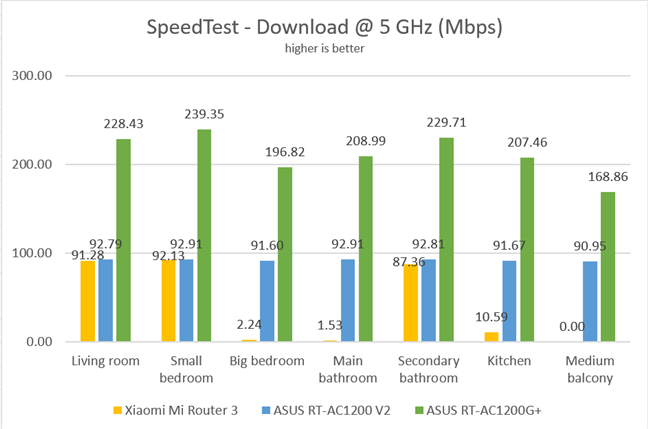
Next, we measured the download speed with SpeedTest in every room of our test apartment. In all rooms, we enjoyed stable downloads close to the maximum speed potential of this router.
SpeedTest - Download speed on the 5 GHz band
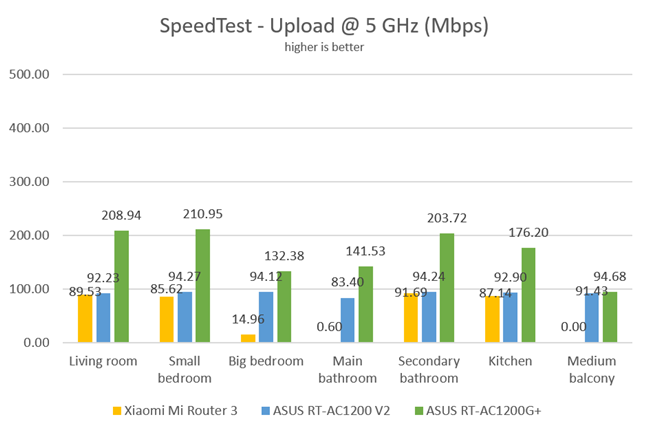
Uploads were sometimes slower, but still stable throughout the apartment.
SpeedTest - Upload speed on the 5 GHz band
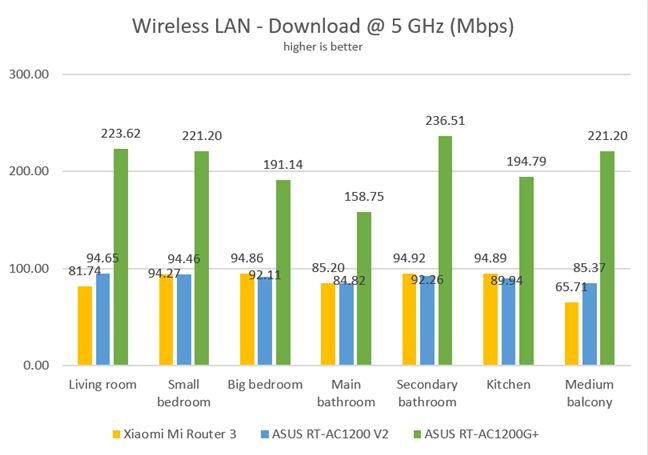
For the last measurements on the 5GHz wireless network, we used the PassMark Performance test to transfer data between two computers connected to the network. The download speed offered by ASUS RT-AC1200 V2 was constant in all rooms.
Wireless transfers - Download speed on the 5 GHz band
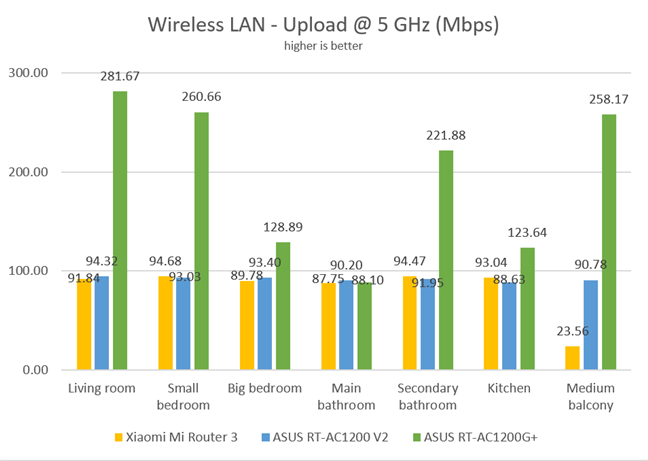
Uploads were slightly slower, but still close to the maximum speed potential of the router.
Wireless transfers - Upload speed on the 5 GHz band
Even though it is an AC1200 wireless router, ASUS RT-AC1200 V2 delivers speeds that are close to 100 Mbps because it is limited to working with internet connections that are up to 100 Mbps.
Wired network performance
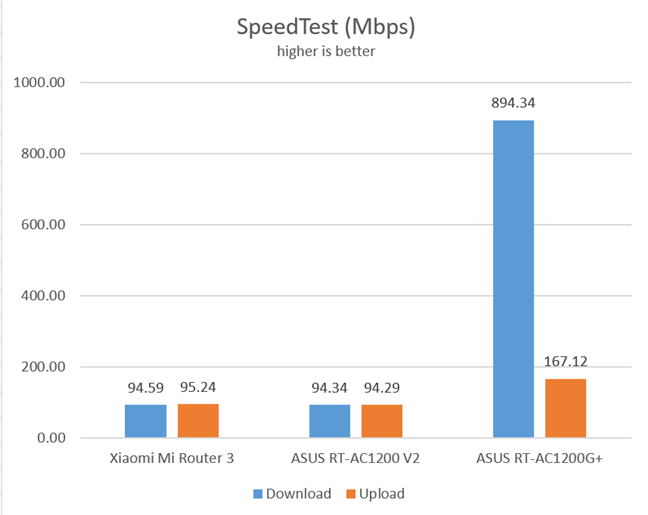
We measured the speed of the internet connection with a 1 Gbps Ethernet cable using SpeedTest. ASUS RT-AC1200 V2 delivered about 94 Mbps both for the download and the upload, which is what we expected from a model that is limited to run at a maximum of 100 Mbps.
SpeedTest on Ethernet connections
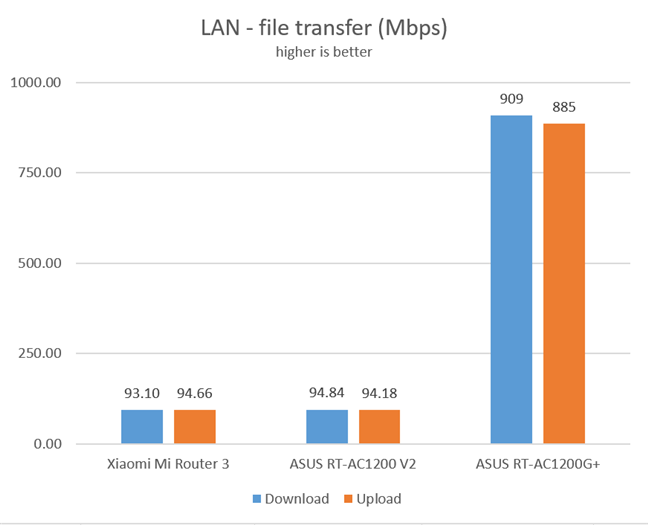
Then, we ran a network transfer between two computers, using the PassMark Performance test. The results were almost identical to the previous test.
Data transfers through Ethernet connections
ASUS RT-AC1200 V2 was built to work at 100 Mbps, and not more. Unfortunately, for most people, this speed is limiting, and other AC1200 routers can offer Ethernet connections at 1 Gbps.
Extra features
The firmware on the ASUS RT-AC1200 V2 is simpler than the one found on more expensive routers. It features only the basics people need from their Wi-Fi router, with some surprising mini-extras:
Guest network - you can enable up to three wireless networks for your guests on each band, with different names, security, access, and bandwidth settings. A neat feature is that you can isolate your guests from the rest of the network.
Traffic Manager - a basic QoS (Quality of Service) feature that helps you manually set limits to how your internet bandwidth is used.
Parental Controls - allows you to set rules for how much time your children can stay connected to the internet on their network device.
Dual WAN - you can use two internet connections on your router. This feature is seldom available on Wi-Fi routers in this price range.
Network Tools - for analyzing the network and identifying what's wrong. They are useful when you need to troubleshoot problems.
IPv6 - support for IPv6 addresses that are going to replace IPv4.
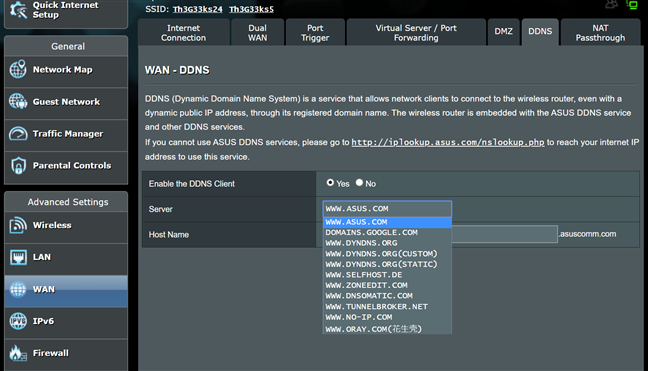
DDNS (Dynamic Domain Name System) - a service that allows you to connect to the router from the internet, even if your internet provider assigns you a dynamic public IP address.
ASUS RT-AC1200 V2 - the DDNS feature
ASUS RT-AC1200 V2 offers all the basics you need to run a Wi-Fi network. However, there's no security included, and most advanced features are lacking. Still, you do get access to Dual WAN, which is a surprising feature for a router this affordable.
What is your opinion about the ASUS RT-AC1200 V2 wireless router?
Now you know what we like and what we don't like about the ASUS RT-AC1200 V2 wireless router. Before closing this review, tell us what you think. Are you interested in purchasing this router? If you already own it, what is your experience with it? Comment below and let's discuss.






























Discussion (0)
Comments are closed.