



Did you ever use a powerline adapter kit to extend the coverage of your network? Have you ever considered this idea? Personally, after testing all kinds of networking devices, I prefer a powerful powerline adapter kit to a range extender. It's more elegant and it tends to work better. And the kit that we are reviewing today (ASUS PL-AC56), got me sold on this concept for good: "Forget about range extenders! Powerline adapter kits are the way!" Read this review and learn why we think this way:
Unboxing the ASUS PL-AC56 1200Mbps AV2 1200 Wi-Fi powerline adapter kit
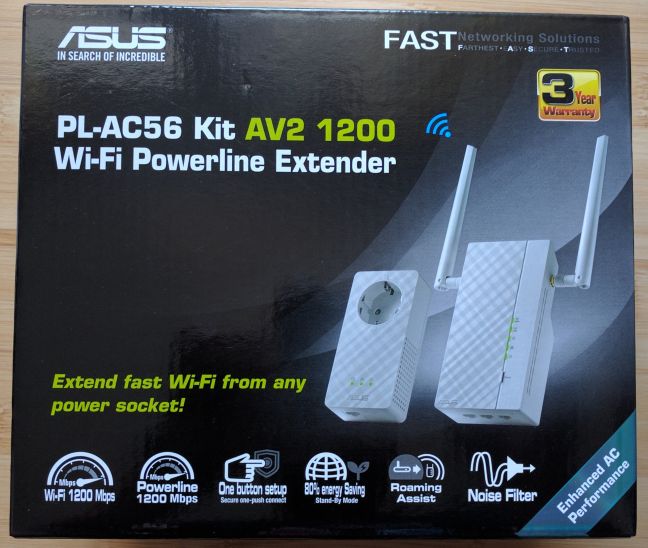
The packaging used by ASUS for the PL-AC56 powerline adapter kit follows the lines of all its networking devices: it's a simple black box with the picture of the device on the front, as well as a list of its most important specifications.
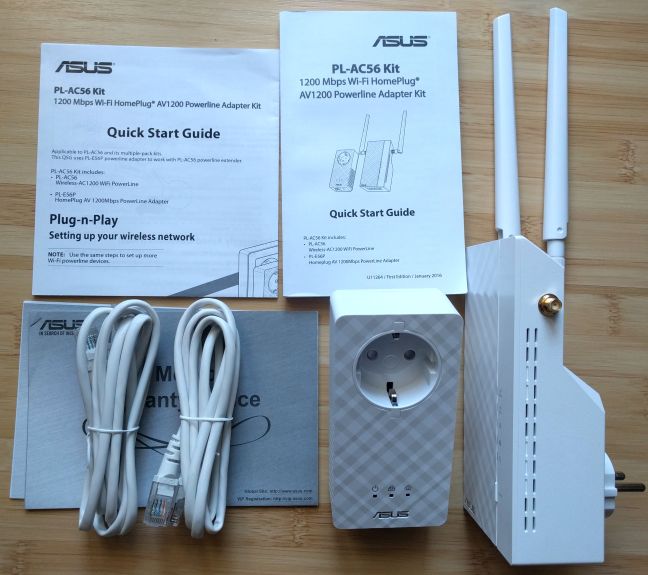
On the back of the box you will find information about how this device works and how to set it up. When you unpack everything, you will find the following items: the two devices that make up the powerline kit (the ASUS PL-E56P adapter and the PL-AC56 extender), two Ethernet cables, the external antennas for the ASUS PL-AC56 extender, the quick start guide, the warranty and other leaflets.
Now that you know about the unboxing experience, let's take a look at what this kit has to offer in terms of specifications and design.
Hardware specifications and design
Unfortunately, the specifications offered by ASUS for this kit are not very detailed. First of all, we have two devices that make up the kit: the ASUS PL-E56P adapter and the PL-AC56 extender.
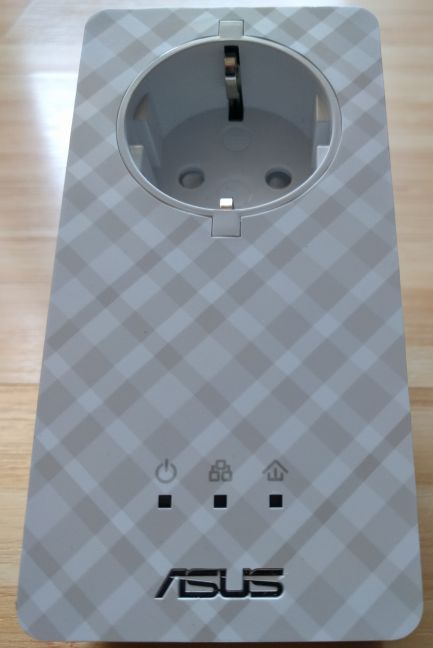
The ASUS PL-E56P adapter is the device that you connect to your wireless router and then you plug into the powerline. Its job is to intermediate the network connection between the router and the ASUS PL-AC56 extender. On the ASUS PL-E56P adapter you will find three LEDs (for Power, Ethernet and the Powerline connection), the Ethernet port for connecting it to the router, the Reset button and the Pair button.
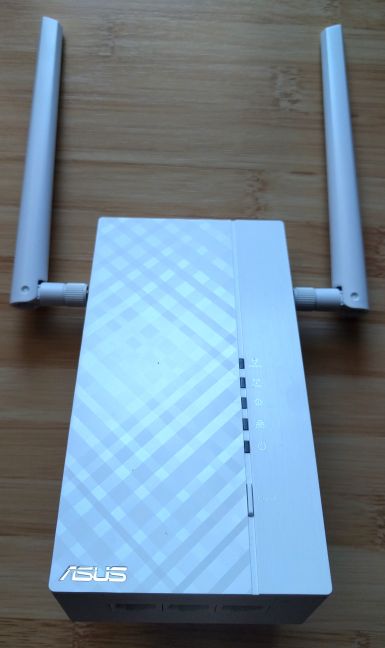
The ASUS PL-AC56 extender has two external antennas that you must connect to it in order for it to broadcast its wireless signal. On its front you will find five LEDs (one for each wireless network that it broadcasts, one for the Powerline connection, one for the Ethernet connection and one for Power) and the Clone button which you can use to connect it to your router using WPS and have it clone your router's wireless settings. On the sides of this device you will also find three Ethernet ports which you can use to connect up to three devices, the Reset button, the Power switch and the Pair button.
In terms of size, both devices are quite large and heavy: the ASUS PL-E56P adapter has a size of 4.7 x 2.3 x 1.5 inches (12 x 6 x 4 cm) in length x width x height and it weighs 0.9 pounds or 423 grams, while the ASUS PL-AC56 extender has a size of 5.9 x 3.14 x 1.69 inches (15 x 8 x 4.3 cm) and it weighs 1.73 pounds or 787 grams, with the two antennas mounted on it.
The ASUS PL-AC56 extender is a dual-band device , meaning that it broadcasts two wireless networks: one using the 2.4 GHz frequency and one using the 5 GHz frequency. The maximum total theoretical bandwidth is of 1200 Mps, split as follows: 300 Mbps on the 2.4 GHz frequency and 867 Mbps on the 5 GHz frequency (that's a total of 1167 Mbps, if you do the math). The ASUS PL-AC56 kit supports the modern wireless networking standards: 802.11n and 802.11ac. I t also offers support for all the modern wireless encryption standards, including WPA2.
You can find its official specifications here: ASUS PL-AC56 Kit - Specifications.
Setting up and using the ASUS PL-AC56 powerline adapter kit
The procedure for setting up the ASUS PL-AC56 kit involves several steps. First, you connect the ASUS PL-E56P adapter to your wireless router and plug it into the powerline. Then, you take ASUS PL-AC56 extender, you plug it into the powerline, wait for it to start and then pair it with the ASUS PL-E56P adapter. Once that is done, you connect to the network that is broadcast by the ASUS PL-AC56 extender and start configuring it from a web browser. As you can see below, the setup wizard is quite easy to follow.
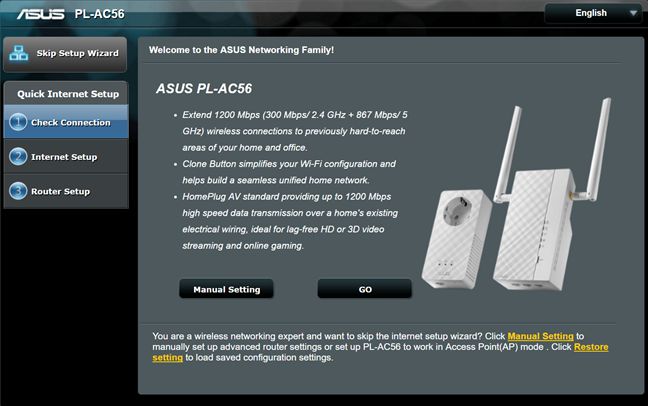
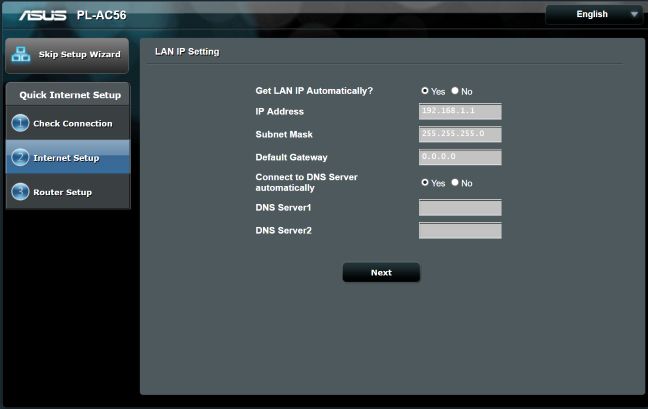
You get to change the default username and password for administering the device, set its IP address, how it connects to DNS servers and set the wireless networks that it broadcasts. One bug that we found is that the ASUS PL-AC56 tends to use the same IP address as all ASUS wireless routers do. Therefore, if you have more than one ASUS networking device, you might get conflicting IP addresses on your network and it is best that you manually set the IP address of the ASUS PL-AC56 kit to be something else than the default address.
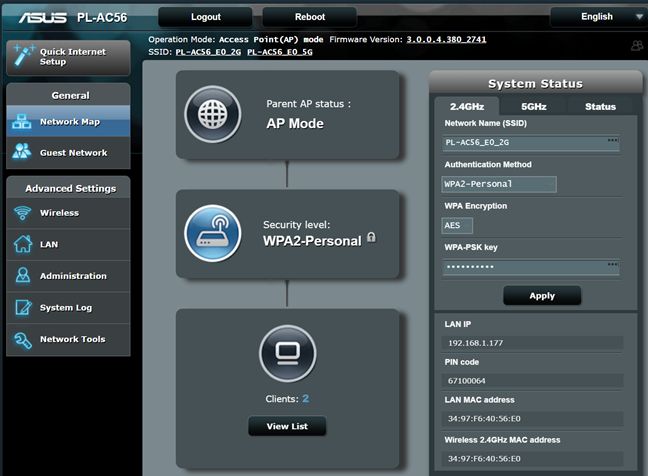
The user interface for administering the device is the classic used by ASUS for all its networking devices, which is great. This means that the user interface looks good, it is well organized, well documented and easy to use.
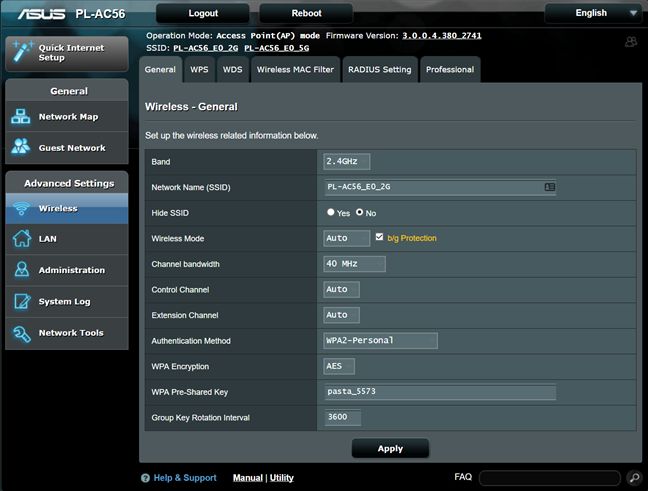
Also, you get access to plenty of advanced settings, so that you can configure in detail how the device works. Knowledgeable users will appreciate this a lot.
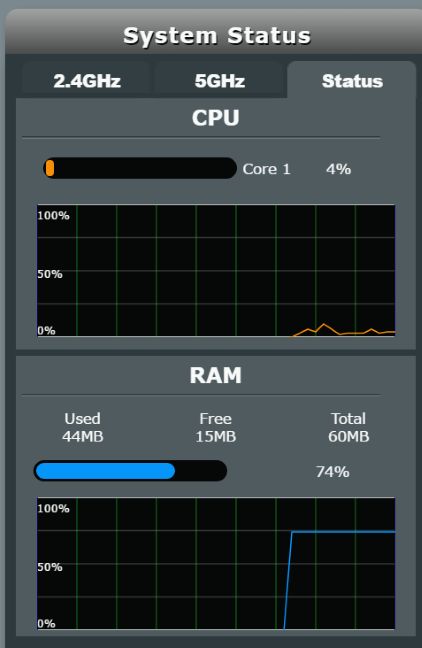
One nice touch in the user interface is the fact that it offers two status graphs which show you the processor and the RAM usage. As you can see below, the ASUS PL-AC56 kit has 60 MB of RAM and an unknown one-core processor.
Non-E nglish speaking users will appreciate the very good multilingual support that is offered by ASUS. Below you can see a list with the 18 languages in which the user interface is available for this powerline adapter kit.

Once the setup is out of the way, you will find that using the ASUS PL-AC56 kit is very easy. We had no issues in connecting both wireless and wired devices to it. Also, in the room where we wanted to extend the network with better coverage and speed, we had no stability or performance issues. But more about the performance offered by this kit, on page 2 of this review.
Wireless network performance
First, let's take a look at the apartment that was used in our testing and how it is set up (the apartment has 753 square feet or 70 square meters). You can see that the router is placed in the living room. With most wireless routers, the signal strength is not that great in rooms like the kitchen. That's why we placed the powerline extender in the kitchen and this is where we made all our measurements. During our testing we used a very fast internet connection capable of downloads of 1 Gbps and of uploads up to 200 Mbps. Our router is ASUS RT-AC88U.
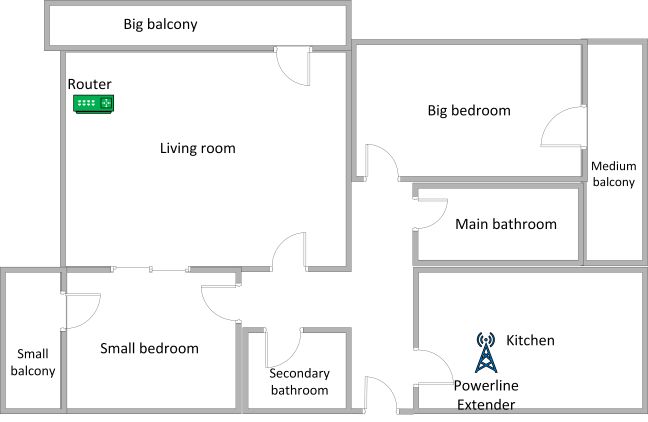
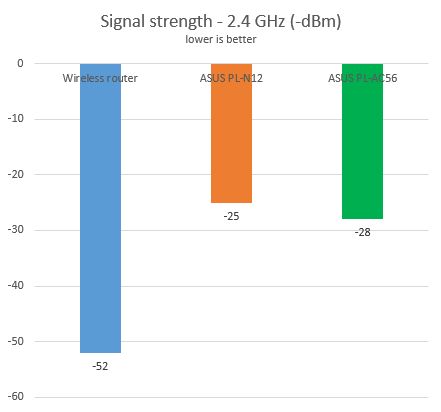
We used a Microsoft Surface Pro 3 for all our measurements and several software tools. To get a better perspective of the performance offered by the ASUS PL-AC56, we compared it with the only other powerline kit that we've tested so far: ASUS PL-N12. That device is much cheaper and it is a single-band device, that's working only using the 2.4 GHz wireless frequency. Therefore, in our measurements on the 5 GHz frequency, this device won't show up for comparison.
We started by evaluating the 2.4 GHz wireless network and measured the signal strength offered, using a tool named inSSIDer. As you can see below, the signal strength that was delivered by ASUS PL-AC56 was very good.
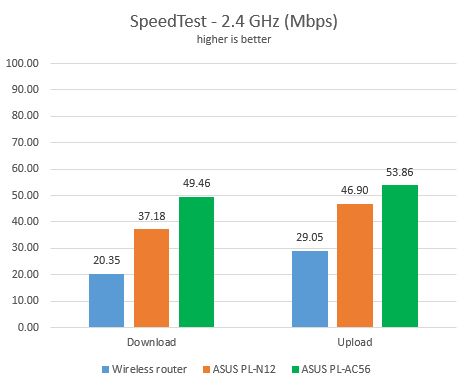
Then, we measured the speed of the internet connection that is offered by ASUS PL-AC56, on the 2.4 GHz wireless frequency, using SpeedTest. In this test ASUS PL-AC56 managed to offer good download and upload speeds, better than our router and the ASUS PL-N12 kit.
Then, we used LAN Speed Test Lite to measure the wireless download and upload speeds when transferring a 350MB file through the network. The results were good, in line with what we measured with SpeedTest.
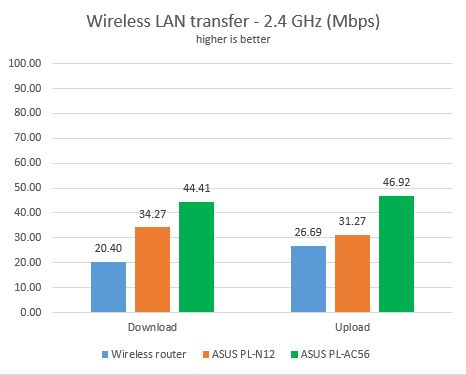
When it comes to the 2.4 GHz wireless network, our conclusion is that the ASUS PL-AC56 kit can deliver a solid connection, that's faster than that of cheaper models.
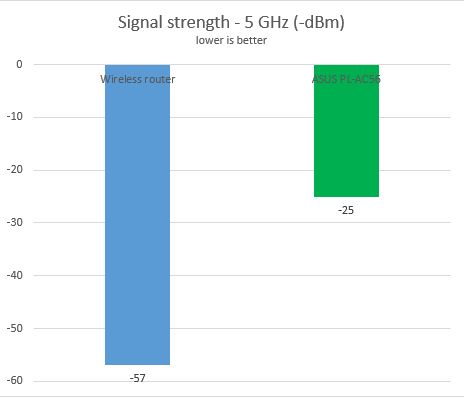
Next, we analyzed the performance offered by the 5GHz wireless network. First, we looked at the signal strength. Again, ASUS PL-AC56 delivered what we expected: solid signal strength.
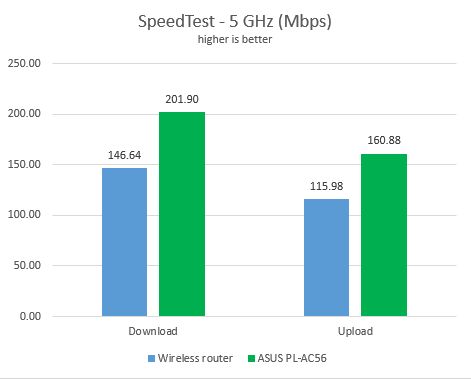
When we measured the speed of the internet connection that is offered by ASUS PL-AC56 on the 5 GHz frequency, we were very pleased. As you can see below, we had no issues in reaching 200 Mbps in download speed.
Lastly, we used LAN Speed Test Lite to measure the wireless download and upload speeds when transferring a 350MB file through the network. While the results were not as great as in the previous measurement, the speed offered by ASUS PL-AC56 was solid, better than what our router could deliver in the same room.
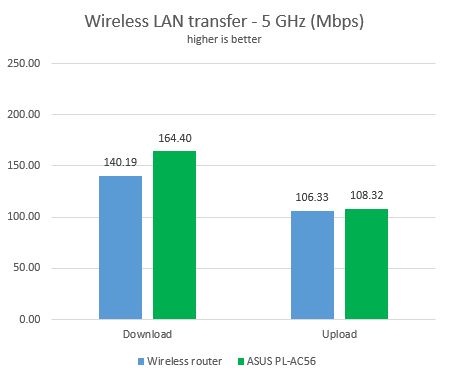
The wireless network that is broadcast by the ASUS PL-AC56 kit on the 5 GHz frequency is one of the strengths of this kit.
Wired network performance
We mentioned earlier in this review that the ASUS PL-AC56 powerline adapter kit offers three Ethernet ports so that you can connect up to three devices. In order to test the quality of the wired Ethernet connection, we used a desktop PC, equipped with an Intel Core i5 4460 processor, running at 3.20GHz, 16GB of RAM and a very fast Samsung 850 Pro 512GB SSD and a Microsoft Surface Pro 3 with an Intel Core i5-4300U processor, running at 1.9 GHz, 8 GB of RAM and a fast 256 GB SSD drive from Samsung. We connected the Surface Pro 3 to the ASUS PL-AC56 kit and the desktop PC to the router.
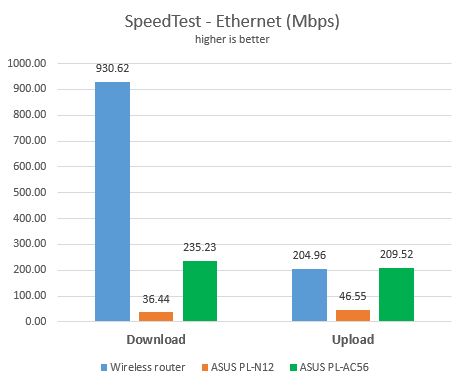
First, we measured the download and upload speeds using SpeedTest. The ASUS PL-AC56 kit delivered an average download speed of 235.23 Mbps, which is a great result.
Then, we used LAN Speed Test Lite to measure the wireless download and upload speeds when transferring a 350MB file through the network. Here, ASUS PL-AC56 kit delivered an average download speed of 241,90 Mbps. We were impressed!
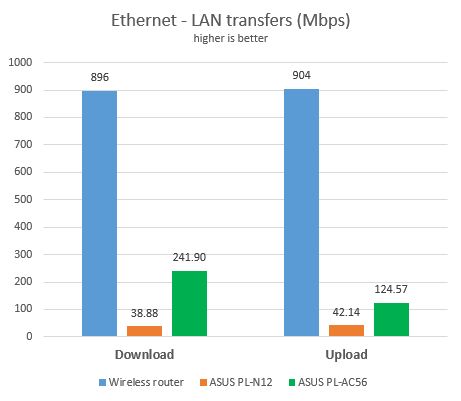
The ASUS PL-AC56 kit delivers Ethernet connections of up to 250 Mbps, which is great for a powerline adapter.
Extra features
The ASUS PL-AC56 kit includes several extra features that you don't generally expect from this devices of this type:
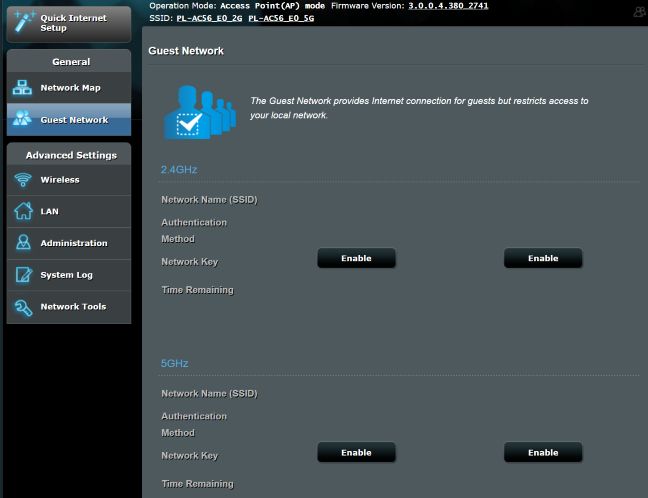
- Guest network - you can set the ASUS PL-AC56 kit to broadcast up to two guest wireless networks for each band: 2.4 GHz and 5 GHz. It is possible to enable a maximum of four guest networks.
- WDS (Wireless Distribution System) - you can set the kit to work not only as an access point that connects to the network through the powerline but also as a repeater that takes the wireless signal of your router and repeats it in your home.
- Network tools - allows you to troubleshoot network problems using commands like ping or netstat.
The extra tools that are offered by the ASUS PL-AC56 kit are not many but they sure are useful. Other devices of this type offer even less in this regard.
Pros and cons
Here are the pros of the ASUS PL-AC56 powerline adapter kit:
- Very good performance on the 5 GHz wireless frequency
- Very good performance when using Ethernet connections
- The user interface for administering the kit is easy to use
- Lots of manual controls and settings
- Great multilingual support
- Useful extra features that you don't tend to get from other manufacturers
There are also some downsides to this kit:
- It's rather expensive
- Both devices that make up the kit are very large and this may be an inconvenience to some users
- You need to pay attention when setting it up for the first time, if you want things to work correctly

Verdict
If we were to sum up the ASUS PL-AC56 powerline adapter kit into one sentence, this would be it: it's a great choice for people who want very solid performance, especially on the 5 GHz wireless frequency and don't mind the premium price. This kit is big, made out of two large devices, with two external antennas on the extender, it's heavy and it delivers! It's also easy to use both by beginners as well as experts and it has great multilingual support.
The only other downside except the price, is that you need to pay a bit of attention during its initial setup, so that you do get everything right on the first try.
Discussion (0)
Comments are closed.