




ASUS RT-AX68U is the spiritual successor of a very popular wireless router: ASUS RT-AC68U. The new model has an elegant look, offering support for Wi-Fi 6, excellent security features, and an innovative VPN app for your mobile devices. If you want to know what you get when buying the ASUS RT-AX68U AX2700 dual-band Wi-Fi 6 router and how it works in the real world, read this review:
![Verdict]()

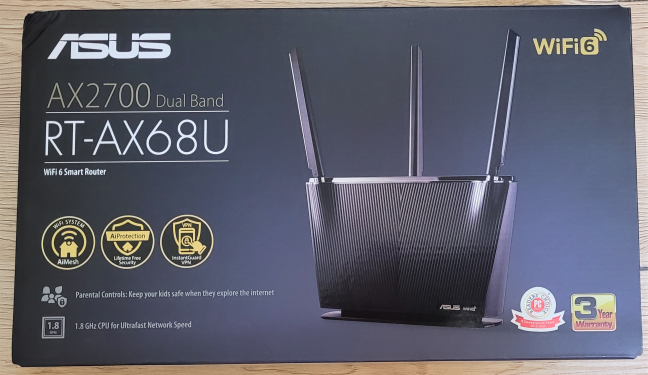
 The packaging used for ASUS RT-AX68U
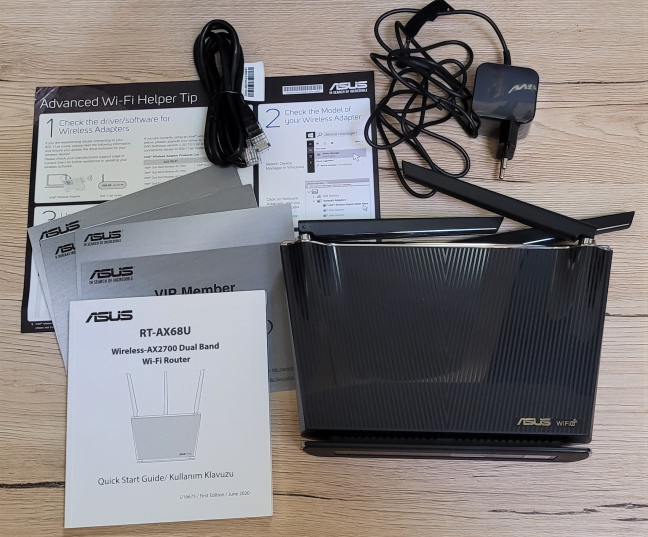
After unpacking everything, you find the following items inside the box: the router itself, its power adapter, a CAT5e network cable, the warranty, the quick start guide, and a leaflet with information about Wi-Fi 6. The brochure tells you about the possible compatibility issues between the Wi-Fi 6 standard and older devices that might not detect networks broadcast using this standard.
The packaging used for ASUS RT-AX68U
After unpacking everything, you find the following items inside the box: the router itself, its power adapter, a CAT5e network cable, the warranty, the quick start guide, and a leaflet with information about Wi-Fi 6. The brochure tells you about the possible compatibility issues between the Wi-Fi 6 standard and older devices that might not detect networks broadcast using this standard.
 Unboxing the ASUS RT-AX68U
ASUS RT-AX68U offers a quick and pleasant unboxing experience. As you would expect, inside the box, you have everything you need to get started and set up your network.
Unboxing the ASUS RT-AX68U
ASUS RT-AX68U offers a quick and pleasant unboxing experience. As you would expect, inside the box, you have everything you need to get started and set up your network.
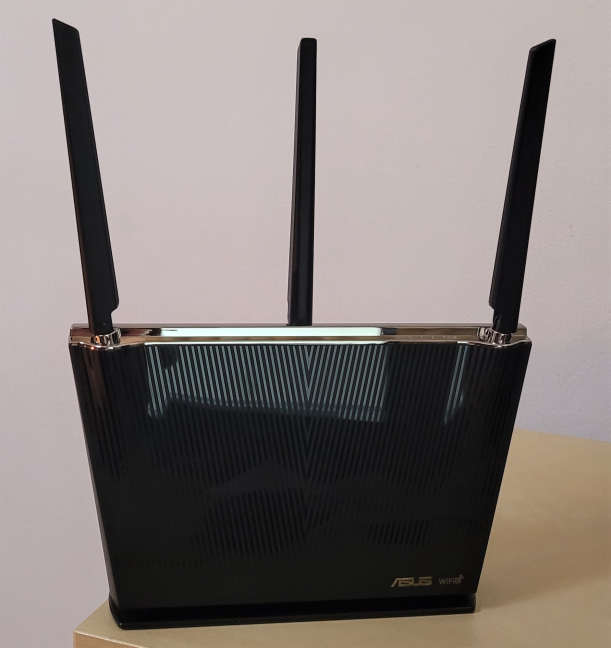
 ASUS RT-AX68U has three non-detachable antennas
As you can see, the router is made of light plastic materials. The dominant color is black, and the router fits quite well in an elegant living room. The top margin is silver, and it includes a few discrete LEDs that signal the functioning status of the router and the Wi-Fi. They are tiny and nicely integrated into the top margin, so that they don’t bother users, not even during the night.
ASUS RT-AX68U has three non-detachable antennas
As you can see, the router is made of light plastic materials. The dominant color is black, and the router fits quite well in an elegant living room. The top margin is silver, and it includes a few discrete LEDs that signal the functioning status of the router and the Wi-Fi. They are tiny and nicely integrated into the top margin, so that they don’t bother users, not even during the night.
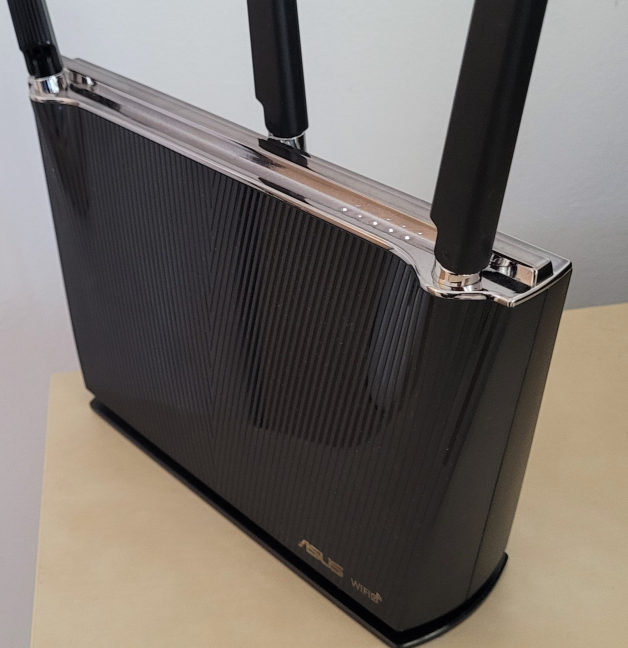
 The LEDs on ASUS RT-AX68U are very discreet
This router doesn't have any holes for mounting it on walls, and on the bottom, there are rubber feet that hold it in place on flat surfaces and stickers with information about your specific device.
ASUS RT-AX68U has a size of 10.19 x 2.66 x 7.33 inches or 25.8 x 6.75 x 18.6 cm, and it weighs 1.38 lbs or about 625 grams. On the back, you find the ports available on the router: the WAN port and four Ethernet ports, all working at 1 Gbps, one USB 2.0 port, and one USB 3.0 port. There’s also the Power jack, the WPS and Reset buttons, as well as the button for turning the router on and off.
The LEDs on ASUS RT-AX68U are very discreet
This router doesn't have any holes for mounting it on walls, and on the bottom, there are rubber feet that hold it in place on flat surfaces and stickers with information about your specific device.
ASUS RT-AX68U has a size of 10.19 x 2.66 x 7.33 inches or 25.8 x 6.75 x 18.6 cm, and it weighs 1.38 lbs or about 625 grams. On the back, you find the ports available on the router: the WAN port and four Ethernet ports, all working at 1 Gbps, one USB 2.0 port, and one USB 3.0 port. There’s also the Power jack, the WPS and Reset buttons, as well as the button for turning the router on and off.
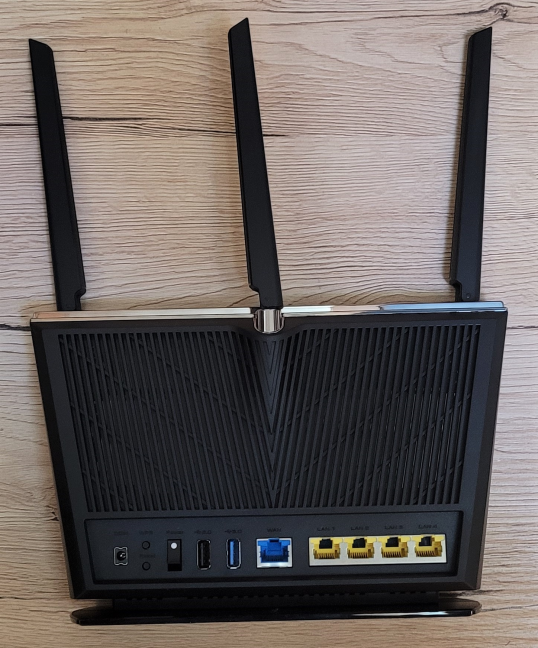
 The ports on the back of the ASUS RT-AX68U
ASUS RT-AX68U is powered by a dual-core Broadcom BCM4906 processor, running at 1.8 GHz, 512 MB of RAM, and 256 MB of storage for the firmware. It is a dual-band router, with a maximum theoretical bandwidth split as follows: 861 Mbps on the 2.4 GHz band, and 1802 Mbps when using the 5 GHz band, while both are using the Wi-Fi 6 standard.
If you would like to learn more about this wireless router’s technical specifications, visit this page: ASUS RT-AX68U Specifications.
The ports on the back of the ASUS RT-AX68U
ASUS RT-AX68U is powered by a dual-core Broadcom BCM4906 processor, running at 1.8 GHz, 512 MB of RAM, and 256 MB of storage for the firmware. It is a dual-band router, with a maximum theoretical bandwidth split as follows: 861 Mbps on the 2.4 GHz band, and 1802 Mbps when using the 5 GHz band, while both are using the Wi-Fi 6 standard.
If you would like to learn more about this wireless router’s technical specifications, visit this page: ASUS RT-AX68U Specifications.
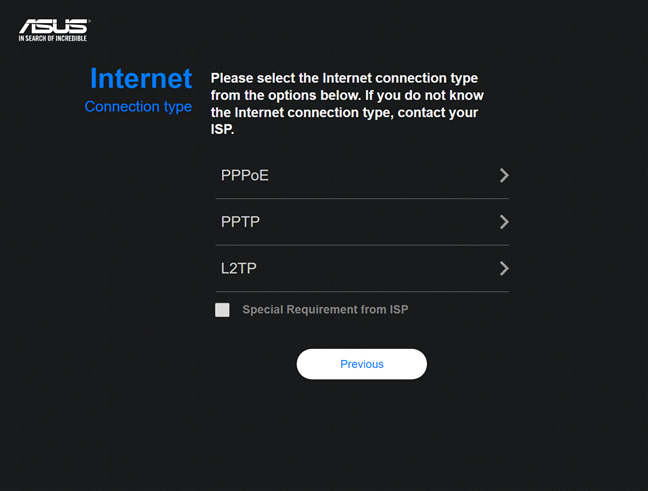
 Setting up the internet connection on ASUS RT-AX68U
When turning on Wi-Fi 6, ASUS informs you that some wireless network cards may have connectivity issues with this standard. Before enabling it, it is a good idea to update the network drivers on all your laptops, computers, and devices.
NOTE: If you have a Sony PS5 console, and you want to know how well it works with Wi-Fi 6 networks, read: Sony PS5 & Wi-Fi 6: How does it work with an ASUS router for gaming?
When the quick setup is finished, connect your devices to the network and access the firmware for more fine-tuning. This router’s administration interface is easy to use, well organized into logical sections, and available in 25 languages. You control everything you wish, and both casual and advanced users will be happy with the level of detail they receive.
Setting up the internet connection on ASUS RT-AX68U
When turning on Wi-Fi 6, ASUS informs you that some wireless network cards may have connectivity issues with this standard. Before enabling it, it is a good idea to update the network drivers on all your laptops, computers, and devices.
NOTE: If you have a Sony PS5 console, and you want to know how well it works with Wi-Fi 6 networks, read: Sony PS5 & Wi-Fi 6: How does it work with an ASUS router for gaming?
When the quick setup is finished, connect your devices to the network and access the firmware for more fine-tuning. This router’s administration interface is easy to use, well organized into logical sections, and available in 25 languages. You control everything you wish, and both casual and advanced users will be happy with the level of detail they receive.
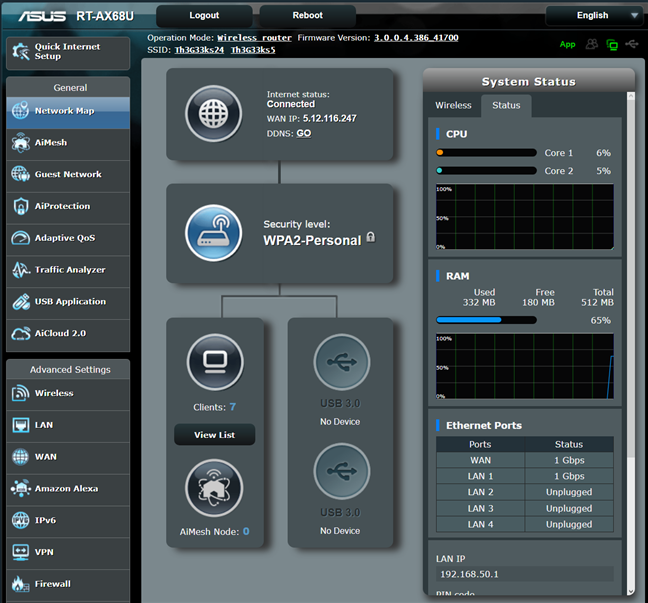
 The firmware on the ASUS RT-AX68U
The help documentation is easily accessible: when you move the mouse cursor over a setting that you do not understand, a question mark is shown. Click the question mark, and you see information explaining that setting. Unfortunately, the documentation has not been updated to include information about all the latest firmware features, so this trick does not work for everything. However, it works often enough to be useful.
The firmware on the ASUS RT-AX68U
The help documentation is easily accessible: when you move the mouse cursor over a setting that you do not understand, a question mark is shown. Click the question mark, and you see information explaining that setting. Unfortunately, the documentation has not been updated to include information about all the latest firmware features, so this trick does not work for everything. However, it works often enough to be useful.
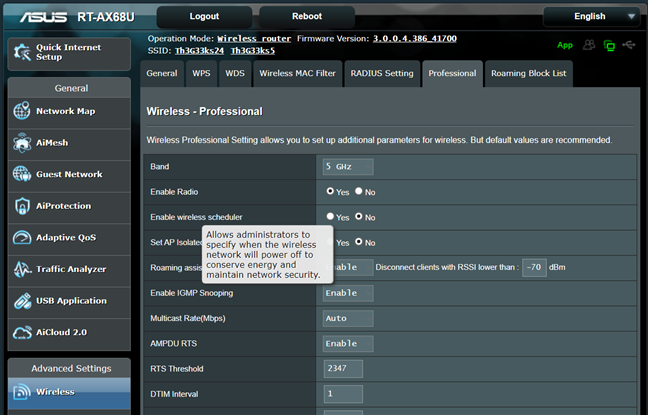
 See more info about a setting on ASUS RT-AX68U
You can also set up and manage the router from any Android smartphone or iPhone using the ASUS Router app. The app can be used from anywhere on the internet, and it includes plenty of settings that can be configured.
See more info about a setting on ASUS RT-AX68U
You can also set up and manage the router from any Android smartphone or iPhone using the ASUS Router app. The app can be used from anywhere on the internet, and it includes plenty of settings that can be configured.
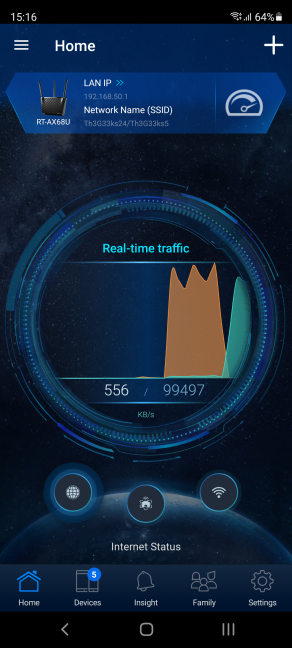
 The ASUS Router app works with ASUS RT-AX68U
To make this router even more appealing, ASUS RT-AX68U, alongside other Wi-Fi 6 models, offers support for Instant Guard - a new mobile app created by ASUS that allows you to connect to your home network through VPN from a public Wi-Fi. This way, you can benefit from an encrypted connection that is not easily snooped by others and from the AiProtection module bundled with ASUS RT-AX68U.
The ASUS Router app works with ASUS RT-AX68U
To make this router even more appealing, ASUS RT-AX68U, alongside other Wi-Fi 6 models, offers support for Instant Guard - a new mobile app created by ASUS that allows you to connect to your home network through VPN from a public Wi-Fi. This way, you can benefit from an encrypted connection that is not easily snooped by others and from the AiProtection module bundled with ASUS RT-AX68U.
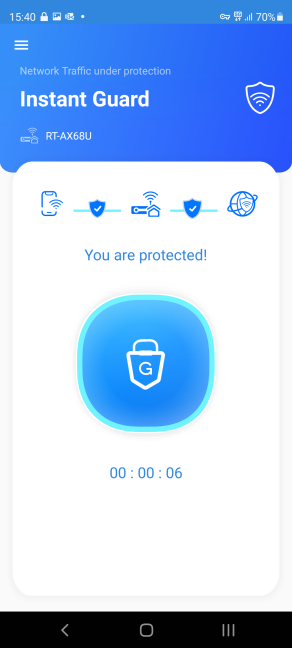 The Instant Guard app works with ASUS RT-AX68U
To verify the quality of the Wi-Fi broadcast by ASUS RT-AX68U, we took our laptop and moved it to a room that is separated by one wall from the router. We made a wireless transfer on it, using a specialized app that measured the average speed and the network transfer variability. On the 2.4 GHz band and the Wi-Fi 4 standard, the average speed was higher than that of other Wi-Fi 6 routers we tested in recent months. However, the variability of the wireless transfer was relatively high.
The Instant Guard app works with ASUS RT-AX68U
To verify the quality of the Wi-Fi broadcast by ASUS RT-AX68U, we took our laptop and moved it to a room that is separated by one wall from the router. We made a wireless transfer on it, using a specialized app that measured the average speed and the network transfer variability. On the 2.4 GHz band and the Wi-Fi 4 standard, the average speed was higher than that of other Wi-Fi 6 routers we tested in recent months. However, the variability of the wireless transfer was relatively high.
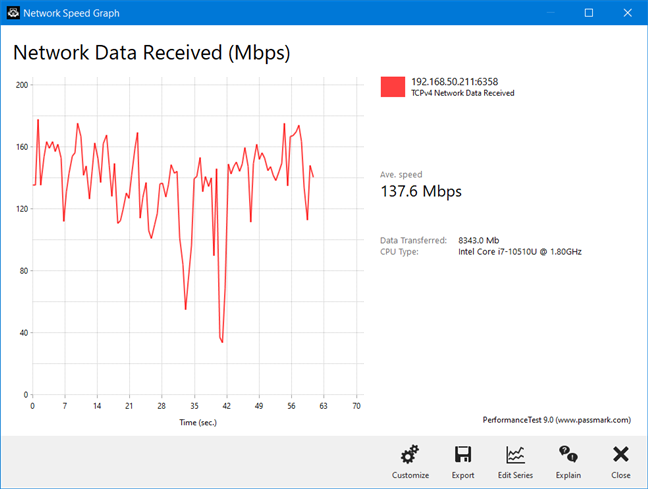
 ASUS RT-AX68U - Wireless transfer on Wi-Fi 4
We switched to the 5 GHz band and the Wi-Fi 5 standard, and we were super pleased both with the average download speed that we measured and how stable the transfer was.
ASUS RT-AX68U - Wireless transfer on Wi-Fi 4
We switched to the 5 GHz band and the Wi-Fi 5 standard, and we were super pleased both with the average download speed that we measured and how stable the transfer was.
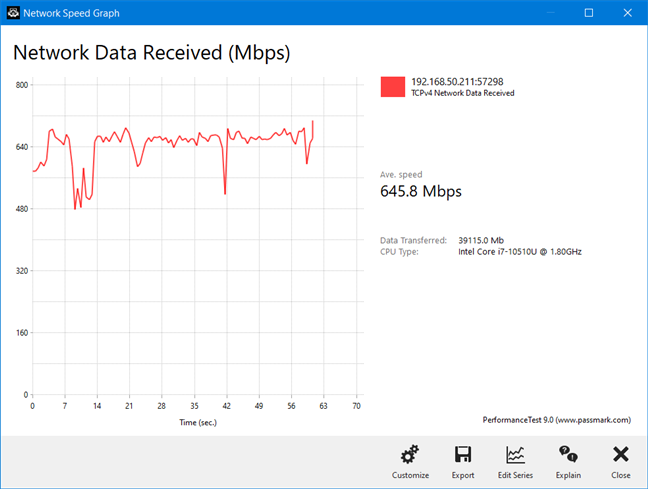 ASUS RT-AX68U - Wireless transfer on Wi-Fi 5
We switched to Wi-Fi 6 on the 5 GHz band, and the wireless data transfer was even stabler than on Wi-Fi 5, but the average speed was slightly lower.
ASUS RT-AX68U - Wireless transfer on Wi-Fi 5
We switched to Wi-Fi 6 on the 5 GHz band, and the wireless data transfer was even stabler than on Wi-Fi 5, but the average speed was slightly lower.
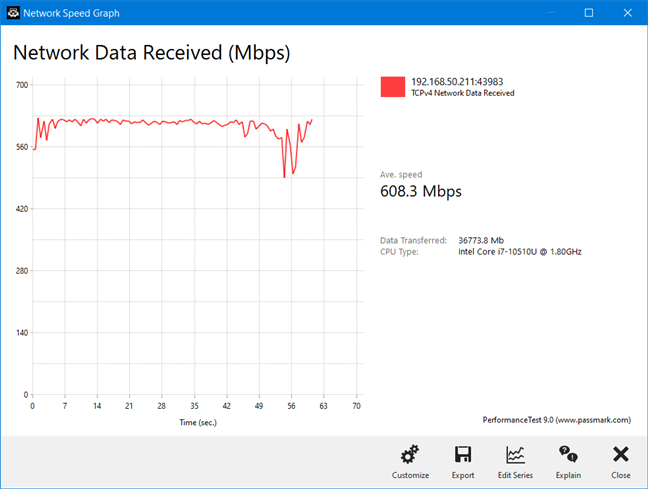 ASUS RT-AX68U - Wireless transfer on Wi-Fi 6
We were satisfied with how ASUS RT-AX68U worked in our testing, especially when using the older standards: Wi-Fi 4 and Wi-Fi 5. If you have many older devices that don’t yet work well with Wi-Fi 6, you may prefer this router because of its reliable performance when using the older standards.
If you want to know more about the real-world performance offered by ASUS RT-AX68U, including comparisons with other wireless routers, go to the next page of this review.
ASUS RT-AX68U - Wireless transfer on Wi-Fi 6
We were satisfied with how ASUS RT-AX68U worked in our testing, especially when using the older standards: Wi-Fi 4 and Wi-Fi 5. If you have many older devices that don’t yet work well with Wi-Fi 6, you may prefer this router because of its reliable performance when using the older standards.
If you want to know more about the real-world performance offered by ASUS RT-AX68U, including comparisons with other wireless routers, go to the next page of this review.
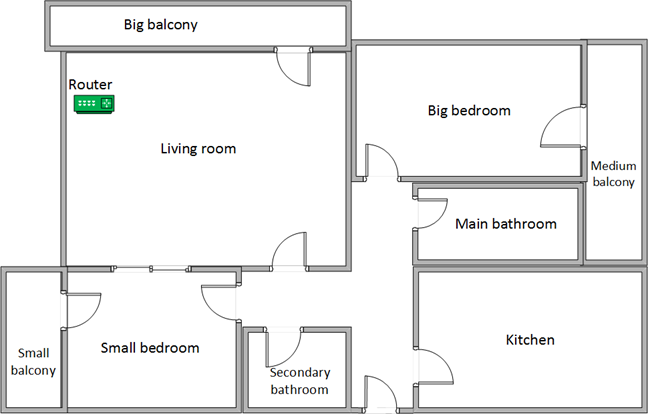
 The apartment in which we tested ASUS RT-AX68U
Our testing was done using a fast 1 Gigabit Internet connection capable of uploads on the internet of up to 800 Mbps. We evaluated the Wi-Fi emitted by ASUS RT-AX68U using the following standards: Wi-Fi 4 on the 2.4 GHz band, Wi-Fi 5, and Wi-Fi 6 on the 5 GHz band.
To get a better idea of the performance offered by ASUS RT-AX68U, we compared it with ASUS RT-AX82U and TP-Link Archer AX20. We analyzed the 2.4 GHz band first when using the Wi-Fi 4 standard, and we measured the signal strength with NetSpot. You can see its evolution in the graphic below.
The apartment in which we tested ASUS RT-AX68U
Our testing was done using a fast 1 Gigabit Internet connection capable of uploads on the internet of up to 800 Mbps. We evaluated the Wi-Fi emitted by ASUS RT-AX68U using the following standards: Wi-Fi 4 on the 2.4 GHz band, Wi-Fi 5, and Wi-Fi 6 on the 5 GHz band.
To get a better idea of the performance offered by ASUS RT-AX68U, we compared it with ASUS RT-AX82U and TP-Link Archer AX20. We analyzed the 2.4 GHz band first when using the Wi-Fi 4 standard, and we measured the signal strength with NetSpot. You can see its evolution in the graphic below.
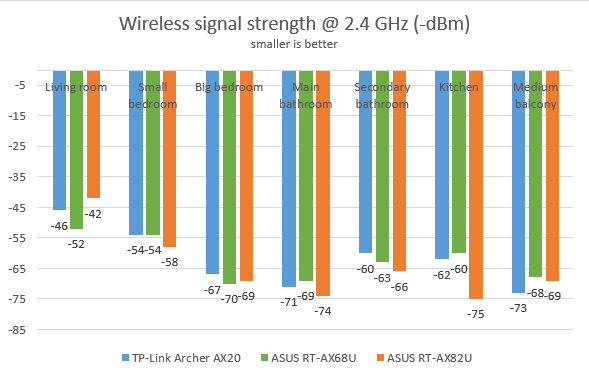
 ASUS RT-AX68U - Signal strength on the 2.4 GHz band
Then, we used SpeedTest to evaluate the speed of the internet connection when using Wi-Fi 4. The download speed offered by ASUS RT-AX68U was a lot higher than that of the routers we compared it to in all the rooms of our test apartment.
ASUS RT-AX68U - Signal strength on the 2.4 GHz band
Then, we used SpeedTest to evaluate the speed of the internet connection when using Wi-Fi 4. The download speed offered by ASUS RT-AX68U was a lot higher than that of the routers we compared it to in all the rooms of our test apartment.
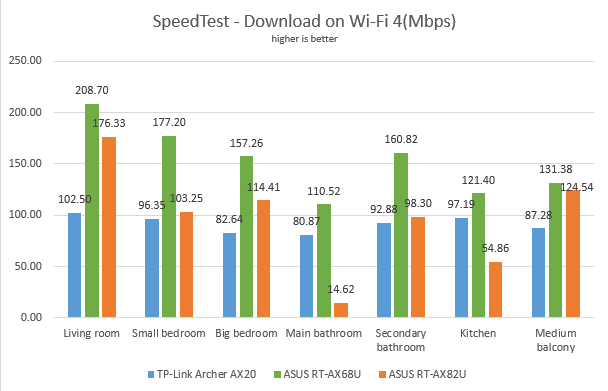
 ASUS RT-AX68U - Downloads in SpeedTest, on Wi-Fi 4
The same happened with the upload speed too.
ASUS RT-AX68U - Downloads in SpeedTest, on Wi-Fi 4
The same happened with the upload speed too.
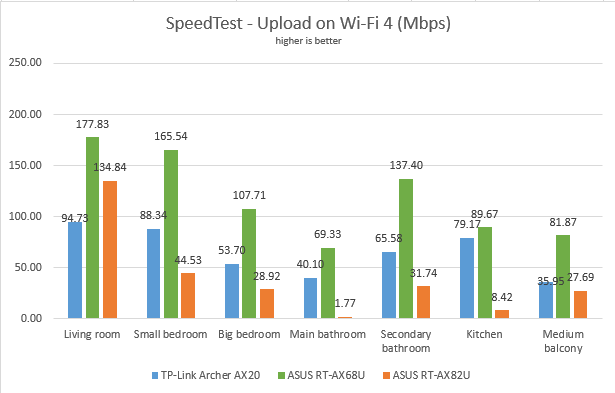
 ASUS RT-AX68U - Uploads in SpeedTest, on Wi-Fi 4
We used the PassMark Performance test to transfer data between two computers connected to the network on the 2.4 GHz band when using Wi-Fi 4. This time too, ASUS RT-AX68U offered the fastest download speed in our comparison.
ASUS RT-AX68U - Uploads in SpeedTest, on Wi-Fi 4
We used the PassMark Performance test to transfer data between two computers connected to the network on the 2.4 GHz band when using Wi-Fi 4. This time too, ASUS RT-AX68U offered the fastest download speed in our comparison.
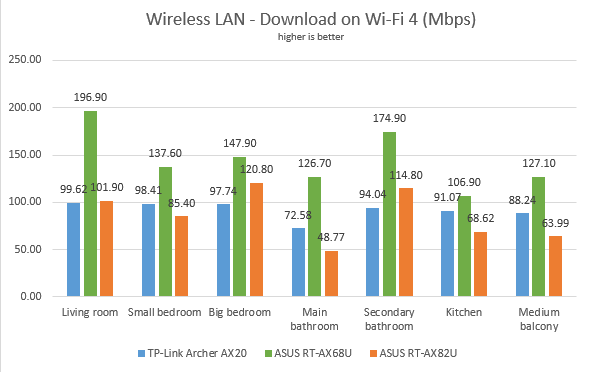
 ASUS RT-AX68U - Downloads on Wi-Fi 4
Except for one room, ASUS RT-AX68U was also the champion when measuring the upload speed.
ASUS RT-AX68U - Downloads on Wi-Fi 4
Except for one room, ASUS RT-AX68U was also the champion when measuring the upload speed.
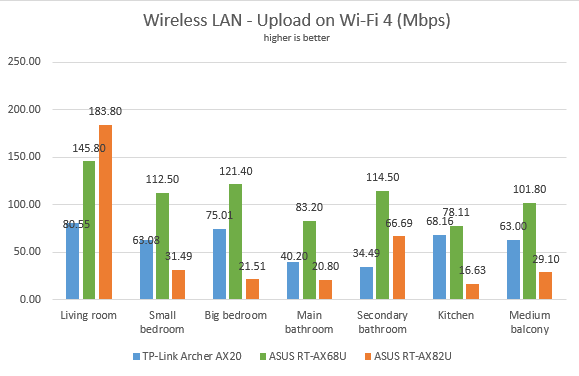
 ASUS RT-AX68U - Uploads on Wi-Fi 4
On the 2.4 GHz band, when using the Wi-Fi 4 standard, ASUS RT-AX68U offered excellent performance, proving that it is an excellent choice for people with older devices, stuck with using the dated Wi-Fi 4 (802.11n) standard.
We analyzed the 5GHz wireless band using the Wi-Fi 5 and Wi-Fi 6 standards for the next set of measurements. We started by looking at the evolution of the signal strength from room to room, and you can see the data that we gathered in the graphic below.
ASUS RT-AX68U - Uploads on Wi-Fi 4
On the 2.4 GHz band, when using the Wi-Fi 4 standard, ASUS RT-AX68U offered excellent performance, proving that it is an excellent choice for people with older devices, stuck with using the dated Wi-Fi 4 (802.11n) standard.
We analyzed the 5GHz wireless band using the Wi-Fi 5 and Wi-Fi 6 standards for the next set of measurements. We started by looking at the evolution of the signal strength from room to room, and you can see the data that we gathered in the graphic below.
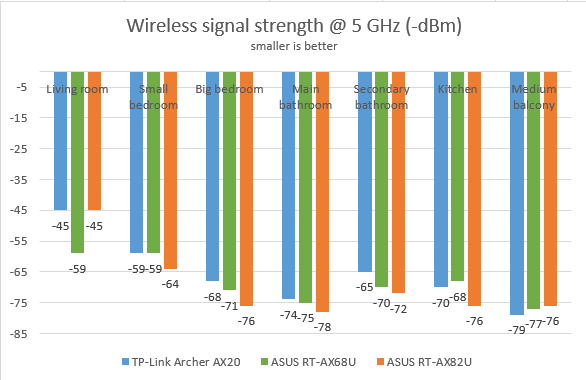
 ASUS RT-AX68U - Signal strength on the 5 GHz band
We used SpeedTest to measure the speed of the internet connection when connected to the 5 GHz band using the Wi-Fi 5 standard. In some rooms, ASUS RT-AX68U delivered super fast downloads, while in a few, it was outmatched by the routers we compared it to.
ASUS RT-AX68U - Signal strength on the 5 GHz band
We used SpeedTest to measure the speed of the internet connection when connected to the 5 GHz band using the Wi-Fi 5 standard. In some rooms, ASUS RT-AX68U delivered super fast downloads, while in a few, it was outmatched by the routers we compared it to.
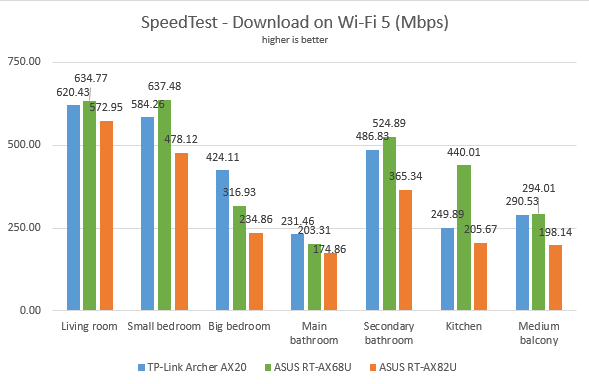
 ASUS RT-AX68U - Downloads in SpeedTest, on Wi-Fi 5
Uploads were very fast, almost everywhere in our test apartment.
ASUS RT-AX68U - Downloads in SpeedTest, on Wi-Fi 5
Uploads were very fast, almost everywhere in our test apartment.
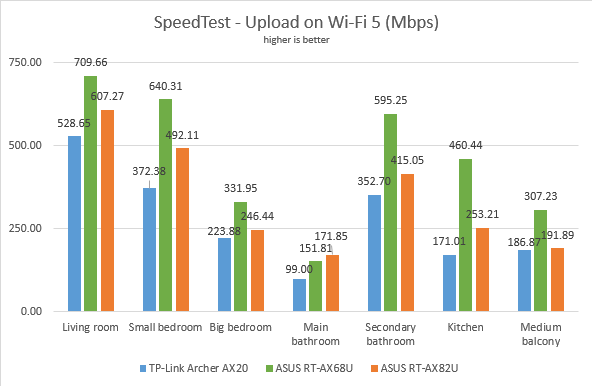
 ASUS RT-AX68U - Uploads in SpeedTest, on Wi-Fi 5
We then used the PassMark Performance test to transfer data between two computers connected to the network using Wi-Fi 5. In this test, ASUS RT-AX68U performed well, but it was no longer a clear speed winner, as it was when using SpeedTest.
ASUS RT-AX68U - Uploads in SpeedTest, on Wi-Fi 5
We then used the PassMark Performance test to transfer data between two computers connected to the network using Wi-Fi 5. In this test, ASUS RT-AX68U performed well, but it was no longer a clear speed winner, as it was when using SpeedTest.
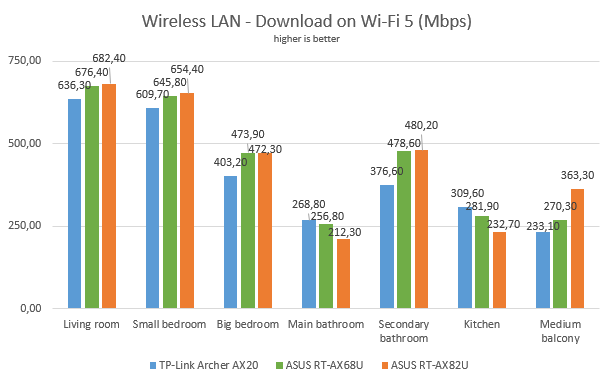
 ASUS RT-AX68U - Downloads on Wi-Fi 5
The upload speeds offered by ASUS RT-AX68U were very good in most rooms, but again, there was no clear winner in this measurement.
ASUS RT-AX68U - Downloads on Wi-Fi 5
The upload speeds offered by ASUS RT-AX68U were very good in most rooms, but again, there was no clear winner in this measurement.
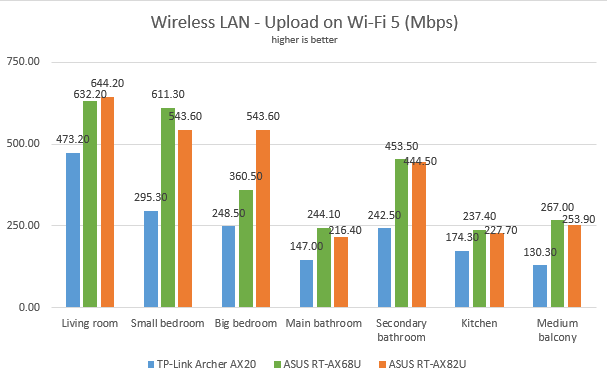
 ASUS RT-AX68U - Uploads on Wi-Fi 5
When using the 5 GHz band and the Wi-Fi 5 standard, ASUS RT-AX68U is a fast and reliable router, which offers speeds that don’t disappoint.
We remained on the 5 GHz wireless band, but we switched to using the Wi-Fi 6 standard and ran SpeedTest in all the rooms of our apartment. ASUS RT-AX68U performed well in all rooms, but the download speed it offered was lower than that of the routers we compared it to.
ASUS RT-AX68U - Uploads on Wi-Fi 5
When using the 5 GHz band and the Wi-Fi 5 standard, ASUS RT-AX68U is a fast and reliable router, which offers speeds that don’t disappoint.
We remained on the 5 GHz wireless band, but we switched to using the Wi-Fi 6 standard and ran SpeedTest in all the rooms of our apartment. ASUS RT-AX68U performed well in all rooms, but the download speed it offered was lower than that of the routers we compared it to.
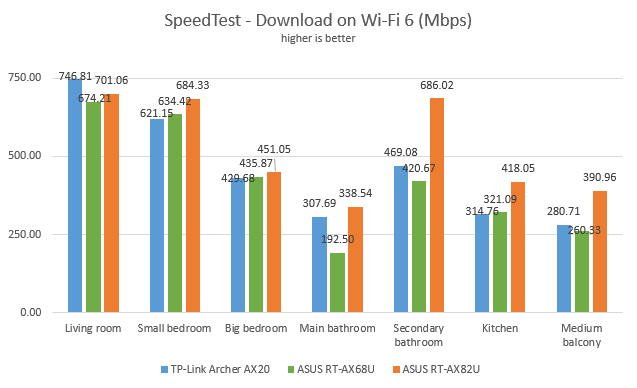
 ASUS RT-AX68U - Downloads in SpeedTest, on Wi-Fi 6
The same happened when measuring the upload speed. The more expensive ASUS RT-AX82U was faster than RT-AX68U in many rooms, but not in all of them.
ASUS RT-AX68U - Downloads in SpeedTest, on Wi-Fi 6
The same happened when measuring the upload speed. The more expensive ASUS RT-AX82U was faster than RT-AX68U in many rooms, but not in all of them.
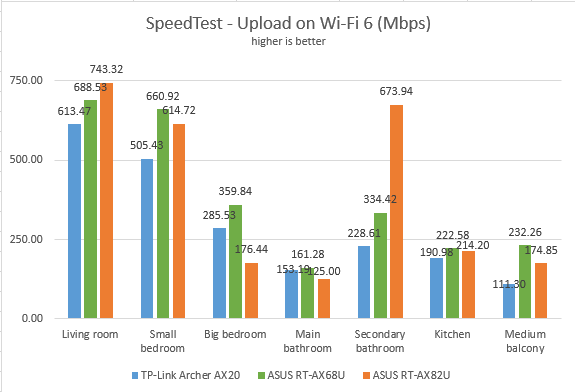
 ASUS RT-AX68U - Uploads in SpeedTest, on Wi-Fi 6
Lastly, we used the PassMark Performance test to transfer data between two computers connected to the network using Wi-Fi 6. We enjoyed faster downloads than when using SpeedTest, and in a few rooms, ASUS RT-AX68U was the quickest router in our comparison.
ASUS RT-AX68U - Uploads in SpeedTest, on Wi-Fi 6
Lastly, we used the PassMark Performance test to transfer data between two computers connected to the network using Wi-Fi 6. We enjoyed faster downloads than when using SpeedTest, and in a few rooms, ASUS RT-AX68U was the quickest router in our comparison.
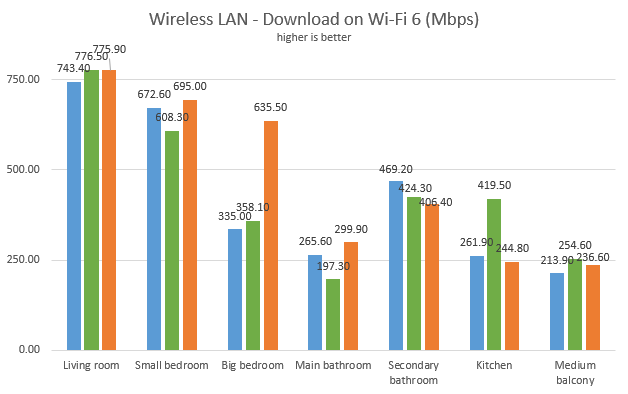
 ASUS RT-AX68U - Downloads on Wi-Fi 6
Upload speeds were good too, but ASUS RT-AX68U did not break any records, and it was outmatched by the routers we compared it to.
ASUS RT-AX68U - Downloads on Wi-Fi 6
Upload speeds were good too, but ASUS RT-AX68U did not break any records, and it was outmatched by the routers we compared it to.
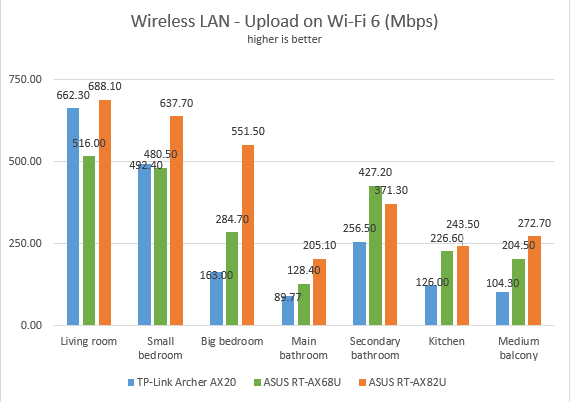
 ASUS RT-AX68U - Uploads on Wi-Fi 6
When using Wi-Fi 6, ASUS RT-AX68U performs well, but it doesn’t outperform its competitors.
ASUS RT-AX68U - Uploads on Wi-Fi 6
When using Wi-Fi 6, ASUS RT-AX68U performs well, but it doesn’t outperform its competitors.
 ASUS RT-AX68U - SpeedTest on Ethernet connections
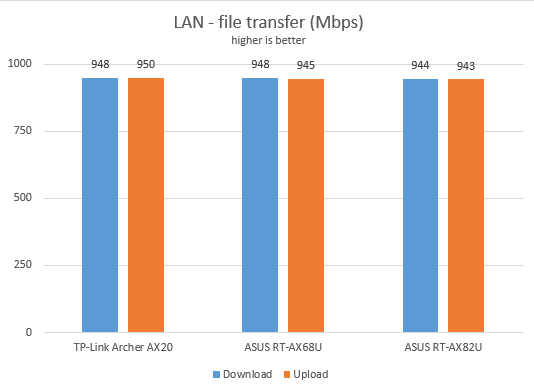
Then, we ran a network transfer between two computers using the PassMark Performance test. This time, all three routers in our comparison offered very similar results.
ASUS RT-AX68U - SpeedTest on Ethernet connections
Then, we ran a network transfer between two computers using the PassMark Performance test. This time, all three routers in our comparison offered very similar results.
 ASUS RT-AX68U - Transfers on Ethernet connections
ASUS RT-AX68U offers reliable Ethernet connections that work at 1 Gbps.
ASUS RT-AX68U - Transfers on Ethernet connections
ASUS RT-AX68U offers reliable Ethernet connections that work at 1 Gbps.
 ASUS RT-AX68U - The speed of the USB 3.0 port
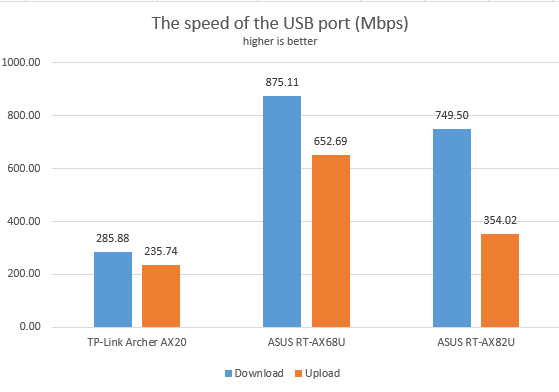
ASUS RT-AX68U has a fast USB 3.0 port that works very well with fast storage solutions that include SSD drives. There’s also a second USB 2.0 port that can be used for connecting printers or other devices that don’t need a lot of speed.
ASUS RT-AX68U - The speed of the USB 3.0 port
ASUS RT-AX68U has a fast USB 3.0 port that works very well with fast storage solutions that include SSD drives. There’s also a second USB 2.0 port that can be used for connecting printers or other devices that don’t need a lot of speed.
 ASUS RT-AX68U works with AiMesh
ASUS RT-AX68U includes the useful AiProtection module that provides the following security features:
ASUS RT-AX68U works with AiMesh
ASUS RT-AX68U includes the useful AiProtection module that provides the following security features:
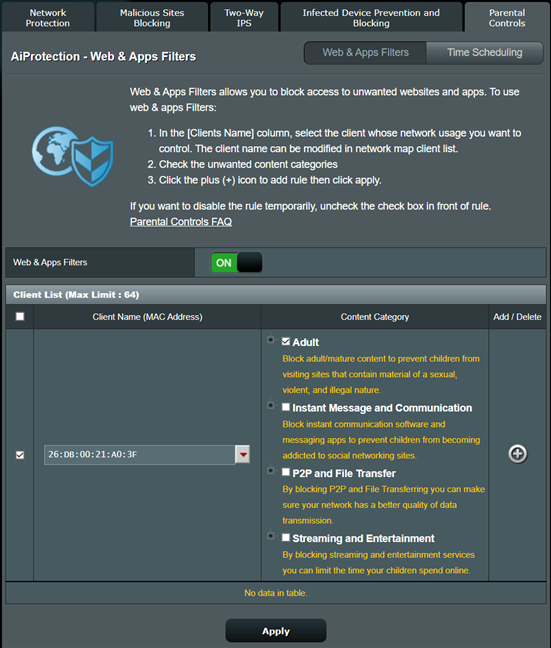
 Parental Controls on ASUS RT-AX68U
The list of advanced features doesn’t stop here though. You also get:
Parental Controls on ASUS RT-AX68U
The list of advanced features doesn’t stop here though. You also get:
ASUS RT-AX68U: Who is it good for?
This wireless router is a suitable choice for:- People who want support for Wi-Fi 6
- Users with less modern devices who also want good performance when using older standards in their network (Wi-Fi 4 and Wi-Fi 5)
- Parents who desire efficient parental controls for their home network
- Users who want a secure network with proper antivirus and firewall protection
- People who want to remotely control their router from anywhere on the internet using a mobile app
- Users who want to control their home network using Alexa and IFTTT (If This, Then That)
Pros and cons
Here are the things we like about ASUS RT-AX68U:
- Wi-Fi 6 support that works well
- Good-looking design that is going to please many users
- Excellent performance when using Wi-Fi 5 and Wi-Fi 4
- Two USB ports: USB 2.0 and a very fast USB 3.0 port
- Excellent security tools and parental controls
- You can remotely control it with a mobile app from anywhere on the internet
- Innovative VPN app that connects your mobile devices to your home network
- Generous multilingual support and easily accessible Help documentation
- It doesn’t have 160MHz channel width support
- It cannot be mounted on walls
Verdict
ASUS RT-AX68U is one of our favorite wireless routers with Wi-Fi 6 for several reasons: we like the way it looks, and we appreciate how it performs when using older standards like Wi-Fi 4 and Wi-Fi 5. Plenty of households and small businesses don’t have many modern devices and computers that work well with Wi-Fi 6. Most Wi-Fi 6 routers focus on providing the best performance when using the new standard, while ASUS RT-AX68U also delivers excellent performance when using the older standards. To top things off, the new Instant Guard mobile app allows you to connect to your home through VPN and protect your mobile devices while on the go. If you want a well-rounded Wi-Fi 6 router, ASUS RT-AX68U is an excellent choice that we recommend to everyone.Unboxing the ASUS RT-AX68U AX2700 dual-band Wi-Fi 6 router
ASUS RT-AX68U comes in a black cardboard box with a picture of the device on the top. The packaging is similar to that of other ASUS Wi-Fi 6 routers, and it is easy to open. You find plenty of information about this model’s hardware and software specifications on all sides of the box.Hardware specifications and design
RT-AX68U follows the design lines of one of ASUS’ most popular models: the venerable RT-AC68U, which is one of the company’s bestsellers. However, ASUS RT-AX68U is a lot thinner, weighs less, and has an updated design that's more modern and elegant than that of its predecessor. ASUS RT-AX68U has three nondetachable external antennas, and it provides support for Wi-Fi 6, WPA3 encryption, and 3x3 MU-MIMO wireless transmissions.Setting up and using the ASUS RT-AX68U router
The setup process for the ASUS RT-AX68U router can be done both in a web browser and with the ASUS Router mobile app. The process involves detecting the type of internet connection that you use, providing the necessary connection details, choosing a name and password for the Wi-Fi, and deciding whether to enable Wi-Fi 6 or not.Wireless network performance
First, let’s look at the apartment used in our testing and how it is set up. ASUS RT-AX68U is placed in the living room. With most wireless routers, the signal strength is not great in places like the Kitchen and the Medium balcony.Wired network performance
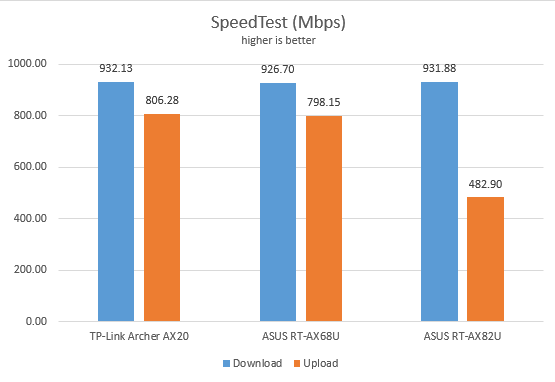
Testing networking performance on Ethernet ports is something that rarely provides any surprises. As expected, ASUS RT-AX68U offers Ethernet ports that work at 1 Gbps, and this was confirmed by the SpeedTest we ran. Our internet connection provides a maximum of 1 Gbps for the download speed and 800 Mbps for the upload. However, back when we tested ASUS RT-AX82U, it was capped at 500 Mbps, and this is why you see this difference in the SpeedTest below.USB performance
We connected a portable SSD to the USB 3.0 port of the ASUS RT-AX68U and made some data transfers. We measured a download speed of 875.11 Mbps, which is excellent, similar to what you get from premium routers that cost a lot more than ASUS RT-AX68U. The upload speed was high too: 652.69 Mbps.Extra features
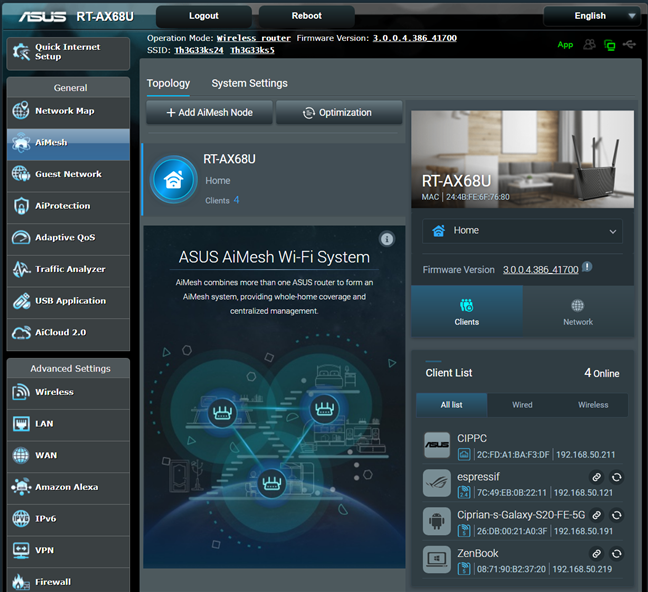
The firmware on the ASUS RT-AX68U is compatible with AiMesh, meaning that you can use this router to create your own, home-made mesh Wi-Fi alongside other ASUS routers. For more details on how it works, read ASUS mesh Wi-Fi: The best of two worlds!- A comprehensive Router Security Assessment tool that verifies whether your settings are secure. When it finds problems, it proactively informs you and helps you fix things.
- Malicious Sites Blocking – an efficient cloud-based module that blocks malicious websites on all the devices connected to your network.
- Two-Way IPS – a two-way intrusion prevention system that protects all your network from spam, DDoS attacks, network attacks, and more. Additionally, it also scans the packets that are sent from your network to the internet.
- Infected Device Prevention and Blocking – if your network devices get infected and become zombies in malware networks, they are automatically blocked, and you are informed about this problem.
- Parental Controls – useful, cloud-based parental controls that can be used to set rules about internet access for children’s devices. If you are interested in using them, read How to set up Parental Controls on an ASUS router and How to control your child’s internet time on your ASUS router.
- Guest Network – you can enable three wireless guest networks with individual security and access settings on each band (2.4 and 5 GHz).
- Adaptive QoS – an advanced Quality of Service feature that you can use to optimize network traffic, including but not limited to online gaming.
- Traffic Analyzer – visual traffic statistics that give you a clear picture of how your network is used and by which devices.
- USB Applications - set up your router to use external hard disks or printers through its USB ports. There’s also support for Apple’s Time Machine functionality from macOS.
- AiCloud 2.0 - gives you the tools to create your cloud storage service using a hard disk connected to the router.
- Dual WAN - you can use two internet connections at the same time.
- IPv6 – support for IPv6 addresses that are going to replace IPv4.
- VPN – you can set the router to work as a VPN server using the following protocols: PPTP, OpenVPN, and IPSec VPN. You can also use it to turn your network-connected devices into VPN-enabled clients without additional VPN software required.
- Network Tools – for analyzing the network and identifying what’s wrong. They are useful when you need to troubleshoot problems.
- DDNS – a service that allows you to connect to the router from the internet, even if your internet provider assigns you a dynamic public IP address.
- Integration with Amazon’s Alexa and IFTTT – you can say things like “Alexa, ask ASUS ROUTER to upgrade the firmware” to perform different tasks. You can also automate tasks that might otherwise be repetitive or unable to “talk to each other.”


Discussion (0)
Comments are closed.