



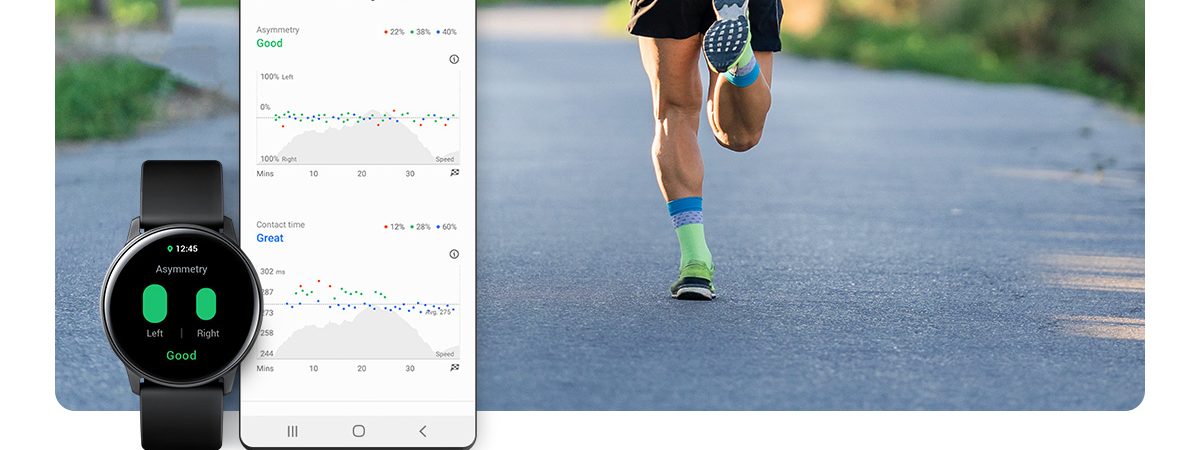
The current circumstances are not the most favorable for sports activities, especially team or competitive activities. Many of us work from home, which can deter us even more from doing sports regularly. In this context, technology has an increasingly important role in preserving our health, in our daily routine, and in achieving goals related to physical activities. Samsung mobile devices have some of the most advanced functions for measuring, evaluating and improving health. We wanted to explore them in detail and evaluate their impact on the user:
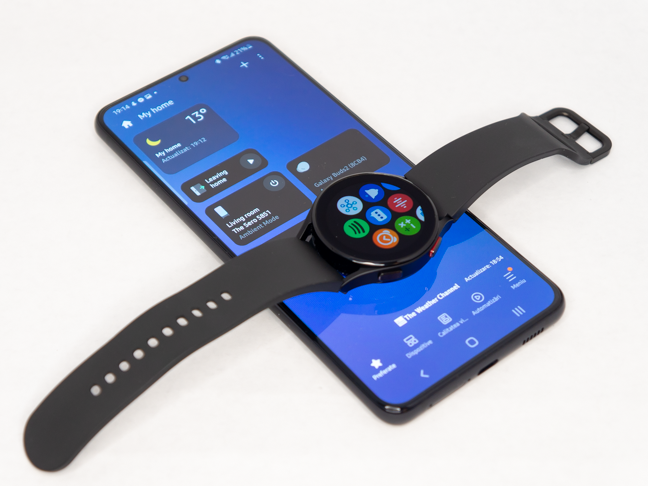
 The Samsung Galaxy S21 Plus and the Samsung Galaxy Watch 4
The Galaxy Wearable and Samsung Health applications are also paramount in retrieving data from the multitude of sensors and presenting them in a simple way. Next, let's see what innovative functions each of the two devices brings and how they are useful to us.
The Samsung Galaxy S21 Plus and the Samsung Galaxy Watch 4
The Galaxy Wearable and Samsung Health applications are also paramount in retrieving data from the multitude of sensors and presenting them in a simple way. Next, let's see what innovative functions each of the two devices brings and how they are useful to us.
 The screen is perfectly legible in bright light
The battery lasts about two days of normal use. A very important feature is the resistance to dust and water, and the Galaxy S21 Plus is very good in this regard as well. The phone is IP68 certified, i.e. it is resistant to dust, sand, and withstands being submerged in up to 1.5 m of water for at least 30 minutes. There will be no danger if you splash water on it by the pool or in case of heavy sweating.
The integrated sensors measure both the steps and the distances traveled. Together with the Samsung Galaxy Watch 4 smartwatch, the phone monitors the user's sleep in detail.
The screen is perfectly legible in bright light
The battery lasts about two days of normal use. A very important feature is the resistance to dust and water, and the Galaxy S21 Plus is very good in this regard as well. The phone is IP68 certified, i.e. it is resistant to dust, sand, and withstands being submerged in up to 1.5 m of water for at least 30 minutes. There will be no danger if you splash water on it by the pool or in case of heavy sweating.
The integrated sensors measure both the steps and the distances traveled. Together with the Samsung Galaxy Watch 4 smartwatch, the phone monitors the user's sleep in detail.
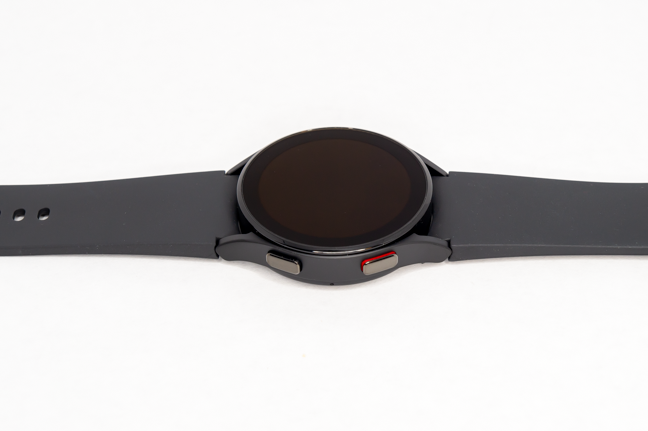
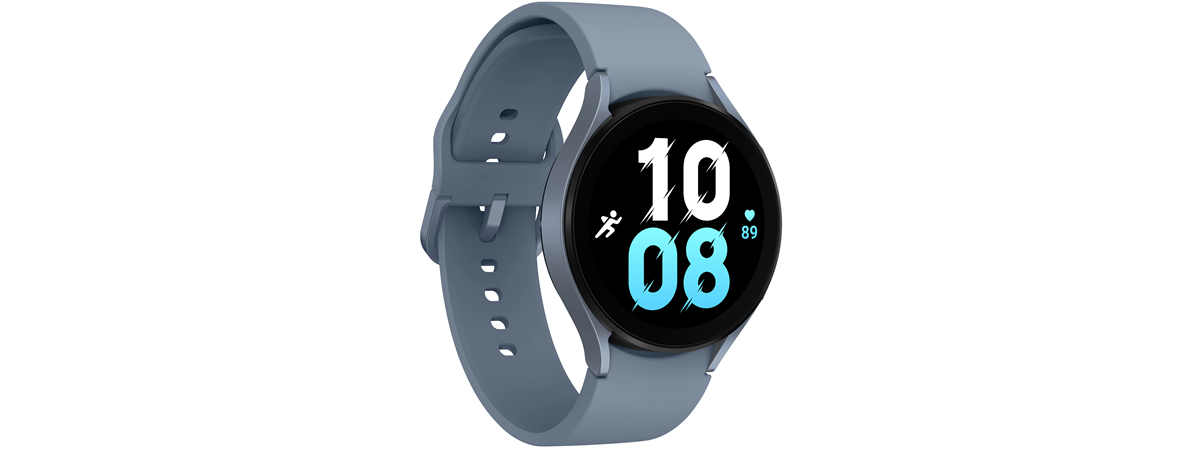
 Galaxy Watch 4 has an elegant, minimalist design
Some technical details relevant to the chosen scenario:
Galaxy Watch 4 has an elegant, minimalist design
Some technical details relevant to the chosen scenario:
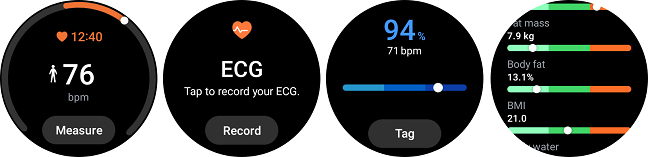
 Some of the measurements that the Samsung Watch 4 can take
The watch can even measure blood pressure, being among only a handful of smartwatches that can do this. We tested the function in detail, and the Samsung Galaxy Watch 4 recorded blood pressure values very close to those measured by a medical blood pressure monitor.
Some of the measurements that the Samsung Watch 4 can take
The watch can even measure blood pressure, being among only a handful of smartwatches that can do this. We tested the function in detail, and the Samsung Galaxy Watch 4 recorded blood pressure values very close to those measured by a medical blood pressure monitor.
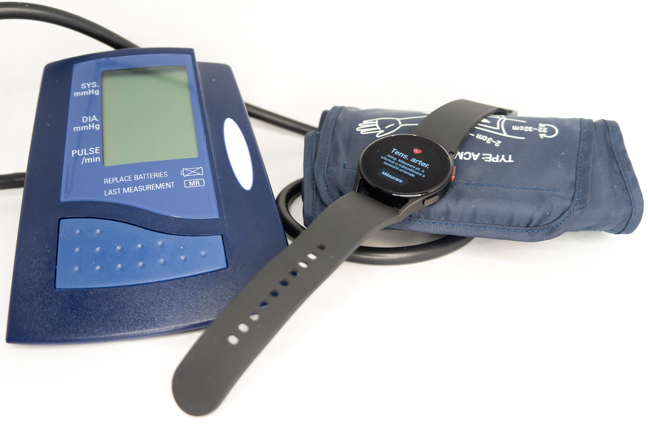 Measuring the blood pressure with a smartwatch isn't just marketing
In our tests, the watch was accurate in measurements and easy to use. The feedback it provided was good, and the battery lasted about a day or even a day and a half if the always-on mode was deactivated. The watch is comfortable even when worn during sleep. If you manage to come to terms with wearing it while sleeping, you get access to detailed data about sleep cycles and sleep quality.
Measuring the blood pressure with a smartwatch isn't just marketing
In our tests, the watch was accurate in measurements and easy to use. The feedback it provided was good, and the battery lasted about a day or even a day and a half if the always-on mode was deactivated. The watch is comfortable even when worn during sleep. If you manage to come to terms with wearing it while sleeping, you get access to detailed data about sleep cycles and sleep quality.
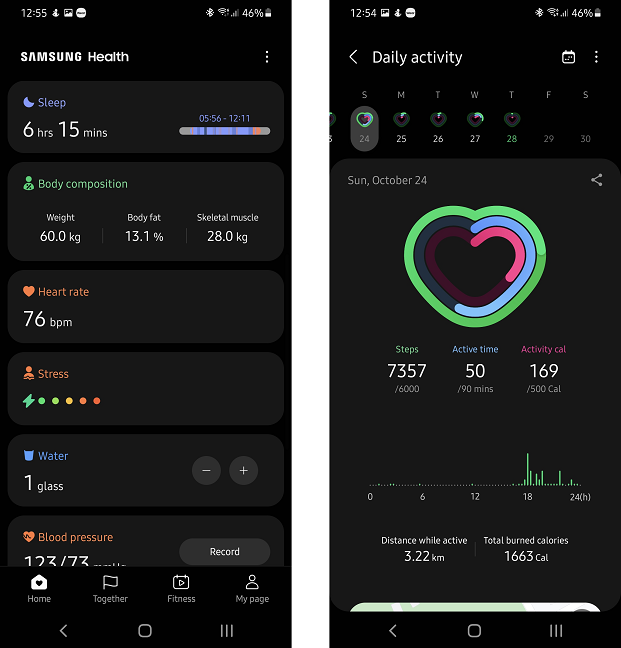
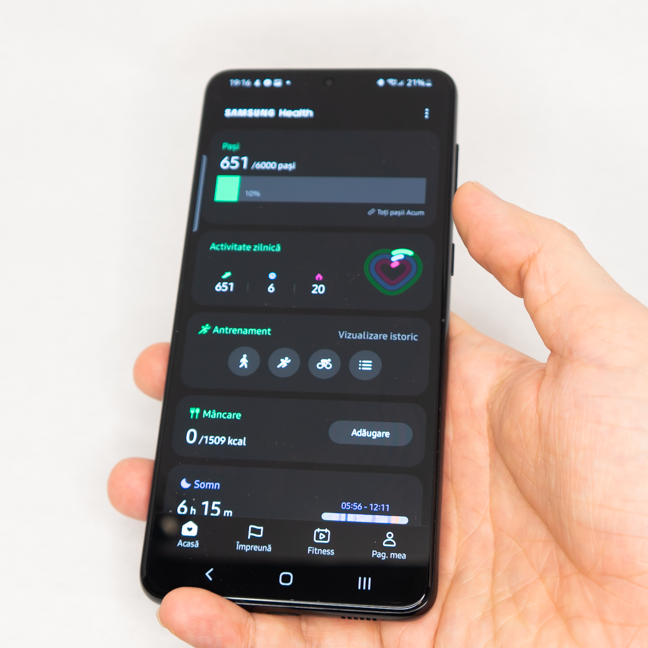
 Samsung Health displays detailed information about daily physical activities
Regarding sleep, the information is just as accurate and interesting. You have access to a chart for each session, with REM, light sleep and deep sleep cycles, but also information on blood oxygen concentration and snoring.
The application also shows the ECG and blood pressure measurement results, can manually record water consumption, and measure stress levels.
The fitness program section is perfect if you want to start exercising, but you lack consistency. The physical activity sessions are organized by date and time in the calendar, and the mobile devices send you notifications to make sure you don’t miss any session.
Samsung Health displays detailed information about daily physical activities
Regarding sleep, the information is just as accurate and interesting. You have access to a chart for each session, with REM, light sleep and deep sleep cycles, but also information on blood oxygen concentration and snoring.
The application also shows the ECG and blood pressure measurement results, can manually record water consumption, and measure stress levels.
The fitness program section is perfect if you want to start exercising, but you lack consistency. The physical activity sessions are organized by date and time in the calendar, and the mobile devices send you notifications to make sure you don’t miss any session.
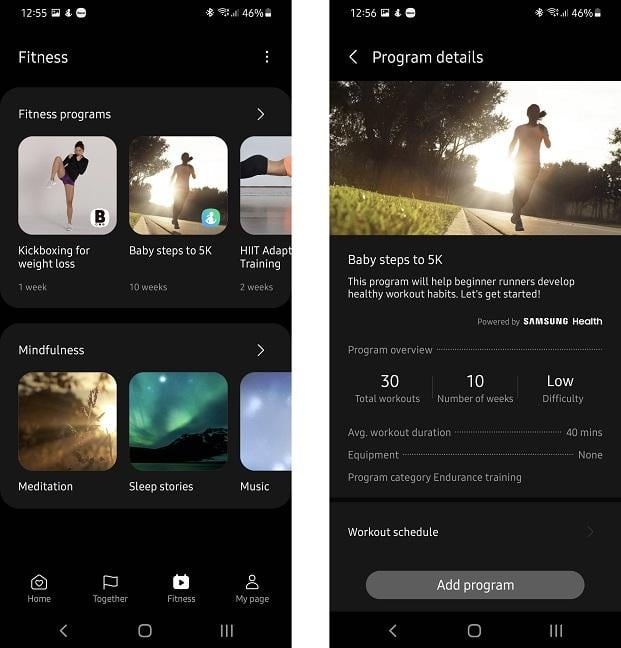 You can choose from a variety of fitness programs

 Technology can be an ally for physical development
Directly related to this subject, we would like to emphasize the importance of choosing devices with a high degree of compatibility. The fit between the watch and the phone, in our case, amplified the usefulness of each device and made them more than the sum of their functions taken separately. Samsung products are created with the goal of integrating into a Smart Home system, so both hardware and software contribute to a positive experience when using multiple devices.
Technology can be an ally for physical development
Directly related to this subject, we would like to emphasize the importance of choosing devices with a high degree of compatibility. The fit between the watch and the phone, in our case, amplified the usefulness of each device and made them more than the sum of their functions taken separately. Samsung products are created with the goal of integrating into a Smart Home system, so both hardware and software contribute to a positive experience when using multiple devices.
Smarter Living with interconnected devices
The Samsung Smarter Living philosophy involves an ecosystem of devices, interconnected and complementary in achieving goals. For this analysis, we chose two top-tier smart devices from the South Korean company, devices that, we believe, have a maximum impact for the goal we set - to remain physically active:- The Samsung Galaxy S21 Plus 5G smartphone - with the latest technical innovations and a battery that matches the processing power, this smartphone fulfills the essential functions of analyzing and evaluating physical activities;
- The Samsung Galaxy Watch 4 smartwatch - with an impressive list of sensors, Samsung's latest smartwatch allows you to monitor your health and its evolution over time at a granular level.
Samsung Galaxy S21 Plus 5G smartphone
For the fitness goal, the choice between Samsung Galaxy S21 and S21 Plus is difficult. Each has its advantages - Galaxy S21 is smaller and lighter, but the Plus version has a 20% larger battery, with approximately identical energy consumption. Given that most fitness-related activities take place away from power sources, we believe that a better battery justifies the difference of about 30 grams and the slightly larger size of the Samsung Galaxy S21 Plus. If we add to this the fact that S series phones can wirelessly charge other devices, the importance of the battery becomes even greater. Here are some features of the chosen phone, important for the scenario discussed in this article:- Dimensions: 6.36" x 2.9"7 x 0.31" (or 161.5 x 75.6 x 7.8 mm)
- Weight: 7.05 oz (200g)
- Battery capacity: 4800mAh
- Screen size: 6.7 inches (169.5 mm)
- Maximum screen brightness: 1300 nits
- Storage capacity: 128 or 256 GB
- Sensors (selection): Accelerometer, barometer, gyroscope
- Connectivity: Wi-Fi (a/b/g/n/ac/6), Bluetooth 5.0, GPS, NFC
Samsung Galaxy Watch 4 Smartwatch
If the smartphone is the user interface and control center, the smartwatch is the data collection point, the place from where the Samsung Health application collects most of its information. Currently, there are no smartwatches that collect more data on user health than the Galaxy Watch 4. For this scenario, we recommend the 40 mm diameter version, because it’s the most suitable for use both during physical activities and for wearing during sleep. If you want to use the watch separately from your phone, you can also opt for the LTE version, which connects to mobile networks using a virtual SIM (eSIM).- Watch size: 1.59" x 1.55" x 0.38" (or 40.4 x 39.3 x 9.8 mm)
- Screen diameter: 1.2" (30.4 mm)
- Weight: 0.91 oz (25.9 grams)
- Storage: 16GB
- Battery capacity: 247 mAh
- Average battery life: up to 40 hours
- Connectivity: NFC, GPS, LTE (eSIM), Bluetooth 5.0, Wi-Fi (a/b/g/n/ac)
- Sensors: Accelerometer, barometer, gyroscopic sensor, geomagnetic sensor, light sensor, optical heart rate sensor, electrical heart sensor, bioelectric impedance analysis sensor
The Samsung Health application
The phone is the "command center" for fitness activities. The most important application in this regard is Samsung Health. It has four main categories:- Home - the place where you can see all the data accumulated over time, divided into categories
- Together - the section that turns physical activities into a game with challenges and rewards
- Fitness - here, you can choose fitness programs or, for a fee, mindfulness programs
- My page - where you can see the weekly summaries, personal records, and awards (badges) obtained; you can also configure the application here
Our experience with the Samsung Health ecosystem
We enjoyed using the Samsung Galaxy S21 Plus and the Galaxy Watch 4. After exploring the functions of the tested devices, we came to some conclusions. First of all, it is clear that technology is an important ally nowadays for maintaining good health. Access to accurate information and measurements allows for proper monitoring of progress in physical activity and general fitness.
Discussion (0)
Comments are closed.