



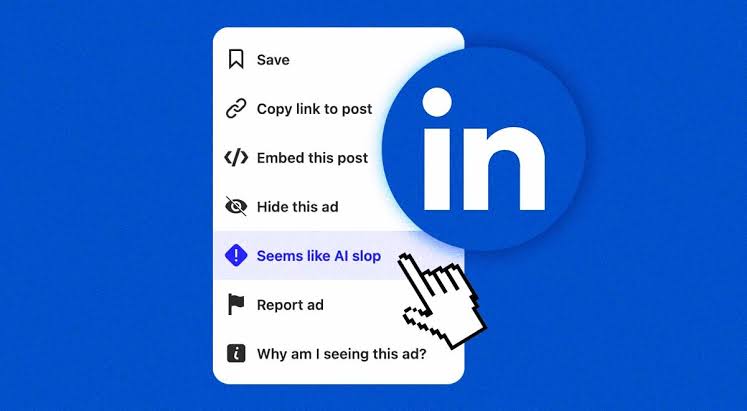
LinkedIn’s new tool for reporting suspected AI generated spam has already been used more than 1 million times, only weeks after the professional social network began testing it.
The feature, labeled “Seems like AI slop,” allows people to flag posts they believe are low quality or overly automated. LinkedIn says the response has been strong enough to produce measurable changes in how some content performs on the platform.
In certain cases, posts classified as AI spam have seen their views fall by as much as 40%.
Community reports are already affecting content reach
LinkedIn has not explained exactly how a report changes the ranking of a post, but the company says community feedback is only one of several signals used to decide how widely content should be shown.
The platform also says safeguards are in place to reduce the risk of the reporting system being abused.
| Detail | Current status |
|---|---|
| Feature | “Seems like AI slop” report option |
| Times used | More than 1 million |
| Reported impact | Up to 40% fewer views for some AI spam |
| Ranking method | Uses multiple signals |
| Anti abuse measures | Safeguards are in place |
| New addition | Creators may be notified when posts receive enough reports |
The feature is designed to address a growing problem on professional social platforms, where AI generated posts can sometimes appear repetitive, generic or overly polished in ways that make them feel less useful.
LinkedIn has not said that all AI assisted writing is a problem. The focus appears to be on content that the community sees as low quality or spam like.
LinkedIn will now warn creators about AI slop reports
The company is also introducing a new feedback feature for people who publish posts.
If a post receives enough community reports, LinkedIn may show a message inside Post Analytics explaining that the content has received feedback related to suspected AI spam.
The goal is not simply to punish creators, but to help them understand how their posts are being received.

LinkedIn’s product team says the system is being approached with the assumption that people generally have good intentions. The feedback is meant to give creators a chance to adjust their writing style if their content is being perceived as overly automated.
That could become important as more professionals use generative AI tools to draft posts, summarize ideas or improve wording.
The feature reflects a broader problem with AI generated content
AI generated writing has become increasingly common across social networks, business platforms and online communities.
The challenge is separating genuinely useful AI assisted posts from large volumes of repetitive or low effort material.
LinkedIn’s decision to introduce a dedicated reporting option shows that the company sees community feedback as one way to manage that problem.
The fact that the button has already been used more than 1 million times suggests there is substantial demand for greater control over AI generated content in professional feeds.
The reported reduction in views also indicates that these reports can have a meaningful effect, at least in some cases.
LinkedIn has not disclosed a universal threshold for when a post is classified as AI spam or how many reports are required before a creator receives a warning.
For now, the system remains focused on community feedback, ranking adjustments and creator awareness rather than an outright ban on AI assisted content.



Discussion (0)
Be the first to comment.