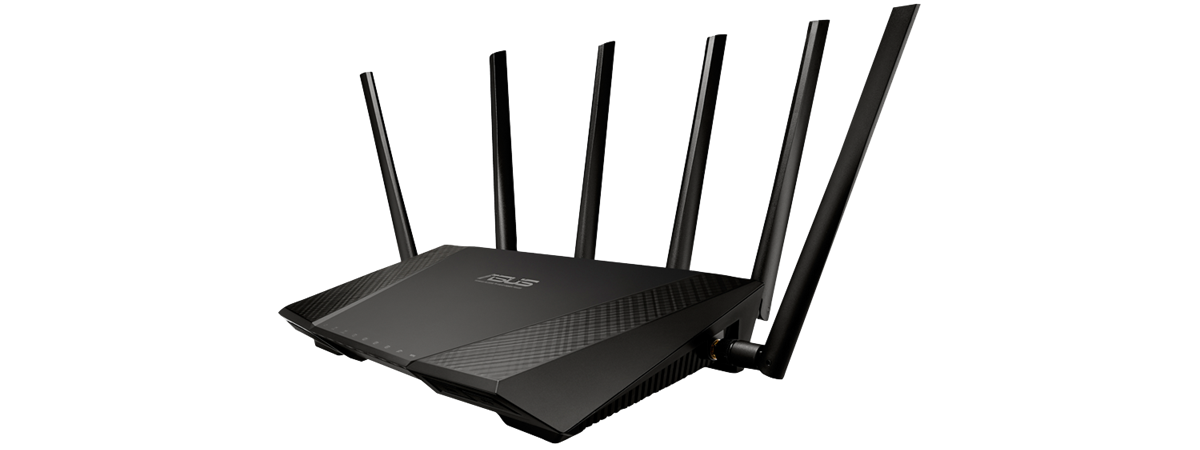
The ASUS Tri-Band Wireless-AC3200 router or RT-AC3200 as it is named by its manufacturer, is the most expensive wireless router offered by ASUS. It's the first tri-band wireless router in this company's portfolio and it boasts some very impressive specifications and a price to match them. Last year, when we reviewed its predecessor - ASUS RT-AC87U, we were very impressed. Imagine our curiosity when we received the upgrade to last year's model. We used ASUS RT-AC3200 in our test lab for a couple of weeks and now we are ready to share our conclusions:
Why Tri-Band Wireless Routers?
Up until recent months, the routers that were launched on the market were mostly dual-band. A dual-band router provides two wireless bands: one 2.4 GHz wireless band and another 5 GHz band, allowing you to use both old devices (which work using only older protocols for 2.4 GHz wireless band) and new devices. It's like having two wireless routers in one. By dividing the clients available on the network, older generation devices aren't interfering with your new devices and each of them uses the fastest possible wireless network connection without negatively impacting the others.
Tri-Band routers take it one step further and provide three wireless bands to accommodate even more devices on a network. The ASUS Tri-Band Wireless-AC3200 router, for instance, provides one 2.4GHz band, offering speeds up to 600Mbps, and two 5Ghz bands, for speeds up to 1300Mbps. That's a maximum total data rate of 3200 Mbps, if you add-up all three wireless networks. Tri-Band routers can be especially useful in networks with many wireless devices. Let's assume that you have about 40 devices that compete for two wireless bands. That's 20 devices/band. If you have them use 3 wireless bands on a Tri-Band router, then you have fewer devices/band (13 or 14), meaning faster wireless network connections for each device and less network congestion.
Unboxing The ASUS RT-AC3200 Tri-Band Wireless Router
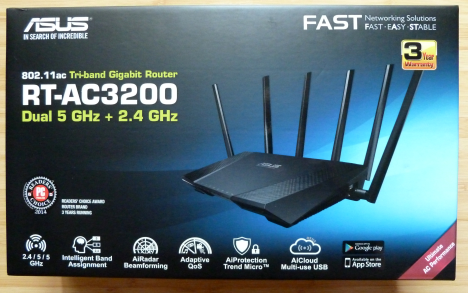
ASUS uses its traditional packaging for the ASUS Tri-Band Wireless-AC3200 router. On the front of the box you can see the router itself and some of its most important specifications.
On the back of the box you will see a comparison with other routers in ASUS's portfolio and information about the connectors that are found on the router.
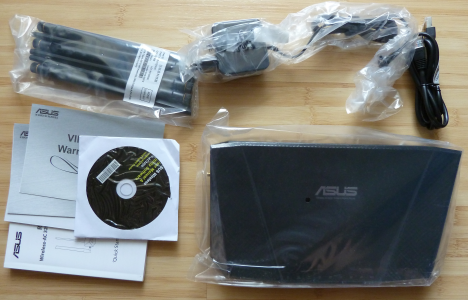
Inside the packaging you will find the following items: the router, an Ethernet cable (RJ-45), the power adapter, a support disc, the quick start guide and the warranty card.
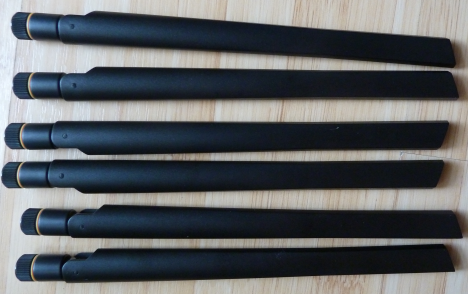
The six antennas that are bundled are quite big and impressive. They are the same as those used for ASUS RT-AC87U, the only difference being that you have even more of them.
But enough about the packaging, let's see what this router offers in terms of specifications:
Hardware Specifications
Just like its predecessor ASUS-RT AC3200 has a Broadcom BCM4709 dual-core 1GHz processor with 256MB of DDR3 RAM and 128MB of flash storage. This router offers two 802.11ac networks, each with a three transmit, three receive (3x3) antenna configuration. It also broadcasts a 2.4 GHz wireless network. Obviously, it supports all the modern wireless networking standards.
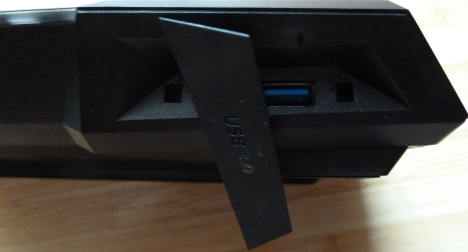
In terms of connectivity, there are 2 USB ports available: one USB 2.0 port on the back and one USB 3.0 port on the front.
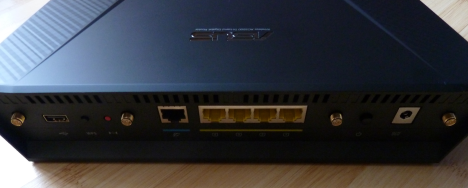
On the back of the device, you will find the following ports and connectors: the USB 2.0 port, the WPS and Reset buttons, a Gigabit WAN port, four Gigabit LAN ports, a button for turning the router On and Off and the AC socket.
The size and weight of this router are impressive: it has 11.4 x 7.4 x 2.28 inch (Width x Depth x Height) or 28.9 x 18.79 x 5.79 cm. ASUS RT-AC3200 weighs 2.24 lbs or 1kg.
The complete set of specifications can be found here: ASUS RT-AC3200 specifications.
Setting Up & Using The ASUS RT-AC3200 Tri-Band Wireless Router
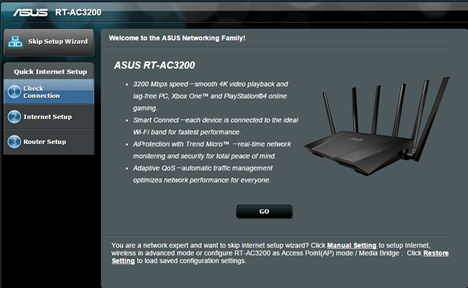
The firmware used by ASUS RT-AC3200 is the same as the one found on other ASUS routers but it has more features than on previous routers. This means that the setup process works great and, in just a couple of minutes, you have your network working. The router detects the type of Internet connection that is available, asks for the appropriate connection details (if required) and then asks you to set up your wireless networks.
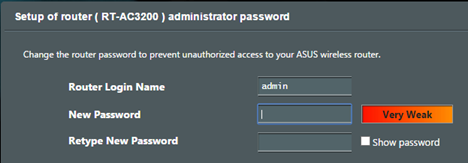
During the initial setup you are also asked to change the admin password, which is a great security precaution, considering how insecure many wireless routers are.
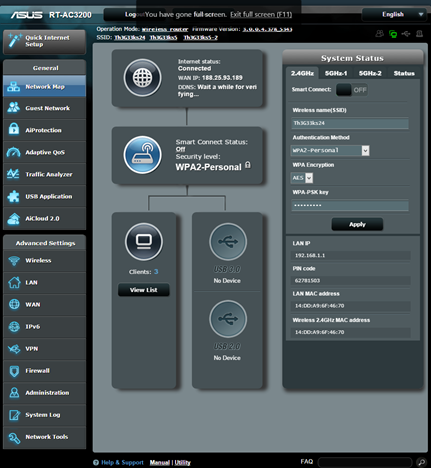
The user interface offered by ASUS for RT-AC3200 is both very advanced and easy to use. What we like about it most is the fact that it is well organized and it's easy to figure out where to look in order to find the settings you are interested in.
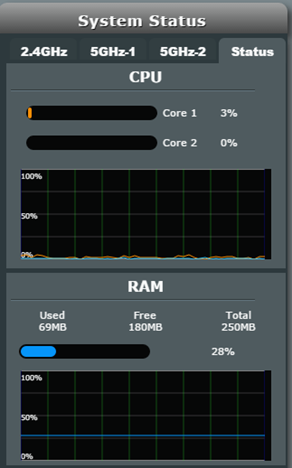
With this router being so advanced and powerful, ASUS decided to also offer a Status graph of its hardware resources. With its help, you can easily see the CPU and RAM consumption and figure out when the router gets overloaded.
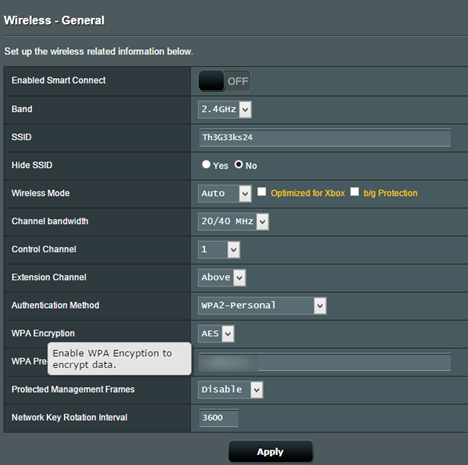
Another aspect that many users will appreciate is the fact that Help documentation is readily available. If you don't understand a setting, move your mouse cursor on top of it and you will see a question mark being displayed. Click on it and and an explanation of that setting is loaded. Easy, isn't it?
In our testing we used the latest firmware version that was available at that time - 3.0.0.4.378_5343 and we did not encounter any stability or performance issues. All our network devices connected without issues and the network managed by this router was very stable during the whole testing period.
We are pleased by how easy it was to set up our network and the amount of control offered by the user interface for administering the ASUS RT-AC3200 router. The user interface is easy to use even though it offers a great deal of customization. Also, the router worked well during our testing and we did not encounter issues with devices not being able to connect, nor any weird disconnects.
Wireless Network Performance
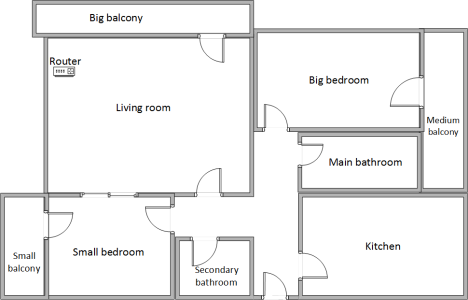
Before we share with you the results of the measurements we have made, let's take a look at the apartment that we used for our testing. In the figure below you can see how the rooms are arranged. You can see that the router is placed in the living room.
Our testing was done using a fast 1 Gigabit Internet connection that's capable of uploads on the Internet of up to 200 Mbps. We used a Microsoft Surface Pro 3 for all our measurements and several software tools. To get a better perspective of the performance offered by the ASUS RT-AC3200 we compared it with its predecessor - ASUS RT-AC87U and with TP-LINK Archer C8, a competing router that we have recently tested.
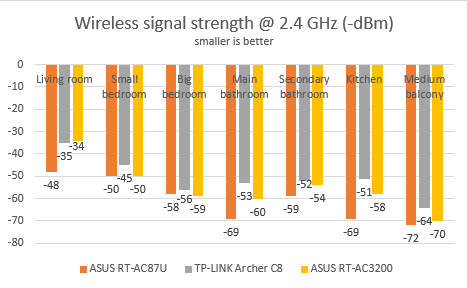
We started by measuring the strength of the wireless signal across the apartment, using inSSIDer. Below you can see how the signal strength evolves from room to room when using the 2.4 GHz wireless network. As you can see, the signal strength is better than that of its predecessor but TP-LINK Archer C8 tends to deliver slightly better signal strength in most rooms.
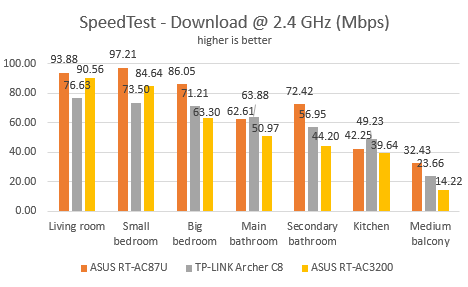
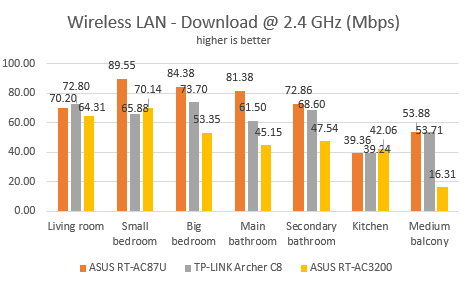
For our next set of measurements, we used SpeedTest. This test tells us how fast is the Internet connection. When using the 2.4 GHz wireless network, ASUS RT-AC3200 delivered good downloads speeds but it was not the top-performing router.
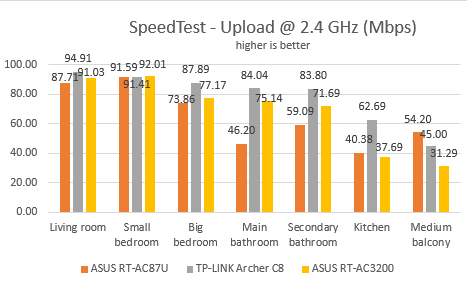
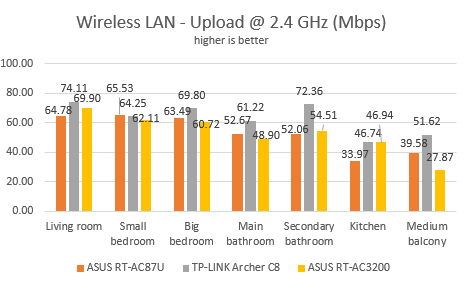
The same was true when measuring the upload speed on the 2.4 GHz wireless network: ASUS RT-AC3200 delivered good results but it wasn't the fastest router.
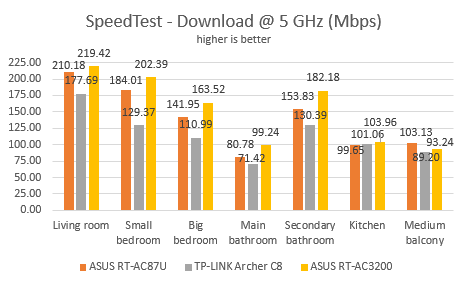
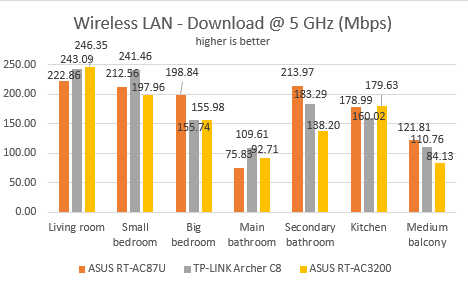
Then we used SpeedTest on one of the 5GHz wireless networks offered by the router. When it comes to downloading data from the Internet, ASUS RT-AC3200 was the fastest router.
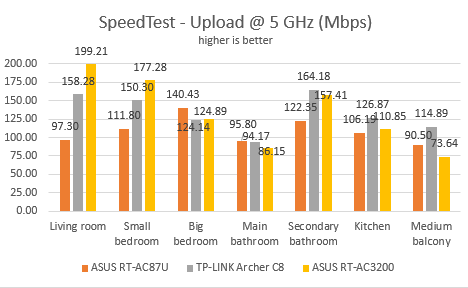
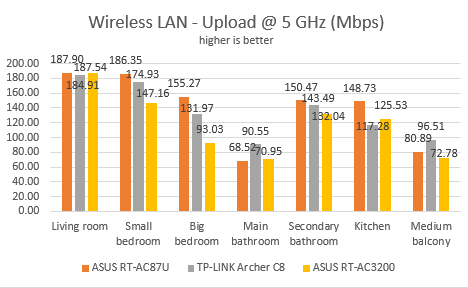
When measuring the upload speed with SpeedTest, the results were mixed. In some rooms, ASUS RT-AC3200 was the top performing router while in others it wasn't.
For our final set of measurements, we used LAN Speed Test Lite to transfer a 350MB file between two computers on the same network. First, we used the 2.4 GHz wireless network. Again, ASUS RT-AC3200 delivered good results but it was outperformed by other routers.
The same was true when measuring the upload speed with LAN Speed Test Lite. It seems that the 2.4 GHz wireless network is not the strong point of the ASUS Tri-Band Wireless-AC3200 router.
Next, we used the same application to transfer files over one of the two 5GHz wireless networks. ASUS RT-AC3200 outperformed its predecessor - ASUS RT-AC87U - in some rooms while in others it did not.
When we measured the upload speed, ASUS RT-AC3200 outperformed TP-LINK Archer C8 but it did not outperform ASUS RT-AC87U. However, the transfer rates it delivered were strong in all rooms.
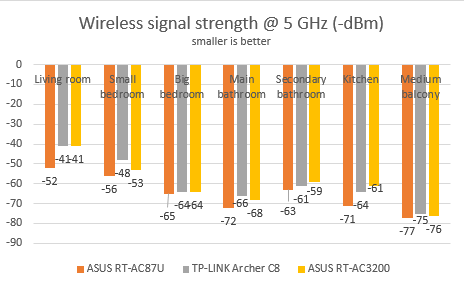
It is clear from our measurements that the strength of the ASUS RT-AC3200 router is networking on its two 5GHz wireless networks. The 2.4GHz wireless network it offers is not as fast as that offered by other routers.
Wired Network Performance
In order to test the quality of the wired Ethernet connection, we used a desktop PC, equipped with an Intel Core i5 4460 processor, running at 3.20GHz, 16GB of RAM and a very fast Samsung 850 Pro 512GB SSD and a Microsoft Surface Pro 3 with an Intel Core i5-4300U processor, running at 1.9 GHz, 8 GB of RAM and a fast 256 GB SSD drive from Samsung.
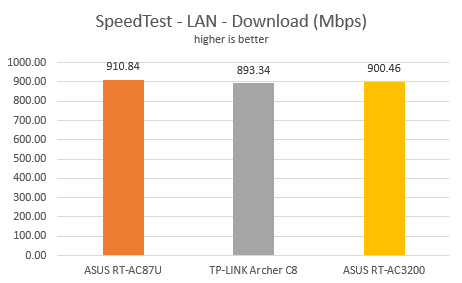
First, we used SpeedTest to measure how fast is our Internet connection. As you can see ASUS RT-AC3200 delivered downloads at 900.46 Mbps, which is great.
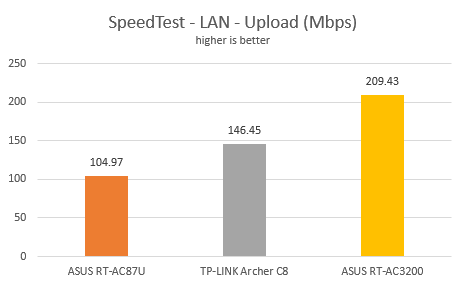
Our Internet connection is limited at 200 Mbps when it comes to uploads on the Internet. Here, ASUS RT-AC3200 delivered the fastest uploads we have measured so far, at 209.43 Mbps.
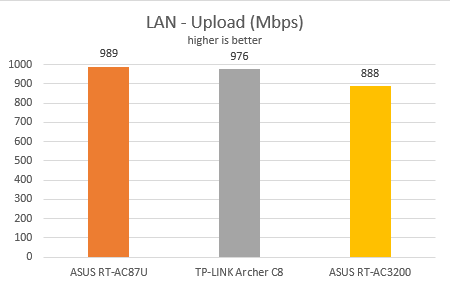
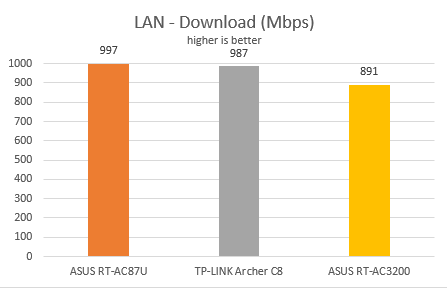
For our final test, we measured the download and upload speeds when transferring an 883 MB file to and from the two computers connected to the network, both of which were using an Ethernet cable. The average download speed offered by ASUS RT-AC3200 was 891 Mbps.
It is obvious that ASUS RT-AC3200 delivers true 1 Gbps wired network connections. If you have computers with modern processors and SSD drives, you will be able to enjoy very fast transfers over the network.
Extra Features
ASUS RT-AC3200 offers lots of advanced features that you won't find on many other routers:
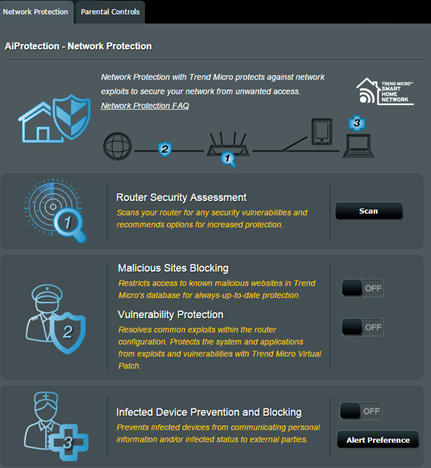
AirProtection - a feature powered by Trend Micro, which includes two modules: Network Protection and Parental Controls. The Network Protection module allows you to block malicious websites for all your computers and devices, prevent infected network devices from communicating personal information and scan your router for any security vulnerabilities. The Parental Controls module can be used to block Internet access to all kinds of content types for any of the devices that are connected to your network.
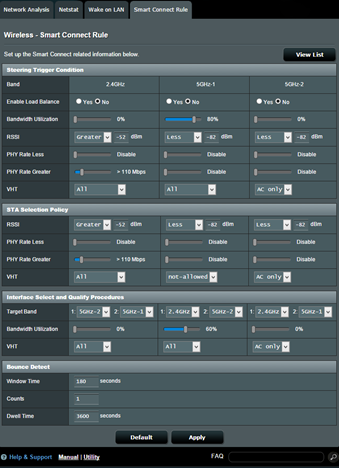
Adaptive Quality of Service (QoS) - a service which ensures bandwidth on both wired and wireless connections that can be set to work automatically or manually, based on the rules you set. This, coupled with the new Smart Connect feature, allow you to set in a very granular way, how your bandwidth is used. Imagine that you can do load balancing for each wireless network independently.
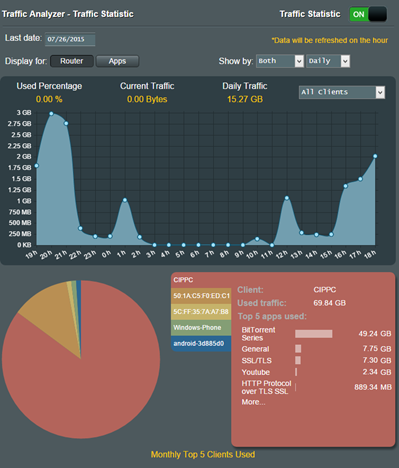
Traffic Analyzer - visual traffic statistics which give you a clear picture of how your network is used and by which devices. If you are managing a network with lots of devices, you will very much enjoy the data shown by the analyzer.
Dual WAN - very useful for both small businesses and professionals who require always-on Internet connections. You can also use a dual WAN to improve the quality of your Internet connection and get the best possible performance. Gamers might also love this.
VPN server - you can set the router to work as a VPN server and you can also use it to turn your network-connected devices into VPN-enabled clients via OpenVPN, PPTP and L2TP protocols without additional VPN software required.
ASUS AiCloud 2.0 - a new and improved version that keeps you connected to your data wherever and whenever you have an Internet connection. With it, you can access the folders shared in your home network from your Android or iOS smartphone or via a personalized URL. The only downside is that there is no Windows Phone app available.
Guest network - you can set up a guest wireless network that provides Internet access for your guests but restricts access to your network devices. You can enable a 2.4GHz guest network and up to two 5GHz guest networks. In total you can have 3 guest wireless networks running.
You also have access to applications that allow you to work with USB devices like printers, external hard drives or 3G/4G modems.
ASUS RT-AC3200 boasts advanced features that are hard to find on other routers, many of which are very useful when managing a network with lots of devices.
Product rating5/5
Verdict
ASUS RT-AC3200 is a very advanced router that offers tri-band connectivity, a great deal of security and plenty of controls to make everything work the way you want to. It's very hard to find another router that's not made by ASUS which offers so many advanced features alongside powerful hardware specs. Couple this with its high-price and aggressive looks and it is clear that this wireless router is not for everyone. In order to be able to enjoy the benefits of using ASUS RT-AC3200, you need a large network with many devices, many of which are new and support the 802.11ac standard. If you don't meet these criteria, more affordable models are a better option.




























Discussion (0)
Comments are closed.