When we have learned about the latest router from ASUS - RT-AC87U and its impressive specifications, we really wanted to get a chance to test it. Reading its specifications, we couldn't feel anything but excitement and, after unboxing it, we jokingly said that this is the WiFi router Batman would use. 🙂 But is this true? Is this router as impressive as its specs would have you believe? Let's find out from this review.
Unboxing the ASUS RT-AC87U Router
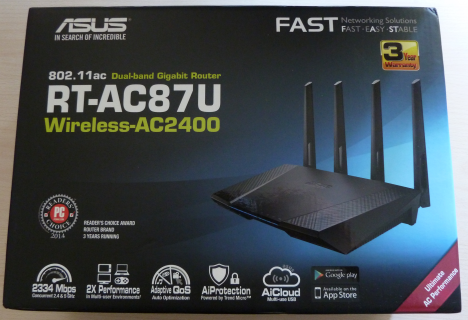
The packaging of the ASUS RT-AC87U wireless router is pretty impressive. The box is bigger than that of any other router and it looks great. As usual, if you read the box you will learn some of the hardware specifications of this router and get an idea of what it looks like.
Inside the box you will find the router itself, four external antennas, a network cable, the power adapter, a support disc with the user manual in several languages, the warranty, several leaflets and the quick start guide in multiple languages.
You can learn more about the unboxing experience by watching the video below:
Hardware Specifications
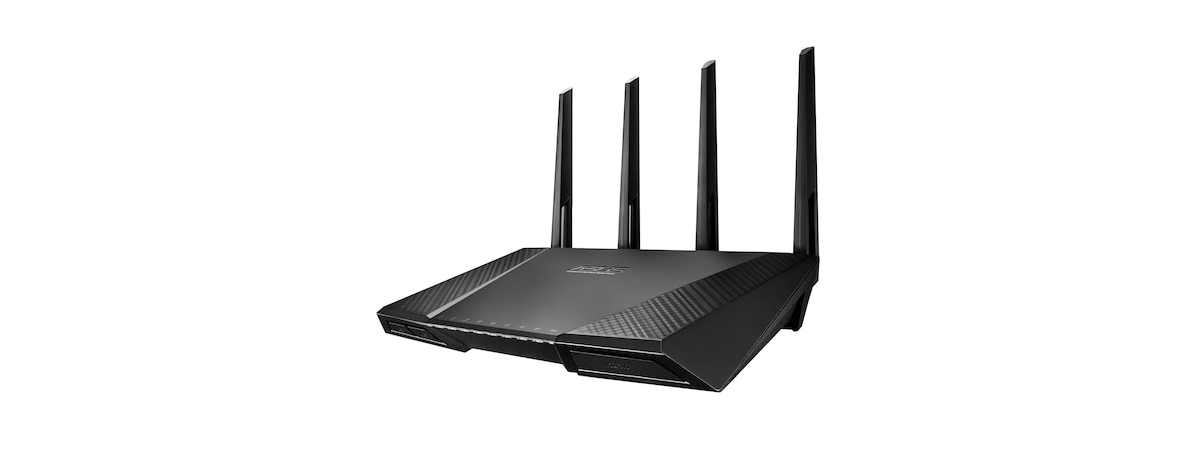
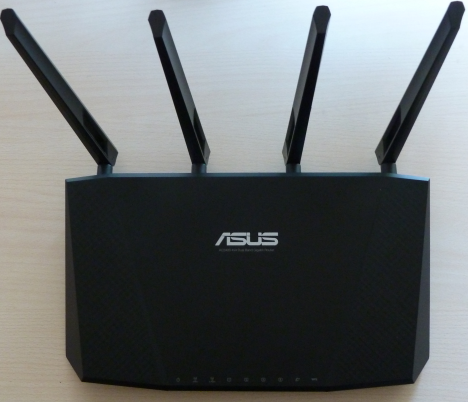
The hardware specifications of this router are impressive, starting with its weight - 747 grams (26.34 ounces), size - 289.5 x 167.6 x 47.5 mm (11.39 x 6.5 x 1.87 inches) and number of external antennas - four.
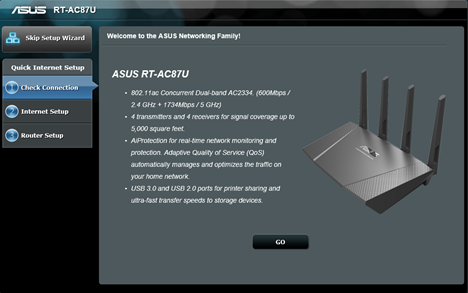
It includes two dual-core processors: one Broadcom BCM4709 running at 1GHz and one Quantenna QT3840BC running at 500MHz. The main processor handles the USB ports and 2.4 GHz WiFi related tasks while the second is dedicated solely to 5 GHz WiFi related tasks.
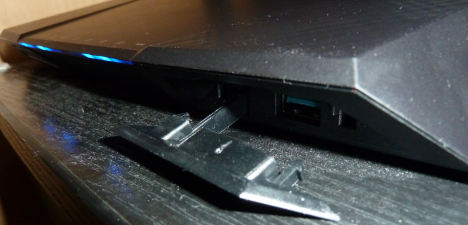
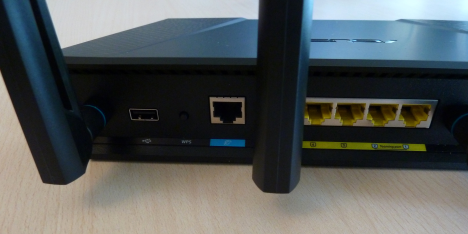
In terms of connectivity, ASUS RT-AC87U includes two ports: one USB 2.0 and one USB 3.0. The USB 2.0 port is on the back of the router and the USB 3.0 port is on the front, masked by a rubber cover.
This router has 128 MB of storage space and 256 MB of RAM, enough for running its firmware and all its features.
ASUS brags about their world's first 4x4 multi-user MIMO (MU-MIMO) antenna design with AiRadar universal beamforming. It allows multiple transmitters to send separate signals and multiple receivers to receive separate signals simultaneously in the same band. With the help of this technology, ASUS RT-AC87U promises to offer wireless signal coverage up to 465 m² (around 5,000ft²) which is downright impressive. The only downside is that you need wireless devices that are compatible with it, in order to take full advantage of everything it has to offer.
As you would expect from a premium router, ASUS RT-AC87U is able to work with all modern wireless networking standards, including 802.11ac. It promises a maximum throughput of 1734 Mbps at 5 GHz and 600 Mbps at 2.4 GHz.
On the back of the router you will find four 1Gbps Ethernet ports, the WPS button and the port for the Internet connection.
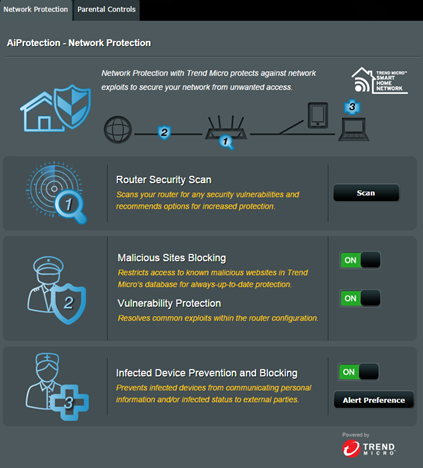
This router also include a security feature named AirProtection. It's based on security technologies provided by Trend Micro and it can detect malware, viruses, infected devices and other types of threats.
Those of you who want the oficial list of specifications, can find them here: ASUS RT-AC87U.
Setting Up & Using the ASUS RT-AC87U Router
ASUS RT-AC87U uses the same firmware as previous models do with the difference that it includes several new features and enhancements. The setup procedure is just as simple and as quick as in the past and it involves setting a custom username and password for accessing your router, detecting the type of Internet connection that is available, setting it up and then configuring the 2.4GHz and 5GHz wireless networks. Then you can start connecting other devices to your network and access the Internet.
The ASUS firmware is very advanced and rich in customization options. You can literally change any setting you wish and have the router work the way you want to. Other manufacturers don't offer as much control as ASUS does and this is one of the reasons why we enjoy using ASUS networking hardware.
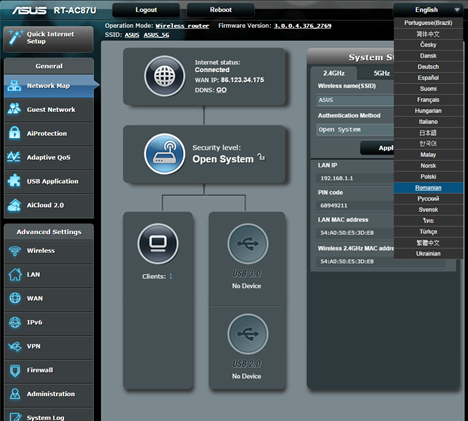
The multilingual support is as great as ever, the user interface being translated into 23 languages. Switching between languages takes only two of clicks and no reboot is required.
If you have used another ASUS router in the past, you will appreciate the fact that you can easily export your settings and have them imported by ASUS RT-AC87U model.
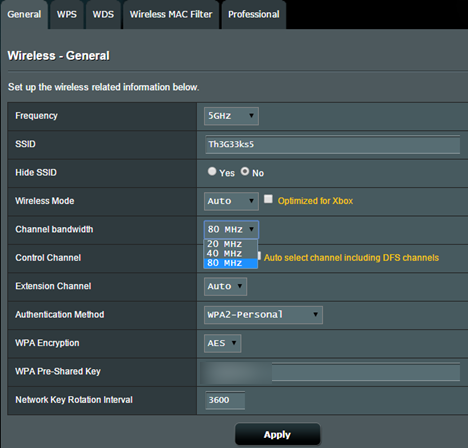
One novelty introduced by ASUS RT-AC87U router is that the 5GHz wireless network can function also at 80MHz and not just 20MHz or 40MHz. This increases the wireless channel bandwidth, which should improve how well your wireless network connection works.
In our testing we used the latest firmware version that was available at that time - 3.0.0.4.276_2769. Some websites and users that had early access to this router complained regarding some stability and performance issues. Since then, ASUS has released three new versions of firmware, each fixing issues that were reported. Happily for us, we did not encounter any stability or performance issues and we were very pleased with this router's functioning. But, we do recommend you to upgrade this router's firmware as soon as you set it up, to make sure that you have the latest fixes and enhancements from ASUS.
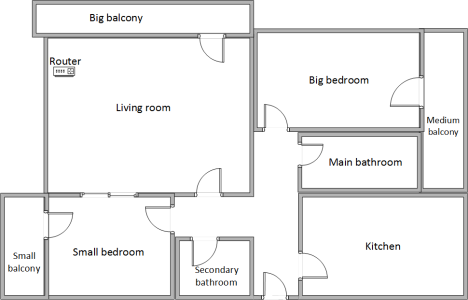
First, let's take a look at the apartment we used in our testing and how it is set up. You can see that the router is placed in the living room. In our measurements, we have compared ASUS RT-AC87U with its most important competitor - Linksys WRT1900AC and the previous high-end router from ASUS - RT-AC68U. Our testing was done using a fast 1 Gigabit Internet connection.
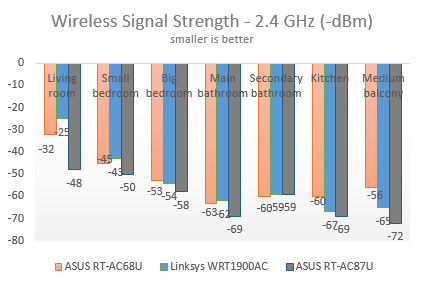
With the help of a tool named inSSIDer and our Surface Pro 2, we have measured the signal strength for the 2.4 GHz wireless network and recorded how it changes from room to room.
As you can see from this graph, the signal strength is not this model's strength. But, as we have learned from our reviews, this is not a good indicator of how fast your wireless connection will be.
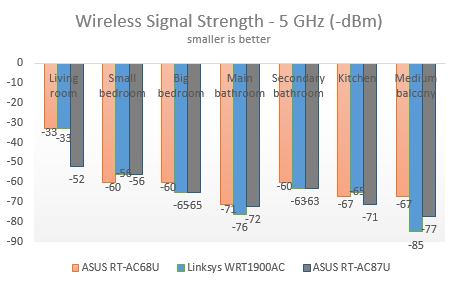
We have made the same measurements for the 5 GHz wireless network and we noticed a similar trend - ASUS RT-AC87U delivers reasonably good signal strength but it doesn't outperform its competitors.
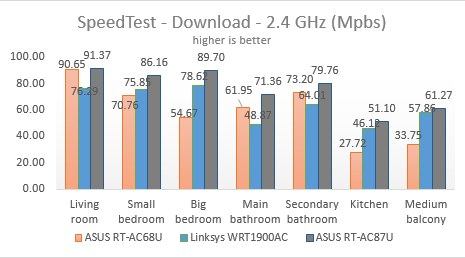
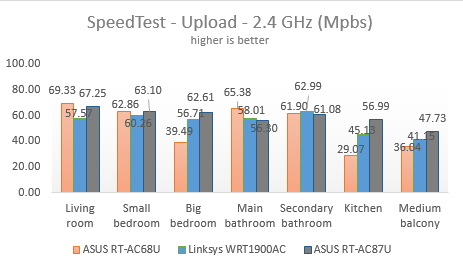
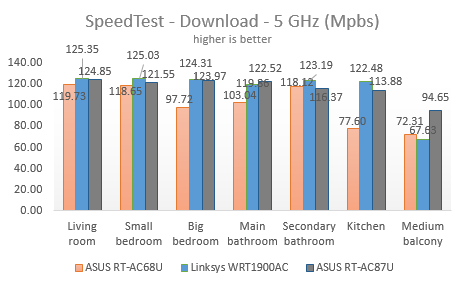
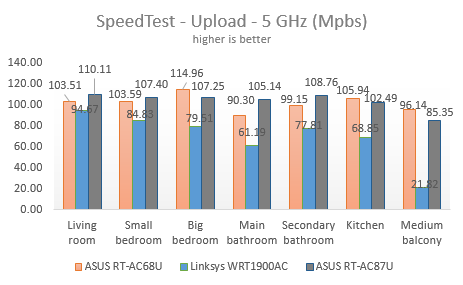
Then, we ran SpeedTest for measuring the download and upload speed on both wireless networks. While doing so, we noticed an interesting trend that was obvious especially in the rooms that are further away from the router: when you move to a new location with your tablet or smartphone, ASUS RT-AC87U will deliver average download and upload speeds, depending on your distance from it. But, after a couple of seconds of sitting in the same place, it will focus its wireless signal in such a way that you will enjoy very good speeds even though you are far away from it. For example, we moved up to the medium balcony which is the room furthest away from the router. We were connected to the 5 GHz wireless network. When running SpeedTest for the first time, we obtained 54.29 Mbps in download speed and 55.39 Mbps in upload speed. After the first test was finished, the router learned the new position of our Surface Pro 2 and it focused the wireless signal correctly. Then, in the next three SpeedTest runs, we obtained an average download speed of 94.65 Mbps and an average upload speed of 85.35 Mbps. This is a 74% increase for the download speed and a 54% increase for the upload speed. Because, of that, we ran 4 individual measurements in each room and we always ignored the first measurement, to allow the router to learn the new position of our Surface Pro 2. What you see below are the average download and upload speeds.
When using the 2.4 Ghz wireless network, ASUS RT-AC87U offered the fastest downloads in all the rooms from our apartment.
When using the 5 GHz wireless network, ASUS RT-AC87U and Linksys WRT1900AC were very close in terms of download speeds. The only room where we measured an important difference between the two was the medium balcony which is the room furthest from the router. Looking at these numbers and the specs of this router, we would have needed a much larger apartment to tell the difference in coverage between ASUS RT-AC87U and Linksys WRT1900AC.
When measuring the upload speeds offered by the 5 GHz wireless network, the differences between ASUS RT-AC87U and Linksys WRT1900AC were generally higher, with ASUS RT-AC87U winning in most rooms, by quite a large margin. In the room furthest from the router, ASUS RT-AC87U was 281% faster than Linksys WRT1900AC, but 11% slower than its more affordable brother ASUS RT-AC68U.
If you look carefully at all the charts shared in this section, you will notice a few trends about the ASUS RT-AC87U router:
The average download and upload speed across the apartment where we performed our testing is higher than that of its competitors.
In most cases, the download and upload speed decreases by a smaller margin when moving further away from the router when compared to its competitors. Therefore you will enjoy quick data transfers also in areas that are not very close to your router.
ASUS RT-AC87U delivers very good wireless networking performance. Unfortunately, in order to enjoy its advanced WiFi technology, you need to have the networking hardware that supports it. Existing devices cannot take full advantage of what this router has to offer and its results might seem underwhelming when looking at our charts, at least when you consider its very impressive specifications. However, even with existing networking hardware, you will enjoy an impressive coverage area and very good speeds even in the more remote areas of your home.
Wired Network Performance
In order to test the quality of the wired Ethernet connection, we have used a desktop PC, equipped with an eight-core processor, 8GB of RAM and a very fast ADATA SX900 SSD drive, as well as an old laptop with a quad-core processor and an SSD drive from RunCore.
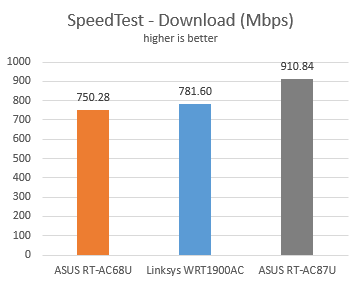
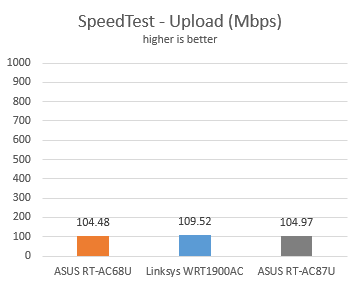
First, we measured the download and upload speeds using SpeedTest. ASUS RT-AC87U was the fastest router in our testing, reaching an average download speed of 910.84 Mbps - 16% faster than Linksys WRT1900AC.
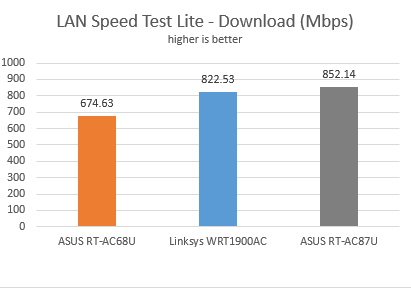
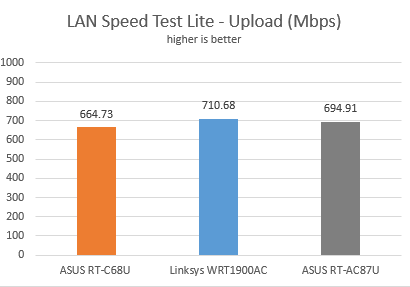
Then, we used LAN Speed Test Lite to measure the download and upload speeds when transferring a 350 MB file to and from two computers connected to the network via Ethernet cables.
Again, ASUS RT-AC87U was the fastest router in our testing, with an average download speed of 852.14 Mbps - 4% faster than Linksys WRT1900AC.
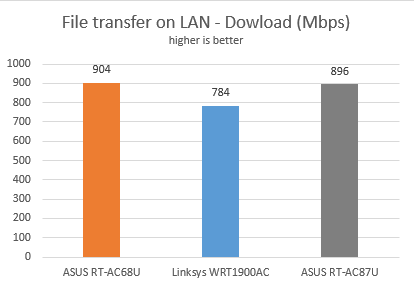
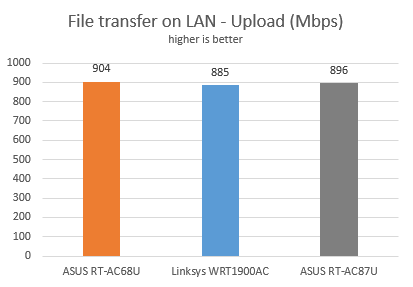
As a final test, we transferred an 883 MB file across the network, between the same two computers. This time, the fastest router was the older ASUS RT-AC68U while the ASUS RT-AC87U was a close second.
In terms of download speed, ASUS RT-AC87U reached an average of 896 Mbps (1% slower than the top performing router).
When it comes to wired Ethernet connections, ASUS RT-AC87U delivers real 1 Gbps data transfers. In our testing, SpeedTest has measured record-breaking average downloads at 910.84 Mbps.
Extra Features
ASUS RT-AC87U offers all the features that are included in earlier models and a few extras. In our view, the star of the show is the new AirProtection feature powered by Trend Micro, which includes two modules: Network Protection and Parental Controls.
The Network Protection module allows you to block malicious websites for all your computers and devices, prevent infected network devices from communicating personal information and scan your router for any security vulnerabilities.
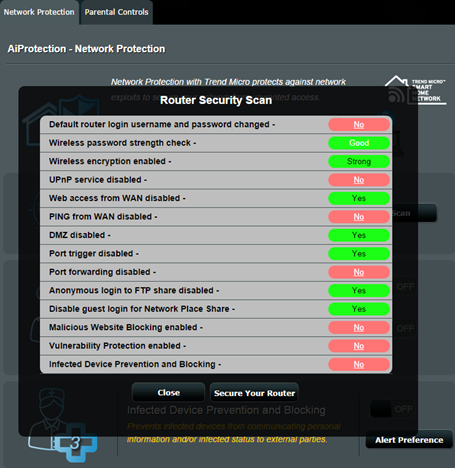
We really liked the Router Security Scan because it acts as an advisor on how to secure your router. Following its recommendations will help you increase the security of your network in a meaningful way and we hope to see other vendors following ASUS's leadership in this area.
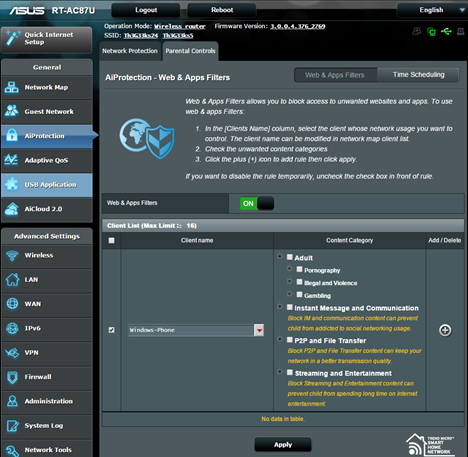
The Parental Controls module is more advanced than the one available in previous ASUS routers. With it, you can block Internet access to all kinds of content types for any of the devices that are connected to your network.
ASUS RT-AC87U includes also the extras from previous models:
Dual WAN - very useful for both small businesses and professionals that require always-on Internet connections. You can also use a dual WAN to improve the quality of your Internet connection and get the best possible performance. Gamers might also love this.
VPN server - you can set the router to work as a VPN server and you can also use it to turn your network-connected devices into VPN-enabled clients via OpenVPN, PPTP and L2TP protocols without additional VPN software required.
ASUS AiCloud 2.0 - a new and improved version that keeps you connected to your data wherever and whenever you have an Internet connection. With it, you can access the folders shared in your home network from your Android or iOS smartphone or via a personalized URL. The only downside is that there is no Windows Phone app available.
Guest network - you can set up a guest wireless network that provides Internet access for your guests but restricts access to your network devices.
You have also access to applications that allow you to work with USB devices like printers, external hard drives or 3G/4G modems.
ASUS RT-AC87U boasts even more advanced features than its predecessors. It is the most powerful and complex router made by ASUS, not only from a hardware perspective but also from a firmware and software perspective.
Product rating5/5
Verdict
Getting back to our Batman joke, ASUS RT-AC87U is the wireless router Batman would use. And yes, this means that this is the most advanced router on the market, both from a hardware and software perspective. But this all comes at a cost: first of all, its price is high for most people. Second, its technology is so advanced that you need top-notch networking hardware in order to fully take advantage of it.
If money is no problem for you and you want the best money can buy, ASUS RT-AC87U is a great choice. It offers the detailed customization, lots of advanced features, great new technologies and it is the most "future-proof" router you can buy today.
I just purchased a RT-AC68U and my wireless devices regularly lose connection to the router. I have multiple devices (iPad, Android phone, PC laptop) and they all drop out at the same time. The only way to get them to reconnect is to switch off / on the router, sometimes multiple times a day. Very annoying. I am running the latest firmware. Any suggestions ?
Hard Coder ·
Just like Alex, I bought this router based on the recommendation of this site but very quickly I got into a figure out that Asus made crappy things. This is what happened :
Opened the box, saw the thing « Incredeble Starts here ». Said to myself, wow, this stuff really worth the least penny that I paid. Installed it and got into the admin page. Configured it with all my basic settings. And got it to work. A while later, after seeing the annoying Gif icon indicating the new Firmware availability on the admin page I updated to the firmware; obviously the thing not to do. Since then the admin page is not displaying correctly.
I then contacted the Asus support. They asked me to send them back the Router and told me that the router had a particular defect. After several weeks Asus sent me a brand new one. After receiving it I did the same thing. And guess what, the same thing happened again. I did it purpousely since I wanted to check if we could rely on their software update especially when my guarentee period is stil valid. I’ll have to renew the return back procedure and have to look forward Asus’s conclusion about the incident. But one thing is clear for me, I’ll buy no more Asus products in the futur.
lionel78 ·
Exactly the same problem, GUI is not correctly loaded after update. I try to downgrade with the first firmware on asus website, but the problem is the same.
I will not buy asus product again too…
Joe Mctroy ·
This test is basically worthless since you were testing using an Internet website for speed, and not locally. SpeedTest.net introduces a zillion variables that have nothing to do with the WiFi and as such not apples to apples. There could have been latency at the test host, on your internet connection, different host, etc, etc. The fact that you didn’t know better than to do that surprises me, that is a total waste of time and all of the data is worthless, so this review has no value in terms of the performance measurements.
In the future to test performance of a local device you must measure locally. That means put a 5 GB file on one device and measure the transfer time (speed) to the other. There are other, better ways, to measure so you can rule out funkiness with a protocol, disk writing or something, but just measuring a simple local network file transfer is 1,000X better than what you did for coming up with an accurate transfer speed.
Ciprian Adrian Rusen ·
The SpeedTest.net test is there to show you the speeds that you can reach with your Internet (NOT LAN) connection, if you would have a 1 Gbps Internet connection available. What’s the maximum speed on the Internet?
We consider this test valid and useful.
Frex ·
Can anyone explain if this AC87 router can be configured with Dual Gateway (one direct ISP and one VPN). That way you can tell a device what internet to connect to.
Miguel ·
Yes it can do that, but only with DDWRT.
Frank ·
Okay, the router said it was using the latest version but on the site there was a newer version. I installed this. Lets see if it works more stable.
Frank ·
My new RT-AC87U keeps dropping the 2.4GHz connection. The 5GHz is stable. I don’t know whats wrong. It’s not just one device which loses it’s connection but several.
Alex ·
Update the firmware to latest? My 2.4 connection is rock solid.
Razvan ·
The WAN>LAN speeds are totally wrong.
My RT-AC68U reaches 930 Mbps with ease.
Most likely, the writer never actually tested the device, but got the numbers from other websites.
Earl ·
Replacing my 7 year old router with this, and went from 2meg ave speed to 16megs which is what my IP wan is set. Very nice GUI, very straight forward set ups. I have set a few port forwarding openings and works perfect. I dialed back the radios power out to 50%- Plenty of range. Dont like the floppy antennas. Cant seem to get them tight. Overall I would recommend this router.
Nico ·
i have the RT-AC87u two months now, and it works fantastic. I use the asuswrt-Merlin firmware on it. I combined it with a Engenius ECB600 AP for further away connections, and i have now the most performant wifi coverage, i ever had. On my router is a usb3 HD, used as storage for ipcam’s footage.
Raj ·
I have RT-AC68U and this router drops connection very frequently. Is there is a setting needs to be done or this is defective router? Please Help
Paul ·
Raj, you really ought to try and do a bit more work before asking for help. For example, it is not clear whether the router loses its connection (e.g., modem or ISP issue), or is it the one client (e.g., a device such as a laptop) to lose its connection with the router, or something else. If you had thought about the issue a bit more, you might have even by now found your own answers.
richard ·
Are there any issues with USB 3.0 and wifi connectivity?
richard ·
Edit: Reason I ask is because I want to connect an external harddrive to the router and treat is as a time machine/capsule backup for the macbook.
TomE ·
WOW!!! Thanks very much for all the comparison tests among the three routers. I ended up deciding on the 68U bc I don’t have equipment to take advantage of the 87U. Also, considered the Linksys, but decided on the 68U bc of better reception bc I have reception problems in my house. This report was very helpful in coming to this decision.
Alex ·
Hi! Yes it does, and works even better with some Taiwanese 9Dbi high gain antennas. Got an extra -10dbm signal strengh, and beamforming still works.
The most impressive thing is it can go past two load bearing walls and an extra marble bathroom wall, and the download speed is still at 6.8MB/s, just 1MB/s off peak.
The thing is, based on your N18U report I’d be getting similar 2.4GHz performance at 1/3 the price!
Alex ·
I bought this router based on the recommendation of this site. Happily, the 2.4GHz signal and transfer rates are among the best I’ve seen and I can definitely see the beamforming working a treat! Unfortunately the 5GHz performance doesn’t pan out for my home and will not get past two load bearing walls. From my Synology NAS on 5GHz, I can transfer a 30GB file at Max of 22MB/s. Past the first load bearing wall that goes down to 11MB/s and past the 2nd load bearing wall the signal is kaput. In fact it is the hoped for 5GHz performance past the 2nd wall that I bought it for, but it unfortunately doesn’t deliver, and I have to go on using 2/4GHz band. Sigh…
Ciprian Adrian Rusen ·
I’m sorry to hear that you have issues with the 5 GHz wireless network. If you not satisfied with it, don’t hesitate to return it. 😐
Does the 2.4 GHz wireless signal get to the location furthest from the router?





























Discussion (22)
I just purchased a RT-AC68U and my wireless devices regularly lose connection to the router. I have multiple devices (iPad, Android phone, PC laptop) and they all drop out at the same time. The only way to get them to reconnect is to switch off / on the router, sometimes multiple times a day. Very annoying. I am running the latest firmware. Any suggestions ?
Just like Alex, I bought this router based on the recommendation of this site but very quickly I got into a figure out that Asus made crappy things. This is what happened :
Opened the box, saw the thing « Incredeble Starts here ». Said to myself, wow, this stuff really worth the least penny that I paid. Installed it and got into the admin page. Configured it with all my basic settings. And got it to work. A while later, after seeing the annoying Gif icon indicating the new Firmware availability on the admin page I updated to the firmware; obviously the thing not to do. Since then the admin page is not displaying correctly.
https://image.noelshack.com/fichiers/2015/35/1440702086-rt-ac87u.png
I then contacted the Asus support. They asked me to send them back the Router and told me that the router had a particular defect. After several weeks Asus sent me a brand new one. After receiving it I did the same thing. And guess what, the same thing happened again. I did it purpousely since I wanted to check if we could rely on their software update especially when my guarentee period is stil valid. I’ll have to renew the return back procedure and have to look forward Asus’s conclusion about the incident. But one thing is clear for me, I’ll buy no more Asus products in the futur.
Exactly the same problem, GUI is not correctly loaded after update. I try to downgrade with the first firmware on asus website, but the problem is the same.
I will not buy asus product again too…
This test is basically worthless since you were testing using an Internet website for speed, and not locally. SpeedTest.net introduces a zillion variables that have nothing to do with the WiFi and as such not apples to apples. There could have been latency at the test host, on your internet connection, different host, etc, etc. The fact that you didn’t know better than to do that surprises me, that is a total waste of time and all of the data is worthless, so this review has no value in terms of the performance measurements.
In the future to test performance of a local device you must measure locally. That means put a 5 GB file on one device and measure the transfer time (speed) to the other. There are other, better ways, to measure so you can rule out funkiness with a protocol, disk writing or something, but just measuring a simple local network file transfer is 1,000X better than what you did for coming up with an accurate transfer speed.
The SpeedTest.net test is there to show you the speeds that you can reach with your Internet (NOT LAN) connection, if you would have a 1 Gbps Internet connection available. What’s the maximum speed on the Internet?
We consider this test valid and useful.
Can anyone explain if this AC87 router can be configured with Dual Gateway (one direct ISP and one VPN). That way you can tell a device what internet to connect to.
Yes it can do that, but only with DDWRT.
Okay, the router said it was using the latest version but on the site there was a newer version. I installed this. Lets see if it works more stable.
My new RT-AC87U keeps dropping the 2.4GHz connection. The 5GHz is stable. I don’t know whats wrong. It’s not just one device which loses it’s connection but several.
Update the firmware to latest? My 2.4 connection is rock solid.
The WAN>LAN speeds are totally wrong.
My RT-AC68U reaches 930 Mbps with ease.
Most likely, the writer never actually tested the device, but got the numbers from other websites.
Replacing my 7 year old router with this, and went from 2meg ave speed to 16megs which is what my IP wan is set. Very nice GUI, very straight forward set ups. I have set a few port forwarding openings and works perfect. I dialed back the radios power out to 50%- Plenty of range. Dont like the floppy antennas. Cant seem to get them tight. Overall I would recommend this router.
i have the RT-AC87u two months now, and it works fantastic. I use the asuswrt-Merlin firmware on it. I combined it with a Engenius ECB600 AP for further away connections, and i have now the most performant wifi coverage, i ever had. On my router is a usb3 HD, used as storage for ipcam’s footage.
I have RT-AC68U and this router drops connection very frequently. Is there is a setting needs to be done or this is defective router? Please Help
Raj, you really ought to try and do a bit more work before asking for help. For example, it is not clear whether the router loses its connection (e.g., modem or ISP issue), or is it the one client (e.g., a device such as a laptop) to lose its connection with the router, or something else. If you had thought about the issue a bit more, you might have even by now found your own answers.
Are there any issues with USB 3.0 and wifi connectivity?
Edit: Reason I ask is because I want to connect an external harddrive to the router and treat is as a time machine/capsule backup for the macbook.
WOW!!! Thanks very much for all the comparison tests among the three routers. I ended up deciding on the 68U bc I don’t have equipment to take advantage of the 87U. Also, considered the Linksys, but decided on the 68U bc of better reception bc I have reception problems in my house. This report was very helpful in coming to this decision.
Hi! Yes it does, and works even better with some Taiwanese 9Dbi high gain antennas. Got an extra -10dbm signal strengh, and beamforming still works.
The most impressive thing is it can go past two load bearing walls and an extra marble bathroom wall, and the download speed is still at 6.8MB/s, just 1MB/s off peak.
The thing is, based on your N18U report I’d be getting similar 2.4GHz performance at 1/3 the price!
I bought this router based on the recommendation of this site. Happily, the 2.4GHz signal and transfer rates are among the best I’ve seen and I can definitely see the beamforming working a treat! Unfortunately the 5GHz performance doesn’t pan out for my home and will not get past two load bearing walls. From my Synology NAS on 5GHz, I can transfer a 30GB file at Max of 22MB/s. Past the first load bearing wall that goes down to 11MB/s and past the 2nd load bearing wall the signal is kaput. In fact it is the hoped for 5GHz performance past the 2nd wall that I bought it for, but it unfortunately doesn’t deliver, and I have to go on using 2/4GHz band. Sigh…
I’m sorry to hear that you have issues with the 5 GHz wireless network. If you not satisfied with it, don’t hesitate to return it. 😐
Does the 2.4 GHz wireless signal get to the location furthest from the router?
Great job, thanks!