



When installing a wireless router in a business environment, you ask a lot more from it than when using a similar device designed for the consumer market. First of all, you expect improved reliability: you need it to be capable of handling more client connections on WiFi, and you have to get better security. ASUS BRT-AC828 is the latest offering from ASUS for the business market, and it promises to deliver in all these areas. We tested this advanced wireless router for two weeks, and this is what we have found:
Unboxing the ASUS BRT-AC828 AC2600 Dual-WAN VPN Wi-Fi Router
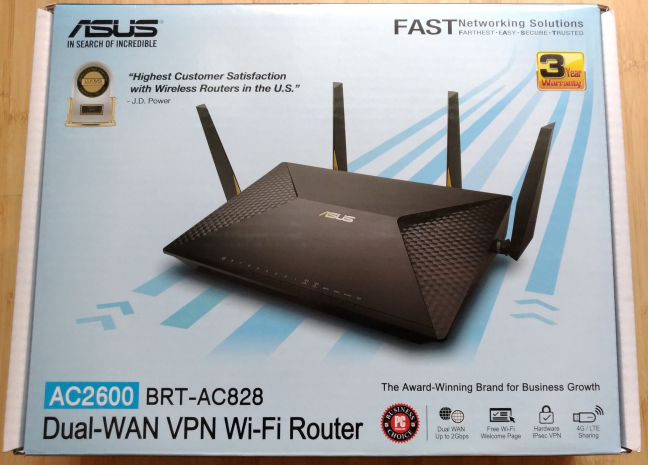
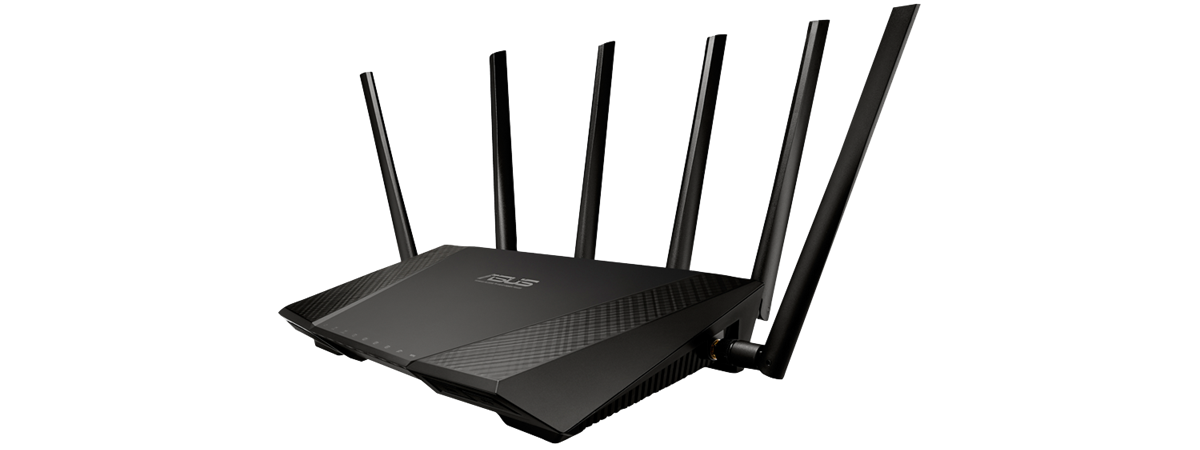
It is clear that the ASUS BRT-AC828 wireless router is designed for businesses, just by looking at its packaging. It no longer uses the colors found on the retail routers of this company, and it brags about features that are useful especially for businesses: dual-WAN connections, custom Wi-Fi welcome pages, hardware VPN and more. On the front side of the box, you get a picture of the device, as well as an idea about maximum theoretical bandwidth this router has to offer: 2600 Mbps.
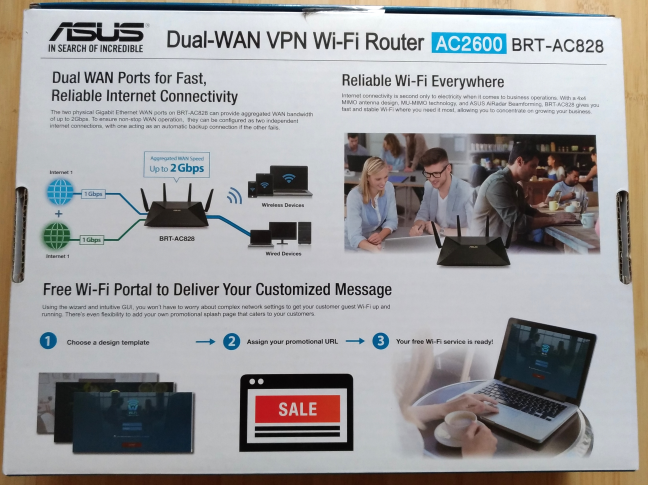
On the back side of the box, ASUS takes a deeper dive in presenting some of the business-oriented features of the BRT-AC828 router.
When you open the box, you find the router itself, the power adapter, the four external antennas, a network cable, a support disc, the user manual and the warranty.
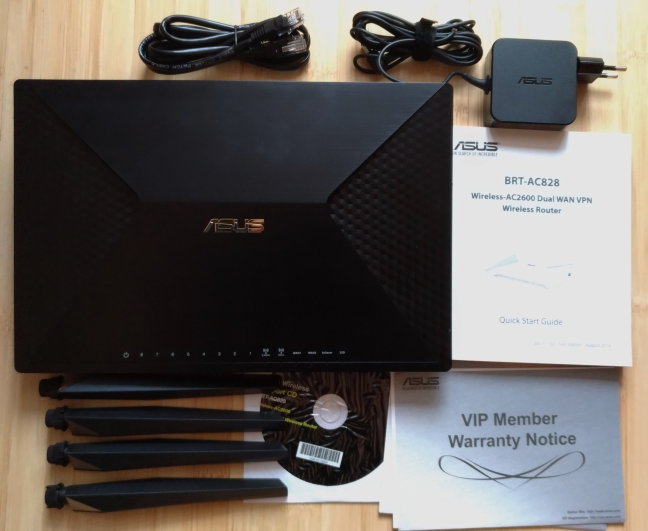
The unboxing experience is quick and pleasant. ASUS bundles everything you would expect from a high-end wireless router.
Hardware specifications and design
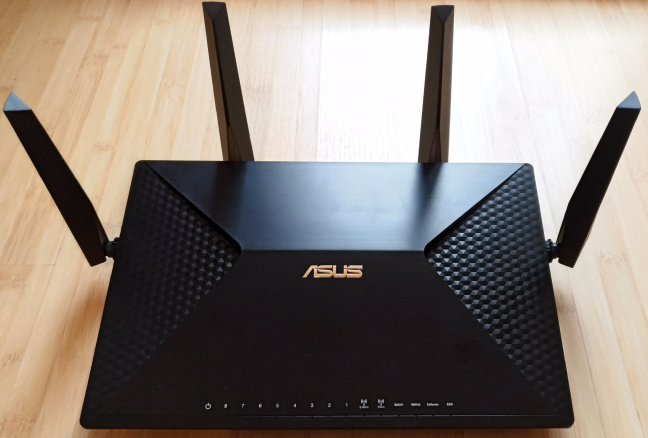
The design is less futuristic than that of the routers that are sold by ASUS in the consumer space. It is straightforward and austere, fitting of a business environment where it should be a discrete and reliable presence. The external antennas are easy to mount, and all the LEDs are on the top side of the router. Luckily, they are not large and distracting, as it happens with routers in the consumer space. We have many LEDs on this business router: one for each of the two WAN connections that you can use, two for both wireless frequencies (2.4 GHz and 5GHz), one for the SSD drive that can be plugged into the router, a LED signaling when the router enters in failover mode, and a LED for each device that is connected to the router using an Ethernet cable (up to a maximum of 8 devices).
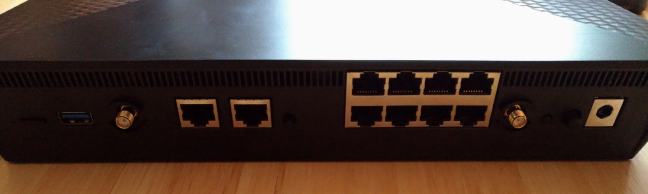
On the back of the router, you have two ports for connecting it to the internet, eight ports for connecting devices through Ethernet cables, a USB 3.0 port and a button for turning On/Off this port, a WPS button, a Reset button and the Power button alongside the power jack.
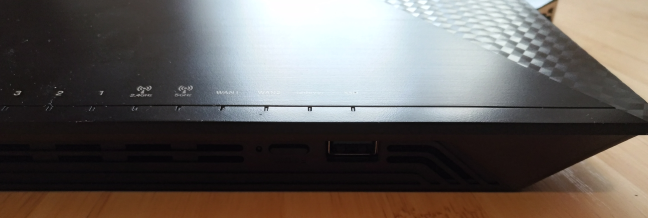
On the front side of the router, there's another USB 3.0 port and a button for turning it On and Off.
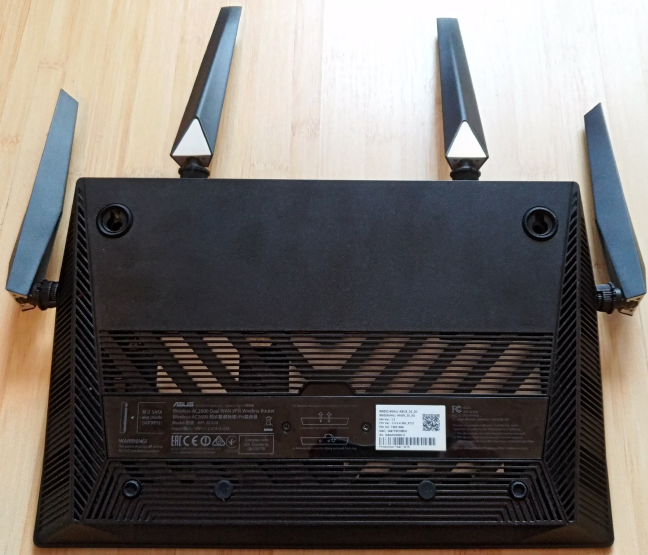
On the bottom there are mounting screw slots that can be used for wall-mounting the router, using a VESA mount. The ASUS BRT-AC828 is also designed to be mounted to a server rack, using an aluminum stand. If you need help with mounting it, read the user manual which offers very detailed instructions for all kinds of situations.
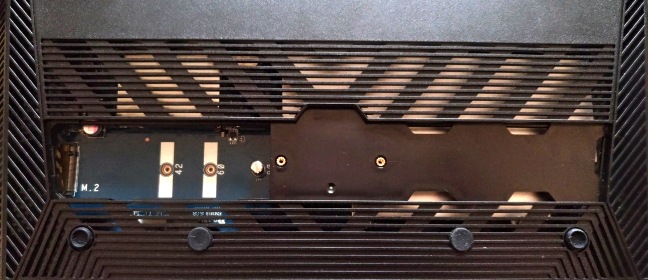
You also have the option of plugging in an SSD drive, using the M.2 SSD socket that can be uncovered with a simple screwdriver.
The hardware inside the ASUS BRT-AC828 wireless router is quite impressive: this device features a dual-core Qualcomm IPQ8065 processor running at 1.7 GHz, 512 MB or DDR3 RAM memory and 256 MB of storage space. It offers support for all modern networking standards up to 802.11ac. It has a 4x4 MIMO antenna design and ASUS AiRadar beamforming for fast and stable wireless connections. ASUS brags about being able to handle 250 simultaneous client connections, which is outstanding.
Regarding size, this router is quite large, having 7.4 x 11.8 x 1.9 inches in width, depth, and height, or 190 x 300 x 49.5 mm. It is also relatively heavy at 2.09 pounds or 950 grams.
The operating system support is outstanding, and it includes all Windows versions starting with the dated Windows XP, as well as Mac OS X 10.6 to 10.8.
If you want to verify the official specifications of this router, go to this page: ASUS BRT-AC828 Specifications.
Setting up and using the ASUS BRT-AC828 AC2600 Dual-WAN VPN Wi-Fi Router
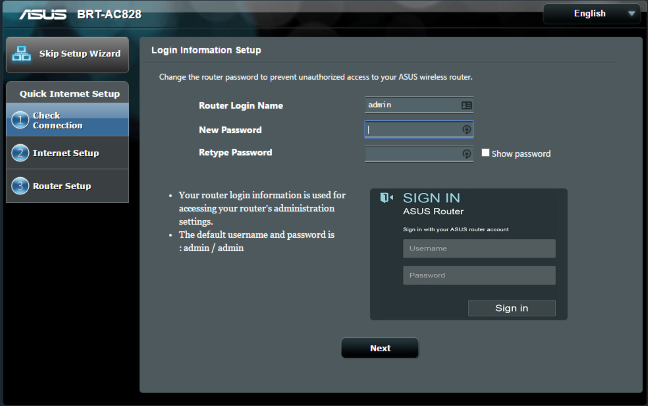
Setting up ASUS BRT-AC828 is similar with other routers and, at first, ASUS takes a security precaution and recommends you to change the default router login name and password. Everyone should stay away from the admin/admin defaults.
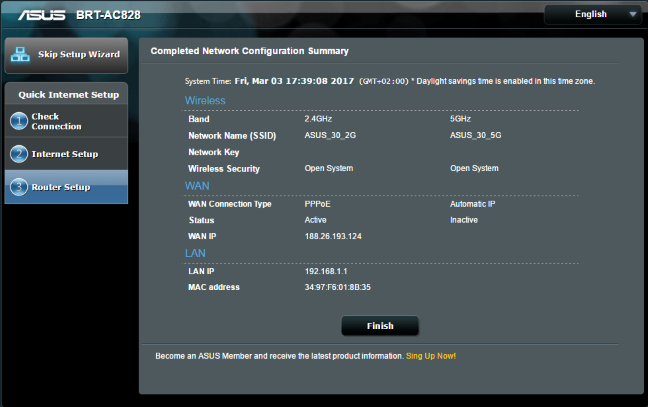
Then, your internet connection is detected, and you are asked to confirm its type. ASUS BRT-AC828 did a good job at detecting our PPPoE connection and then asked us to enter the connection details we received from our internet provider. Next, you are asked to set the wireless networks that are broadcast by the router. When done, you are shown a summary of your settings. Click or tap Finish, and you can start configuring your network in detail.
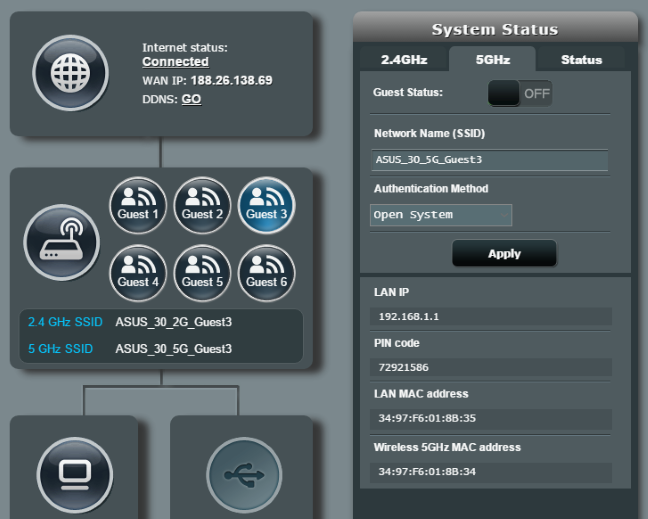
The user interface is the same you have on other ASUS routers, including those sold in the consumer space. What's different is that ASUS BRT-AC828 has many more features than consumer routers and the user interface offers all the options you need to configure everything. Seeing all the available configuration options, you may feel overwhelmed. There's a lot to take in, understand and configure. However, network administrators are going to be pleased with the number of features and the detailed control that they get. In the end, this router is designed for businesses, not home users who prefer simplicity over advanced features.
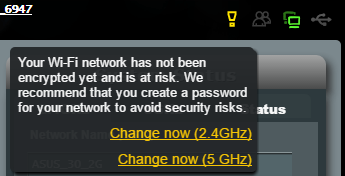
One thing that I always appreciate about ASUS routers is that their firmware is proactive. When you sign into the administration interface, visible warnings are popping up when there are issues that you must fix, when firmware updates are available and so on.
Also, the user interface is available in 18 languages, which you can see below.

Another positive is that help is always at hand. If you get lost in some of the more advanced settings, move the mouse cursor over the setting that you don't understand. If you see a question mark display on top, click on it and a description of that setting is shown.
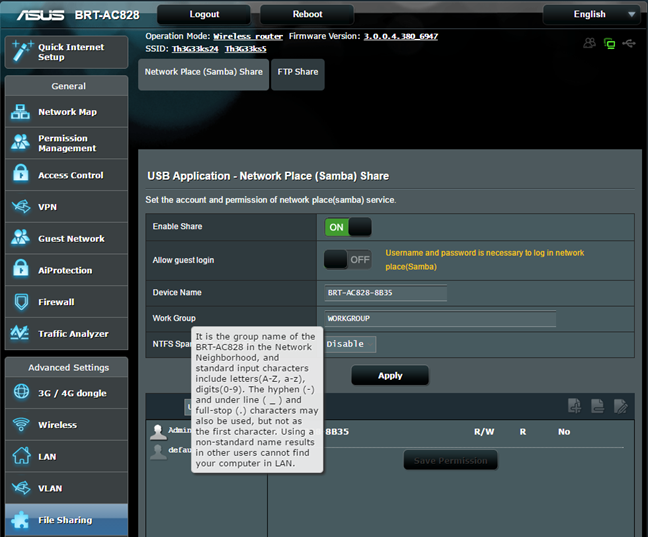
The only downside of the firmware on the ASUS BRT-AC828 is that it is slower to respond to commands than the firmware of consumer routers from the same company. This is understandable since the feature list is longer and more complex. Also, many of the business-oriented features require a reboot when turned on, which means waiting for a minute or more, until they are applied.
Once you are done configuring the router, using your network is a breeze. You should have no issues with sharing files and devices over the network. Also, wireless connections tend to be quite stable and, as you will see in our benchmarks, ASUS BRT-AC828 offers superb coverage.
The setup process for the ASUS BRT-AC828 wireless router is what you would expect from a business device. The firmware has lots of advanced features, configuration options, and great multilingual support. Network administrators will not be disappointed with what this router has to offer. Also, users enjoy fast and stable network connections.
Go to the second page of this guide to see the results of our measurements, learn more about the business features offered by this router and our final verdict.
Wireless network performance
First, let's take a look at the apartment that was used in our testing and how it is set up. You can see that the router is placed in the living room. With most wireless routers, the signal strength is weak in rooms like the Kitchen and the Medium balcony.
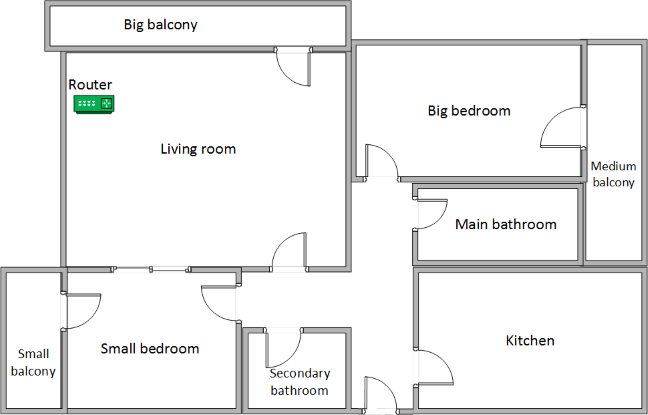
Our testing was done using a fast 1 Gigabit Internet connection that's capable of uploads on the internet of up to 500 Mbps. We used a Microsoft Surface Pro 3 for all our measurements and several software tools. To get a better perspective of the performance offered by ASUS BRT-AC828, we compared it with TP-LINK Archer AC2600 (a competing router with a similar total bandwidth) and ASUS RT-AC88U (a retail router made by the same company with many similar specs and features).
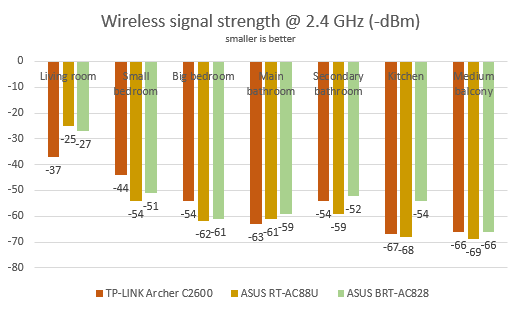
We started by evaluating the 2.4 GHz wireless network and measured the signal strength offered in each room, using a tool named inSSIDer. As you can see in the graph below, BRT-AC828 offers a signal strength which is close but slightly better than what you get from ASUS RT-AC88U.
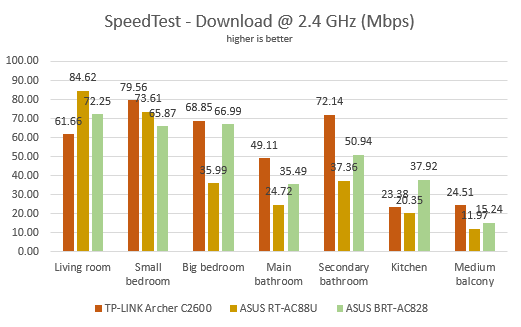
For the next set of measurements, we used SpeedTest to measure how fast the internet connection offered by this router is when using 2.4 GHz wireless network. At first, we used an ASUS PCE-AC88 PCI-Express network card, to see the maximum speed we can achieve with high-end networking hardware. As you can see below, we achieved an impressive maximum download speed of 422.30 Mbps. That is very fast for a 2.4 GHz wireless network.

Then, we took our Surface Pro 3 and moved from room to room to make our measurements. The results are shown in the table below. While ASUS BRT-AC828 is not the fastest router in this test, it is very clear that it offers good coverage, including in the rooms that are furthest from the router.
When it comes to uploads, ASUS BRT-AC828 was faster than the other routers.
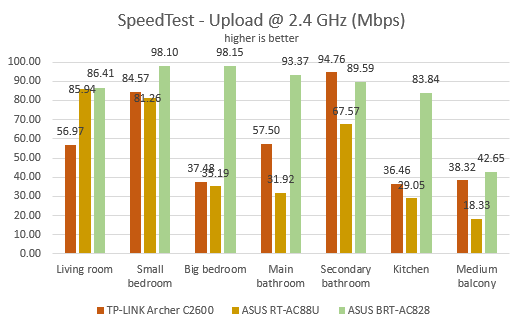
Continuing our measurements on the 2.4 GHz wireless network, we used LAN Speed Test Lite to measure downloads and uploads when transferring a 350MB file between two computers connected to the network. Here, ASUS BRT-AC828 was the best router of the bunch in several rooms.
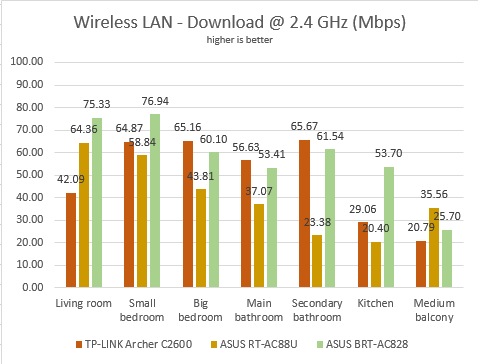
The same trend was noticed when measuring the upload speed. Here, ASUS BRT-AC828 has proved to be very reliable, including in the rooms furthest from the router.
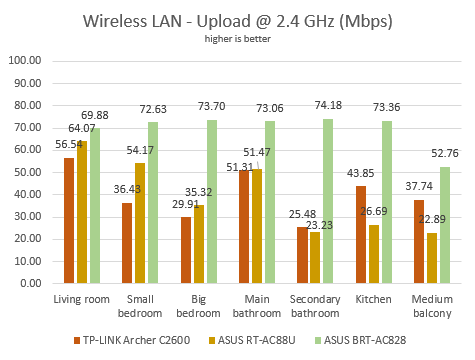
ASUS BRT-AC828 offers fast and stable wireless network connections on the 2.4 GHz frequency. We especially appreciate how fast the uploads are, and the quality of the coverage that we received even in the rooms farther from the router.
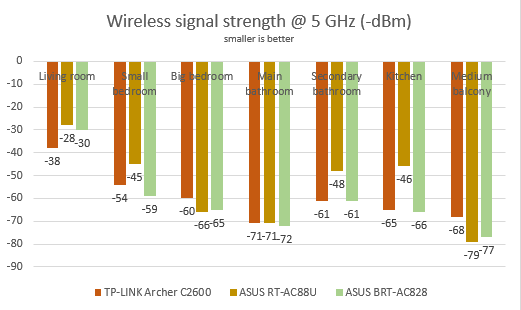
For the next set of measurements, we analyzed the performance offered by the 5GHz wireless network and we looked at the evolution of the signal strength, from room to room. As you can see below, BRT-AC828 offers a signal strength that doesn't vary so much between rooms, like it is the case with other routers.
Then, we used SpeedTest to measure the speed of the Internet connection on the 5GHz wireless network. At first, we used an ASUS PCE-AC88 PCI-Express network card, to see the maximum speed we can achieve with high-end networking hardware. As you can see below, we achieved a maximum download speed of 612.12 Mbps, which is fantastic. However, the upload speed was limited by our internet provider which caps it at 500 Mbps. We cannot tell what this router is capable of when measuring uploads on the internet.

Then, we took our Surface Pro 3 and moved from room to room to make our measurements. The results are shown in the table below. As you can see, ASUS BRT-AC828 can deliver very fast downloads.
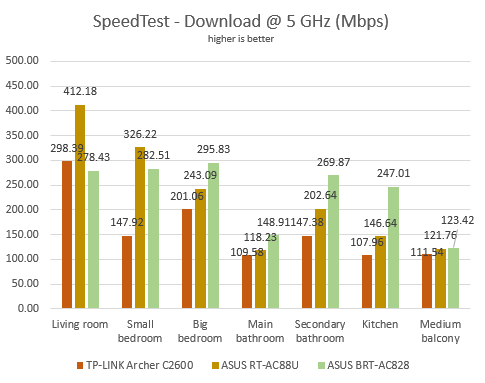
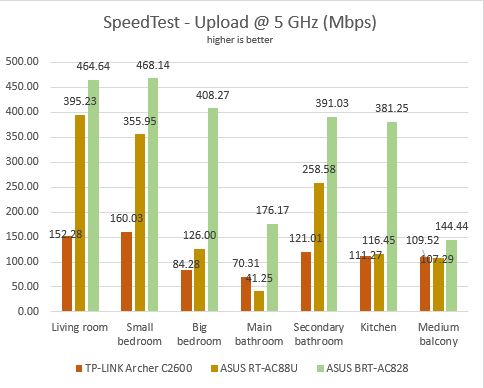
When looking at the upload speed, its performance was spectacular. However, there's one thing to note here: at the time we performed the measurements for TP-LINK Archer AC2600, we had an internet connection which couldn't deliver more than 200 Mbps for uploads. When making this review, our connection has been upgraded to 500 Mpbs.
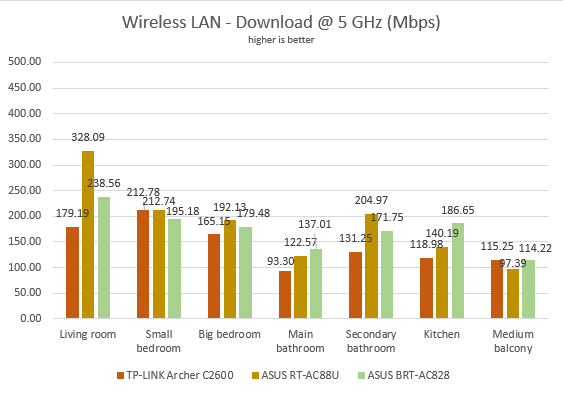
Continuing our measurements on the 5 GHz wireless network, we used LAN Speed Test Lite to measure downloads and uploads when transferring a 350MB file between two computers connected to the network. Here, ASUS BRT-AC828 was a solid performer.
When looking at the upload speed, ASUS BRT-AC828 was again the uncontested leader. We were pleasantly surprised to see it perform great, especially in the rooms where the wireless signal is not that good.
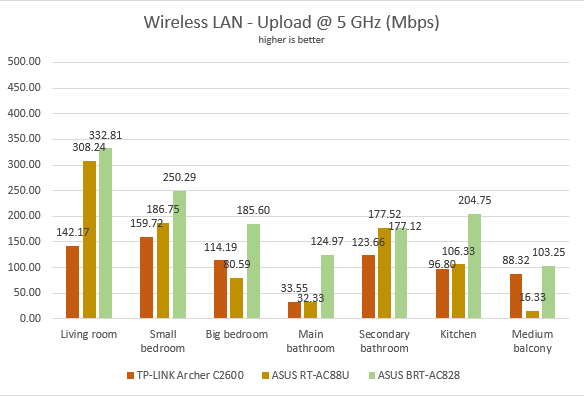
ASUS BRT-AC828 offers solid coverage on the 5 GHz wireless frequency. Its strengths are the very fast uploads and the wireless coverage it offers in rooms where other routers cannot offer good signal strength and connection speeds.
Wired network performance
For testing the quality of the wired Ethernet connection, we used a desktop PC, equipped with an Intel Core i5 4460 processor, running at 3.20GHz, 16GB of RAM and a very fast Samsung 850 Pro 512GB SSD drive. We measured the download and upload speeds using SpeedTest. Regarding the download speed, we reached an average speed of 920.2 Mbps. The upload was limited by the maximum allowed by our internet connection - 507.37 Mbps.
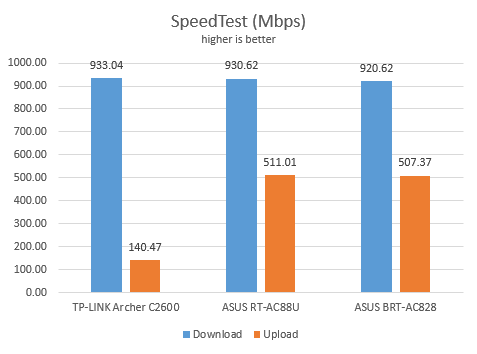
As you can see in the graph above, ASUS BRT-AC828 is capable of delivering Ethernet connections that are very close to the promised 1Gbps.
Extra features
ASUS BRT-AC828 offers an incredible amount of features. Some of them are present also in wireless ASUS routers that are designed for the consumer market, while others are clearly aimed at businesses. The list includes the following:
- Permission management - you can create great user groups, each with a specific list of devices so that you can assign different rules and permissions for each.
- Access control - you can assign different access rules for different user groups which you have created using Permission management.
- VPN - you can set the ASUS BRT-AC828 to work as a VPN server, using the following protocols: PPTP, OpenVPN, and IPSec VPN.
- Guest network - this router can broadcast up to six guest networks, three for each wireless frequency.
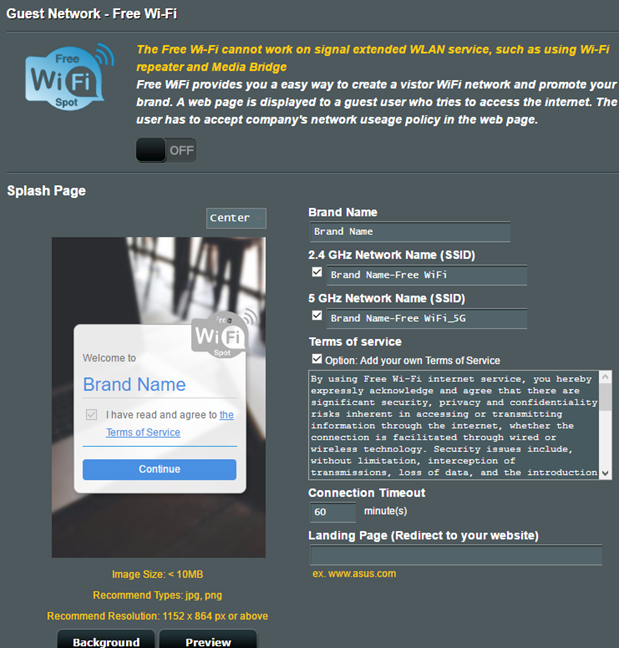
- Brand Name Splash Page - when setting up a guest network for the customers of your business, you can set a landing page, like the Facebook page for your business.
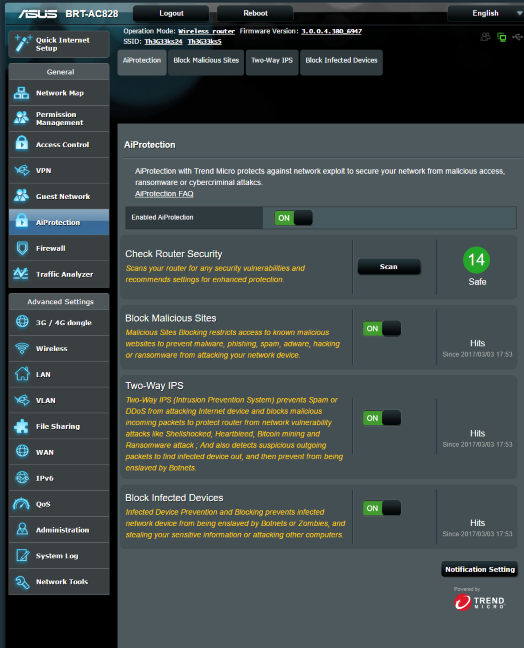
- AiProtection - this feature helps keep your network safe, using Trend Micro's cloud protection against security vulnerabilities, malicious sites, infected devices. Another protection layer that's added for business users is a Two-Way Intrusion Prevention System.
- Firewall - an advanced firewall that offers the possibility to block different types of commercial applications (not only traditional consumer apps or P2P transfers, like on consumer routers from ASUS), web content filters, as well as a filter for network services.
- Traffic Analyzer - it offers statistics on a client or app basis so that you know how your network is used and how much data it is being transferred.
- 3G/4G dongle - you can plug in a USB dongle from your mobile provider into a USB port on the router and use it as a backup internet connection.
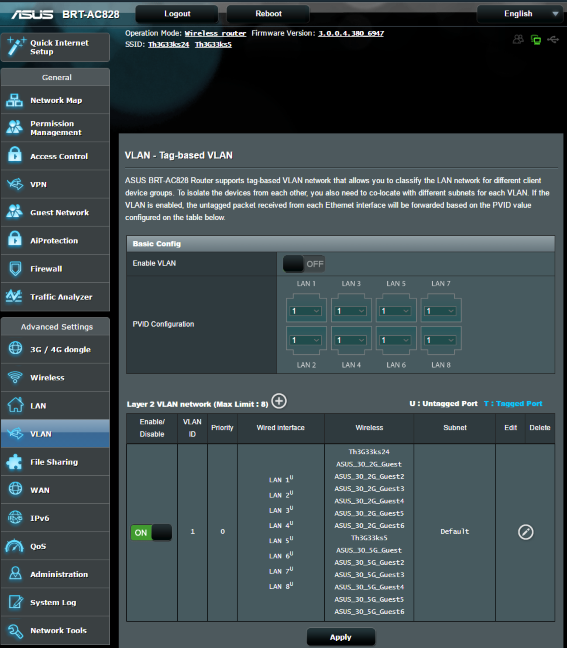
- VLAN (Virtual LAN) - Virtual Local Area Networks divide a single physical network into multiple logical networks. Each VLAN forms its broadcast domain and communication between different VLANs is only possible through a router that has been connected to all VLANs. In larger networks, this feature is useful to network administrators.
- File Sharing - You can connect one or more storage devices to the router, using its USB ports and then enable file sharing on those devices. Access can be set based on very specific rules.
- Dual WAN - ASUS BRT-AC828 promotes the use of two internet connections. The router is cable of doing load balancing to optimize bandwidth, maximize throughput, minimize response time, and prevent data overload for both WAN connections. It can also be set to use one internet connection as a backup for the main connection.
- DDNS (Dynamic Domain Name System) - a service that allows network clients to connect to the wireless router, even with a dynamic public IP address, through its registered domain name.
- QoS - a very advanced Quality of Service feature that can be used to ensure bandwidth for prioritized tasks and applications.
- Network Tools - a set of tools that you can use to troubleshoot problems on your network.
ASUS BRT-AC828 includes many advanced features that are very useful to both network clients and network administrators.
Pros and cons
ASUS BRT-AC828 has many good things going for it:
- A wealth of functions that are helpful in a business environment
- Network administrators will appreciate the very advanced firmware that is highly customizable
- This router includes many Ethernet ports, as well as support for 250 simultaneous client connections
- ASUS BRT-AC828 was incredibly fast in all the uploads that we have measured
- Top-notch hardware that can offer excellent coverage and reliable wireless network connections
- This router does not focus on being the fastest in the branch, but on providing reliable wireless connections with speeds that don't drop dramatically towards the edges of its area of coverage
- Great multi-lingual support
There are also some minor negatives to consider:
- Because of its many features, the firmware is also slower to respond to commands than on consumer routers from the same brand
- Many of the business-oriented features require a reboot when turned on, which involves waiting for a minute or more until they are applied.

Verdict
ASUS BRT-AC828 is a wireless router with a very clear audience in mind: business customers. It offers many features that are enjoyed in this environment, and it focuses on critical aspects like a large number of simultaneous client connections, reliability and stability. It is fast, but it is not the fastest router on the market. However, it beats consumer routers in the quality of the coverage that it offers. Also, some of its advanced features are designed to increase the security of the network that is maintained by the router. Overall, we are very pleased with this router, and we highly recommend it to its intended audience.
Discussion (2)
I just would like to share my experience. DO NOT BUY THIS PRODUCT. It looked interesting because it has loads of features and I wanted more for my home network. However only within 2 weeks 5 GHZ is down, so I went down to claim the hardware. And it happened about 3 weeks ago and guess what, now the 5Ghz also down. When I went down to exchange, there is also customer exchanging his router (he uses RT-AC88U).
So my advice is, don’t get fooled by the looks and the features, some more this device is ridiculously expensive but failed to meet the qualtiy standard. I came from network engineering background and guess what – if you dig deep into the technology you will find lots of flaws. For example everytime you make change to wireless setting it needs to reboot – what the …? even for turning on and off the captive portal. It supports vlan but no intervlan routing. The DMZ feature which is suppose to make more secure of your network when opening a service for internet, it happens to permit all ports to your inside network which cause a more big hole to your network again WHAT THE …? The traffic analyzer looks nice but after a while it will just generalize unknown ports to other general traffic, the firewall only supports ipv6 and currently majority service provider uses IPv4 still for home network – maybe because of the limitation dealing with NAT… and lot lot more so I give up.
I am planning to go down and make an exchange again… just for the sake of not loosing money – but I truly, madly, deeply, disappointed with this ridiculously fail to perform wireless router.
The other reviews, trust me, I fell for them too – but they did not go deep – if they do they won’t praise this product at all – really just technology jargons being used for marketing purpose but not giving lots of sense. Either you go with normal home network or go to prosumer product like Mikrotik or Ubiquity if you want more features or if you have loads of cash you can go for enterprise line like Cisco (less feature but really robust). So it’s up to you but I do give my honest experience so others may save their precious money and live a better life.
This is a router with terrible price to value ratio. It is very expensive and it is lacking essential features expected, like strict binding of a MAC address to an IP. It has limitations like 64 assignments (only) to DHCP server.
In general, not a business router, just an expensive home one.
In a firmware bug that I faced (which “bricked” my router for 3 days and managed to recover it by random actions), support from ASUS was really bad. They did nothing actually. The only help that I got was “return it to the store”.