



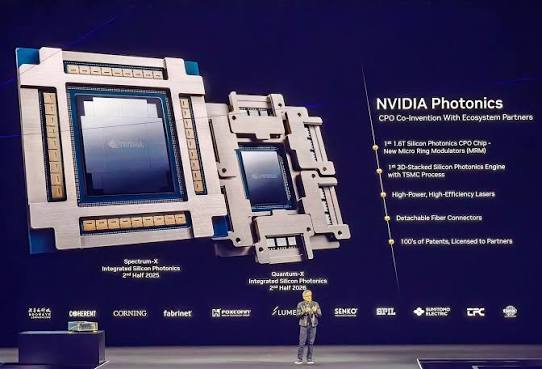
Nvidia’s first co packaged optics switch has reached Lambda, giving the AI infrastructure company an early look at Quantum X InfiniBand hardware built to reduce networking power and improve data movement inside large GPU clusters. The switch is designed for GB300 NVL72 scale systems, where networking is no longer a background component but a key part of how fast an AI cluster can operate.
The main benefit is power efficiency. Nvidia’s co packaged optics design is said to cut switch power by about 3.05kW compared with a standard switching solution. In large AI data centers, that saving can add up quickly and leave more power available for GPUs.
For AI companies, this matters because power is becoming one of the biggest limits on expansion. More GPUs require more electricity, more cooling, and faster networking. If the network fabric can consume less power, operators can use the same data center footprint more efficiently.
Nvidia is moving optical networking closer to the switch
Traditional data center switches rely on many separate optical transceiver modules. These modules connect networking hardware to fiber, but they also consume power, add heat, and create more possible failure points.
Co packaged optics changes that design by bringing optical components closer to the switching silicon. Nvidia’s Quantum X platform uses silicon photonics to move data through the network more efficiently, with 800G connectivity aimed at large AI clusters.
| Feature | Nvidia Quantum X CPO switch |
|---|---|
| Platform | Quantum X InfiniBand |
| Switch ASIC | Nvidia Quantum X800 |
| Ports | 144 x 800G InfiniBand |
| Switching capacity | 115.2Tb/s non blocking |
| Form factor | 4U |
| Optical connectors | 144 MPO connectors |
| Power input | 48V DC busbar |
| Cooling | Liquid cooling with dual internal loops |
| Light source design | 18 removable external modules |
The system is built for dense AI infrastructure where GPUs must exchange data constantly during training, inference, and agentic AI workloads.
Power savings can become huge at scale
The reported power difference is large. A standard switch solution is said to consume around 7.0kW, while Nvidia’s silicon photonics switch uses about 3.95kW. That gives a saving of roughly 3.05kW per switch layer comparison.
In small deployments, that is already useful. In very large clusters, the impact becomes much bigger.
| GB300 NVL72 cluster size | CPO switches | Network power freed | Power equivalent extra GPUs |
|---|---|---|---|
| 576 GPUs | 12 | 37kW | 26 GPUs |
| 4,608 GPUs | 100 | 305kW | 217 GPUs |
| 10,368 GPUs | 216 | 658kW | 470 GPUs |
| 41,472 GPUs | 1,440 | 4,392kW | 3,137 GPUs |
That last figure explains why data center operators care so much about networking efficiency. Saving power in the switching fabric can effectively create room for thousands of extra GPUs in a massive deployment.
Fewer optical modules could also reduce failures
Lambda says a 128,000 GPU data center can use around 655,000 discrete transceiver modules across its switching fabric. Each module is another part that can fail, heat up, or require replacement.
Co packaged optics reduces the number of separate optical components needed in the fabric. That can help improve reliability and lower maintenance complexity, especially in facilities running at very large scale.
This is important because AI clusters are not easy to operate. A single failure can affect throughput, job scheduling, or cluster availability. Reducing failure points can help keep expensive GPU infrastructure productive.
The design is built for liquid cooled AI racks
The engineering samples delivered to Lambda use 18 removable light source modules that feed 144 MPO ports. Instead of standard OSFP cages, the design uses fiber array connections that feed directly into the silicon photonics engine.
The rear of the unit uses 48V DC power with DGX compliant busbar connectors. Cooling is handled through four UDQ4 liquid cooling connections and dual internal loops. That makes the design familiar for operators already working with GB300 NVL72 racks and other high density Nvidia AI systems.
This is not consumer networking hardware. It is built for data centers where every watt, cable, port, and serviceable module matters.
AI factories are making networking as important as GPUs
The rise of large AI clusters has changed the role of networking. In older data centers, networking was often discussed separately from compute. In modern AI factories, the network directly affects training speed, inference throughput, and how efficiently GPUs work together.
If data cannot move quickly enough between GPUs, memory, storage, and servers, the cluster wastes compute power. That is why Nvidia is pushing InfiniBand, silicon photonics, and co packaged optics as part of its full AI infrastructure strategy.
For Lambda, early access to Nvidia’s Quantum X CPO switch could help reduce power overhead and improve cluster efficiency. For Nvidia, the delivery shows that its AI hardware push is moving beyond GPUs into the entire data center fabric.
The larger message is clear. Future AI performance will depend not only on faster accelerators, but also on more efficient networking. Co packaged optics could become one of the key technologies that lets AI data centers scale without being stopped by power, heat, and reliability limits.



Discussion (0)
Be the first to comment.