




TensorWave is raising $350 million to expand its AMD based AI infrastructure, with new deployments focused on AMD Instinct MI355X accelerators. The investment will help the company add more compute capacity for memory heavy AI workloads such as LLM training, high throughput inference, and generative AI production systems.
The move gives AMD another visible win in the AI infrastructure market, where Nvidia still dominates but supply limits and ecosystem lock in have pushed some companies to look for alternatives. TensorWave is positioning itself as a major provider of AMD powered AI compute for customers that need large scale GPU access without depending on a single hardware ecosystem.
TensorWave says its infrastructure is already being used by AI companies including Fireworks AI and Luma AI. These customers are using AMD based compute for large generative AI workloads and production inference systems, areas where memory capacity and total cost are becoming just as important as raw accelerator performance.
TensorWave is building one of the largest AMD AI GPU fleets in the US
TensorWave has been expanding aggressively since its Series A funding in 2025. The company already has 8,192 AMD Instinct MI325X GPUs online and is now deploying MI355X GPUs across new data centers in North America.
The company has also secured more than 2 gigawatts of long term AI data center capacity. That gives it room to scale as enterprise, research, and AI native customers demand more compute.
| Detail | TensorWave AI infrastructure plan |
|---|---|
| New funding | $350 million Series B |
| Main hardware focus | AMD Instinct MI355X GPUs |
| Existing online GPUs | 8,192 AMD Instinct MI325X GPUs |
| Target workloads | LLM training, inference, generative AI |
| Data center capacity | More than 2 gigawatts secured |
| Key customers mentioned | Fireworks AI and Luma AI |
| Long term direction | Larger AMD powered AI clusters |
This scale is important because AI companies often struggle to find available GPU capacity. Even when demand is high, supply can be locked behind major cloud providers or tied to long term contracts.
AMD gains another foothold in the AI cloud market
AMD has been trying to turn its Instinct GPU lineup into a stronger alternative to Nvidia’s AI accelerators. TensorWave’s investment shows that some infrastructure providers see an opportunity in offering large AMD based clusters.
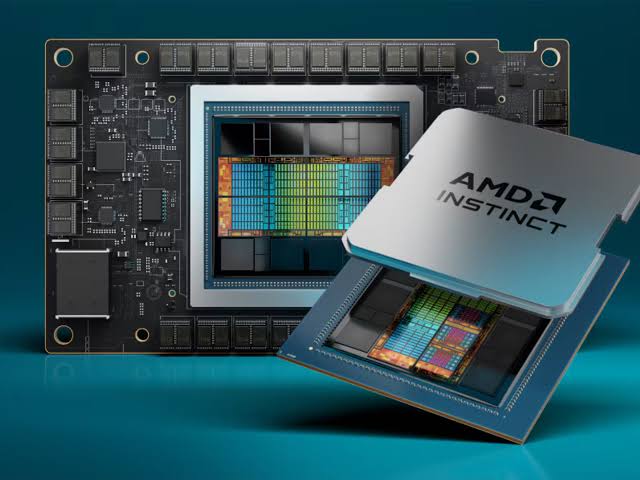
The appeal is clear. AI companies want access to high memory capacity, strong performance, and flexible infrastructure. They also want options that are not fully tied to Nvidia’s vertically integrated software and hardware stack.
That does not mean AMD has an easy path. Nvidia still has the strongest ecosystem, the widest software support, and deep relationships with major cloud and AI firms. But AMD’s Instinct hardware is gaining attention, especially where memory capacity and cost efficiency matter.
The MI355X is aimed at memory intensive AI workloads
TensorWave’s focus on the MI355X makes sense because many modern AI workloads are limited by memory as much as compute. Large language models, multimodal systems, and generative AI pipelines need high bandwidth memory and large accelerator pools to run efficiently.
Training larger models requires dense GPU clusters, while production inference needs predictable capacity and strong throughput. If TensorWave can offer that at competitive pricing, it could attract companies that need more than small scale cloud GPU rentals.
This also fits a broader industry shift. Many AI companies are moving from experiments to production. That means they need more stable infrastructure, not just occasional access to expensive accelerators.
AMD’s next fight is MI455X against Nvidia Vera Rubin
The timing also points toward AMD’s next major AI push. AMD is preparing its next generation Instinct MI455X accelerators, which are expected to compete against Nvidia’s Vera Rubin platform in future data centers.
This upcoming battle will be about performance, memory, power efficiency, software maturity, and total cost of ownership. Nvidia will likely remain the default choice for many customers, but AMD is trying to prove that large AI deployments can run efficiently on its platform too.
TensorWave’s growing AMD fleet could become a useful proof point. If its customers can run serious production AI workloads at scale, it strengthens AMD’s argument that the market needs more than one dominant accelerator supplier.
AI compute demand is pushing customers toward alternatives
The biggest reason TensorWave’s investment matters is simple: AI compute demand is still outpacing supply. Companies need more capacity for training, inference, fine tuning, video generation, image generation, and agentic AI workloads.
That demand has created room for alternative cloud providers and hardware platforms. TensorWave is trying to fill that gap with AMD based infrastructure, while AMD gains a partner that can show its Instinct GPUs working in large real world deployments.
The $350 million investment does not change the AI hardware market overnight. But it shows that AMD’s AI GPU strategy is gaining support from infrastructure companies that see value in a more open and flexible compute stack.
For customers, the result could be more choice in AI compute. For AMD, TensorWave’s expansion is another step toward becoming a serious second force in large scale AI acceleration.


Discussion (0)
Be the first to comment.