




NVIDIA’s upcoming N1X and N1 laptop chips have appeared in a detailed specification leak, giving an early look at how the company may enter the Windows laptop processor market with Arm based CPUs and integrated Blackwell graphics.
The leaked information suggests that NVIDIA is preparing multiple versions of the N1 family, with the higher end N1X aimed at premium laptops and the standard N1 likely targeting more affordable systems. The full N1X configuration is said to match the GB10 chip used in NVIDIA’s DGX Spark platform, which makes this leak especially interesting because it points to a broader commercial use for the same basic design.
According to the leak, the top N1X chip uses a 20 core CPU layout split into 10 Cortex X925 cores and 10 Cortex A725 cores. On the graphics side, it reportedly includes 48 SMs, which equals 6,144 CUDA cores. That is a large integrated GPU configuration for a laptop chip and suggests NVIDIA may be aiming at systems that need strong graphics performance without a separate GPU.
A second N1X version is also listed with an 18 core CPU setup, using 9 Cortex X925 cores and 9 Cortex A725 cores. That model reportedly includes 40 SMs, or 5,120 CUDA cores. Both N1X versions are said to operate in a 45W to 80W power range.
The standard N1 could target thinner and cheaper laptops
The standard N1 chips appear to be smaller and more efficient. One version reportedly uses a 12 core CPU configuration with 8 Cortex X925 cores and 4 Cortex A725 cores, paired with 20 SMs or 2,560 CUDA cores. Another version uses a 10 core CPU layout with 7 Cortex X925 cores and 3 Cortex A725 cores, paired with 16 SMs or 2,048 CUDA cores.
These standard N1 chips are listed with an 18W to 45W power range, which would make them better suited for thinner laptops or more affordable designs. The lower power target also suggests NVIDIA is not only chasing workstation class systems. It may want the N1 brand to appear across a wider range of Windows notebooks.
| Chip | CPU layout | GPU | Power range | Memory support |
|---|---|---|---|---|
| N1X high end | 10 Cortex X925 plus 10 Cortex A725 | 48 SMs, 6,144 CUDA cores | 45W to 80W | 16GB to 128GB LPDDR5X, 16 channel |
| N1X lower variant | 9 Cortex X925 plus 9 Cortex A725 | 40 SMs, 5,120 CUDA cores | 45W to 80W | 16GB to 128GB LPDDR5X, 16 channel |
| N1 high end | 8 Cortex X925 plus 4 Cortex A725 | 20 SMs, 2,560 CUDA cores | 18W to 45W | 8GB to 64GB LPDDR5X, 8 channel |
| N1 lower variant | 7 Cortex X925 plus 3 Cortex A725 | 16 SMs, 2,048 CUDA cores | 18W to 45W | 8GB to 64GB LPDDR5X, 8 channel |
The leaked platform details also point to different I/O capabilities between the two chip classes. N1X reportedly supports 12 PCIe 5.0 lanes and 5 PCIe 4.0 lanes, while N1 is listed with 8 PCIe 5.0 lanes and 3 PCIe 4.0 lanes. N1X is said to support up to three M.2 drives, while standard N1 supports up to two.
NVIDIA may be aiming beyond gaming laptops
The most important part of this leak is not only the CUDA core count. It is what the N1 family could mean for NVIDIA’s broader PC plans.
NVIDIA already dominates discrete laptop GPUs, but an Arm based laptop processor would put the company in a different position. Instead of supplying only the graphics chip, NVIDIA could provide a full CPU and GPU platform for laptop makers. That would put it closer to Apple’s approach with the M series and closer to Qualcomm’s Windows on Arm strategy.
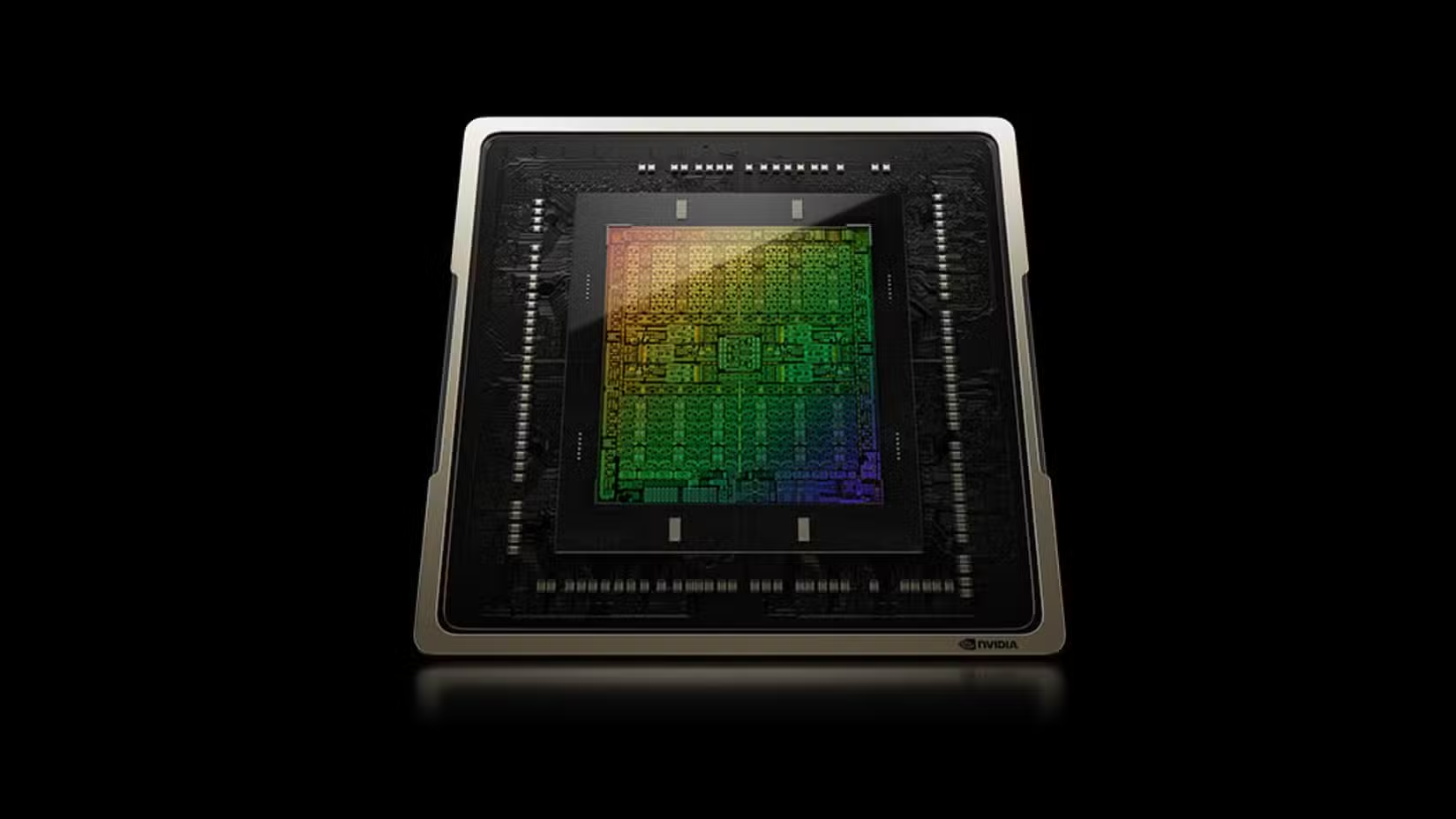
The N1X power range suggests high performance laptops, possibly creator systems, AI focused notebooks, and premium gaming capable machines. With up to 128GB of LPDDR5X memory and a large Blackwell based GPU section, the top chip could be attractive for workloads that need graphics, AI acceleration, and strong memory bandwidth.
The standard N1 is just as important because it could reach more mainstream designs. An 18W to 45W chip with integrated NVIDIA graphics could appeal to laptop makers that want better graphics than typical integrated GPUs without adding a separate discrete chip.
Of course, hardware is only one part of the story. Windows on Arm still depends on software compatibility, driver quality, app support, and battery life. NVIDIA would also need strong cooperation with Microsoft and laptop brands to make these systems feel polished from day one.
The leak also mentions that at least one slide was dated 2024, which suggests NVIDIA has been working on this platform for a long time. That makes sense for a project of this scale. Building a laptop chip family is not just about designing silicon. It requires firmware, platform validation, cooling targets, software support, OEM partnerships, and long term driver plans.
The real test will be final products and pricing
The leaked N1X and N1 specifications look impressive, but they are still preliminary. Not every listed variant may reach retail laptops, and some configurations could be reserved for specific partners or product tiers.
Pricing will also matter. If N1X laptops are too expensive, they may compete only with high end creator notebooks and gaming laptops. If standard N1 systems are priced well, NVIDIA could have a better chance of reaching mainstream buyers.
Performance will need independent testing too. CUDA core counts and CPU core layouts sound strong on paper, but real laptop performance depends on sustained power, cooling, memory bandwidth, driver maturity, and how well Windows handles the platform.
Still, the leak makes NVIDIA’s laptop processor plans look more serious than a small experiment. The N1X appears built for premium machines with a large integrated Blackwell GPU, while the N1 could bring NVIDIA’s platform to thinner and more affordable systems.
If the final chips match these specifications, NVIDIA could become a much bigger force in laptops, not just as the company behind the GPU, but as the provider of the entire processor platform.



Discussion (0)
Be the first to comment.