



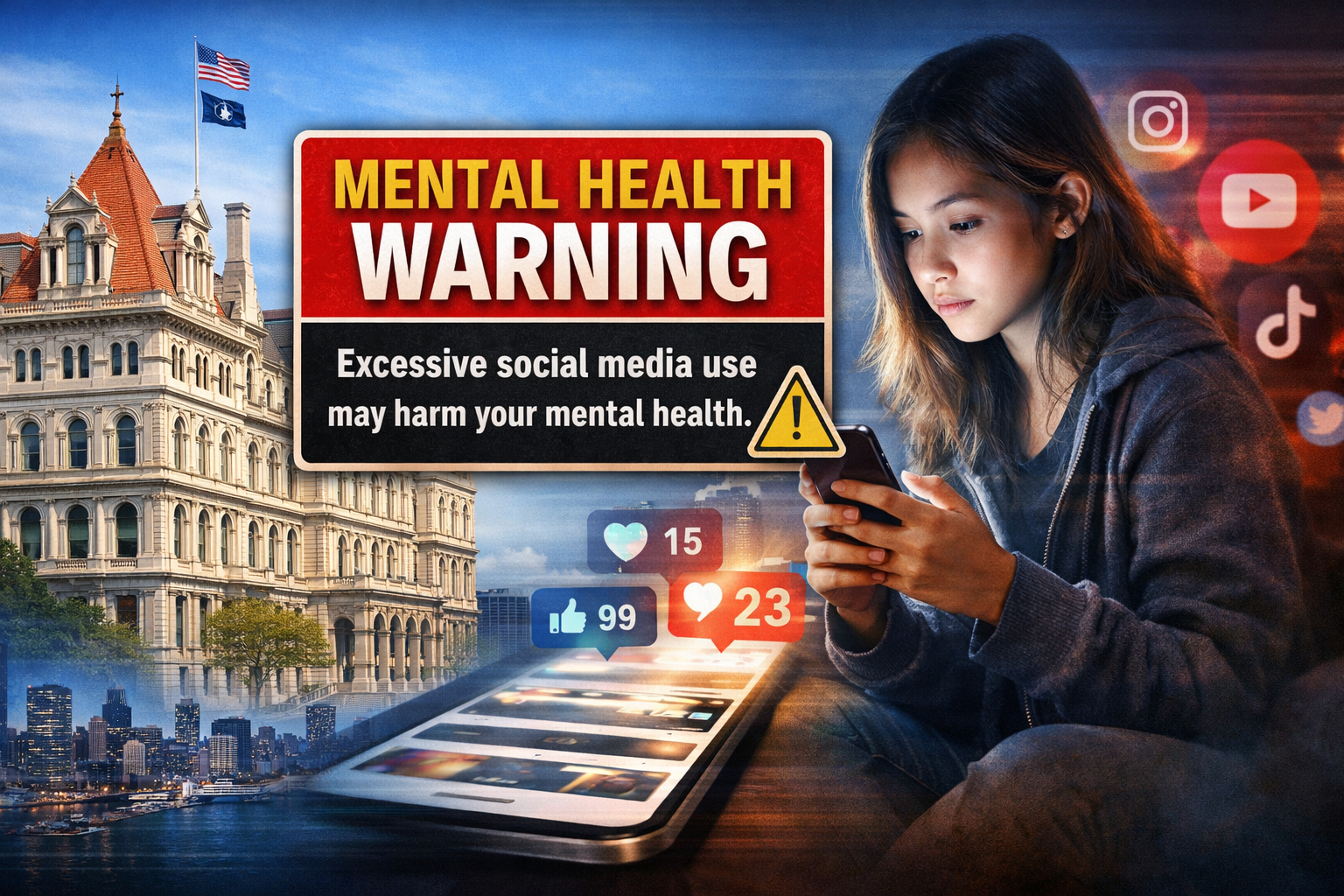
New York has taken a major step toward regulating social media’s impact on mental health, especially for younger users. Governor Kathy Hochul has signed new legislation that requires social media platforms to display mental health warning labels on features designed to keep users engaged.
The move places New York at the center of a growing national push to hold tech companies accountable for the psychological effects of their products.
What the new law requires
The law targets design elements that encourage prolonged or compulsive use. Platforms must display clear mental health warnings when users encounter features such as infinite scrolling, autoplay videos, and algorithm-driven content feeds.
These warnings must appear when users first interact with these features and reappear periodically during continued use. The state aims to ensure users, particularly minors, understand the potential mental health risks associated with excessive social media engagement.
Focus on youth mental health
Lawmakers crafted the legislation in response to rising concerns about anxiety, depression, sleep disruption, and body image issues among teenagers. State officials argue that addictive design choices amplify these risks and warrant consumer-style warnings similar to those used for tobacco or alcohol.
Governor Hochul framed the measure as a public health intervention rather than a content moderation effort, emphasizing transparency over censorship.
Enforcement and penalties
The New York State Attorney General will enforce the law. Platforms that fail to comply face civil penalties of up to $5,000 per violation.
The rules apply to social media services operating in New York or offering services to New York residents. Users outside the state do not fall under the law’s scope.
Tech industry reaction
The announcement triggered immediate reactions across the tech sector. Shares of companies tied to major social platforms, including Meta, Snap, and Alphabet, dipped as investors weighed the potential regulatory and compliance costs.
Industry groups have raised concerns about implementation details and possible First Amendment challenges, arguing that mandated warnings could set a precedent for broader state-level regulation of digital products.
A broader national trend
New York’s action follows similar efforts in states such as California and Minnesota, where lawmakers continue to explore ways to protect minors online. While approaches vary, the momentum reflects increasing bipartisan concern about social media’s role in the ongoing youth mental health crisis.
As enforcement timelines come into focus, tech companies now face pressure to redesign user experiences or risk mounting penalties in one of the country’s largest digital markets.
What happens next in New York could shape how other states - and possibly federal lawmakers - approach social media regulation in the years ahead.


Discussion (0)
Be the first to comment.