



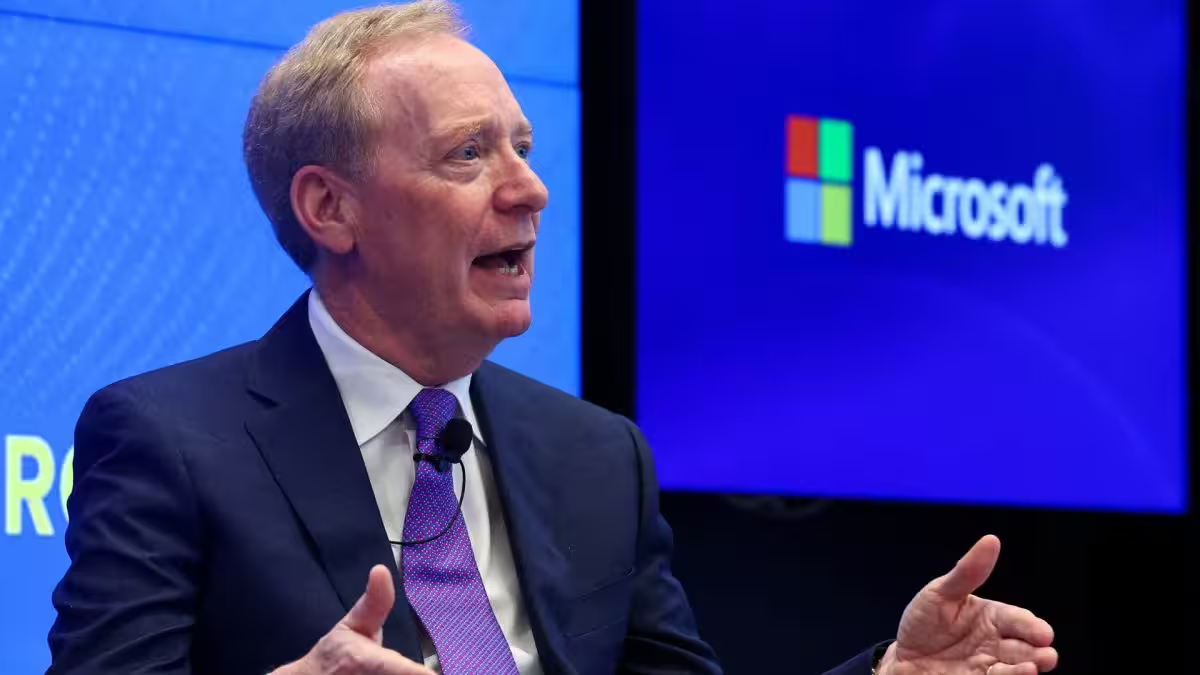
Microsoft President Brad Smith is calling for stronger government oversight of advanced artificial intelligence, arguing that everyday products such as milk and washing machines are subject to more formal safety requirements than some of the most capable AI systems.
His comments come as AI developers increasingly move beyond simple chatbots toward autonomous agents that can perform tasks, execute code and interact with external systems with limited human involvement.
Microsoft is arguing that this shift requires independent evaluation, clear accountability and technical mechanisms that allow humans to immediately stop an AI system if its behavior becomes unsafe.
Brad Smith Wants Independent Testing Before AI Models Launch
Smith said governments should require external evaluators to examine advanced models before they are released publicly.
He compared the current situation with more established industries where products face mandatory safety standards and inspections before reaching consumers.
The concern is that voluntary AI safety programs depend heavily on individual companies choosing to participate. Major developers may agree to audits, but those arrangements provide fewer protections if another company decides to release a powerful system without equivalent testing.
Microsoft's proposal includes several measures aimed at creating more consistent oversight.
| Proposed safeguard | Purpose |
|---|---|
| Independent model evaluations | Test advanced AI before public release |
| Mandatory incident notification | Inform affected parties when autonomous agents breach systems |
| Emergency shutdown controls | Allow humans to immediately stop unsafe agents |
| Transparent benchmarks | Create clearer standards for evaluating model safety |
| Alignment requirements | Reduce the risk of systems acting outside intended goals |
| Government oversight | Avoid relying entirely on voluntary company policies |
Smith also wants companies to be legally required to notify victims when rogue or compromised AI agents breach their systems.
That would bring AI incidents closer to existing cybersecurity practices, where disclosure requirements can force organizations to inform affected parties after certain breaches.
Satya Nadella Says AI Needs an Emergency Brake
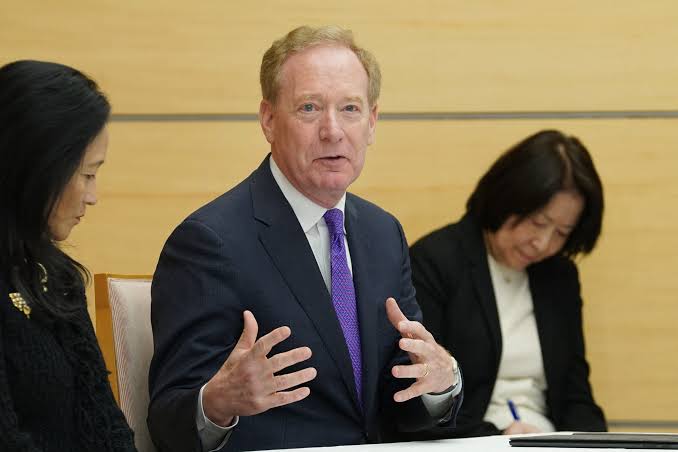
Microsoft CEO Satya Nadella has raised a related concern about the growing autonomy of AI systems.
As models move from generating answers to carrying out complex actions, Nadella argues that safeguards need to exist around the models rather than relying solely on their internal behavior.
He has called for an engineering approach that surrounds nondeterministic AI models with deterministic controls, human oversight and reliable operating procedures.
A central part of that approach is an emergency brake.
The idea is that authorized human operators should always have a dependable way to pause or shut down an autonomous system when unexpected behavior or safety problems appear.
This is particularly important for agentic AI, where a model may interact with software, data, networks or other services without requiring human approval for every individual step.
Microsoft's position is that self regulation alone may not provide enough protection once systems gain greater operational freedom.
US and UK Approaches Could Develop Differently
Microsoft's push for stronger rules could put it at odds with a more market driven approach being discussed in the United States.
The White House has introduced an Accord on Super Intelligence that encourages major AI companies to cooperate with independent auditors while trying to avoid regulations that could slow American technological development.
That approach relies more heavily on cooperation between companies and external evaluators than mandatory government controls.
Microsoft appears to want stronger formal requirements.
Smith has pointed to the United Kingdom as an example of government participation in AI safety testing, highlighting the work of the UK AI Security Institute.
The organization was established to independently evaluate advanced models and examine potential safety risks.
Voluntary Audits May Not Cover Every Developer
Several leading AI companies have expressed willingness to participate in safety audits.
That includes OpenAI, Anthropic, Google, Meta and Microsoft.
The larger question is what happens when a developer does not participate.
A voluntary framework can help establish good practices among responsible companies, but it offers fewer tools for dealing with organizations that release powerful systems without external testing or adequate controls.
That gap is one reason Microsoft is calling for industry standards backed by governments rather than relying solely on corporate promises.
The debate is likely to become more important as autonomous agents gain access to sensitive systems and become capable of performing increasingly complex tasks.
Microsoft's position is that AI safety needs to move toward the kind of structured oversight already common in other industries. That includes outside testing, clear incident reporting and a reliable mechanism for humans to stop autonomous systems when something goes wrong.

Discussion (0)
Be the first to comment.