



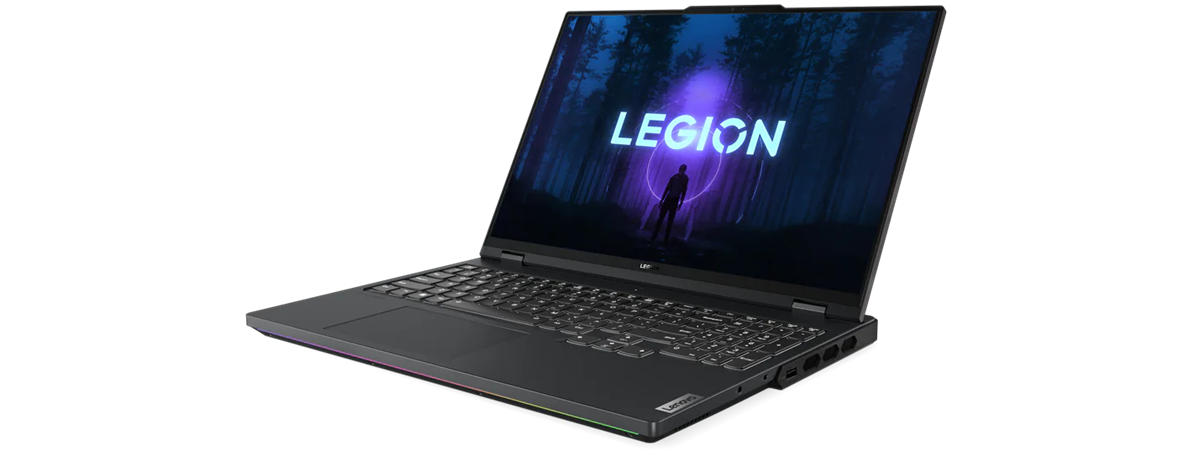
If you’re looking for a powerful gaming laptop that can handle any game or demanding task, you might want to check out the Lenovo Legion Pro 7. It’s the latest flagship model from Lenovo’s gaming laptops series, offering impressive performance, design, and features. In this review, I’m taking a closer look at the Lenovo Legion Pro 7 and what it can do both in real life and in benchmarks. Do you want to know more about it? Read on and see what makes the Lenovo Legion Pro 7 stand out from the crowd:
![Verdict]()


 Unboxing the Lenovo Legion Pro 7
Open the box, and you’ll find the gaming laptop accompanied by its power charger and cable, a small box with a couple of keycaps, a quick start guide, and the warranty details.
Unboxing the Lenovo Legion Pro 7
Open the box, and you’ll find the gaming laptop accompanied by its power charger and cable, a small box with a couple of keycaps, a quick start guide, and the warranty details.
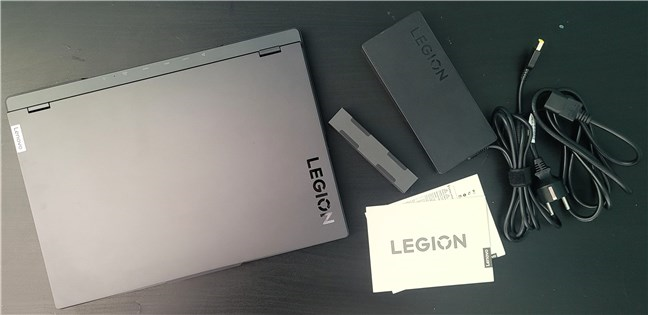
 Lenovo Legion Pro 7: What's inside the box
Unboxing the Lenovo Legion Pro 7 gaming laptop is a straightforward yet pleasant experience, and the bundled additional keycaps are a nice touch that gamers will definitely appreciate.
Lenovo Legion Pro 7: What's inside the box
Unboxing the Lenovo Legion Pro 7 gaming laptop is a straightforward yet pleasant experience, and the bundled additional keycaps are a nice touch that gamers will definitely appreciate.
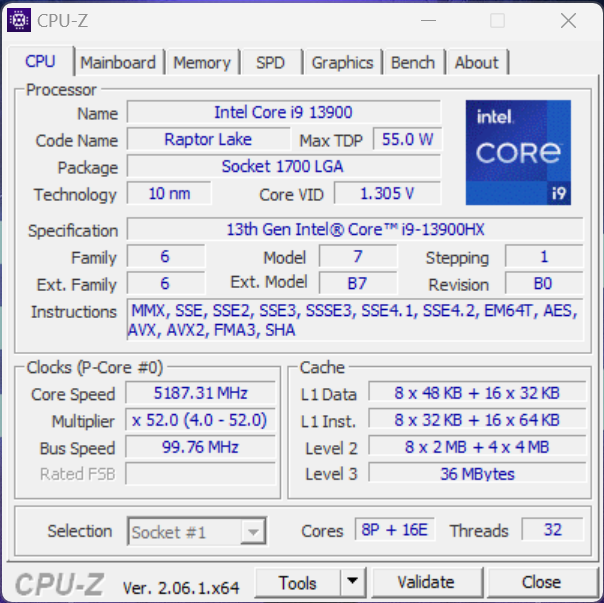
 CPU specifications shown by CPU-Z
The laptop can be equipped with up to 32 GB of DDR5 memory, running at 5600 MHz, and with up to two PCIe 4 solid-state drives, each with a maximum storage capacity of 1 TB. As you can see in the next screenshot, the model I tested had the maximum amount of RAM possible - 32 GB - and one SSD with a storage capacity of 1 TB.
CPU specifications shown by CPU-Z
The laptop can be equipped with up to 32 GB of DDR5 memory, running at 5600 MHz, and with up to two PCIe 4 solid-state drives, each with a maximum storage capacity of 1 TB. As you can see in the next screenshot, the model I tested had the maximum amount of RAM possible - 32 GB - and one SSD with a storage capacity of 1 TB.
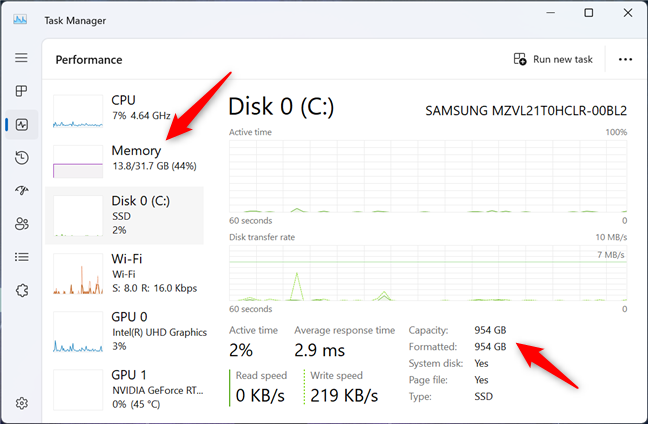
 Memory and SSD installed in the Lenovo Legion Pro 7
As the Lenovo Legion Pro 7 is a laptop designed for gaming, the options you get in terms of graphics are excellent too. Besides the Intel UHD graphics chip built into the processor, depending on your budget and preferences, you can equip this laptop with any of these graphics cards from the Nvidia GeForce RTX 4000 series:
Memory and SSD installed in the Lenovo Legion Pro 7
As the Lenovo Legion Pro 7 is a laptop designed for gaming, the options you get in terms of graphics are excellent too. Besides the Intel UHD graphics chip built into the processor, depending on your budget and preferences, you can equip this laptop with any of these graphics cards from the Nvidia GeForce RTX 4000 series:
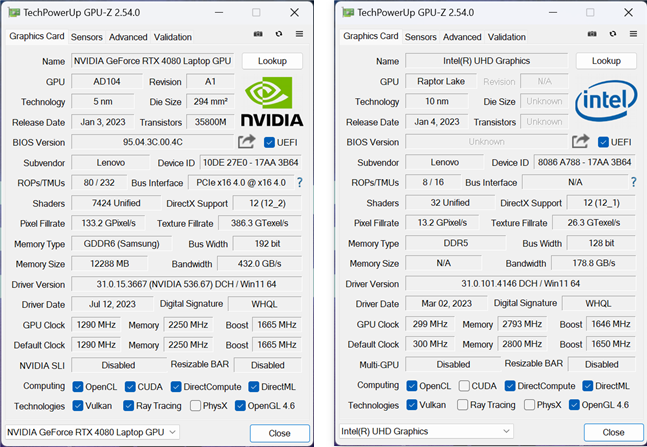
 GPU specs for the Lenovo Legion Pro 7
The screen that Lenovo chose to use for the Legion Pro is a 16” WQXGA matte display with a resolution of 2560 x 1600 pixels. Based on an IPS panel (In-plane switching) that ensures excellent colors and viewing angles, the display also offers an impressive 240 Hz refresh rate, high brightness levels (up to 500 nits), and support for Nvidia G-Sync.
GPU specs for the Lenovo Legion Pro 7
The screen that Lenovo chose to use for the Legion Pro is a 16” WQXGA matte display with a resolution of 2560 x 1600 pixels. Based on an IPS panel (In-plane switching) that ensures excellent colors and viewing angles, the display also offers an impressive 240 Hz refresh rate, high brightness levels (up to 500 nits), and support for Nvidia G-Sync.
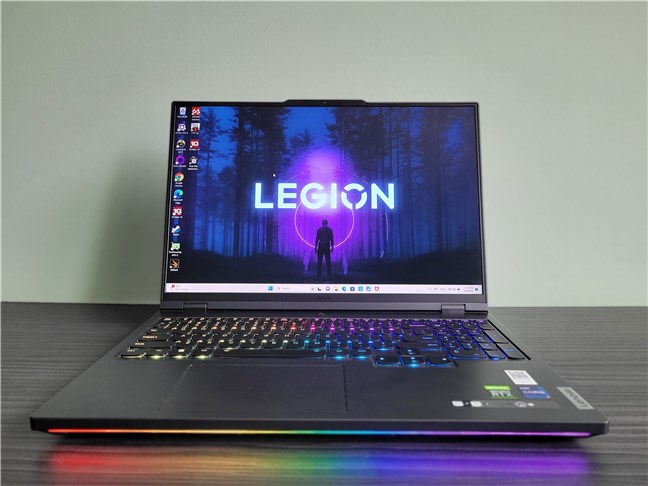
 The IPS screen has a 240Hz refresh rate
The audio is delivered by two 2W Harman speakers with Nahimic Audio. On the upper frame, above the screen, you’ll also find a webcam with a standard 1080 FHD resolution, useful for making video calls or, why not, showing yourself while streaming/broadcasting your favorite game.
The IPS screen has a 240Hz refresh rate
The audio is delivered by two 2W Harman speakers with Nahimic Audio. On the upper frame, above the screen, you’ll also find a webcam with a standard 1080 FHD resolution, useful for making video calls or, why not, showing yourself while streaming/broadcasting your favorite game.
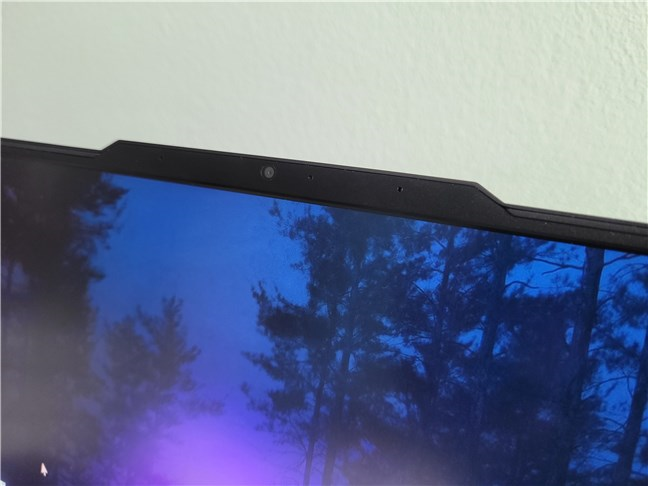 The 1080p webcam on the Lenovo Legion Pro 7
Regarding connectivity options, the Lenovo Legion Pro 7 laptop is quite generous. On its left side, you get one USB 3.2 Gen1 Type-A port and one USB 3.2 Gen2 Type-C port. The latter is compatible with DisplayPort 1.4 and supports 140W Power Delivery.
The 1080p webcam on the Lenovo Legion Pro 7
Regarding connectivity options, the Lenovo Legion Pro 7 laptop is quite generous. On its left side, you get one USB 3.2 Gen1 Type-A port and one USB 3.2 Gen2 Type-C port. The latter is compatible with DisplayPort 1.4 and supports 140W Power Delivery.
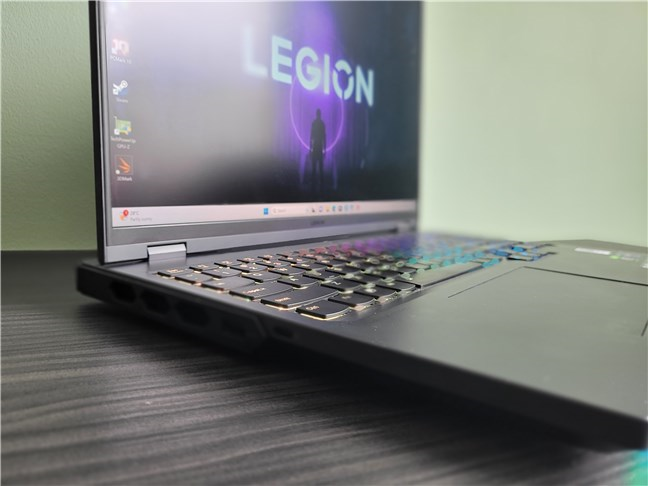 The ports on the left side of the Lenovo Legion Pro 7
On the right side of the laptop, you get a 3.5 mm audio jack, a webcam e-Shutter switch (enables/disables the webcam), and a USB 3.2 Gen1 Type-A port.
The ports on the left side of the Lenovo Legion Pro 7
On the right side of the laptop, you get a 3.5 mm audio jack, a webcam e-Shutter switch (enables/disables the webcam), and a USB 3.2 Gen1 Type-A port.
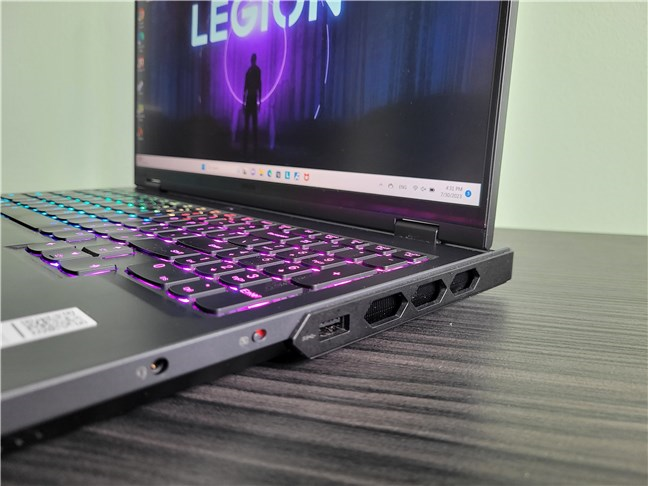 The ports on the right side of the Lenovo Legion Pro 7
Last but no least, the rear edge of the Legion Pro 7 is also home to a series of ports: one RJ-45 LAN, one USB 3.2 Gen2 Type-C (with DisplayPort 1.4 and 140W Power Delivery), one HDMI 2.1, two USB 3.2 Gen1 Type-A, and, of course, the DC-in jack used for powering and charging the laptop.
The ports on the right side of the Lenovo Legion Pro 7
Last but no least, the rear edge of the Legion Pro 7 is also home to a series of ports: one RJ-45 LAN, one USB 3.2 Gen2 Type-C (with DisplayPort 1.4 and 140W Power Delivery), one HDMI 2.1, two USB 3.2 Gen1 Type-A, and, of course, the DC-in jack used for powering and charging the laptop.
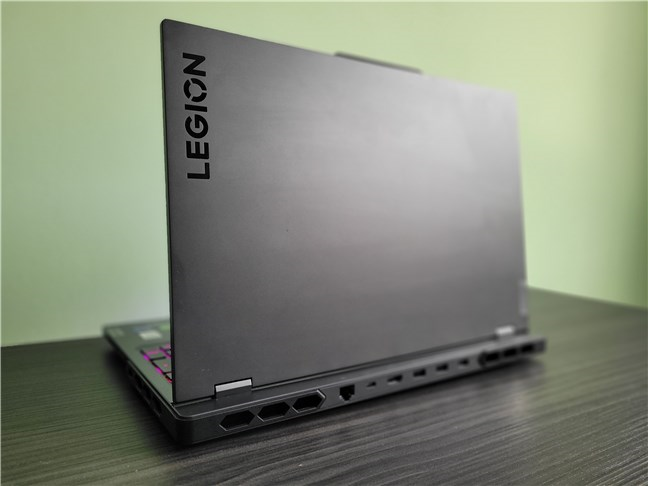 Back ports on the Lenovo Legion Pro 7
In terms of networking options, the laptop comes with a Gigabit Ethernet card made by Realtek and, more importantly, with a Killer Wi-Fi 6E AX1675i 160MHz wireless network adapter. The latter supports the latest 802.11ax standard and offers 2x2 MIMO, which means it can use two spatial streams of transmitting and receiving data on the same channel or frequency. On top of all that, you also get a Bluetooth 5.1 chip.
Back ports on the Lenovo Legion Pro 7
In terms of networking options, the laptop comes with a Gigabit Ethernet card made by Realtek and, more importantly, with a Killer Wi-Fi 6E AX1675i 160MHz wireless network adapter. The latter supports the latest 802.11ax standard and offers 2x2 MIMO, which means it can use two spatial streams of transmitting and receiving data on the same channel or frequency. On top of all that, you also get a Bluetooth 5.1 chip.
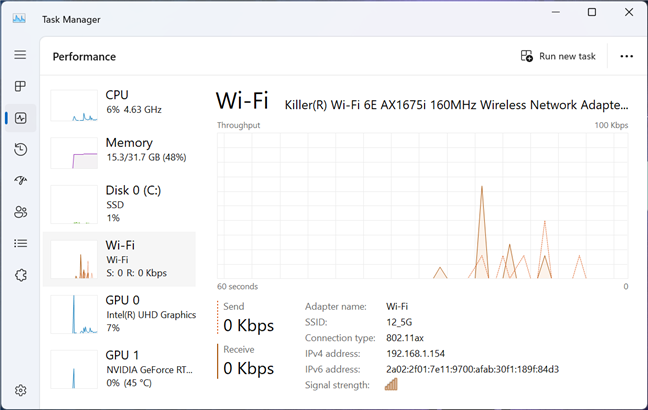
 Lenovo Legion Pro 7 has Wi-Fi 6E
The Lenovo Legion Pro 7 gets its autonomy from a 99.99 Watt Hour battery that supports fast charging (80% in about 30 minutes, 100% in about one hour). The power adapter is capable of an output of 20V DC, 16.5 A, 330W, which is more than enough to keep the laptop going even for very long gaming sessions. Check the last part of the benchmarks section in this review to see what to expect from the battery in real life.
Lenovo Legion Pro 7 has Wi-Fi 6E
The Lenovo Legion Pro 7 gets its autonomy from a 99.99 Watt Hour battery that supports fast charging (80% in about 30 minutes, 100% in about one hour). The power adapter is capable of an output of 20V DC, 16.5 A, 330W, which is more than enough to keep the laptop going even for very long gaming sessions. Check the last part of the benchmarks section in this review to see what to expect from the battery in real life.
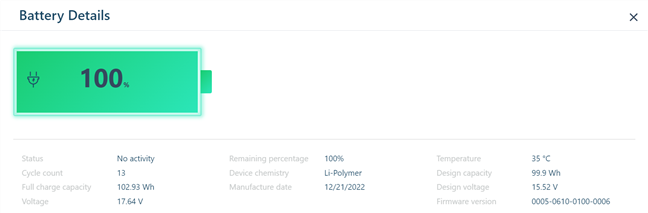
 Battery details for the Lenovo Legion Pro 7
Depending on its configuration, the Lenovo Legion Pro 7 weighs at least 2.8 kg (6.17 lbs), but no less than that. As for its physical dimensions, the laptop is 363.4mm (14.3 inches) in width by 262.15mm (10.32 inches) in depth. Depending on what graphics card it’s equipped with, its thickness can be 21.95 or 25.9 mm (0.86 or 1.01 inches).
If you want more details, you can find the official hardware specifications here: Lenovo Legion Pro 7 Tech Specs.
The hardware specifications of the Lenovo Legion Pro 7 portray a powerful gaming laptop that should be capable to flawlessly run any game regardless of how high its system requirements might be, as well as any creative software, no matter how demanding.
Read the next page of this review to see what my experience using it was like, what software is bundled with the Lenovo Legion Pro 7, and also what benchmarks had to say about its performance.
Battery details for the Lenovo Legion Pro 7
Depending on its configuration, the Lenovo Legion Pro 7 weighs at least 2.8 kg (6.17 lbs), but no less than that. As for its physical dimensions, the laptop is 363.4mm (14.3 inches) in width by 262.15mm (10.32 inches) in depth. Depending on what graphics card it’s equipped with, its thickness can be 21.95 or 25.9 mm (0.86 or 1.01 inches).
If you want more details, you can find the official hardware specifications here: Lenovo Legion Pro 7 Tech Specs.
The hardware specifications of the Lenovo Legion Pro 7 portray a powerful gaming laptop that should be capable to flawlessly run any game regardless of how high its system requirements might be, as well as any creative software, no matter how demanding.
Read the next page of this review to see what my experience using it was like, what software is bundled with the Lenovo Legion Pro 7, and also what benchmarks had to say about its performance.
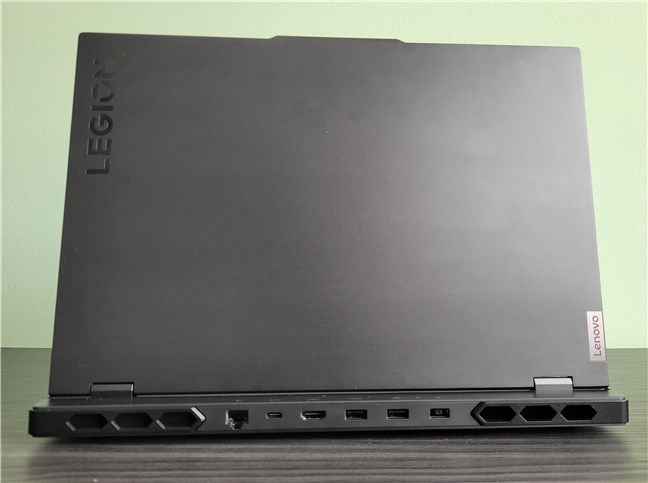
 The lid of the Lenovo Legion Pro 7
The bottom is divided into two large sections: one is filled with many small rectangular perforations for venting, while the other one is completely flat, holding only some stickers. Towards the back of the frame, as well as in the front corners of the laptop’s bottom, you’ll also find some thick rubber feet. These are useful for keeping the laptop away from the desk or table you’re using it on, thus ensuring proper ventilation.
The lid of the Lenovo Legion Pro 7
The bottom is divided into two large sections: one is filled with many small rectangular perforations for venting, while the other one is completely flat, holding only some stickers. Towards the back of the frame, as well as in the front corners of the laptop’s bottom, you’ll also find some thick rubber feet. These are useful for keeping the laptop away from the desk or table you’re using it on, thus ensuring proper ventilation.
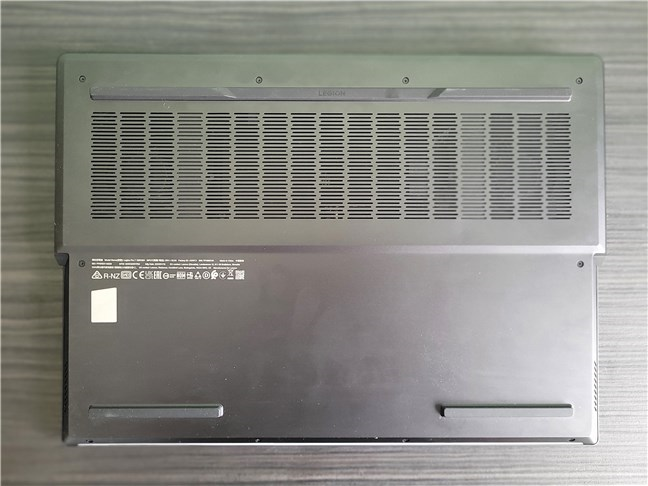 The bottom of the Lenovo Legion Pro 7
For all you RGB lovers out there, the good news is that the Legion Pro 7 features such lights. The keyboard is fully RGB-lit, and there’s also a side-to-side strip on the front edge. While not really visible when holding the laptop in your lap 🙂, the strip throws a nice light on the desk where the laptop is placed, especially at night.
The bottom of the Lenovo Legion Pro 7
For all you RGB lovers out there, the good news is that the Legion Pro 7 features such lights. The keyboard is fully RGB-lit, and there’s also a side-to-side strip on the front edge. While not really visible when holding the laptop in your lap 🙂, the strip throws a nice light on the desk where the laptop is placed, especially at night.
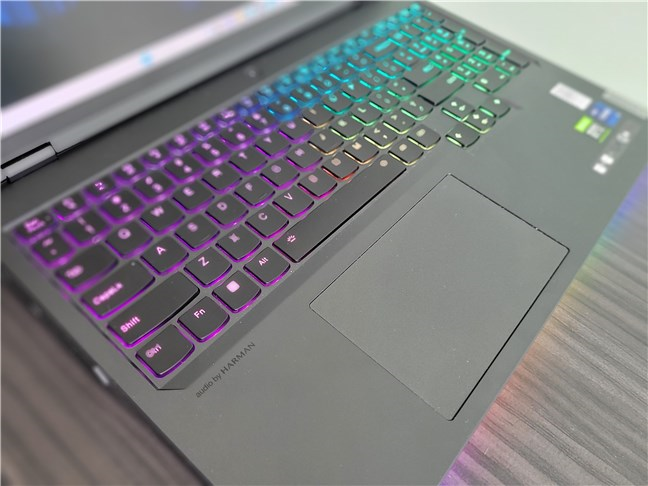 The RGB-lit keyboard of the Lenovo Legion Pro 7
When I opened the lid, the first thing I noticed was that the laptop’s hinges seem very solid and that the screen doesn’t bend or twist, not even by a bit. That’s probably a direct consequence of using metal for the laptop’s frame. Then, the second thing I liked was the fact that, except for the bottom one, the bezels of the screen are quite thin. Call me pretentious, but I’ve become a fan of thin bezels. The more invisible they are, the better. One more thing to mention: the top bezel has a part that sticks out: the webcam resides there, and it also serves as a handle (which you use to open the lid).
The RGB-lit keyboard of the Lenovo Legion Pro 7
When I opened the lid, the first thing I noticed was that the laptop’s hinges seem very solid and that the screen doesn’t bend or twist, not even by a bit. That’s probably a direct consequence of using metal for the laptop’s frame. Then, the second thing I liked was the fact that, except for the bottom one, the bezels of the screen are quite thin. Call me pretentious, but I’ve become a fan of thin bezels. The more invisible they are, the better. One more thing to mention: the top bezel has a part that sticks out: the webcam resides there, and it also serves as a handle (which you use to open the lid).
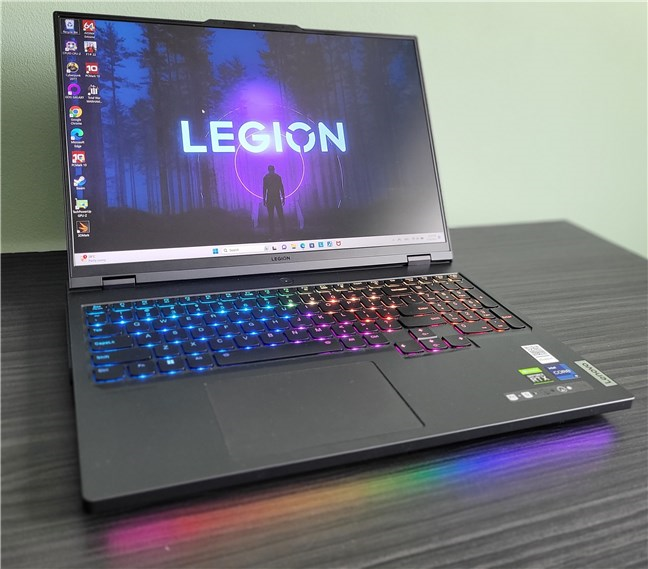
 The screen has thin bezels
Moving on to the actual user experience offered by the Legion Pro 7, I only have good things to say. It offers a lot of power and performance for gamers and creators alike. In my daily tasks - writing, browsing the internet, watching videos, etc. - it doesn’t break a sweat. And the same was true in the few games I played, which by the way, I’ve set to maximum quality visuals! The stunning display, powerful processor, high-end graphics card, and advanced thermal system really make the Legion Pro 7 stand out from the crowd.
The screen has thin bezels
Moving on to the actual user experience offered by the Legion Pro 7, I only have good things to say. It offers a lot of power and performance for gamers and creators alike. In my daily tasks - writing, browsing the internet, watching videos, etc. - it doesn’t break a sweat. And the same was true in the few games I played, which by the way, I’ve set to maximum quality visuals! The stunning display, powerful processor, high-end graphics card, and advanced thermal system really make the Legion Pro 7 stand out from the crowd.
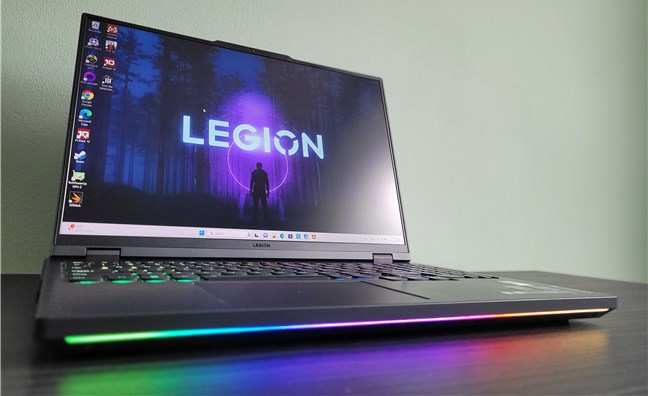
 Lenovo Legion Pro 7 offers top performance
The only thing I could hold against it is the battery. Although on paper, the battery is quite generous (99.99 Whrs), in real life, I’ve found it to be a bit underwhelming. In regular use, the laptop kept on going for about two hours, but in gaming, it didn’t manage to get even one hour of functioning (after 45 minutes, the battery would deplete).
The Lenovo Legion Pro 7 is a gaming laptop that looks stylish and professional, and it manages to deliver an exquisite user experience. The hardware on it is powerful, and it can run any game or app without issues. Except for an underwhelming autonomy on battery, the Lenovo Legion Pro 7 is a top-performer in every aspect.
Lenovo Legion Pro 7 offers top performance
The only thing I could hold against it is the battery. Although on paper, the battery is quite generous (99.99 Whrs), in real life, I’ve found it to be a bit underwhelming. In regular use, the laptop kept on going for about two hours, but in gaming, it didn’t manage to get even one hour of functioning (after 45 minutes, the battery would deplete).
The Lenovo Legion Pro 7 is a gaming laptop that looks stylish and professional, and it manages to deliver an exquisite user experience. The hardware on it is powerful, and it can run any game or app without issues. Except for an underwhelming autonomy on battery, the Lenovo Legion Pro 7 is a top-performer in every aspect.
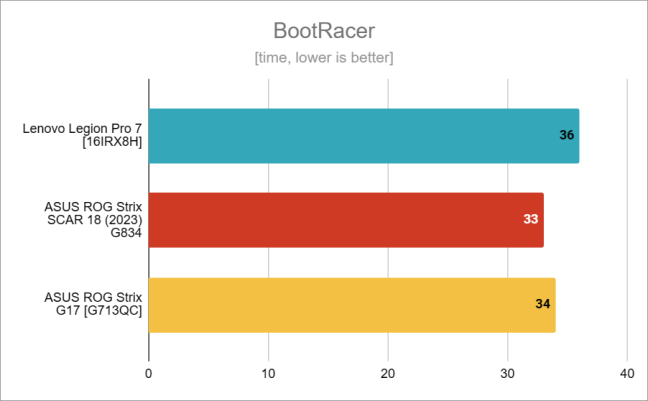
 Boot times measured with BootRacer
I continued benchmarking the Lenovo Legion Pro 7 with CPU-Z. In the Single Thread test, its processor had a huge score of 852 points, which means 17.84% more performance than what the Intel NUC 12 Enthusiast Kit processor can offer.
Boot times measured with BootRacer
I continued benchmarking the Lenovo Legion Pro 7 with CPU-Z. In the Single Thread test, its processor had a huge score of 852 points, which means 17.84% more performance than what the Intel NUC 12 Enthusiast Kit processor can offer.
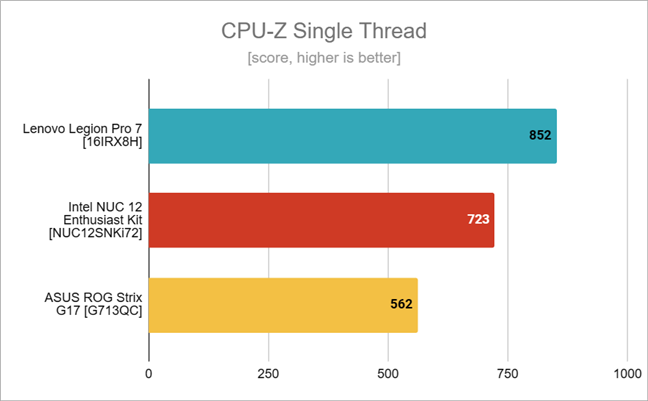 Benchmark results in CPU-Z Single Thread
In CPU-Z’s Multi-Thread test, the Lenovo Legion Pro 7 offers a whopping 77.36% more speed than the 12th Gen Intel processor in the NUC 12 mini PC! Compared to my older ASUS ROG Strix G17 laptop, the increase was even more amazing: 141!
Benchmark results in CPU-Z Single Thread
In CPU-Z’s Multi-Thread test, the Lenovo Legion Pro 7 offers a whopping 77.36% more speed than the 12th Gen Intel processor in the NUC 12 mini PC! Compared to my older ASUS ROG Strix G17 laptop, the increase was even more amazing: 141!
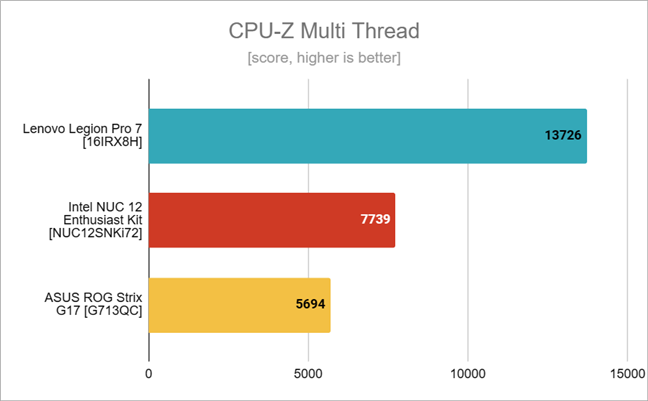 Benchmark results in CPU-Z Multi Thread
Next, I ran the Cinebench R23 benchmark to measure the rendering speed of the gaming laptop. I got a score of 27494 points in the multi-thread test for the processor, which is a 73.08% increase compared to the result of the CPU in the mini PC. Compared to my old gaming laptop, the Legion Pro 7 is more than one and half times faster… 🙂
Benchmark results in CPU-Z Multi Thread
Next, I ran the Cinebench R23 benchmark to measure the rendering speed of the gaming laptop. I got a score of 27494 points in the multi-thread test for the processor, which is a 73.08% increase compared to the result of the CPU in the mini PC. Compared to my old gaming laptop, the Legion Pro 7 is more than one and half times faster… 🙂
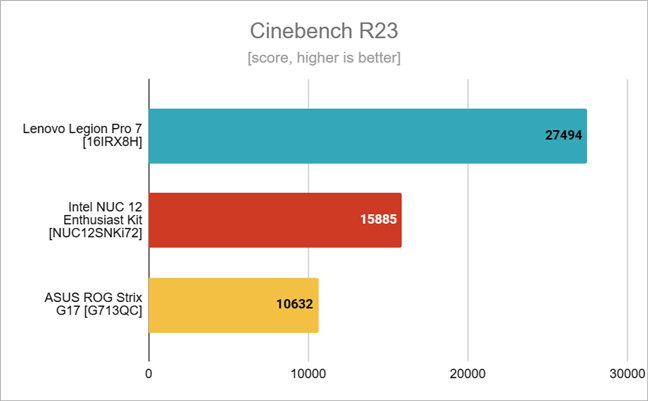 Benchmark results in Cinebench R23
7-Zip is a file compression app that can also be used to check how fast a processor is. The compression test showed that the processor on the Lenovo Legion Pro 7 is incredibly fast in this area too. Can you imagine a 375% performance increase compared to the 12th Gen Intel Core i7-12700H powering the Intel NUC 12 mini PC? Wow!
Benchmark results in Cinebench R23
7-Zip is a file compression app that can also be used to check how fast a processor is. The compression test showed that the processor on the Lenovo Legion Pro 7 is incredibly fast in this area too. Can you imagine a 375% performance increase compared to the 12th Gen Intel Core i7-12700H powering the Intel NUC 12 mini PC? Wow!
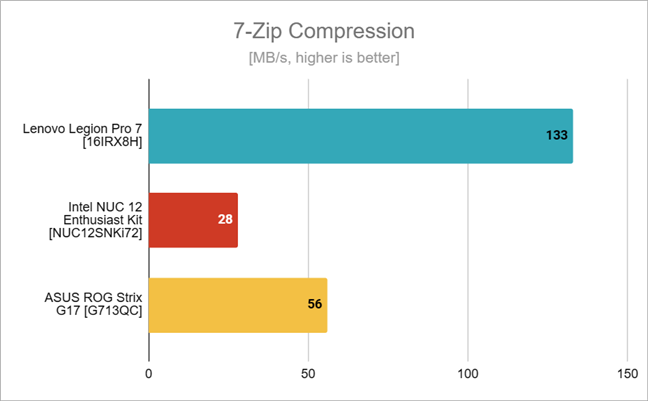 Benchmark results in 7-Zip Compression
The decompression test results were sensational too, showing a performance increase of almost 85%.
Benchmark results in 7-Zip Compression
The decompression test results were sensational too, showing a performance increase of almost 85%.
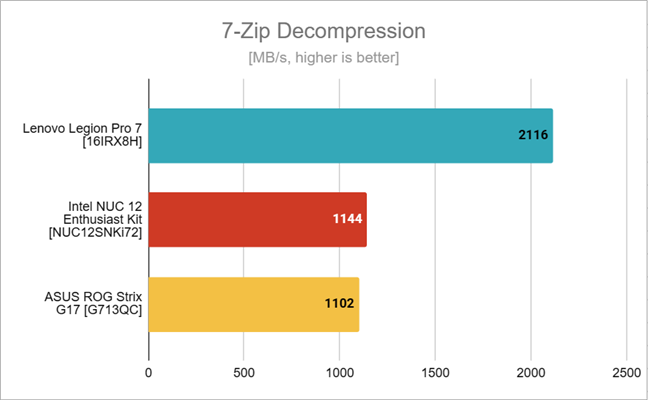
 Benchmark results in 7-Zip Decompression
I continued with PCMark 10, a benchmarking app that measures performance in regular productivity tasks like using Office apps, video conferencing, browsing the web, or creating digital content. In this benchmark, the Lenovo Legion Pro 7 got a score of 7846 points, which places it in the best 5% results measured by PCMark 10. The only mobile device tested here, at Digital Citizen, that outmatched it, was the ASUS ROG Strix SCAR 18, which has an even more powerful processor and graphics card.
Benchmark results in 7-Zip Decompression
I continued with PCMark 10, a benchmarking app that measures performance in regular productivity tasks like using Office apps, video conferencing, browsing the web, or creating digital content. In this benchmark, the Lenovo Legion Pro 7 got a score of 7846 points, which places it in the best 5% results measured by PCMark 10. The only mobile device tested here, at Digital Citizen, that outmatched it, was the ASUS ROG Strix SCAR 18, which has an even more powerful processor and graphics card.
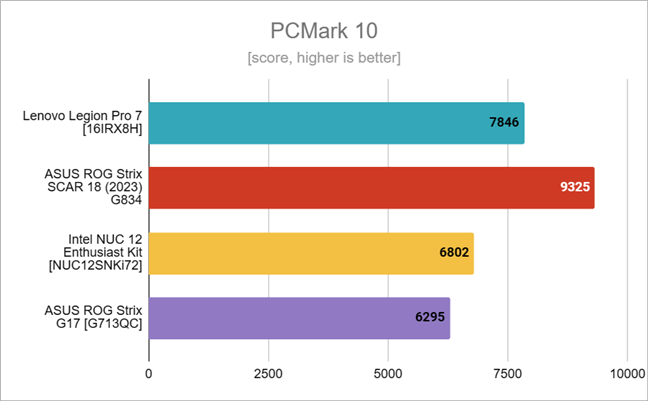 Benchmark results in PCMark 10
On the same note of daily use, I also checked how fast the Lenovo Legion Pro 7 is when browsing the internet. For that, I used the JetStream 2 benchmark in Google Chrome. The Lenovo Legion Pro 7 had an excellent score of 308 points, meaning that it was also roughly 11% faster than the Intel NUC 12 mini PC and almost 28% faster than my old gaming machine.
Benchmark results in PCMark 10
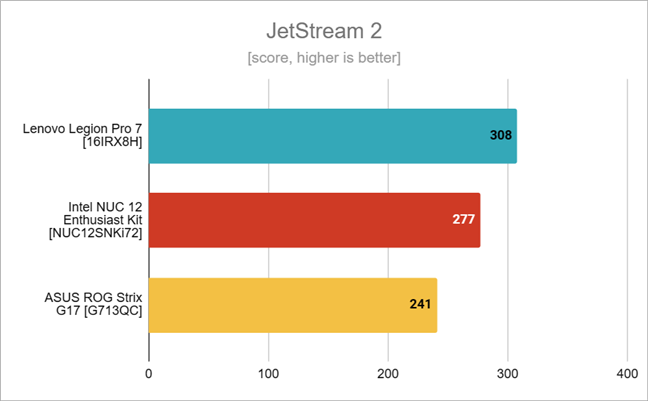
On the same note of daily use, I also checked how fast the Lenovo Legion Pro 7 is when browsing the internet. For that, I used the JetStream 2 benchmark in Google Chrome. The Lenovo Legion Pro 7 had an excellent score of 308 points, meaning that it was also roughly 11% faster than the Intel NUC 12 mini PC and almost 28% faster than my old gaming machine.
 Benchmark results in JetStream 2
All the benchmarks I’ve run until now show the same thing: the Lenovo Legion Pro 7 is an extremely powerful mobile device that can withstand even the most demanding workloads.
Benchmark results in JetStream 2
All the benchmarks I’ve run until now show the same thing: the Lenovo Legion Pro 7 is an extremely powerful mobile device that can withstand even the most demanding workloads.
 Benchmark results in 3DMark Speed Way
Next, I tested the Lenovo Legion Pro 7 in a few games to see what it can do. I started with CyberPunk 2077, one of the most beautiful games these days, but also one that demands a lot of performance from the GPU. Set to 1080p resolution and on the High preset, the Lenovo Legion Pro 7 and its Nvidia GeForce RTX 4080 GPU managed to render an average of 117 frames per second, which is a great result! While the chart below doesn’t show it (as I don’t have similar tests for the other devices included), know that I’ve also benchmarked this game using the laptop’s native resolution (2560 x 1600) and I got some awesome results: 35 fps using the Ultra Ray Tracing preset and no DLSS, 109 with DLSS set to Balanced, and 111 fps with DLSS set to High!
Benchmark results in 3DMark Speed Way
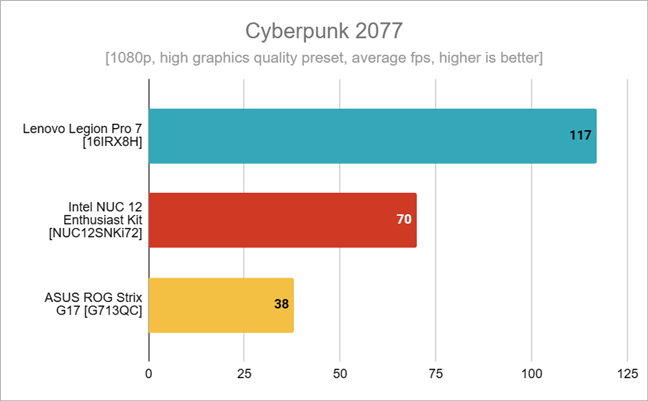
Next, I tested the Lenovo Legion Pro 7 in a few games to see what it can do. I started with CyberPunk 2077, one of the most beautiful games these days, but also one that demands a lot of performance from the GPU. Set to 1080p resolution and on the High preset, the Lenovo Legion Pro 7 and its Nvidia GeForce RTX 4080 GPU managed to render an average of 117 frames per second, which is a great result! While the chart below doesn’t show it (as I don’t have similar tests for the other devices included), know that I’ve also benchmarked this game using the laptop’s native resolution (2560 x 1600) and I got some awesome results: 35 fps using the Ultra Ray Tracing preset and no DLSS, 109 with DLSS set to Balanced, and 111 fps with DLSS set to High!
 Benchmark results in Cyberpunk 2077
The following game tested was Total War WARHAMMER III, a turn-based strategy and real-time tactics game. The Lenovo Legion Pro 7 rendered an average of 179 frames per second in 1080p resolution with the visual quality set on High. It’s a jaw-dropping result that confirms the laptop’s high-end performance in gaming.
Benchmark results in Cyberpunk 2077
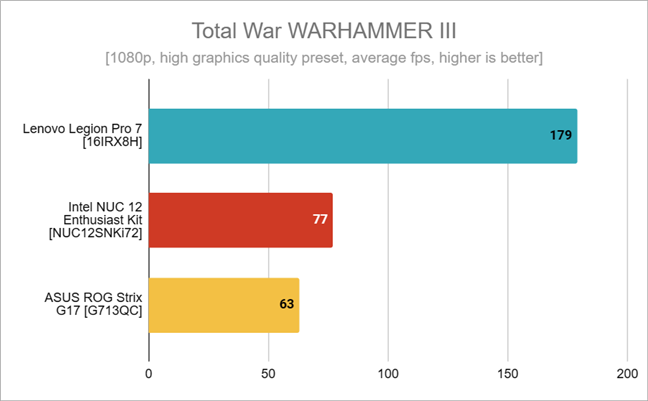
The following game tested was Total War WARHAMMER III, a turn-based strategy and real-time tactics game. The Lenovo Legion Pro 7 rendered an average of 179 frames per second in 1080p resolution with the visual quality set on High. It’s a jaw-dropping result that confirms the laptop’s high-end performance in gaming.
 Benchmark results in Total War WARHAMMER III
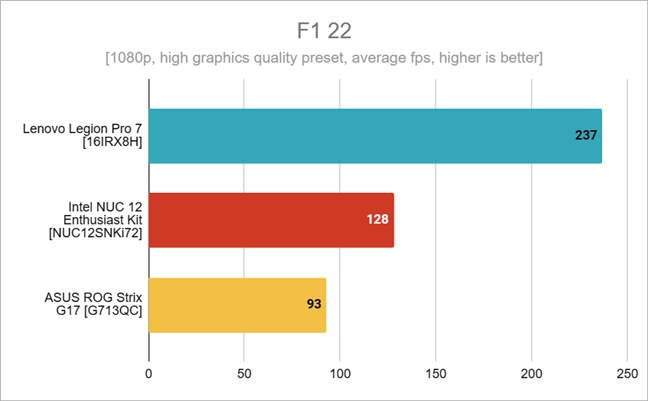
The third and last game I tested was F1 22. I’ve set this car racing game to run in 1080p resolution and on the High graphics preset, and the Lenovo Legion Pro 7 didn’t disappoint: the number of fps (frames per second) measured was huge: 237! Again, it’s a result that proves the laptop can run any game at maxed visual quality and a high resolution without any issues whatsoever.
Benchmark results in Total War WARHAMMER III
The third and last game I tested was F1 22. I’ve set this car racing game to run in 1080p resolution and on the High graphics preset, and the Lenovo Legion Pro 7 didn’t disappoint: the number of fps (frames per second) measured was huge: 237! Again, it’s a result that proves the laptop can run any game at maxed visual quality and a high resolution without any issues whatsoever.
 Benchmark results in F1 22
The results in the gaming benchmarks prove that the Lenovo Legion Pro 7 deserves in full to be named a gaming device. Its hardware is extremely powerful and can run any game at maxed visual settings and high resolutions, without breaking a sweat.
Benchmark results in F1 22
The results in the gaming benchmarks prove that the Lenovo Legion Pro 7 deserves in full to be named a gaming device. Its hardware is extremely powerful and can run any game at maxed visual settings and high resolutions, without breaking a sweat.
 CPU temperature under stress
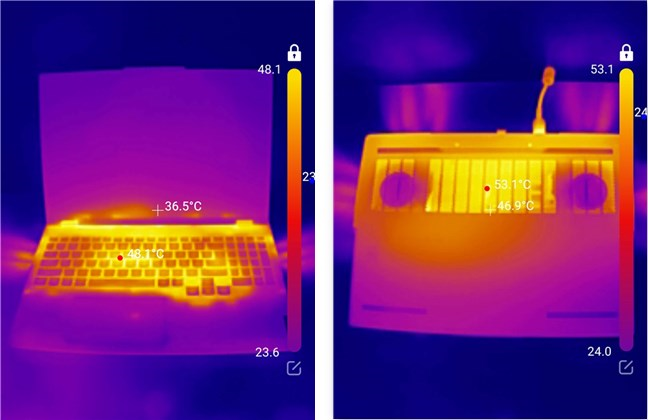
While using it for daily tasks, the Lenovo Legion Pro 7 stays cool and quiet, which is great. However, when playing games or running demanding software, the coolers are starting to spin faster and faster, and they get noticeably louder. Still, the cooling system manages to keep the temperatures low, and that’s a good thing. After a couple of minutes of gaming, I used my Topdon TC001 thermal imaging camera to check which areas of the device are getting hotter. As you can see below, the temperatures are rising right beneath the screen and under the central part of the keyboard, as well as on the bottom of the laptop. Still, the laptop doesn’t get so hot that it’s uncomfortable to use and, what’s more important, the area around the WASD keys (used a lot in gaming) seems to be a few degrees cooler than the rest of the keyboard.
CPU temperature under stress
While using it for daily tasks, the Lenovo Legion Pro 7 stays cool and quiet, which is great. However, when playing games or running demanding software, the coolers are starting to spin faster and faster, and they get noticeably louder. Still, the cooling system manages to keep the temperatures low, and that’s a good thing. After a couple of minutes of gaming, I used my Topdon TC001 thermal imaging camera to check which areas of the device are getting hotter. As you can see below, the temperatures are rising right beneath the screen and under the central part of the keyboard, as well as on the bottom of the laptop. Still, the laptop doesn’t get so hot that it’s uncomfortable to use and, what’s more important, the area around the WASD keys (used a lot in gaming) seems to be a few degrees cooler than the rest of the keyboard.
 Surface temperatures when gaming
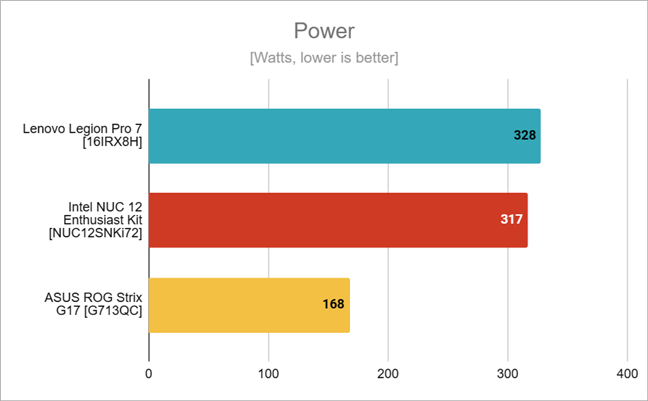
For the Lenovo Legion Pro 7, I measured a maximum total power consumption of 328 Watts. That’s close to the maximum rating of the power adapter, and although it’s quite a lot, the levels of performance you get from the laptop justify the consumption. At least, in my opinion. 🙂
Surface temperatures when gaming
For the Lenovo Legion Pro 7, I measured a maximum total power consumption of 328 Watts. That’s close to the maximum rating of the power adapter, and although it’s quite a lot, the levels of performance you get from the laptop justify the consumption. At least, in my opinion. 🙂
 Maximum power consumption
As you’ve seen earlier in this review, the only aspect that didn’t impress me about this laptop was the autonomy of its battery. However, that was only a subjective opinion. To get an objective point of view on how long the laptop’s battery lasts, I used PCMark 10’s Modern Office and Gaming battery tests.
In the Modern Office benchmark, which simulates working with Office applications while on battery, the laptop managed to run for three hours and six minutes. It’s not much, although you could say that it’s a decent result for a gaming device.
Maximum power consumption
As you’ve seen earlier in this review, the only aspect that didn’t impress me about this laptop was the autonomy of its battery. However, that was only a subjective opinion. To get an objective point of view on how long the laptop’s battery lasts, I used PCMark 10’s Modern Office and Gaming battery tests.
In the Modern Office benchmark, which simulates working with Office applications while on battery, the laptop managed to run for three hours and six minutes. It’s not much, although you could say that it’s a decent result for a gaming device.
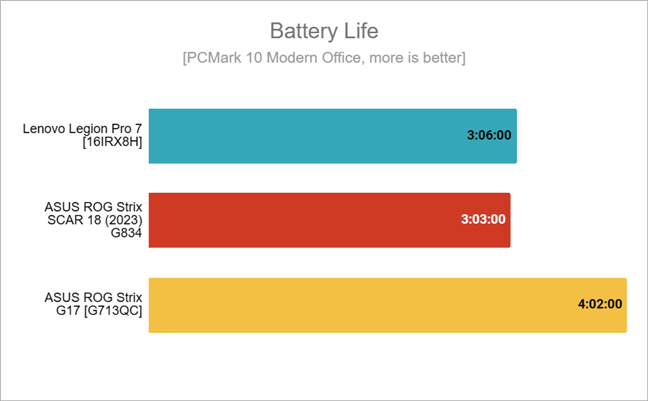 Battery life in PCMark 10 Modern Office
In the Gaming test however, the battery could keep the Legion Pro 7 going for only 50 minutes. That’s less than what I expected, and less than many similar gaming laptops. Maybe some firmware optimizations could improve Legion Pro 7’s autonomy in this case?
Battery life in PCMark 10 Modern Office
In the Gaming test however, the battery could keep the Legion Pro 7 going for only 50 minutes. That’s less than what I expected, and less than many similar gaming laptops. Maybe some firmware optimizations could improve Legion Pro 7’s autonomy in this case?
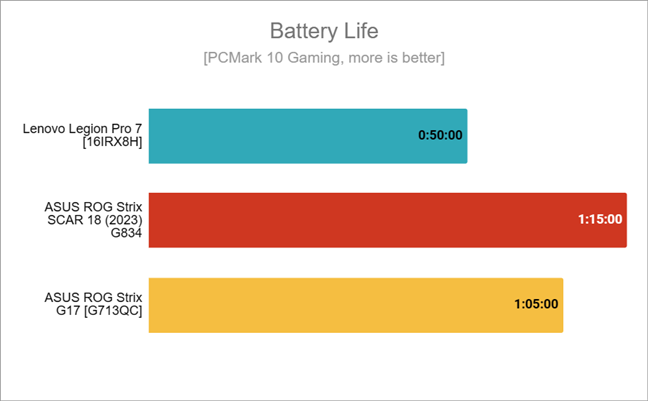 Battery life in PCMark 10 Gaming
While the heat is kept at bay by the cooling system, the excellent performance levels offered by the Lenovo Legion Pro 7 come with high energy requirements. Besides drawing a lot of power from the wall outlet, the laptop also has a rather limited autonomy on battery, especially when gaming is involved.
Battery life in PCMark 10 Gaming
While the heat is kept at bay by the cooling system, the excellent performance levels offered by the Lenovo Legion Pro 7 come with high energy requirements. Besides drawing a lot of power from the wall outlet, the laptop also has a rather limited autonomy on battery, especially when gaming is involved.
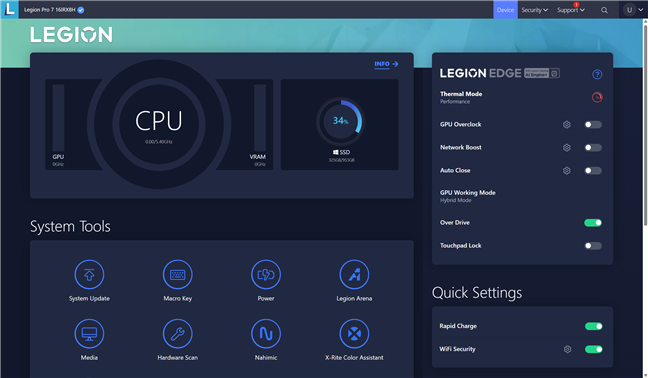
 Lenovo Vantage
Out of the box, the Lenovo Legion Pro 7 comes with Microsoft’s Windows 11. The additional software bundled with it includes useful tools that you’ll need in order to configure this gaming laptop to work exactly as you like it.
Lenovo Vantage
Out of the box, the Lenovo Legion Pro 7 comes with Microsoft’s Windows 11. The additional software bundled with it includes useful tools that you’ll need in order to configure this gaming laptop to work exactly as you like it.
Lenovo Legion Pro 7: Who is it good for?
This laptop is an excellent choice for:- Gaming, video editing, and computer-aided design (CAD)
- Users who need high performance, comparable to a desktop computer
- Those who want fast Wi-Fi or Ethernet network connectivity on their laptop
Pros and cons
There are a lot of good things to say about the Lenovo Legion Pro 7:
- Incredible gaming performance
- Solid frame and excellent build quality
- Large high-quality IPS display with a fast 240Hz refresh rate
- Beautiful and customizable keyboard and chassis RGB lighting
- Storage that’s fast, generous, and extendable
- Excellent wireless connectivity (Wi-Fi 6E)
- Many ports, including USB-C with DisplayPort and Power Delivery
- Efficient cooling system
- Can get loud under stress, like when you’re gaming
- Battery life could be better
Verdict
The Lenovo Legion Pro 7 is a powerful gaming laptop that offers impressive performance, a sleek design, and a stunning display. It can handle any game or task with ease, thanks to its 13th generation Core processor, plenty of RAM, and high-end Nvidia GeForce RTX 4000 series graphics card. The 16-inch IPS screen delivers crisp and vibrant visuals, with a 240Hz refresh rate and high brightness levels. The laptop also features an excellent RGB-lit keyboard, an efficient cooling system, and a generous selection of ports. The only thing I can hold against it is its battery. Although it has a large capacity of 99.99 Whrs, I believe that the laptop’s autonomy could be improved with some firmware optimization. The Lenovo Legion Pro 7 is not an affordable device, but it’s worth every penny. If you’re a gamer or a professional creator, this might be the laptop for you.Unboxing the Lenovo Legion Pro 7 (16IRX8H) gaming laptop
The Lenovo Legion Pro 7 gaming laptop arrives in a black cardboard box with a minimalistic design. All you see on its front side is a red and white Lenovo logo in a corner and a large glossy Legion text that covers the box in its entirety.Hardware specifications
The Lenovo Legion Pro 7 gaming laptop can be equipped with a 13th Generation Intel Core i9-13900HX processor. This is a high-end CPU that can reach a maximum speed of 5.40 GHz with Turbo Boost. It features 24 cores, out of which 8 are performance cores and 16 are efficient cores, thus resulting in a total number of 32 threads. The P-cores can run at a maximum frequency of 5.40 GHz, while the E-cores can tick at a maximum clock of 3.90 GHz. Complementing its cores, the processor offers 36 MB of Intel Smart Cache memory. Evidently, we’re talking about a very powerful laptop CPU, which means that its power requirements are also quite high, though far from what you’d expect from a similar desktop processor. The Intel Core i9-13900HX has a PBP (Processor Base Power) of 55 Watts and an MTP (Maximum Turbo Power) of 157 Watts. Note that, although at the moment this is the only CPU available for this laptop, Lenovo might add other options (including Intel Core i7 models) in the future.- NVIDIA GeForce RTX 4080 (12GB GDDR6)
- NVIDIA GeForce RTX 4090 (16GB GDDR6)
Design and user experience
I’ll start this section by saying right away that the Lenovo Legion Pro 7 is a gaming laptop that manages to offer both a sleek and stylish design and an amazing amount of performance. The frame of the laptop is made of aluminum and features a dark gray (almost black) color scheme that looks great. When turned off and with its lid closed, all you see is a small silver(-ish) Lenovo logo on one corner of the lid, and a larger Legion text engraved on the opposite corner.Performance in benchmarks
The hardware inside the Lenovo Legion Pro 7 is certainly powerful and more than enough to deliver excellent performance in any kind of game, as well as creative or productivity tasks. But how does this translate into numbers? For this task, I used a couple of benchmarks and games, and I also compared them with the results I got with other devices. In some of the charts below, I’ve included the results of:- An ASUS ROG Strix SCAR 18 laptop (Intel Core i9-13980HX CPU, NVIDIA GeForce RTX 4090 GPU, 32GB DDR5 RAM)
- An Intel NUC 12 Mini PC Enthusiast Kit (Intel Core i7-12700H CPU, Intel Arc A770M GPU, 12GB DDR4 RAM)
- An ASUS ROG Strix G17 (AMD Ryzen 7 5800H CPU, NVIDIA GeForce RTX 3050 GPU, 16GB DDR4 RAM). Note that not all the charts include all these devices, as the tests I and my colleagues ran in the past were different from one device to the other.
Performance in games
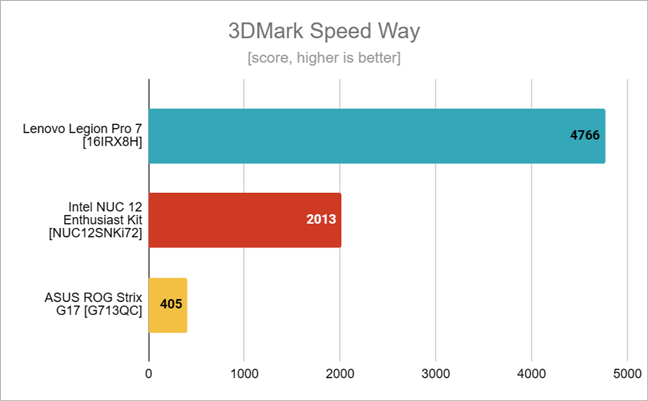
First, I ran 3DMark’s Speed Way test. The Lenovo Legion Pro 7 got a score of 4766 points, which is one of the best scores you get on a gaming laptop. I also find it quite impressive that the decrease in performance compared to an Nvidia GeForce RTX 4070 Ti desktop graphics card is only 13%.Temperatures, power needs, and autonomy
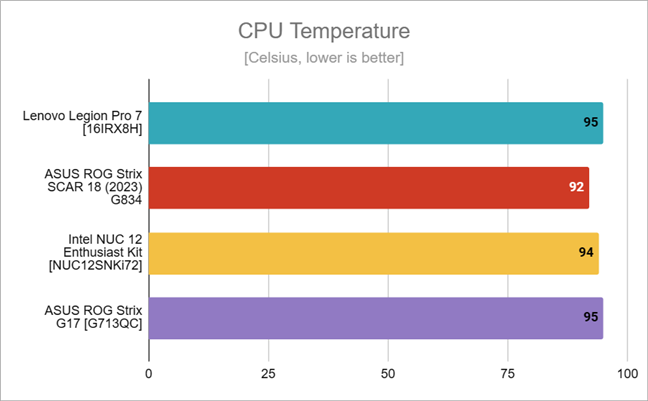
During benchmarks, I kept an eye on the processor’s temperatures and power needs too. The highest temperature I saw for the Intel Core i9-13900HX was 95 degrees Celsius (203 Fahrenheit), which may seem high but is absolutely in line with its operating specs.Apps bundled with the Lenovo Legion Pro 7
The Lenovo Legion Pro 7 that I tested came with Windows 11 Home pre-installed, but you can also get it with Windows 11 Pro. Besides the default apps of the operating system, Lenovo also bundles some additional software. These are the apps I’ve found on the Legion Pro 7 gaming laptop:- Lenovo Vantage: an app that acts like a central hub for controlling all the ins and outs of the laptop. For instance, it shows details about the usage of the hardware (like the utilization levels of the CPU, GPU, and SSD), but it also gives you quick access to a series of System Tools. Among these, you’ll find tools that allow you to update essential software on your system, control the power and battery settings, the touchpad and keyboard use, audio settings, and set display color profiles. Last but not least, the app also allows you to configure the Tobii eye-tracking solution, which uses the laptop’s webcam to track your eyes and head movements during games in order to provide a more immersive playing experience.
- McAfee LiveSafe: a trial version of the security product developed by McAfee. The evaluation period is 30 days long, and then you’ll have to buy a subscription if you still want to use it. In my experience, there are better security products available out there, so you might want to check out your other options before making a decision.

Discussion (0)
Comments are closed.