



Quoting a source is usually straightforward until the passage you want to use already contains a quotation. You now have one person’s words appearing inside another person’s words, and using the same quotation marks for both can make the sentence difficult to understand.
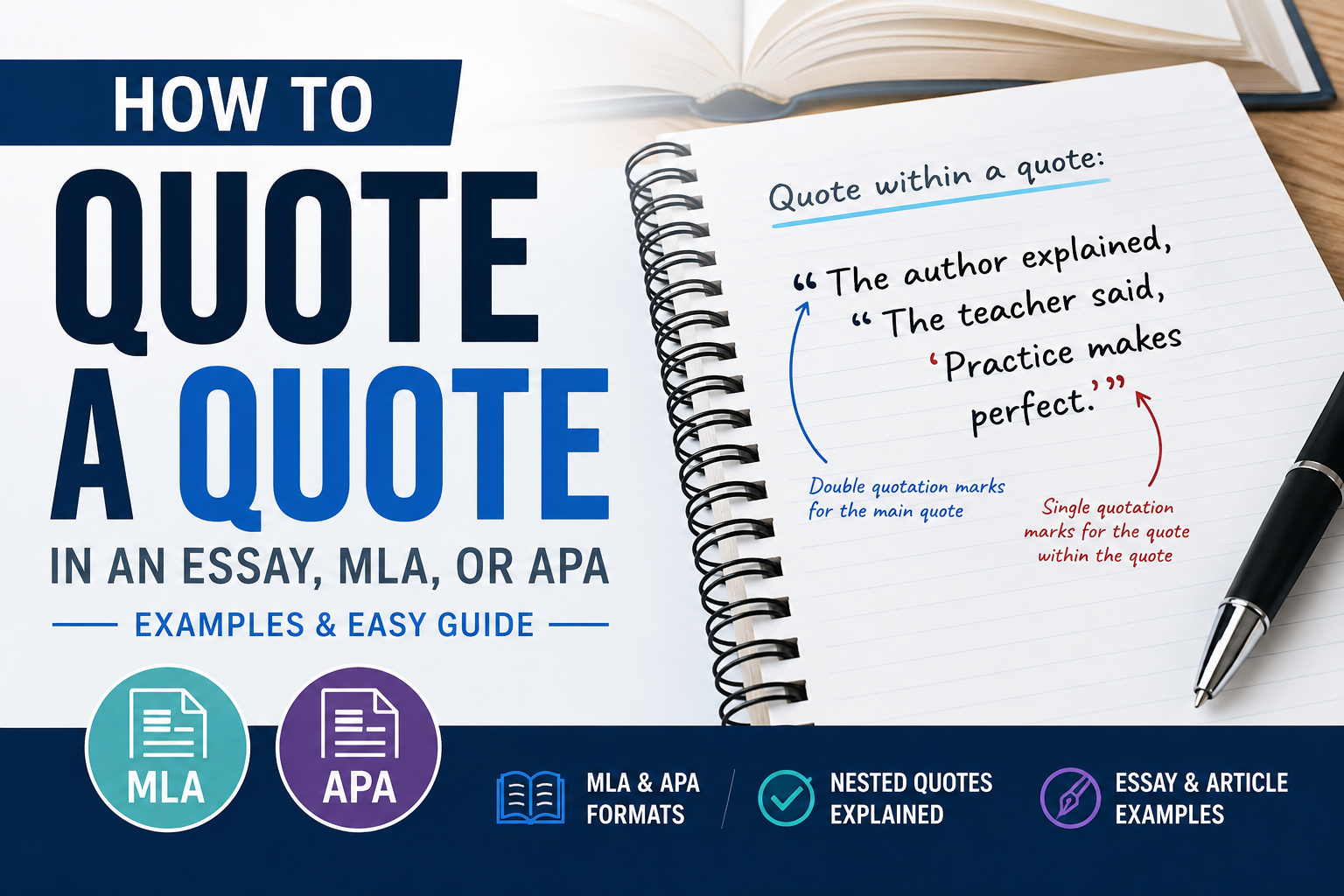
In American English, the basic rule is simple: use double quotation marks around the complete quotation and single quotation marks around the quotation inside it.
Example: The journalist reported, “The mayor described the proposal as ‘the safest option available.’”
This arrangement is known as a nested quotation, or a quote within a quote. However, “quoting a quote” can also mean repeating words attributed to someone in a source you read. In that situation, you may need a secondary-source citation, such as qtd. in for MLA or as cited in for APA.
MLA and APA both use double quotation marks for the main short quotation and single quotation marks for quoted material inside it.
How do you quote a quote?
To quote a quote, place the entire passage you are copying inside double quotation marks. Change the quotation marks already appearing inside that passage to single quotation marks.
Use this pattern:
“Main quotation ‘quotation within the quotation’ main quotation”
For example:
Original passage: The witness said, “The hallway was completely silent.”
If a reporter quotes that statement:
The reporter writes, “The witness said, ‘The hallway was completely silent.’”
If you then quote the reporter’s sentence in an essay:
Ramos writes, “The reporter noted that ‘the witness said, “The hallway was completely silent.”’”
Quotation marks alternate whenever another level is added:
| Quotation level | Marks used |
|---|---|
| First level | Double quotation marks |
| Second level | Single quotation marks |
| Third level | Double quotation marks again |
Three levels of quotation are grammatically possible, but they can be hard to read. When a sentence becomes cluttered with quotation marks, rewriting or paraphrasing part of it is often clearer.
How to quote a quote within a quote
A quote within a quote occurs when the passage you are reproducing contains dialogue, a statement from another person, or words the original writer placed in quotation marks.
Consider this source sentence:
The researcher called the results “a major warning for the industry.”
An article might report it this way:
Patel writes, “The researcher called the results ‘a major warning for the industry.’”
The double marks show where Patel’s sentence begins and ends. The single marks identify the researcher’s exact words inside Patel’s sentence.
Quoting a complete passage that contains a quote
When you reproduce the complete sentence from your source, preserve both levels:
The article states, “The committee described the delay as ‘the most expensive option,’ but approved it anyway.”
Quoting only the words of the original speaker
You do not need nested quotation marks when you take only the original speaker’s words from the article.
Instead of quoting the entire sentence:
Patel writes, “Dr. Silva described the findings as ‘a warning, not a prediction.’”
You could quote only Dr. Silva:
Dr. Silva described the findings as “a warning, not a prediction.”
However, if you found Silva’s words in Patel’s article and did not consult Silva’s original interview, speech, or publication, you must make that clear in the citation:
Dr. Silva described the findings as “a warning, not a prediction” (qtd. in Patel 47).
This is an indirect or secondary quotation. MLA uses qtd. in to show that the writer found the original person’s words inside another source.
Quoting a quote inside a block quotation
Block quotations are not surrounded by quotation marks. Therefore, any direct quotation appearing inside a block quote normally returns to double quotation marks.
The pattern changes as follows:
| Format | Main passage | Quotation inside it |
|---|---|---|
| Short, run-in quotation | Double marks | Single marks |
| Block quotation | No outer marks | Double marks |
For example, a block passage could contain the sentence:
The witness then said, “I heard the alarm before I saw any smoke.” Investigators later treated this statement as an important part of the timeline.
The witness’s words use double quotation marks because the block itself has no outer quotation marks. MLA uses block formatting for prose quotations longer than four typed lines and verse quotations longer than three lines. APA uses block formatting for quotations of 40 words or more.
How to quote a quote in an essay
A quotation should support your argument rather than appear without explanation. The clearest method is to introduce the source, present the quotation, cite it, and then explain why it matters.
1. Identify who is speaking
Determine whether the words belong to the author you are reading or to another person quoted by that author.
For example:
Article author: Patel
Person quoted by Patel: Dr. Silva
This distinction determines whether you need a normal citation, nested quotation marks, or a secondary-source citation.
2. Introduce the passage with a signal phrase
A signal phrase gives readers context before the quotation.
Useful verbs include:
- argues
- explains
- reports
- observes
- states
- warns
- concludes
For example:
Patel reports, “The committee called the postponement ‘the costliest choice available’” (62).
3. Use the correct quotation marks
For a short quotation in American academic writing, use double marks around the passage from your source and single marks around any quotation inside that passage.
“The director called the revised plan ‘more realistic than the original.’”
4. Add the appropriate citation
The citation format depends on the required style.
MLA example:
Patel writes, “The director called the revised plan ‘more realistic than the original’” (62).
APA example:
Patel (2025) wrote, “The director called the revised plan ‘more realistic than the original’” (p. 62).
5. Explain the quotation
Do not let the quote stand alone. Connect it to your argument:
Patel writes, “The director called the revised plan ‘more realistic than the original’” (62). This description suggests that the committee accepted the revision because it reduced the project’s scope, not because it resolved the underlying financial problem.
The explanation shows the reader why the quotation was included.
How to quote a quote in MLA format
MLA citations normally identify the author and the relevant page number. If the author is already named in your sentence, include only the page number in parentheses.
MLA quote-within-a-quote example
Ortiz writes, “The witness described the hallway as ‘completely silent’ before the alarm sounded” (27).
If the author is not named in the sentence:
The witness described the hallway as “completely silent” before the alarm sounded (Ortiz 27).
For short quotations, MLA places the closing quotation mark before the parenthetical citation and the final period after the citation.
MLA template for a nested quotation
Author writes, “Main quotation ‘quotation inside it’ main quotation” (page).
Example:
Brooks reports, “The chair called the proposal ‘an incomplete but necessary compromise’” (91).
MLA secondary quotation example
When you quote a person whose words appear inside the source you consulted, use qtd. in:
Dr. Hale calls the discovery “a major shift in the field” (qtd. in Brooks 91).
In this example:
- Dr. Hale is the original speaker.
- Brooks is the author you actually read.
- Page 91 is where Hale’s words appear in Brooks’s work.
- The Works Cited entry should be for Brooks, the source you consulted.
Whenever practical, locate and cite the original publication instead of relying on an indirect quotation.
MLA block quotations
Use an MLA block quotation when prose exceeds four typed lines or verse exceeds three lines. Begin the quotation on a new line, indent the entire passage half an inch, keep it double-spaced, and omit the outer quotation marks.
If the block contains another quotation, retain double quotation marks around that quoted material. The parenthetical citation follows the block’s closing punctuation.
MLA quotations from articles without page numbers
Do not invent page numbers for an online article and do not use the page count produced by your browser’s print preview.
When the article has an author but no page or section numbers, identify the author in your prose or citation:
Garcia writes that the committee considered the result “a temporary improvement.”
Or:
The committee considered the result “a temporary improvement” (Garcia).
If Garcia is named in the signal phrase and the article has no page or other numbered division, no additional parenthetical citation is required. MLA guidance says not to create a page number when the source provides none.
How to quote a quote in APA
APA uses an author-date citation system. A direct quotation normally needs:
- the author’s surname
- the publication year
- a page number or another locator
APA requires the author, year, and page number for direct quotations when page numbers are available.
APA quote-within-a-quote example
Ortiz (2025) wrote, “The witness described the hallway as ‘completely silent’ before the alarm sounded” (p. 27).
Parenthetical version:
“The witness described the hallway as ‘completely silent’ before the alarm sounded” (Ortiz, 2025, p. 27).
APA template for a nested quotation
Author (Year) wrote, “Main quotation ‘quotation inside it’ main quotation” (p. X).
Example:
Lewis (2025) wrote, “The editor considered the revision ‘far clearer than the original’” (p. 18).
APA secondary quotation example
APA uses as cited in when you have not read the original source.
Hale described the discovery as “a major shift in the field” (as cited in Brooks, 2025, p. 91).
When the original publication year is known, it can also be included:
Hale’s 1999 study described the discovery as “a major shift in the field” (as cited in Brooks, 2025, p. 91).
Another acceptable structure is:
Hale (1999, as cited in Brooks, 2025) described the discovery as “a major shift in the field” (p. 91).
Only Brooks, the source you actually consulted, should appear in the reference list. APA advises writers to use primary sources when possible and secondary citations sparingly.
APA block quotations
Use block formatting for a direct quotation containing 40 words or more.
Start the passage on a new line, indent the entire block half an inch, maintain double spacing, and omit quotation marks around the block. Place the parenthetical citation after the block’s final punctuation. If the block contains quoted words, use double quotation marks around those words.
APA quotations from articles without page numbers
For an online article without page numbers, use another locator that helps the reader find the passage.
Possible locators include:
(Garcia, 2025, para. 8)
(Garcia, 2025, “Recommended Changes” section, para. 2)
Garcia (2025) described the change as “a significant improvement” (para. 8).
APA recommends using paragraph numbers, section headings, chapter numbers, tables, or another logical locator when page numbers are unavailable.
How to quote a quote from an article
The correct format depends on exactly which words you want to reproduce.
Imagine that Patel’s article contains this sentence:
Dr. Silva described the result as “a warning, not a prediction.”
Option 1: Quote the article author’s complete sentence
Use nested quotation marks:
Patel writes, “Dr. Silva described the result as ‘a warning, not a prediction’” (47).
Here, you are directly quoting Patel’s sentence. Patel’s outer words use double quotation marks, while Silva’s quoted phrase uses single quotation marks.
Option 2: Quote only the person mentioned in the article
Use normal double quotation marks and identify the article as an indirect source.
MLA:
Dr. Silva described the result as “a warning, not a prediction” (qtd. in Patel 47).
APA:
Dr. Silva described the result as “a warning, not a prediction” (as cited in Patel, 2025, p. 47).
Option 3: Find the original source
The strongest approach is to locate the original interview, study, speech, transcript, or publication containing Silva’s words.
You can then quote Silva directly and cite the original source rather than Patel’s article. This lets you:
- confirm that the wording is accurate
- understand the statement’s original context
- check whether the article shortened or altered the quote
- provide readers with the most authoritative citation
Avoid attributing a quotation directly to its original speaker when you have only seen it on a quotation website, social media post, or unsourced graphic. Verify the original source whenever possible.
Punctuation rules for a quote within a quote
The quotation marks are only part of the problem. The punctuation must also show where each statement ends.
Use single marks inside double marks
The review describes the film as “an ‘unexpectedly moving’ sequel.”
Close the inner quotation first
The report states, “The chair called the decision ‘a serious mistake.’”
The closing sequence is:
- period
- single closing quotation mark
- double closing quotation mark
Put the period after an academic citation
When a short quotation is followed by a parenthetical citation, close the quotation marks, add the citation, and then add the period:
The chair called the decision “a ‘serious mistake’ that could delay construction” (Patel 62).
Keep a quoted question mark inside
When the question mark belongs to the quoted passage, keep it inside the quotation marks:
Patel asks, “Why did the chair call the delay ‘unavoidable’?” (62).
Put your own question mark outside the citation
When your entire sentence is the question, rather than the quoted words, place the question mark after the citation:
Why did Patel describe the decision as “an ‘unavoidable’ delay” (62)?
Use no outer quotation marks for a block quote
The block’s indentation replaces its outer quotation marks. Quoted dialogue or wording inside the block still uses double quotation marks.
How to shorten or change a quotation
A direct quotation should reproduce the original wording accurately. You may shorten or clarify it, but you must show readers what you changed.
Use an ellipsis for omitted words
Original:
The proposal was expensive, difficult to implement, and unlikely to receive unanimous support.
Shortened:
The proposal was “expensive . . . and unlikely to receive unanimous support” (Patel 62).
An ellipsis should not remove words in a way that changes the original meaning.
Use brackets for added or changed words
Original:
They considered it a temporary solution.
Clarified:
The committee members “considered [the proposal] a temporary solution” (Patel 62).
The brackets show that the proposal was added for clarity and did not appear in that exact form in the source.
MLA guidance uses brackets for additions and ellipses for omitted material. APA likewise requires quotations to preserve the source’s wording, spelling, and internal punctuation except for specifically permitted changes.
Common mistakes when quoting a quote
Using double quotation marks at both levels
Incorrect:
“The witness called the room “completely silent.””
Correct:
“The witness called the room ‘completely silent.’”
Using single quotation marks for an ordinary quotation
In American MLA and APA writing, a standard short quotation begins with double quotation marks. Single quotation marks are primarily used for a quote inside that quotation.
Citing an original source you did not read
Do not create the impression that you consulted the original study or interview when you only read another author’s account of it. Use qtd. in or as cited in.
Inventing page numbers for a web article
Browser page counts can change with screen size, font size, and printing settings. Use the locator supplied by the source or follow the style’s rules for an unpaginated work.
Leaving quotation marks around a block quote
Indentation replaces the outer quotation marks in a block quotation.
Ending a paragraph immediately after the quote
Explain what the quotation proves, why the wording matters, or how it connects to your argument.
Changing the wording silently
Use brackets for additions and ellipses for omissions. Never make a quotation fit your argument by changing its meaning.
Quick reference guide
| Situation | Correct format |
|---|---|
| Ordinary short quotation | “Quoted words” |
| Quote within a short quote | “Outer quote ‘inner quote’ outer quote” |
| Third quotation level | “Outer ‘middle “inner” middle’ outer” |
| Quote inside a block quote | No outer marks; use “double marks” inside |
| MLA indirect quotation | “Quoted words” (qtd. in Author page) |
| APA indirect quotation | “Quoted words” (as cited in Author, Year, p. X) |
| MLA long prose quote | Block quote when longer than four typed lines |
| APA long quote | Block quote at 40 words or more |
| MLA article without pages | Use author or title, but do not invent a page |
| APA article without pages | Use paragraph, section, or another locator |
Frequently asked questions
Do you use single quotation marks for a quote within a quote?
Yes. In American English, MLA and APA use double quotation marks around the main short quotation and single quotation marks around the quotation inside it.
“The manager described the result as ‘better than expected.’”
How do you quote someone who is quoting another person?
You can quote the entire passage with nested quotation marks:
Lewis writes, “The manager described the result as ‘better than expected’” (18).
You can also quote only the original speaker. If you did not consult the original source, use an indirect citation such as qtd. in for MLA or as cited in for APA.
Does a quote within a quote need its own citation?
You need to cite the source you actually consulted. When the original speaker is quoted inside that source, identify the original speaker in your sentence and use the appropriate secondary-source format when necessary.
Where does the period go in a quote within a quote?
Without a parenthetical citation, the period normally goes inside the closing quotation marks in American English:
The article calls the result “an ‘unexpected success.’”
When an academic citation follows, the final sentence period normally comes after the citation:
The article calls the result “an ‘unexpected success’ for the company” (Patel 47).
How do you quote a quote from a website?
Use the same nested quotation marks as you would for a printed source. For the citation, do not invent page numbers. MLA may use the author or shortened title, while APA normally uses a paragraph number, section heading, or another available locator.
Can you use double quotation marks inside double quotation marks?
Not for two consecutive quotation levels in standard American academic writing. Alternate the marks:
“First level ‘second level “third level” second level’ first level”
Rewriting is usually preferable if three levels make the passage difficult to follow.
Are the rules different in British English?
They can be. Many British publishers use single quotation marks for the main quotation and double marks for the quotation inside it. Follow the citation style, publication style guide, or instructor’s requirements rather than mixing conventions.
Should I quote the original article instead?
Whenever the original publication is available, cite it directly. Use a secondary-source citation only when you cannot reasonably access the source in which the statement first appeared.
Final answer
To quote a quote in MLA or APA, place the complete short quotation inside double quotation marks and the quotation appearing within it inside single quotation marks:
The article states, “The director called the decision ‘a necessary compromise.’”
For a block quotation, omit the outer quotation marks and use double quotation marks for quoted words inside the block. When you have not read the original source, cite the source you actually consulted using qtd. in for MLA or as cited in for APA.

Discussion (0)
Be the first to comment.