If you use a laptop, a 2-in-1 device, or any other kind of mobile computer, you are also probably using a touchpad. Therefore, you should set your touchpad to work the way you want it. Windows 10 gives you many options for handling simple settings like adjusting the touchpad sensitivity, along with advanced settings for configuring touchpad gestures that trigger different actions. Of course, everything depends on your specific hardware and drivers. Let's see how to configure your touchpad in Windows 10:
Microsoft divides the touchpads available on the market into two broad categories:
Precision Touchpads - are touchpads designed for modern laptops and tablets, running Windows 10. These types of touchpads support a variety of touch gestures that can help you get around your PC more quickly. They offer a great user experience, but the downside is that they are not available on just any laptop or tablet. To get all the gestures, features, and options a precision touchpad can offer, Microsoft requires touchpad manufacturers to comply with a set of specific hardware requirements. If you'd like to see these requirements, read Windows Precision Touchpads - Device Integration.
Normal Touchpads - all the other touchpads that do not fit into Microsoft's standards for precision touchpads. By default, these touchpads do not support Windows gestures and have fewer features and options available than precision touchpads. Depending on the manufacturer and model of the touchpad, its drivers could include some functions that are found on precision touchpads.
As a rule of thumb, more expensive Windows laptops and devices tend to have precision touchpads, while cheaper ones come with regular touchpads.
What kind of touchpad do you have?
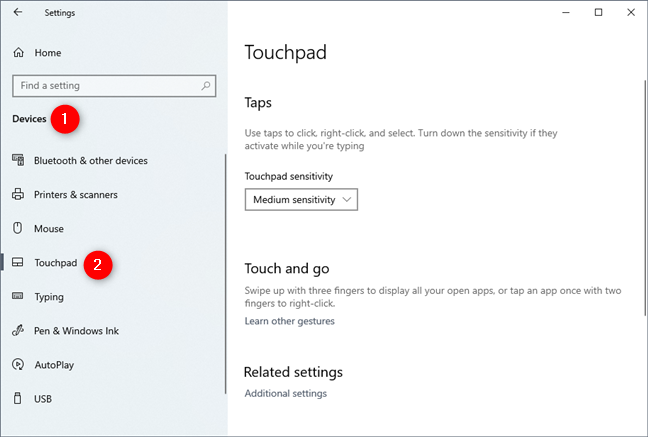
Now that you know there are two types of touchpads, how do you know what kind of touchpad you have on your Windows device? To find out, you must use the Settings app. Open it, navigate to Devices, and select Touchpad on the left side of the window.
The Touchpad section from the Windows 10 Settings app
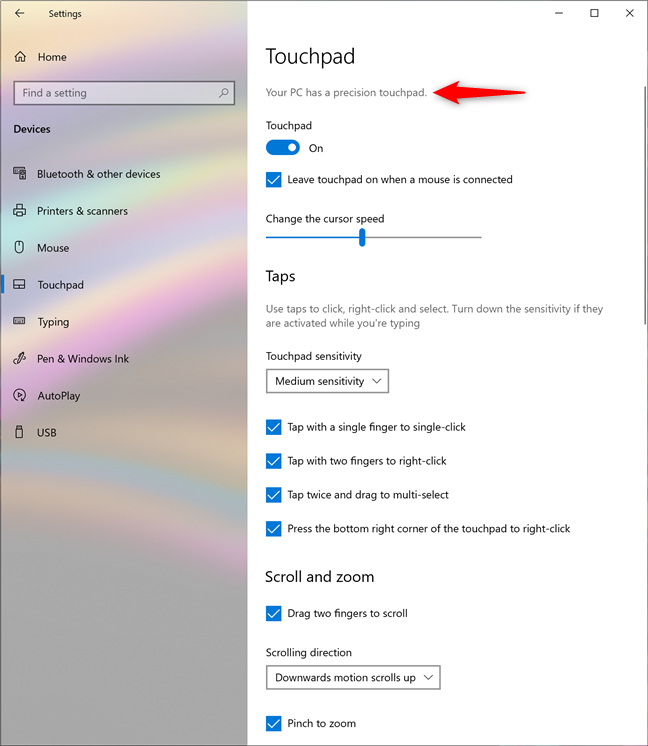
If your Windows 10 laptop or tablet has a precision touchpad, on the right side of the Settings window, you should see a message that says: "Your PC has a precision touchpad." Also, if your Windows 10 laptop or tablet has a precision touchpad, there are many settings that you can configure, split into various sections such as Touchpad, Taps, Scroll and zoom, or Three-finger gestures.
The message you get when you have a precision touchpad
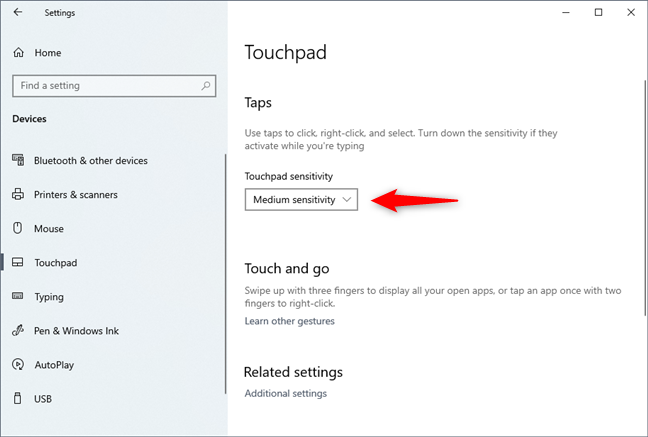
If your laptop or tablet does not have a precision touchpad, you're not going to see the statement shown earlier. Also, the only setting that you can configure is the Touchpad sensitivity.
The Touchpad sensitivity setting
In the next sections of this tutorial, we're going to tell you about the touchpad settings available in Windows 10, how to adjust the touchpad sensitivity in Windows 10, how to enable the touchpad in Windows 10, and more. We're covering both precision and regular touchpads (at the end of this guide), so read on and use the information that applies to you, depending on what kind of touchpad type you have.
How to enable or disable a precision touchpad in Windows 10
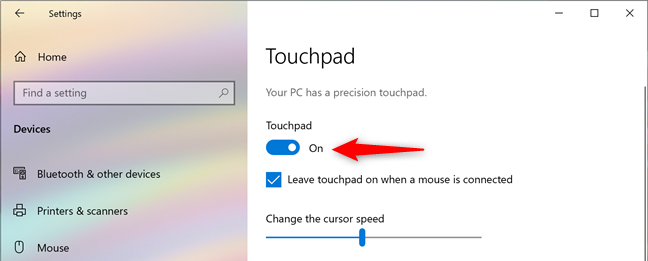
If your Windows 10 laptop or tablet has a precision touchpad, you can enable or disable it by turning the Touchpad switch On or Off.
The switch that turns the touchpad on or off
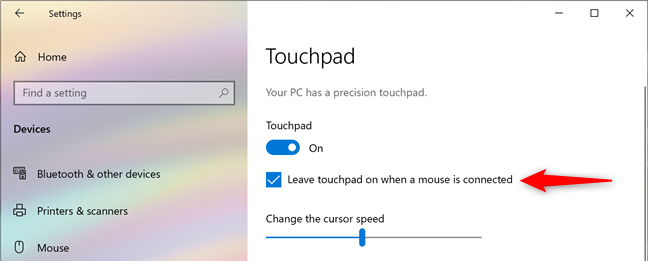
Windows 10 also lets you choose whether you prefer to keep your touchpad enabled or automatically disable it whenever you connect a mouse to your laptop or tablet. To select the touchpad behavior that you prefer, check or uncheck the "Leave touchpad on when a mouse is connected" setting.
The setting that disables the touchpad when a mouse is connected
How to adjust the touchpad cursor speed in Windows 10, for a precision touchpad
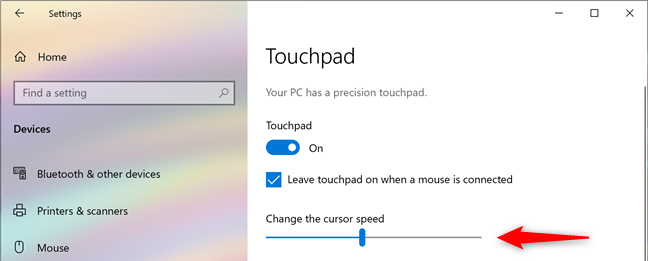
Unfortunately, many touchpads have their cursor speed set very high or very low by default, which is not a good thing if you are not accustomed to working with touchpads. However, if yours is a precision touchpad, you can change its cursor speed easily by adjusting the *"*Change the cursor speed" slider from the Touchpad settings.
The slider that sets the touchpad cursor speed
How to change the touchpad sensitivity for taps, when you have a precision touchpad
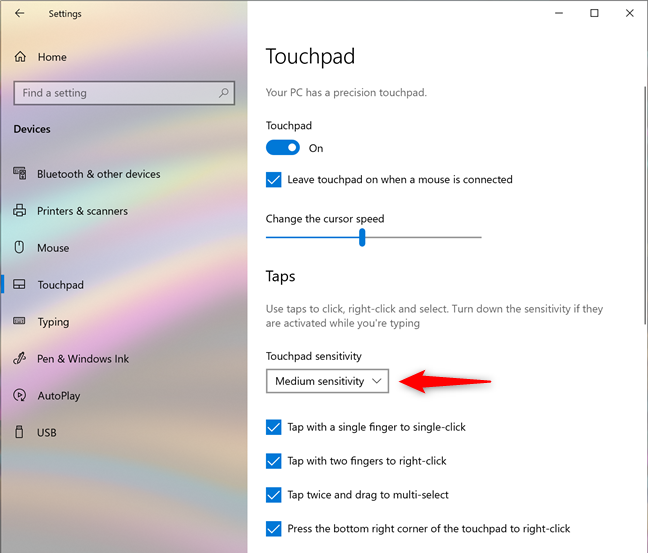
If you have a precision touchpad, Windows 10's Settings app also lets you adjust how sensitive it is to taps. That's quite useful for all those times when you start typing on your laptop and accidentally touch the touchpad with your hands. In such cases, you could find that the cursor moved and you're typing in random places, or that you have double-clicked on things and you didn't even notice you did. To avoid that, in the Taps area, click or tap on Touchpad sensitivity, and choose whether you want your touchpad to have a Low sensitivity, Medium sensitivity, High sensitivity or be the Most sensitive possible.
The setting that controls Touchpad sensitivity
Note that selecting the Most sensitive option is the same as not using this feature, as there's no delay between your taps or touches and the reaction of the touchpad.
HINT: Most times, Ctrl-Z should put you back where you're supposed to be. 🙂
How to configure what taps do, on a precision touchpad
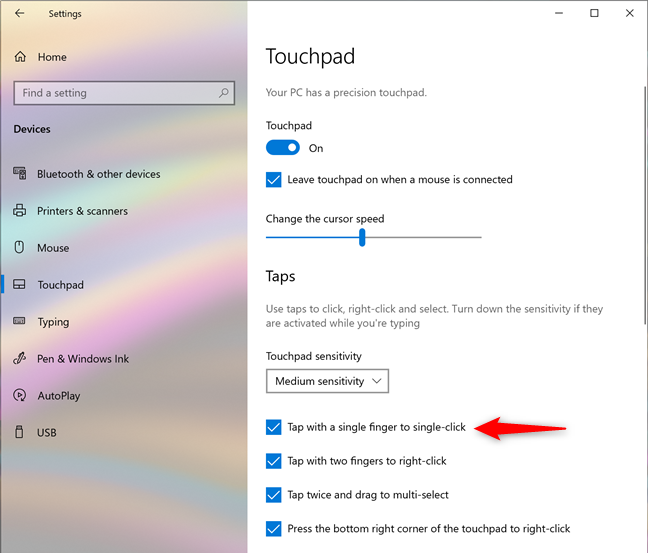
Even if your touchpad has buttons for left and right-clicks, you might prefer to tap on it to perform a click. If you have a precision touchpad, you can make sure that happens by enabling the "Tap with a single finger to single-click" setting. If you do not, uncheck this setting.
Set the touchpad to interpret a single-finger tap as a single-click
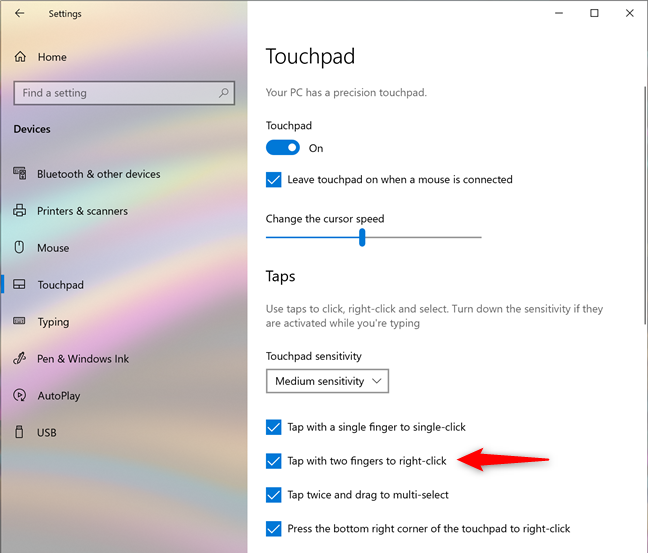
You can also choose to make your precision touchpad right-click whenever you touch it with two fingers. For that, check the *"*Tap with two fingers to right-click" setting. In Windows 10 and most apps, this action shows a contextual menu, similar to right-clicking with a mouse.
Set the touchpad to interpret a two-finger tap as a right-click
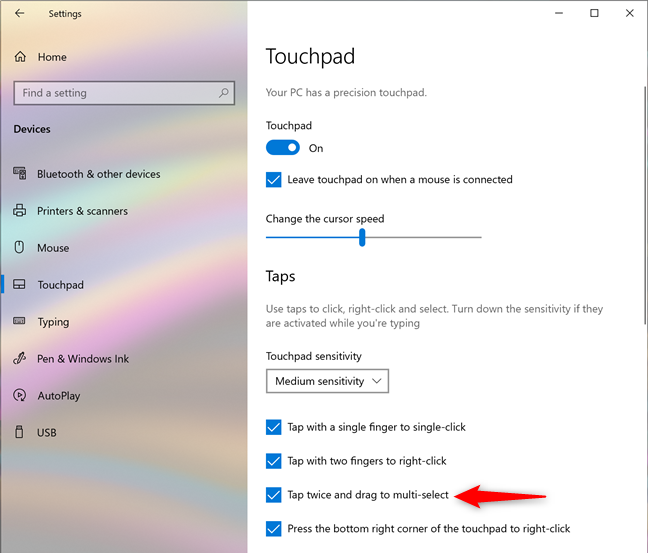
You can also tap and then quickly tap again and drag your finger on the touchpad to select multiple elements, like files, folders, or text. However, this only works if you enable the *"*Tap twice and drag to multi-select" touchpad setting.
Touchpad setting for tap twice and drag to multi-select
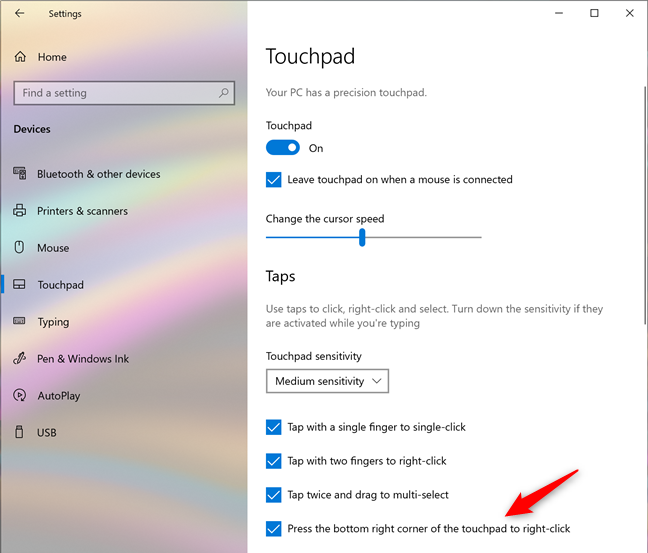
If you have a precision touchpad, you can also make Windows 10 right-click whenever you press in the lower-right corner of the touchpad. If you want to enable this option, make sure that the "Press the lower right corner of the touchpad to right-click" setting is on.
Set the touchpad to interpret tap in its lower-right corner as a right-click
How to configure the precision touchpad scroll and zoom settings
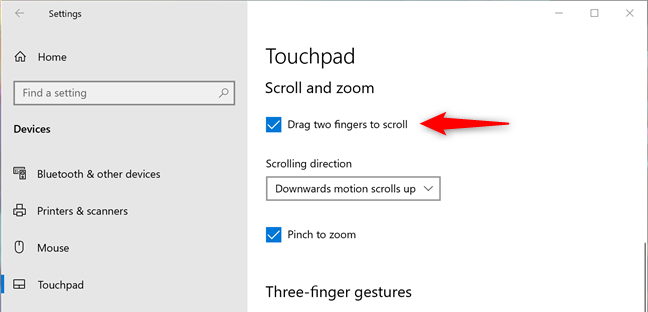
In the Scroll and zoom section of a precision touchpad settings, you can choose how you want to use your touchpad for scrolling and zooming: if you want to scroll horizontally or vertically by placing two fingers on the touchpad and then sliding them on it, enable the "Drag two fingers to scroll" setting.
Set touchpad to scroll when you drag two fingers on it
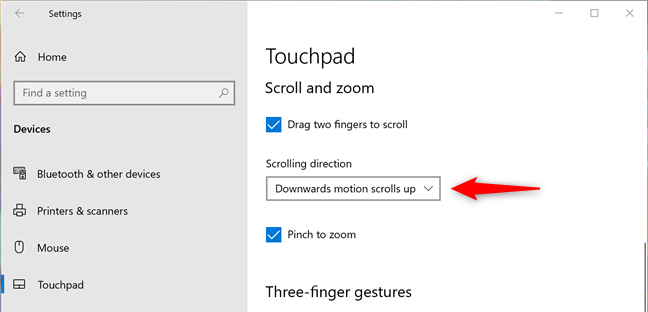
Tap or click on "Scrolling direction" and choose whether you want a downward motion on the touchpad to scroll up or down.
Choose the scrolling direction
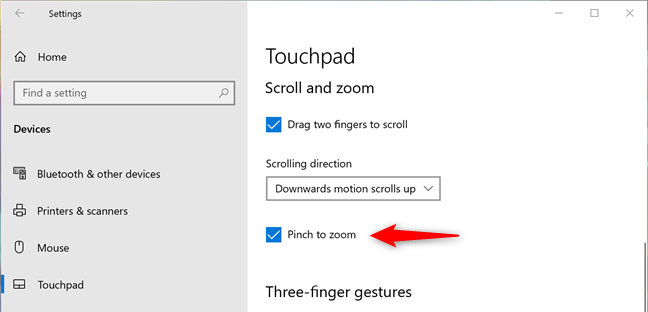
Finally, enable the "Pinch to zoom" setting if you want to be able to place two fingers on your touchpad and then pinch to zoom in, or stretch out to zoom out.
Set the touchpad to zoom when you pinch it
How to configure the three-finger and four-finger settings on a precision touchpad
On precision touchpads, you can also use three-finger and four-finger gestures. The Settings app gives you separate sections for them, and the options in them are the same. However, the actions set by Windows 10 by default are different between three-finger and four-finger gestures, so make sure you set them to your preference. Let's see what they are:
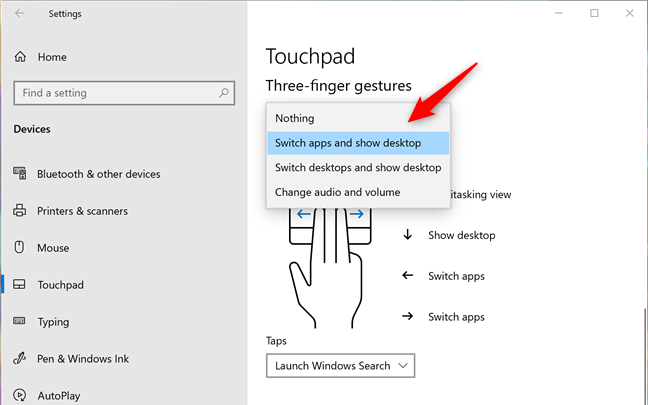
First of all, there are Swipes: when you slide three or four fingers on your touchpad, Windows 10 can be set to "Switch apps and show desktop," "Switch desktops and show desktop," "Change audio and volume," or do "Nothing." Depending on what you choose to set Windows 10 to do when you swipe three or four fingers on the touchpad, the swipes are illustrated using arrow diagrams, beneath the Swipes lists.
Choose what swiping with three or four fingers does
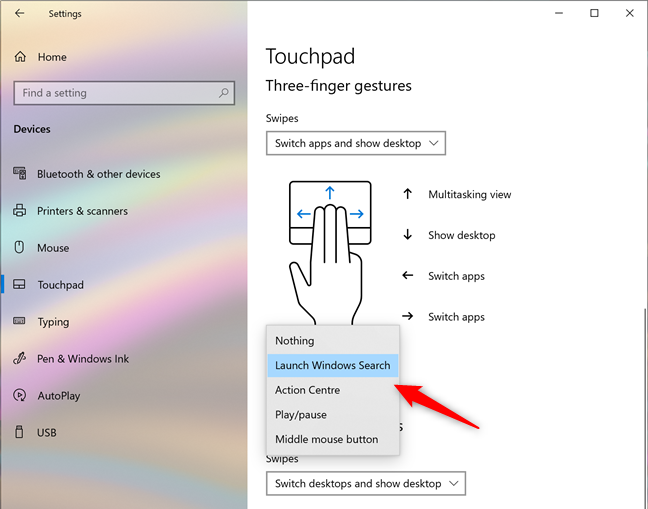
The Taps lists let you choose what happens when you tap the touchpad with three or four fingers. You can set Windows 10 to Launch Windows Search, open the Action Center, Play/pause the media that's being played, act as the Middle mouse button or do Nothing.
Choose what tapping with three or four fingers does
TIP: Usually, pressing on the middle mouse button on a link in a web browser opens it in a new tab. With a precision touchpad, you can do the same thing with a three-finger or four-finger tap on that link.
How to reset the precision touchpad settings
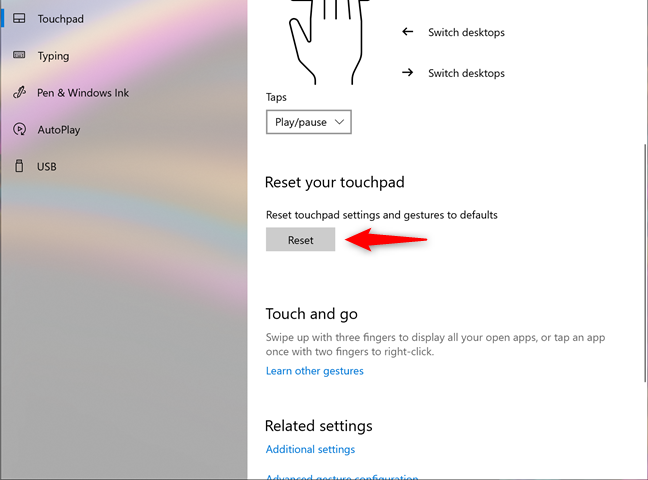
At the end of the precision touchpad settings page, there is also a small section called Reset your touchpad. It only has one button, called Reset, which you can click or tap if you no longer like the way you've configured your touchpad and want to reset its settings and gestures to the defaults provided by Windows 10.
Reset touchpad settings
This is what you get when you have a precision touchpad on your Windows 10 device. As you can see, there are quite a lot of settings to make and options to choose from.
How to configure a regular touchpad (change touchpad sensitivity) in Windows 10
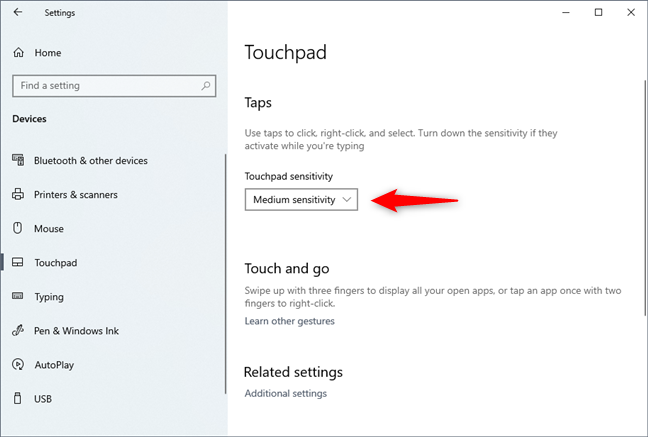
If your laptop or device does not have a precision touchpad, then Windows 10 only lets you set the delay for the taps you make on the touchpad. This is useful for all those times when you start typing on your laptop and accidentally touch the touchpad with your hands. In such cases, you could find that the cursor moved and you're typing in wrong places.
Change the touchpad sensitivity on a regular touchpad
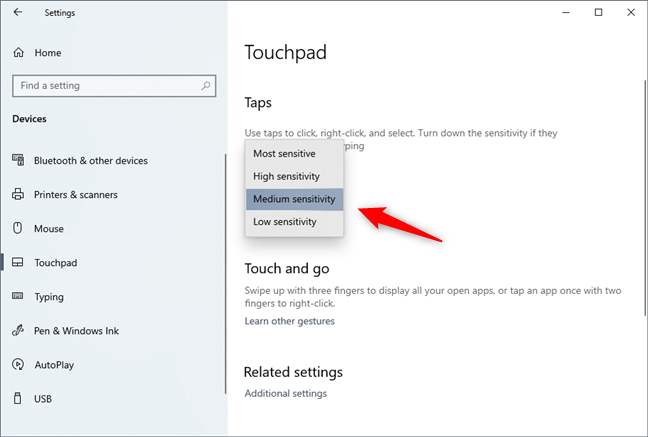
To avoid this, Windows 10 allows you to set your touchpad to have a Low sensitivity, Medium sensitivity, High sensitivity, or have the Most sensitivity. That means the taps you make on the touchpad can have a long delay, medium delay, short delay, or no delay at all. If you do not want to use this feature, the option you should choose is Most sensitive, which means that there's no delay between the tap you make on the touchpad and its reaction.
The list of sensitivity levels available for a touchpad
By default, Windows 10 sets your touchpad to have a Medium sensitivity. If you have a traditional touchpad on your Windows 10 device, this is pretty much all that you can configure for it.
Did you manage to configure your touchpad as you wanted?
Windows 10 has plenty of settings that you can configure for your touchpad if it's a precision touchpad. If you do, we bet that you are going to be more than pleased with what you get. If you don't have a precision touchpad or if you have an exotic touchpad (like the ones on Halo keyboards found on Lenovo Yoga Book tablets), you should also check if your laptop or tablet manufacturer offers additional apps or options via their custom drivers.
Appreciate that you have weighed-in on the touchpad issues and also offered the help for folks needing to tweak theirs.
I found win-10’s latest support which you have helped with here as soon as I fired up my MSI GE 75 Raider, and after some repeated tweaking got it “as good as possible” with those settings.. I am going to have to hope that MSI is working on more refinements specific to this “precision touchpad” however.
Even on the lowest sensitivity – the touchpad is so sensitive, and relatively large, that it is very difficult to avoid making the tiniest incidental contact with palms (specifically beneath base of the thumb I think). I’m getting better at it but, the touchpad seems to “sense” that my palm is within a few mm of the edge and suddenly my mouse is dancing all over the screen – it is rage-inducing.
The other thing I encounter is that, even while typing (yes, I selected “hide mouse while typing”), the mouse will suddenly reposition while I am using VIM and I’ll find half a word, or sentence even, placed somewhere randomly within the document – as the mouse repositioned WHILE I WAS TYPING. Infuriating.
Just wanted to thank you and .. rant for a moment. I thought my Asus Strix was bad (the touchpad) but the MSI makes it very hard to have an rage-free experience – even when just typing a comment on digitalcitizen.life for xxxx!-sake.
Cheers!
aprilia1k
Ciprian Adrian Rusen ·
Sorry to hear about your frustrating experience. Try to update the touchpad drivers from MSI’s support page: https://www.msi.com/Laptop/support/GE75-Raider-10SX
Maybe the latest version fixes some of the problems you are encountering.
Sebastian ·
I don’t understand. Windows says non precision touchpads have to finger tapping action as secondary click. Yet, it’s not true.
Shen ·
Can anyone point me to how to customize the size/area of the corners? I do not like the half of the right lower corner of the touchpad to be right click. I would like to know how to set the area to only one-fourth of the corner. Has anyone looked into it?
linsuwillow ·
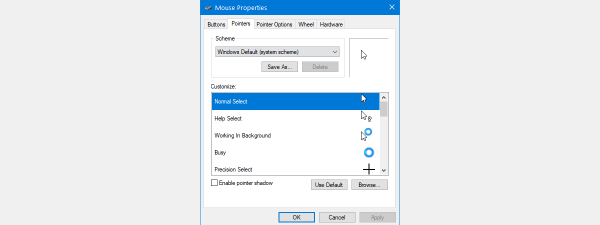
Even though mine is NOT a precision touchpad, here is the path I found to set MANY multifingered choices. Holding the lower left corner of the touchpad and using my right finger to move the cursor was ZOOMING the page. Now it is not; hurray!
Settings
Devices
Touchpad
Related Settings
Additional Settings
Mouse properties (yes for touchpad!:-)
far right tab for me was “Elan” my touchpad!
Options
Rob C. ·
Apparently I have a normal touchpad. I used to be able to configure it through asus smart gesture. Smart gesture is now gone and I can no longer do two finger scrolling. I don’t know when or how this happened but I am extremely disappointed with the situation.
jessica boakye ·
you saved my life thank you
randall ·
still no info on touchscreen sensitivity??
Moomie ASUS ux510uxk ·
If you have a precision ASUS touchpad which is too sensitive and cannot resolve it with the app settings then go to “Device Manager”. Click on “Human Interface Devices”. Click on “Asus Precision Touchpad”. Choose “Driver” Tab. Click “Update Driver”. Choose “Browse My Computer for Driver Software”. Choose “Let me pick from a list of drivers on my computer”. Choose “HID compliant touch pad”. Click “next”. Click “close”. Worked perfectly for me.
Russell Brown ·
I’m still looking for the setting in Windows 10 that says “make the touchpad behave like an old two-button trackpad,” with check-boxes underneath for “Left click makes a tiny little noise, like a small button was pressed, not a giant clunk, like 10 square inches of real estate was just shoved in” and “Left click is a left click. Right click is a right click. It’s almost impossible to accidentally do one while trying to do the other.” Anybody know where this is located, ’cause I haven’t been able to find it. I can’t even find anybody that will sell me a decent trackpad that I can plug in to my so-called-wonderful-Windows-10 machine.
Annette ·
Too much time is wasted just figuring out the settings. Windows 7 was the best. Bring it back so we can spend time using the computer not setting it up.
Juuso ·
For me as the happy owner of a nice senior laptop (without the high resolution version touchpad) the only option was to install Synaptics touchpad drivers. All the above comments suggest that the tapping gesture is the major cause of difficulties and complaints. Windows enables it by default, though it should be enabled only for touchpad expert users. I know too many laptop owners who complaint they had to install an external mouse, because the touchpad is too impossible to use. Without the Synaptics drivers Windows 10 does not even allow the disabling of the tapping gesture.!!!!!
Ciprian Adrian Rusen ·
Thank you for sharing this information. I’m sure other readers will find it useful.
Ciprian Adrian Rusen ·
Thank you for sharing this information. I’m sure other readers will find it useful.
bill ·
Not clear how the double tap and drag is supposed to work. Is it supposed to stay in drag state until you click to cancel it? Asking because I just got a laptop with the new precision touchpad dialog and it behaves differently from my old laptop which had a precision touchpad but the old dialog, and the hardware vendor supplied dialog handled the rest. Trouble is the new behavior is unusable. I double tap to drag and then it just keeps dragging after i lift my finger.
Dean ·
How do I increase the mouse pad touch sensitivity on Windows 10, so commands do not happen so easily when I simply brush my finger over the mouse pad while using it?
Edith Reardon ·
from what i understand windows 10 does not support older touchpads, period. i can’t shut mine off and now i think something is effecting my caps on my keyboard. i will be looking at the maker of my laptop for other ideas as i can not shut off my touchpad. this is driving me nuts. my solution and expensive one, buy a newer computer. i’m sure window’s loves all the laptops, printers and other computer equipment that has to be replaced because windows will not support them. to the dump to the dump to the dump dump dump.
ge97aa ·
So, according to the article’s instructions, it would appear that Windows thinks I have a “normal” touchpad, but I don’t think that’s actually the case. My touchpad treats taps as clicks and other similar gesture nonsense (which incidentally no touchpad should EVER do – it leads to ENORMOUS numbers of false positives, and that’s what the BUTTONS beneath the touchpad are for, but I digress…).
Anyway, before some major Windows update about a week ago I had disabled all the tap-click and “advanced” gesture B.S. on the touchpad (don’t remember how). Since the update, those settings seem to have reverted (grrrrr…..) and I can no longer figure out how to disable them again. Any help?
J. Kober ·
I had a similar issue since the latest update. All my preferred settings for the touchpad seemed to have disappeared, and annoyingly no way to reconfigure it. Why does Microsoft feel as though it has to make these sorts of choices and decisions for us? Anyway, I found the device under Mouse settings…wasn’t labeled a touchpad (of course) but on my computer it was Asus Support Device. Settings>devices>mouse&touchpad>additional mouse options>Hardware tab. This is where the touchpad was located. I just disabled it entirely.
Might be able to find it through device manager, but the above ‘route’ worked for me.
sdkluber ·
Ok, so here’s my deal. I like the pinch zoom but don’t like the “starting zone” that defines from which part of the touchpad the multifinger gestures (like pinch zoom) begin (HP Envy, W-10, Synaptics ClickPad).
I can edit by going to
Settings>Devices>Mouse & Touchpad>Additional Mouse Settings;
Clickpad Settings>SmartSense (settings button/gears), and changing the “Starting Zone.”
The problem with this, however, is that every time my computer shuts down, the ‘starting zone’ resets. Has anyone been able to change this setting and actually have permanence?
Brad Henderson ·
My laptop has a touchpad. I use a mouse to do all of my pointing. I had windows 7, and the touchpad was disabled, and all was well. Ever since I updated to windows 10, I can’t type a message for anything without the stupid track pad causing all kinds of havoc. All I want to do is disable the track pad, but since it’s apparently not a precision trackpad, it seems I don’t have that option. Anyone know how to simply turn it OFF?
Patrick ·
Hi I don’t know a technical answer to your problem but an old school fix is to tape a credit type card over the track pad then you can type without problems the woman in my old office did this all the time and used a mouse when needed hope this helps
Nanci ·
I installed Windows 10. I had numerous problems that it took me over a month to repair but I have one remaining that I cannot fix. When I tap my touch pad in the upper right corner the current screen is minimized. When I tap in the lower right corner the screen closes. This is driving me crazy. How can I stop this? I cannot find a reference to it anywhere.
Stephen Brown ·
I am trying to understand how to adjust my touchpad because it constantly zooms in and out, causes the cursor to jump to different places, and opens various unwanted dialogs and windows, when I only want it to move the cursor and NOTHING ELSE. Your instructions say this:
“In order to avoid this, Windows 10 allows you to set your touchpad to use a Short delay, Medium delay or a Long delay. Of course, if you don’t want to use this feature, you can also disable it by selecting No delay (always on).”
I cannot understand that. First, what does “in order to avoid this” refer to? Avoid what? Second, what does “use this feature” refer to? What feature? Third, my setting is on MEDIUM DELAY, but I do not know what how delay affects anything, so I don’t know whether I need longer delay or shorter delay, or no delay. Or maybe delay will not help my problem(s) at all. This computer is virtually unusable with Windows 10.
Ciprian Adrian Rusen ·
In order to avoid a situation when the cursor moved and you're typing in wrong places because you accidently touched the touchpad.
Arlyce ·
I am having the exact same problems! Also, my laptop screen keeps “flipping” from landscape to portrait, and the cursor is so eratic at that point it is nearly impossible to get it changed back to landscape. It is happening several times a day.
Steve Bee ·
I am having the exact same issues and am ready to throw this surface pro 4 out the window. Many people are having a number of similar issues and the windows 10 options don’t do a great deal to correct them. The touchpad is just too twitchy. One thing is not mentioned, but it seems to me to be one of the main culprits in causing my grief. At the bottom of the touchpad are the left and right mouse buttons (buried under the pad). When you touch these areas to do a click, like to call up a right click menu, that area of the touchpad is part of the active surface to control the cursor position. If you are not EXTREMELY careful not to slide your thumb on that touchpad area, the cursor moves. If you have your mouse on high sensitivity and your screen on high resolution the level of frustration to not select the wrong thing is INSANE. As an example, I created a folder and had to rename it. I right clicked to get to the rename option, but when I tried to click rename (very carefully I might add), the selection instead clicked on delete and I deleted that directory. The directory was empty, so no big deal, but it happened so fast, I couldn’t even figure out what I just did. Making that area of the mouse pad active is just plain stupid and serves no other purpose than to frustrate. I have a Toshiba ultrahigh with a much smaller touchpad and real buttons. I can use my computer with the limited size touchpad. I can almost not deal with the difficulty of the surface pro touchpad. No one comments on this, instead looking for some way to correct things using settings. I believe this is a surface pro design flaw! BTW, turn your sensitivity DOWN to make the pad a bit more usable. I also made my cursor bigger and made my resolution a bit lower and now my thumb moving the cursor off where I want it to be is tolerable vs. intolerable. One final thing. A bunch of folks complain about the touchpad simply making the cursor completely jump around. I saw this myself in of all places the Microsoft store here in Chicago. That jittery thing is another issue and something Microsoft has to resolve because it makes for a touchpad experience that is just plain broken. Sorry if I sound frazzled, but I really wanted to like this machine!












Discussion (27)
Appreciate that you have weighed-in on the touchpad issues and also offered the help for folks needing to tweak theirs.
I found win-10’s latest support which you have helped with here as soon as I fired up my MSI GE 75 Raider, and after some repeated tweaking got it “as good as possible” with those settings.. I am going to have to hope that MSI is working on more refinements specific to this “precision touchpad” however.
Even on the lowest sensitivity – the touchpad is so sensitive, and relatively large, that it is very difficult to avoid making the tiniest incidental contact with palms (specifically beneath base of the thumb I think). I’m getting better at it but, the touchpad seems to “sense” that my palm is within a few mm of the edge and suddenly my mouse is dancing all over the screen – it is rage-inducing.
The other thing I encounter is that, even while typing (yes, I selected “hide mouse while typing”), the mouse will suddenly reposition while I am using VIM and I’ll find half a word, or sentence even, placed somewhere randomly within the document – as the mouse repositioned WHILE I WAS TYPING. Infuriating.
Just wanted to thank you and .. rant for a moment. I thought my Asus Strix was bad (the touchpad) but the MSI makes it very hard to have an rage-free experience – even when just typing a comment on digitalcitizen.life for xxxx!-sake.
Cheers!
aprilia1k
Sorry to hear about your frustrating experience. Try to update the touchpad drivers from MSI’s support page: https://www.msi.com/Laptop/support/GE75-Raider-10SX
Maybe the latest version fixes some of the problems you are encountering.
I don’t understand. Windows says non precision touchpads have to finger tapping action as secondary click. Yet, it’s not true.
Can anyone point me to how to customize the size/area of the corners? I do not like the half of the right lower corner of the touchpad to be right click. I would like to know how to set the area to only one-fourth of the corner. Has anyone looked into it?
Even though mine is NOT a precision touchpad, here is the path I found to set MANY multifingered choices. Holding the lower left corner of the touchpad and using my right finger to move the cursor was ZOOMING the page. Now it is not; hurray!
Settings
Devices
Touchpad
Related Settings
Additional Settings
Mouse properties (yes for touchpad!:-)
far right tab for me was “Elan” my touchpad!
Options
Apparently I have a normal touchpad. I used to be able to configure it through asus smart gesture. Smart gesture is now gone and I can no longer do two finger scrolling. I don’t know when or how this happened but I am extremely disappointed with the situation.
you saved my life thank you
still no info on touchscreen sensitivity??
If you have a precision ASUS touchpad which is too sensitive and cannot resolve it with the app settings then go to “Device Manager”. Click on “Human Interface Devices”. Click on “Asus Precision Touchpad”. Choose “Driver” Tab. Click “Update Driver”. Choose “Browse My Computer for Driver Software”. Choose “Let me pick from a list of drivers on my computer”. Choose “HID compliant touch pad”. Click “next”. Click “close”. Worked perfectly for me.
I’m still looking for the setting in Windows 10 that says “make the touchpad behave like an old two-button trackpad,” with check-boxes underneath for “Left click makes a tiny little noise, like a small button was pressed, not a giant clunk, like 10 square inches of real estate was just shoved in” and “Left click is a left click. Right click is a right click. It’s almost impossible to accidentally do one while trying to do the other.” Anybody know where this is located, ’cause I haven’t been able to find it. I can’t even find anybody that will sell me a decent trackpad that I can plug in to my so-called-wonderful-Windows-10 machine.
Too much time is wasted just figuring out the settings. Windows 7 was the best. Bring it back so we can spend time using the computer not setting it up.
For me as the happy owner of a nice senior laptop (without the high resolution version touchpad) the only option was to install Synaptics touchpad drivers. All the above comments suggest that the tapping gesture is the major cause of difficulties and complaints. Windows enables it by default, though it should be enabled only for touchpad expert users. I know too many laptop owners who complaint they had to install an external mouse, because the touchpad is too impossible to use. Without the Synaptics drivers Windows 10 does not even allow the disabling of the tapping gesture.!!!!!
Thank you for sharing this information. I’m sure other readers will find it useful.
Thank you for sharing this information. I’m sure other readers will find it useful.
Not clear how the double tap and drag is supposed to work. Is it supposed to stay in drag state until you click to cancel it? Asking because I just got a laptop with the new precision touchpad dialog and it behaves differently from my old laptop which had a precision touchpad but the old dialog, and the hardware vendor supplied dialog handled the rest. Trouble is the new behavior is unusable. I double tap to drag and then it just keeps dragging after i lift my finger.
How do I increase the mouse pad touch sensitivity on Windows 10, so commands do not happen so easily when I simply brush my finger over the mouse pad while using it?
from what i understand windows 10 does not support older touchpads, period. i can’t shut mine off and now i think something is effecting my caps on my keyboard. i will be looking at the maker of my laptop for other ideas as i can not shut off my touchpad. this is driving me nuts. my solution and expensive one, buy a newer computer. i’m sure window’s loves all the laptops, printers and other computer equipment that has to be replaced because windows will not support them. to the dump to the dump to the dump dump dump.
So, according to the article’s instructions, it would appear that Windows thinks I have a “normal” touchpad, but I don’t think that’s actually the case. My touchpad treats taps as clicks and other similar gesture nonsense (which incidentally no touchpad should EVER do – it leads to ENORMOUS numbers of false positives, and that’s what the BUTTONS beneath the touchpad are for, but I digress…).
Anyway, before some major Windows update about a week ago I had disabled all the tap-click and “advanced” gesture B.S. on the touchpad (don’t remember how). Since the update, those settings seem to have reverted (grrrrr…..) and I can no longer figure out how to disable them again. Any help?
I had a similar issue since the latest update. All my preferred settings for the touchpad seemed to have disappeared, and annoyingly no way to reconfigure it. Why does Microsoft feel as though it has to make these sorts of choices and decisions for us? Anyway, I found the device under Mouse settings…wasn’t labeled a touchpad (of course) but on my computer it was Asus Support Device. Settings>devices>mouse&touchpad>additional mouse options>Hardware tab. This is where the touchpad was located. I just disabled it entirely.
Might be able to find it through device manager, but the above ‘route’ worked for me.
Ok, so here’s my deal. I like the pinch zoom but don’t like the “starting zone” that defines from which part of the touchpad the multifinger gestures (like pinch zoom) begin (HP Envy, W-10, Synaptics ClickPad).
I can edit by going to
Settings>Devices>Mouse & Touchpad>Additional Mouse Settings;
Clickpad Settings>SmartSense (settings button/gears), and changing the “Starting Zone.”
The problem with this, however, is that every time my computer shuts down, the ‘starting zone’ resets. Has anyone been able to change this setting and actually have permanence?
My laptop has a touchpad. I use a mouse to do all of my pointing. I had windows 7, and the touchpad was disabled, and all was well. Ever since I updated to windows 10, I can’t type a message for anything without the stupid track pad causing all kinds of havoc. All I want to do is disable the track pad, but since it’s apparently not a precision trackpad, it seems I don’t have that option. Anyone know how to simply turn it OFF?
Hi I don’t know a technical answer to your problem but an old school fix is to tape a credit type card over the track pad then you can type without problems the woman in my old office did this all the time and used a mouse when needed hope this helps
I installed Windows 10. I had numerous problems that it took me over a month to repair but I have one remaining that I cannot fix. When I tap my touch pad in the upper right corner the current screen is minimized. When I tap in the lower right corner the screen closes. This is driving me crazy. How can I stop this? I cannot find a reference to it anywhere.
I am trying to understand how to adjust my touchpad because it constantly zooms in and out, causes the cursor to jump to different places, and opens various unwanted dialogs and windows, when I only want it to move the cursor and NOTHING ELSE. Your instructions say this:
“In order to avoid this, Windows 10 allows you to set your touchpad to use a Short delay, Medium delay or a Long delay. Of course, if you don’t want to use this feature, you can also disable it by selecting No delay (always on).”
I cannot understand that. First, what does “in order to avoid this” refer to? Avoid what? Second, what does “use this feature” refer to? What feature? Third, my setting is on MEDIUM DELAY, but I do not know what how delay affects anything, so I don’t know whether I need longer delay or shorter delay, or no delay. Or maybe delay will not help my problem(s) at all. This computer is virtually unusable with Windows 10.
In order to avoid a situation when the cursor moved and you're typing in wrong places because you accidently touched the touchpad.
I am having the exact same problems! Also, my laptop screen keeps “flipping” from landscape to portrait, and the cursor is so eratic at that point it is nearly impossible to get it changed back to landscape. It is happening several times a day.
I am having the exact same issues and am ready to throw this surface pro 4 out the window. Many people are having a number of similar issues and the windows 10 options don’t do a great deal to correct them. The touchpad is just too twitchy. One thing is not mentioned, but it seems to me to be one of the main culprits in causing my grief. At the bottom of the touchpad are the left and right mouse buttons (buried under the pad). When you touch these areas to do a click, like to call up a right click menu, that area of the touchpad is part of the active surface to control the cursor position. If you are not EXTREMELY careful not to slide your thumb on that touchpad area, the cursor moves. If you have your mouse on high sensitivity and your screen on high resolution the level of frustration to not select the wrong thing is INSANE. As an example, I created a folder and had to rename it. I right clicked to get to the rename option, but when I tried to click rename (very carefully I might add), the selection instead clicked on delete and I deleted that directory. The directory was empty, so no big deal, but it happened so fast, I couldn’t even figure out what I just did. Making that area of the mouse pad active is just plain stupid and serves no other purpose than to frustrate. I have a Toshiba ultrahigh with a much smaller touchpad and real buttons. I can use my computer with the limited size touchpad. I can almost not deal with the difficulty of the surface pro touchpad. No one comments on this, instead looking for some way to correct things using settings. I believe this is a surface pro design flaw! BTW, turn your sensitivity DOWN to make the pad a bit more usable. I also made my cursor bigger and made my resolution a bit lower and now my thumb moving the cursor off where I want it to be is tolerable vs. intolerable. One final thing. A bunch of folks complain about the touchpad simply making the cursor completely jump around. I saw this myself in of all places the Microsoft store here in Chicago. That jittery thing is another issue and something Microsoft has to resolve because it makes for a touchpad experience that is just plain broken. Sorry if I sound frazzled, but I really wanted to like this machine!