



In this day and age, you can find many apps that promise to help you recover deleted files. It is great to have lots of options, but the question is, which programs are good at recovering deleted files? Which of them deliver on their promise? To find out, we tested some of the most popular applications in this niche, all of which are free for personal use. Let's see what we discovered:
NOTE: In this article, we test three truly free file recovery software: Recuva vs. PhotoRec vs. IObit Undelete. We also wanted to do a Recuva vs. EaseUS comparison, but, unfortunately, the latter is not a genuinely free app, as it only allows you to recover up to 2 GB of lost data.
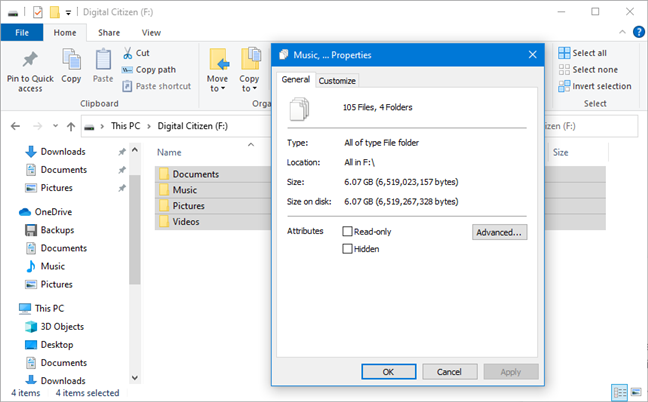
 The files we used for testing recovery software
Next, we deleted all the files permanently, using the Shift + Delete keys, and added 20 new files (jpeg images, 57.40 MB total size) on the memory stick. We did that to see how good each program would be at recovering files when there are chances of having some deleted files partially overwritten by others. Since the deleted files were on a USB memory stick, we recovered the files to our computer's solid-state drive.
Then it was time to test the data recovery apps we planned to review. We chose the programs you see below because, at this moment, they are the most popular in the niche. We also wanted to restrict this review only to free apps, without any limitations, because most people are not keen on spending money on apps they might only use once or twice.
The files we used for testing recovery software
Next, we deleted all the files permanently, using the Shift + Delete keys, and added 20 new files (jpeg images, 57.40 MB total size) on the memory stick. We did that to see how good each program would be at recovering files when there are chances of having some deleted files partially overwritten by others. Since the deleted files were on a USB memory stick, we recovered the files to our computer's solid-state drive.
Then it was time to test the data recovery apps we planned to review. We chose the programs you see below because, at this moment, they are the most popular in the niche. We also wanted to restrict this review only to free apps, without any limitations, because most people are not keen on spending money on apps they might only use once or twice.
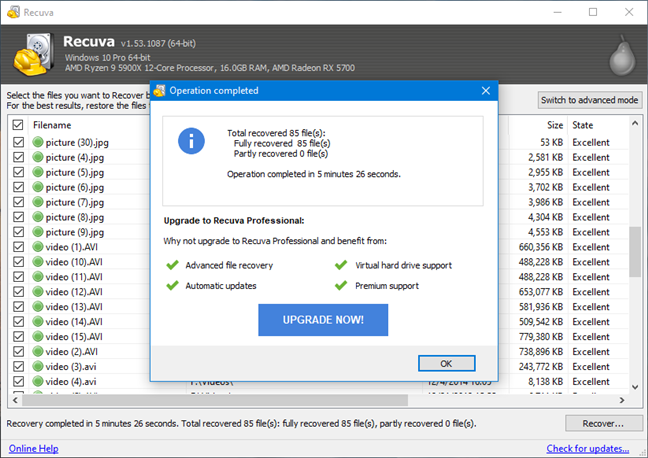
 Deleted files recovered by Recuva using fast scan
Running Recuva a second time, using the deep scan option gave better results. Although the deep scan itself took much longer (31 minutes and 3 seconds), Recuva identified 144 recoverable files. That’s more than the number of files we copied on the USB memory stick: Recuva managed to detect 59 additional image files that were found on the stick before formatting it. However, the twenty .mp3 files that it didn’t recover on the first (fast) scan were still undetected and unrecoverable. The recovery time was similar to the first one we recorded: 5 minutes and 24 seconds.
Deleted files recovered by Recuva using fast scan
Running Recuva a second time, using the deep scan option gave better results. Although the deep scan itself took much longer (31 minutes and 3 seconds), Recuva identified 144 recoverable files. That’s more than the number of files we copied on the USB memory stick: Recuva managed to detect 59 additional image files that were found on the stick before formatting it. However, the twenty .mp3 files that it didn’t recover on the first (fast) scan were still undetected and unrecoverable. The recovery time was similar to the first one we recorded: 5 minutes and 24 seconds.
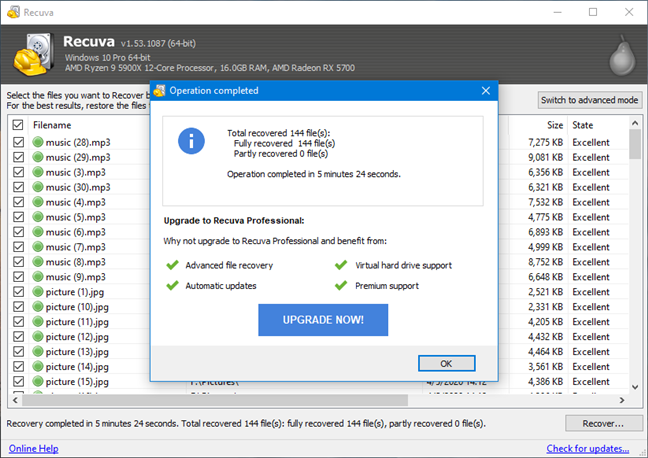 Deleted files recovered by Recuva using deep scan
Download: Recuva
Deleted files recovered by Recuva using deep scan
Download: Recuva
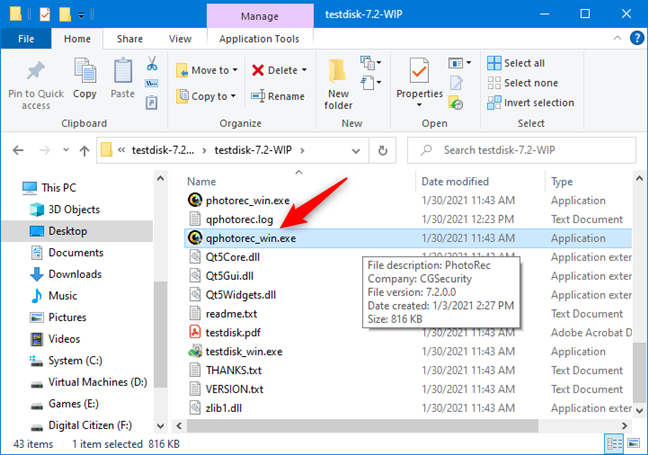
 TestDisk PhotoRec has a tool with graphical interface
Looking at PhotoRec vs. Recuva, PhotoRec handles the lost files recovery process differently from Recuva or other similar software. After selecting the drive that you want to scan and the recovered files’ location, it immediately retrieves everything it can.
In our test, it found and rescued 85 files from the 105 deleted files. It managed to do it in 25 minutes and 56 seconds. That is quite a long time, and, unfortunately, this app doesn’t have a deep-scan feature like Recuva.
TestDisk PhotoRec has a tool with graphical interface
Looking at PhotoRec vs. Recuva, PhotoRec handles the lost files recovery process differently from Recuva or other similar software. After selecting the drive that you want to scan and the recovered files’ location, it immediately retrieves everything it can.
In our test, it found and rescued 85 files from the 105 deleted files. It managed to do it in 25 minutes and 56 seconds. That is quite a long time, and, unfortunately, this app doesn’t have a deep-scan feature like Recuva.
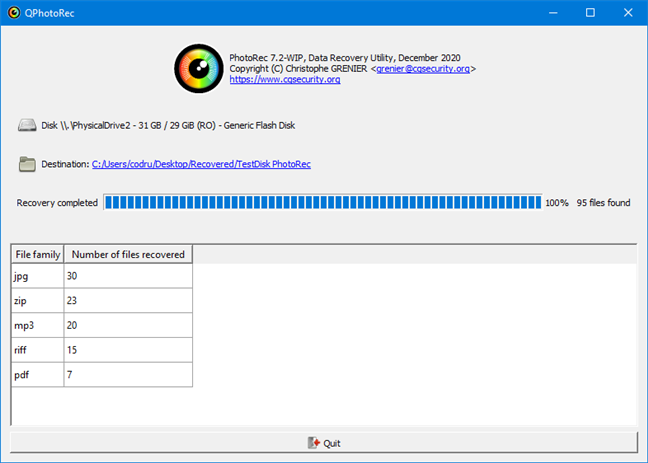
 Deleted files recovered by PhotoRec
Download: TestDisk PhotoRec
Deleted files recovered by PhotoRec
Download: TestDisk PhotoRec
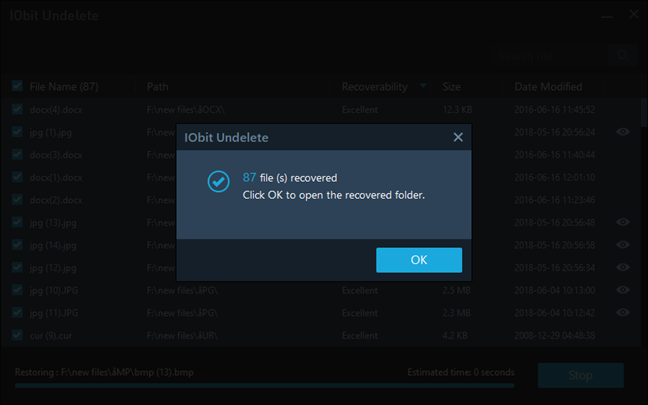
 Deleted files recovered by IObit Undelete
IObit Undelete recovered a total of 85 files out of the 105 files that we’ve deleted. The scan time was 14 seconds, while the total file recovery time was 5 minutes 18 seconds. Unfortunately, IObit Undelete doesn’t offer an in-depth scan feature similar to Recuva.
Download: IObit Undelete
Deleted files recovered by IObit Undelete
IObit Undelete recovered a total of 85 files out of the 105 files that we’ve deleted. The scan time was 14 seconds, while the total file recovery time was 5 minutes 18 seconds. Unfortunately, IObit Undelete doesn’t offer an in-depth scan feature similar to Recuva.
Download: IObit Undelete
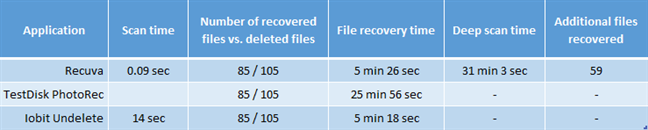
 Free file recovery software comparison
Summing everything up, it is evident that the clear winner is Recuva. Looking at the number of deleted files that were recovered, both Recuva, TestDisk PhotoRec, and IObit Undelete managed to retrieve the same number of files. However, when running a deep scan, Recuva managed to recover even some files that were found on the USB memory stick before we formatted it. That’s a better result than what the other two apps managed.
We also noticed meaningful differences regarding the scanning speed and the time it took to recover the deleted files. From any perspective you look at, it seems that the contest of IObit Undelete vs. TestDisk vs. Recuva was won by the latter. Out of the apps we tested, none was better than Recuva.
Free file recovery software comparison
Summing everything up, it is evident that the clear winner is Recuva. Looking at the number of deleted files that were recovered, both Recuva, TestDisk PhotoRec, and IObit Undelete managed to retrieve the same number of files. However, when running a deep scan, Recuva managed to recover even some files that were found on the USB memory stick before we formatted it. That’s a better result than what the other two apps managed.
We also noticed meaningful differences regarding the scanning speed and the time it took to recover the deleted files. From any perspective you look at, it seems that the contest of IObit Undelete vs. TestDisk vs. Recuva was won by the latter. Out of the apps we tested, none was better than Recuva.
How we tested the free file recovery software
We took a USB memory stick and formatted it to make sure there was nothing left on it. Then we copied a wide range of files on it:- 30 documents (16 .xlsx, 7 .pdf, and 7 .docx files) with a total size of 3.30 MB
- 30 music files (.mp3 files) with a total size of 198 MB
- 30 images (.jpg files) with a total size of 90.10 MB
- 15 videos (.avi files) with a total size of 5.78 GB
1. Recuva
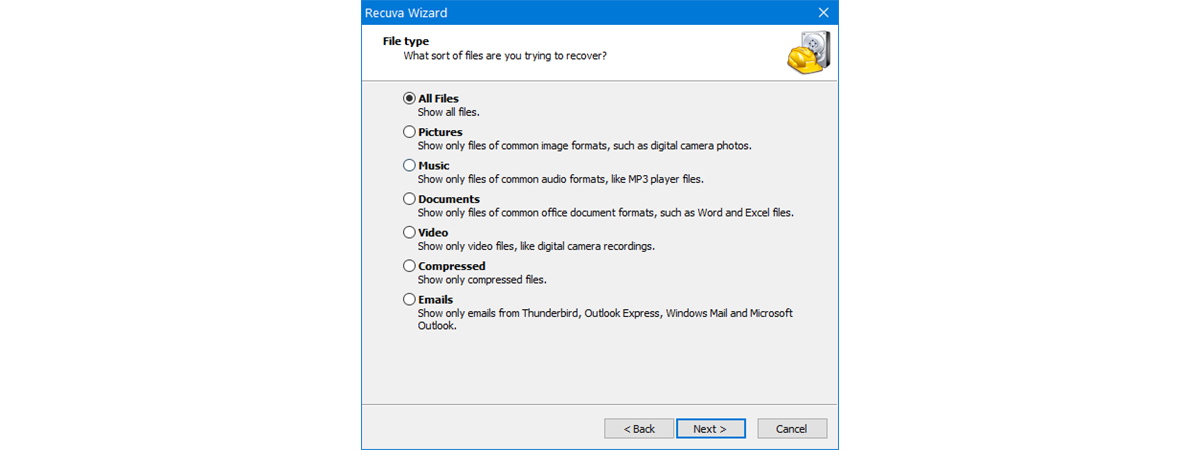
Recuva starts with a wizard, which helps you choose the location and file types you are about to scan. The application made the scan in 0.09 seconds and found 85 out of the 105 files we deleted. It recovered them in 5 minutes and 26 seconds, and all of the 85 recovered files were intact. Unfortunately, twenty out of the thirty .mp3 music files we had initially were unrecoverable.2. TestDisk PhotoRec
TestDisk PhotoRec is an excellent data recovery app. The software is open-source, meaning that it is entirely free for anyone to use. Inexperienced users might be tempted to dismiss it right from the start because it’s not advertised as having a graphical user interface. However, if you look closely inside the zip file you download, you’re going to find an app called qphotorec_win.exe, which is nothing else but the PhotoRec tool with a graphical interface. 🙂3. IObit Undelete
IObit Undelete offers an easy-to-use interface that also looks good. The file recovery process can be as simple as selecting what type of files you lost, choosing the drive on which they were found, and then starting the search. This app does not include many advanced settings, but that means you can jump right into getting your files back without having to read user manuals.Best file recovery software: Recuva vs. TestDisk PhotoRec vs. IObit Undelete?
We created a table with a summary of our findings. Take a look to get a good overview: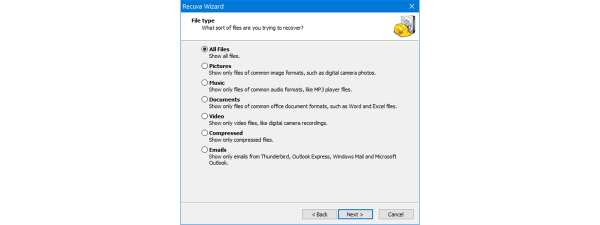
Discussion (19)
I had other experience. I checked if there were any deleted files on Kingston Datatraveller USB flash. Deep search of Recuva found nothing. Search of graphical interface of Photorec found 3 files. Big file with miy extension was one of them. Its size was 47 Gb. It was not miy file really. But I looked it with Hxd and understood, which types of files were on the flash and found their places. So, if Recuva was useless, Photorec gave information to try to recover. I have no knowledge in recovery but if I wanted, I would like to recover after reading Ghatgpt, Duck Ai, Deepseek or Grok advices.
Hi, I used Recuva data recovery software It’s work well as compare any other free tool. In Paid Tool Stellar Photo Recovery is best files recovery tool which recover deleted photos, video, audio, and many more!
I think that the evaluation method could be improved significantly. I’m sure time and effort is a big factor in this but it would have added so much more value to the results. You should have had at ten trials (25 trials is the cutoff for the minimal requirements for scientific experiements) and the erasure of different program extensions. You should also had different methods of erasures like some files that were deleted with different method. Why can’t software review articles conduct experiments more like this. It would probably only take a few more hours but reveal so much more.
Oh well.
Because the time it takes to write one article would increase exponentially, and no publication can afford to spend days writing just one article.
It’s not clear from the article whether the procedure (delete files, add some new ones) was repeated for every test, or if the test memory stick was produced once, then cloned as-is. If it was made anew every time, the actual recoverability of the files would vary from one instance to the next, thus not being a repeatable test of the programs tested.
OKay so my computer won’t start, it only goes to recovery options. If I download recuva, how do I use it when I can’t get to windows? And where do I save the file? These are the questions (I think) most people want to know.
For example, I just downloaded recuva, but was given no option to download it to my thumb stick. It just downloaded right to my other computers hard drive.
Hi Kristi,
This would actually entail a whole other article outside the scope of this article. There are different ways to recover data in your situation, but I’ll give you the run down on how I do it using an adapter or dock.
You would need to take the hard drive out of the computer and use an adapter or docking unit to mount the hard drive to a different, functioning computer. The adapter or docking unit essentially makes the hard drive function like a thumb drive where you just plug it into another computer’s USB port. Then you can run Recuva on the functioning computer and attempt to recover data. ** You may actually not even need Recuva since you may be able to get to your files after mounting the hard drive.
Here’s a great article on how to mount your hard drive to another computer: https://www.howtogeek.com/182452/how-to-get-data-off-an-old-hard-drive-without-putting-it-in-a-pc/
Adapters/Docks: https://www.amazon.com/s/ref=nb_sb_noss_2?url=search-alias%3Daps&field-keywords=hard+drive+dock&rh=i%3Aaps%2Ck%3Ahard+drive+dock
I deleted some photos on my camera and transfered them to my phone. Few hours later, the worst thing happened and I lost my phone. I was wondering if I use Image Rescue by Lexar which can only recover 3 photos then use Recuva to recover other photos. Would it corrupt/override the other photos to be recovered? or Should I just stick to Recuva to recover more photos?
You can use what software you wish. You should only recover them to a different partition or hard disk than the one were they were placed initially.
You list Recuva and Puran as being the “clear” winners, but when you take out the files it recovered but were corrupt, it looks to be a more even playing field with Disk Drill. Take Disk Drills shorter time to recover and it almost becomes even.
This type of comparison has limited usefulness, IMO. Since it is of a serious emergency-type of software, I’d prefer its scope not to be limited only to free products. I’d like to know your opinion as to the BEST means of recovering my data — free or paid– and then to decide for myself if any cost is justified.
If you were drowning, you would not insist on only free life preservers being thrown to you, would you?
You are right about the best tools for recovering data. But that would make another article.
This comparison states right from the beginning (title) that it’s only about free products.
I noted your opinion and we’ll try to get back as soon as possible with a “Best Tools For Recovering Data (Commercial Or Not)” comparison.
Thanks for the super-fast reply. I’ll eagerly be looking for any such review as, right now for instance, I really could use it! I have a 750 GB Seagate HDD from which two partitions “magically” disappeared. Much of the huge amount of time I’ve spent unsuccessfully using various paid and free recovery tools could have been saved — partially at least– if I could have relied on a definitive, side-by-side comparison like you made of these five, free products.
It seems that sites like yours shy away from reviewing/comparing commercial products, perhaps to avoid the appearance of being biased for monetary reasons(?)
Anyway, I’ll ‘stay tuned’ just in case you do do such a review. 🙂
Regards.
Hi Jmj,
I guess the tutorial website are limited to suggesting free tools for the shake of home users that can’t afford or wants to invest in paid software.
There are other places on the web where you can find and compare list of paid recovery applications. You can use whichever you want depending upon your interest.
Below are the three popular software I’d recommend you to give a shot and see if you’d able to recover anything:
1. R-Studio
2. Stellar Phoenix
3. GetDataBack
Good luck!!
Thank you for a great comparison. I was Recuva a long time ago and your testing should I selected the right one.
Super job, again, Thank you
This was a very good article to read. When you restored the files from the PC Inspecter File Recovery were you able to scroll through all of your files? I have found that this program works very well, the search is the only things that freezes. And then the whole scrolling through the files. Feel kind of silly that I can’t figure it out, there is no scroll bar on the side, and when there is you still can’t scroll through all the files.
That program was full of bugs when we tested it and we recommend you to try another, that has less usability issues.
excellent!!
a professional comparison with informative results—extra effort made to allow for possible unfair comparison—-will be sending to my tech savv friends
Excellent article and comparison. Super helpful. This is one I’ll be passing along to family and friends.