




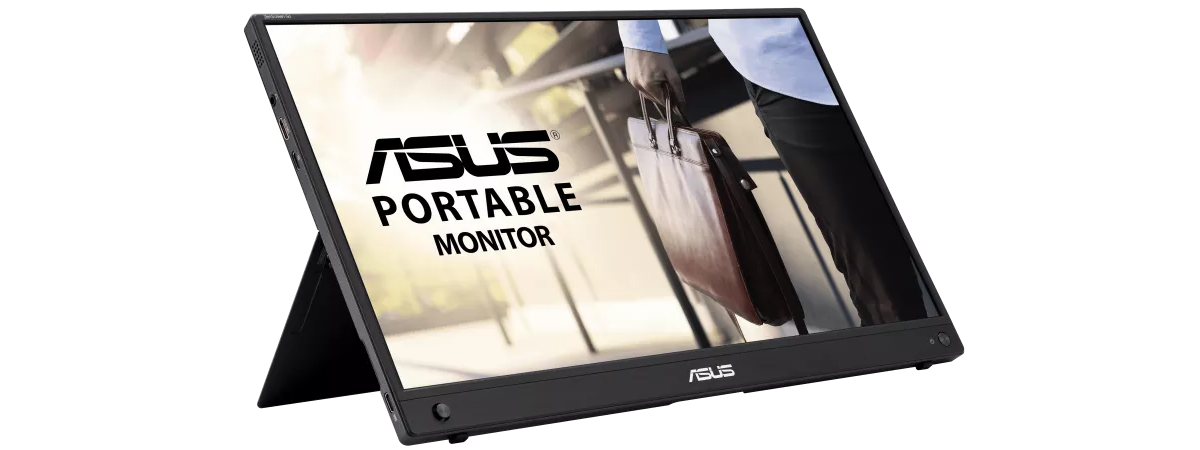
Are you familiar with portable monitors? Did you ever think of getting one? Maybe as a secondary screen for your desktop, or to increase the screen estate while traveling and working remotely on your laptop or tablet? Don’t hold it against me, but until a year or so ago, I didn’t. However, now I’m seriously considering getting a portable monitor, and, as it happens, I’ve recently tested one that I genuinely like: the ASUS ZenScreen Go MB16AWP. Here’s why I think this will be my next acquisition in terms of computing devices and why you might want one too:
NOTE: If you want to read the full review of this portable monitor, you can get to it here: ASUS ZenScreen Go MB16AWP review: A feature-rich portable monitor.
 ASUS ZenScreen Go MB16AWP looks nice and has excellent specs
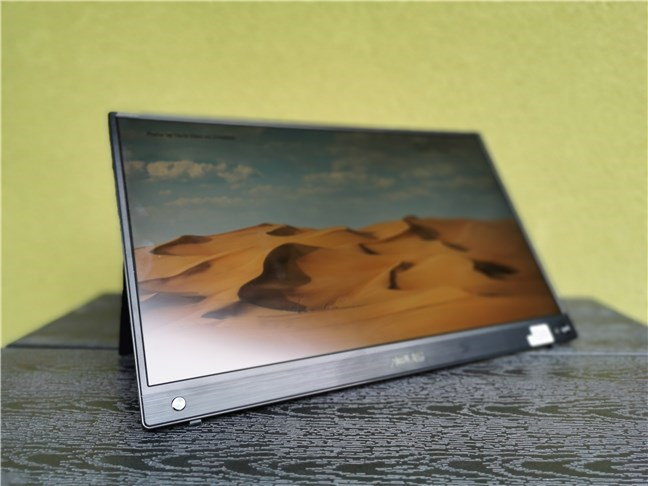
As for the technical specs, ASUS ZenScreen Go MB16AWP has everything you might want from a portable monitor these days. First of all, it’s precisely the size of a laptop display: 15.6 inches in diagonal, with a widescreen aspect ratio, so it fits perfectly next to your laptop if you want a dual-screen setup. Hey, two of them would be even better for those who really need a lot of screen estate. Then, it uses a high-quality 1080p IPS panel with excellent color reproduction, contrast, and viewing angles. It even has a built-in battery that can last for up to four hours on a charge. Last but not least, the ZenScreen Go MB16AWP is as rich as it can be in terms of connectivity options, but more on that in the next section.
ASUS ZenScreen Go MB16AWP looks nice and has excellent specs
As for the technical specs, ASUS ZenScreen Go MB16AWP has everything you might want from a portable monitor these days. First of all, it’s precisely the size of a laptop display: 15.6 inches in diagonal, with a widescreen aspect ratio, so it fits perfectly next to your laptop if you want a dual-screen setup. Hey, two of them would be even better for those who really need a lot of screen estate. Then, it uses a high-quality 1080p IPS panel with excellent color reproduction, contrast, and viewing angles. It even has a built-in battery that can last for up to four hours on a charge. Last but not least, the ZenScreen Go MB16AWP is as rich as it can be in terms of connectivity options, but more on that in the next section.
 The ASUS ZenScreen Go MB16AWP can connect via USB-C, mini HDMI, and Wi-Fi
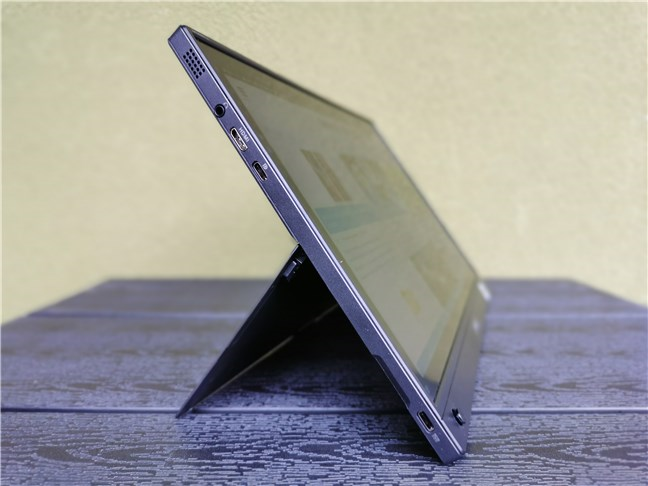
I connected it to my desktop PC, laptop, Android tablet, and smartphone, as well as an iPhone. I used mini HDMI and USB-C connections, as well as wireless projection, and the monitor worked great each time. All types of connections were fast and established without any issues, and never have I encountered random disconnects, as I did with some other portable monitors I tested in the past. This, together with the fact that you can practically use it with any kind of device, makes me genuinely happy, and I’m sure it will make a great addition to anyone’s computing toolbox.
The ASUS ZenScreen Go MB16AWP can connect via USB-C, mini HDMI, and Wi-Fi
I connected it to my desktop PC, laptop, Android tablet, and smartphone, as well as an iPhone. I used mini HDMI and USB-C connections, as well as wireless projection, and the monitor worked great each time. All types of connections were fast and established without any issues, and never have I encountered random disconnects, as I did with some other portable monitors I tested in the past. This, together with the fact that you can practically use it with any kind of device, makes me genuinely happy, and I’m sure it will make a great addition to anyone’s computing toolbox.
 OSD menu and Wi-Fi details shown on the ASUS ZenScreen Go MB16AWP
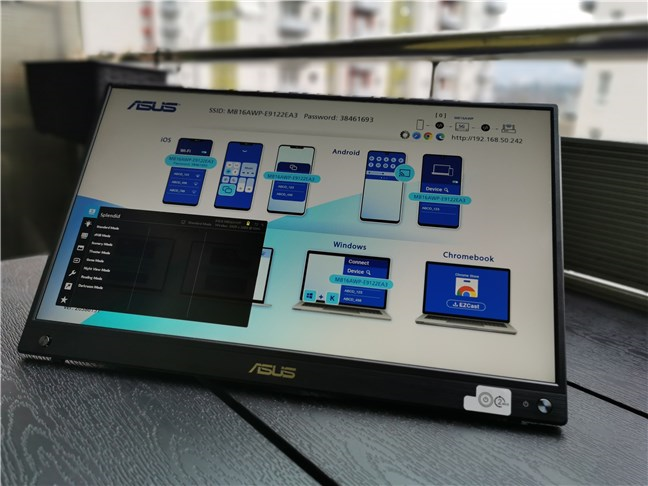
Furthermore, the web interface is just as easy to access, navigate and understand. When on standby, the portable monitor shows you its network name, password, and IP address. All you have to do is connect to its Wi-Fi and use any web browser to go to the monitor’s IP address. Then, you can connect the ASUS ZenScreen Go MB16AWP to your home network, upgrade its firmware, change its Wi-Fi name and password, etc. It’s really easy!
OSD menu and Wi-Fi details shown on the ASUS ZenScreen Go MB16AWP
Furthermore, the web interface is just as easy to access, navigate and understand. When on standby, the portable monitor shows you its network name, password, and IP address. All you have to do is connect to its Wi-Fi and use any web browser to go to the monitor’s IP address. Then, you can connect the ASUS ZenScreen Go MB16AWP to your home network, upgrade its firmware, change its Wi-Fi name and password, etc. It’s really easy!
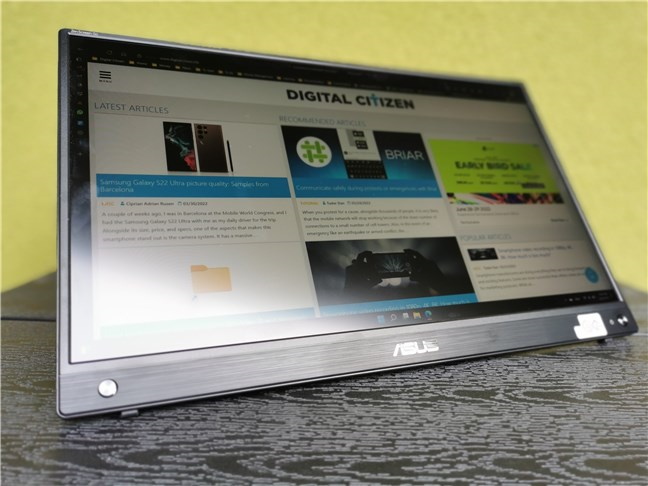 The ASUS ZenScreen Go MB16AWP is an excellent choice for a secondary screen
And although I’m into writing, I can see how a portable monitor like this one can be of great service to other types of professionals. For example, if you’re a software or web developer, a portable monitor is what you probably want when you’re working away from home, either to preview your code or for documentation. Or, similarly, if you’re a designer or a videographer, you’re likely using apps that demand a lot of screen estate for their interfaces. It’s only natural, as such programs usually have many features, options, settings, timelines, etc. In this case, a portable monitor is, in my mind, a must-have for when you’re working remotely.
The ASUS ZenScreen Go MB16AWP is an excellent choice for a secondary screen
And although I’m into writing, I can see how a portable monitor like this one can be of great service to other types of professionals. For example, if you’re a software or web developer, a portable monitor is what you probably want when you’re working away from home, either to preview your code or for documentation. Or, similarly, if you’re a designer or a videographer, you’re likely using apps that demand a lot of screen estate for their interfaces. It’s only natural, as such programs usually have many features, options, settings, timelines, etc. In this case, a portable monitor is, in my mind, a must-have for when you’re working remotely.
1. The looks, technical specs, and price
I’ll start this article with the things I noticed first about the ASUS ZenScreen Go MB16AWP and the ones that made me want to try it: the way it looks, its technical specifications, and its price. These are all essential details that anyone looks at before deciding to purchase a device. Before I got the ASUS ZenScreen Go MB16AWP, I saw its presentation documents and product images. It looked nice, its recommended price seemed fair, and the technical specs were what I was looking for. Then, when I received, unpacked, and started using it, it proved to be exactly what I wanted. The portable monitor looks great and well built, and besides the embedded stand, it also has a tripod mount on its back. Meaning that you can attach it to any regular tripod to adjust its position on your desk or even place it on a rock while hiking and spending a few days in the mountains. This makes it a great choice if you still have to work while enjoying some “free time” in the great outdoors. 🙂2. The connectivity options
The ZenScreen Go MB16AWP can connect to all kinds of devices, which makes it a great choice for people who work with a multitude of gadgets, myself included. It has two physical ports (USB-C and mini HDMI) and wireless connectivity too (Wi-Fi on both 5GHz and 2.4GHz bands). During the time I had to review it, I used this portable monitor with almost all of my devices.3. The ease of use
The ASUS ZenScreen Go MB16AWP offers a simple and intuitive OSD menu and a similarly uncomplicated web interface. For regular adjustments and settings, like brightness, contrast, or color, the on-screen menu is what you need. And it’s easy to use it: the monitor’s joystick makes navigating the menu elementary, while the menu itself is well organized and doesn’t come with setting names that are difficult to comprehend.4. The remarkable versatility as a portable monitor
To be honest, when I see a portable monitor, I usually think of it as a possible extension to my screen space in terms of work. A secondary monitor represents a good way of increasing the screen estate, especially when I use my laptop, providing a much-needed additional space for the windows and apps I need to check regularly but are not my main focus - like Slack, WhatsApp, or Asana. I like having them in the corner of my eye, always being online and on top of what’s happening. The ASUS ZenScreen Go MB16AWP did just that for me, and I found it especially useful when I traveled and worked remotely.
Discussion (4)
Hello, reading your review of ASUS ZenScreen Go MB16AWP, I get encouraged to using this portable wireless PC monitor as a real workable computer monitor with a mini-pc ASUS PB62, with a wireless keyboard and mouse, within the range of Wi-Fi from another room 😀
However, the supplier of mini-pc ASUS PB62 and ASUS customer support in Europe didn’t g8ve me any positive feedback other than usability as a second monitor ☹️
What am I missing 😕
I don’t like a laptop with inferior performance and short life, I would rather use a desktop/mini-pc with superior performance, wire-connected to a desk, using it wirelessly, moving from one desk to another in different rooms, to balcony, with a wireless portable monitor, keyboard and mouse, within Wi-Fi, Bluetooth range.
So, this impasse in getting right information/confirmation from PC supplier/ASUS Customer service on a 2018 portable wireless monitor or such a possibility with another such monitor in Europe is depressing 😕
Your opinion, comments, suggestions would be appreciated 👍 😊
Thank you,
Roy Simpson
[email protected]
Hi! This monitor is an excellent choice as a second display.
However, I wouldn’t use such a device as my main monitor if connected via Wi-Fi.
Although quite unnoticeable when used as the second screen, as primary display on Wi-Fi, the “fps” is too low for my liking – latency is too high for that. It should be Ok if connected via HDMI or USB-C, however.
I read a seperate review that says this monitor does NOT support Windows 11 extended display. It only duplicates what you show on your laptop monitor.
I find that hard to believe (and useless if true). Is that a true limitation? And is it a limitation when connecting to it wirelessly or with a cable or both?
Thanks in advance.
It supports “extended display” both on WiFi and when connected with a cable. I used it both on my desktop PC and on my laptop, and I have Windows 11 on both. 🙂