ASUS RT-AC85P is an AC2400 wireless router with a classic, robust design, similar to that of many popular routers from the same company. This router's positioning on the market, as well as its hardware and feature set, are slightly different from that of other ASUS routers that we recently tested. Therefore, we were curious to see how it performs, and who is the right audience for this wireless router. If you want to know more about the ASUS RT-AC85P, read this review:
ASUS RT-AC85P AC2400: Who is it good for?
ASUS RT-AC85P is a good choice for the following types of users:
Families with mid-sized apartments or one-floor houses without many rooms
Users who want firmware that offers complete control
People who want to remote-control their router from their mobile devices
Users who want proper multi-lingual firmware for their router
Pros and cons
ASUS RT-AC85P has the following strengths:
Excellent WiFi speed for devices that have a direct line of sight to the router
Firmware that is easy to use, and offers complete control
Advanced smartphone app for administering the router and the network
Great multilingual support and easily accessible Help documentation
Tried-and-tested design that's similar to that of other popular routers from ASUS
There are also negatives to consider:
The USB port is slower than expected
The WiFi coverage is not reliable in rooms separated by two walls from the router
The features of the firmware are like those on lower-end ASUS routers
Product rating4/5
Verdict
ASUS RT-AC85P is an interesting wireless router. Its hardware, features, and performance position it somewhere between mid-range and low-end wireless routers from ASUS. The features built into the firmware are similar to those of lower-end ASUS routers. The performance is excellent and similar to that of mid-range ASUS wireless routers when network clients have a direct line of sight to the router or are separated by one wall from it. However, the further away you go from the router, the performance declines to the level of low-end wireless routers. ASUS RT-AC85P is a great choice for people with mid-sized apartments or one-floor houses that do not have many rooms. For larger apartments and homes, you should look at more expensive models like ASUS Blue Cave or ASUS RT-AC86U.
Unboxing the ASUS RT-AC85P wireless router
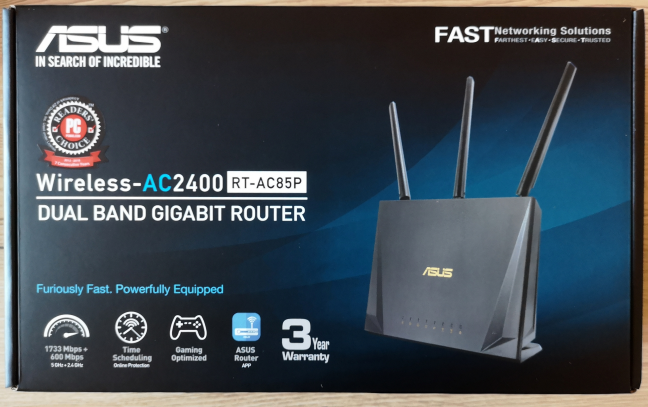
The packaging used for ASUS RT-AC85P is similar to that of other wireless routers from the same brand. On the top cover, we see a picture of the devices and a list of its most prominent features.
The packaging for ASUS RT-AC85P
On the back and the sides, you see lots of technical information about this product, including its entire list of specifications. When you open the box, you find the router itself, the power adapter, a CAT5E network cable, the user manual, and the warranty.
ASUS RT-AC85P - The contents of the package
The unboxing experience for the ASUS RT-AC85P wireless router is quick and painless. Inside the box, you find everything you need to get started right away.
Hardware specifications and design
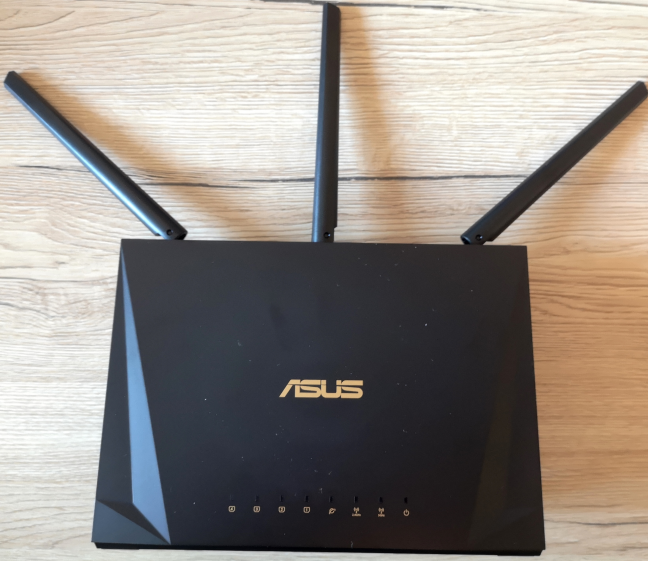
Unlike most wireless routers from ASUS, RT-AC85P comes with a dual-core MediaTek MT7621 processor, running at 880 MHz, 256 MB of RAM, and 128 MB of storage space for the firmware. The company usually has more expensive Broadcom processors on its mid-range wireless routers, and we were surprised by this choice of processor. ASUS RT-AC85P has three non-detachable antennas and one internal antenna. It offers support for the 802.11ac Wave 2 (Wi-Fi 5) standard and 4x4 MU-MIMO wireless transfers, which means that it should be a fast wireless router. It is a dual-band wireless router with a theoretical maximum bandwidth of 2400 Mbps, split as follows: 600 Mbps for the 2.4 GHz band and 1733 Mbps for the 5 GHz band.
The ASUS RT-AC85P AC2400 wireless router
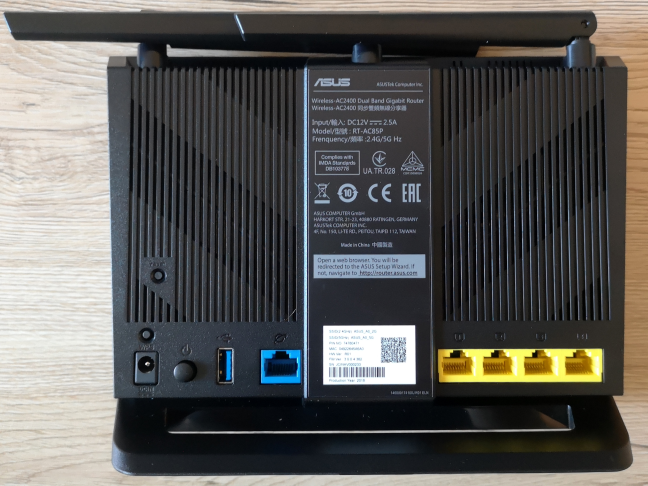
The router has a stand for placing it on flat horizontal surfaces. Unfortunately, it cannot be mounted on walls. On the back of the router, you have all the buttons and ports: the WPS button, the Reset button, the Power button, the Power jack, one USB 3.1 port that can also work using the USB 2.0 standard (it is the default setting for it), the WAN port, and four Ethernet ports that work at 1 Gbps.
The ports on the back side of ASUS RT-AC85P
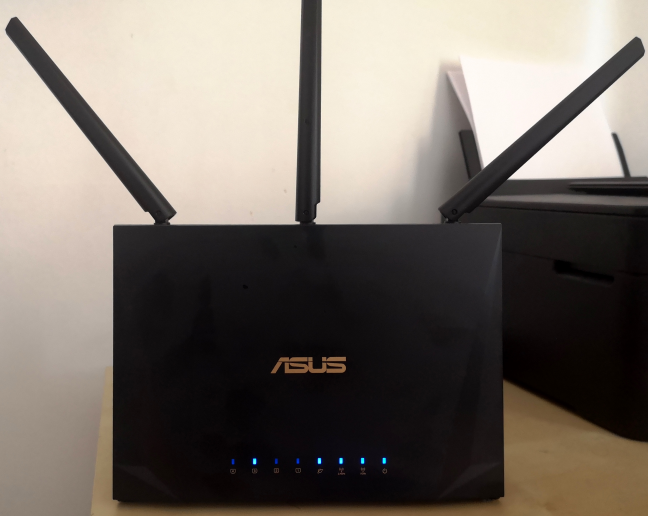
All the LEDs are on the front side of the router: one for Power, four LEDs for the Ethernet ports, one port for the internet connection, and two for the WiFi (one for each band). As you can see, the design is classic for ASUS. There is nothing flashy about the ASUS RT-AC85P - it looks and feels as you would expect, and it is similar in design to many popular models from the same company.
ASUS RT-AC85P AC2400 turned on
ASUS RT-AC85P is an average sized router, with 8.6 x 3.4 x 6.2 inches or 220 x 87 x 158 mm in width, depth, and height. The weight is standard too, at 18.8 ounces or 533 grams.
If you would like to learn more about the official specifications of this wireless router, go to this page: ASUS RT-AC85P Specifications .
Setting up and using the ASUS RT-AC85P wireless router
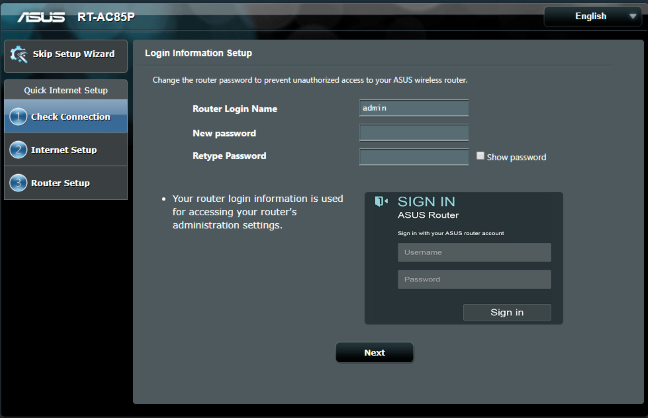
Setting up the router is easy: plug it to the powerline, connect it to the internet, and to a computer, using the Ethernet cable found in the packaging. Then, access its configuration wizard in a web browser. First, you are asked to set the username and password for administering the router. Next, you enter the details of your internet connection and configure the name(s) and password(s) for the wireless network. When done, you are shown a summary of your settings.
Setting up ASUS RT-AC85P AC2400
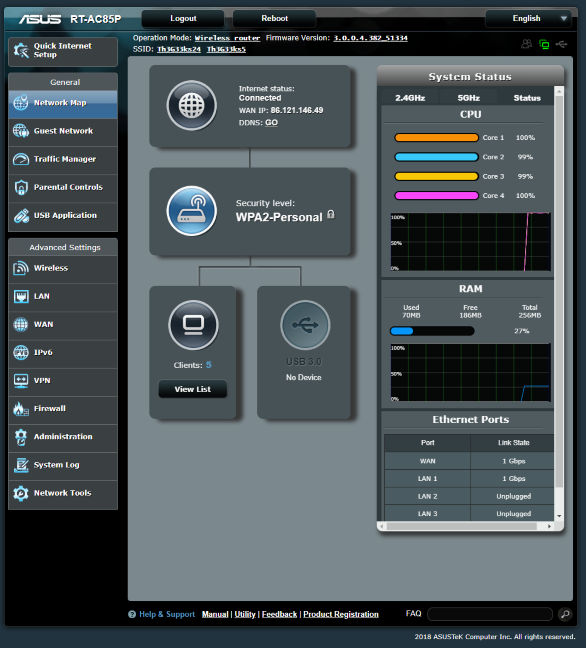
The user interface is the same as on other ASUS wireless routers. One aspect that we noticed is that the firmware reports four cores for the processor, instead of two, as you see in its specifications. It was a first for us to test a router that has a processor with two physical cores and four logical cores. You do not encounter this often on the market for wireless routers.
The firmware on the ASUS RT-AC85P
The user interface is well organized and easy to use. All the settings are split into logical sections and finding your way is easy. You can configure everything that matters in detail, and advanced users are going to appreciate this.
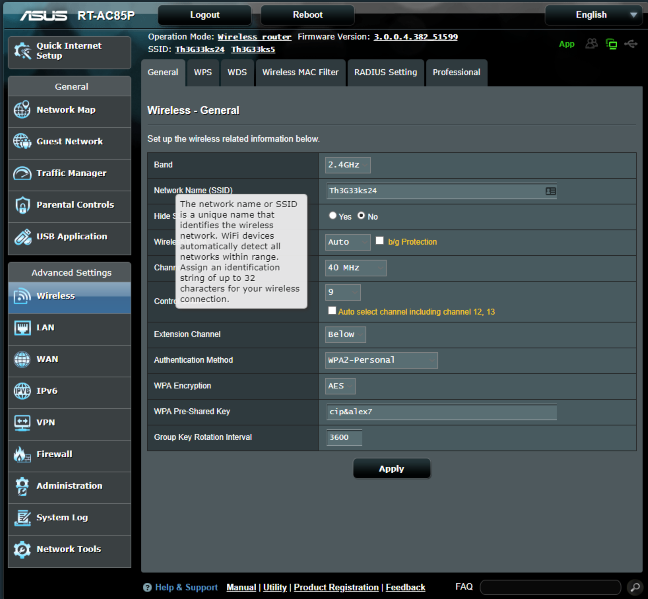
The user documentation is well done and easily accessible. One neat trick is to move the mouse cursor over a setting that you do not understand, and a question mark is shown. Click on it, and you see information explaining that setting.
The Help tips when configuring ASUS RT-AC85P
Another positive is the multilingual support: the firmware for ASUS RT-AC85P is available in twenty-five languages, and switching between them is easy. Most router manufacturers do not offer their firmware in so many languages.
The firmware for ASUS RT-AC85P is available in 25 languages
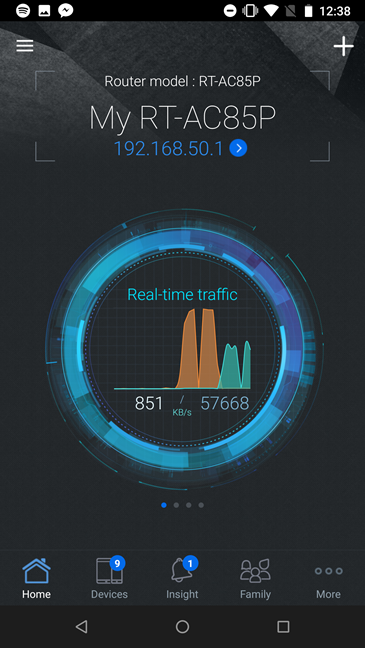
When you want to control the network from your smartphone or tablet, including when you are not at home, you can use the ASUS router app. It offers many advanced customization options, including the ability to check on your children's devices, and set up rules for parental controls. The remote network diagnostics can be useful too when your family has problems with their WiFi, and you are not home to help.
The ASUS router mobile app for ASUS RT-AC85P
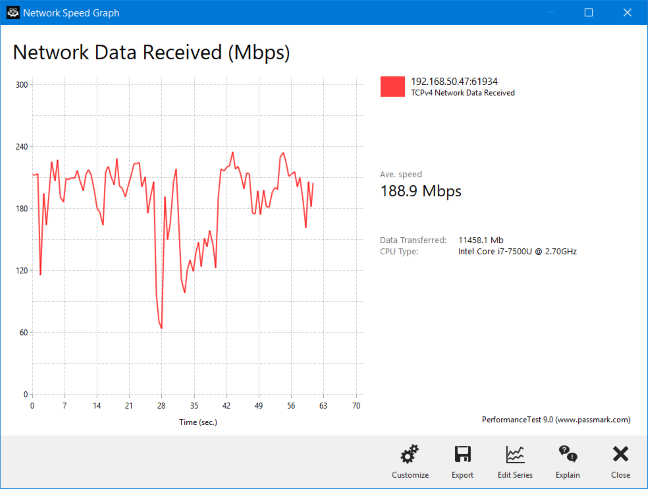
We connected about twenty devices to the network managed by ASUS RT-AC85P, including two desktop PCs, laptops, tablets, several smartphones, one wireless printer, two smart plugs, one smart bulb, and an Xbox One console. Then, we started sharing data and making transfers between devices. We noticed that when network clients had a direct line of sight to the router or were separated by just one wall, we had excellent download speeds both on the 2.4 GHz band and the 5 GHz band. However, when two walls separated the network clients from the wireless router, the variability increased significantly when compared to other routers, and the average speeds we measured were not that great. To help you better understand, let's take a look at a network transfer on the 2.4 GHz band, in the same room with the router: as you can see the average speed is quite good, and there is some degree of variability.
ASUS RT-AC85P - A wireless transfer on the 2.4 GHz band
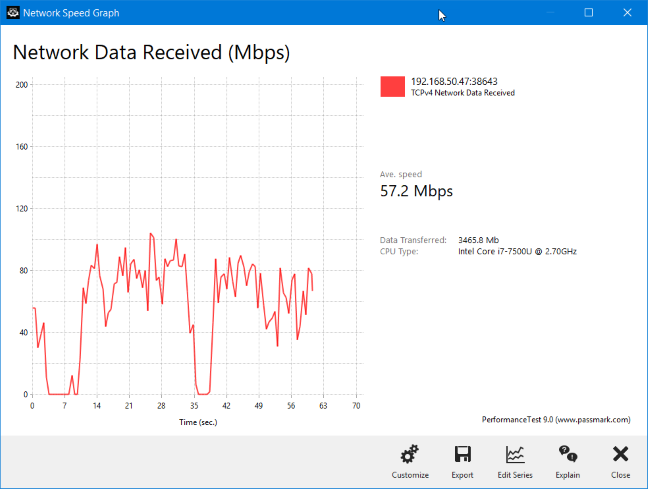
After moving to a room separated from the router by two walls, and repeating the same test, the average speed lowered significantly, and the transfer had moments when the speed was 0.
ASUS RT-AC85P - A wireless transfer on the 2.4 GHz band
On the 5 GHz band, we noticed a similar tendency, but the overall performance was higher, and the variability less dramatic. This problem should be fixed in a future firmware update.
Another aspect we observed is that the WiFi coverage offered by ASUS RT-AC85P is not very large. The router performs well in medium-sized apartments or one-floor houses without many walls and rooms. However, if you want good WiFi for two-floor houses or large apartments, other wireless routers offer better coverage.
If you want to know more about the real-world performance offered by this wireless router, go to the next page of this review.
Wireless network performance
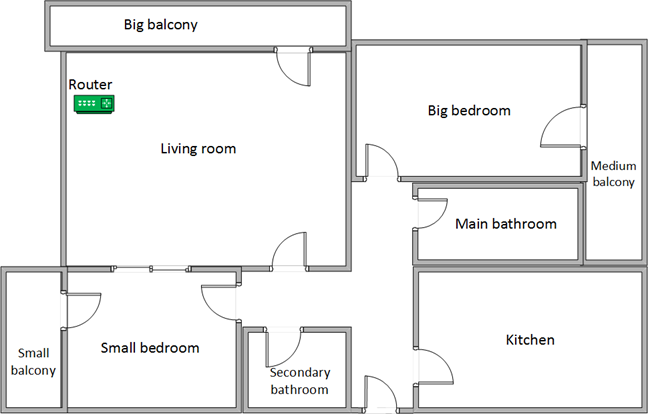
Let's look at the apartment that was used in our testing and how it is set up. You can see that the router is placed in the Living room. With most wireless routers, the signal strength is not that high in places like the Kitchen and the Medium balcony.
The apartment in which we tested ASUS RT-AC85P
Our testing was done using a fast 1 Gigabit Internet connection that is capable of uploads on the internet of up to 500 Mbps. We used an HP Spectre 13 laptop and a Lenovo Yoga Book for our measurements and several software tools. To get a better idea of the performance offered by ASUS RT-AC85P, we compared with two similarly priced wireless routers: Bitdefender Box 2 and TP-Link Archer C3150.
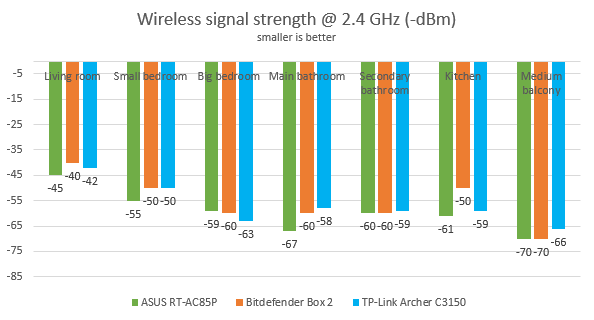
We analyzed the 2.4 GHz band first and measured the signal strength with NetSpot. The signal strength delivered by ASUS RT-AC85P was generally weaker than of the routers we compared it to, in almost every room. That does not automatically translate into slower speeds, but it does signal the fact that this router does not have a large WiFi coverage area.
ASUS RT-AC85P - The WiFi signal strength on the 2.4 GHz band
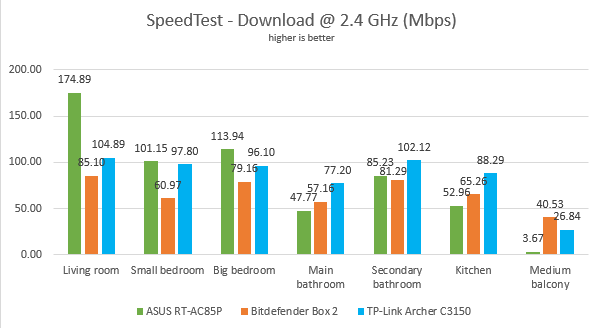
We used SpeedTest to measure how fast the internet connection offered by this router is when using 2.4 GHz wireless network. In the rooms closest to the wireless router, with maximum one wall separating them from the router, ASUS RT-AC85P delivered the fastest downloads in this comparison. In the room furthest from the router, we barely managed to run this test.
ASUS RT-AC85P - The download speed in SpeedTest using the 2.4 GHz band
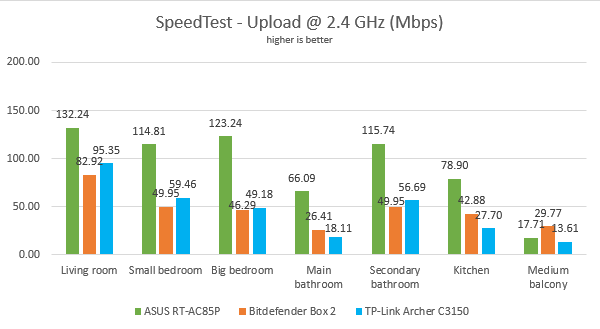
When we measured the upload speed, ASUS RT-AC85P delivered good performance in all rooms, beating its competitors almost every time.
ASUS RT-AC85P - The upload speed in SpeedTest using the 2.4 GHz band
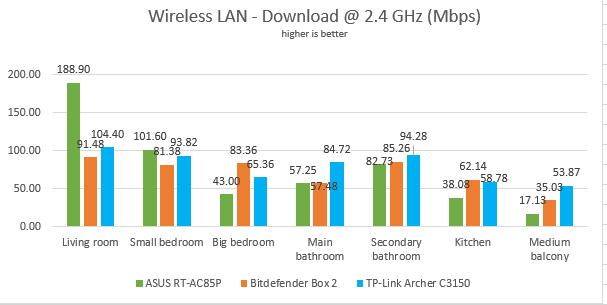
We used the PassMark Performance test to transfer data between two computers while using the 2.4 GHz wireless network. In the room where the router is placed, ASUS RT-AC85P was the fastest router in our comparison, while in others, the competition outmatched it. Again, in the room furthest from the router, we had troubles finishing this test.
ASUS RT-AC85P - The download speed on WiFi using the 2.4 GHz band
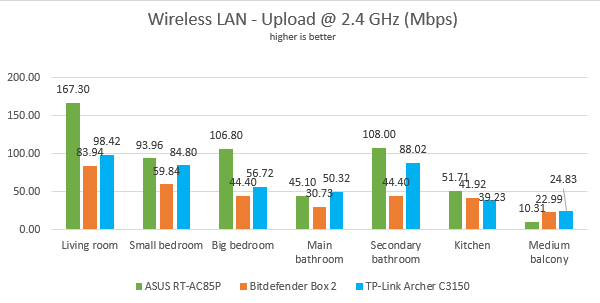
The upload speed is a clear strength of ASUS RT-AC85P. This router outmatched its competition in almost every room.
ASUS RT-AC85P - The upload speed on WiFi using the 2.4 GHz band
Our testing has shown that ASUS RT-AC85P is very fast on the 2.4 GHz wireless band, in the rooms that are close to the router, and separated only by one wall. While you move further away from the router, its competitors tend to perform better.
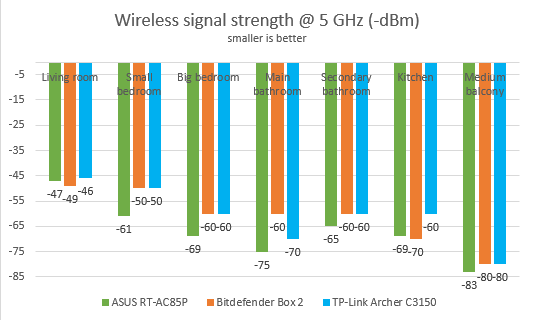
For the next set of measurements, we analyzed the performance of the 5GHz wireless band. We looked at the evolution of the signal strength, and we noticed that ASUS RT-AC85P wasn't great at this metric.
ASUS RT-AC85P - The WiFi signal strength on the 5 GHz band
Then, we ran SpeedTest to see how fast the internet connection is when using the 5GHz wireless band. To view the maximum potential of this router, we used the ASUS PCE-AC88 network card with support for 4x4 MU-MIMO. We obtained a maximum speed of 641.38 Mbps for the download and 489.37 Mbps for the upload. Great speeds for this price point.
ASUS RT-AC85P - The maximum download speed in SpeedTest
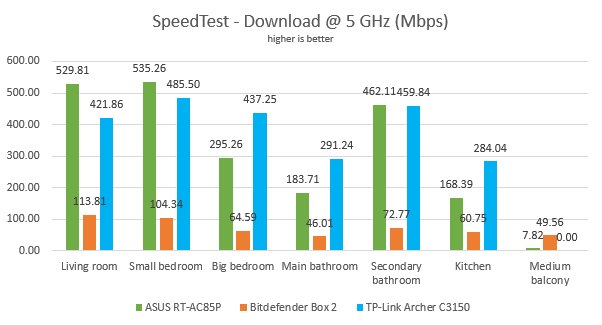
To get back to earth, and everyday devices people use, we took our laptops and measured the download speed with SpeedTest, in every room of our test apartment. ASUS RT-AC85P had spectacular performance in the rooms that were separated by maximum one wall from the router. Again, in the room furthest from the router, we could barely finalize this test.
ASUS RT-AC85P - The download speed in SpeedTest using the 5 GHz band
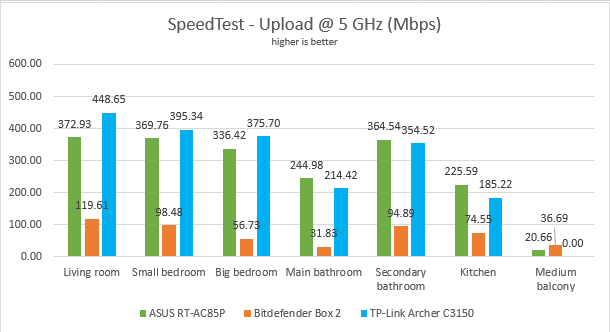
The upload speed was fast too, but TP-Link Archer C3150 was slightly faster.
ASUS RT-AC85P - The upload speed in SpeedTest using the 5 GHz band
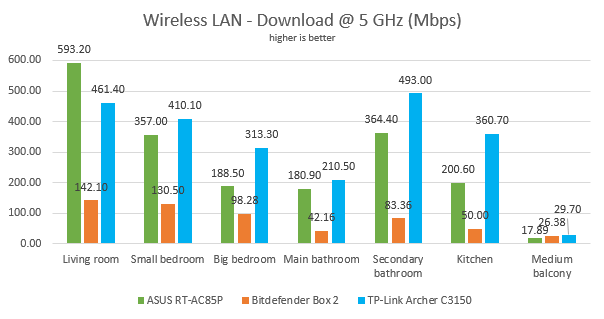
For the last measurements on the 5GHz WiFi band, we used the PassMark Performance test to transfer data between two computers connected to the network. ASUS RT-AC85P was the fastest router in the room where it was placed, but it was outmatched in other rooms.
ASUS RT-AC85P - The download speed on WiFi using the 5 GHz band
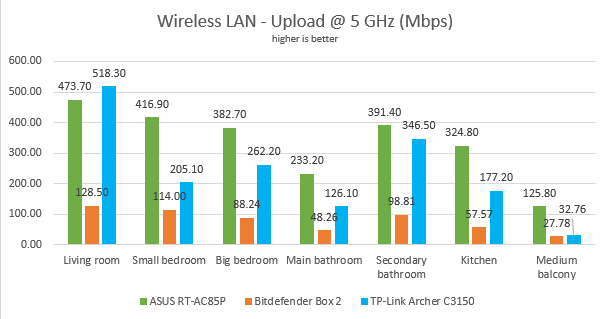
The upload performance offered by ASUS RT-AC85P was high in all rooms.
ASUS RT-AC85P - The upload speed on WiFi using the 5 GHz band
When network clients have a direct line of sight to ASUS RT-AC85P, this router delivers excellent speed on the 5 GHz band. However, when more walls get in the way, some competitors may outperform it.
Wired network performance
To test the quality of the wired Ethernet connection, we used a desktop PC equipped with a fast Samsung 850 Pro 512GB SSD, and a mini PC equipped with an Intel SSD drive.
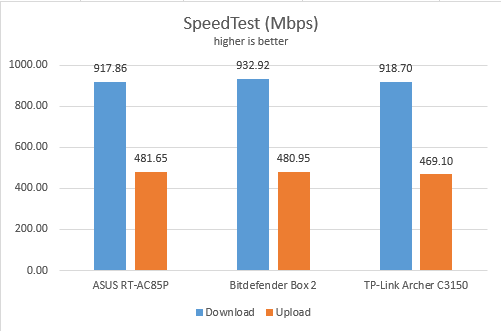
We measured the speed of the internet connection when using a 1 Gbps Ethernet cable, using SpeedTest. ASUS RT-AC85P delivered speeds that were close to the maximum potential of our internet connection. Do not forget that our upload speed is capped at 500 Mbps.
ASUS RT-AC85P - SpeedTest on Ethernet connections
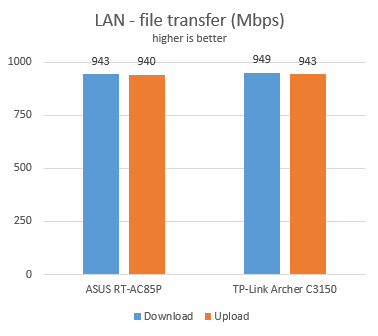
Then, we ran a network transfer between the two computers, using the PassMark Performance test. ASUS RT-AC85P delivered transfer speeds above 900 Mbps, just like other routers. Bitdefender Box 2 doesn't show up in this comparison because it doesn't have enough Ethernet ports to run this test.
ASUS RT-AC85P - Ethernet transfers
The Ethernet ports on the ASUS RT-AC85P wireless router work at speeds close 1 Gbps, both for the download and the upload.
USB performance
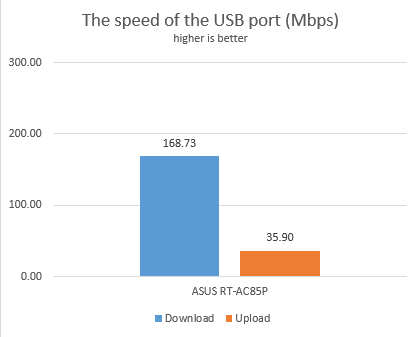
We connected a portable SSD drive to the USB port of the ASUS RT-AC85P. Then we ran a few transfers from a desktop computer to this drive and back. Unfortunately, even when the port was set to function using the USB 3.0 standard, the speeds we measured were underwhelming. It gets the job done to transfer data to your storage devices, but not more than that.
The speed offered by the USB port on the ASUS RT-AC85P is similar to that of lower-end wireless routers.
Extra features
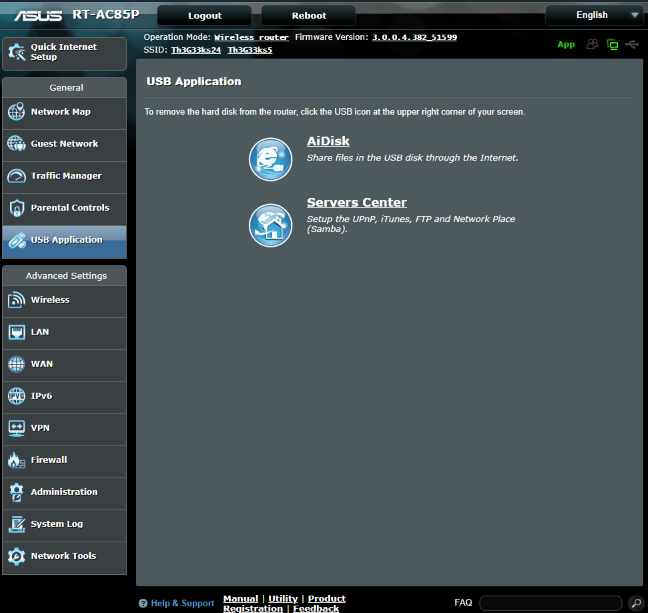
ASUS RT-AC85P bundles fewer features than other mid-range wireless routers from ASUS. The big missing feature is the AiProtection module that offers antivirus and advanced parental controls. On this wireless router, you get the following:
ASUS RT-AC85P - USB applications
USB Applications - apps that are designed to work external hard disks that are connected through the available USB port.
Guest Network - you can enable up to three wireless networks for each band, with individual security and access settings.
Traffic Manager - a basic QoS (Quality of Service) tool, coupled with a Traffic Monitor, that you can use to analyze and prioritize network traffic based on the rules that you set manually.
Parental Controls - use it to set time limits for the devices used by your children. It is not an intelligent cloud-based protection module like that found on other ASUS wireless routers.
DDNS - a service that allows you to connect to the router from the internet, even if your internet provider gives you a dynamic public IP address.
IPv6 - support for IPv6 addresses that are going to replace IPv4.
VPN - you can set the router to work as a VPN server, and you can also use it to turn your network-connected devices into VPN-enabled clients, without additional VPN software required.
Network Tools - for analyzing the network and identifying what's wrong. They are useful when you need to troubleshoot problems.
The tools bundled with ASUS RT-AC85P are similar to those found on lower-end ASUS wireless routers, not on mid-range and high-end routers from the same brand.
What is your opinion of the ASUS RT-AC85P?
Now you know our opinion about the ASUS RT-AC85P AC2400 wireless router, what we liked and did not like about it. Before closing this review, share with us what you think about this model. Is it a wireless router that you like? Do you consider purchasing it? If you already have it, what has been your experience with it? Comment below and let's discuss.



































Discussion (0)
Comments are closed.