



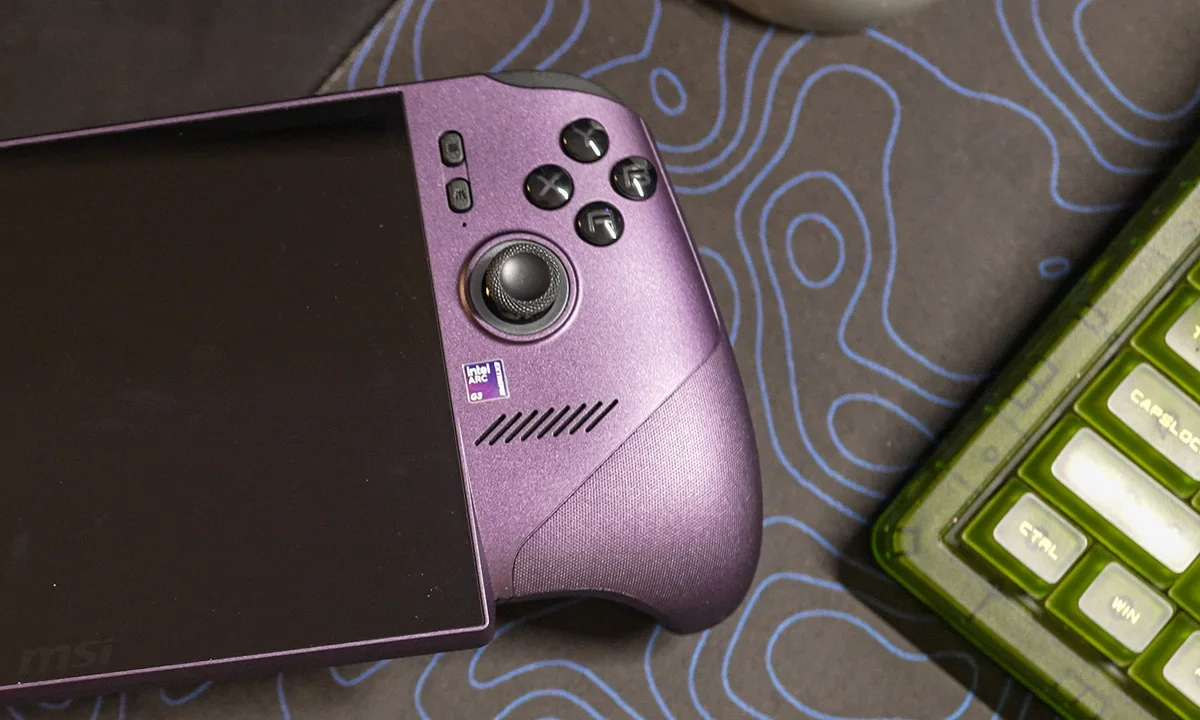
Intel is reportedly developing a new Panther Lake processor aimed at more affordable gaming handhelds, potentially expanding its strategy beyond the higher end Arc G3 and Arc G3 Extreme chips already appearing in premium devices.
The unannounced processor is said to use a 4+0+4+4 configuration. That would combine four Performance cores, no standard Efficient cores, four low power Efficient cores and four Xe3 graphics cores.
The information has not been officially confirmed by Intel, so the specifications should still be treated as preliminary.
Reported Panther Lake handheld configuration
| Component | Reported configuration |
|---|---|
| Performance cores | 4 |
| Efficient cores | 0 |
| Low power Efficient cores | 4 |
| Total CPU cores | 8 |
| Xe3 GPU cores | 4 |
| Target segment | Entry level gaming handhelds |
| Status | Reported, not officially announced |
The configuration would be significantly smaller than Intel’s existing Arc G3 handheld focused processors.
Current Arc G3 and Arc G3 Extreme chips combine 14 CPU cores with 10 or 12 Xe3 graphics cores. Their integrated graphics are known as Arc B370 and Arc B390 respectively, and they are intended to deliver much stronger gaming performance without a discrete GPU.
Those processors have already appeared in new handheld systems, but devices using them can easily move beyond the $1,000 mark.
Intel may be targeting cheaper handhelds
The reported eight core Panther Lake chip suggests Intel could be preparing a separate option for lower priced systems instead of relying entirely on its more powerful Arc G3 products.
Its 4+0+4 CPU layout is similar to configurations used in some Panther Lake laptop processors, including members of the Core Ultra 5 and Core Ultra 7 families.
The biggest reduction would be on the graphics side, where four Xe3 cores would provide much less GPU hardware than the 10 or 12 cores available in Arc G3 models.
That would likely position the chip below premium handhelds designed to compete with AMD based systems using Strix Point or Strix Halo processors.
Lower chip costs could help bring prices down
Handheld PC prices have been under pressure from several directions.
Memory and storage costs remain major contributors, especially as RAM and SSD prices continue to increase. A less complex processor could still give manufacturers another way to reduce overall system cost.
If Intel moves ahead with this reported design, it could make sub $1,000 handhelds easier to produce, with the possibility of some devices reaching below $800 depending on memory, storage and display choices.

That would give Intel a broader presence in the handheld market rather than concentrating mainly on premium hardware.
Performance remains unknown
There are currently no confirmed clock speeds, power targets, memory specifications or gaming benchmarks for the reported chip.
Those details will be important because reducing the integrated GPU from 10 or 12 Xe3 cores to four could create a significant performance gap.
The tradeoff may still make sense for cheaper handhelds designed around lower resolutions, reduced graphics settings or less demanding games.
For now, the processor remains a reported Panther Lake variant rather than an announced product. If Intel confirms it, the chip could become an important part of a two tier handheld strategy, with Arc G3 serving premium systems and the smaller four Xe3 design targeting buyers with tighter budgets.



Discussion (0)
Be the first to comment.