



ASUS has three mesh WiFi systems on the consumer market. The cheapest of them is ASUS Lyra Mini. It is an AC1300 mesh system, with support for 2x2 MU-MIMO transfers, mobile remote management, built-in security that does not expire, and an administration user interface that can also be accessed from a PC, not only from a smartphone or tablet. If you want to know whether it is a suitable choice for your needs, read our review of ASUS Lyra Mini:
ASUS Lyra Mini: Who is it good for?
This whole-home mesh WiFi system is a suitable choice for:
- Users who appreciate discreet, good looking devices
- Secure smart homes with built-in anti-malware protection and intrusion prevention systems
- Large apartments with many devices that need access to WiFi
Pros and cons
ASUS Lyra Mini has the following positives:
- It is easy to use and set up through the ASUS Lyra mobile app
- Excellent performance on the 2.4 GHz wireless band
- Remote control from anywhere on the internet
- It can be managed from a web browser too (not many mesh systems offer this feature)
- Excellent antivirus protection and parental controls that do not expire
There are also some downsides to consider:
- Performance on the 5 GHz wireless band needs to be improved
- Its price at launch is on the expensive side
Verdict
ASUS Lyra Mini is a good-looking whole-home mesh WiFi system. The set up is easy, it bundles excellent antivirus protection and parental controls, and it can be remotely controlled from anywhere on the internet. Its performance is top-notch on the 2.4 GHz band, while on the 5 GHz band it is underwhelming. Its price is higher than that of its direct competitors, and this diminishes its appeal. However, if you use many network devices that connect only with 2.4 GHz wireless networks, ASUS Lyra Mini might be the best mesh WiFi system for you.
Unboxing the ASUS Lyra Mini AC1300 mesh WiFi system
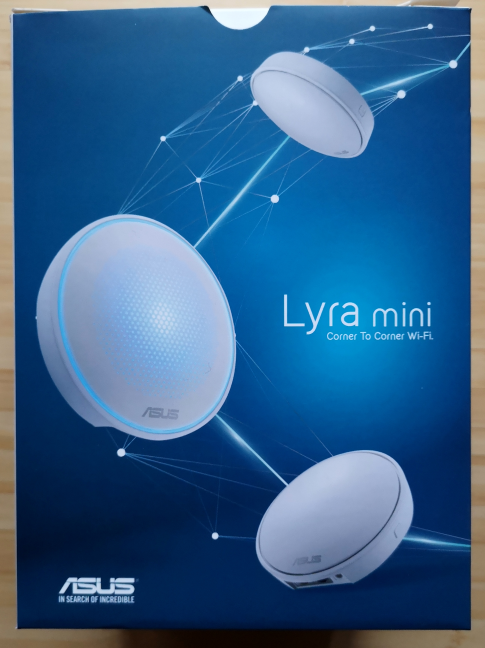
ASUS Lyra Mini comes in a vertical blue box, with a picture of the device on the front. On the sides, you have information about this product, its mobile app, security features, and hardware specs.
Inside the package, there are three ASUS Lyra Mini hubs, their power adapters and charging cables, an Ethernet cable, the warranty, and the quick start guide. Unfortunately, the packaging of the ASUS Lyra Mini that we tested was used by other reviewers before us, and the Ethernet cable was missing.
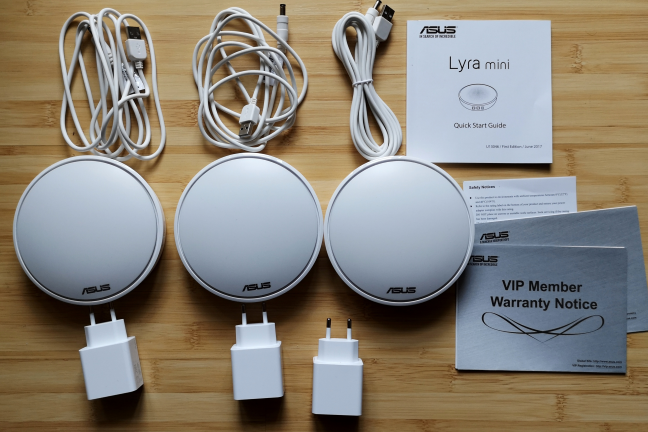
The packaging of the ASUS Lyra Mini looks good, and it includes all the accessories you need to be up and running in no time.
Hardware specifications and design
Each ASUS Lyra Mini station has a quad-core Qualcomm IPQ4018 processor running at 717 MHz, 256 MB of RAM and 32 MB of storage space for the firmware. It offers support for the latest wireless networking standards, including 802.11ac Wave 2, and 2x2 MU-MIMO transfers. Each ASUS Lyra Mini has three internal antennas, and the total theoretical maximum bandwidth is split as follows: 400 Mbps for the 2.4 GHz wireless band, and 867 Mbps for the 5 GHz band.
The ASUS Lyra Mini hubs look similar to the more expensive ASUS Lyra. They are a bit smaller and lighter, at 5.1 x 5.1 x 1.47 inches or 130mm x 130mm x 37.5mm in length x width x height, without the bezel. They weigh 15.87 ounces or 450 grams each.
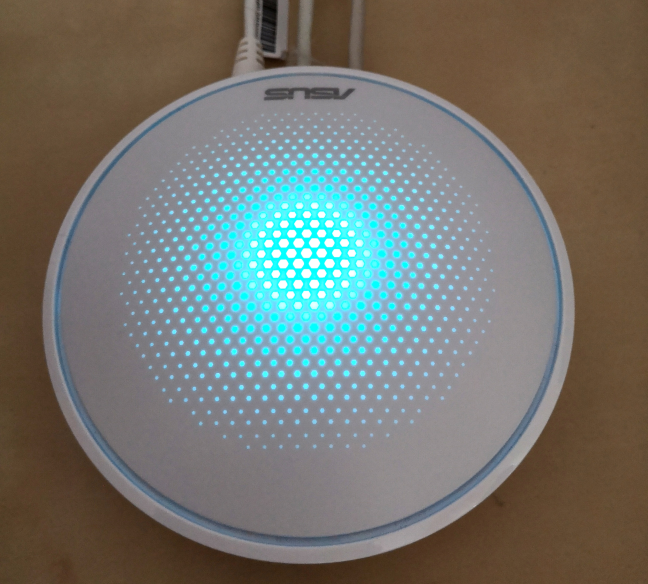
When you plug each ASUS Lyra Mini into a power source, it starts to boot. It has small LEDs that color differently, depending on what is going on:
- Light cyan - means that everything works well
- Red - signals that the station has lost the connection to the central hub
- Yellow - signals that the internet connection is not working
- Solid white - means that the hub is ready to be configured
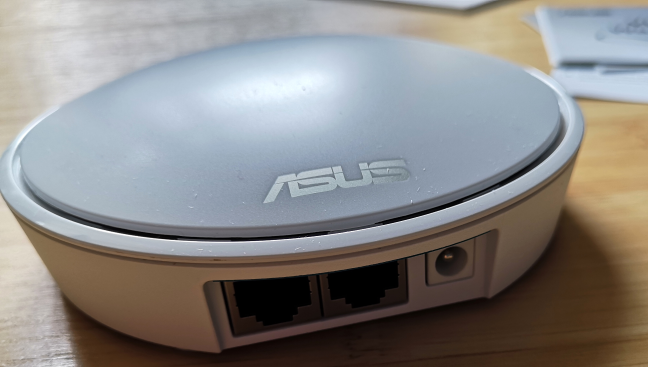
On each ASUS Lyra Mini there are two Ethernet ports on the back, working at 1 Gbps, and the power jack. On the main Lyra Mini, one Ethernet port must be used to connect it to the router or the modem that your Internet Service Provider has offered.
On the bottom of each station, you can find the Reset button, four rubber feet, so that you can place it on flat surfaces without slipping, and mounting screw slots that can be used for wall-mounting. There are also details about the WiFi name of the station.
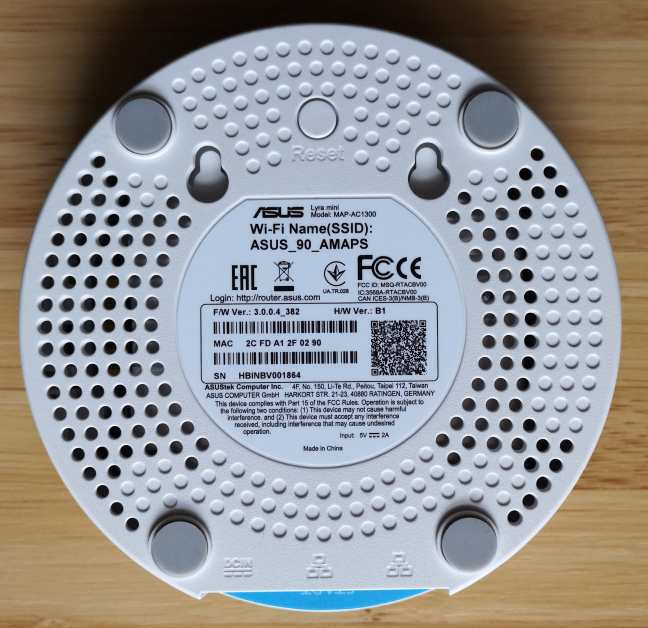
If you would like to read all the official specifications of this product, go to this page: ASUS Lyra Mini Specifications.
Setting up and using the ASUS Lyra Mini
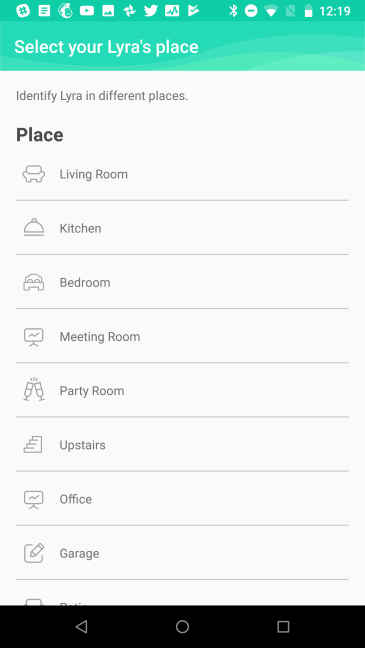
Setting up the ASUS Lyra Mini is done using the ASUS Lyra app for Android or iOS, or from a PC, using a web browser. Both methods worked well. However, we enjoyed the quick setup process more when using the mobile app. It offers a faster setup, with more personalization. If you follow its instructions, you should not have issues with setting up the ASUS Lyra Mini mesh system. However, do put aside 10 to 15 minutes for the whole process to be finished successfully. The quick setup involves the following: providing details for your internet connection, choosing the network name and password, choosing the place of each Lyra Mini, and adding all the Lyra Mini stations to the network.
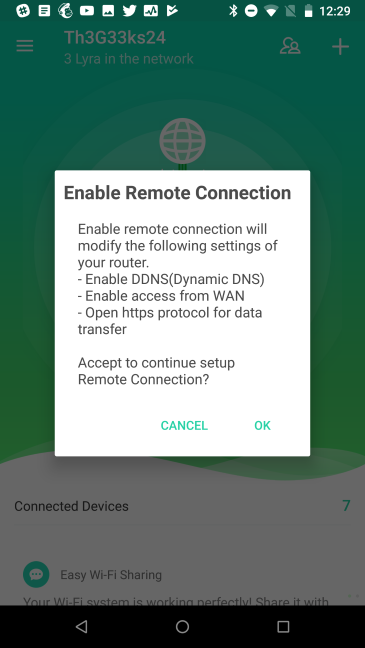
Once you are done with the initial setup, the mobile app recommends enabling the remote connection from anywhere on the internet. This is a welcome feature that many users appreciate.
The app also checks for firmware updates and informs you when there is a new version available. You should update your ASUS Lyra Mini to the latest firmware because this fixes performance and security issues, which plagued the initial version. An issue that we observed is that the firmware update may fail the first time you try it, and install itself only on two out of the three hubs. If you encounter this issue, we recommend reading this troubleshooting guide.
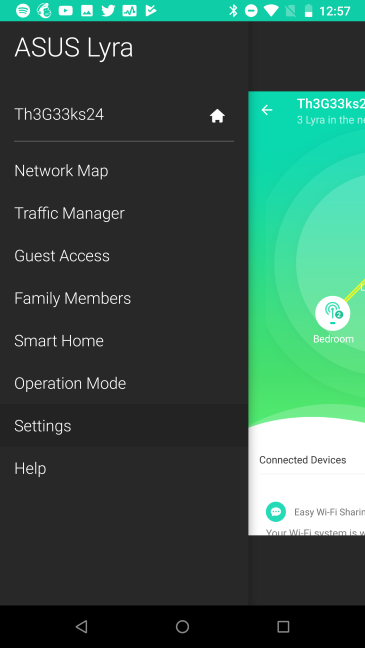
The ASUS Lyra mobile app is easy to use and with few configuration options. On the main screen, you see a map of your home network, your network's approximate real-time traffic, and security insights. Tap the burger icon, and you see the menu and all the major categories of settings. You can configure things like the traffic manager (or QoS), the guest access to your home network, manage family members and their devices, smart home features, the operation mode, and the settings of the ASUS Lyra Mini. Non-technical users will not have problems configuring the basics of their network, using the ASUS Lyra mobile app. Also, you can access the Help documentation, which is available only in English, from the same menu.
Geeks and IT professionals will enjoy that they can access the firmware of the ASUS Lyra Mini from a web browser. The firmware is available in 19 languages, unlike the mobile app which seems to be available only in English.

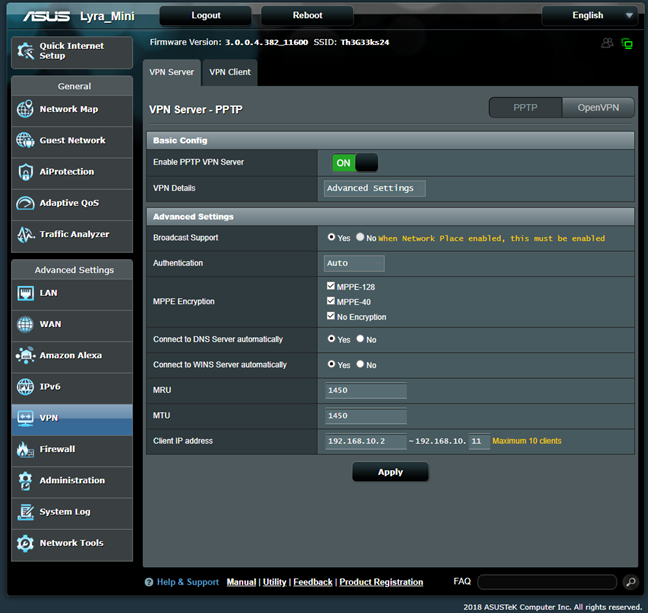
The web-based user interface offers complete control over all the features that ASUS Lyra Mini has to offer. For example, you can set in detail how the AiProtection module works, while in the mobile app, you can only turn it on and off. Here you can also configure features like the VPN server, which is not available in the mobile app.
When you are done configuring everything, start connecting your network devices. When using a mesh WiFi system, network devices see only one network name being broadcast. Modern smartphones and laptops that support the 802.11ac standard connect to the network using the 5GHz frequency. Cheaper or older devices that support the 802.11n standard connect to the network on the slower 2.4 GHz frequency.
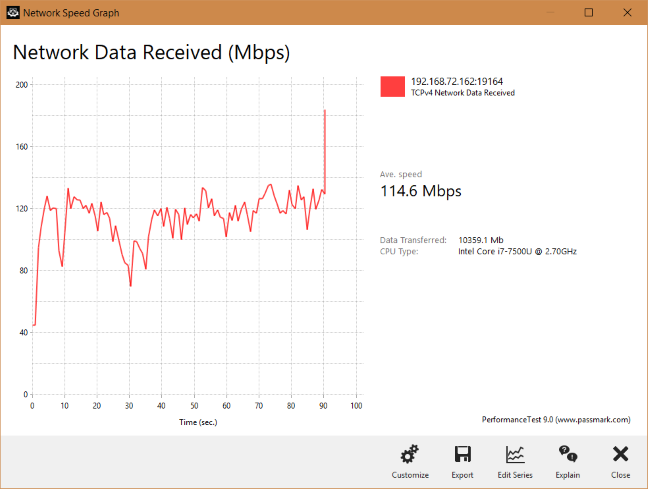
The ASUS Lyra Mini worked well, and we connected various devices to the network: desktop PCs, laptops, tablets, smartphones, an Xbox One console, a few smart plugs, a smart bulb, and a wireless printer. We had no issues in sharing content over the network, and the WiFi network coverage was good and stable. When we measured the stability of our wireless network transfers, we had good results. In the graph below, you can see the evolution of a network transfer on the 5 GHz wireless band. There were no sudden drops, and the variability was within reasonable limits. However, the best performance was enjoyed on the 2.4 GHz wireless band, not the 5 GHz band. More on that later in this review.
We enjoyed the setup process, and the user experience offered by ASUS Lyra Mini. Its performance was excellent on the 2.4 GHz wireless band. Some users will appreciate that they can connect the Lyra Minis through Ethernet cables, for maximum speed and coverage.
If you want to know more about the real-world performance offered by ASUS Lyra Mini, go to the next page of this review.
Wireless network performance
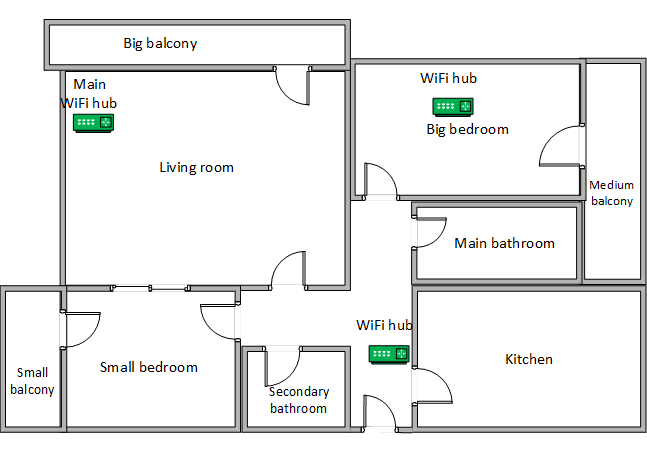
First, let's take a look at the apartment that was used in our testing and how it is set up. You can see that the main ASUS Lyra Mini hub is placed in the living room. When using wireless routers, the signal strength is not that high in rooms like the Kitchen and the Medium balcony. To improve the coverage of the network, we placed the second hub in the Big Bedroom. As a result, the Medium balcony should benefit from more stable WiFi. Then, the third hub was placed near the entrance to the Kitchen, to improve the coverage there too.
Our testing was done using a fast 1 Gigabit Internet connection that is capable of uploads on the internet of up to 500 Mbps. We used an HP Spectre 13 laptop for our measurements.
We decided to compare the ASUS Lyra Mini with TP-Link Deco M5 (a competing whole-home mesh WiFi system), and ASUS RT-AC1200G+ (an excellent AC1200 wireless router from the same company).
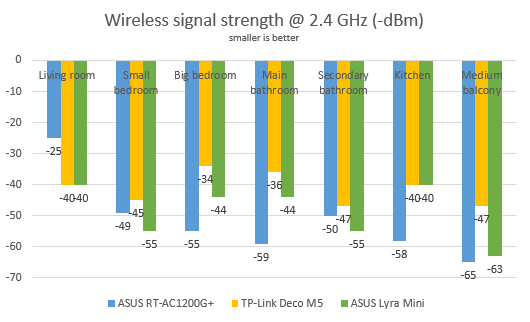
We started by evaluating the 2.4 GHz wireless network and measured the signal strength offered in each room, using a tool named NetSpot Pro. As you can see, in this regard ASUS Lyra Mini was an average performer. We expected fewer variations in signal strength, between rooms.
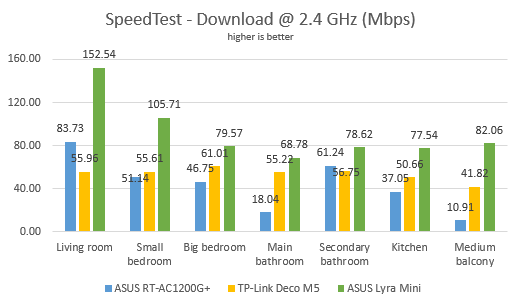
Then, we used SpeedTest to see how fast the internet connection is when using the 2.4 GHz wireless frequency. ASUS Lyra Mini performed great in all rooms, and incredibly well in the room where the main station was placed.
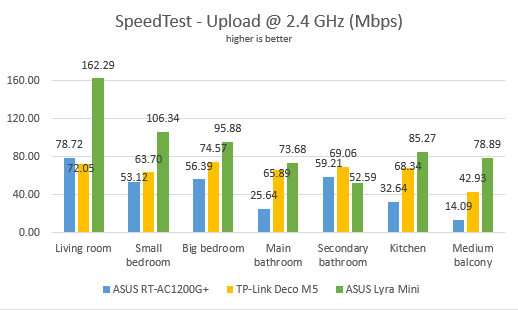
When measuring the upload speed with SpeedTest, we noticed a similar story.
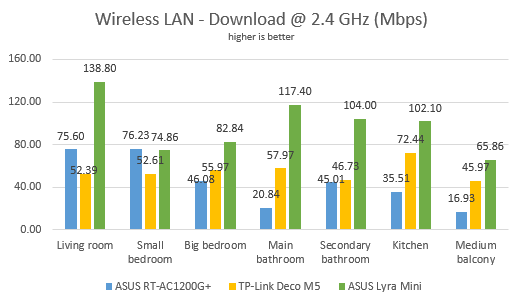
Next, we used the PassMark Performance test to transfer data between two computers connected to the network, using the 2.4 GHz wireless frequency. This time too, ASUS Lyra Mini was a great performer, delivering fast downloads everywhere.
When looking at the upload speed, the performance was again, top notch.
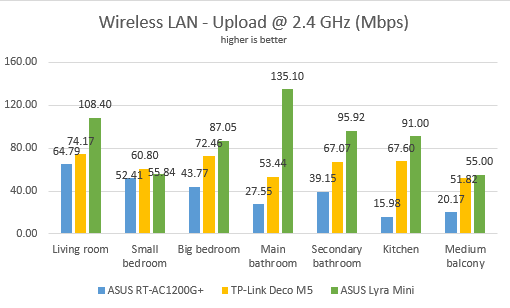
When using the 2.4 GHz wireless frequency, ASUS Lyra Mini is a great performer.
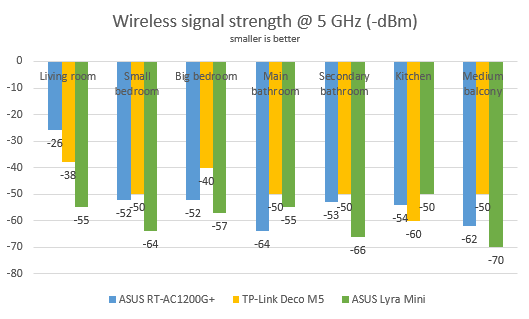
Next, we analyzed the performance offered by the 5GHz wireless network. First, we looked at the evolution of the signal strength, from room to room. The signal strength delivered by ASUS Lyra Mini was disappointing, worse than that of a standalone wireless router from the same company.
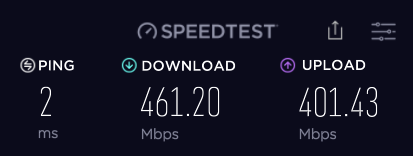
Next, we ran SpeedTest to see how fast the internet connection is on the 5GHz band. To see the maximum potential of ASUS Lyra Mini, we used the world's only PCI-E network card with support for 4x4 MU-MIMO. When we used this network card, we obtained a maximum speed of 461.20 Mbps for the download, and of 401.43 Mbps for the upload. It is good, but it is not the fastest we have seen on a mesh system. Others can deliver more than 500 Mbps for the download speed.
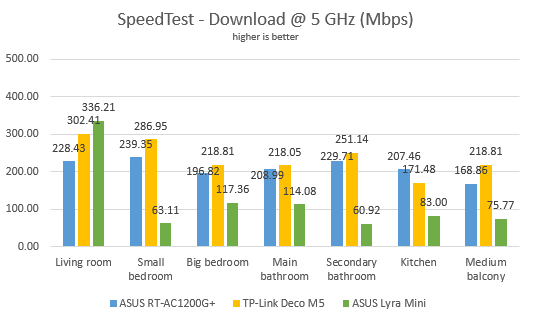
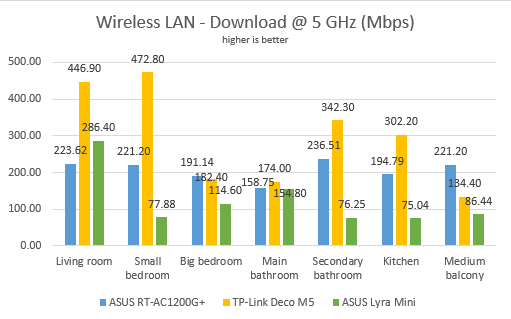
We also measured the download speed with SpeedTest, in every room of our test apartment, using our test laptop. When looking at the download speed, ASUS Lyra Mini performed great only in the room where we placed the main station. In the other rooms, it was disappointing.
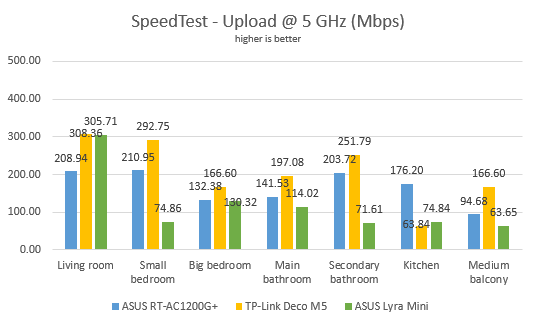
When measuring the upload speed, we noticed the same trend.
For the last measurements on the 5GHz wireless network, we used the PassMark Performance test to transfer data between two computers connected to the network. The download speed offered by ASUS Lyra Mini was good only in the room where we placed the main station.
The same was true when measuring the upload speed.
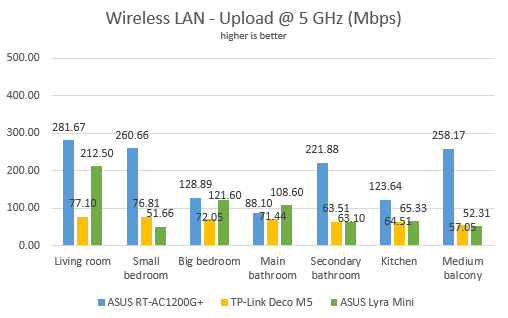
When using the 5 GHz wireless band, ASUS Lyra Mini is disappointing, both concerning signal strength, and speed.
Wired network performance
To test the quality of the wired Ethernet connection, we used a desktop PC equipped with an AMD Ryzen 5 1600 processor, running at 3.20GHz, 16GB of RAM, a fast Samsung 850 Pro 512GB SSD, and a Lenovo IdeaCentre 610s mini PC.
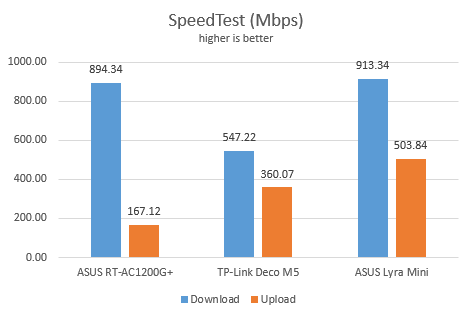
We measured the speed of the internet connection when using a 1 Gbps Ethernet cable, using SpeedTest. ASUS Lyra Mini performed well and was faster than TP-Link Deco M5. We made the measurements on the desktop PC, which was connected to the main hub.
Then, we ran a network transfer between the two computers, each connected with an Ethernet cable to a different ASUS Lyra Mini. Since the hubs were connected to each other wirelessly, the transfer was mediated through WiFi. We used PassMark Performance test for this measurements. As you can see, the transfer speeds we got were rather unimpressive.
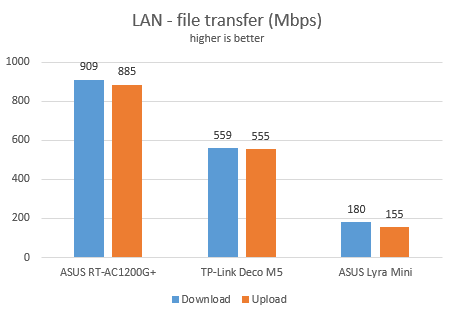
You can enjoy 1 Gbps connections just on one Ethernet port, on the central ASUS Lyra Mini station. On all the others you get less unless you connect all hubs using Ethernet cables.
Extra features
ASUS Lyra Mini offers many useful extra features:
- AiProtection - ASUS Lyra Mini can automatically block malicious websites when they are accessed from any device. You also get a Two-Way Intrusion Prevention System that prevents attacks coming from the internet. Unfortunately, there is no vulnerability protection available, like on premium router wireless from ASUS.
- Family Members - allows you to set a schedule for internet access as well as content filters for your children and the devices that they use. Parents will appreciate this feature. What we found strange though is that this feature can be set up only when using the mobile app. There is no mention of it in the web user interface that is available for administering the ASUS Lyra Mini.
- Guest network - you can enable a guest WiFi network for people visiting your home. From the mobile app, you can only set time limits for guests.
- Traffic Manager (Adapting QoS) - a user-friendly service that allows you to set prioritization rules for different kinds of traffic. For example, if you are a gamer, you can prioritize online gaming versus other types of traffic.
- VPN Server - this can be enabled only in the web-based administration user interface. You can set the ASUS Lyra Mini to work as a VPN server, using the PPTP and OpenVPN protocols.
- Network Tools - a set of troubleshooting tools that help you figure out how to solve networking problems. They can be accessed and used only from the web-based administration user interface.
- Amazon Alexa - if you use Alexa, you can control ASUS Lyra Mini through voice commands like: "Alexa, ask ASUS Router to turn on the Guest network."
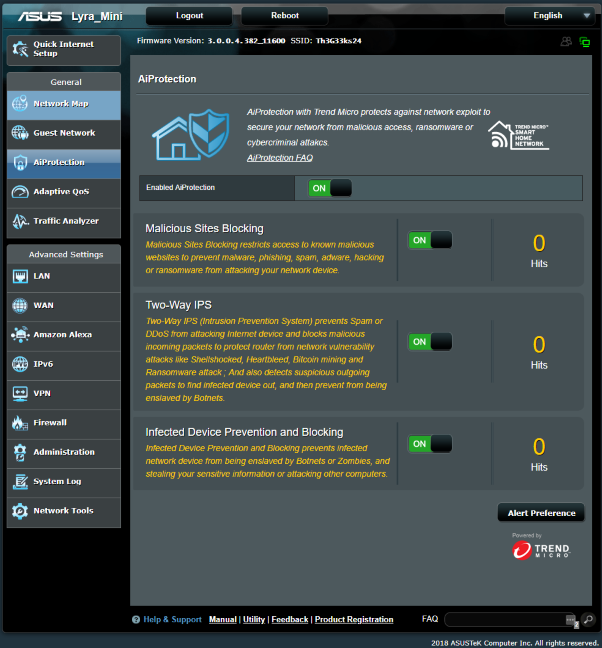
ASUS Lyra Mini offers everything you need for a safe and secure smart home experience. It is also integrated with Amazon Alexa so that you can control it using voice commands.
What is your opinion of the ASUS Lyra Mini?
Now you know our opinion about the ASUS Lyra Mini whole home mesh WiFi system, and how it performed in our testing. If you already purchased it, share with us your experience with this mesh WiFi system. Do you find it easy to use? How about its performance? Comment below and let's discuss.
Discussion (0)
Be the first to comment.