




A photo from an old phone rarely holds up today. Most cameras then had sensors under 8MP and struggled in low light.
As a result, many old photos look grainier than people remember, even ones that seemed fine initially. For years, that was the ceiling. A soft or compressed file just stayed that way.
Not anymore. AI restoration, often using super-resolution upscaling and face-specific reconstruction, can now rebuild detail in a photo or video, sometimes in under a minute.
What's more interesting is that people are starting to treat old files as recoverable instead of lost for good. This shift is changing how digital memories are preserved. Let's explore how AI is transforming digital memory preservation.
Different Ways AI Helps Restore Old Memories.
Now that we understand how AI works, let us look at some ways it can enhance digital memories.
Restoring Old Family Photos.
Many family photographs survive only as printed copies. Printed photos fade due to oxidation and aging of the photographic paper. When these images are digitised, the scanner also captures imperfections like grain and reduced contrast.
Modern restoration models analyse colour channels and edge information independently before applying corrections. Rather than increasing saturation across the entire image. The algorithms identify regions where colours have faded.

After that, it restores tonal balance and reconstructs fine textures that have become less visible. This selective approach helps preserve the character of the original photograph instead of producing an overly processed result.
Enhancing Blurry Memories.
Blur presents a different technical challenge because important image information becomes spread across neighbouring pixels. Traditional sharpening filters simply increase edge contrast, which often exaggerates digital noise. Eventually, it creates unnatural halos.
AI deblurring models work differently. They are trained to recognise how motion blur and focus blur affect different objects within an image.
Using deep neural networks, these systems estimate where object boundaries should appear. They reconstruct local textures and distinguish meaningful details from sensor noise. AI can significantly improve perceived sharpness while maintaining a more natural appearance.
Improving Pixelated Images.
Low-resolution images contain fewer pixels than modern displays can accurately reproduce. Instead of enlarging the image through interpolation alone, AI uses super-resolution models to generate visual information.
During this process, the AI tools typically:
- Analyze repeating textures.
- Predict additional pixels using patterns learned from HD training images.
- Refine edges to reduce jagged outlines.
- Produce an image that appears sharper on larger displays.
Because the additional detail is generated intelligently rather than copied, the results are generally more convincing. This is useful for older photos taken at family events where lighting conditions made capturing a sharp image difficult.
Enhancing Faces in Old Photos.
Facial features occupy a relatively small portion of an image, so even minor blur can obscure details such as the eyes or contours.
Many AI restoration systems therefore use facial restoration models alongside general image enhancement.
These models first detect facial landmarks and process them. After that, they analyse surrounding features to improve clarity while maintaining natural proportions. Depending on the condition of the image, AI can:
Detect key facial landmarks to guide the restoration process.
- Improve the definition of eyes and eyebrows.
- Restore skin texture while avoiding excessive sharpening.
- Preserve facial symmetry during enhancement.
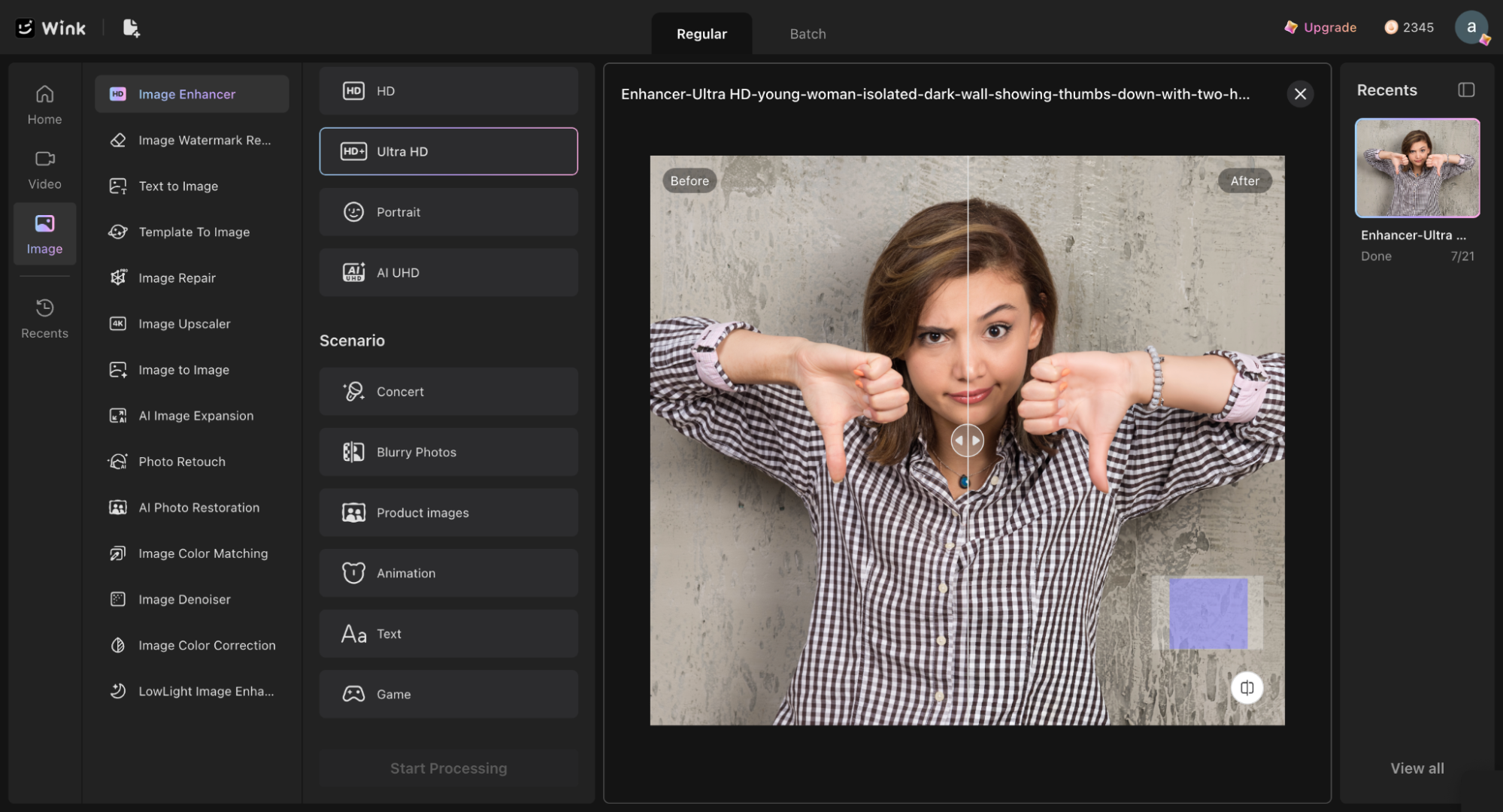
Today, these restoration techniques are available through consumer tools such as Wink, where an AI image enhancer makes advanced photo restoration accessible to everyday users.
AI Restoration Has Its Limits.
AI restoration can significantly improve old photos, but it does not recover lost information exactly. Computer vision models analyse existing pixels. After that, they use patterns learned from training data to reconstruct missing details.
Key limitations include:
- Generated details are predictions: AI fills unclear areas based on learned patterns, so restored details may not always represent the original image.
- Results depend on image quality: Photos with some remaining detail produce better results than heavily damaged, compressed, or low-resolution images.
- Different models produce different outcomes: Restoration quality varies based on the model architecture and techniques used for enhancement.
For this reason, AI-restored images should be treated as improved versions of original memories.
The Future of Digital Memory Preservation
AI restoration is still evolving. In the coming years, improvements in AI restoration will probably be centered on achieving greater accuracy of results, particularly in cases involving videos.
Researchers are also exploring multimodal AI. These systems combine image data with context like metadata to restore digital memories.
Consumer platforms such as Wink are making AI restoration more accessible by bringing advanced enhancement features to everyday users.
As these technologies improve, future tools may also provide greater transparency by distinguishing original details from AI-generated enhancements.
The future of digital preservation may not only restore old memories. It may also create new ways for people to experience and interact with them.


Discussion (0)
Be the first to comment.