The Chinese mobile devices manufacturer Xiaomi has released their latest flagship Android smartphone: Xiaomi Mi 5. It features impressive hardware specifications and great design that leaves you with a very good first impression. Although it doesn't brag about introducing any " first of their kind" features like being the first water resistant smartphone or the first modular smartphone, or even the first "warp speed" smartphone, the Xiaomi Mi 5 has lots of details that might make you consider buying it sooner rather than later. We had it for testing for about a week and now it's time for us to share our impressions about this device, in this review:
Hardware specifications and packaging
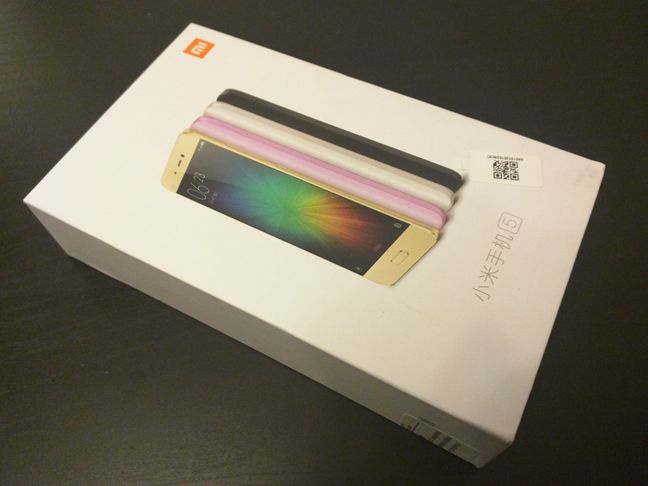
The Xiaomi Mi 5 comes in a glossy white cardboard box with a simple and classic design. On the top of the package you can see a picture of the smartphone in all its four available color variants. On the sides of the box there's only blank space and the bottom of the box holds just some stickers with information about the smartphone and its technical specifications.
Xiaomi Mi 5
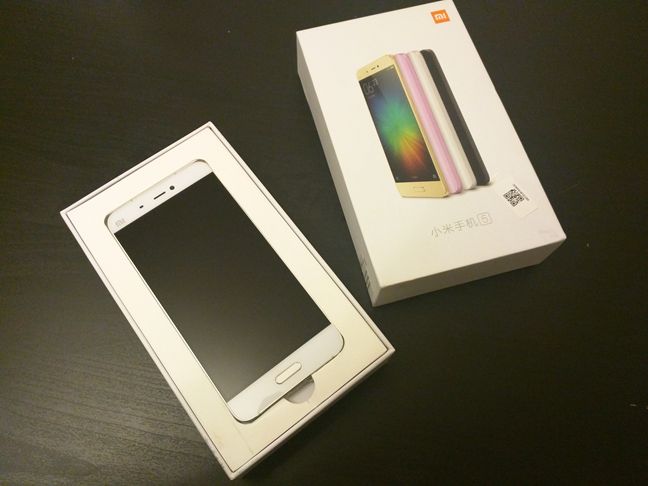
Open the box and you get to see the Xiaomi Mi 5 you just bought.
Xiaomi Mi 5
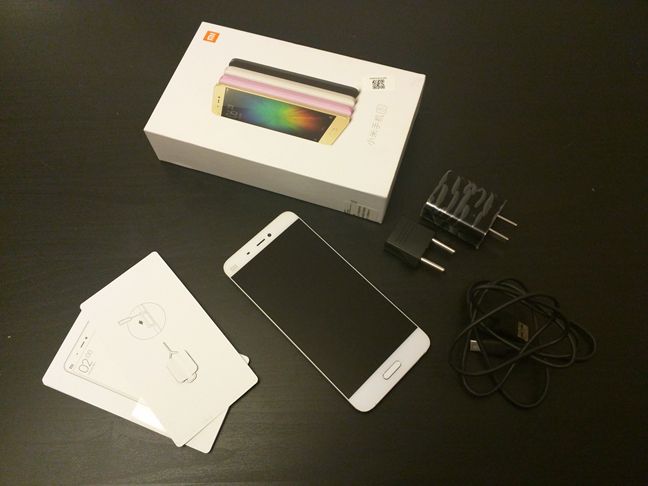
The smartphone sits on a cardboard support and, if you take it out of the way, you get to see the entire content of the package: the smartphone's power charger and its detachable USB Type-C cable, a small metal pin useful for taking out the SIM holder, the warranty card and the user guide. Unfortunately, just like many other manufacturers, Xiaomi chose not to include headphones in the package. This approach probably helps in keeping the costs low, but it's not something we appreciate, especially when we're dealing with a flagship device.
Xiaomi Mi 5
The Xiaomi Mi 5 is a flagship Android smartphone that's a bit smaller than what we've seen lately from other manufacturers. The Mi 5 has a 5.15 inch display that benefits from an IPS LCD panel. It offers a resolution of 1080x1920 pixels at 428 PPI pixel density. The display is protected by Corning Gorilla Glass 4, so it shouldn't scratch easily.
This smartphone is powered by a high-end Snapdragon 820 quad core Kryo processor running at a maximum frequency of 1.8 GHz and an equally powerful Adreno 530 graphics processing unit. You also get 3 GB of RAM memory and 32 or 64GB of internal storage space, depending on the edition you buy. Unfortunately, the smartphone has no microSD card slot so you can't expand the storage space with a flash memory card.
The main camera on the Xiaomi Mi 4 uses a lens with 6 elements, it has a Sony IMX298 16 megapixel sensor and uses Optical Image Stabilization (OIS) technology. As a result, it should be able to take sharp photos even when you're moving or your hands are shaking. The camera is also getting aid from a dual tone LED flash when you're shooting photos in low light environments. As for the front camera, there's not too much to say about it except the fact that it has a 4 megapixel sensor, which should be good enough for video chat apps, but it's probably not the best for taking great-looking selfies.
In terms of connectivity options, the Xiaomi Mi 5 is a dual SIM smartphone, meaning that it can simultaneously work with 2 SIM cards. It can connect to 4G mobile networks, it includes a built-in Bluetooth 4.2 chip and offers NFC support. Also, in terms of wireless connectivity, the Xiaomi Mi 5 has a network chip that is compatible with the 802.11 a/b/g/n/ac networking standards, so it can connect to both 2.4 GHz and to 5 GHz wireless networks. An interesting thing about the Xiaomi Mi 5 is the fact that it also includes an infrared sensor and that's something you don't see too often on a smartphone. Moving on to the wired connectivity options, the Xiaomi Mi 5 has an USB Type-C reversible connector and a 3.5 mm audio jack.
It might also be interesting for you to know that this smartphone comes with quite a lot of sensors built-in. Besides the usual accelerometer, gyro, proximity or compass sensors, the Xiaomi Mi 5 also has a barometer and a fingerprint sensor .
The body is built from plastic, metal and glass, but together with its non-removable 3000 mAh lithium-ion polymer battery, it weighs only 4.55 ounces (129 grams). This feather-light weight is held by a body with a length of 5.69 inches (144.55 mm), a width of 2.72 inches (69.2 mm) and a thickness of 0.28 inches (7.25 mm).
If you'd like to see more details about the specifications of the Xiaomi Mi 4, check its official website: Xiaomi Mi 5 Specs.
The Mi 5 is the new Xiaomi flagship and it has all the hardware it needs to prove it. The specs are all high-end and the raw performance you should get from it should be more than plenty for any Android app or game, no matter how power hungry it is. The only thing we can point as negative is the fact that you don't get any headphones in the standard package and you need to purchase them separately.
Design and build quality
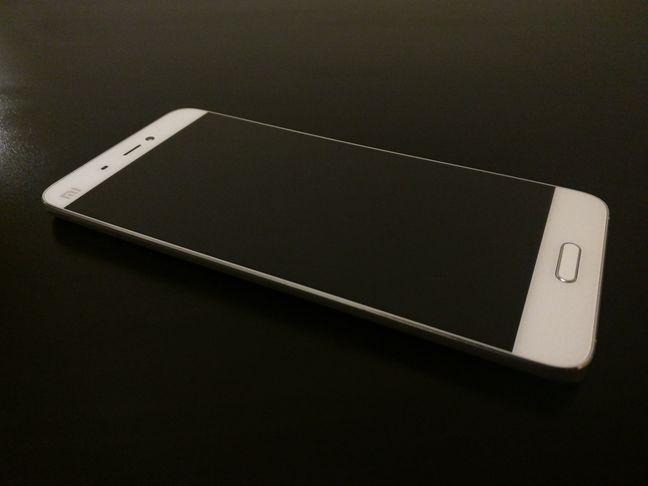
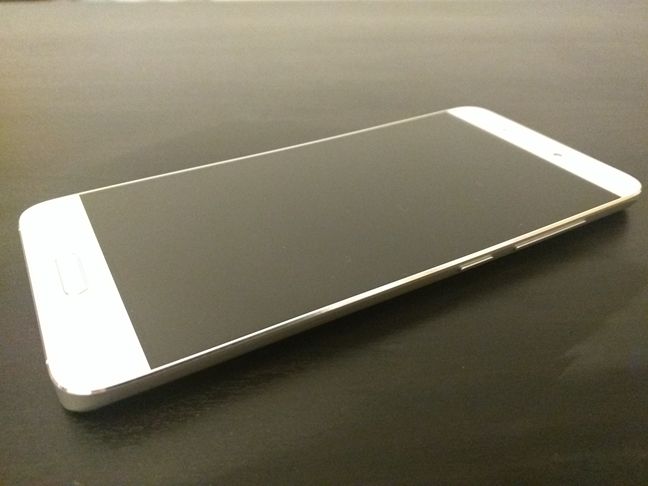
The Xiaomi Mi 5 is one of the most beautiful smartphones we've seen this year. The first thing that strikes you is that, although it's a flagship, it's smaller than the best smartphones of other manufacturers. The Xiaomi Mi 5 has a 5.15 inch display which, as you can see in the photo below, is almost frameless, with incredibly thin left and right bezels.
Xiaomi Mi 5
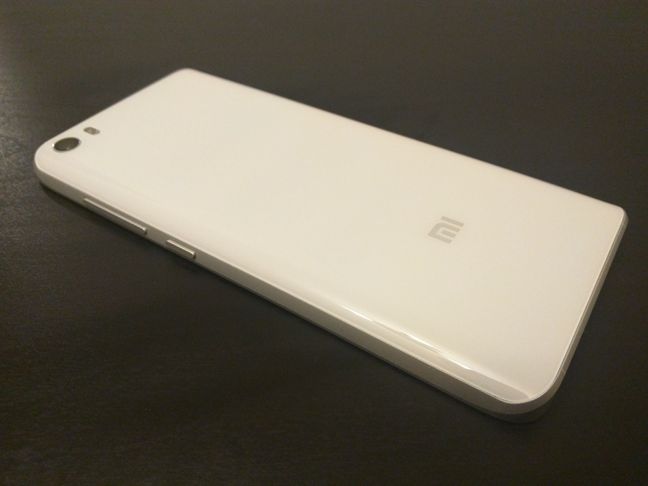
Both the front and the back of the Xiaomi Mi 5 are covered and protected by a Corning Gorilla Glass 4 layer that makes the smartphone look glossy and glamorous at the same time. However, the glossy back also means that the Mi 5 has a natural tendency to slip and slide when you place it on a plane surface. For instance, when I put it on a coffee table made from glass, it seemed like the Mi 5 had a will of its own and just wanted to slip away. If you buy this smartphone, you should take care with this aspect.
All that glass on the Xiaomi Mi 5 meets at the edges of the smartphone and ends under an aluminum frame with sleek and elegant lines.
Xiaomi Mi 5
The power button and the volume rocker are found in their usual Android spot, on the upper right edge of the smartphone and, even if they don't have different textures, they are easily identifiable because of their sharp edges.
Xiaomi Mi 5
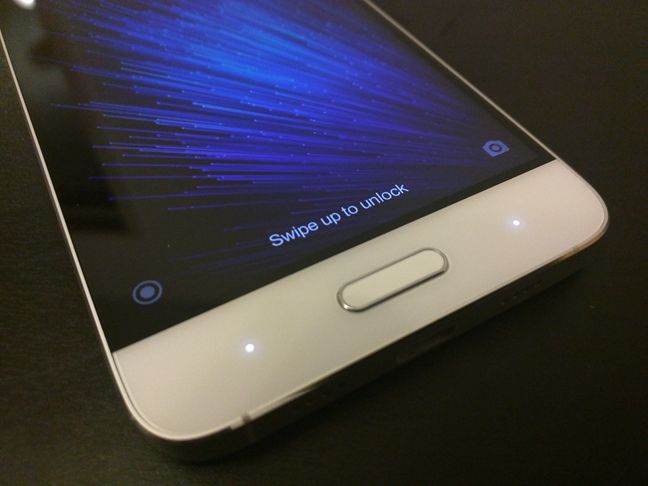
The Home button is the only physical button from the from of the device and it also holds the fingerprint sensor. Having the fingerprint sensor placed on the front of the smartphone makes it very easy to use. It's also one of the fastest fingerprint sensors I've seen.
To the left and to the right of the Home button, you will find the other two traditional Android buttons for Back and Recent apps. Xiaomi chose a minimalist design here, as the two capacitive buttons are actually invisible and can be seen only when their white LED lights activate. In our opinion, this is a great design choice that contributes a lot to the good looks of this smartphone.
Xiaomi Mi 5
You might have noticed that we didn't say anything about the existence of a camera button. That's because there is none on the Xiaomi Mi 5, although it would have made a nice addition, especially considering the fact that the main camera of this smartphone is actually good. But more on that later in the camera experience section of this review.
The Xiaomi Mi 5 impressed us with its good looks. Although there's nothing about it that we would call spectacular, we love the simple and elegant way in which every part meets another and the efficient way in which each bit of space is used. This is a smartphone that you will fall in love at first sight in most cases.
The smartphone experience on the Xiaomi Mi 5
The Xiaomi Mi 5 features a 5.15 inch Full HD display that benefits from the IPS technology. After using it for a while, both indoors and outdoors, we can testify that the screen has very good contrast, it displays vivid colors and, most of all, it has a really high brightness. You will have no problems whatsoever in deciphering what's on the screen, even if you use it in direct sunlight.
Xiaomi Mi 5
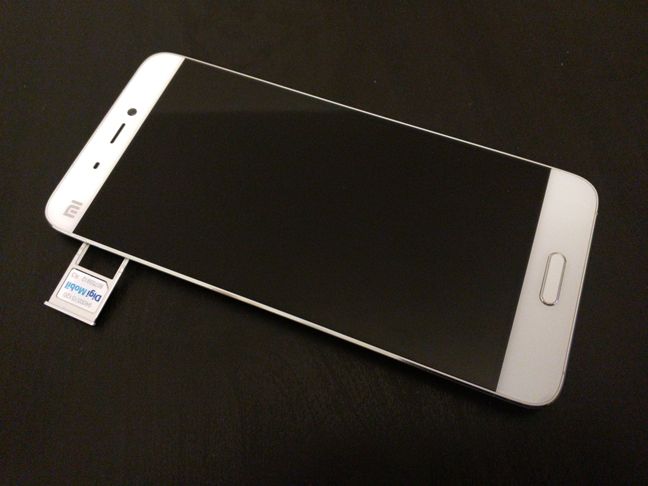
You might have noticed earlier in this review that we mentioned that the Xiaomi Mi 5 is a dual SIM smartphone. It can use up to two SIM cards simultaneously. Another great feature is the fact that both SIM cards can use 4G networks, although once you connect to 4G using one SIM card, the other will be limited to 2G. Both cards must be nanoSIMs and they are both inserted in the same card tray from the left edge of the smartphone. To take the tray out you will have to use the metallic pin from the smartphone's package.
Xiaomi Mi 5
During the time we had the Xiaomi Mi 5 for testing, I used it as my main Android smartphone. While doing so, I could see and hear how this smartphone fulfills its basic duty of being a phone. 🙂 I can say that the phone conversations I had on it were of very good quality and the sound levels were satisfying. I could hear the people with whom I talked without problems and they were also able to understand what I was saying, even when I was in loud and noisy environments.
If you're concerned about whether the mobile signal reception is any good, I can tell you that it is, at least on the 3G network aired by my mobile operator in my geographical area.
Xiaomi Mi 5
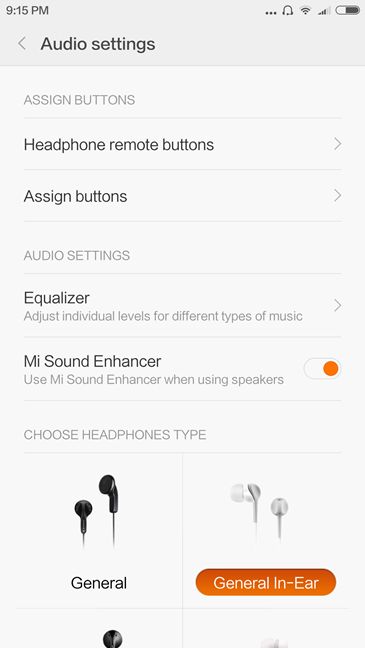
In terms of audio quality, the loudspeaker does a pretty good job and it doesn't distort sounds, even at the highest volume. However, the highest volume is not as high as we've heard on other high-end smartphones like the Motorola Nexus 6 , for instance. However, even if the loudspeaker is above average, the audio fidelity you'll get from a good set of headphones will outmatch it anytime.
Xiaomi Mi 5
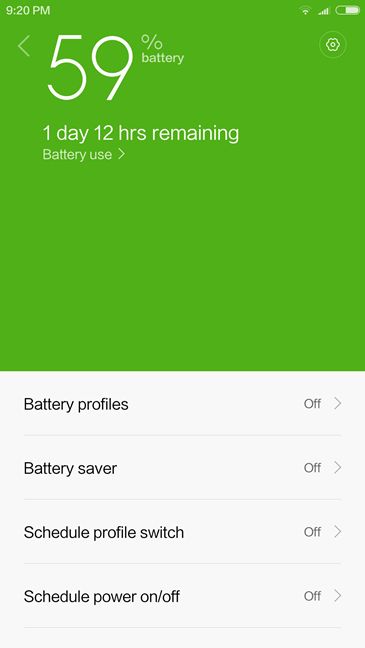
The autonomy you'll get from the 3000 mAh battery is above average but it's not great. If you use your smartphone heavily and you like checking your Facebook and Twitter accounts often, read every email you receive instantly or browse the internet a lot, than the Xiaomi Mi 5 will probably last you for a day. If you use it rar ely , you might get two or even three days out of it. I for one, managed to keep it away from the power outlet for a day and half, and considering the powerful hardware packed inside this smartphone, this is good battery life.
Xiaomi Mi 5
We like how the Xiaomi Mi 5 fulfills its basic role of being a phone and we love how its display looks. On the other hand, the loudspeaker could have been a bit louder considering that it is Xiaomi's flagship.
If you will go to the next page, yo u will find out details about the camera experience offered by the Xiaomi Mi 5, the software installed on it and the results it managed to obtain in benchmarks.
The camera experience on the Xiaomi Mi 5
The camera you get on the Xiaomi Mi 5 is based on a 16 megapixel image sensor from Sony and uses a a 6-elements lens with OIS (Optical Image Stabilization). When you want to shoot photos in low light, you get better results with the help of its dual LED (dual-tone) flash.
As you will soon see, all these hardware specs deliver the right results: most of the photos we took with the Xiaomi Mi 5 have lots of detail, sharp focus, vivid colors and good contrast. The main camera does especially well in well lit environments. In low light environments, the image sensor and the camera software tend to make the photos a bit grainy and the colors faded, but that is something normal for almost any smartphone camera.
There's nothing special about the front camera though: it has a 4 megapixel image sensor and it's good only for video chat apps. If you intend on taking selfies with it, you might feel a bit disappointed.
If you want to take a closer look at some photo samples, in the gallery below you can find a series of photos we shot with the Xiaomi Mi 5 both outdoors, in bright light, and indoors, in dim light. You will find some landscape photos, panoramas and close-ups.
If you're curious about the video options you get, you should know that the Xiaomi Mi 5 is able to record 4K videos, at a maximum resolution of 3840 x 2160 pixels and 30 fps.
Here's a video sample in which you can see how the Xiaomi Mi 5 fares when it has to record videos with lots of movement involved. As you can see, the optical image stabilization offered by this smartphone is pretty good, considering the fact that I was driving a car in this video.
And here's a video in which I recorded a static panorama with the Xiaomi Mi 5. It's a panorama of the Bucegi mountains from Romania, which I recorded by moving the smartphone while I was standing still.
An nice detail regarding the Xiaomi Mi 5 is the fact that, if you want to, the camera software also lets you record time lapse videos and slow motion videos. Here's a sample of how slow motion videos look like:
The main camera found on the Xiaomi Mi 5 offers very good results, both when shooting photos and when recording videos. We especially liked the way the camera shoots photos outdoors, while the fast focus and the optical image stabilization technologies helped us in taking good photos indoors too.
Android 6.0, MIUI 7.3.2.0 and the bundled apps
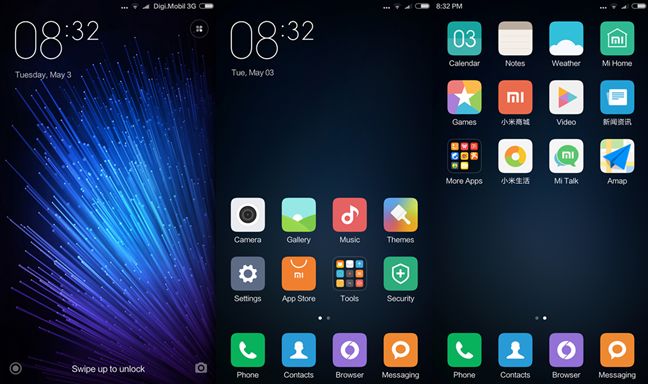
The Xiaomi Mi 5 runs on Android 6 and Xiaomi's own user interface MIUI 7. Unfortunately, at the time when this review is written, Xiaomi Mi 5 is available only with a Chinese version of the operating system and skin. It does support English, but even if you set it so, the smartphone will still give you lots of default Chinese-only apps. This Chinese targeted variant is also lacking in Google services and the Play Store. Instead, it uses Xiaomi's own App Store and other Asia-based services.
Xiaomi Mi 5
We scoured the official forums for a while and what we found is that the Xiaomi Mi 5 will soon get a global variant of the operating system and user interface, one that will include the Google services as well. However, this has not happened by the day we published this review. We don't know when it will happen, but it should be soon enough, as Xiaomi officially sells the Mi 5 not only in China, but also in India.
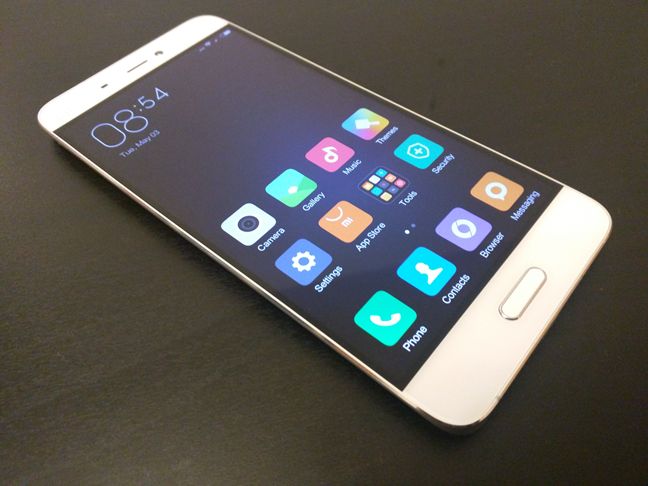
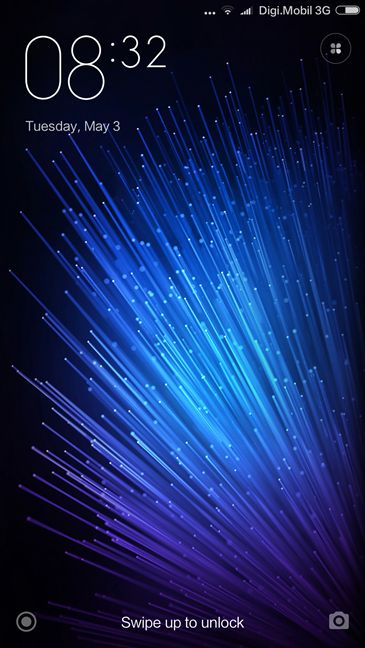
Other than that, we must say that we like how MIUI looks, just as much as we liked it in the past. Sure, it 's not the original Android experience Google wants us to have, but MIUI 7 is fast and responsive and, most of all, it looks great.
Xiaomi Mi 5
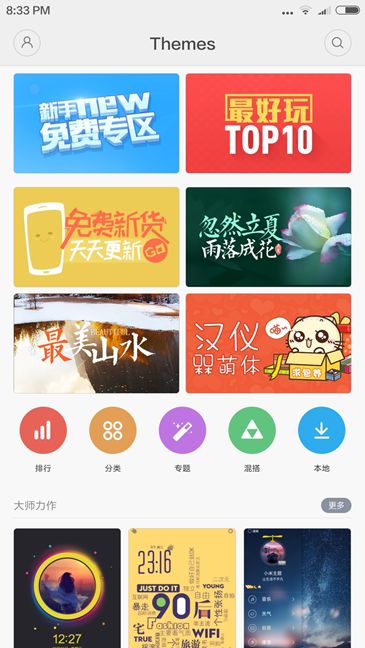
MIUI 7 is filled with customization features and personalization options that will surely make many people happy. There are countless user interface themes available and the library of visual styles is huge, so that you can make your Xiaomi Mi 5 look unique in just a few minutes.
It's worth noting that, although the Chinese targeted MIUI 7 doesn't offer the Google services for now, Xiaomi includes a set of default apps for all things basic like emails, messaging, music and video playing, and it even includes an antivirus app.
Without including the apps available only in Chinese, the Xiaomi Mi 5 bundles the following apps by default:
Camera - the MIUI 7 default camera app for taking photos.
Xiaomi Mi 5
Gallery - displays the pictures stored on your Xiaomi Mi 5.
Music - lets you listen music and watch music videos online or listen to radio stations. It even includes a music identification service, similar to Shazam.
Themes - is a portal of sorts, from where you can download, install and set all kinds of visual styles and themes for your smartphone.
Xiaomi Mi 5
App Store - is the application store maintained by Xiaomi. English speaking users will have little use for it.
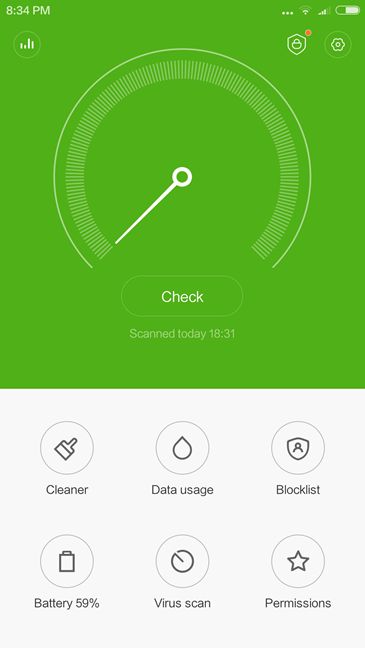
Security - keeps your smartphone secure by running antivirus scans and also helps you clean junk files from it.
Xiaomi Mi 5
Calendar - a calendar app that lets you schedule your daily agenda.
Notes - a simple app that lets you take notes.
Weather - gives you the weather prognosis in your location (based on GPS) or anywhere else in the world.
Xiaomi Mi 5
Mail - the default email app offered by Xiaomi.
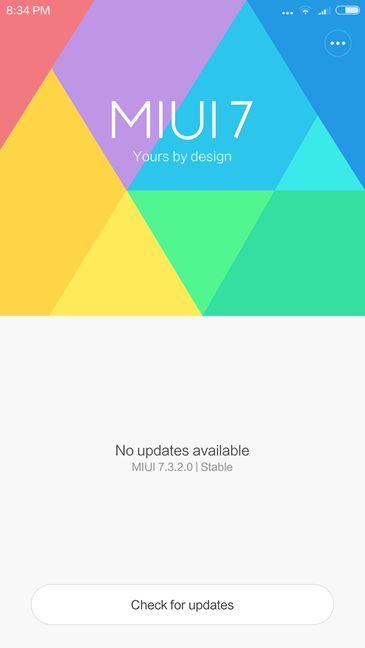
Updater - the official app for checking, downloading and installing new system updates for the Xiaomi Mi 5.
Xiaomi Mi 5
Clock - a simple clock app that also lets you set alarms and use a stopwatch and a timer.
Recorder - an app that records sounds using the smartphone's microphone.
Calculator - makes math calculations easy. 🙂
Explorer - lets you browse and manage the folders and files stored on your Xiaomi Mi 5.
Compass - shows you where the North is, unless you're at the Magnetic North Pole. 🙂
Mi Remote - uses Xiaomi Mi 5's infrared sensor to make your smartphone act as a remote for various devices like your TV, DVD player or AC. This is actually useful when you can't find your TV's remote.
Scanner - uses the smartphone's camera to scan QR codes.
Report Bug - connects to the MIUI Bug Report center and lets you report anything that you believe to be a bug in MIUI.
WPS Office - is an office suite that lets you open and edit documents of all kinds.
Xiaomi Mi 5 runs on the latest version of Android but uses Xiaomi's own MIUI 7 user interface. This skin is fast and simple to use and it's also highly customizable. Unfortunately, the Mi 5 is available only in a Chinese variant for now, and it does not include the default Google services. However, a new international variant should be made available by Xiaomi soon.
Performance in benchmarks
We've seen what the Xiaomi Mi 5 has to offer in terms of hardware and software specifications and we know that it's a powerful smartphone. But what about some real performance scores? Let's see how the Xiaomi Mi 5 did in the benchmark tests we ran on it:
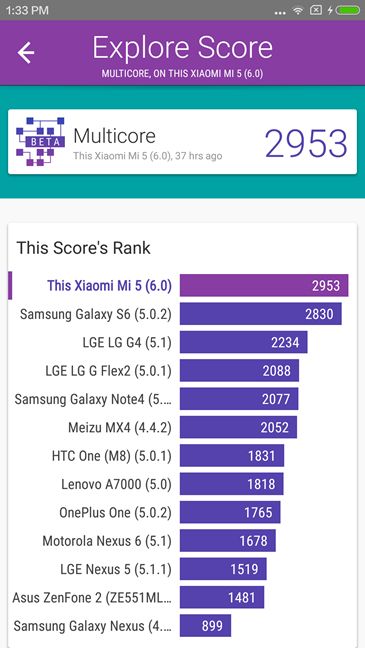
We started with Vellamo , a benchmarking tool designed to measure the performance offered by the processor unit. The first test we ran was Vellamo Multicore , a test designed to assess how good is the processor when running multiple tasks simultaneously. Xiaomi Mi 5 managed to get 2953 points, which is a better score than the average score of a Samsung Galaxy S6 and almost double than what you'd get from a Motorola Nexus 6.
Xiaomi Mi 5
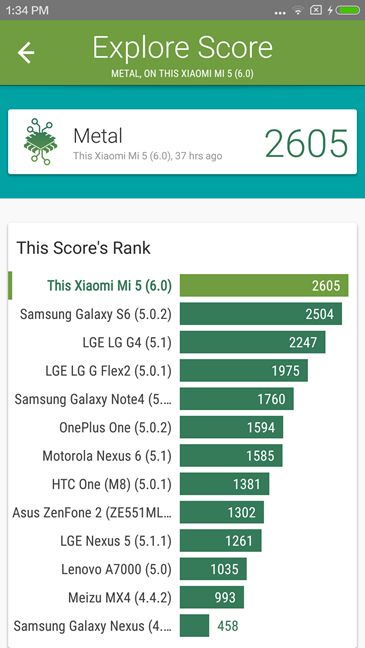
Then we ran the Metal tests from Vellamo. These tests measure the processor's performance when running single task operations. In other words, they measure the single core performance, which is very important when you're thinking about how good the processor is when running games or apps that don't know to use more than one single core. The Xiaomi Mi 5 scored 2605 points, which confirms that it's better than the Samsung Galaxy S6, and also almost twice as strong as a Motorola Nexus 6.
Xiaomi Mi 5
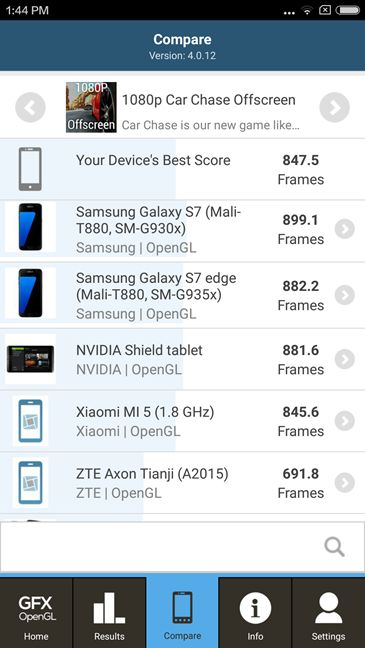
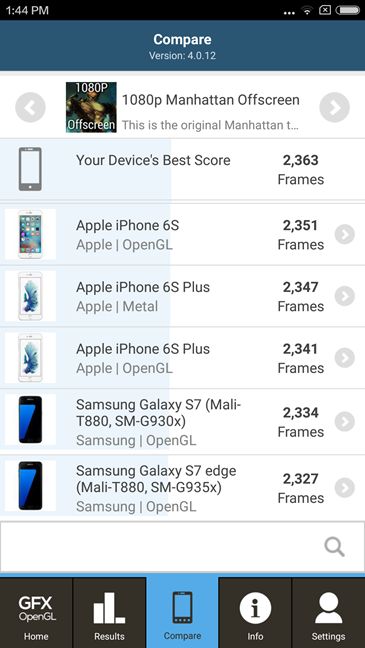
Gaming is another very important aspect for many people when deciding whether to buy a certain smartphone or not. To measure Xiaomi Mi 5's performance in this regard, we went to GFXBench GL Benchmark. The gaming tests we consider relevant are the 1080p Car Chase Offscreen, the 1080p Manhattan Offscreen and the 1080p T-Rex Offscreen benchmarks. We only chose the standardized 1080p Full HD tests because we consider the results more relevant if all the devices tested are running the benchmarks using the same display resolution.
The Xiaomi Mi 5 managed to render 847.5 frames in the 1080p Car Chase Offscreen test, which is an extraordinary result, very close to that achieved by the Samsung Galaxy S7 and around 40% better than that you'd get from a Samsung Galaxy S6 or from a Motorola Nexus 6.
Xiaomi Mi 5
In the 1080p Manhattan Offscreen test, the Xiaomi Mi 5 rendered 2363 frames, which is again a jaw-dropping result. It's a slightly better result than what you get from a Samsung Galaxy S7 and even from an Apple iPhone 6S or 6S Plus. Compared with the Motorola Nexus 6, the Xiaomi Mi 6 is three times better in this test. Wow!
Xiaomi Mi 5
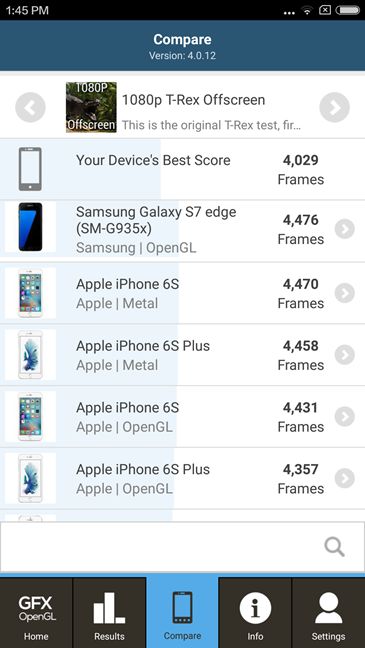
In our final gaming benchmark, we ran the 1080p T-Rex Offscreen test. The Xiaomi Mi 5 rendered 4029 frames, which is almost 450 frames less than the Samsung Galaxy S7 or the Apple iPhone 6S renders in this test. However, it's not a meaningful difference, especially if you use percentages: the Xiaomi Mi 5 is only 10% slower than these smartphones.
Xiaomi Mi 5
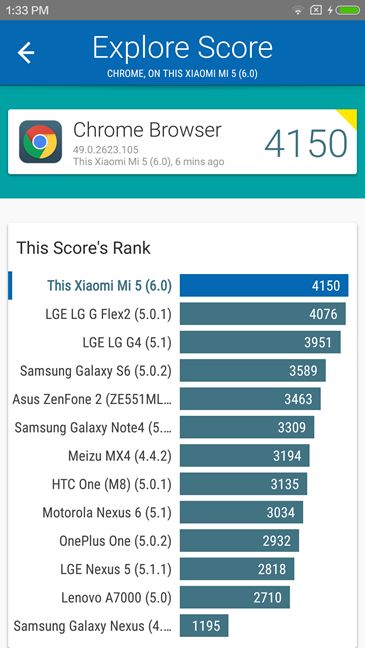
The Xiaomi Mi 5 is clearly a very powerful device and both the processor and the gaming benchmarks confirmed this. But what about the simple task of browsing the web? To find out if it's just as good in this regard too, we turned to Vellamo once again and ran its Browser tests, using Google's Chrome web browser which we manually installed on the Xiaomi Mi 5. We got 4150 points, which means that the Mi 5 is faster at rendering websites than a Samsung Galaxy S6 by about 11% and 37% faster than a Motorola Nexus 6. These are great results!
Xiaomi Mi 5
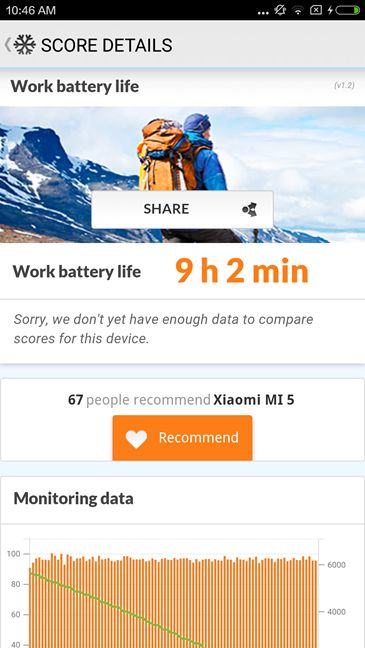
The final benchmark we ran was to test the battery life of the Xiaomi Mi 5. To do that, we fully charged its battery and then we ran PCMark'sWork battery life test. The Xiaomi Mi 5 managed to resist for 9 hours, which is very impressive considering how powerful the hardware it packs is.
Xiaomi Mi 5
The Xiaomi Mi 5 is a very powerful Android smartphone and each and every benchmark test we ran confirms it. From a performance point of view, the Mi 5 is exactly what a flagship smartphone should be.
Pros and cons
In our opinion, the obvious pros of the Xiaomi Mi 5 are:
It packs seriously powerful hardware
It has a very elegant body design
It's very easy
It offers a very good camera
It has a fast front facing fingerprint scanner
The battery life you get from the Mi 5 is above average
It's almost half the price of the flagships of other smartphone manufacturers
What we don't like about the Xiaomi Mi 5 is:
Until a global international version of MIUI for Xiaomi Mi 5 is released, you have to manually add the Google Play services
It slips and slides easily because of the glass coating on its back
It doesn't support microSD cards
The loudspeaker is not as good as you'd expect from a flagship smartphone
Product rating4/5
Verdict
The Xiaomi Mi 5 is one of the best smartphones we've seen this year and it's also probably the most affordable Android flagship that you can buy today. It has a great design, it has powerful hardware and it shoots very good photos. The MIUI user interface is fluid, fast and highly customizable and many people will love it. The only reasons that might hold you back from buying the Xiaomi Mi 5 is the lack of integration with Google services, which needs to be added manually by the user. It's either this or you wait for the international variant of MIUI to be made available sometime in the near future. Leaving this negative aside, Xiaomi Mi 5 is definitely a top-notch Android flagship that you should consider purchasing. It might just be one of the best flagship smartphone buys in 2016.











Discussion (0)
Comments are closed.