It's been quite a while now since mobile manufacturers tried to design and build better camera smartphones. We've seen Samsung do this and we've seen Nokia doing it, but we didn't yet see ASUS do it. Not until recently that is, because ASUS has entered the competition for the best camera smartphone with their new ASUS ZenFone Zoom. It is a smartphone that promises to offer its users a camera with true 3X optical zoom, in a compact body with no moving parts on the outside. Of course, the ASUS ZenFone Zoom also packs high-end hardware to match its top of the line camera lenses. However, like all else in life, everything comes at a price. After playing, testing and using the ASUS ZenFone Zoom for more than a week now, here's what we think of it:
Hardware specifications and packaging
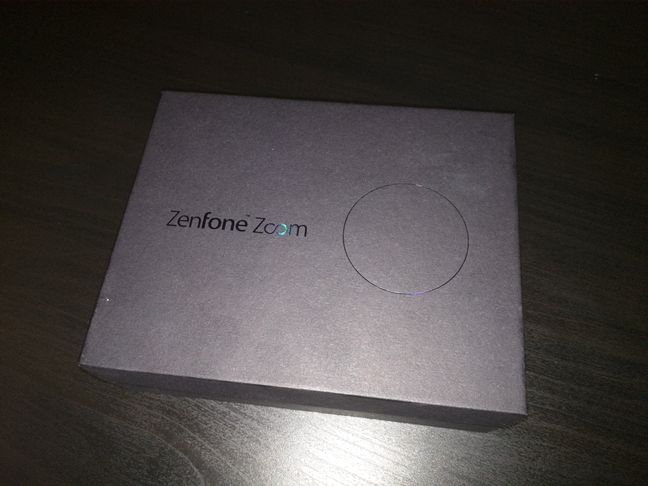
The ASUS ZenFone Zoom comes in a beautifully crafted box made of premium black cardboard. It has a minimalistic design that features only the company brand on one side and the smartphone's model name on the top.
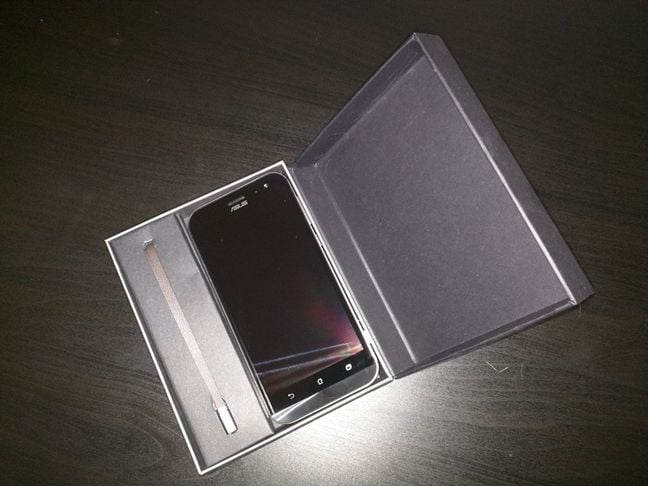
A nice touch regarding the the packaging is that the box opens like a book or like a jewelry case, as you can see in picture below. After you open it, the first thing that will catch your eye is the smartphone itself, sitting on top of a rather intricate cardboard support.
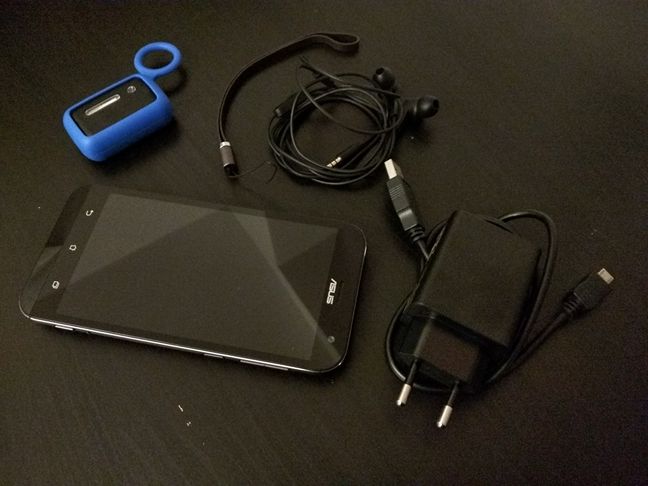
Besides the ZenFone Zoom itself, inside the box you will find a power charger together with a detachable USB cable, a wrist strap that can be tied to the smartphone to make it easier to carry, a pair of wired headphones and the usual documents you get with almost any hardware device: the user manual and the warranty card. The ASUS ZenFone Zoom we received for testing also included an ASUS ZenFlash , which is an external portable flash that you can connect and use to take better pictures with the smartphone, especially in low light environments. There is a chance that, i n some markets, ASUS won't include the ZenFlash in the default package.
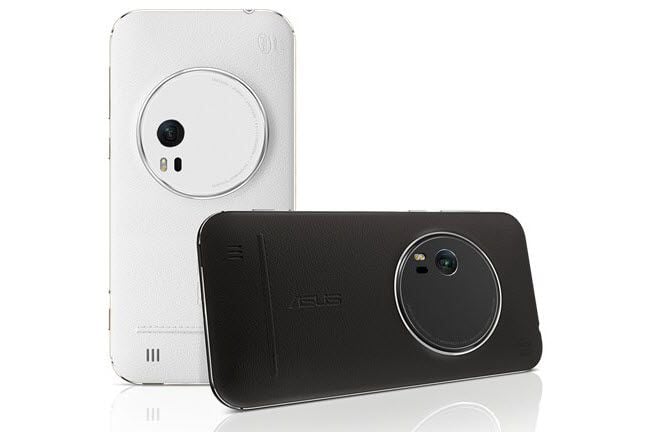
The ASUS ZenFone Zoom is available in two different color variations: black and white. Both of them look really nice, also because of the high quality crafting materials used by ASUS.
Depending on the model you choose, the ASUS ZenFone Zoom is powered by an Intel Atom Quad Core Z3580 processor running at 2.3 GHz or by an Intel Atom Quad Core Z3590 running at 2.5 GHz. In terms of memory and storage space, this Android smartphone comes with 4GB of RAM memory and 64GB or 128GB of storage space, depending on the variant that you buy. The internal storage space can be supplemented with a MicroSD memory card of up to 128 GB.
The screen has a diagonal size of 5.5 inches and a Full HD display resolution of 1920 x 1080 pixels at a 403 ppi (pixels per inch) density. The display panel is built using the IPS technology, so it should offer a good color reproduction and wide viewing angles. In terms of physical protection, the screen is covered with Corning Gorilla Glass 4 which means that it should be able to resist fine scratches, although it will probably not be enough to save it from a second floor fall. 🙂
The connectivity options offered by the ASUS ZenFone Zoom include wireless network connections using the 802.11 a/b/g/n/ac networking standards, Bluetooth v4.0 and NFC support. The smartphone uses one Micro SIM card and supports 2G, 3G and 4G mobile networks. The main attraction of the ASUS ZenFone Zoom is its camera. Although it uses only a 13 megapixel sensor, it features a 3X optical zoom which is also the reason why the smartphone is called Zoom. The rear camera has optical image stabilization and it's built on 10 lens elements crafted by HOYA. We usually associate the name HOYA with camera photo filters. The rear camera also benefits from a very fast 0.03 second laser auto-focus and a dual-color Real Tone flash for when it shoots photos in dim environments. The ASUS ZenFone Zoom also includes a front facing camera with a 5 megapixel sensor and a wide view angle for taking selfies.
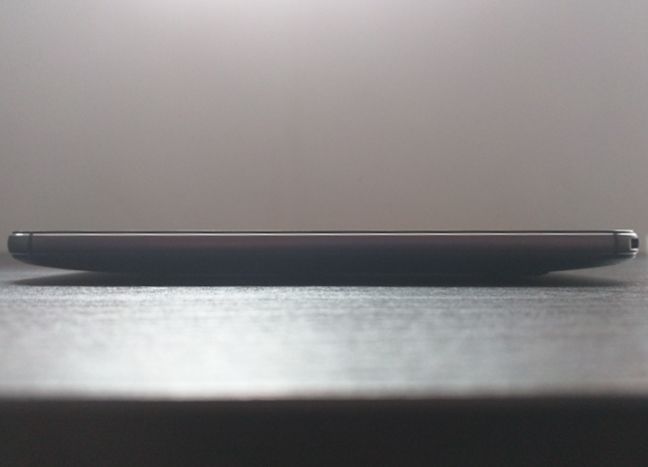
In terms of size, the ASUS ZenFone Zoom is 6.25 inches (158.9 mm) long, 3.10 inches (78.84 mm) wide and 0.47 inches (11.95 mm) thick. With its built-in non-removable 3000 mAh Li-Polymer battery, the ASUS ZenFone Zoom weighs 185 grams or 6.52 ounces.
If you want to look even closer at all its specifications, check its official webpage: ASUS ZenFone Zoom ZX551ML Specifications.
The ASUS ZenFone Zoom is a premium device with high-end hardware specifications. They should be enough to put it on par with other high-end Android smartphones and, because of its special optical zoom technology, it should shine when it comes to the camera experience it has to offer.
Design and build quality
The ASUS ZenFone Zoom is a high end device and that is easily seen in the way it's built and in the materials that are used for crafting it. The Zoom follows the general design lines we saw in all the smartphones from the ZenFone family, yet it has its own distinctive spots.
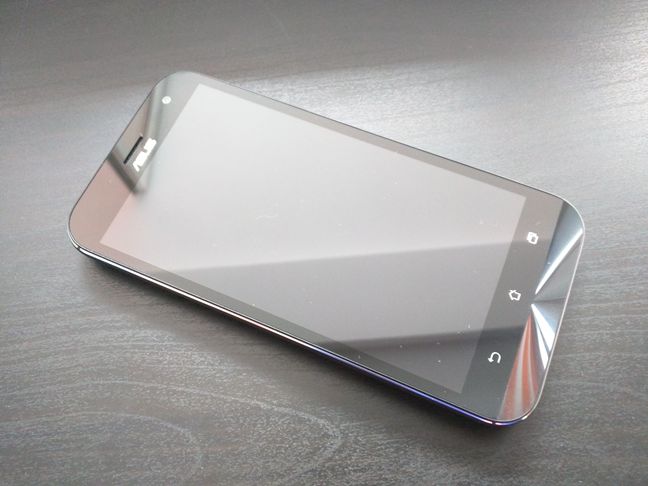
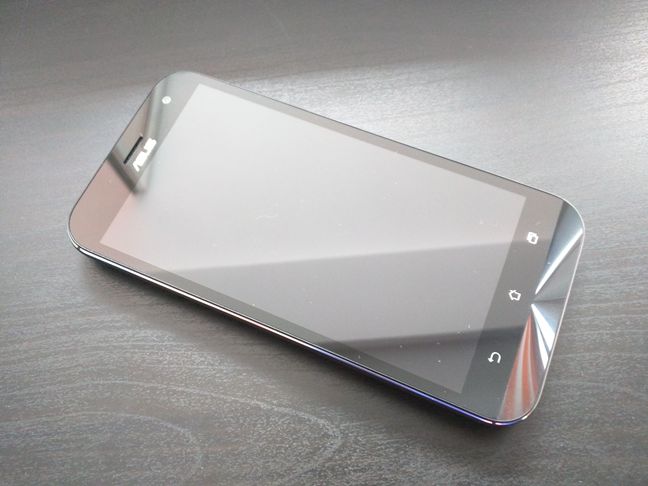
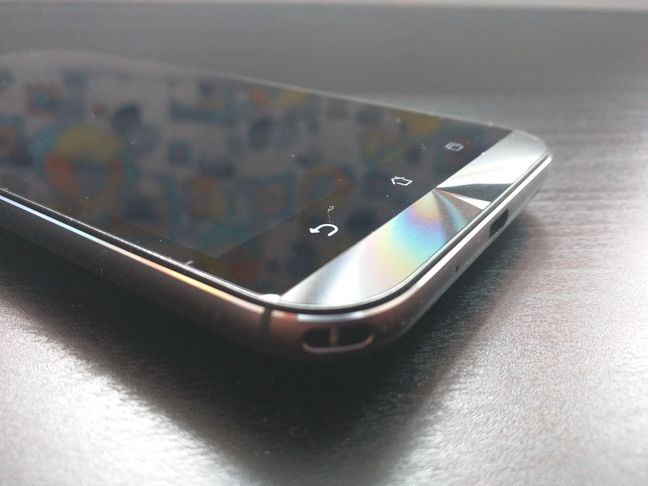
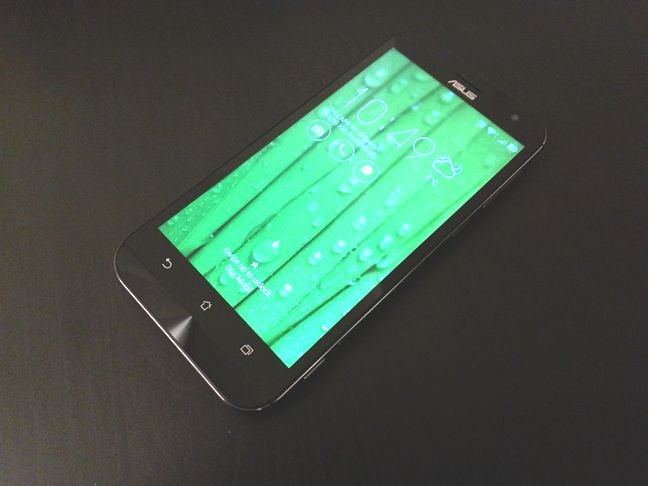
On its front side, the ASUS ZenFone Zoom is clearly a ZenFone smartphone: the display is surrounded by not too thin and not too thick bezels, the top side is home to the ASUS logo and the earpiece speaker, while the bottom holds the Android capacitive buttons plus the spun metal band that's an ASUS trademark.
Unfortunately, the capacitive buttons are not backlit so finding them at night might be an issue. The whole body is held together by a slightly rounded aluminum metal edge that looks great.
A nice design choice that ASUS made for its ZenFone Zoom is the fact that it includes two hardware buttons for the camera: one for the camera shutter and one for video recording. You will find them together with the power button and the volume rocker on the right edge of the smartphone. What's even nicer is the fact that the shutter button is a two-step button so you can half press it to focus and full press it to actually shoot the photo.
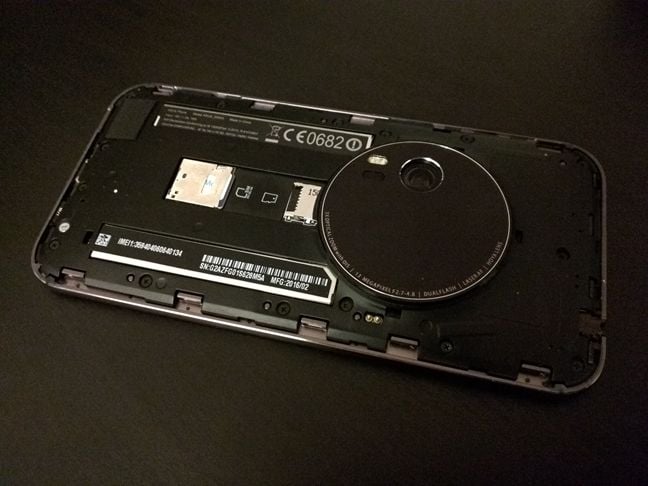
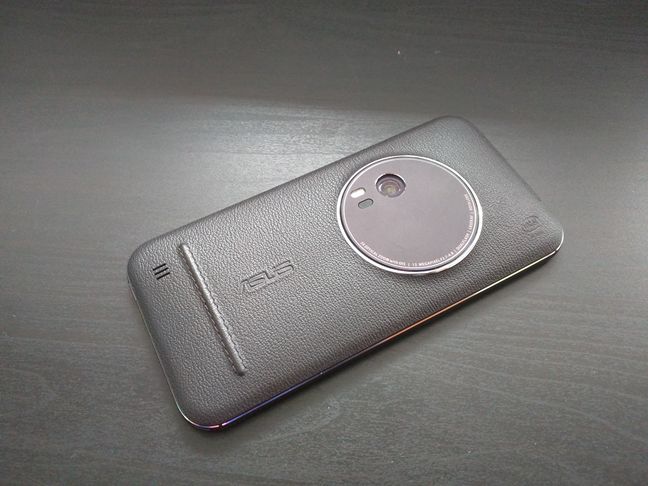
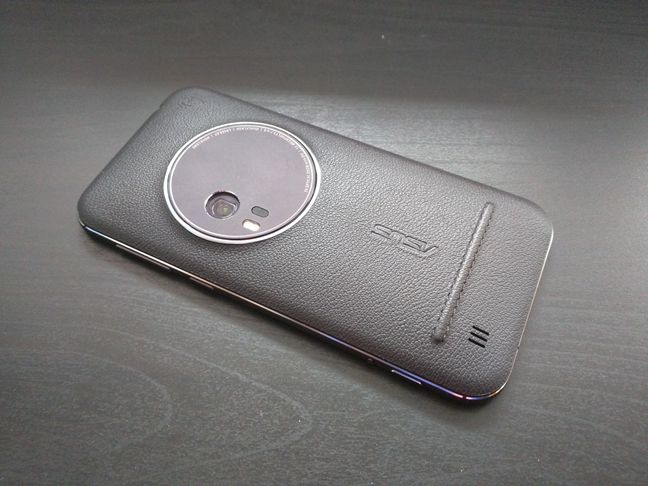
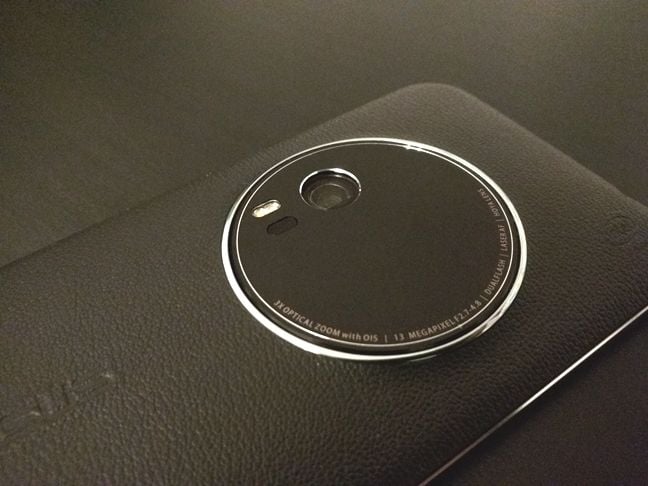
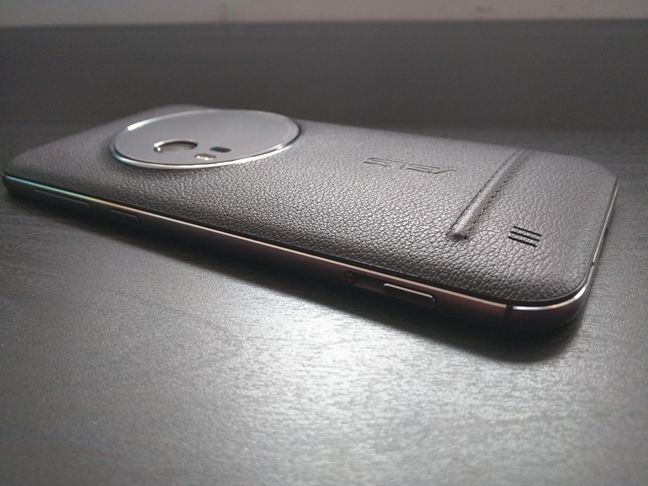
Turn the ASUS ZenFone Zoom with its backside up and you get to see what makes it special: the optical zooming camera. If you've ever seen a Nokia Lumia 1020 , you will now have a deja-vu. The back of the ASUS ZenFone Zoom is dominated by a very large disc that holds the insides of the camera, with all the 10 elements of the lens.
The zooming lens on the ASUS ZenFone Zoom makes the smartphone feel a bit bulkier and heavier than other smartphones, but that's a compromise that you have to make if you want to interbreed a smartphone with a camera.
To balance the back of the smartphone, ASUS made a very interesting design choice of adding a stitched bulge on the bottom side of the back cover. This bulge helps in keeping the ASUS ZenFone Zoom horizontally straight when you place it on a plane surface. Oh, and by the way, the back cover is made of what looks like real leather. That's as premium as it can get!
The ASUS ZenFone Zoom is a premium smartphone built with high quality materials. Its design is similar to that of other smartphones from the ZenFone family, with one exception: its back looks very different from all the other ZenFones. That's because it has to accommodate some pretty intricate mechanisms for its zooming lens. That's why it also resembles a very different smartphone, one that was also trying to change the way we look at smartphone cameras: the Nokia Lumia 1020. All in all, we like the way the ASUS ZenFone Zoom looks.
The smartphone experience on the ASUS ZenFone Zoom
The ASUS ZenFone Zoom has all the horsepower required for completing any task you ask of it. While its operating system, Android 5 Lollipop is outdated, it doesn't feel sluggish: browsing the Internet, playing games, endlessly scrolling through Facebook or Twitter - all these are activities that the ASUS ZenFone Zoom lets you do without any slowdowns.
I used the ASUS ZenFone Zoom as my main smartphone for a week. My phone conversations were of good quality and the sound levels were pretty high. Both I and the people with whom I've talked over the phone were able to understand what I was saying without a hitch. The smartphone is also quite good at silencing the environmental sounds so you can hear the person whom you speak to, even if he or she is in a really loud place. The loudspeaker is located on the back of the smartphone and does its job well. It seems like it's a bit better than the one we saw (or heard to be exact) on the older ASUS ZenFone 2. It offers clear sound and it can get pretty loud too if that's what you want.
However, as with almost any portable device, the best audio quality you get from the ASUS ZenFone Zoom is when you connect your headphones to it. Fortunately, when you unbox this smartphone you also get a pair of headphones in the package. It's nice to see that, as more and more manufacturers chose not to bundle headphones these days. However, the headphones quality isn't jaw dropping - they do their job but if you want higher quality sound, we recommend you go for some better aftermarket headphones like the Monster Clarity HD High Definition In-Ear Headphones , for instance .
The ASUS ZenFone Zoom is able to connect to 2G/3G and 4G mobile networks. In my geographical area, my mobile carrier offers only 3G, so I can only testify for that. The ASUS ZenFone Zoom had no problem in connecting to the mobile network, but there were places (like in supermarket nearby) where it lost the network signal, although my other smartphone - a Motorola Nexus 6 - did manage to keep the connection going. That may or may not be an indicator to the fact that the Zoom's antenna is not that great, or it could be just that my mobile carrier has issues with its network coverage.
In terms of battery life, the ASUS ZenFone Zoom managed to last for a whole day of browsing the Internet, reading articles and eBooks or checking the Facebook feed. I usually had to charge it each evening, although when I ran benchmarks and when I played Asphalt on it, I had to charge it twice a day. The 3000 mAh Li-Polymer battery is good but I don't think that you could get two days out of it, even if you use your smartphone like you were an ascetic.
The ASUS ZenFone Zoom feels like a powerful smartphone. It fulfills its basic purpose of being a phone very well, although the smart part could benefit from an update. Overall, we can say that we were generally pleased by the ASUS ZenFone Zoom when it comes to the smartphone experience we got from it.
Turn the page to find out details about the camera experience offered by the ASUS ZenFone Zoom, the software you get on it, and the results it managed to obtain in benchmarks.
The camera experience on the ASUS ZenFone Zoom
The ASUS ZenFone Zoom is a smartphone that aims to become your all-in-one phone plus a compact camera. It's not the first of its kind, as other manufacturers like Samsung also released smartphones with optical zooming lenses in the past. However, the ASUS ZenFone Zoom is the first of its name, as they say. 🙂 The Zoom has no moving parts on the outside and that should make it feel as portable and as user friendly as any other smartphone.
The ASUS ZenFone Zoom main camera - the one that zooms in and out - is powered by a 13 megapixel Panasonic sensor and uses a 10 element Hoya lens that are responsible for the 3X optical zoom. The rear camera also benefits from OIS (Optical Image Stabilisation), laser autofocus and a dual-LED "Real Tone" flash that helps when you're shooting photos in environments with low light.
There's not much to be said about the front camera, except that it uses a 5 megapixel OmniVision sensor. It is good enough for video chat apps but not so much for taking high quality selfies, if that's your thing.
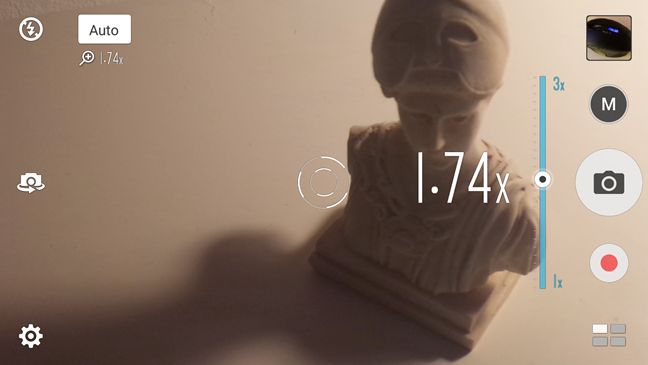
Let's go back to the main camera: the fact that it offers 3x optical zoom means that the photos you shoot zoomed in should be noise free. They should also be a lot sharper than what you would achieve if you would digitally zoom in on the same object with a different smartphone. Add the fact that the camera also knows how to use optical image stabilization and the zoomed photos you take with the ASUS ZenFone Zoom are definitely better than what you'd get from most other smartphones out there. Here's a sample of how much the optical zoom means in real life:
The zoomed photo is not bad, but it's not impressive either. It's true that it's not grainy, but it does suffer from an unwanted blur and the colors are oversaturated. Unfortunately, these are problems we've stumbled upon in all the photos we took with the ASUS ZenFone Zoom.
If you're reading this review, it's obvious that you're interested in how good is the camera on the ASUS ZenFone Zoom. To get a better "picture", browse through the gallery below - we included lots of photos we took with the ASUS ZenFone Zoom, both outdoors and indoors, both zoomed in and zoomed out, and we also included a few selfies.
We have also made a comparison between the camera offered by the ASUS ZenFone Zoom and one of the best camera smartphones in the world: the Microsoft Lumia 950. In the gallery below, you will find a series of photos that we took with both these smartphones on the same subjects and at the same time. Please hit the Information button in the top corner of the photo gallery, so that you know which picture was took with which smartphone. We bet that you'll find this comparison interesting. 🙂
When it comes to video recordings, the camera on the ASUS ZenFone Zoom is able to capture 1080p videos at 30 frames per second. Here's a video sample I recorded in a children's playground - watch it if you're curious to see how the Zoom fares when dealing with moving subjects:
And here's another video sample in which you can see how the ASUS ZenFone Zoom does when recording static videos. It's a mountain panorama I took by moving the smartphone, while I was standing still.
The ZenFlash is an interesting addition to the standard camera experience offered by the ASUS ZenFone Zoom. It is an external Xenon Flash device that connects to your smartphone's USB port and magnetically attaches to the back cover. Then, using the ASUS ZenFlash Camera app, your smartphone can use the external flash to take better pictures in low light and at slightly greater distances than what you could shoot using only the built-in flash. As far as we've seen, the ZenFlash does its job well, at least when we're talking about subjects no farther than 2 or 3 meters from the smartphone.
If you sum up all the theoretical features and characteristics of the rear main camera you would expect that the ASUS ZenFone Zoom is great when it comes to shooting pictures. Unfortunately, that's not exactly true. However, it's the first of its kind so we should probably look at it more like a first generation device. The next generation of ASUS ZenFone Zoom will probably be a lot better, especially if ASUS will use a better camera sensor than the one it used for this model.
Android 5.0 Lollipop, ASUS Zen UI and the bundled apps
The ASUS ZenFone Zoom comes with Android 5 Lollipop, which is a rather outdated version of Android. Considering the fact that Android 6 Marshmallow has been available for quite a while now, and the fact that the ASUS ZenFone Zoom is a new smartphone, we were expecting to see it using Android 6.
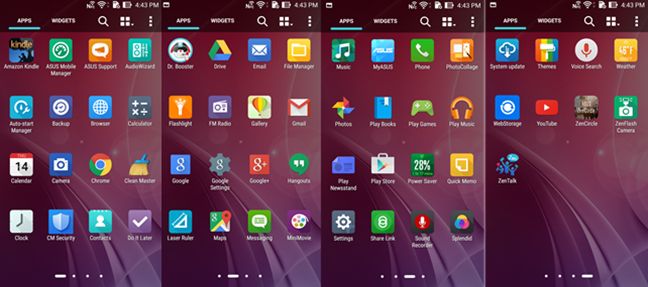
Although there are a few things we like at ASUS' Zen UI user interface, like the lockscreen or the various system themes you can install, there's one thing that seems to go from bad to worse each time we see an ASUS ZenFone smartphone: the sheer amount of useless apps that the manufacturer bundles. The ASUS ZenFone Zoom comes with no less than 57 bundled apps . Sure, some of them are useful but most of them don't really add value to the user, or do so only for a few users.
If you're curious to know which are the apps bundled by ASUS on their ZenFone Zoom, we've made a list with all of them, which you can see below. Note that we didn't include the absolutely necessary apps like Contacts or Camera, nor default Google apps like Gmail, Google+, Maps or the Play Store, apps that you will find on almost any Android device and which are useful to most users.
Amazon Kindle - an ebook reader app developed by Amazon that lets you shop and read eBooks.
ASUS Mobile Manager - acts as a central point for various system maintenance tasks. A useful thing about it is that it gives you a quick overview of the battery and memory use. Other than that, we didn't find it to be genuinely useful.
ASUS Support - gives you some information about the Zen UI user interface and includes support options for any smartphone related problems.
AudioWizard - lets you personalize the audio settings of your smartphone.
Auto-start Manager - lets you set which apps are allowed to start automatically.
Backup - lets you create and restore backups of your system apps and the apps that you installed on the smartphone.
Browser and Puffin Browse r - Browser is a web browser customized and enhanced by ASUS, while Puffin is another web browser from another company. Take into consideration that you also have Google Chrome pre-installed and you will understand why we said that the ASUS ZenFone Zoom is bloated. Three different web browsers on the same device is too much, even for power users.
Calculator - a basic calculator app.
Calendar - is a calendar app that allows you to integrate appointments from multiple agendas, including Google Calendar and Microsoft Exchange.
Clean Master - is an utility that focuses mainly on finding and removing unneeded cache files, empty folders, unused thumbnails and other junk files. Some people might use this app, while others won't.
CM Security - an antivirus and app locker app that can prove to be useful from a security point of view.
Do It Later - helps you create and organize daily tasks, reminders, notes and other planning tools.
Dr. Booster - obviously, a "booster" app that promises to make your smartphone faster and more efficient "in every aspect". Unfortunately, most "booster" apps are usually just bloatware.
Email - an email app that might be useful to those that don't rely on Google's Gmail app.
File Manager - lets you see and manage the files found on your ASUS ZenFone Zoom.
Flashlight - lights up your smartphone's flash or screen, so that you can find your way in your Bloated Man's Grotto. It's also a very fast and good way to run down your smartphone's battery. 🙂
FM Radio - lets you listen to the FM radio stations in your area, as long as you have connected your headphones to the ASUS ZenFone Zoom. They act as an antenna.
Laser Ruler - uses the laser camera sensor in order to measure distances. It works nice and fast, but it can make precise measurements only for distances of up to 50 cm (19.68 in).
MiniMovie - creates movies from the photos you took with your smartphone, which you can then share on social media websites.
MyASUS - offers access to 24/7 support from ASUS.
PhotoCollage - lets you easily create photo collages. Some people, especially teenagers, will like this app.
Quick Memo - a simple app for taking quick notes.
Share Link - lets you d o various types of file transfer, such as sharing multimedia files and applications, quickly and seamlessly.
Sound Recorder - a simple app that uses the smartphone's microphone to record sound.
Splendid - lets you personalize the color settings of your smartphone's display.
Themes - is a portal where you can view, download, install and apply various system themes created by ASUS for the Zen UI.
Weather - an app developed by ASUS that gives you weather forecasts based on AccuWeather's data feeds.
WebStorage - a cloud service from ASUS that offers you 5GB of free storage space.
ZenCircle - a social network that works by sharing videos that you created with your ZenFone smartphone.
ZenFlash Camera - if you buy yourself a ZenFlash (an external Xenon Flash device from ASUS), this app connects it to your ASUS ZenFone Zoom and helps you take better pictures in dim light.
ZenTalk - a forum dedicated to ZenFones owners.
Unfortunately, even if Android 6 Marshmallow has been available for quite some time now, ASUS didn't take the step of using it on this smartphone. As such, the ZenFone Zoom comes with the outdated Android 5 Lollipop. To make it worse, it also comes with an increasing number of bundled apps that don't add much value to the end user. We would have preferred a simpler and more up to date experience, with fewer bundled apps.
Performance in benchmarks
The ASUS ZenFone Zoom is essentially an ASUS ZenFone 2 with a camera on steroids. The same processors, the same RAM memory, the same connectivity options and so on. We don't know for sure, but we suspect that even the camera sensor is the same on these two smartphones, only that the Zoom has a different optical hardware. Anyway, we were also curious about the hardware performance that the ASUS ZenFone Zoom is able to offer. In everyday use, it did its job without a hitch, but that is just our subjective opinion. That's why, to get a better idea, we also ran a couple of benchmarks.
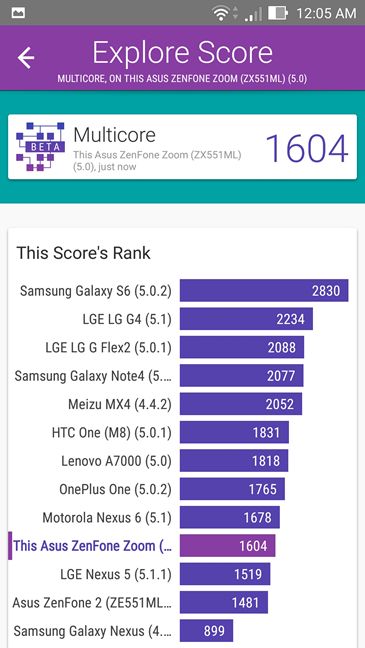
We started by testing the processor performance with an app called Vellamo. As you know, the ASUS ZenFone Zoom smartphone we had in tests is the variant with the Intel quad-core Z3850 processor that runs at a maximum frequency of 2.3GHz. The first test we ran on the ASUS ZenFone Zoom was Vellamo's Multicore test, which assesses the processor's multithreading efficiency. The smartphone scored 1604 points, which is a good score. It's slightly better than the ASUS ZenFone 2 and the LG Nexus 5, and slightly weaker than the Motorola Nexus 6.
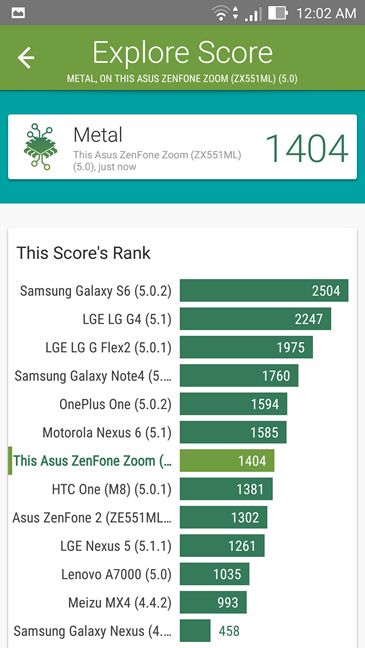
Unfortunately, not all the apps from the Play Store know how to use multiple processor cores. Some of them only know how to work with just one processor core and that's why the result of our next test is important. Vellamo's Metal test evaluates the performance you get from a single core of the processor. The ASUS ZenFone Zoom got 1404 points, which confirms the results we saw in the Multicore tests. The smartphone is better than the ASUS ZenFone 2 or the LG Nexus 5, but it's also weaker than the Motorola Nexus 6.
If you love to play games and you do that on any device you own, including on your Android smartphone, you will surely be interested by the scores the ASUS ZenFone Zoom got in our video benchmarks. We used the Manhattan and T-Rex tests offered by the GFXBench GL Benchmark app, and we only took into consideration their offscreen versions. If you're wondering why, the answer is that they are run at a 1080p resolution, regardless of the native resolution of the tested device and the ones with which we compare it to.
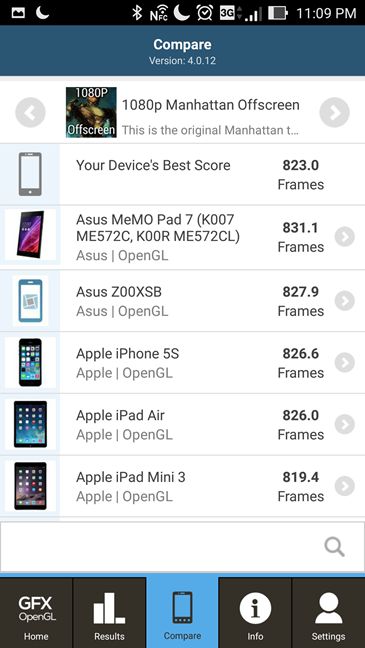
In the Manhattan test, the ASUS ZenFone Zoom managed to render 823 frames, which is a good result and puts it on par with Apple iPhone 5S, and much higher on the ranking ladder than a Samsung Galaxy S5 or a Xiaomi Mi 4, for example.
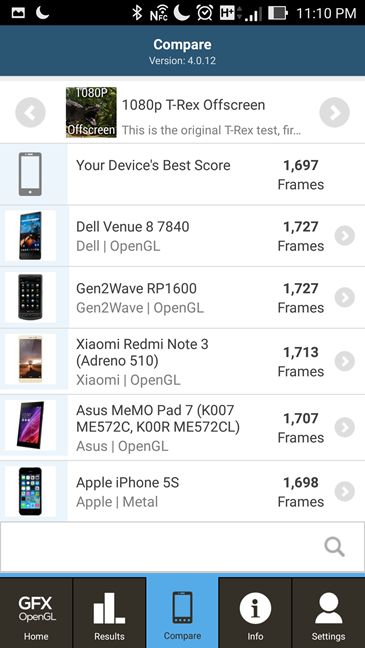
In the T-Rex test, the ASUS ZenFone Zoom rendered 1697 frames, a score which shows that the gaming performance offered by ZenFone Zoom is similar to what you'll get from an Apple iPhone 5S and better than what you'll get from a Samsung Galaxy S5.
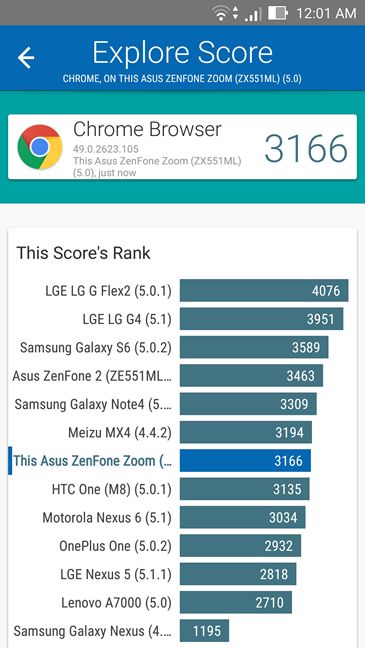
Next, we wanted to see how well the ASUS ZenFone Zoom did when it comes to browsing the Web. For that, we turned to Vellamo again, which also offers a browser test that measures the performance of a device when it has to render websites using things like HTML 5, CSS 3 or JavaScript. Using the Google Chrome web browser, the ZenFone Zoom managed to get 3166 points, ranking it higher than the HTC One M8 or the Motorola Nexus 6 (with Android 5.1), but also below what you'd get from a Samsung Galaxy S6 or from a Motorola Nexus 6 with Android 6. This is proof that newer Android is better Android. 🙂
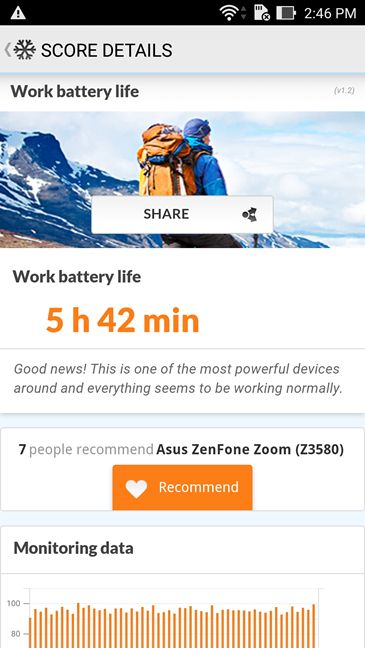
Just like its older brother, the ASUS ZenFone 2, the ASUS ZenFone Zoom uses a 3000 mAh Li-Polymer battery. Because all the rest of the hardware parts are almost the same, we were also expecting to see a similar autonomy on battery for these two devices. However, we had a surprise when we saw the results of the Work battery life tests we ran in PCMark. The ASUS ZenFone Zoom managed to hold on only for 5 hours and 42 minutes, while the older ZenFone 2 kept on running for 7 hours and 18 minutes.
The ASUS ZenFone Zoom is a powerful Android smartphone and it's probably able to handle anything you throw at it. However, its hardware would probably perform even better if it were handled by a newer operating system like Android 6 Marshmallow.
Product rating3/5
Verdict
The ASUS ZenFone Zoom is a high-end smartphone that packs powerful hardware inside a well designed body that is built with premium materials. Its main point of attraction is the 3X optical zoom camera. The camera is also the likely reason for the premium price you have to pay in order to get the ASUS ZenFone Zoom. All in all, we found the ASUS ZenFone Zoom to be a good smartphone but, after taking into consideration that it fails at what it should have done the best, which is the quality of its camera, we don't think that it is a great buy, at least not for its launch price. It would have deserved its premium price only if it had a better camera sensor, which allowed it to fulfill its promise of a great camera smartphone. Right now, ASUS ZenFone Zoom is worth buying only if you get it with a sensible discount.














Discussion (0)
Comments are closed.