



Mini PCs have been around for years. Brands like Intel NUC, ASUS PN series, and Minisforum have proved that serious computing power can fit in a small box. Most of them share the same fundamental problem: when something breaks or falls behind, you replace the whole unit.
Framework's first desktop computer takes a different approach. Announced in February 2025 and shipping from Q3 2025, it brings the same repairability philosophy that defined Framework's laptops into a 4.5-litre desktop. It also happens to contain one of the most interesting processors available in any small PC, making the hardware case as compelling as the design philosophy.
What Is Inside
The Framework Desktop is built around AMD's Ryzen AI Max processor family, specifically the Strix Halo architecture. This is not a laptop chip squeezed into a small box. Strix Halo is an ambitious design that puts a capable GPU alongside a powerful CPU inside a single unified package.
The top configuration uses the Ryzen AI Max+ 395. It brings up to 16 CPU cores with a 5.1GHz boost clock, Radeon 8060S graphics delivering discrete-level gaming performance, and support for up to 128GB of unified LPDDR5x memory with 256GB/s of memory bandwidth.
That memory bandwidth figure is what makes this processor unusual. Most mini PCs and laptops have memory bandwidth measured in the tens of gigabytes per second. The Ryzen AI Max+ 395 delivers 256GB/s. The practical consequence is that the GPU shares a massive pool of fast memory with the CPU. This enables AI inference on genuinely large models in a way that was previously impossible on consumer hardware without a dedicated server-class GPU.
Framework CEO Nirav Patel noted at the announcement that the Ryzen AI Max caused Framework to shift its entire roadmap by a year to accommodate it. When AMD first shared the chip details, the team immediately recognised it as the right foundation for a desktop.
The Repairability That Sets It Apart
Standard desktop PCs are already more repairable than laptops. ATX motherboards, PCIe slots, and off-the-shelf components mean experienced builders can swap most parts without drama. Framework had to think carefully about what additional value its approach could genuinely add here.
The answer is tool-free access and deliberate open design.
The case panels use thumbscrews and magnets rather than proprietary fasteners. Removing a panel to access components takes seconds with no tools at all. The internal layout is designed to be navigated intuitively rather than requiring a repair manual to avoid breaking clips. iFixit's early teardown noted that the Desktop uses standard connectors and off-the-shelf components throughout, with the tool-free panel design extending across all accessible parts of the machine.
The mainboard is also available to purchase separately, without the case. This allows builders to put the hardware into their own enclosure, mount it in a rackmount chassis, or run multiple mainboards in parallel. Framework has demonstrated this by building a mini-rack with four Desktop mainboards running simultaneously for AI inference testing.
The Expansion Card System Returns
Framework did not abandon the modular port system that defines its laptops. The Desktop includes two front-side expansion card slots using the same cards from the laptop ecosystem.
If you already own USB-A, USB-C, HDMI, DisplayPort, or storage expansion cards from a Framework laptop, they work in the Desktop without any changes. If you want to change your front-port configuration, you swap cards in seconds.
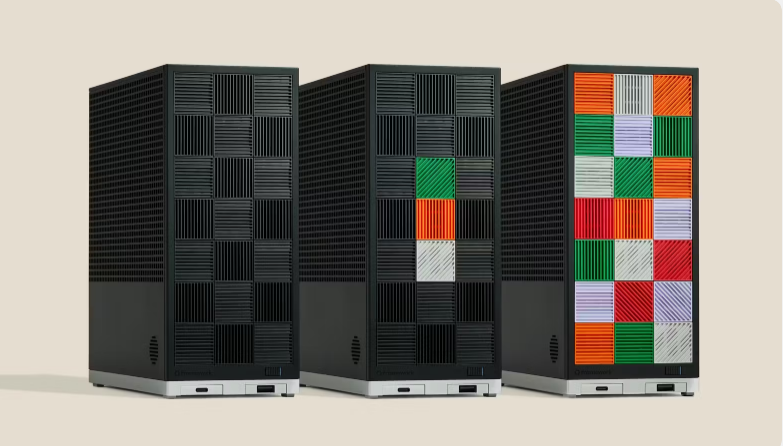
The front panel also includes 21 interchangeable decorative tiles for customising the appearance of the machine. This does not change performance, but it reflects Framework's broader approach of giving users control over every aspect of the device, including how it looks.
The AI Use Case
The 128GB of unified memory in the top configuration is the specification that makes this Desktop genuinely interesting for a growing audience.
Running large language models locally has been restricted by available memory in consumer hardware. A GPU with 16GB or 24GB of VRAM can handle smaller quantised models comfortably. Anything in the 70 billion parameter range requires either expensive server hardware or significant quality compromises through aggressive quantisation.
The Ryzen AI Max+ 395 with 128GB of unified memory changes this. Framework confirms that Llama 3.3 70B runs at real-time conversational speed using Ollama or llama.cpp. Other large open-weight models from Mistral, DeepSeek, and similar sources run without the memory constraints that force compromises on smaller consumer hardware.
The Hexagon NPU in the Ryzen AI Max delivers 50 TOPS of dedicated AI processing, comfortably meeting Microsoft's Copilot Plus certification requirements. For users running on-device AI workflows for productivity, development, or personal projects, the combination of NPU acceleration and 128GB of GPU-accessible memory creates a capable local AI workstation at a price that previously had no equivalent in this form factor.
The Gaming Side
The Radeon 8060S GPU inside the Ryzen AI Max is not a typical integrated graphics solution. AMD positions it as delivering discrete-level performance, and benchmarks support that claim at 1080p and 1440p resolutions.
The Desktop's sustained 120W power delivery and 140W boost allows the chip to run at its full performance envelope in a way that thin laptops with the same processor cannot. Thermal constraints in thin-and-light laptops force significant throttling. The Desktop's larger cooling solution, using a standard 120mm fan from Noctua or Cooler Master that can be swapped with any 120mm fan, provides the headroom the chip needs to sustain performance across long sessions.
Framework describes the result as capable of 1440p gaming on demanding titles. For an integrated GPU in a 4.5-litre enclosure, that is a genuinely strong result. The Desktop is a credible small gaming PC without requiring a discrete graphics card.
The One Compromise
Framework is transparent about where the Desktop departs from its usual principles.
The memory is soldered. Unlike Framework's laptops, where RAM is user-replaceable, the LPDDR5x in the Desktop is permanently attached to the mainboard. This is a direct consequence of the Ryzen AI Max's 256-bit memory bus. Achieving its bandwidth targets requires the memory to be physically close and directly connected to the processor. Framework spent months working with AMD to find a modular solution and concluded it was not technically feasible without sacrificing the memory bandwidth that makes the processor compelling.
Framework addressed this limitation by pricing memory configurations more reasonably than comparable products from other manufacturers. The Ryzen AI Max+ 395 with 128GB starts at $1,999, which is significantly below what 128GB unified memory machines with comparable GPU performance have historically cost elsewhere.
Soldered RAM is a real compromise for a company built on repairability. Framework acknowledges it plainly rather than reframing it as a benefit. That honesty is consistent with how the company has always communicated about its products.
Pricing and Software
The Framework Desktop starts at $1,099 for the base configuration and reaches $1,999 for the top-spec Ryzen AI Max+ 395 with 128GB of memory.
Software support mirrors the laptops. Windows 11 is fully supported alongside Ubuntu, Fedora, and Bazzite, the gaming-focused Linux distribution that has become popular in the handheld PC community. Framework's commitment to Linux compatibility is genuine rather than incidental, backed by active driver support and community documentation.
Who It Is Actually For
The Framework Desktop occupies a specific intersection that no other small PC currently fills.
Developers and researchers who want to run large language models locally without cloud inference costs or server-class GPU hardware will find the 128GB configuration at $1,999 has no direct equivalent in this form factor.
Users who want a capable small gaming PC they can repair themselves, maintain long-term, and expand with the same expansion card ecosystem as a Framework laptop get that without the compromises of a sealed device.
Anyone who values the Framework philosophy of genuinely owning hardware rather than being locked into a manufacturer's ecosystem gets a desktop built on open standards with tool-free access and a company committed to long-term parts availability.
It is not for someone who needs a discrete GPU for intensive 3D rendering or maximum-settings gaming. The Radeon 8060S has a real ceiling that a mid-range discrete GPU surpasses in demanding workloads.



Discussion (0)
Be the first to comment.