



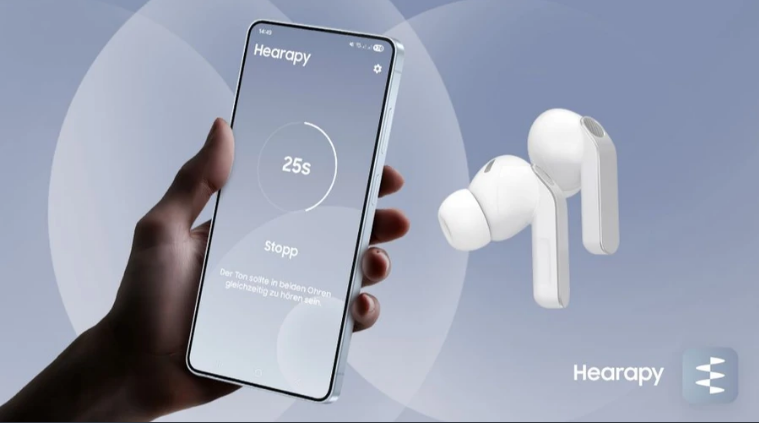
Samsung launched Hearapy on March 28, 2026, a free Android app that plays a precisely timed 100Hz tone through your earbuds for 60 seconds before travel. The premise is that this low-frequency sound stimulates the inner ear's balance system, reducing the nausea and dizziness associated with motion sickness for up to two hours.
The app is free, requires no Samsung account, and works on any Android device. It is available on the Google Play Store now.
Why Motion Sickness Happens
Motion sickness results from a sensory conflict. When you read your phone in a moving car, your inner ear detects the vehicle's movement and reports it to your brain. Your eyes, fixed on a static screen, report no movement at all. The brain receives contradictory signals it cannot reconcile and triggers a stress response. The result is the familiar nausea, dizziness, and discomfort that roughly a third of the population experiences during travel.
Most existing solutions are pharmaceutical. Antihistamines and scopolamine patches are effective but cause drowsiness. Acupressure wristbands have mixed evidence. Hearapy attempts something different: resolving the conflict at the source by stimulating the vestibular system before it becomes confused.
The Science Behind It
Hearapy is built on a peer-reviewed study from researchers Takumi Kagawa and Masashi Kato at Nagoya University Graduate School of Medicine, published in Environmental Health and Preventive Medicine in 2025. The researchers tested participants across three scenarios after brief tone exposure: a physical swing, a driving simulator, and actual car rides. In each case, brief exposure to a 100Hz tone at 75 to 85 decibels reduced motion sickness symptoms compared to a control group.
The mechanism is vestibular stimulation. The inner ear contains the vestibular system, which is responsible for balance and spatial orientation. A 100Hz bass sine wave, delivered at sufficient volume, stimulates this system directly through sound. The theory is that pre-stimulating the vestibular system helps the brain process conflicting sensory inputs more effectively when travel begins, reducing the severity of the mismatch response.
Samsung adapted the study's parameters directly into the app. The tone is 100Hz. The volume target is approximately 85 decibels. The duration is 60 seconds. The claimed effect window is up to two hours.
How to Use It
Download Hearapy from the Google Play Store. Connect your earbuds or headphones. Open the app and tap the large central button on the screen. A 60-second timer runs automatically while the tone plays. The app is intentionally minimal, with no complex menus or settings to navigate, which is practical given that users are often already feeling unwell.
Samsung advises setting the volume loud but comfortable. The app includes guidance but no automatic volume calibration, meaning you control the output level. At 85 decibels the tone produces a noticeable low-frequency vibration sensation in the ear. Some users find this disorienting initially.
If symptoms continue after the first session, Samsung says you can repeat it. The majority of tested cases showed improvement after the first minute of use.
The Galaxy Buds 4 Pro Recommendation
Samsung recommends the Galaxy Buds 4 Pro as the optimal hardware for Hearapy. The reason is technical rather than commercial. Reproducing a clean 100Hz tone at the target volume requires earbuds capable of accurate low-frequency bass reproduction. The Galaxy Buds 4 Pro feature a larger vibration surface and a two-way speaker system designed to handle deep bass cleanly.
However, the app works with any earbuds or headphones that can reproduce 100Hz. Most quality in-ear buds and over-ear headphones reach this frequency without difficulty. Budget earbuds with weak bass response may not reproduce the tone accurately enough to replicate the studied effect, which is the practical limitation Samsung is indirectly acknowledging with the Galaxy Buds recommendation.
9to5Google tested the app with Jabra Elite Gen 2 earbuds, which reach as low as 20Hz, and confirmed the tone played correctly. The effect outside Samsung's own hardware likely varies based on driver quality and fit rather than brand.
What the Science Does Not Confirm
Being clear about the limitations of the evidence is important before treating Hearapy as a clinically validated medical intervention.
The Nagoya University study is one peer-reviewed study. It found that the 100Hz tone reduced symptoms in specific, bounded scenarios. The word the researchers used was alleviates, not eliminates. Several early media reports used the word cure, which overstates what the research actually showed.
Hearapy itself has not been independently tested as a consumer product. There are no published trials of the app running on consumer hardware under real travel conditions. The variability in bass response across different earbud models means not all devices reproduce the studied stimulus accurately. Samsung's app cannot assess or compensate for a given earbud's actual 100Hz output at your ear.
The two-hour relief figure comes from Samsung's own communications rather than from independent research measuring app-specific outcomes.
None of this makes Hearapy implausible. The underlying mechanism is credible, the source research is peer-reviewed, and the parameters match the study. It makes Hearapy a consumer translation of early-stage research rather than a clinically validated treatment, which is a meaningful distinction for anyone with severe motion sickness who might otherwise rely on medication.
Who Should Try It
For anyone who gets mildly to moderately motion sick during car travel, Hearapy is worth testing. Car travel is the closest real-world context to what the Nagoya study actually examined. The risk is minimal: the app is free, the session takes 60 seconds, and brief exposure to a 100Hz tone at moderate volume carries no meaningful hearing risk for most people.
For people with severe motion sickness that makes travel significantly difficult, Hearapy is worth trying alongside rather than instead of established approaches. For those who experience motion sickness predominantly in other contexts like air travel or sea travel, the evidence is thinner because those scenarios were less central to the original research.
Samsung positions Hearapy as a drug-free alternative to antihistamines and patches. For users who dislike the drowsiness associated with medication, that is a reasonable framing given the current evidence, with the caveat that the app has not been directly compared to pharmaceutical interventions in clinical trials.
Frequently Asked Questions
Does Hearapy work with iPhones?
No. Hearapy is available only on Android through the Google Play Store. It is not available on iOS. Samsung has not announced an iPhone version.
Do I need Galaxy Buds to use it?
No. The app works with any earbuds or headphones that can reproduce a 100Hz tone. Samsung recommends the Galaxy Buds 4 Pro for the most accurate bass reproduction, but the app functions on any compatible Android device with any capable earbuds. The practical question is whether your earbuds reproduce deep bass cleanly enough to match the study's parameters.
Is the app safe to use regularly?
The app plays a 100Hz tone at approximately 85 decibels for 60 seconds. Brief, occasional exposure at this volume is generally considered safe. Repeated sessions at maximum volume over extended periods could contribute to hearing fatigue in sensitive users. Samsung includes guidance to keep the volume loud but comfortable rather than at the maximum your device can produce.


Discussion (0)
Be the first to comment.