



Proton launched Proton Workspace on March 31, 2026. It is a bundled productivity suite that packages all of Proton's existing tools alongside new additions into a single subscription designed to replace Google Workspace or Microsoft 365 for privacy-conscious organisations.
The launch also introduced Proton Meet, a new end-to-end encrypted video conferencing platform built specifically to rival Zoom and Google Meet.
What the Suite Includes
Proton Workspace ships with the following products across both plans:
Proton Mail is Proton's flagship encrypted email service, which the company has offered since 2014. It supports custom email domains for businesses and end-to-end encryption by default.
Proton Calendar handles team scheduling and now includes appointment scheduling tools for external bookings.
Proton Drive provides encrypted cloud storage for files and folders with real-time collaborative access.
Proton Docs is Proton's encrypted document editor for collaborative writing.
Proton Sheets is the encrypted spreadsheet tool, released in December 2025, which addressed the most significant remaining gap in the suite before this launch.
Proton Meet is the headline new product. It is an end-to-end encrypted video conferencing platform built on the Messaging Layer Security protocol, an open standard that encrypts all audio, video, screen sharing, and in-call messages by default. Unlike Zoom, Google Meet, or Microsoft Teams, Proton cannot access the contents of calls because the encryption architecture gives Proton no access to call data.
Proton VPN is included in both plans, providing encrypted internet access and network protection alongside the productivity tools.
Proton Pass is Proton's encrypted password manager for managing team credentials securely.
The Two Plans and What They Cost
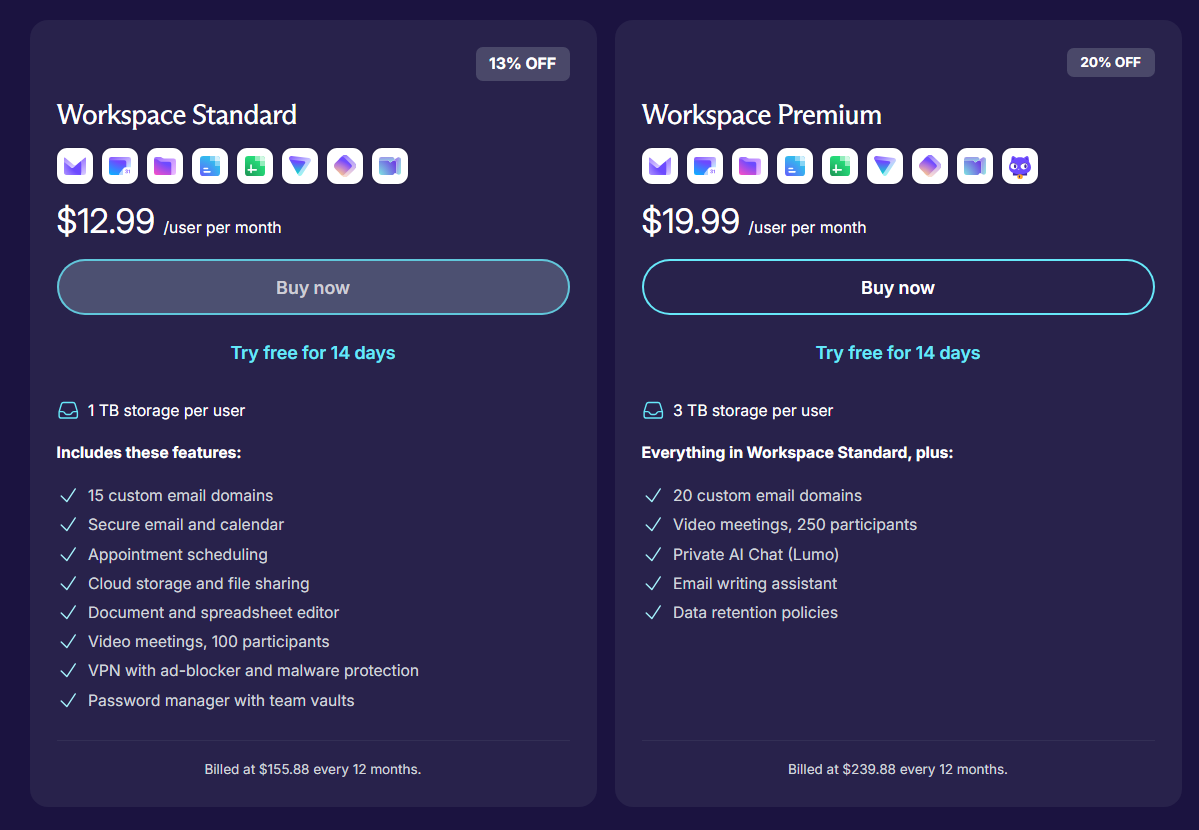
Workspace Standard costs $12.99 per user per month billed annually, or $14.99 per month. It includes all of the above tools, 1TB of encrypted storage per user, support for up to 15 custom email domains, and video meetings for up to 50 participants simultaneously.
Workspace Premium costs $19.99 per user per month billed annually. It adds 3TB of storage per user, up to 20 custom email domains, video meetings for up to 250 participants, email data retention policies for compliance, and access to Lumo, Proton's privacy-first AI assistant, with unlimited prompts.
Both plans offer a 14-day free trial. Enterprise customers, large organisations, public sector bodies, and nonprofits can contact Proton's sales team for custom pricing.
Lumo: The Privacy-First AI Assistant
Lumo is Proton's answer to Copilot, Gemini, and ChatGPT. It is available with unlimited access on the Workspace Premium plan and with limited prompts on Standard.
The key distinction from other AI assistants is architectural. Lumo processes prompts only to generate a reply. After generating the response, the plaintext of the prompt is immediately erased. Proton states that Lumo never trains AI models using user conversations and never shares data with third parties or governments. The privacy guarantee here is structural rather than just a policy statement, because Proton's zero-access encryption means the company cannot read the data even if compelled to.
Proton also announced a Lumo API on its spring and summer 2026 roadmap, which will allow other businesses to integrate Lumo into their own products and workflows.
The Encryption Architecture That Defines It
The core differentiator between Proton Workspace and Google Workspace or Microsoft 365 is not the feature set. It is the encryption model.
Google and Microsoft both offer encryption for data at rest and in transit. However, both companies hold the encryption keys, which means they can decrypt and read your data if they choose to, if required to by law, or if their infrastructure is compromised. Both companies' business models are built substantially on data analysis.
Proton uses end-to-end encryption and zero-access encryption throughout the suite. Zero-access means that data is encrypted on your device before it reaches Proton's servers. Proton holds no decryption key. If Proton's servers were compromised, the attacker would find only encrypted data they cannot read. If a government compelled Proton to hand over data, Proton could only provide encrypted files it cannot decrypt itself.
All Proton apps are open source, meaning independent security researchers can and do verify that the encryption works as described and that no backdoors exist. Proton is also independently audited on a regular basis.
The Compliance and Jurisdiction Advantage
Proton is headquartered in Geneva, Switzerland, and is majority-owned by a non-profit foundation. Switzerland's privacy laws are among the strongest in the world.
For European organisations subject to GDPR, and for any business that handles sensitive data and worries about US legal exposure, this jurisdiction matters. The US CLOUD Act allows American authorities to compel US-headquartered technology companies to hand over user data regardless of where it is physically stored. This has become a compliance concern for European organisations using Google Workspace or Microsoft 365. Proton, operating under Swiss law, explicitly sits outside that legal framework.
Proton Workspace is ISO 27001 certified and SOC 2 Type II audited. It supports compliance with GDPR, HIPAA, and CCPA, with a Business Associate Agreement available for healthcare organisations subject to HIPAA. This makes the suite viable for law firms, healthcare providers, financial services companies, and public sector bodies where regulatory compliance is a hard requirement rather than a preference.
Who Proton Workspace Is and Is Not For
Proton is targeting specific segments rather than trying to compete with Google and Microsoft across every customer category.
The primary audience is organisations for whom encryption is a requirement, not a preference. Law firms protecting client privilege, healthcare providers managing patient data, financial services firms handling sensitive client information, NGOs operating in politically sensitive environments, and journalists protecting source communications all fit this profile. Proton reports over 100,000 enterprise customers and a growing shift from individual product purchases to full ecosystem adoption.
The limitations worth knowing are real. Proton Sheets is new and less feature-complete than Google Sheets or Microsoft Excel for complex spreadsheet work. There is currently no presentation tool, meaning Proton cannot fully replace Google Slides or PowerPoint. Offline editing for Docs and Sheets is more limited than Google's or Microsoft's offline capabilities. Third-party integrations are far fewer than either major platform offers.
Proton CEO Andy Yen acknowledged the challenge directly: "We're offering a secure, bundled alternative that matches the ease of migration and integration of Google or Microsoft, but without the privacy trade-offs." That is an accurate description of both the ambition and the current gaps. The suite is mature enough to replace Google Workspace or Microsoft 365 for teams where privacy is the primary requirement. For teams where deep feature parity and extensive integrations are the primary requirement, it is not yet a complete substitute.
Frequently Asked Questions
Is Proton Workspace actually cheaper than Google Workspace?
When you account for what is included, it can be. Google Workspace Business Starter starts at $7 per user per month but does not include a VPN or password manager. When you add the cost of a comparable VPN and password manager separately, the total exceeds Proton Workspace Standard's $12.99. For organisations that need all three, Proton Workspace offers better value. For organisations that do not need VPN and password management, Google is cheaper.
Can Proton actually not read my emails and files?
Yes, structurally. Proton's zero-access encryption means files, emails, and documents are encrypted on your device before they reach Proton's servers. Proton holds no decryption key. The company cannot read the content even if compelled by a government authority. This is verified through open-source code and independent security audits rather than relying solely on Proton's own assurances.
Does Proton Meet require an account to join a call?
Proton Meet is designed with a no-account-required model for participants joining calls, making it accessible for teams that work with external clients or partners who are not Proton users. The host needs a Proton Workspace account, but joining a meeting link does not require one.


Discussion (0)
Be the first to comment.