




Most games give you a gun, a sword, or a character to move around a world. osu! gives you circles. Your job is to click them in time with the music.
That description makes it sound simple. It is not. osu! is one of the most demanding skill-based games ever made, with a ceiling so high that reaching the top requires years of dedicated practice. It is also completely free, available on every major platform, and home to one of the most passionate gaming communities on the internet. As of 2026, over 30 million accounts have been created, with around 20,000 players active daily.
Where osu! Came From
osu! was created by Australian developer Dean Herbert, known online as peppy, and released on September 16, 2007. The original inspiration was a Nintendo DS game called Osu! Tatakae! Ouendan, a Japanese rhythm game where players tapped circles, traced sliders, and spun wheels in time with music to encourage on-screen cheerleaders. Herbert recreated that experience for PC and eventually expanded it into a full platform.
What made osu! different from most rhythm games was that it did not come with a fixed song library. Instead, players could create and upload their own beatmaps for any song they chose. This community-driven model meant the available song library grew essentially without limit. Today there are millions of beatmaps available, covering every genre from anime soundtracks to classical music to pop, metal, and electronic.
How the Game Actually Works
The core concept is consistent across all game modes. A song plays. Objects appear on screen. You interact with those objects at precisely the right moment. How accurately you time your inputs determines your score.
Every beatmap, which is what osu! calls its levels, is created specifically for a song. The mapper listens to the music and places objects that correspond to the rhythm, melody, and feel of the track. A well-made beatmap feels like you are playing the music itself rather than just reacting to prompts.
There are four game modes, each with its own mechanics and dedicated community.
The Four Game Modes
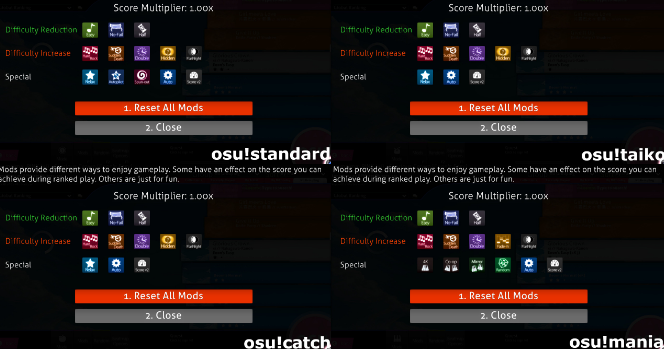
osu!standard
This is the original mode and still the most popular. Hit circles appear on screen and shrink inward. You click or tap each one exactly as the shrinking ring closes in. Miss the timing and you lose health. Miss enough and the song ends.
Beyond simple circles, there are sliders, which require you to click and drag your cursor along a path, and spinners, which require you to rotate your cursor rapidly for a moment. Higher difficulty maps push circles closer together, require faster clicking, and place patterns that demand precise mouse control and quick hand movement.
Most players use a combination of a mouse or drawing tablet for cursor movement and keyboard keys for clicking. Using a graphics tablet instead of a mouse removes the issue of mouse drift and allows more precise cursor control, which is why many competitive players switch to tablets as they advance.
osu!taiko
This mode is inspired by Taiko no Tatsujin, a popular Japanese arcade drumming game. Notes travel from right to left. When they reach the hit zone, you press one of four keys that represent the centre or rim of a virtual drum.
Red notes use the centre keys. Blue notes use the rim keys. Large versions of each note require pressing both corresponding keys simultaneously. The mode also features drum rolls requiring rapid alternating presses and swells requiring sustained rapid input.
osu!taiko rewards strong rhythm sense and clean finger alternation. It is considered one of the most accessible modes to begin with, though high-level play requires significant stamina and speed.
osu!catch
Formerly called Catch the Beat, this mode places you in control of a character at the bottom of the screen. Fruit falls from above. Move left and right to catch it. Miss enough and the song fails.
The challenge comes from the speed and density of falling objects at higher difficulties, as well as Hyper Dash mechanics that require split-second directional changes to cover large horizontal distances quickly. The mode rewards strong spatial awareness and fast reflexes rather than the hand-eye coordination of osu!standard.
osu!mania
This mode resembles games like IIDX or DJMax. Notes fall down multiple vertical columns. Press the corresponding key as each note reaches the judgement line at the bottom of the screen. Long notes, called hold notes, require pressing and holding the key for the note's duration.
The most common formats are 4-key and 7-key, though the mode supports anywhere from one to nine keys. osu!mania rewards finger independence, fast reaction time, and the ability to process multiple simultaneous inputs cleanly. It is the closest of the four modes to traditional keyboard rhythm games.
The Ranking System and Performance Points
osu! does not rank players simply by score. It uses a system called Performance Points, abbreviated as PP. Every play you make earns a PP value based on two factors: how difficult the beatmap is and how well you played it.
Accuracy, combo, and the number of missed notes all affect your PP. Playing a very hard map poorly earns less PP than playing a moderately hard map nearly perfectly. Your total global PP ranking comes from a weighted sum of your best plays, with your top play contributing the most and subsequent plays contributing diminishing amounts.
This system means raw grinding does not automatically improve your rank. To earn significant PP, you need to genuinely improve your skill level, because harder maps that push your limits are what generate meaningful PP. The system has been praised for creating an accurate representation of a player's actual ability.
The Beatmap Community
The community-created beatmap system is the engine that has kept osu! alive for almost two decades. Any registered user can create a beatmap using the game's built-in editor. Mappers listen to a song, place hit objects timed to the music, and upload their work to the osu! servers for others to play.
Beatmaps go through a modding and ranking process where experienced community members review them for quality, consistency, and playability. Ranked beatmaps contribute to PP. Loved beatmaps, which do not contribute to PP but have been voted on by the community as notable or beloved, form a separate category for maps that may not meet ranked standards but have strong player support.
The music library spans essentially every genre imaginable. Anime music dominates, reflecting osu!'s roots and its association with Japanese gaming culture, but competitive and community players have created high-quality maps for virtually every style of music.
Why Players Get Obsessed
osu! occupies an unusual position in gaming. It is entirely skill-based in a way that almost no other game is. A player cannot get lucky in osu!. You either click the circle at the right time or you do not. Progress is entirely determined by practice and improvement.
This creates a deeply satisfying feedback loop. When you first start, even straightforward maps feel chaotic. After a few weeks of consistent play, patterns you once found overwhelming become manageable. After months, you start reading complex streams and jumps that previously looked impossible. The progress is real and measurable, which is part of what makes the game so compelling.
The ceiling is genuinely extreme. The world's best players, including the current top-ranked player mrekk from Australia, execute beatmaps at speeds and densities that appear physically impossible to newcomers. Even watching these players is impressive, which has contributed to osu!'s strong YouTube and Twitch presence.
In early 2025, an AI VTuber called Neuro-sama became an internet phenomenon partly through playing osu! at a high level and even defeating mrekk in a one-versus-one match, which brought a new wave of interest to the game.
Getting Started
osu! is free to download from osu.ppy.sh. Create an account, download the client, and you are in. The game includes a tutorial and a set of beginner beatmaps to help you understand each game mode.
New players should focus on the basics before worrying about difficulty or ranking. Start at one to two star beatmaps. Focus on timing accuracy rather than trying to maintain combo. Let yourself fail songs repeatedly. Progress in osu! is gradual and cumulative.
Most players find that switching between mouse-only to a tablet or to a mouse-plus-keyboard setup early on saves time compared to developing habits they have to unlearn later. The two-key keyboard setup, where one key handles most clicks and the second alternates in, is the standard approach for osu!standard.
Patience is more important than talent in osu!. Every player starts at the same point and improves through repetition. The ceiling is so high that no matter how good you become, there is always something harder to work toward.



Discussion (0)
Be the first to comment.