



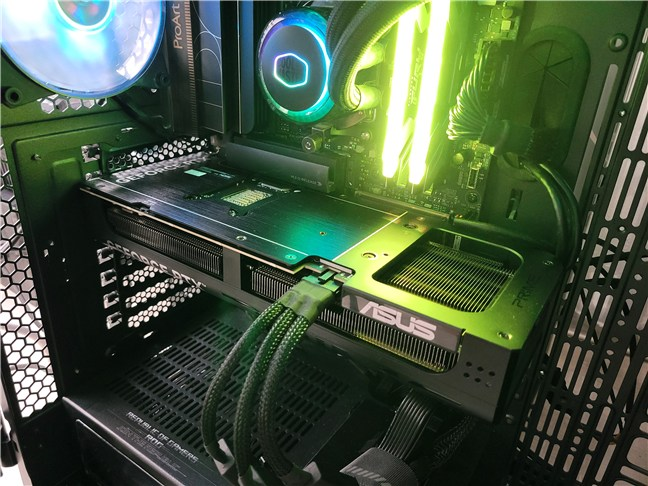
If your PC sounds like a jet taking off every time you start a game, and you have already cleaned the dust, replaced the thermal paste, and adjusted the fan curve, there is one more thing worth trying that most people never even know about. It is called undervolting, it is completely free, it requires no hardware changes, and it can drop your GPU temperatures by 10 to 15 degrees while making your fans noticeably quieter, all without losing a single frame of performance.
That last part is the bit that surprises people. You are not giving anything up. In many cases, you actually gain something.
What Undervolting Actually Means
Your graphics card runs on electricity. More specifically, it runs on a specific voltage of electricity, and that voltage determines, along with the clock speed, how much heat the card produces.
GPU manufacturers face a problem when they design their cards. They cannot test every individual chip that comes off the production line. Every chip is slightly different, a phenomenon called the silicon lottery, and some chips need more voltage to hit a target clock speed than others. So manufacturers set the voltage conservatively high, high enough to guarantee that even the least efficient chips in the batch will work reliably.
The result is that your specific GPU is almost certainly being fed more voltage than it actually needs. You are paying for it in electricity, in heat, and in fan noise, and you are getting nothing in return for that extra voltage except a hotter, louder system.
Undervolting means finding the minimum voltage at which your specific GPU can run its target clock speeds stably, and telling it to use that instead. Less voltage, less heat. Less heat, slower fans. Slower fans, quieter PC. Same clock speed, same performance.
Why It Works So Well
The relationship between voltage and heat is not linear. It is exponential. A relatively small reduction in voltage produces a disproportionately large reduction in heat output. Cutting voltage by 5 to 10 percent can drop temperatures by 15 to 20 percent. This is why undervolting feels almost too good to be true the first time you do it.
There is another benefit that catches people off guard. Modern GPUs thermal throttle, meaning they automatically reduce their clock speeds when they get too hot to protect themselves. If your GPU is regularly hitting thermal limits during long gaming sessions, it may actually be running below its rated boost clock. After undervolting, the card runs cooler, the fans keep up more easily, and the GPU can sustain its full boost clock for longer. Some people actually see a small performance improvement from undervolting, precisely because they were throttling before without realising it.
What You Need
You need two pieces of free software. The first is MSI Afterburner, which works on Nvidia and AMD cards regardless of the brand of card you have. The second is HWiNFO64, which lets you monitor GPU temperature, power draw, and clock speeds in real time while you are testing.
Download both from their official websites. Install Afterburner with the default options, which includes RivaTuner Statistics Server as a companion application. You need that too.
Before touching any settings, run a benchmark or play a demanding game for around 15 minutes and note your GPU's peak temperature and typical clock speed. Write these down. They are your baseline, and you will want them for comparison after the undervolt.
The Actual Process
1: Unlock Voltage Control in Afterburner
Open MSI Afterburner. Click the gear icon to open Settings. Under the General tab, tick the boxes for Unlock voltage control and Unlock voltage monitoring. Click OK and restart Afterburner. Without this step, the voltage editing controls will be greyed out.
2: Open the Voltage Frequency Curve Editor
Press Ctrl and F in Afterburner. A graph appears with voltage in millivolts on the horizontal axis and clock speed in megahertz on the vertical axis. This is your GPU's voltage curve. Each point on it represents a clock speed your GPU targets at that specific voltage level. The curve generally rises from left to right: lower voltages produce lower clocks, higher voltages produce higher clocks.
3: Find Your Target Frequency
Look at the right end of the curve where your GPU's maximum boost clock sits. Run HWiNFO64 alongside a benchmark and note the clock speed your GPU typically sustains under load. This is the speed you want to maintain at a lower voltage. For example, if your GPU is hitting 2700MHz at 1100mV, your goal is to maintain 2700MHz at something closer to 1000 or 1050mV.
4: Flatten the Curve
This is the core of undervolting. Find the point on the voltage axis corresponding to your target lower voltage, around 50 to 75mV below where your current max clock sits. Hold Shift and click that point on the curve. This selects every point to the right of it simultaneously. Now drag that selected point upward until all the selected points are sitting at your target clock speed. The curve should flatten across the right portion, meaning your GPU will try to run at the same clock speed across a range of voltages rather than climbing continuously.
This sounds more complicated in text than it is in practice. When you see the graph in front of you, it clicks immediately.
5: Apply and Test
Click the tick mark button in Afterburner to apply your new voltage curve. Now stress test the GPU for at least 15 minutes using Furmark or 3DMark, or simply play a demanding game. Monitor your temperatures and clock speeds in HWiNFO64.
If the system runs stably at lower temperatures without crashing, you have found a working undervolt. If it crashes or you see visual artefacts on screen, the voltage is too low for your chip. That is the worst outcome: a crash that you fix by pressing Ctrl and F again and bringing the voltage point up by 25mV, then testing again.
6: Iterate and Save
Most cards need a few rounds of testing to find the sweet spot. Start conservatively, bringing the voltage down by 50mV from stock. If that passes testing, try another 25mV reduction. Keep going until you find instability, then back off by 25 to 50mV to the last stable point. Once you have a stable configuration, click the save profile button in Afterburner and save it to one of the numbered slots. Enable the option to apply this profile at Windows startup so your settings load automatically every time.
What Kind of Results to Expect
The improvements vary between cards and individual chips, but they are consistently real. Most modern Nvidia and AMD cards drop 8 to 15 degrees Celsius under load after a good undervolt. Fan noise drops noticeably because the fans do not need to spin as hard to maintain lower temperatures. Power draw from the wall goes down, which adds up meaningfully on electricity bills if you game for hours daily.
On cards that were thermally throttling, you can see a small but genuine bump in average frame rates and more consistent frame times in CPU-bound games. On cards that were not throttling, performance stays essentially identical to stock.
Is It Safe?
Yes. Undervolting is the opposite direction from the kind of modifications that can stress or damage hardware. You are reducing electrical stress on the chip, not increasing it. The worst thing that happens during an unsuccessful undervolt attempt is a crash or driver restart, which you resolve by adding voltage back. There is no scenario where undervolting correctly damages your GPU.
It does not void your warranty. Unlike overclocking, which pushes hardware beyond its rated specifications, undervolting simply runs the card at lower electrical stress within its designed operating range.
The settings are also completely software-based. If you ever want to go back to stock behaviour entirely, uninstalling Afterburner or not loading the profile at startup returns your GPU to its factory defaults instantly.
Final Thoughts
Undervolting is genuinely one of the best things you can do for a desktop PC. Free, safe, reversible, and with real tangible results. A GPU that runs 12 degrees cooler is a GPU whose fans spin slower, whose components age less quickly, and whose thermal throttle sits comfortably further away from where normal gaming loads land. If you have never done it, set aside an hour on a weekend and give it a try. The process feels technical until you actually open the curve editor, at which point it becomes obvious, almost intuitive, and the results show up immediately in your temperature readings.
Frequently Asked Questions
Can undervolting actually improve performance?
In cases where your GPU was thermally throttling before the undervolt, yes. When a GPU hits its thermal limit, it reduces its own clock speed to bring temperatures down. Undervolting removes that ceiling, allowing the card to sustain its full boost clock. If your GPU was not throttling, performance stays essentially identical to stock.
What is the difference between undervolting and lowering the power limit?
Lowering the power limit in Afterburner is a simpler but blunter approach. It caps the total power the GPU can draw, forcing it to reduce clock speeds under sustained load. Undervolting is more precise. You maintain the same clock speeds but at lower voltage, so you lose less performance while still reducing heat and power draw.
Does undervolting work differently on AMD versus Nvidia cards?
The concept is identical but the tools differ slightly. Nvidia cards are best undervolted using MSI Afterburner's voltage curve editor as described above. AMD cards can also use Afterburner, or AMD's own software through a feature called Radeon Chill and the manual voltage controls in AMD Software: Adrenalin Edition. The process is similar but the interface looks different.
Will I need to redo my undervolt after a driver update?
Sometimes. Driver updates occasionally reset power management settings or change how the GPU reports voltage, which can affect your saved profile's behaviour. After any major driver update, it is worth checking your temperatures again and re-running a stability test to confirm everything still holds.
What should I do if my screen goes black or the system crashes during testing?
This means the voltage is too low for the clock speed you asked for. In most cases, Windows will recover automatically within a few seconds by resetting the GPU driver. Open Afterburner again, go back into the curve editor, and raise your voltage point by 25mV. Test again. This is a normal and expected part of the process and causes no damage.


Discussion (0)
Be the first to comment.