



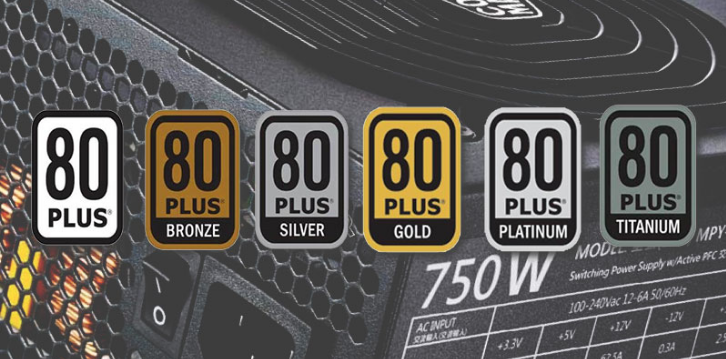
The power supply is the component that almost nobody thinks about until it dies. When building or buying a PC, most people spend their time comparing CPUs and GPUs and RAM, then make a quick decision on the PSU based on wattage alone. The efficiency rating badge sitting on the box, Bronze, Gold, Platinum, Titanium, gets a passing glance and then ignored.
That is a shame, because the efficiency rating tells you something meaningful about the component that every single watt in your system passes through. Understanding it takes about five minutes, costs nothing, and can genuinely inform a better buying decision.
What Efficiency Actually Means
Your power supply's job is to take the alternating current coming from your wall socket and convert it into the direct current that your PC components run on. No power supply does this conversion perfectly. Some energy is lost as heat during the process.
Efficiency is simply the ratio of useful power delivered to your components versus the total power drawn from the wall. A power supply that draws 500 watts from the wall and delivers 400 watts to your PC is operating at 80% efficiency. The remaining 100 watts is wasted as heat inside the PSU.
This matters in two ways that are easy to overlook. First, that wasted heat has to go somewhere. Your PSU fan runs faster to manage it. The temperatures inside your case rise. Second, you are paying your electricity provider for every watt drawn from the wall, including the wasted portion. A less efficient PSU costs more to run every single day it is powered on.
What the 80 Plus Program Actually Is
80 Plus is a voluntary certification program that has been running since 2004, managed by an organisation called CLEAResult. The premise is straightforward: any power supply that passes testing and meets the efficiency thresholds earns certification and can display the badge.
The baseline requirement for any 80 Plus certification is that the PSU must operate at at least 80% efficiency when tested at three different load levels: 20%, 50%, and 100% of its rated capacity. A PSU that passes this basic test earns the standard 80 Plus certification. Higher tiers require higher efficiency at each of those same load points.
The testing is conducted in a certified lab under controlled conditions. All results are published publicly on CLEAResult's website, so you can verify any specific model's actual measured performance rather than relying solely on marketing claims. This matters because there have been documented cases of manufacturers claiming certifications their products do not legitimately hold.
The Tiers Explained
The hierarchy runs from the baseline certification up through Bronze, Silver, Gold, Platinum, and Titanium. Silver is rarely seen in practice since most manufacturers focus on Bronze or Gold, so it is mostly of academic interest.
| Certification | Efficiency at 20% load | Efficiency at 50% load | Efficiency at 100% load |
|---|---|---|---|
| 80 Plus (Standard) | 80% | 80% | 80% |
| 80 Plus Bronze | 82% | 85% | 82% |
| 80 Plus Silver | 85% | 88% | 85% |
| 80 Plus Gold | 87% | 90% | 87% |
| 80 Plus Platinum | 90% | 92% | 89% |
| 80 Plus Titanium | 90% | 94% | 90% |
These numbers are for 115V systems, which covers North America. European units tested at 230V have slightly higher efficiency requirements at each tier.
Looking at these numbers, a few things stand out. The jump from Bronze to Gold is more meaningful than it might appear at a glance. At 50% load, the difference is five percentage points. For a system that draws 300 watts at typical gaming load, that translates to the Gold PSU wasting 30 watts less than a Bronze unit at that load level. Over a year of daily use, that adds up to a real number on your electricity bill.
The jump from Gold to Platinum is smaller, around two to three percentage points depending on the load level. Titanium adds more efficiency specifically at lighter loads, which is why it matters for systems that spend a lot of time idling.
What Wasted Watts Cost You in Real Money
The calculation is simpler than most people realise. Take the wasted watts at your typical load, multiply by the hours your PC runs per year, divide by 1000 to get kilowatt-hours, and multiply by your electricity rate.
A practical example: a gaming PC drawing 300 watts at the wall during a typical session. A Bronze PSU operating at 85% efficiency at that load wastes 53 watts. A Gold PSU operating at 90% wastes 33 watts. The difference is 20 watts. Running the PC for 2,000 hours a year, that is 40 kilowatt-hours of difference annually. At the UK average electricity rate of around 24p per kilowatt-hour, that is roughly £10 per year saved by choosing Gold over Bronze.
Over a five year PSU lifespan, that is £50 saved. If the Gold unit costs £15 more than the Bronze equivalent, the efficiency pays for itself and then some.
The calculation becomes more compelling the more the PC is used, the higher your local electricity costs, and the more power-hungry the system. A high-end gaming rig with a flagship GPU drawing 500 watts under load sees the efficiency difference translate into significantly more money over time. A light office PC that rarely exceeds 100 watts sees very little practical difference between tiers.
The Heat Argument Is Equally Relevant
The financial case for efficiency is real but modest for most users. The thermal and reliability case is arguably more important.
Every watt wasted as heat inside the PSU has to be managed by the PSU fan. A less efficient unit runs hotter. Its fan works harder. The components inside the PSU, capacitors in particular, age faster at elevated temperatures. A cooler running PSU lasts longer and is less likely to fail in a way that damages other components.
Higher rated PSUs also tend to use better quality internal components to achieve their efficiency targets. The correlation is not perfect, and efficiency rating alone does not guarantee a well-built unit, but a Platinum or Titanium certified PSU from a reputable brand is almost certainly going to contain better capacitors, better inductors, and better overall build quality than a Bronze unit at the same wattage from the same brand.
This has a secondary effect on your whole system. A power supply with tighter voltage regulation and less ripple delivers cleaner power to your CPU, GPU, and motherboard. Clean power means those components operate with less electrical noise, which is a minor but real factor in long-term component longevity.
Efficiency at Low Loads and Why Titanium Cares
One quirk of the 80 Plus testing regime is that it only tests at 20%, 50%, and 100% load. The Titanium tier adds a fourth test point at 10% load, which is where many systems spend a significant amount of time when idle, browsing, or doing light tasks.
A typical gaming PC doing light work might be drawing only 80 to 100 watts, which on a 750W PSU is around 10 to 13% of rated capacity. At that load level, Bronze and Gold units can drop to efficiency figures meaningfully below their rated performance at heavier loads. Titanium units are required to maintain high efficiency even there.
If your PC is on for long hours doing a mix of demanding and light work, and especially if you leave it on overnight or run it as a light server, Titanium's advantage at low loads is a legitimate practical benefit rather than a theoretical one.
What Rating to Actually Choose
For most gaming and everyday desktop builds, the sensible answer is Gold. It has become the standard for quality builds at sensible prices. The efficiency gap over Bronze is real and eventually pays back through electricity savings, the component quality correlation is meaningful, and the price premium is no longer dramatic. In 2026, Gold units from reputable brands are widely available at price points that once only got you Bronze.
Bronze is perfectly acceptable for lower-powered systems and tighter budgets. A good Bronze unit from a reputable manufacturer is vastly preferable to a no-name unit with a suspicious Gold badge. For anything under 400 watts of system draw, the efficiency savings from going to Gold are smaller in absolute terms.
Platinum makes financial sense for high-powered systems, systems that run continuously, or situations where electricity costs are particularly high. The price premium over Gold is moderate enough that for a capable gaming rig used heavily, it pays off over a multi-year lifespan.
Titanium is for enthusiasts, professionals, and anyone running hardware around the clock where every watt genuinely matters. For a typical home gaming PC used a few hours an evening, the Titanium premium is hard to justify purely on running cost savings.
The Most Important Caveat
The 80 Plus rating tells you about efficiency. It does not tell you everything about PSU quality. A Bronze unit from Seasonic or be quiet! is a better PSU than a fake Gold unit from an unknown brand. The certification badge is a useful filter, not a complete picture.
Always cross-reference the specific model with reviews from reputable hardware sites. Look for measurements of voltage regulation, ripple, and hold-up time. A PSU that fails and sends unclean power or a surge through your components can take the rest of the system with it. The power supply is not the place to cut corners on brand reputation in pursuit of a certification badge alone.
Final Thoughts
The 80 Plus rating is not marketing noise. It represents a real, independently tested measurement of how much electricity your power supply wastes as heat, and by extension says something meaningful about the component quality required to achieve that efficiency. Gold is the sensible choice for most builds in 2026, Bronze is fine for lighter systems and tighter budgets, and Platinum earns its place in high-power or continuously-running systems.
The PSU is the one component that every watt in your system passes through. It deserves at least as much consideration as any other part of the build.



Discussion (0)
Be the first to comment.