


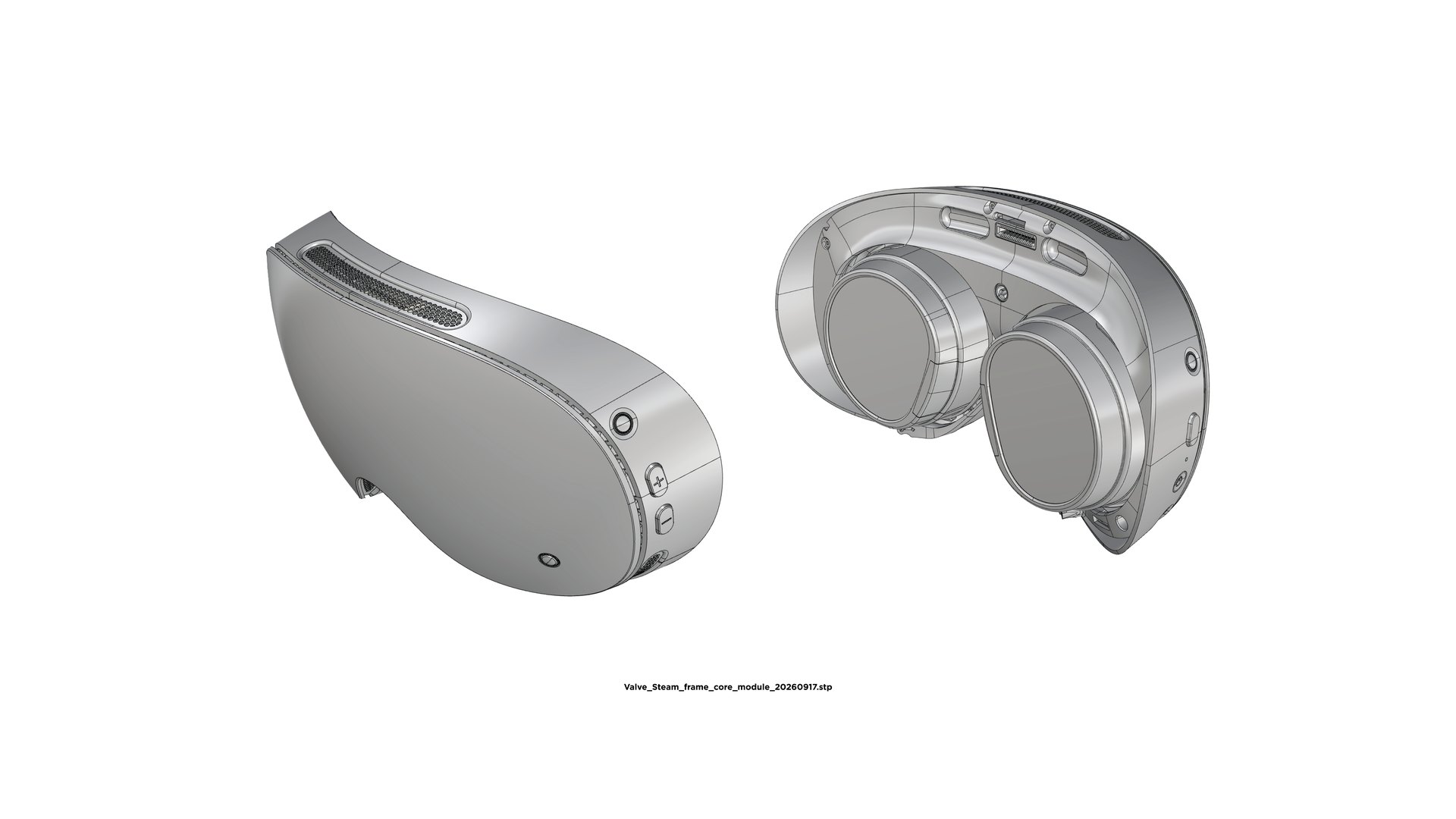
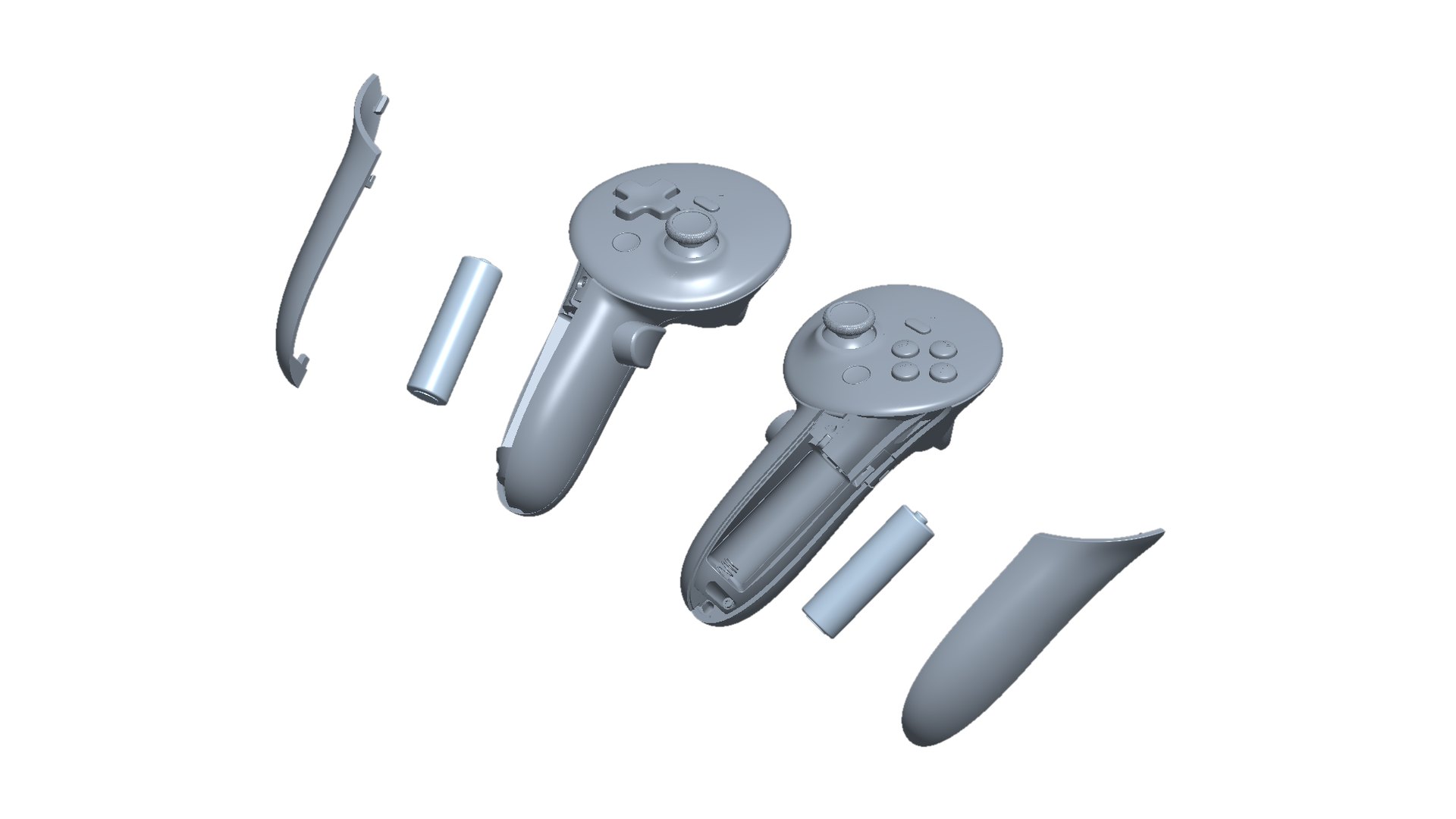
Valve's published hardware files for the Steam Frame cover the core module, the head strap and both controllers as STEP models, plus a detailed spec for the front expansion port. None of them is a model of the color passthrough camera.
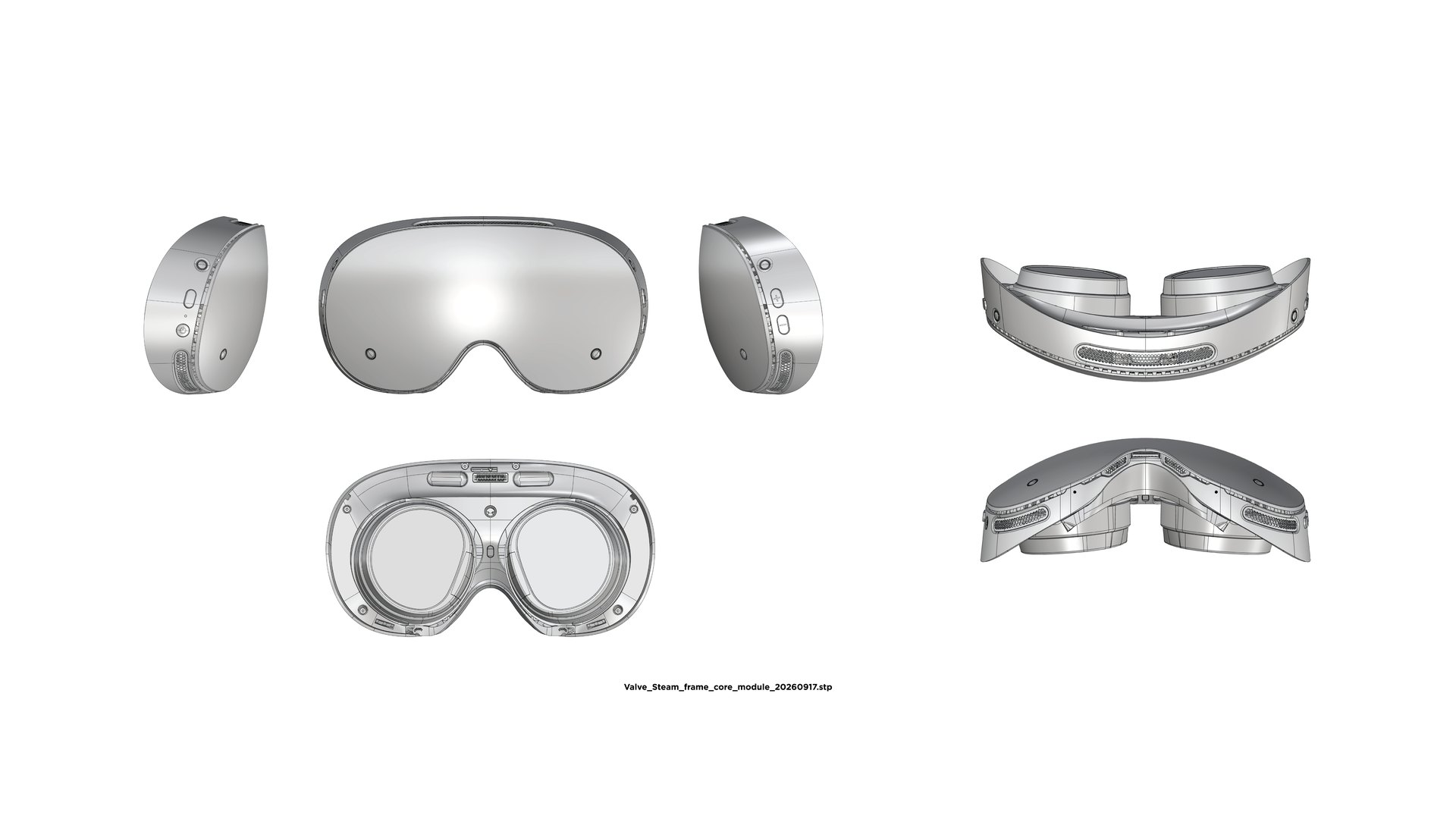
The repository on Valve's own GitLab server holds just two commits. The first, dated October 2, added most of the material, and the second, dated October 13, added nose bridge detail to the core module.
What Valve put in the Steam Frame repository
Valve describes the project as public Steam Frame CAD and electrical references, and its README lists seven items. The headset itself launched at $1,059 in September, and an early hands-on revealed a $60 accessory kit.
The mechanical CAD is STEP format only. The core module is a single .stp file and the head strap is another.
The controllers arrive as six: a left and right controller, a left and right battery door, and a left and right battery door strap.
Valve twice calls its own mechanical files stripped down. Nothing in the published repository covers the facial interface, the light blocker or the battery housing.
The rest is electrical. A seven-page PDF documents the front port, two DXF files give its PCB outline, and two reference designs for a USB 3.0 hub are included, one in Altium and one in KiCad.
The expansion port is the part that lets anyone build hardware
Valve titles the connector the auxiliary port at the nose bridge. Arcturus, which makes the color passthrough camera, calls the same thing the front expansion port.
The pinout makes clear what it was built for. Two four-lane MIPI D-PHY v1.2 interfaces run to left and right cameras at up to 2.5 Gbps per lane.
Alongside them sit 19.2 MHz camera master clocks, a trigger line, strobe inputs and a 400 kHz I2C bus.
Several of those camera pins are multiplexed with a single PCI Express Gen4 lane. The port is therefore a stereo camera interface or a one-lane PCIe slot, not both at once.
Power comes from a 3.1V rail rated at 2A continuous, with a current limit near 3A. Valve notes that the allowable 6W of draw will consume over 25% of the Frame's battery capacity, and recommends minimizing consumption.
The port stays dark until an accessory identifies itself
No power reaches the connector until the peripheral grounds the detect pin, pin 44. After that, Valve's document describes three probes, one of which must succeed.
The first is a valid I2C response for a known camera configuration, which Valve names as Arcturus RGB. The second is shorting the reset and strobe pins together on the peripheral, which Valve says yields power only or PCIe only.
The third is a valid I2C response from a temperature sensor or an EEPROM. Without one of the three, Valve says power will be removed from the port.
That paragraph explains more about third-party accessories than the CAD files do. Custom hardware has to carry an EEPROM at an address Valve specifies.
Non-commercial terms, and tolerances precise enough to build against
The licence is Creative Commons Attribution-NonCommercial-ShareAlike 4.0. Valve's licence file permits use and modification for creating accessories or other modifications, provided there is proper attribution and no claim or implication of Valve endorsement.
Commercial use is excluded outright. Valve points anyone wanting to sell a product based on the files to a steamframecompatible address at valvesoftware.com.
The same file warns that opening the enclosure voids a warranty, as does attaching hardware that is not Steam Frame Compatible to any electrical interface port.
The dimensions, however, are specific enough to design against. Pads sit at 0.5mm pitch and 0.35mm width, and boards should be 0.8mm thick from pad to pad.
Insertion corners should be cut at 45 degrees, and the edge should be chamfered at 20 degrees to a depth of 0.3mm.
Valve's minimal KiCad example carries its own caveat. Valve does not recommend that design for a real accessory, because of its rigid connection to the port.
What the camera files change, and what they do not
Arcturus published its own developer resources on October 20, and that, rather than anything from Valve, was what changed that week. They include a simplified exterior mesh of the camera in STL and Blender form.
The company gives the camera's approximate dimensions as 79.987 by 25.703 by 14.114mm and its weight as under 10 grams.
That mesh is a case-design reference and little more. Arcturus says a direct camera access API is not yet available, and that passthrough blending currently works only for apps running on the Frame, not for PC titles streamed to it.
So the concrete consequence is narrow. Accessory makers can now design shells, mounts and cases to exact published dimensions instead of measuring a headset themselves, much as third-party makers already do with custom faceplates for the Steam Machine.
Several things remain unpublished. Valve's interface document is an excerpt, its footers running from page 8 to page 14 of 14, and nothing in the released material warns against covering the headset's sensors.
There is no public page, application process or fee schedule for the Steam Frame Compatible designation beyond that email address. Valve also reserves the right to change hardware designs in any way, so today's dimensions are a reference and not a guarantee.

Discussion (0)
Be the first to comment.