




Many people are upgrading their routers to Wi-Fi 6. They benefit from improved speeds, stronger routers that handle more simultaneous connections, as well as improved wireless coverage. However, depending on the router you buy and the layout of your home, you may still encounter some dead spots where the Wi-Fi is underperforming. They are fewer than in the world of Wi-Fi 5 routers, but such situations still exist. One solution is buying another router and setting up a mesh Wi-Fi system, or purchasing a range extender. If you’re looking for a Wi-Fi 6 range extender, chances are you’ve seen the TP-Link AX1500 RE500X in shops, both online and offline. To find out if the RE500X range extender is a good choice for you, read this review:
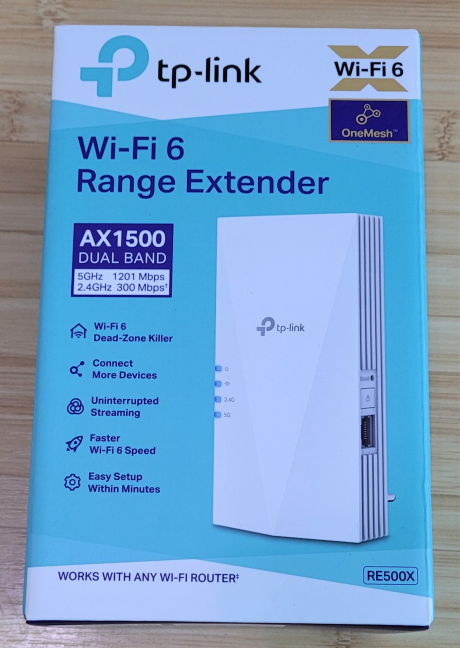
 The packaging used for TP-Link RE500X
Taking the range extender out is quick and painless. Inside the box, you find the range extender itself, the quick installation guide, warranty information, and some troubleshooting tips.
The packaging used for TP-Link RE500X
Taking the range extender out is quick and painless. Inside the box, you find the range extender itself, the quick installation guide, warranty information, and some troubleshooting tips.
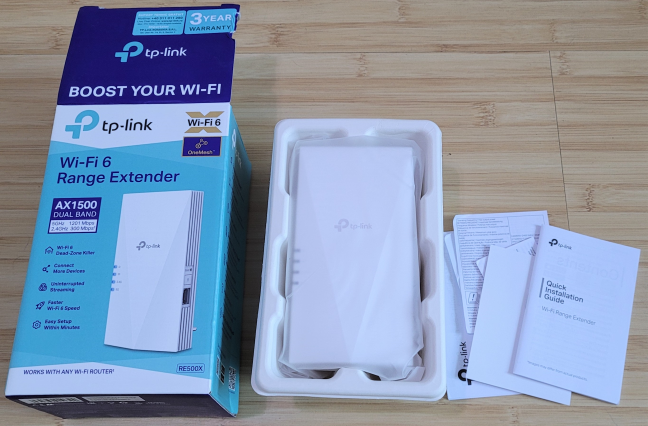
 Unboxing the TP-Link RE500X range extender
After you unpack the range extender, plug it into a power outlet close to your Wi-Fi router, and read the user manual for setting it up.
Unboxing the TP-Link RE500X range extender
After you unpack the range extender, plug it into a power outlet close to your Wi-Fi router, and read the user manual for setting it up.
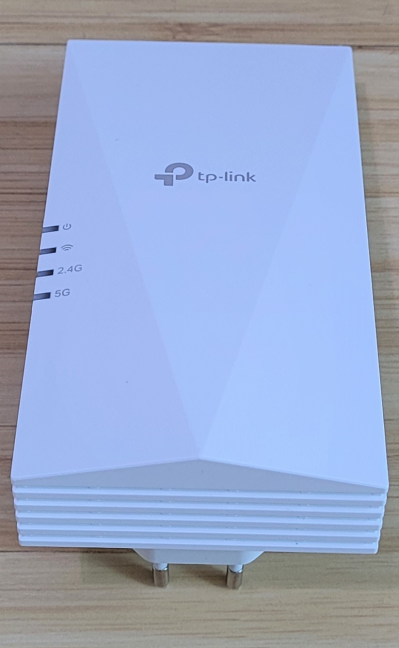
 TP-Link RE500X is quite large and heavy
However, it is not a bad-looking device. The TP-Link logo is discreet, and so are the LEDs on the left edge of the range extender. On its right, you find the Reset and WPS buttons, as well as an Ethernet port working at 1 Gbps.
TP-Link RE500X is quite large and heavy
However, it is not a bad-looking device. The TP-Link logo is discreet, and so are the LEDs on the left edge of the range extender. On its right, you find the Reset and WPS buttons, as well as an Ethernet port working at 1 Gbps.
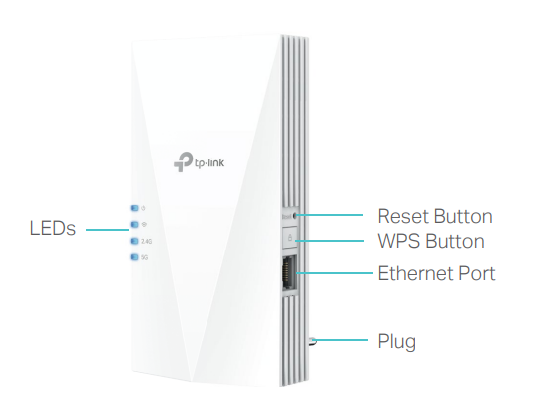
 The LEDs and buttons found on the range extender
On the bottom, you find a sticker with details about the range extender you just bought and the plug. We tested the EU variant, which has a different plug than the one used in the USA, as you can see below.
The LEDs and buttons found on the range extender
On the bottom, you find a sticker with details about the range extender you just bought and the plug. We tested the EU variant, which has a different plug than the one used in the USA, as you can see below.
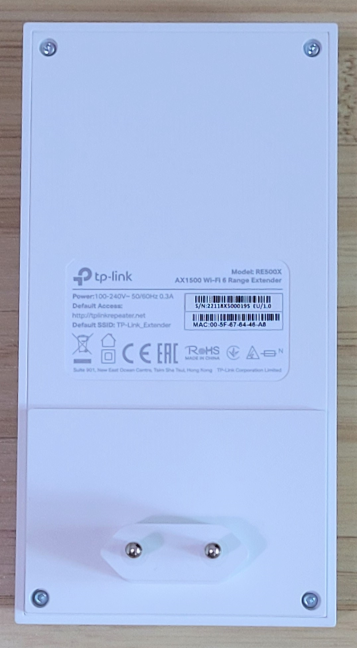
 The bottom of the TP-Link RE500X
Large ventilation grids on the sides help cool the hardware found inside the RE500X: the company brags about using a triple-core SoC running at 1.5 GHz. We suspect it is using a Broadcom BCM6750 chip, but we didn’t receive official confirmation from the company. The range extender is dual-band, has Wi-Fi 6 support, two internal antennas, and uses 2x2 MU-MIMO for wireless transfers. It is a good choice for extending the network coverage offered by modern Wi-Fi 6 routers, especially TP-Link ones, due to its OneMesh support.
The bottom of the TP-Link RE500X
Large ventilation grids on the sides help cool the hardware found inside the RE500X: the company brags about using a triple-core SoC running at 1.5 GHz. We suspect it is using a Broadcom BCM6750 chip, but we didn’t receive official confirmation from the company. The range extender is dual-band, has Wi-Fi 6 support, two internal antennas, and uses 2x2 MU-MIMO for wireless transfers. It is a good choice for extending the network coverage offered by modern Wi-Fi 6 routers, especially TP-Link ones, due to its OneMesh support.
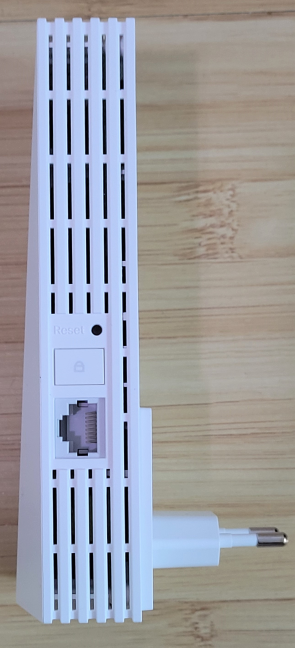
 The Ethernet port on the TP-Link RE500X
The total maximum theoretical bandwidth is split as follows: 300 Mbps on the 2.4 GHz band and 1201 Mbps on the 5 GHz band. While the RE500X works with the Wi-Fi 6 standard, it doesn’t offer support for WPA3 encryption. Instead, it only works with WPA2, which may be a downside to users who have migrated to the new password encryption standard.
One interesting fact about the TP-Link AX1500 RE500X is that it has a maximum power consumption of 10.8W, which is quite a lot, more than that of some routers like the TP-Link Archer AX10. If you would like to learn more about this range extender, visit: TP-Link AX1500 RE500X Specifications.
The Ethernet port on the TP-Link RE500X
The total maximum theoretical bandwidth is split as follows: 300 Mbps on the 2.4 GHz band and 1201 Mbps on the 5 GHz band. While the RE500X works with the Wi-Fi 6 standard, it doesn’t offer support for WPA3 encryption. Instead, it only works with WPA2, which may be a downside to users who have migrated to the new password encryption standard.
One interesting fact about the TP-Link AX1500 RE500X is that it has a maximum power consumption of 10.8W, which is quite a lot, more than that of some routers like the TP-Link Archer AX10. If you would like to learn more about this range extender, visit: TP-Link AX1500 RE500X Specifications.
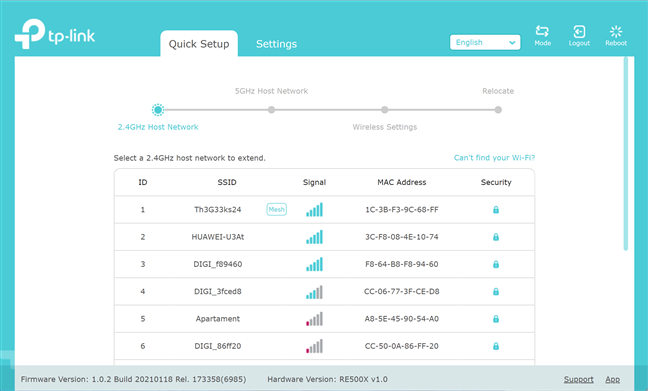
 Setting up the range extender is easy due to OneMesh
For details about how it works, read this guide: How to set up TP-Link OneMesh Wi-Fi 6 routers and range extenders.
The OneMesh feature makes it easy for the range extender to integrate with your TP-Link router. The settings available are few and easy to understand. Also, the RE500X automatically clones all the settings from your router without the need for extra effort.
Setting up the range extender is easy due to OneMesh
For details about how it works, read this guide: How to set up TP-Link OneMesh Wi-Fi 6 routers and range extenders.
The OneMesh feature makes it easy for the range extender to integrate with your TP-Link router. The settings available are few and easy to understand. Also, the RE500X automatically clones all the settings from your router without the need for extra effort.
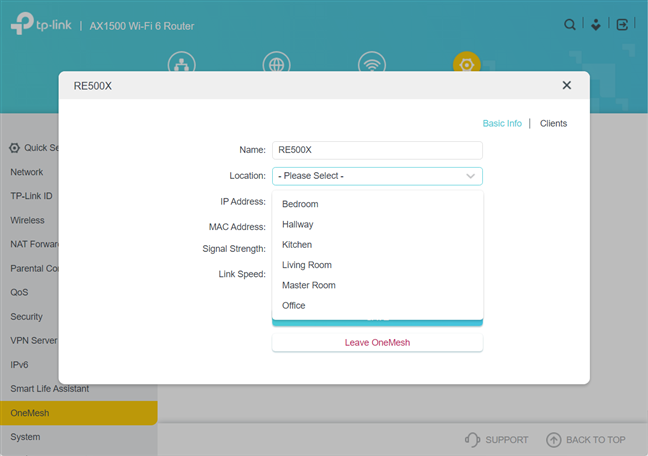
 The OneMesh settings are few and easy to understand
What I didn’t like is that OneMesh doesn’t also handle firmware updates. The devices that are part of the OneMesh network need to be updated individually. Therefore, you can’t update your RE500X from your router’s firmware when going to the OneMesh section. Instead, you must log in to the firmware of the RE500X and update it from there. By the way, I recommend that you do that immediately after installing this range extender to benefit from the latest security fixes and performance improvements.
The OneMesh settings are few and easy to understand
What I didn’t like is that OneMesh doesn’t also handle firmware updates. The devices that are part of the OneMesh network need to be updated individually. Therefore, you can’t update your RE500X from your router’s firmware when going to the OneMesh section. Instead, you must log in to the firmware of the RE500X and update it from there. By the way, I recommend that you do that immediately after installing this range extender to benefit from the latest security fixes and performance improvements.
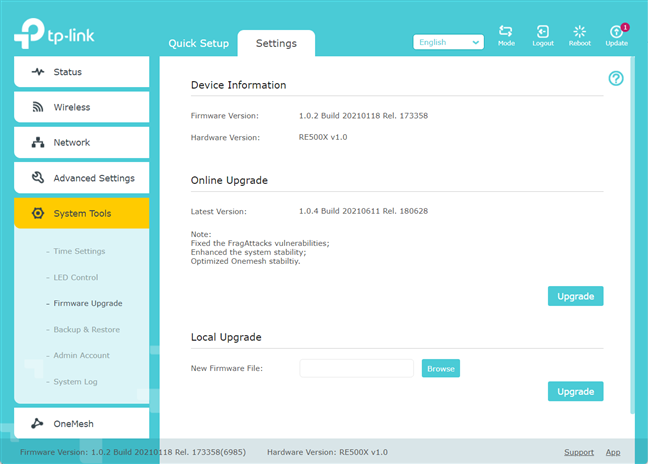
 It is a good idea to update the firmware on the TP-Link RE500X
The TP-Link AX1500 RE500X works with routers from other manufacturers and older TP-Link routers without OneMesh support. The user interface is simple and similar to that of many TP-Link routers. In addition, it is available in 22 languages, making it easy to navigate even if you don’t speak English.
It is a good idea to update the firmware on the TP-Link RE500X
The TP-Link AX1500 RE500X works with routers from other manufacturers and older TP-Link routers without OneMesh support. The user interface is simple and similar to that of many TP-Link routers. In addition, it is available in 22 languages, making it easy to navigate even if you don’t speak English.
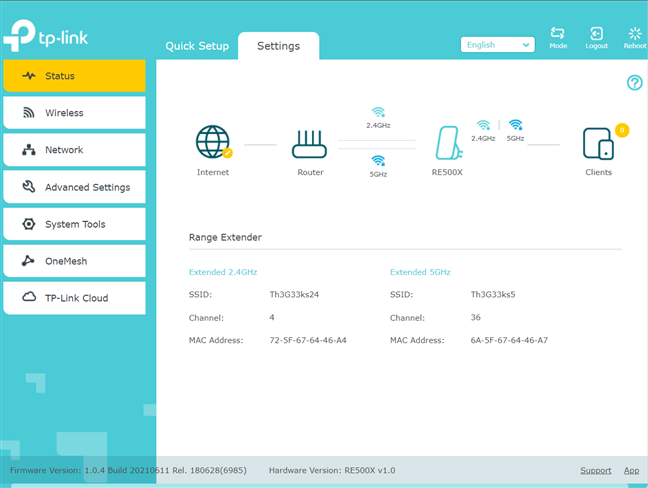
 The admin user interface for TP-Link RE500X
If you want to remotely control the RE500X from anywhere on the internet, you must add a TP-Link ID and use it for managing the range extender in a web browser or the Tether app.
The admin user interface for TP-Link RE500X
If you want to remotely control the RE500X from anywhere on the internet, you must add a TP-Link ID and use it for managing the range extender in a web browser or the Tether app.
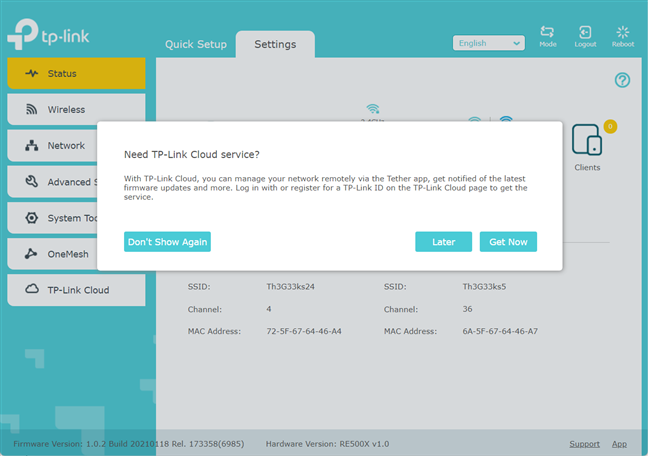 For remote control, you need a TP-Link ID
The user documentation is readily available. On the top-right corner of each settings page, there’s a question mark. Click or tap on it, and you see definitions and explanations for everything on that page. Beginners will enjoy this approach a lot.
For remote control, you need a TP-Link ID
The user documentation is readily available. On the top-right corner of each settings page, there’s a question mark. Click or tap on it, and you see definitions and explanations for everything on that page. Beginners will enjoy this approach a lot.
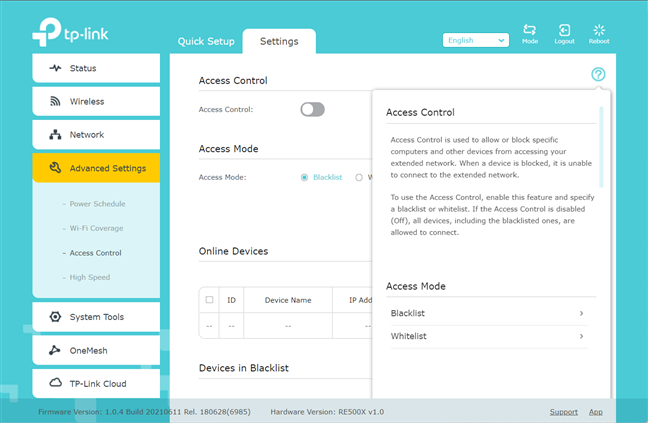
 Help documentation is easily available
We set the TP-Link RE500X range extender to use Wi-Fi 6 on the 5 GHz band and Wi-Fi 4 on the 2.4 GHz frequency. We connected several devices to its Wi-Fi, and we did not encounter any problems. Also, the Ethernet port on the RE500X can be helpful when you need to connect a Smart TV, a desktop, or a console that’s located in a room where your router doesn’t offer good Wi-Fi.
As you will see later in this review, we were pleased with how the RE500X performed on the 2.4 GHz band. It managed to significantly improve the speed of the Wi-Fi in the rooms where it needed improvement. However, when using the Wi-Fi 6 standard, its performance was underwhelming and did not provide significant benefits other than a larger coverage area.
If you want to know more about the real-world performance offered by TP-Link AX1500 RE500X, go to the next page of this review.
Help documentation is easily available
We set the TP-Link RE500X range extender to use Wi-Fi 6 on the 5 GHz band and Wi-Fi 4 on the 2.4 GHz frequency. We connected several devices to its Wi-Fi, and we did not encounter any problems. Also, the Ethernet port on the RE500X can be helpful when you need to connect a Smart TV, a desktop, or a console that’s located in a room where your router doesn’t offer good Wi-Fi.
As you will see later in this review, we were pleased with how the RE500X performed on the 2.4 GHz band. It managed to significantly improve the speed of the Wi-Fi in the rooms where it needed improvement. However, when using the Wi-Fi 6 standard, its performance was underwhelming and did not provide significant benefits other than a larger coverage area.
If you want to know more about the real-world performance offered by TP-Link AX1500 RE500X, go to the next page of this review.
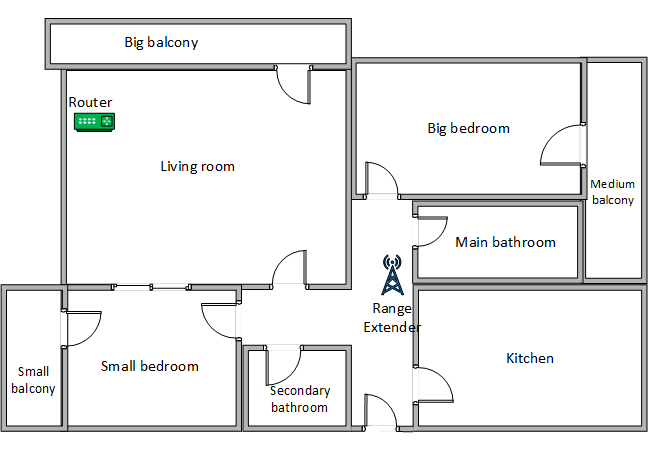
 Where we installed the router and the range extender
We have a fast 1 Gigabit Internet connection capable of upload speeds of up to 800 Mbps. We evaluated the TP-Link RE500X by pairing it with a TP-Link Archer AX10 (AX1500) and then making measurements using Wi-Fi 4 on the 2.4 GHz band and Wi-Fi 6 on the 5 GHz band.
We analyzed the 2.4 GHz band first when using the Wi-Fi 4 standard, and we measured the signal strength with NetSpot.
In the Living room, the Archer AX10 router had the best signal strength, which is not surprising since that is the room where it was placed. However, in the rooms where we needed to improve our Wi-Fi coverage, the RE500X range extender did provide better signal quality.
Where we installed the router and the range extender
We have a fast 1 Gigabit Internet connection capable of upload speeds of up to 800 Mbps. We evaluated the TP-Link RE500X by pairing it with a TP-Link Archer AX10 (AX1500) and then making measurements using Wi-Fi 4 on the 2.4 GHz band and Wi-Fi 6 on the 5 GHz band.
We analyzed the 2.4 GHz band first when using the Wi-Fi 4 standard, and we measured the signal strength with NetSpot.
In the Living room, the Archer AX10 router had the best signal strength, which is not surprising since that is the room where it was placed. However, in the rooms where we needed to improve our Wi-Fi coverage, the RE500X range extender did provide better signal quality.
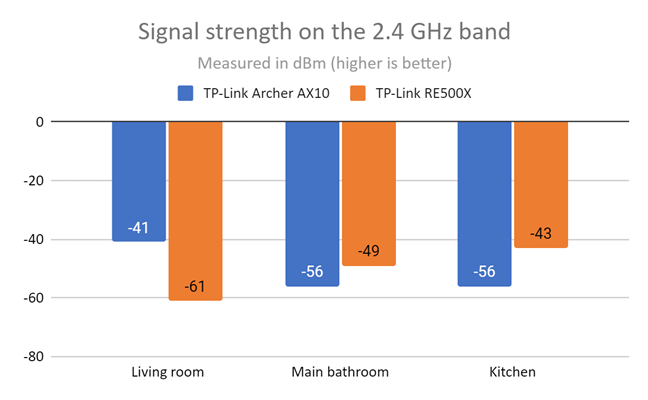
 TP-Link RE500X - signal strength on the 2.4 GHz band
We used SpeedTest to measure the internet connection speed when connected to the 2.4 GHz band on Wi-Fi 4. In the Living room, unsurprisingly, the router offered faster downloads, while in the other rooms, the range extender increased the download speed up to 22%.
TP-Link RE500X - signal strength on the 2.4 GHz band
We used SpeedTest to measure the internet connection speed when connected to the 2.4 GHz band on Wi-Fi 4. In the Living room, unsurprisingly, the router offered faster downloads, while in the other rooms, the range extender increased the download speed up to 22%.
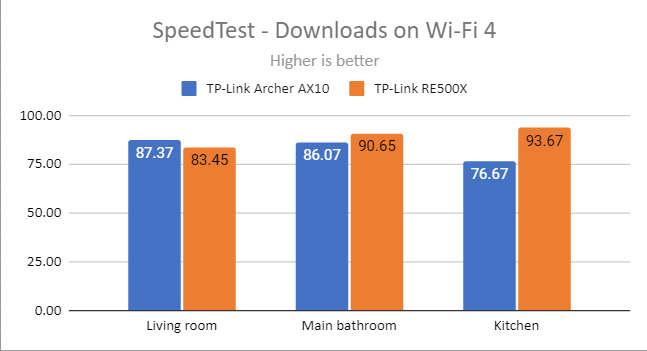
 TP-Link RE500X - SpeedTest downloads on Wi-Fi 4
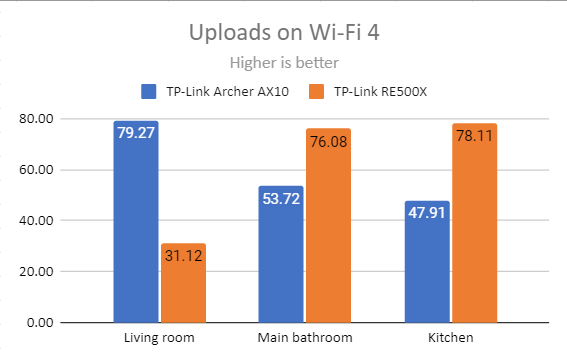
The positive impact on the upload speed was even higher. In the rooms where we wanted better Wi-Fi, the upload speed was improved up to 50%.
TP-Link RE500X - SpeedTest downloads on Wi-Fi 4
The positive impact on the upload speed was even higher. In the rooms where we wanted better Wi-Fi, the upload speed was improved up to 50%.
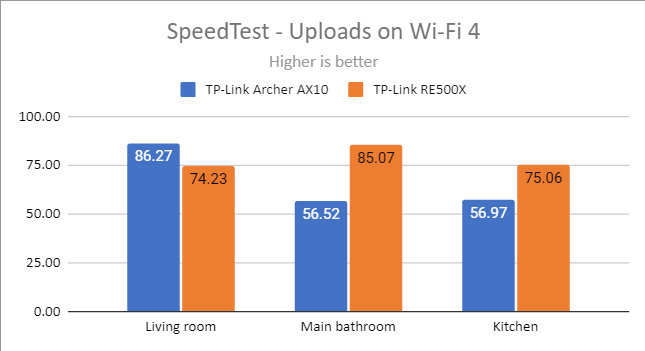
 TP-Link RE500X - SpeedTest uploads on Wi-Fi 4
We used the PassMark Performance test to transfer data between two computers connected to the network on the 2.4 GHz band when using Wi-Fi 4. This time we noticed even higher improvements for the download speed, up to 74%.
TP-Link RE500X - SpeedTest uploads on Wi-Fi 4
We used the PassMark Performance test to transfer data between two computers connected to the network on the 2.4 GHz band when using Wi-Fi 4. This time we noticed even higher improvements for the download speed, up to 74%.
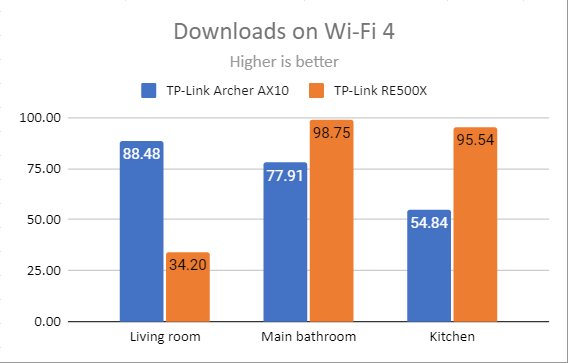
 TP-Link RE500X - Downloads on Wi-Fi 4
The measurements for the upload speed are gathered in the graphic below. In the Kitchen, the upload was improved up to 63%.
TP-Link RE500X - Downloads on Wi-Fi 4
The measurements for the upload speed are gathered in the graphic below. In the Kitchen, the upload was improved up to 63%.
 TP-Link RE500X - Uploads on Wi-Fi 4
On the 2.4 GHz band, when using the Wi-Fi 4 standard, the TP-Link RE500X range extender delivered meaningful improvements in the rooms where we needed better coverage.
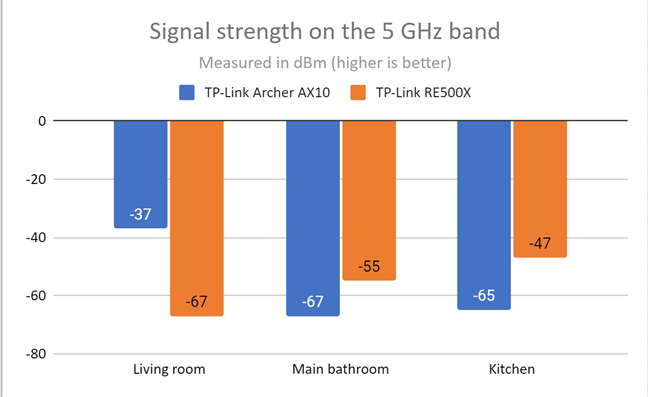
For the next set of measurements, we analyzed the performance of the 5GHz wireless band, using Wi-Fi 6. We looked at the evolution of the signal strength from room to room. As you can see below, the signal strength was improved significantly by the TP-Link RE500X.
TP-Link RE500X - Uploads on Wi-Fi 4
On the 2.4 GHz band, when using the Wi-Fi 4 standard, the TP-Link RE500X range extender delivered meaningful improvements in the rooms where we needed better coverage.
For the next set of measurements, we analyzed the performance of the 5GHz wireless band, using Wi-Fi 6. We looked at the evolution of the signal strength from room to room. As you can see below, the signal strength was improved significantly by the TP-Link RE500X.
 TP-Link RE500X - signal strength on the 5 GHz band
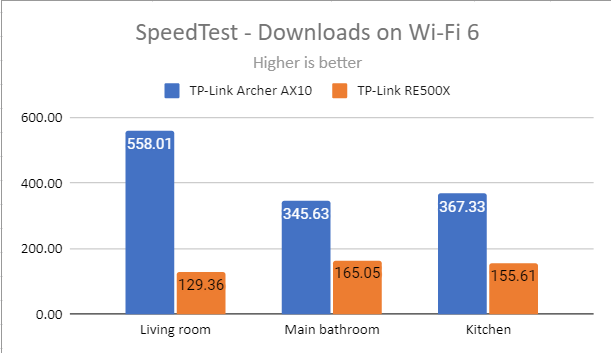
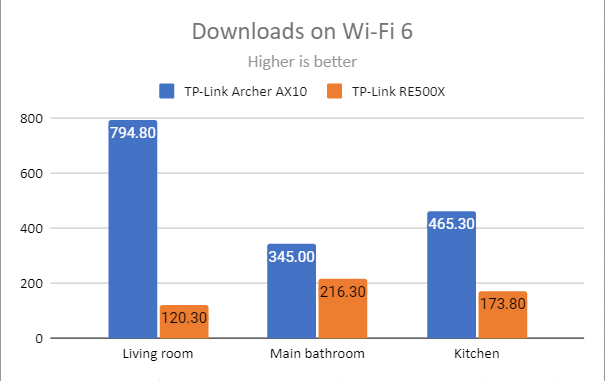
We used SpeedTest to measure the speed of the internet connection when connected to the 5 GHz band when using the Wi-Fi 6 standard. In this case, we noticed that the TP-Link Archer AX10 performed admirably well in all rooms, and the range extender wasn’t capable of delivering faster Wi-Fi.
TP-Link RE500X - signal strength on the 5 GHz band
We used SpeedTest to measure the speed of the internet connection when connected to the 5 GHz band when using the Wi-Fi 6 standard. In this case, we noticed that the TP-Link Archer AX10 performed admirably well in all rooms, and the range extender wasn’t capable of delivering faster Wi-Fi.
 TP-Link RE500X - SpeedTest downloads on Wi-Fi 6
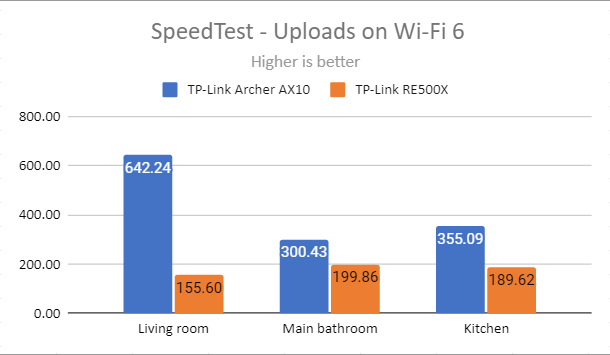
The same happened when measuring the upload speed with SpeedTest.
TP-Link RE500X - SpeedTest downloads on Wi-Fi 6
The same happened when measuring the upload speed with SpeedTest.
 TP-Link RE500X - SpeedTest uploads on Wi-Fi 6
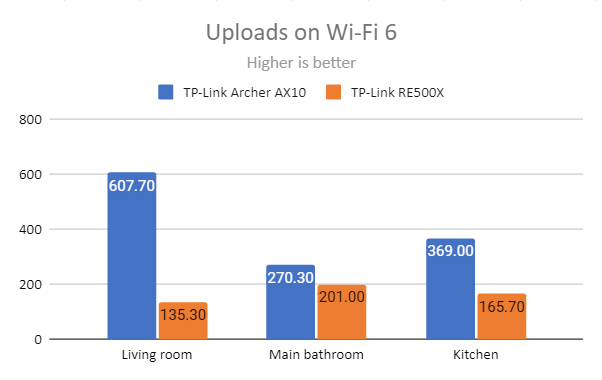
We then used the PassMark Performance test to transfer data between two computers connected to the network using Wi-Fi 6. Again, the router performed very well, and the range extender was not able to improve anything.
TP-Link RE500X - SpeedTest uploads on Wi-Fi 6
We then used the PassMark Performance test to transfer data between two computers connected to the network using Wi-Fi 6. Again, the router performed very well, and the range extender was not able to improve anything.
 TP-Link RE500X - Downloads on Wi-Fi 6
The same happened when measuring the upload speed.
TP-Link RE500X - Downloads on Wi-Fi 6
The same happened when measuring the upload speed.
 TP-Link RE500X - Uploads on Wi-Fi 6
When using the Wi-Fi 6 standard on the 5 GHz band, the TP-Link RE500X range extender is not capable of delivering speeds worthy of this standard. The Archer AX10 router performed very well in all the rooms from our apartment, and on Wi-Fi 6, RE500X was not able to deliver meaningful improvements.
TP-Link RE500X - Uploads on Wi-Fi 6
When using the Wi-Fi 6 standard on the 5 GHz band, the TP-Link RE500X range extender is not capable of delivering speeds worthy of this standard. The Archer AX10 router performed very well in all the rooms from our apartment, and on Wi-Fi 6, RE500X was not able to deliver meaningful improvements.
 TP-Link RE500X - SpeedTest when using the Ethernet port
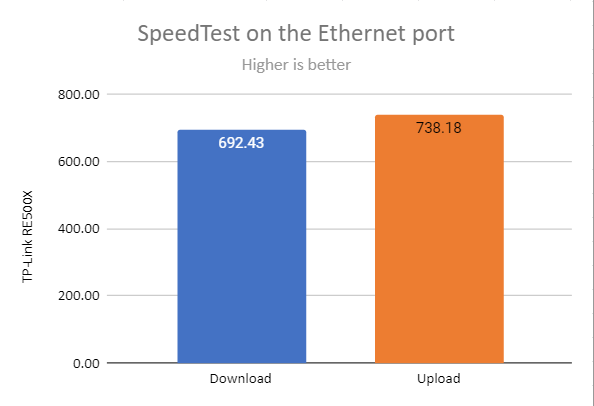
However, do expect these numbers to be lower in your home as you increase the distance between the router and the range extender. Also, our router and range extender were connected through Wi-Fi 6, thus maximizing the speed we get. If your network is using Wi-Fi 5, you’re going to see lower numbers than we did.
TP-Link RE500X - SpeedTest when using the Ethernet port
However, do expect these numbers to be lower in your home as you increase the distance between the router and the range extender. Also, our router and range extender were connected through Wi-Fi 6, thus maximizing the speed we get. If your network is using Wi-Fi 5, you’re going to see lower numbers than we did.
TP-Link AX1500 RE500X: Who is it good for?
This range extender is a good choice for:- People who already own a Wi-Fi 6 router, but it doesn’t fully cover their home or apartment
- Users with many devices in their network that need a range extender with powerful hardware
- People who need a range extender with an Ethernet port for connecting one non-wireless device
- Users who already own a TP-Link router with OneMesh support
Pros and cons
Here are the things we like about TP-Link AX1500 RE500X:
- Robust hardware with a tri-core processor that can handle many clients
- OneMesh support makes it easy to link with other TP-Link equipment
- It can extend Wi-Fi 6 networks
- Good performance on the 2.4 GHz band
- Useful Ethernet port
- Great multilingual support
- It can also be set up and controlled from a mobile app
- The price is on the higher side
- Wi-Fi 6 performance can use some improvement
- No support for WPA3 encryption
- Firmware updates should be easier to perform when using OneMesh
Verdict
The TP-Link RE500X range extender is a useful choice for people who want to extend Wi-Fi 6 networks. It has powerful hardware that can handle many network clients, and it is compatible with TP-Link’s OneMesh ecosystem. This means that adding it to a network managed by a TP-Link router with OneMesh literally takes seconds. While it does have a couple of weaknesses, the TP-Link RE500X is a relatively well-balanced range extender that meets the expectations of most users.Unboxing the TP-Link AX1500 RE500X
The TP-Link RE500X range extender comes in a simple cyan cardboard box, with the company logo and a picture of the device on top. TP-Link does an excellent job at communicating the main features and specifications of this range extender. If you see the RE500X in shops, reading all the information printed on the sides of the box should give a pretty good idea about the device.Hardware specifications and design
As you can see for yourself, the TP-Link RE500X Wi-Fi 6 range extender is quite large, with a spartan look. It has a size of approximately 3.1×1.4×5.9 inches or 78×36×149 mm in width x depth x height, and it weighs 7.93 ounces or 225 grams. That’s quite heavy for a range extender.Setting up and using the TP-Link RE500X Wi-Fi 6 range extender
If you have a TP-Link wireless router with OneMesh support, adding and setting up the TP-Link AX1500 RE500X is really easy, especially if done through WPS. However, the setup can be performed also using a laptop and a web browser, or the Tether app for Android and iOS.Wireless network performance
Let’s look at the apartment used in our testing: the router is placed in the living room. Unfortunately, the signal strength is not good with most wireless routers in the Kitchen and the Main Bathroom. So we took the range extender and installed it in the hallway to boost the Wi-Fi coverage in these two rooms, made measurements in the Living room (to see what the router has to offer), and then in the Kitchen and the Main Bathroom.Wired network performance
The TP-Link RE500X Wi-Fi 6 range extender has one Ethernet port on it that you can use to connect a device like a Smart TV, console, or desktop PC. Unfortunately, while the port works at 1 Gbps, it most probably won’t deliver this speed because the range extender is connected wirelessly to your router at a slower speed. To see the maximum potential of the Ethernet port on the RE500X, we connected our laptop to it and ran a SpeedTest. As you can see below, we achieved 692.43 Mbps for the download speed and 738.18 Mbps for the upload.

Discussion (0)
Comments are closed.