



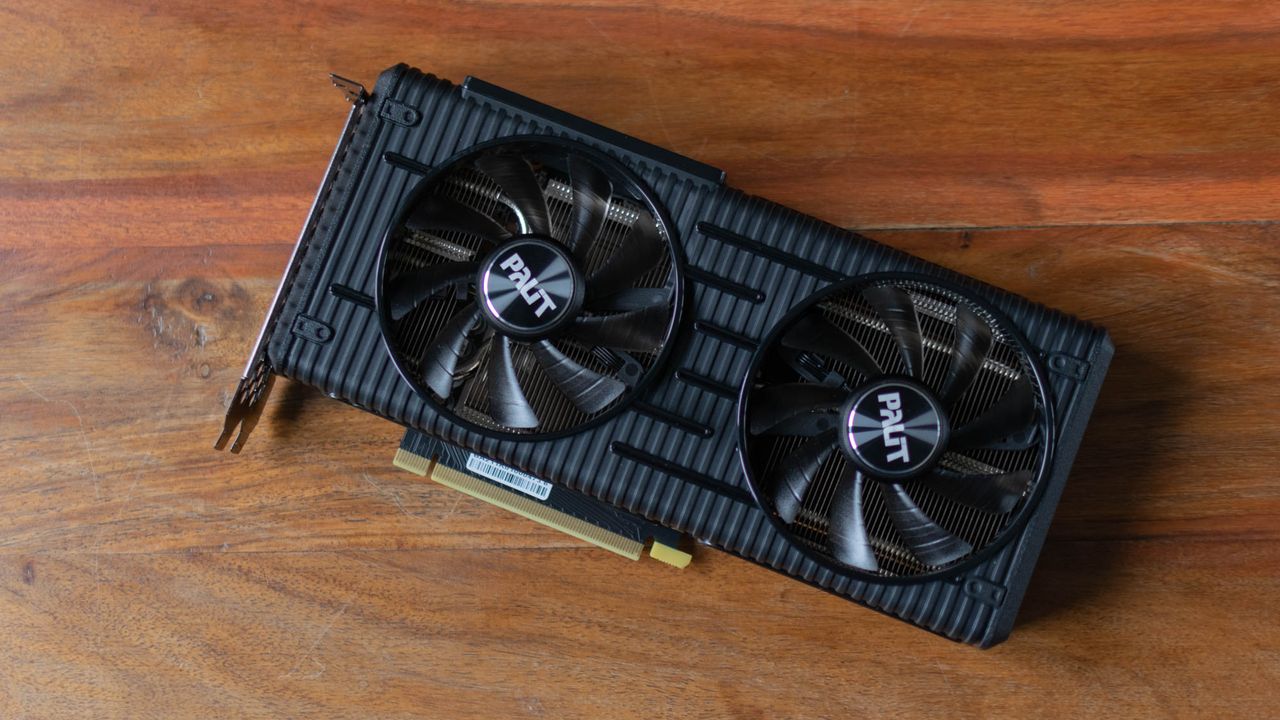
An unusual GeForce RTX 3060 has appeared online in an extremely compact single slot design that draws power only from the PCIe slot.
The card uses the RTX 3060's 12GB memory configuration but removes the external power connector normally required by the GPU. That makes the design suitable for very small systems, but the tradeoff is severe performance loss and high temperatures.
In testing, the modified card scored 4,821 points in 3DMark Time Spy, roughly half the performance expected from a normal RTX 3060.
| Detail | Compact RTX 3060 |
|---|---|
| GPU | GeForce RTX 3060 |
| Memory | 12GB GDDR6 |
| Form factor | Low profile, single slot |
| Cooler | Blower style |
| External power connector | None |
| Display outputs | 1 HDMI, 1 DisplayPort |
| Sustained core clock | Around 900MHz |
| Reported boost clock | Around 1777MHz |
| Time Spy score | 4,821 |
| Hotspot temperature | Above 90°C |
PCIe Slot Power Creates a Major Limitation
A standard RTX 3060 is normally designed around a much higher power budget than a PCIe slot can provide by itself.
A desktop PCIe slot typically supplies up to about 75W, while normal RTX 3060 boards operate at substantially higher power levels.
The compact card therefore appears to use a modified power sensing circuit to keep the GPU operating without an external connector.
The exact modification has not been officially documented by the manufacturer, but the video demonstrating the card suggests that changes were made around the power sensing circuitry.
This also means software readings should be interpreted carefully.
GPU Z reportedly displayed board and chip power figures far above what the PCIe slot should realistically deliver. Because the power monitoring circuit appears to have been altered, those reported numbers are unlikely to represent true consumption.
Clock Speeds Collapse Under Load
The biggest consequence of the reduced power budget is lower sustained GPU frequency.
Although the card reports a boost clock of around 1777MHz, it reportedly struggles to maintain core speeds above roughly 900MHz during demanding workloads.
That reduction has a large effect on performance.
A conventional RTX 3060 can score around 9,000 points or more in 3DMark Time Spy depending on configuration.
The compact card managed only 4,821 points.
That places the result below what can be seen from some much older graphics cards, including the GeForce GTX 1060 and Radeon RX 580 in comparable benchmark results.
Cooling Is Also a Problem
Power delivery is not the only limitation.
The graphics card uses a very small blower style cooler in order to remain low profile and fit within a single expansion slot.
Hotspot temperatures reportedly climbed beyond 90°C during testing.
That suggests thermal throttling may also be contributing to the low sustained clock speeds.
A larger heatsink and stronger airflow could potentially improve thermal behavior, but that would undermine the main purpose of the design, which is to remain extremely compact.
The Card Still Has a Specific Use Case
Despite its poor benchmark results, the design could make sense in systems where space and power connectivity matter more than maximum performance.
Some compact PCs have enough room for only a low profile single slot graphics card and may not provide PCIe power cables.
In those machines, a heavily restricted RTX 3060 could still offer access to 12GB of VRAM and newer NVIDIA features while fitting into a chassis that cannot support a conventional card.
That makes the product more of a specialist solution than a normal RTX 3060 replacement.
Compact Design Comes With Heavy Compromises
The card demonstrates how far a desktop GPU can be reduced in size when performance is secondary.
Removing the external power connector and using a single slot cooler allows the RTX 3060 hardware to fit into unusually small systems, but the result is a much lower sustained clock speed, weaker benchmark performance, and high temperatures.
For buyers interested primarily in gaming performance, a normal RTX 3060 remains far faster.
For a very small PC with strict power and space limits, however, this unusual design shows that even a 12GB RTX class GPU can be adapted to run from the PCIe slot alone, provided substantial compromises are accepted.


Discussion (0)
Be the first to comment.