



Valve's Steam Client Beta of Thursday, October 15 made the Linux client a 64-bit application. It also moved the client inside a Steam Runtime container, and neither change lets a Linux distribution stop shipping 32-bit libraries.
Those are two of the three lines under Linux in the beta changelog. Valve says the container "will help the Steam client provide a more consistent experience across multiple distributions", and calls it "the same technology used by Steam games".
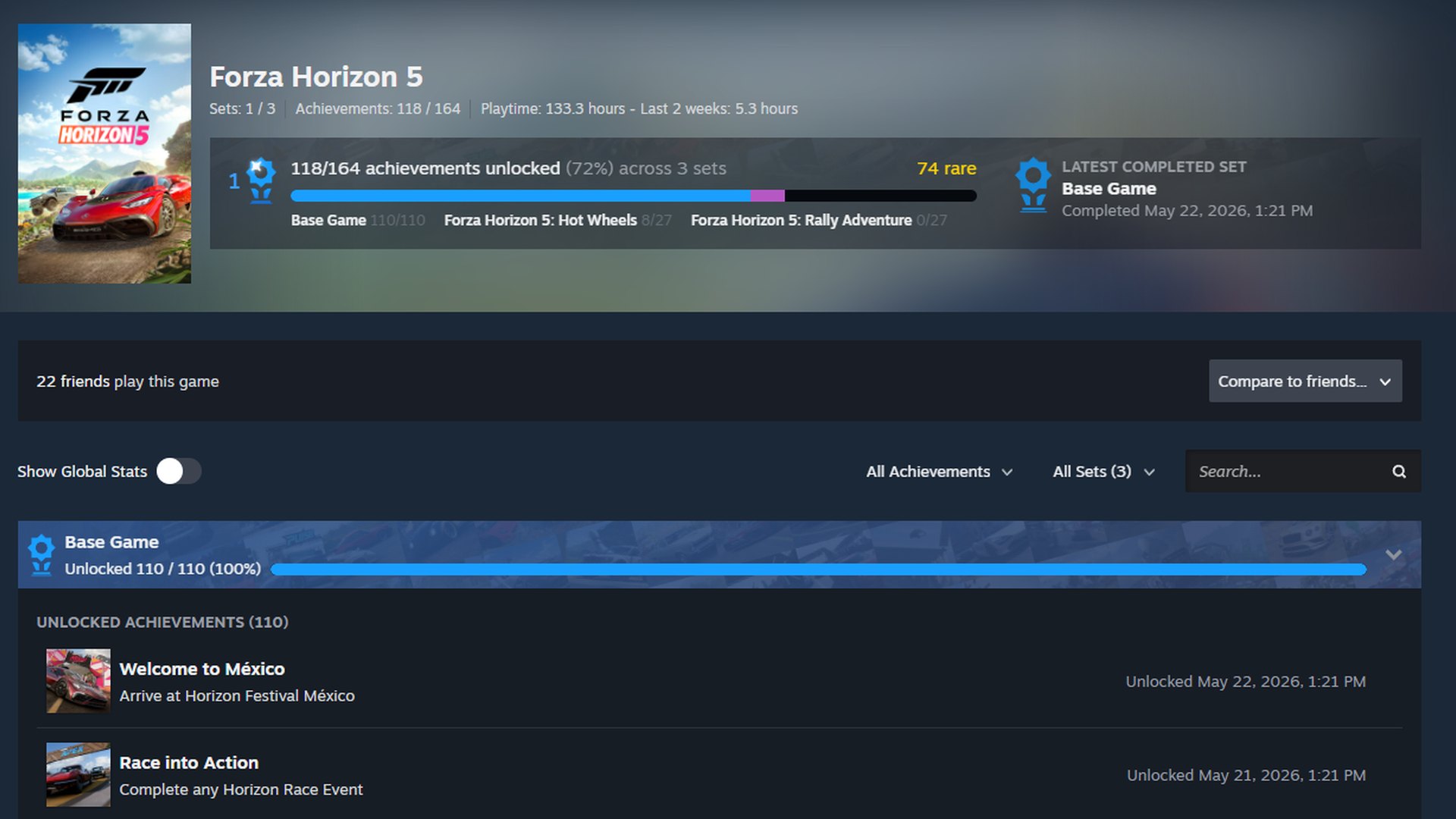
The same build also introduced Steam Achievement Sets, which took most of the attention. The Linux entries sit four sections below it.
One point needs settling first. This is the Steam client on the Beta channel, not SteamOS and not the Stable client.
The newest Stable release arrived on Tuesday, October 13, carrying Big Art Mode and screensavers. It has a Linux section of its own, covering compatibility tool defaults and download speeds, and it mentions neither 64-bit nor containers.
What Valve actually changed
The Linux section runs to three bullets, and two of them carry the news. Valve writes that "The Steam client is now a 64bit application" and that "The Steam client now runs inside a Steam Runtime container".
The third is a fix for the Steam updater interface failing to appear for some users. Nothing else in the changelog touches Linux.
The 32-bit history is not incidental here. Valve's runtime documentation still describes the original Steam Runtime as installed under ~/.steam/root/ubuntu12_32, a path that names the architecture it was built for.
Why distributions have carried 32-bit libraries
Steam has long been one of the reasons a 64-bit Linux desktop still keeps a parallel set of 32-bit libraries. The packaging shows it plainly.
Debian 13 builds steam-installer for amd64 only, yet it depends on steam-libs-i386, which Debian describes as a metapackage for 32-bit Steam dependencies. Arch Linux keeps its steam package in the multilib repository, where it pulls in lib32-glibc, lib32-libgl and lib32-vulkan-icd-loader among others.
Valve set out its position in December 2016, on its own Linux bug tracker. It said it would not drop support for games shipped with only 32-bit builds, so Steam would still need basic 32-bit support from the host.
Valve named a 32-bit glibc, ELF loader and OpenGL driver library. It added that porting the client interface itself to 64-bit was a separate question.
The multilib requirement survives the move
That separate question now has an answer, and the rest of the 2016 position still stands. Valve published a requirements file for this beta client on October 15, the same day.
It states that x86_64 systems "must support multilib and have both 32-bit (x86, i386, lib32) and 64-bit (x86_64, amd64) versions of required libraries and graphics drivers installed". It then says 64-bit-only x86_64 systems are not supported.
The stable client's requirements say the same in older wording, asking for both 64-bit and 32-bit glibc and graphics drivers. Valve has not said anywhere that either set can now be removed.
What the container asks for instead
The container brings requirements of its own, and they are more demanding than a library check. Valve asks for glibc 2.31 or newer and Linux kernel 5.6 or newer.
The client also needs to create new user and mount namespaces without special privileges. Valve lists the relevant sysctl values, and notes that AppArmor must either permit userns or have its unprivileged restriction switched off.
A D-Bus session bus is required, along with an X11 server, either a real session or Xwayland. Audio has to come from pipewire-pulse or PulseAudio, and Valve states flatly that JACK and ALSA dmix are not supported.
This is the same container machinery that already runs games, and that recent Proton releases depend on. The client is now a guest inside it too, which is where the consistency claim comes from.
What Valve has not quantified
No figure is attached to any of this. There is no memory number, no startup number and no list of the distributions that were breaking before.
The audience is small and specific. Linux sat at 3.05 percent of systems in Valve's September 2026 hardware survey, below the level it reached in July. Every Linux entry the survey lists is already 64-bit.
No date has been given for the Stable channel, and the beta stays opt-in. Until Valve publishes requirements without the 32-bit entries, the safe reading is that those libraries stay exactly where they are.
Discussion (0)
Be the first to comment.